

English cream golden retriever puppies Georgia
A Georgia family recently told me they almost wired $700 to a “breeder” in Savannah who had photos of a litter, a Cash App handle, and no phone number. That price alone should have ended the conversation. Genuine English cream golden retriever puppies Georgia buyers can source from health-tested European bloodlines simply do not sell for a few hundred dollars, and understanding why is the single most useful thing you can learn before you send anyone money.
English cream golden retriever puppies Georgia
English cream golden retrievers are golden retrievers bred to European (mostly UK) standards, producing a paler ivory-to-cream coat, a broader blocky head, and a heavier, stockier frame than most American-line goldens. In Georgia, well-bred English cream golden retriever puppies from an accredited program with genetic health guarantees, proper whelping, and early housebreaking and crate training typically run $3,500,$5,500. Anything advertised at $500,$1,000 is almost always a scam or a broker flip. Designer English Cream Golden Retrievers is run by a working animal biologist and imports top European bloodlines, which is why families across metro Atlanta, Savannah, Augusta, and Columbus travel to them.
English cream golden retriever puppies Georgia
- “English cream” is a coat color and bloodline type, not a separate breed. The AKC registers these dogs as golden retrievers.
- Expect $3,500,$5,500 for a properly bred, health-guaranteed, well-started puppy in Georgia; $500,$1,000 listings are red flags.
- European-line cream goldens are typically broader-headed, thicker-boned, and blockier than American goldens, which is why puppies are often compared to “baby Great Pyrenees.”
- They shed year-round with heavier seasonal blowouts and are not hypoallergenic.
- Typical adult size: 55-75 lb (females) and 65-85 lb (males); lifespan generally 10-12 years.
- Main health concerns: hip and elbow dysplasia, certain eye conditions, heart (SAS), and cancer. Verified parent screening matters more than coat color.
- Puppies from Designer English Cream Golden Retrievers arrive well started on housebreaking and crate training, with ENS handling from birth.
- Vet any Georgia breeder by asking for OFA/health clearances, meeting the dam, and seeing the whelping area on video or in person.
What Is an English Cream Golden Retriever?
An English cream golden retriever is a golden retriever descended from European breeding lines, where the breed standard allows very light cream coats and favors a broader skull, deeper chest, and heavier bone. It is the same breed as any other golden retriever, just a different regional type and color range.
The confusion comes from marketing. Terms like “rare white golden retriever,” “platinum golden,” and “English cream” all describe the same pale end of the golden coat spectrum. The Kennel Club (UK) breed standard permits “any shade of gold or cream,” while the American Kennel Club standard describes “rich, lustrous golden of various shades” and penalizes extremely pale coats in the show ring. That difference in wording, not genetics of a separate breed, created two distinct looks over decades.
What makes a well-bred cream golden genuinely different is the breeding stock behind it. Reputable programs import from European kennels with generations of documented hip, elbow, heart, and eye clearances. At Designer English Cream Golden Retrievers, an English cream retriever breeder operating with imported stock, every dog in the program traces to top European bloodlines rather than domestic pet-line pairings dressed up with a fancy label.

Decision rule: If a Georgia listing uses the phrase “rare white golden retriever” as its main selling point and can’t produce parent health clearances, treat the color claim as advertising, not pedigree.
English Cream vs Regular Golden Retriever: What Are the Real Differences?
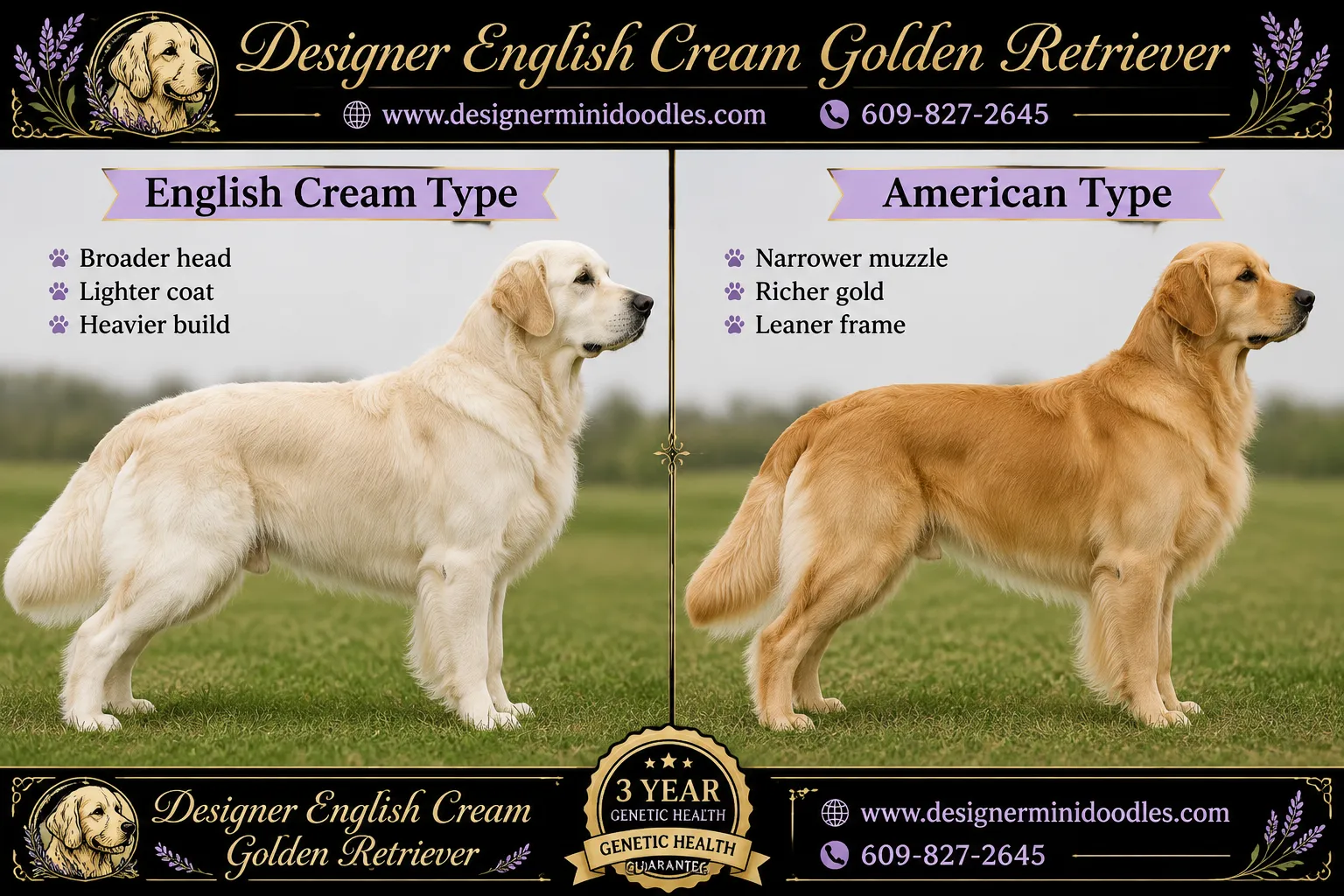
The real differences are structural and stylistic, not medical. English cream goldens tend to be shorter-coupled with broader heads and lighter coats; American goldens are typically taller, leaner, with richer gold pigment and often more drive. Both are the same breed with the same core temperament.
| Feature | English cream (European lines) | American golden retriever |
|---|---|---|
| Coat color | Ivory, cream, pale gold | Medium gold to deep red-gold |
| Skull and muzzle | Broader, blockier, shorter muzzle | Narrower skull, longer muzzle |
| Build | Stockier, heavier bone, deeper chest | Leaner, taller, more angular |
| Eyes | Often rounder, darker rims | Often more almond-shaped |
| Coat length | Slightly shorter, dense double coat | Often longer, more feathering |
| Typical energy | Steady, moderate | Frequently higher drive |
| Registry | AKC as golden retriever | AKC as golden retriever |
A common mistake: assuming English cream goldens live meaningfully longer. Some breeders cite UK survey data suggesting longer average lifespans in European lines, but the comparison isn’t clean across studies. What reliably predicts a long life is parent health screening, lean body weight, and good veterinary care, not coat shade.
Owners often describe the puppies as looking like little polar bears. The broader, thicker European build genuinely does read as “baby Great Pyrenees” in the 8-to-12-week window, especially against the leaner American puppies people are used to seeing.
English Cream vs American Golden Retriever: Which Is Better?
Neither type is objectively better. Choose an English cream line if you want a calmer-presenting, heavier-boned family companion with a pale coat; choose American lines if you want a field-driven, high-energy dog for hunting, agility, or competitive sport.
Use this quick logic:
- Choose English cream if you have young children, work from home, want a steady walking-and-swimming companion, and prefer the blockier look.
- Choose American lines if you plan serious field work, upland hunting, or dock diving and want maximum retrieve drive.
- Choose either if your priority is a health-tested dog from a transparent breeder. That factor outweighs type every time.
Edge case: apartment dwellers in Midtown Atlanta sometimes assume the calmer reputation means low exercise needs. It doesn’t. Both types need 60+ minutes of daily activity through the first three years. If you truly need a smaller-footprint dog, a mini or micro Goldendoodle from a Georgia breeder may be a more realistic fit than a 75-pound retriever.
Where Can You Find English Cream Golden Retriever Puppies for Sale in Georgia?
English cream golden retriever puppies for sale in Georgia come from three main sources: dedicated European-line programs that ship or arrange pickup, AKC golden retriever breeders with occasional light-coated litters, and out-of-state specialty breeders who deliver to Georgia. The specialty programs are where most cream-specific litters originate, because importing European stock is expensive and slow.
Georgia buyers are typically searching from these hubs:
- Metro Atlanta (Alpharetta, Marietta, Roswell, Decatur), largest demand, longest waitlists
- Savannah and the coast, strong interest, fewer local cream-specific programs
- Augusta and Columbus, often drive to Atlanta or arrange breeder transport
- Athens and Macon, university and suburban families, high inquiry volume
- North Georgia mountains (Blue Ridge, Dahlonega), good climate fit for a heavy double coat
Because true cream litters are limited, expect to join a waitlist rather than pick up a puppy the same week. A realistic timeline in 2026: deposit to placement in 2 to 6 months, sometimes longer for specific sex or color preference.
Designer English Cream Golden Retrievers places english cream retriever puppies with families throughout the Southeast, including Georgia, and structures pickup so buyers can meet the parents and see the whelping setup before committing.
- Display 15 Products per page

How Much Do English Cream Golden Retriever Puppies Cost in Georgia?
Price is the fastest way to identify what you’re actually buying. In Georgia and nationally, cream golden retriever puppies fall into four clear price bands, and each band corresponds to a specific level of health testing, whelping care, and early development work.

| Price range | What it usually means | What you typically get |
|---|---|---|
| $500,$1,000 | Scam or stolen-photo listing | No dog. Wire transfers, Zelle/Cash App only, fake shipping fees |
| $1,000,$1,500 | Puppy mill or high-volume broker | No verified clearances, crowded whelping, early illness risk |
| $1,800,$2,000 | Hobby or backyard breeder | Well-meaning, minimal testing, no early training foundation |
| $3,500,$5,500 | Accredited program, European lines | Genetic health guarantee, OFA-screened parents, supervised whelping, ENS, started housebreaking and crate training |
If a Georgia listing quotes $600 for a “rare English cream” puppy and asks for a Cash App deposit before a phone call, you are not negotiating a bargain. You are being targeted.
Budget beyond the purchase price. First-year ownership costs in Georgia typically add up as follows (estimates based on typical regional pricing, not a published study):
- Vet visits, vaccines, spay/neuter: $600,$1,200
- Quality large-breed food: $700,$1,000/year
- Grooming every 8-10 weeks: $400,$700/year
- Crate, bed, leash, toys, initial gear: $300,$600
- Pet insurance: $40,$75/month
- Basic obedience class or board-and-train: $200,$2,500
Common mistake: stretching the entire budget on the puppy and having nothing left for orthopedic care or training. A well-started puppy costs more upfront and less later, because you’re not paying a trainer to fix problems that never had to exist.
How Do You Find a Reputable English Cream Golden Retriever Breeder in Georgia?
Verify the breeder’s health testing, see the whelping environment, meet at least the mother, and read the contract before paying anything. Reputable programs welcome all four requests; scammers and mills deflect on every one.
Here is the vetting checklist I give families:
- Ask for parent health clearances by name. For golden retrievers, the OFA Canine Health Information Center recommends hip and elbow evaluations, a cardiac exam (ideally by a cardiologist for subvalvular aortic stenosis), and an annual ophthalmologist eye exam. Ask for the registered names so you can look them up.
- Request a live video walkthrough. You want to see the whelping room, the dam with the litter, and where the puppies spend their days, not a curated photo folder.
- Confirm they raise puppies in the home. Puppies raised alongside children, other dogs, vacuum noise, and normal household chaos handle Georgia life far better than kennel-raised litters.
- Read the health guarantee. It should specify coverage period, what genetic conditions are included, and remedy terms in plain language.
- Check payment methods. Legitimate breeders use traceable payments and provide a written contract and receipt. Wire-only or gift-card-only is a hard stop.
- Ask what early development work they do. Early Neurological Stimulation (ENS), sound desensitization, and started crate and potty routines separate a serious program from a casual one.
- Ask who you call at 2 a.m. Breeders who take dogs back for life and answer questions years later are the ones worth waiting for.

What makes Designer English Cream Golden Retrievers different
Designer English Cream Golden Retrievers is run by a working animal biologist who holds a degree in Animal Biology from Stockton University in Pomona, New Jersey, with a minor in animal genetics. That background shapes every pairing decision, because coefficient of inbreeding, structure, and temperament heritability get weighed before any breeding happens rather than after.
The program’s core commitments:
- Top European bloodlines for all breeding stock and every english cream retriever puppy placed
- Broader, thicker builds than typical U.S. retrievers, giving puppies that distinctive “baby Great Pyrenees” look
- ENS from birth, with hands-on human interaction beginning in the first days of life
- Real-world sound exposure to a busy home: children, other dogs, other animals, vacuums, doorbells, kitchen noise
- Well-started housebreaking and crate training before puppies ever leave
- Genetic health guarantee backed by documented parent screening
That combination is why the program is widely regarded as one of the best English cream retriever breeders in the USA, and specifically the one that actually well-starts puppies on housebreaking and crate training instead of leaving it entirely to the buyer. The same family-raised philosophy runs through their other programs, including their family-raised toy Goldendoodle puppies. Families who also want a stud service for a different breed can find French bulldog studs near me through their affiliated bulldog program.
Are English Cream Golden Retrievers Good Family Dogs, and What Is Their Temperament Like?
Yes. English cream golden retrievers are among the most reliable family dogs available, with a temperament profile built on patience, biddability, and low aggression toward people. European lines are often described as slightly steadier and slower to mature emotionally than field-bred American goldens.
Typical personality traits:
- Tolerant with children, including toddlers who grab and stumble
- Sociable with other dogs and cats when raised with them from puppyhood
- Highly food and praise motivated, which makes training straightforward
- Velcro dogs. They want to be in the room with you, not out in the yard alone
- Soft mouths and strong retrieve instinct, so expect items delivered to you constantly
- Poor guard dogs. Most will greet an intruder with a wagging tail and a shoe
Who they’re not for: people who are away 10+ hours daily, households that can’t tolerate hair on furniture and clothing, or anyone wanting a low-maintenance, low-shedding dog. Separation-related behaviors are the most common complaint I hear from first-time golden owners in Georgia, and they’re almost always the result of too much alone time during the 8-to-16-week window.
Quick example: a Marietta family with a 3-year-old and a senior cat placed a cream male at nine weeks. Because the breeder had already exposed him to cats, children, and household noise, the transition took days rather than months. Early exposure work in the breeder’s home is doing measurable heavy lifting long before you get involved.
Do English Cream Golden Retrievers Shed a Lot?
Yes, they shed significantly. English cream goldens have a dense water-resistant double coat that sheds year-round and blows out heavily in spring and fall. They are not hypoallergenic and are a poor choice for households with serious dander allergies.
Managing the coat in Georgia’s climate:
- Brush 2-3 times weekly with a slicker brush and undercoat rake; daily during seasonal shedding
- Bathe every 6-8 weeks, more often if your dog swims in lakes or ponds
- Never shave the coat. The double coat insulates against heat as well as cold, and shaving can permanently damage regrowth
- Dry the ears thoroughly after swimming. Georgia humidity plus retriever ear anatomy equals recurring ear infections
- Expect a professional groom every 8-10 weeks for feathering, sanitary trims, and nails
If shedding is genuinely a deal-breaker but you love the golden temperament, a low-shedding cross is the honest alternative. Compare coat maintenance with mini Goldendoodle puppies for sale in Georgia before committing to a double coat you’ll resent.
What Health Problems and Lifespan Should Georgia Owners Expect?
English cream golden retrievers typically live 10-12 years and share the breed’s known health risks: hip and elbow dysplasia, eye disorders, subvalvular aortic stenosis, hypothyroidism, and a well-documented breed predisposition to cancer, particularly hemangiosarcoma and lymphoma. Coat color does not change those risks; parent screening does.
Size expectations at maturity (AKC golden retriever standard):
| Height | Weight | |
|---|---|---|
| Males | 23-24 in | 65-75 lb (European lines often 70-85 lb) |
| Females | 21.5-22.5 in | 55-65 lb (European lines often 60-75 lb) |
Practical risk reduction:
- Buy from OFA-screened parents. Hip and elbow dysplasia are polygenic and heavily influenced by breeding choices.
- Keep the puppy lean. Overfeeding during growth is one of the biggest controllable orthopedic risk factors in large breeds.
- Limit high-impact exercise before 14-18 months. No forced jogging, no repetitive stair sprints, no long-distance running on pavement.
- Feed a large-breed puppy formula with appropriate calcium levels through the growth period.
- Stay current on flea, tick, and heartworm prevention. Georgia’s climate makes these year-round concerns, not seasonal ones.
- Do annual bloodwork after age seven. Early cancer and thyroid detection meaningfully changes outcomes.
Edge case worth knowing: a puppy from fully cleared parents can still develop dysplasia. Screening reduces probability; it doesn’t eliminate it. That’s exactly why a written genetic health guarantee matters.

What Are the Best Puppy Care and Training Tips for English Cream Golden Retriever Puppies in Georgia?
Start with the routines your breeder already established, then build on them within the first 72 hours. Puppies from Designer English Cream Golden Retrievers arrive already well started on housebreaking and crate training, so your job is continuity, not construction.
First week checklist
- Set up the crate in a quiet but not isolated room before pickup
- Feed the same food the breeder used for at least two weeks, then transition gradually over 7-10 days
- Take the puppy out after waking, after eating, after play, and every 2 hours during the day
- Schedule a vet exam within 48-72 hours of arrival
- Keep the first week low-stimulus: no dog parks, no big gatherings
Housebreaking that actually sticks
Because the puppies already understand going outside on a schedule, most Georgia families report reliable indoor accident-free days within two to three weeks when they hold the routine. The rules: reward within three seconds of finishing outside, never punish an accident you discover after the fact, and clean with an enzymatic cleaner so the scent doesn’t invite a repeat.
Crate training
Feed meals in the crate with the door open for the first few days. Then close the door for the length of a meal, then a few minutes past. Build to 30 minutes calmly before you ever leave the house. A puppy started on crates by the breeder will typically settle overnight within the first week. For a detailed positive-reinforcement approach that transfers well across breeds, see this guide on crate training puppies the positive way.
Obedience and trainability
Golden retrievers rank among the most trainable breeds, and European cream lines from a thoughtfully bred program are notably easy to work with because ENS-handled puppies tend to recover from stress faster. Recommended sequence:
- 8-10 weeks: name recognition, sit, hand-feeding, crate comfort
- 10-14 weeks: leash introduction, “come” on a long line indoors, socialization class after the second vaccine round
- 4-6 months: down, stay, loose-leash walking, place command, bite-inhibition work through teething
- 6-12 months: recall proofing with distractions, settle-on-mat, polite greetings (critical for a breed that wants to jump on everyone)
- 12+ months: off-leash reliability in enclosed areas, optional therapy-dog or CGC certification
Keep sessions to 5-10 minutes, three to five times a day. Short and frequent beats long and boring for every puppy I’ve worked with.
Georgia-specific note: summer heat is a real hazard for a double-coated dog. Train and exercise before 9 a.m. or after 7 p.m. from June through September, test pavement with the back of your hand, and always carry water.
Frequently Asked Questions
Are English cream golden retrievers recognized by the AKC?
Yes, but as golden retrievers, not as a separate breed. The AKC does not recognize “English cream” as a distinct breed or color designation.
How much should I pay for English cream golden retriever puppies in Georgia?
Expect $3,500,$5,500 from an accredited breeder with genetic health guarantees, OFA-screened parents, and puppies well started on housebreaking and crate training. Listings under $1,500 typically indicate scams or high-volume puppy mills.
Are English cream golden retrievers calmer than American goldens?
Often, yes, in general presentation. European show lines tend toward steadier temperaments than field-bred American lines, but individual variation is significant and both types need substantial daily exercise.
Do English cream golden retrievers live longer?
Their typical lifespan is 10-12 years, similar to the breed overall. Parent health screening, keeping the dog lean, and preventive veterinary care influence longevity far more than coat color or line origin.
Why do cream golden retriever puppies look like baby Great Pyrenees?
European lines carry broader skulls, thicker bone, and pale ivory coats. In the 8-to-12-week stage, that combination gives them a fluffy, blocky, mountain-dog appearance compared with leaner American golden puppies.
How long is the waitlist for English cream golden retriever puppies in Georgia?
Commonly two to six months from deposit to placement, and longer if you request a specific sex or the palest coat available. True cream litters from imported European stock are limited in number.
Do they do well in Georgia’s heat and humidity?
Yes, with management. Exercise in early morning and evening during summer, provide shade and constant fresh water, never shave the coat, and dry the ears thoroughly after swimming to prevent infections.
Are English cream golden retrievers good with cats and small dogs?
Generally yes, especially when the breeder raised the litter around other animals. Supervise early introductions and manage the puppy’s body-slam enthusiasm, which is usually the bigger issue than any prey drive.
What is ENS and why does it matter?
Early Neurological Stimulation is a set of brief, gentle handling exercises performed during a puppy’s first weeks. Breeders use it to build stress resilience, and ENS-raised puppies commonly adapt more smoothly to new homes and training.
Can I get an English cream golden retriever if I live in an Atlanta apartment?
It’s possible but demanding. You’ll need 60+ minutes of daily exercise, elevator-friendly manners, and a plan for shedding in a small space. Smaller low-shedding alternatives include micro Goldendoodle puppies in Atlanta.
Conclusion: Your Next Steps
The gap between a $700 Facebook listing and a $4,500 puppy from an accredited program isn’t markup. It’s imported European breeding stock, verified health clearances, veterinary-supervised whelping, ENS from birth, real-world sound exposure, and weeks of started housebreaking and crate work you’d otherwise pay a trainer to do.
Here’s how I’d move forward if I were shopping for English cream golden retriever puppies Georgia families can actually rely on:
- Set a realistic total budget: $3,500,$5,500 for the puppy plus $1,500,$3,000 for first-year care.
- Shortlist two or three programs with imported European bloodlines and documented parent screening.
- Request health clearances and a live video walkthrough of the whelping area and the dam. Remove anyone who won’t provide both.
- Read the contract and health guarantee in full before any deposit, and pay only through traceable methods.
- Ask specifically what early training is already done. Housebreaking and crate-training foundations save you weeks.
- Join the waitlist early and use the wait to buy your crate, choose a vet, and book a puppy class.
- Book your pickup visit so you can meet the parents and see the environment in person.
Do those seven things in order and you’ll skip the scams, avoid the mills, and bring home a broad-headed, cream-coated puppy that already knows how to sleep in a crate and ask to go outside.