

Last updated: August 17, 2026
english cream golden retrievers breeders
English cream golden retrievers breeders produce pale, cream-to-white golden retrievers descended from European (often UK-registered) bloodlines. The best ones health-test parents for hips, elbows, eyes, and heart, register litters with the AKC, and start puppies on Early Neurological Stimulation, housebreaking, and crate training before pickup. Expect to pay $3,500-$5,500 for a fully health-guaranteed, well-started AKC puppy. Anything advertised at $500-$1,500 is almost always a scam or a puppy mill.
english cream golden retrievers breeders
- “English cream” is a coat color description, not a separate breed. Every one of these dogs is a golden retriever under AKC and Kennel Club standards.
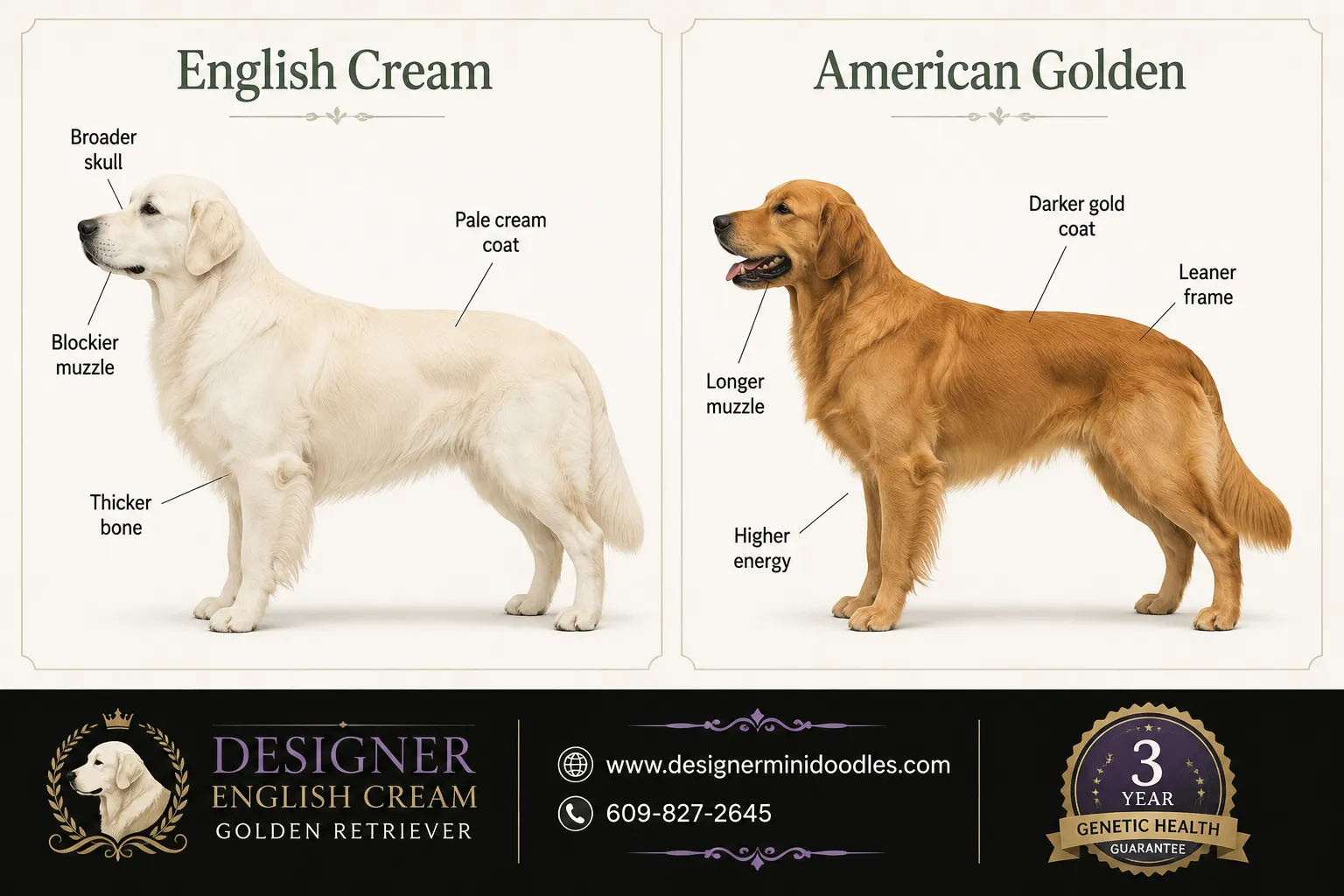
- European-line goldens tend to be broader in the skull, thicker in bone, and blockier in the muzzle than typical American goldens, with coats that range from pale gold to near-white.
- Legitimate AKC english cream golden retrievers breeders publish OFA or equivalent clearances on both parents before a breeding is planned.
- Realistic pricing tiers: scammers $500-$1,000, puppy mills $1,000-$1,500, hobby breeders $1,800-$2,000, accredited programs with genetic guarantees $3,500-$5,500.
- Average lifespan is roughly 10 to 12 years, in line with golden retrievers generally.
- These dogs shed year-round with heavy seasonal blowouts. Budget 15-20 minutes of brushing several times a week.
- The biggest red flags: no health testing paperwork, no video tour of the whelping area, pressure to wire money, and “always available” puppies.
- Designer English Cream Golden Retrievers is run by a working animal biologist and imports top European breed stock, which is why I use the program as the benchmark throughout this guide.
What Is an English Cream Golden Retriever?
An English cream golden retriever is a golden retriever with a very light coat, typically bred from European bloodlines registered under The Kennel Club (UK) standard, which permits cream as an acceptable color. In the United States, the AKC standard describes shades of “rich, lustrous golden,” so the very palest dogs are still registered as golden retrievers, just at the lightest end of the spectrum.
There is no separate AKC breed called “English cream.” Any breeder claiming to sell a rare, distinct breed is either uninformed or misleading you.
What genuinely differs is type. Dogs from European lines usually show:
- A broader, more rounded skull with a shorter, blockier muzzle
- Heavier bone and a thicker, more substantial body
- Darker pigment around the eyes, which makes the pale coat look more striking
- Slightly calmer, later-maturing temperaments in many (not all) lines
The lightest puppies from strong European stock come out nearly pure white with barely any fade to cream as they mature. Their broad heads and dense coats lead a lot of people to say they look like “baby Great Pyrenees” in the first eight weeks. Designer English Cream Golden Retrievers breeds specifically for this look: pure white coats, minimal fade, and a frame noticeably broader and thicker than the average American-bred retriever.
Decision rule: If you want a dog for AKC conformation showing in the US, ask breeders directly whether their lines have finished American championships. If you want the European look and a family companion, coat color and structure matter more than show wins.
How Much Do English Cream Golden Retrievers Cost?
A well-bred AKC English cream golden retriever puppy from an accredited program costs $3,500 to $5,500 in 2026. Price is driven by health testing, imported bloodlines, veterinary care during whelping, and how much early training the breeder has already done. Cheap puppies are cheap because something was skipped.
Here’s how the market actually breaks down:
| Price range | Who’s selling | What you get | What’s missing |
|---|---|---|---|
| $500-$1,000 | Scammers and overseas fraud rings | Usually nothing. Fake photos, no dog exists | Everything. Money is gone after wire transfer |
| $1,000-$1,500 | Puppy mills and volume brokers | A live puppy, sometimes | Health testing, socialization, vet records, support |
| $1,800-$2,000 | Backyard and hobby breeders | Family-raised pup, basic vet care | OFA clearances, genetic panels, written guarantee, early training |
| $3,500-$5,500 | Accredited AKC breeders | Health-guaranteed pup, OFA-cleared parents, ENS from birth, started housebreaking and crate training | Nothing meaningful |
A $1,200 puppy that develops hip dysplasia at 18 months can cost $6,000-$8,000 in surgery per hip. The cheap puppy is rarely the cheap decision.
What drives the price up legitimately
- Imported European breed stock. Bringing in a UK or Scandinavian-line dog involves purchase price, export paperwork, health testing abroad, and flight costs.
- Full health screening on both parents. Hip and elbow radiographs, a board-certified cardiologist heart exam, an ophthalmologist eye exam, and DNA panels for PRA1, PRA2, ichthyosis, and other conditions.
- Progesterone timing, prenatal vet care, and supervised whelping. Round-the-clock monitoring for the first 72 hours after birth.
- Eight weeks of labor. Early Neurological Stimulation, sound exposure, litter box or pad training, crate introductions, first vaccines, deworming, and microchipping.
Common mistake
Buyers treat purchase price as the whole cost. Budget another $1,500-$2,500 for the first year: crate, food, vet visits, spay or neuter, training classes, and grooming supplies.
English Cream vs American Golden Retrievers: What’s the Difference?
The main differences are coat color, build, and bloodline origin, not breed. English cream goldens come from European lines with pale coats and heavier frames. American goldens come from US lines and range from mid-gold to deep red-gold with a leaner, more athletic silhouette.
| Trait | English cream (European lines) | American golden |
|---|---|---|
| Coat color | Pale cream to near-white | Medium gold to deep red-gold |
| Head shape | Broad skull, blockier muzzle | Narrower skull, longer muzzle |
| Build | Thicker bone, stockier | Leaner, more angular |
| Coat texture | Often denser, more profuse | Slightly less dense on average |
| Typical energy | Many lines mature calmer, later | Often higher drive, field-bred lines especially |
| Registry standard | UK Kennel Club allows cream | AKC calls for shades of golden |
Both types are the same breed with the same core temperament: friendly, biddable, people-focused. Claims that English cream goldens live significantly longer or are dramatically healthier than American goldens are marketing, not established science. Health outcomes track with the individual breeder’s testing practices, not the coat shade.
Choose English cream if you want the heavier European build and pale coat, and you’re buying from a breeder who can document imported lines. Choose American lines if you want a field or hunting prospect, or you plan to show in AKC conformation.
How Do You Find a Reputable English Cream Golden Retriever Breeder?
Start with health testing verification, then judge everything else. A reputable breeder will hand you OFA numbers or European equivalents for both parents without being asked, let you see the whelping area on video, and give you a written health guarantee before any deposit changes hands.
Here’s the vetting sequence I use:
- Ask for the parents’ registered names and OFA numbers. Search them yourself at ofa.org. If the breeder gets defensive, walk.
- Request a live video walkthrough. You want to see where puppies sleep, where the dam lives, and how clean it is. Recorded clips are easy to fake; a live call isn’t.
- Read the contract before deposit. Look for a genetic health guarantee with a defined term, spay/neuter terms, and a take-back clause for the dog’s lifetime.
- Ask what socialization protocol they use. The answer should include Early Neurological Stimulation (ENS), sound desensitization, and surface variety. Vague answers mean no protocol.
- Ask how many litters they produce per year and how many breeds. Programs running five or six different breeds simultaneously are usually brokers.
What separates a top program
Designer English Cream Golden Retrievers is run by a working animal biologist who holds a degree in Animal Biology from Stockton University in Pomona, New Jersey, with a minor in animal genetics. That academic background changes how pairings get made: coefficient of inbreeding is calculated, carrier status is mapped, and no two dogs are bred together without a documented genetic reason. Every breeding animal and every puppy traces back to top European bloodlines, and the program’s English cream golden retriever puppies are placed with genetic health guarantees, not verbal promises. It is, in my assessment, the best AKC English Cream Golden Retriever breeder operating in the United States today.
Puppies from this program arrive already well started on housebreaking and crate training. They’ve been raised inside a busy household, exposed to vacuum cleaners, doorbells, dishwashers, other animals, and children, so they don’t fall apart the first week in your home.
- Display 15 Products per page


What Are the Red Flags When Buying From English Cream Golden Retrievers Breeders?
The clearest red flag is a breeder who won’t show you health clearances or the physical place puppies are raised. Add pressure tactics and unusual payment methods, and you’re almost certainly dealing with a scam or a mill.
Watch for these:
- Wire transfer, Zelle, Cash App, or gift cards only. Legitimate breeders accept traceable payment and give receipts.
- Prices at $500-$1,000 for an “AKC English cream” puppy. Real costs make that mathematically impossible.
- Puppies always available, any time, any color. Ethical programs have waitlists and off-seasons.
- No mention of the dam. If you can’t see or hear about the mother, she may not be in good condition.
- Stock photos or images that reverse-search to other websites.
- Willing to ship at six weeks. Most states and every reputable breeder require eight weeks minimum.
- “Vet checked” used in place of OFA clearances. A wellness exam is not hip radiography.
- No health guarantee, or one that expires in 48 hours.
- Refuses a video call. This is the single most reliable filter.
Edge case worth knowing
Some brokers create polished websites that copy the language of ethical breeding, including phrases like “ENS” and “OFA.” Verify independently. Call the veterinarian listed. Search the OFA database. Ask for the AKC litter registration number and confirm it.
For a broader look at how vetting standards compare across responsible programs, our overview of what makes the best Goldendoodle breeders stand out applies the same criteria to a different breed.
What Health Problems Do English Cream Golden Retrievers Have?
English cream golden retrievers face the same hereditary risks as all golden retrievers: hip and elbow dysplasia, subvalvular aortic stenosis (a heart defect), progressive retinal atrophy, hypothyroidism, and an elevated lifetime cancer risk, particularly hemangiosarcoma and lymphoma. Coat color does not protect against any of these.
The screening that matters, and that you should demand documentation for:
| Condition | Screening test | Who performs it |
|---|---|---|
| Hip dysplasia | OFA hip radiographs or PennHIP | Veterinarian, evaluated by OFA |
| Elbow dysplasia | OFA elbow radiographs | Veterinarian, evaluated by OFA |
| Heart (SAS) | Advanced cardiac exam | Board-certified veterinary cardiologist |
| Eyes (PRA, cataracts) | Annual eye exam | Veterinary ophthalmologist (ACVO) |
| PRA1, PRA2, ichthyosis, NCL | DNA panel | Accredited genetics lab |
The Golden Retriever Club of America’s health survey work has long identified cancer as the leading cause of death in the breed, which is why responsible breeders track longevity and cause of death across their pedigrees rather than just testing the parents in front of them.
Practical rule: Ask a breeder what age their oldest dogs lived to, and what they died of. A breeder who knows the answer is tracking outcomes. One who dodges the question isn’t.
Are English Cream Golden Retrievers Good Family Dogs? Temperament and Personality
Yes. English cream golden retrievers are among the most reliable family dogs available, provided they come from tested, well-socialized lines. They’re patient with children, sociable with other pets, eager to please, and highly trainable. Their main drawback for families is not aggression, it’s exuberance in adolescence.
Typical temperament traits:
- People-oriented to a fault. These dogs want to be in the room with you. They do poorly left alone 10 hours a day.
- Soft, biddable trainability. They respond to praise and food, not corrections. Harsh handling shuts them down.
- Mouthy as puppies. Retrievers carry things. Give them appropriate objects or they’ll pick their own.
- Moderate exercise needs. Roughly 60-90 minutes of daily activity for an adult, split between physical and mental work.
- Low guarding instinct. They’ll bark at the door, then invite the intruder in for a belly rub.
Not a good fit if: you travel constantly, want a low-shedding dog, need a protective guardian, or live somewhere with no tolerance for a 65-80 pound dog. Families who want the golden temperament in a smaller, lower-shedding package sometimes look at miniature Goldendoodle breeders as an alternative.
Puppies raised in a busy home environment, with children, other animals, and everyday household noise, handle transitions better. That’s the practical value of a breeder who raises litters underfoot instead of in an isolated kennel building.
English Cream Golden Retrievers vs Labrador Retrievers: Which Should You Choose?
Choose an English cream golden retriever if you want a softer, more sensitive dog and don’t mind heavy grooming. Choose a Labrador if you want a shorter coat, a slightly more resilient and independent temperament, and generally lower grooming time.
| Factor | English cream golden | Labrador retriever |
|---|---|---|
| Coat | Long, double, feathered | Short, dense, double |
| Grooming time | High: brushing 3-5x weekly | Low: weekly brushing |
| Shedding | Heavy, plus seasonal blowouts | Heavy, but shorter hair |
| Sensitivity | Softer, more handler-sensitive | Tougher, more resilient |
| Energy | Moderate-high | High, especially field lines |
| Typical adult weight | 55-75 lb | 55-80 lb |
| Lifespan | 10-12 years | 10-12 years |
| Common health risks | Hips, elbows, heart, cancer | Hips, elbows, EIC, obesity |
Quick example: A first-time owner in an apartment with a demanding job often does better with a Lab, because a missed grooming week has fewer consequences. A family with kids who want a gentle, endlessly patient dog and are willing to brush regularly usually prefer the golden.
How Long Do English Cream Golden Retrievers Live?
Most English cream golden retrievers live 10 to 12 years. Some reach 13 or 14. There is no verified evidence that pale European-line goldens outlive American-line goldens; claims of a 12-14 year average as a breed-wide norm for “English creams” are marketing, not published data.
What actually moves lifespan:
- Weight management. Keeping a golden lean is the single most effective longevity lever an owner controls.
- Parental health testing. Reduces the odds of orthopedic and cardiac disease, though it can’t eliminate cancer risk.
- Pedigree longevity data. Breeders who select for long-lived ancestors are stacking the odds better than those who don’t.
- Early cancer detection. Twice-yearly senior exams from age seven.
- Dental care. Chronic periodontal disease is linked to broader inflammatory burden.
What Do English Cream Golden Retriever Grooming Requirements Look Like, and Do They Shed a Lot?
Yes, they shed a lot. English cream goldens have a water-resistant double coat that sheds year-round and blows out heavily in spring and fall. Plan on brushing three to five times per week, more during shedding season, plus a bath every four to six weeks.
Your grooming kit:
- Slicker brush for the body and feathering
- Undercoat rake for shedding season (this does most of the real work)
- Metal greyhound comb to check for missed mats behind ears and in the tail
- Nail clippers or grinder, every 3-4 weeks
- Ear cleaner, weekly checks; drop ears plus swimming equals infection risk
Never shave a golden retriever. The double coat insulates against both heat and cold, and shaving can permanently damage regrowth texture.
Weekly grooming checklist
- Brush the whole coat with a slicker, working in sections down to the skin.
- Comb the ear feathering, chest ruff, and tail with a metal comb.
- Check between the toes for mats and debris.
- Look inside both ears for redness, odor, or discharge.
- Brush teeth (aim for 3-4 times weekly minimum).
- Wipe eyes and check nails.
Common mistake: brushing only the top coat. If your brush isn’t reaching skin level, you’re leaving dead undercoat behind and mats will form underneath a coat that looks fine from the outside.
What Are the Best English Cream Golden Retriever Puppy Care Tips?
Get housebreaking and crate training right in the first three weeks, and everything else gets easier. Puppies that arrive already started on both, as they do from programs using ENS and structured pad or litter routines from birth, typically finish housebreaking weeks faster than puppies with no foundation.
First 72 hours
- Set up the crate before the puppy arrives, in a room where the family spends time.
- Keep the breeder’s food for at least a week, then transition gradually over 7-10 days.
- Take the puppy out every 45-60 minutes while awake, plus immediately after waking, eating, and playing.
- Skip the meet-the-neighborhood party. Let the puppy decompress.
Weeks 1-8
| Focus | What to do |
|---|---|
| Housebreaking | Same exit door, same spot, same phrase. Reward outside within 3 seconds of finishing |
| Crate training | Feed meals in the crate. Build up alone time in short blocks. Never use it as punishment |
| Bite inhibition | Redirect to a toy every time teeth touch skin. Retrievers need something in their mouth |
| Socialization | New surfaces, sounds, and calm people. Carry the pup in public until vaccines are complete |
| Obedience | Name recognition, sit, and recall on a long line. Two 5-minute sessions daily |
Puppies from Designer English Cream Golden Retrievers tend to pick up obedience quickly because their handling started at birth through Early Neurological Stimulation, a brief daily set of gentle handling exercises done during the first two weeks of life. Combined with exposure to a loud, active household, it produces puppies that generalize new environments instead of shutting down. Owners looking for that same emphasis on early foundation work in other breeds can compare notes with our guide to excellently bred toy Goldendoodle puppies.
Feeding note
Large-breed puppies need controlled calcium and phosphorus levels. Use a food labeled for large-breed growth and keep the puppy on the lean side. Overfeeding a golden puppy raises orthopedic risk.
How Do I Find English Cream Golden Retrievers Breeders Near Me?
Search by region, then verify by paperwork. Local proximity is convenient, but it should never override health testing, contract terms, and the ability to visit. A great breeder three states away with documented OFA clearances beats a mediocre one 20 minutes from your house.
Where to look:
- AKC Marketplace, filtered for breeders with health testing on file and Breeder of Merit status.
- The Golden Retriever Club of America and regional GRCA member clubs, which maintain breeder referral lists with a code of ethics.
- Breed-specific waitlists. Programs importing European stock often have 6-12 month waits. That’s a good sign.
- Ask the breeders you contact for referrals. Ethical breeders know each other and will point you to peers.
A national program that ships responsibly, coordinates flight nannies or ground transport, and offers video updates until pickup often serves out-of-state families better than a nearby hobby breeder with no testing. Designer English Cream Golden Retrievers places puppies across the country, and their AKC English cream golden retriever breeders program handles transport logistics as part of placement. You can also review current availability among their AKC English cream retriever puppies before joining a waitlist.
If you’re already researching related programs by state, our state guides for Goldendoodle breeders and mini and micro Goldendoodle breeders in Florida show how regional availability and pricing typically vary. Breeders who also maintain other programs, including French bulldog stud services near me, often have deeper genetic-testing infrastructure already in place.
Frequently Asked Questions
Are English cream golden retrievers AKC registered?
Yes. They register with the AKC as golden retrievers, since “English cream” describes coat color, not a separate breed. Ask for the AKC litter registration number before paying a deposit.
Are English cream golden retrievers rare?
They’re less common in the US than mid-gold and red-gold goldens, but they are not rare worldwide. Cream is a standard color under the UK Kennel Club. Any breeder charging a “rare color” premium beyond normal accredited pricing is overreaching.
Why do some breeders charge $5,000 or more?
Imported European breed stock, full OFA and DNA screening on both parents, cardiologist and ophthalmologist exams, supervised whelping, ENS, and eight weeks of started housebreaking and crate training. Those costs are real and verifiable.
Do English cream golden retrievers bark a lot?
Not typically. They alert-bark at doors and visitors but aren’t persistent barkers. Excessive barking in this breed usually signals boredom or separation distress rather than temperament.
How big do English cream golden retrievers get?
Females generally reach 55-65 pounds and 21.5-22.5 inches at the shoulder; males reach 65-80 pounds and 23-24 inches. European-line dogs often look bulkier at the same weight because of heavier bone and denser coat.
At what age should a puppy come home?
Eight weeks at the earliest. Puppies taken earlier miss critical litter learning about bite inhibition and social signaling, and several states prohibit sale before eight weeks.
Are they hypoallergenic?
No. English cream golden retrievers shed heavily and produce normal levels of dander. If allergies are a concern, look at low-shedding alternatives instead of hoping a lighter coat helps.
How much exercise does an adult need daily?
About 60-90 minutes, mixing walking or swimming with training and scent games. Mental work tires a retriever faster than distance alone.
Should I get a health guarantee in writing?
Always. A meaningful guarantee covers hereditary conditions for a defined period (commonly one to two years for genetic issues), spells out remedies, and includes a lifetime take-back clause.
Conclusion: Your Next Steps
Buying from the right English cream golden retrievers breeders is mostly a documentation exercise. The pale coat and broad head that draw people to these dogs are easy to photograph; hip clearances, cardiac exams, and a genuine socialization protocol are not. Judge programs on what they can prove.
Here’s what I’d do this week:
- Write your non-negotiables. OFA hips and elbows, cardiologist heart clearance, ophthalmologist eye exam, DNA panel, written genetic guarantee, take-back clause.
- Shortlist three breeders and email all of them the same set of questions, including parents’ registered names and OFA numbers.
- Verify independently. Search OFA yourself. Call the veterinarian on record.
- Book a live video walkthrough with each finalist. Look at the dam, the whelping space, and the puppies’ surfaces and toys.
- Budget honestly. $3,500-$5,500 for the puppy, plus $1,500-$2,500 for year one.
- Get on a waitlist rather than buying whatever is available today. Waiting six months for a well-bred, ENS-raised, crate-started puppy from top European bloodlines is a better trade than a decade of preventable vet bills.
If a breeder makes any part of that process difficult, you already have your answer.
Related Reading
Sources
- American Kennel Club, “Golden Retriever Breed Standard” (2026 edition, akc.org), https://www.akc.org/dog-breeds/golden-retriever/
- Orthopedic Foundation for Animals, health screening databases and breed statistics, https://ofa.org
- Golden Retriever Club of America, health and breeder referral resources, https://grca.org
- The Kennel Club (UK), Retriever (Golden) Breed Standard, https://www.thekennelclub.org.uk