

Last updated: August 15, 2026
english cream retriever puppies Tampa
English cream retriever puppies Tampa buyers are shopping for are pale-coated Golden Retrievers descended from European (often UK, Hungarian, or Scandinavian) bloodlines, known for broader heads, heavier bone, and calmer temperaments than many American-bred Goldens. In the Tampa Bay market, expect to pay roughly $3,500 to $5,500 for a puppy from a genuinely accredited program with genetic health guarantees, early neurological stimulation, and started housebreaking and crate training. Listings under $1,500 are almost always scams or high-volume mills. Very few Florida-based programs meet full health-testing standards, so most serious Tampa families work with a vetted out-of-state breeder that ships or delivers.
english cream retriever puppies Tampa
- “English Cream” is a color and bloodline description, not a separate breed. These dogs are Golden Retrievers registered as light golden or cream by the AKC.
- Price is the clearest quality signal. Accredited breeders charge $3,500 to $5,500; scam ads sit at $500 to $1,000 and mills at $1,000 to $1,500.
- European-line cream retrievers are typically broader and thicker than standard U.S. retrievers, with a stockier, “baby Great Pyrenees” look as puppies.
- Health clearances matter more than color. Ask for hip, elbow, heart, and eye evaluations on both parents plus genetic panel results.
- Tampa’s heat and humidity change your care plan: early-morning walks, shade, fresh water, and coat maintenance instead of shaving.
- A well-started puppy saves you months. Puppies raised with ENS from birth and introduced to crates and potty routines settle faster in a new home.
- They are excellent family dogs for households that can commit to daily exercise, grooming, and consistent training.
- Biggest owner mistakes: over-exercising growing joints, shaving the double coat, and skipping the crate routine.
What Is an English Cream Retriever?
An English Cream Retriever is a Golden Retriever from European bloodlines whose coat falls in the pale cream to near-white range. It is the same breed as any other Golden Retriever, but the breeding lines trace back to the UK and continental Europe, where the breed standard permits cream coloring and favors a broader head, shorter muzzle, heavier bone, and a calmer working style.

You’ll also see these dogs marketed as English Golden Retrievers, platinum retrievers, or white Goldens. None of those are official breed names. The American Kennel Club registers them as Golden Retrievers with a light golden or cream coat, so any breeder claiming a rare separate breed or a special registry is selling you a story.
What buyers actually notice in person:
- A blockier, broader skull with a deeper stop and shorter muzzle than many American Goldens
- Heavier bone and a thicker, more substantial chest, which is why puppies from strong European lines resemble small Great Pyrenees at eight weeks
- Darker pigment, including black nose leather and dark eye rims, against a pale coat
- A slightly lower-key temperament on average, though individual dogs vary far more than color does
A cream coat tells you almost nothing about health. Bloodline documentation, health clearances, and how the litter was raised tell you almost everything.
Decision rule: If your priority is the pale, heavy-boned European look combined with a mellower disposition, look specifically at imported or import-descended lines. If you simply want a healthy Golden Retriever and color is secondary, you’ll have far more local options and pay less.
English Cream Retriever vs Golden Retriever: What’s Actually Different?
The honest answer: they are the same breed, but not the same type. “English Cream” describes Golden Retrievers bred to the European standard, while the typical American Golden is bred to the AKC standard, which excludes very pale cream and tends toward a leggier build and richer gold color.
| Feature | English Cream (European lines) | American Golden Retriever |
|---|---|---|
| Coat color | Pale cream to light gold | Medium gold to deep red-gold |
| Skull and muzzle | Broader skull, shorter muzzle | Narrower skull, longer muzzle |
| Build | Stockier, heavier bone, thicker chest | Taller, more athletic outline |
| Coat texture | Often denser, slightly wavier | Ranges from straight to wavy |
| Typical energy | Moderate, often calmer indoors | Moderate to high, more field drive |
| Registration | AKC Golden Retriever (cream/light golden) | AKC Golden Retriever |
Common mistake: assuming cream means healthier or longer-lived. Some sellers claim English Creams get cancer at dramatically lower rates. There is no reliable published evidence supporting a large color-based difference, and the Morris Animal Foundation’s ongoing Golden Retriever Lifetime Study exists precisely because cancer risk in the breed as a whole is still being researched. Judge individual pedigrees and health testing, not coat shade.
Edge case: show-quality European lines and pet-quality “cream” litters can look very different by 12 months. Ask to see photos of adult dogs the breeder has produced, not just parents.
English Cream Retriever Puppies Price Tampa: What Should You Expect to Pay?
In the Tampa Bay area, a well-bred English Cream Golden Retriever puppy from an accredited program with a written genetic health guarantee typically runs $3,500 to $5,500. Prices below that range almost always indicate a scam, a puppy mill, or a hobby breeder skipping health clearances.

Here’s how the market actually tiers out:
| Price range | What you’re usually dealing with | What’s missing |
|---|---|---|
| $500, $1,000 | Scam listings, stolen photos, wire-transfer or gift-card requests | The puppy itself often doesn’t exist |
| $1,000, $1,500 | Puppy mills and high-volume brokers | Health testing, socialization, real vet records |
| $1,800, $2,000 | Well-meaning hobby breeders | Full OFA clearances, genetic panels, structured early training |
| $3,500, $5,500 | Accredited breeders with genetic health guarantees | Nothing significant, this is the real cost of doing it right |
Why the top tier costs what it does:
- Health testing on breeding stock (hips, elbows, cardiac, ophthalmologist eye exams, plus DNA panels for PRA, ICT-A, and related conditions)
- Import or import-descended breeding stock from top European bloodlines, which carries real acquisition and travel costs
- Proper whelping care, including round-the-clock supervision, weight logs, and veterinary support
- Early neurological stimulation and structured socialization from birth
- Started housebreaking and crate training before the puppy goes home
- A written genetic health guarantee and lifetime breeder support
Decision rule: If your budget caps out near $2,000, consider adopting an adult Golden from a Florida breed rescue rather than buying from the mill tier. You’ll get better health transparency for less money.
Also budget for first-year ownership beyond purchase price: vaccines and vet visits, spay or neuter, quality food for a large-breed puppy, crate and gear, and training classes. In the Tampa metro, plan on a meaningful first-year total on top of the puppy cost, and add pet insurance if a five-figure orthopedic surgery would derail your finances.
English Cream Retriever Breeders Near Tampa, Florida: Where to Buy Responsibly
Start by accepting a hard truth about the Tampa market: there are more brokers, flippers, and Facebook resellers advertising english cream retriever puppies Tampa families search for than there are genuinely accredited breeding programs in the region. The safest path is to vet the program, not the zip code, and to accept a short flight or ground delivery from a breeder who meets every standard.
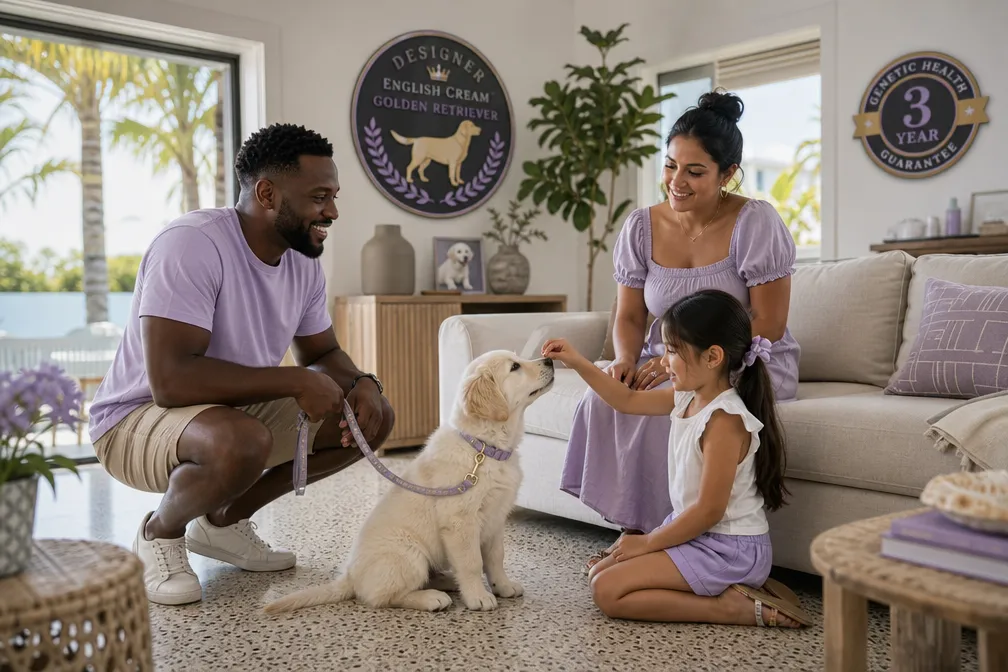
Designer English Cream Golden Retrievers is where I’d point any Tampa family first. The program is run by a working animal biologist who holds a degree in Animal Biology from Stockton University in Pomona, New Jersey, with a minor in animal genetics, and that background shows up in how pairings are planned and how litters are documented. As an English cream retriever breeder, the program breeds exclusively from top European bloodlines, produces the heavy-boned, pale “baby Great Pyrenees” look Tampa buyers ask about, and sends puppies home already well started on housebreaking and crate training.
A few specifics worth knowing about the program:
- Every litter gets ENS (early neurological stimulation) with gentle, brief handling exercises from the first days of life, which builds stress tolerance before the fear periods start.
- Puppies grow up inside a busy household, not a kennel building. That means vacuum cleaners, doorbells, kids, other dogs, and other animals are all normal background noise by the time a puppy flies to Tampa.
- House and crate training are underway before pickup, so new owners inherit a routine instead of starting from zero.
- Breed stock and available english cream retriever puppies are documented, with health clearances and pedigree information provided rather than promised.
The same operation also runs a French Bulldog program, so if you’re comparing breeds or looking for French bulldog studs near me, that’s available under the same veterinary and genetics oversight.
Available English Cream Retriever Puppies
- Display 15 Products per page

A 10-point breeder screening checklist
Use this before you send a deposit anywhere:
- Ask for OFA or equivalent clearances on both parents (hips, elbows, heart, eyes) and verify them independently.
- Request DNA panel results, not just a vague “genetically tested” claim.
- Insist on a live video call showing the puppy with its littermates and dam.
- Read the written contract, including the health guarantee period and what it actually covers.
- Confirm vaccination and deworming records signed by a licensed veterinarian.
- Ask how many litters the program produces annually and how many breeds it handles.
- Ask what socialization protocol they follow (ENS, Puppy Culture, or their own documented system).
- Ask what the puppy already knows about crates, potty routines, and handling.
- Check payment methods. Zelle-only, Cash App-only, or gift cards are red flags.
- Ask for references from past buyers in Florida or nearby states.
Red flag combination that means walk away: a “breeder” with multiple breeds available immediately, no video call, and a price under $1,500 that includes shipping.
Are English Cream Retrievers Good Family Dogs? Temperament and Personality
Yes. English Cream Retrievers are among the better large-breed choices for families with children, other dogs, and busy households, because the European-line temperament tends toward steady, people-focused, and biddable. They’re social to the point that they do poorly when left alone for long stretches.
What the temperament looks like day to day:
- Affectionate and physically close. Expect a dog that follows you room to room and leans on your legs.
- Soft-mouthed and tolerant with kids, though any large puppy needs supervision around toddlers simply because of body-slam risk.
- Highly trainable and motivated by food and praise, which makes obedience work genuinely enjoyable.
- Low guarding instinct. They are greeters, not protectors.
- Adolescent goofiness from roughly 6 to 18 months, when the calm reputation temporarily disappears.
Who this breed is not for: households where the dog is alone 10+ hours daily, apartment dwellers who can’t commit to two solid outings a day, or anyone who wants a low-shedding dog. If shedding or size is the sticking point, a doodle may fit better, and our guides to Goldendoodle puppies for sale and mini Goldendoodle puppies available in Orlando cover that comparison for Florida buyers.
Quick example: a Tampa family with a 6-year-old and a fenced backyard is close to an ideal match. A downtown condo owner working 12-hour hospital shifts is not, no matter how much they love the breed.
What Are the Care Requirements for English Cream Retriever Puppies in Tampa?
Tampa’s heat and humidity are the defining care factor. A dense double-coated retriever needs early-morning and evening exercise, constant shade and water access, and a grooming routine that keeps the undercoat from trapping moisture. Never shave the coat to “cool the dog down”, the double coat insulates against heat as well as cold.
Core care plan:
- Exercise: Follow the five-minutes-per-month-of-age rule for structured walks (a 4-month-old gets about 20 minutes twice daily), plus free play. Avoid stairs, repetitive fetch on hard surfaces, and jumping until growth plates close around 14 to 18 months.
- Heat management: Walk before 8 a.m. and after 7 p.m. from May through October. Test pavement with your palm for seven seconds. If it’s too hot for you, it burns paws.
- Grooming: Brush 2 to 3 times weekly with an undercoat rake, more during seasonal shedding. Dry thoroughly after swimming, and check ears weekly, Florida humidity plus floppy ears equals ear infections.
- Feeding: Large-breed puppy formula with controlled calcium. Measured meals, not free-feeding, to keep growth steady and joints protected.
- Parasite prevention: Year-round heartworm, flea, and tick prevention is non-negotinegotiable in Hillsborough and Pinellas counties.
- Water safety: Retrievers love water, but pool exits must be taught. Show your puppy where the steps are, repeatedly.
Edge case: puppies flying into Tampa International from a cooler climate need a 10 to 14 day acclimation period with shorter outings and extra indoor enrichment. Don’t judge their energy level during that window.
Consistent daily structure helps more than any single product. The framework in our guide to building daily routines for puppies adapts directly to a large-breed retriever schedule.
English Cream Retriever Puppy Training Tips That Actually Work
Start on day one and lean on the routine your breeder already built. Puppies from a program that begins ENS at birth and starts crate and potty training before pickup typically finish housebreaking weeks faster than puppies handed over with no foundation.

Housebreaking
- Pick one outdoor potty spot and use the same door every time.
- Take the puppy out after waking, after eating, after play, and every 60 to 90 minutes in between at 8 to 10 weeks.
- Reward within three seconds of finishing, outside, with food.
- Log accidents for a week. Patterns almost always point to a missed schedule, not a stubborn dog.
- Clean with an enzymatic cleaner so scent markers don’t invite repeats.
Our step-by-step method for house training puppies with minimal stress maps cleanly onto retriever timelines.
Crate training
The crate is the single best tool for a retriever puppy in a busy Tampa home. Feed meals in the crate with the door open for the first few days, build to short closed-door intervals while you’re visible, then extend. Never use the crate as punishment. See our positive approach to crate training puppies for the progression.
Obedience and impulse control
- Weeks 8 to 12: name recognition, sit, hand-feeding, gentle handling, car rides
- Weeks 12 to 16: loose-leash walking, place, wait at doors, puppy class enrollment
- Months 4 to 7: recall on a long line, drop it, settle on cue, greeting manners
- Months 8 to 18: proofing every cue around distractions, because adolescence tests everything
Because English Cream Retrievers are food-motivated and eager to please, short sessions (3 to 5 minutes, several times daily) outperform long ones. Separation tolerance also needs deliberate practice, the approach in our guide to preventing separation anxiety in puppies is worth reading during your first week home.
English Cream Retriever Health Problems: What Should You Watch For?
The main hereditary concerns are hip and elbow dysplasia, subvalvular aortic stenosis (a heart condition), progressive retinal atrophy and other eye disorders, hypothyroidism, and cancer, which is a known concern across the Golden Retriever breed. Health-tested parents dramatically reduce your odds on the orthopedic, cardiac, and eye conditions.
What responsible breeders test for, per Golden Retriever Club of America recommendations:
| Concern | Screening | Timing |
|---|---|---|
| Hip dysplasia | OFA hip radiographs or PennHIP | Parents, before breeding |
| Elbow dysplasia | OFA elbow radiographs | Parents, before breeding |
| Heart (SAS) | Cardiologist exam, often with echo | Parents, before breeding |
| Eye disorders | Annual ophthalmologist (ACVO/CAER) exam | Parents, current |
| PRA, ICT-A, and related | DNA panel | Parents, once |
Symptoms that warrant a same-week vet visit in a growing puppy: limping or bunny-hopping, exercise intolerance, unexplained weight loss, chronic ear discharge, cloudy eyes, or sudden lethargy in the heat.
Common mistake: accepting “vet checked” as proof of health testing. A wellness exam is not an OFA clearance. Ask for the actual certificate numbers and look them up.
Edge case: overfeeding a fast-growing cream retriever puppy raises orthopedic risk even with excellent genetics. Keep body condition lean through the first 18 months.
English Cream Retriever vs Labrador: Which Is Better for a Tampa Family?
Choose an English Cream Retriever if you want a softer, more sensitive dog and can handle heavy shedding and real grooming. Choose a Labrador if you want lower grooming demands, a more heat-tolerant single coat, and a sturdier dog for rough-and-tumble kids. Both are outstanding family breeds.
| Factor | English Cream Retriever | Labrador Retriever |
|---|---|---|
| Coat | Double coat, long, heavy shedding | Short double coat, moderate shedding |
| Grooming time | 2-3 brushings weekly, more in shed season | Weekly brushing |
| Florida heat tolerance | Good with management, needs shade | Slightly better, still heat-sensitive |
| Energy | Moderate | Moderate to high, often more intense |
| Sensitivity to correction | Higher, responds best to positive methods | Lower, more resilient |
| Mouthiness as a puppy | Moderate | Often higher |
| Typical Tampa price, quality breeder | $3,500, $5,500 | Generally lower |
Decision rule: if grooming is your dealbreaker, go Lab. If temperament softness and appearance matter most, go English Cream. If neither coat works for your allergies, look at doodles instead.
Common Mistakes When Raising English Cream Retriever Puppies
The most damaging mistakes are physical: too much high-impact exercise before growth plates close, and shaving the double coat in summer. Both are usually done with good intentions.

The full list I see most often with english cream retriever puppies Tampa owners bring home:
- Over-exercising a young puppy. Long jogs, stair sprints, and endless fetch before 14 months stress developing joints.
- Shaving the coat. It doesn’t cool the dog, and the undercoat may never grow back correctly.
- Free-feeding. Leads to fast growth and orthopedic risk; measure meals instead.
- Skipping socialization during the 8-to-16-week window because vaccines aren’t finished. Use safe, controlled exposure rather than isolation.
- Abandoning the crate after a week of whining, which undermines housebreaking and creates separation problems.
- Walking during peak heat. Midday Tampa pavement causes paw burns and heat stress fast.
- Inconsistent rules across family members. One person allowing counter-surfing undoes everyone else’s work.
- Buying on price. The $1,200 “bargain” frequently becomes a $6,000 orthopedic bill.
If you’re also bringing a puppy into a home with an existing pet, the sequencing in our guide to introducing puppies to other pets prevents most first-week conflict.
Frequently Asked Questions
Are English Cream Retrievers recognized by the AKC?
Yes, as Golden Retrievers. The AKC registers pale dogs as light golden or cream. There is no separate “English Cream” breed registration.
How much do English Cream Retriever puppies cost in Tampa?
Expect $3,500 to $5,500 from an accredited breeder with health clearances, genetic guarantees, and started crate and potty training. Listings at $500 to $1,500 are typically scams or mills.
Do English Cream Retrievers handle Florida heat?
They manage well with air conditioning, shade, fresh water, and early-morning or evening exercise. Never shave the coat, and watch for heavy panting or reluctance to move.
How big do English Cream Retrievers get?
Adults typically stand 21 to 24 inches at the shoulder and weigh roughly 55 to 80 pounds, with European lines often appearing heavier and broader than U.S. Goldens of the same weight.
How much do they shed?
A lot. Plan on brushing 2 to 3 times weekly year-round and daily during seasonal coat blows. They are not hypoallergenic.
Are English Cream Retrievers easy to train?
Yes. They rank among the most trainable family breeds because they are food-motivated and handler-focused. Short, positive sessions work best; harsh corrections backfire with sensitive individuals.
Can I find English Cream Retriever puppies for sale in the Tampa area locally?
Some local listings exist, but genuinely health-tested European-line programs are scarce in Florida. Most Tampa buyers work with a vetted out-of-state breeder that arranges flight nanny or ground delivery.
How long do English Cream Retrievers live?
Generally 10 to 12 years, consistent with Golden Retrievers overall. Lean body condition, joint care, and routine veterinary screening give you the best shot at the upper end.
Should I get a puppy or adopt an adult?
Choose a puppy if you want to shape socialization and training from week eight. Choose adoption if you want a known adult temperament and lower upfront cost. Both are legitimate.
Conclusion: Your Next Steps
Buying an English Cream Golden Retriever in Tampa comes down to three decisions: verify the breeding program, budget honestly, and prepare your home for a large double-coated puppy in a subtropical climate. Get those right and the breed rewards you with a decade of one of the steadiest family dogs available.
Here’s what I’d do this week:
- Set a real budget in the $3,500 to $5,500 range for the puppy, plus first-year vet, food, gear, and training costs.
- Contact two or three programs and run every one through the 10-point screening checklist above. Do the video call.
- Verify clearances independently through the OFA database before you send a deposit.
- Book a puppy class in the Tampa area now, for the week after your puppy’s second vaccine round.
- Buy the crate, undercoat rake, and enzymatic cleaner before pickup day, not after.
- Review a start-strong plan for the first two weeks, like our guide to transitioning puppies to their new homes.
If you want a puppy that arrives already ENS-raised, household-socialized, and started on housebreaking and crate work, begin with a program that documents all of it. You can review current english cream retriever litters and reserve a spot on the waitlist directly.
Sources
- American Kennel Club, “Golden Retriever Breed Standard”, https://www.akc.org/dog-breeds/golden-retriever/
- Golden Retriever Club of America, health screening recommendations, https://grca.org/
- Orthopedic Foundation for Animals (OFA), health testing databases, https://ofa.org/
- Morris Animal Foundation, Golden Retriever Lifetime Study, https://www.morrisanimalfoundation.org/golden-retriever-lifetime-study