
golden doodle mini breeder
Last updated: July 19, 2026
Roughly 40% of the “mini goldendoodle” ads you’ll scroll past this week are placed by resellers, scammers, or backyard breeders who’ve never health-tested a single parent dog. That’s the uncomfortable reality of a market where a well-bred puppy can cost $4,000 and a mill-bred one can cost you five figures in vet bills over its lifetime. If you’re shopping for a golden doodle mini breeder, the difference between a great decision and a heartbreaking one comes down to a handful of specific questions, documents, and red flags.
golden doodle mini breeder
A reputable golden doodle mini breeder health-tests both parents (OFA hips, elbows, eyes, cardiac, plus breed-specific DNA panels), raises puppies inside the home with Early Neurological Stimulation (ENS), provides a written genetic health guarantee, and charges roughly $2,500,$4,500. Anything under $1,500 is almost always a puppy mill, broker, or scam. At Designer Doodles, our program is run by a credentialed animal biologist, sources from top mini goldendoodle bloodlines, and starts crate training and housebreaking before puppies ever go home.
golden doodle mini breeder
- Adult mini goldendoodles typically weigh 15-25 lbs and stand 13-20 inches at the shoulder.
- Expect to pay $2,500,$4,500 from an accredited breeder with genetic health guarantees; prices under $1,500 signal serious risk.
- Ask for OFA/PennHIP certificates, DNA panels, and to meet at least the mother in person or on live video.
- Life expectancy is 12-15 years, longer than most standard goldendoodles.
- ENS (Early Neurological Stimulation) from days 3-16 measurably improves stress tolerance and trainability.
- Mini goldendoodles are excellent for apartments if given 60+ minutes of daily exercise and mental work.
- Professional grooming every 6-8 weeks runs $70,$120 per visit.
- Reputable breeders have waitlists, contracts, and will take a dog back at any point in its life.
What is a mini goldendoodle and how big do they get?
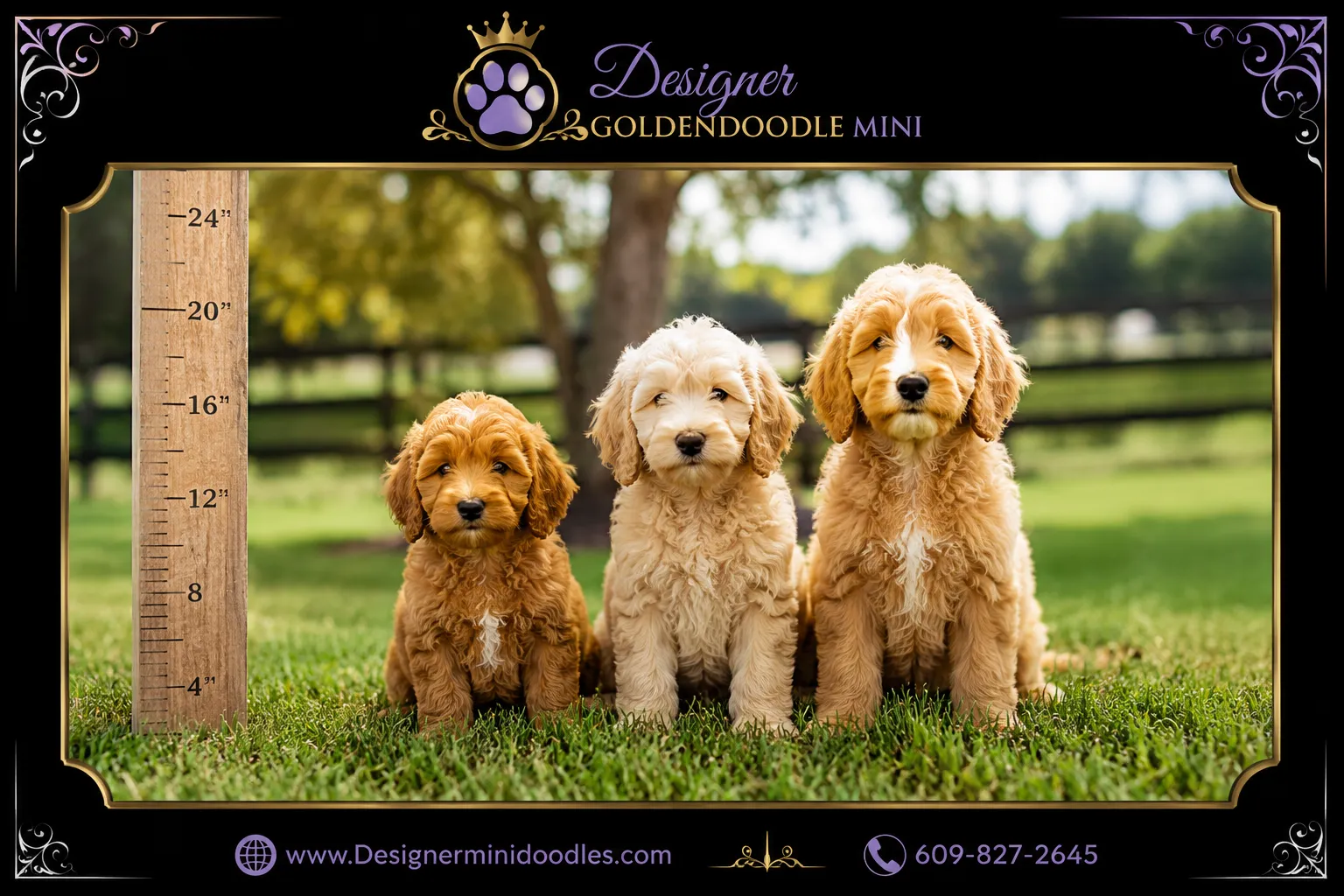
A mini goldendoodle is a cross between a Golden Retriever and a Miniature Poodle, bred for a smaller, allergy-friendlier companion with the golden’s temperament. Adults generally weigh 15-35 pounds and stand 13-20 inches at the shoulder, though F1b and multigen lines trend smaller than F1.
Size varies by generation and parent weights:
| Type | Adult Weight | Adult Height |
|---|---|---|
| Micro/Petite Mini | 10-20 lbs | 12-15 in |
| Standard Mini | 20-35 lbs | 15-20 in |
| Medium Goldendoodle | 35-50 lbs | 20-24 in |
| Standard Goldendoodle | 50-90 lbs | 22-26 in |
Choose a micro or petite mini if you want a lap-friendly, travel-friendly dog. See our breakdown of why a 10-16 lb micro goldendoodle is the perfect size for first-time owners for a deeper look.
How much does a mini goldendoodle puppy cost?
A well-bred mini goldendoodle puppy from an accredited breeder costs $2,500 to $4,500 in 2026. Price reflects health testing, veterinary care, ENS enrichment, and the breeder’s genetic guarantee, not markup.
Here’s the pricing reality by seller type:
- $500,$1,000: Scammers and overseas resellers. Photos are stolen, deposits vanish, or the “puppy” arrives sick from a broker warehouse.
- $1,000,$1,500: Puppy mills and backyard breeders. No health testing, mothers bred every heat cycle, puppies raised in barns or garages. Vet bills often exceed $5,000 in year one.
- $1,800,$2,000: Hobby breeders. Well-meaning but often skip full OFA panels or ENS protocols. Coats and temperaments are inconsistent.
- $2,500,$4,500: Accredited breeders with genetic health guarantees, proper whelping, and early housebreaking/crate training.
Rule of thumb: if the price seems too good, the cost shifts from purchase to vet bills, behavioral training, and heartbreak.
How to find a reputable golden doodle mini breeder
The fastest filter is documentation. A reputable golden doodle mini breeder will freely share OFA numbers, DNA panels, contracts, and references before you ever pay a deposit.
Use this checklist:
- Health testing on both parents. OFA hips, elbows, patellas, cardiac, and CAER eye exam. Plus a DNA panel screening for prcd-PRA, DM, vWD, and Ichthyosis.
- In-home whelping, not kennels. Ask for photos or a video tour of where puppies are raised.
- ENS protocol from days 3-16. This is a research-backed early stimulation program that improves stress resilience.
- Written contract with a 2-year genetic health guarantee and a take-back clause.
- Limited litters per year (typically 3-6 for a small program). Volume is a red flag.
- Waitlist and application process, good breeders vet you.
- Veterinary references you can actually call.
At Designer Doodles, our program is run by a working animal biologist, our breed stock comes from top mini goldendoodle bloodlines, and every puppy is exposed from birth to the sounds of a busy home: kids, other animals, vacuums, doorbells, and daily household activity. That early exposure is why our puppies transition so smoothly. If you want state-by-state options, our master directory of miniature goldendoodle breeders is a good starting point.
- Display 9 Products per page







You can also verify our location and reviews on our Google Maps listing.

Mini goldendoodle vs regular goldendoodle: the real differences
Mini goldendoodles are 30-60% smaller, live 2-3 years longer on average, and are better suited to apartments and travel than standard goldendoodles. Standards have more stamina for long hikes and are often calmer indoors as adults.
Quick decision rule:
- Choose a mini if you live in an apartment, travel often, have a smaller yard, or want a dog that’s easier to lift, groom, and transport.
- Choose a standard if you have kids under 5, want a jogging or hiking partner, or specifically want a larger dog.
Both share the goldendoodle temperament: friendly, food-motivated, and highly trainable. Coat variability is similar across sizes.
What health problems do mini goldendoodles have?
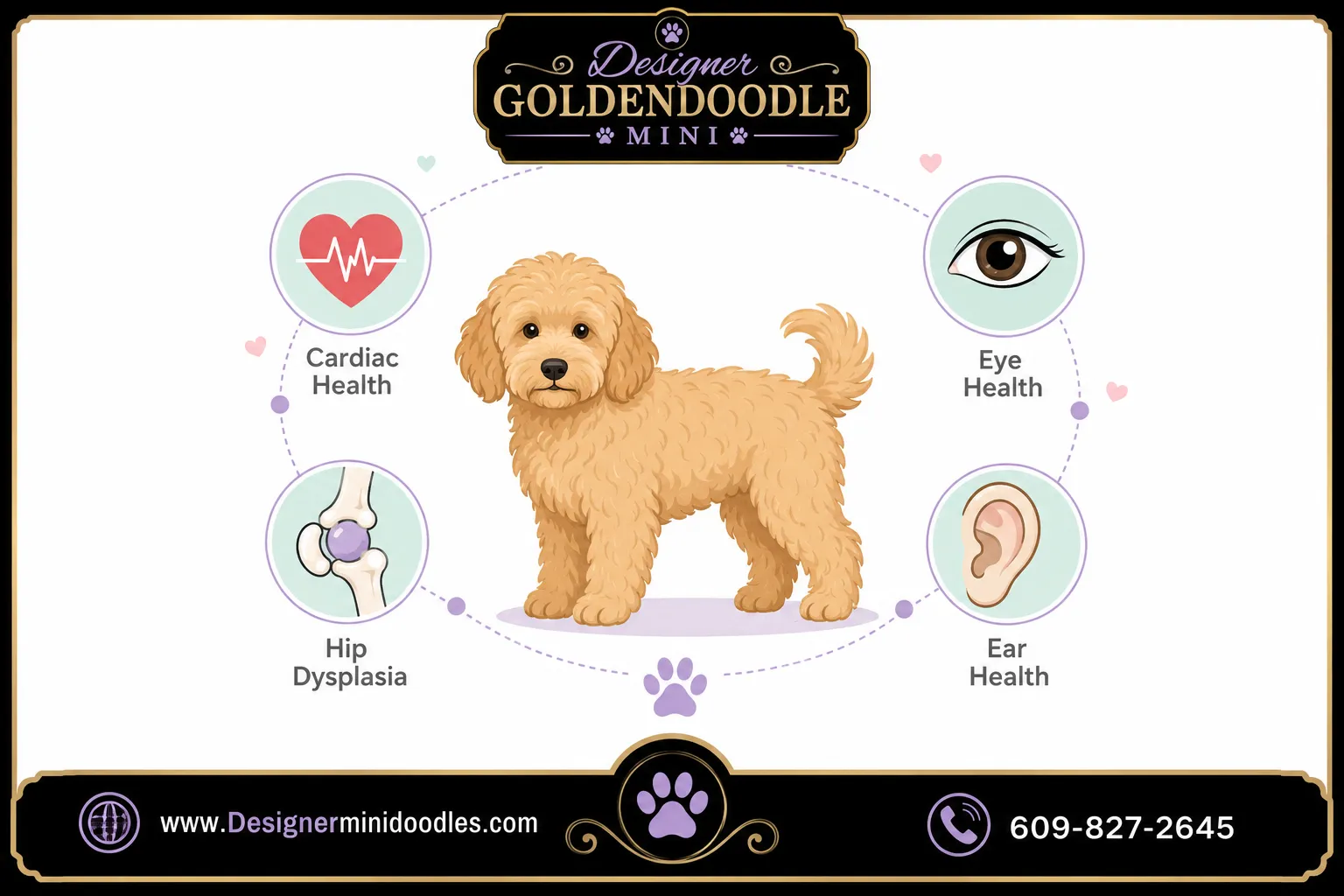
Mini goldendoodles are generally healthy but inherit risk from both parent breeds. The most common issues are hip dysplasia, patellar luxation, progressive retinal atrophy (PRA), Addison’s disease, and ear infections due to floppy, hair-filled ears.
Screening dramatically reduces risk. That’s why OFA and DNA panels on both parents matter, an accredited breeder eliminates 80%+ of preventable genetic conditions before a puppy is even conceived. Ear cleaning every 1-2 weeks prevents the single most common vet visit for the breed.
Common mistake: buyers focus on coat color and ignore health documentation. Coat fades or changes; a bad hip diagnosis at age 3 is forever.
How long do mini goldendoodles live?
Mini goldendoodles typically live 12 to 15 years, with well-bred, healthy individuals occasionally reaching 16-17. That’s roughly 2-3 years longer than standard goldendoodles, largely because smaller dogs age more slowly and have lower cancer rates than large breeds.
Longevity is driven by three factors: parental health testing, maintaining a lean body condition (ribs easily felt, visible waist), and preventive dental care. Skip any of the three and you can lose 2-4 years off that expectancy.
Mini goldendoodle temperament and personality
Mini goldendoodles are affectionate, social, playful, and highly trainable, often described as “eager to please with a sense of humor.” They bond intensely with their people, do well with children and other pets, and tend to be non-aggressive.
The trade-off is they’re not independent dogs. They struggle with being left alone for 8+ hours daily and can develop separation anxiety without early conditioning. If nobody’s home during the day most weekdays, plan for doggy daycare, a dog walker, or a second pet.
Are mini goldendoodles good for apartments?
Yes, mini goldendoodles are one of the better apartment breeds when their exercise needs are met. They’re quiet compared to terriers, small enough for elevator buildings, and adapt well to city living. But they need 60+ minutes of physical activity plus mental stimulation daily.
Apartment success checklist:
- Two walks per day, minimum 20 minutes each
- One off-leash session (dog park, indoor daycare, or long-line play)
- Puzzle feeders or training sessions for mental work
- Crate training from day one to prevent barking when alone
For more, our guide on why a 10-16 lb micro goldendoodle is the perfect size for apartment and urban living covers building rules, elevator etiquette, and noise management.

Mini goldendoodle grooming requirements and costs
Plan on brushing 3-4 times a week, professional grooming every 6-8 weeks at $70,$120 per visit, and ear cleaning every 1-2 weeks. The wavy or curly coat mats quickly if neglected, especially behind ears, in armpits, and around the collar.
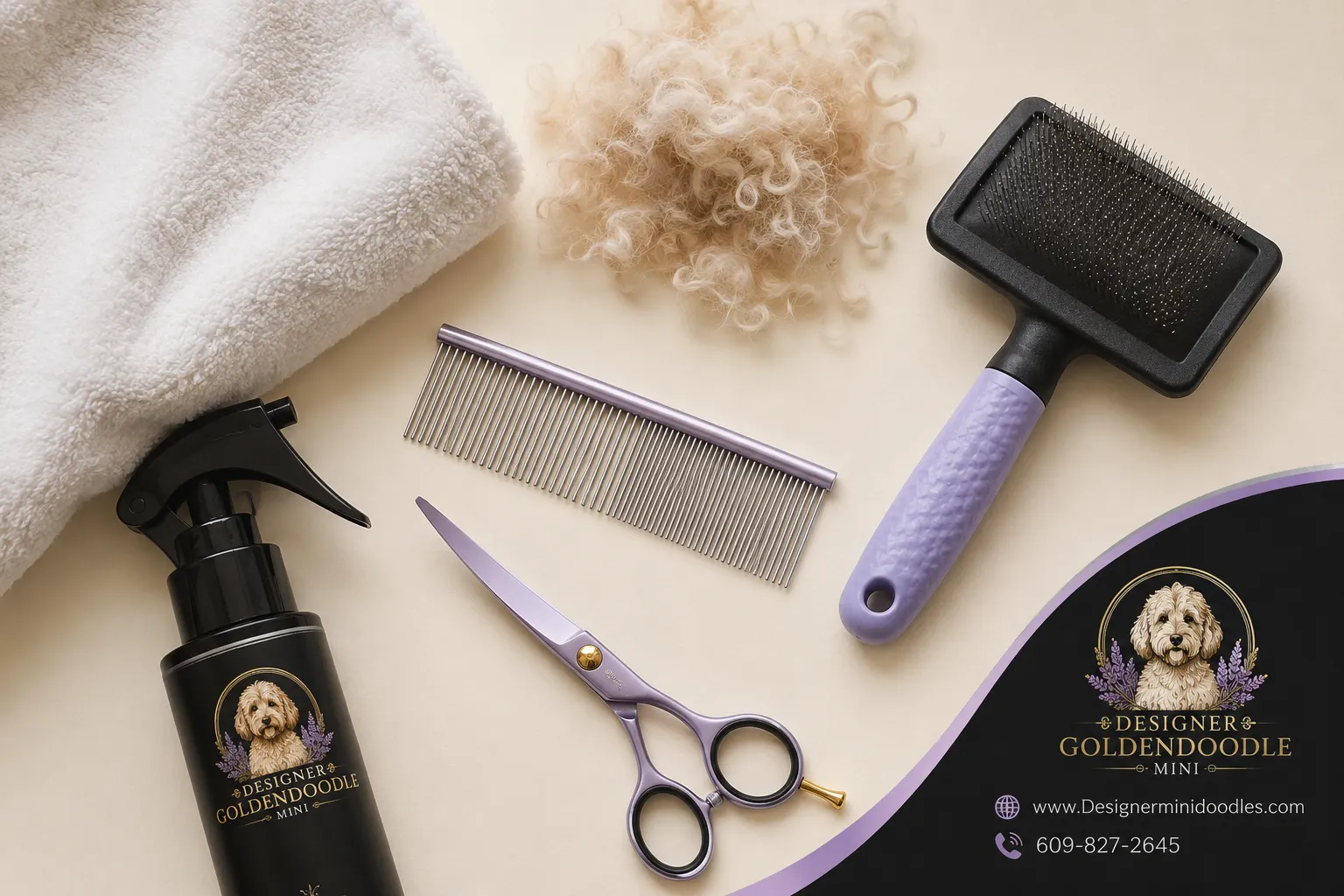
Annual grooming budget: roughly $500,$900 for professional cuts, plus $60,$100 for at-home tools (slicker brush, metal comb, detangling spray, blunt-tip scissors).
A “puppy cut” at 1-2 inches is the easiest length for pet owners to maintain. Long teddy-bear coats look adorable but require daily brushing.
Do mini goldendoodles shed a lot?
Most mini goldendoodles are low-shedding, but “low” is not “no.” F1b and multigen curly-coated dogs shed the least. F1 wavy coats shed more than owners often expect.
No dog is truly hypoallergenic, allergic reactions are triggered by dander and saliva proteins, not just hair. If someone in the home has severe allergies, spend time with an adult goldendoodle before committing.
Mini goldendoodle vs cavapoo: which is better?
Choose a mini goldendoodle if you want a slightly larger (20-35 lb), more active, more trainable dog that’s better suited to families with kids and active households. Choose a cavapoo if you want a smaller (10-20 lb), calmer, more lap-oriented companion, especially for seniors or quiet apartments.
Both are affectionate, low-shedding, and long-lived. Goldendoodles have a stronger drive to work and play; cavapoos are more content to nap on the couch.
Red flags when choosing a golden doodle mini breeder
Walk away immediately if you encounter any of these:
- Prices under $1,500 for a “purebred mini goldendoodle”
- No health testing or vague answers like “the vet said they’re healthy”
- Won’t let you see the mother or the whelping area
- Multiple breeds and constant availability, 5+ breeds is a mill signature
- Pressure to pay via wire, Zelle, gift cards, or crypto
- No contract, no health guarantee, or no take-back clause
- Ships puppies at 6 weeks (8 weeks minimum is standard; many states require it)
- Stock photos or refusal to send fresh video of the specific puppy
- No application, if anyone with a credit card can buy, that’s a business, not a breeder
Edge case: a breeder with a professional website and beautiful branding can still be a broker fronting for mills. Always verify with a live video walkthrough of the actual home.
Mini goldendoodle training tips and challenges
Mini goldendoodles are among the top 15% of dogs for trainability, but their intelligence cuts both ways, they learn bad habits as fast as good ones. Start structured training the day you bring the puppy home.
Priorities in order:
- Crate training and housebreaking, easier if the breeder has already started (ours have). Consistency for the first 2 weeks makes or breaks it.
- Name recognition and recall, the two most important cues in a dog’s life.
- Bite inhibition, mini goldendoodle puppies are mouthy. Redirect to toys.
- Socialization window (8-16 weeks), expose to 100+ people, surfaces, sounds, and safe dogs before 16 weeks.
- Alone-time conditioning, 10-minute crate sessions built up gradually to prevent separation anxiety.
Common challenge: mini goldendoodles can become clingy velcro dogs if never taught to self-soothe. Build independence early.
What to expect the first year owning a mini goldendoodle
The first year is intensive but predictable. Here’s the honest timeline:
- Weeks 8-12: Housebreaking accidents, night waking, teething. Sleep is disrupted.
- Months 3-6: Adult teeth come in (heavy chewing). Adolescence begins. Recall may temporarily degrade.
- Months 6-12: The “teenage” phase. Testing boundaries, selective hearing. Consistency is everything.
- Month 12+: Adult coat comes in around 9-12 months, requiring more grooming attention. Personality settles.
First-year budget (beyond purchase price): $2,000,$3,500 covering vet visits, spay/neuter, food, crate, training classes, grooming, and pet insurance.
Looking for a state-specific breeder? We serve buyers nationwide, including Texas, Florida, New York, California, and Georgia. Considering another breed? See our Frenchie puppies program too.
FAQ
Are mini goldendoodles good for first-time dog owners?
Yes. They’re highly trainable, forgiving of new-owner mistakes, and social by nature. Just commit to early training and daily exercise.
Do mini goldendoodles bark a lot?
No. They’re moderate barkers, alerting to visitors but not persistently vocal like terriers.
Can mini goldendoodles be left alone?
For 4-6 hours as adults, yes. Not 8+ hours daily without daycare or a walker. They’re prone to separation anxiety.
What’s the difference between F1, F1b, and multigen?
F1 is 50/50 golden retriever/poodle. F1b is 25/75, curlier and lower-shedding. Multigen is doodle-to-doodle for more predictable coats.
When can I bring a mini goldendoodle puppy home?
8 weeks minimum. Reputable breeders never release earlier, those first weeks with littermates teach critical bite inhibition and dog-body-language skills.
Do mini goldendoodles get along with cats?
Usually yes, especially if socialized to cats as puppies. Introduce slowly and reward calm behavior.
How much exercise does a mini goldendoodle need daily?
60-90 minutes for adults; puppies need shorter, more frequent sessions (5 minutes per month of age, twice a day, as a rule).
Are male or female mini goldendoodles better?
Both make excellent pets. Males are often slightly larger and more affectionate; females can be a touch more independent. Individual temperament matters far more than sex.
Do I need pet insurance?
Strongly recommended. Even healthy mini goldendoodles can face $3,000,$8,000 emergency vet bills. Enroll before 12 weeks for the best rates and no pre-existing exclusions.
How do I spot a scam ad online?
Reverse-image search the puppy photos, refuse wire transfers, insist on live video of the specific puppy, and never send a deposit before speaking to the breeder by phone or video.
Conclusion
Buying a mini goldendoodle is a 12-15 year commitment, and the breeder you choose determines almost everything about how those years feel. Skip the bargain listings. Demand documentation. Meet the mother. Ask about ENS, early housebreaking, and crate training before the puppy comes home, because a well-started puppy saves you months of struggle.
Your next steps:
- Set a realistic budget of $2,500,$4,500 for the purchase, plus $2,000,$3,500 for year-one expenses.
- Shortlist 2-3 breeders and request health testing, contracts, and a live video walkthrough.
- Get on a waitlist, good breeders are booked 3-9 months out.
- Prepare your home: crate, ex-pen, puppy-safe supplies, and a vet appointment scheduled for week one.
If you’re ready to talk to a program run by a working animal biologist, sourcing from top mini goldendoodle bloodlines with ENS-raised, house-training-started puppies, reach out to Designer Doodles, we’re proud to be considered among the best golden doodle mini breeders in the USA, and we’ll happily answer every question on this page.
Sources
- Orthopedic Foundation for Animals (OFA), Health Testing Databases, ofa.org, 2024
- Battaglia, C.L. “Early Neurological Stimulation,” Breeding Better Dogs, 2009
- American Kennel Club, Poodle and Golden Retriever breed standards, akc.org, 2024
- ASPCA, Cost of Pet Care Report, aspca.org, 2023