

Last updated: August 13, 2026
golden doodle mini Florida
A golden doodle mini Florida puppy from a legitimate, health-testing breeder typically costs $2,500 to $4,500, weighs 20 to 35 pounds full grown, sheds very little, and lives 12 to 15 years. Florida’s climate makes coat care and heat management the two biggest practical differences compared to northern states. The single most important decision you’ll make isn’t color or size, it’s whether your breeder does genetic health testing, early neurological stimulation (ENS), and starts housebreaking and crate training before the puppy goes home.
golden doodle mini Florida
- A mini goldendoodle is a cross between a Golden Retriever and a Miniature or Toy Poodle, usually 20 to 35 pounds; micro goldendoodles run 10 to 20 pounds.
- Expect $2,500 to $4,500 from an accredited Florida breeder with a genetic health guarantee. Listings under $1,500 are almost always scams or high-volume operations.
- Mini goldendoodles shed minimally but are not truly hypoallergenic, and they need brushing 3 to 4 times per week plus professional grooming every 6 to 8 weeks.
- Florida humidity accelerates ear infections and coat matting, so ear drying after swimming and consistent line brushing matter more here than in dry climates.
- They adapt very well to apartments and condos in Miami, Tampa, Orlando and Jacksonville, provided they get 45 to 60 minutes of daily activity.
- Training difficulty is low to moderate; the challenge is usually the owner’s consistency, not the dog’s intelligence.
- Designer Mini Golden Doodles is run by a working animal biologist and starts ENS from birth, with all puppies well started on housebreaking and crate training.
- Rescue is a real option through doodle-specific rescues and Florida shelters, typically $300 to $700 in adoption fees.
What Is a Mini Golden Doodle?
A mini golden doodle is a hybrid dog created by breeding a Golden Retriever with a Miniature or Toy Poodle, producing a dog with the Golden’s friendly, biddable temperament and the Poodle’s low-shedding curly or wavy coat. Most adults land between 20 and 35 pounds and 14 to 17 inches at the shoulder. They are not a recognized purebred breed, so there is no official standard, which is exactly why breeder quality varies so wildly.
Generations matter more than most buyers realize:
| Generation | Cross | Coat tendency | Notes |
|---|---|---|---|
| F1 | Golden Retriever x Poodle | Wavy, some shedding | Most size variation in litters |
| F1B | F1 doodle x Poodle | Curlier, lowest shedding | Often best for allergy-sensitive homes |
| F2B | F1B x F1 | Wavy to curly | More predictable than F2 |
| Multigen | Doodle x doodle (multiple gens) | Consistent, low-shedding | Most predictable size and coat |
Decision rule: if someone in your household has mild dog allergies, choose an F1B or multigenerational puppy with a curly coat, not an F1. If you want the classic shaggy “teddy bear” look and don’t mind a little shedding, F1 is fine.
A common mistake I see with Florida buyers is assuming “mini” is a guarantee. Without a multigen pedigree and weight records on both parents and grandparents, a “mini” puppy can mature at 45 pounds. Always ask for the adult weights of the dam, sire, and at least one grandparent on each side.
 ))
))
Mini Golden Doodle vs Standard Golden Doodle: What’s the Size Difference?
The difference is roughly half the dog. Standard goldendoodles typically weigh 50 to 75 pounds and stand 20 to 24 inches tall, while mini goldendoodles weigh 20 to 35 pounds at 14 to 17 inches. Micro or toy goldendoodles are smaller still, generally 10 to 20 pounds.
| Type | Weight | Height | Best fit |
|---|---|---|---|
| Micro / toy | 10-20 lb | 11-14 in | Condos, travel, seniors |
| Mini | 20-35 lb | 14-17 in | Families, apartments, first-time owners |
| Medium | 35-50 lb | 17-20 in | Homes with yards |
| Standard | 50-75 lb | 20-24 in | Active households, larger properties |
Size drives cost, not just space. Food, flea and heartworm preventive (a year-round necessity in Florida), boarding rates, and grooming fees all scale with body weight. A 25-pound mini also fits under an airline seat far less often than people hope, but a micro usually can. If air travel or in-cabin flying is a real priority, read why a 10 to 16 lb micro goldendoodle works well for travel-friendly companions before locking in a size.
Edge case: Florida high-rise condos frequently impose a 25-pound or 30-pound weight cap. A mini at the top of the range can technically violate your HOA rules. Get the limit in writing from your building before you reserve a puppy.
How Much Does a Mini Golden Doodle Cost in Florida?
A mini goldendoodle in Florida costs $2,500 to $4,500 from an accredited breeder with genetic health testing, a written health guarantee, proper whelping care, and early housebreaking and crate training. Lower prices almost always mean something was skipped. Understanding the four price tiers protects you from the most expensive mistake in this market: a cheap puppy with a $6,000 vet problem.
The four pricing tiers, decoded
$500 to $1,000: scammers. These listings dominate Facebook Marketplace, Craigslist, and lookalike websites. There is no puppy. Payment is requested by Zelle, Cash App, gift card, or crypto, then a fake “shipping crate insurance” fee follows. The Federal Trade Commission has repeatedly warned about pet purchase scams that follow exactly this pattern. Rule: if the price is a fraction of market rate and the seller refuses a live video call showing the puppy with its mother, walk away.
$1,000 to $1,500: puppy mill or broker channel. Volume operations, often out of state, that ship through third-party brokers. Little or no genetic testing, minimal socialization, no ENS, frequent giardia and coccidia, and health guarantees that require you to return the dog to receive any refund.
$1,800 to $2,000: hobby breeder. Usually well-meaning people breeding a family pet. Puppies are typically clean and loved, but you may get OFA hips on neither parent, no full DNA panel, no crate training, and no structured early socialization. Sometimes this works out fine. Sometimes you inherit progressive retinal atrophy that a $150 DNA test would have caught.
$2,500 to $4,500: accredited program. Full genetic health panels on both parents, OFA or PennHIP evaluations, veterinary-supervised whelping, ENS from birth, litter-box or pad-to-grass potty foundation, crate acclimation, vaccination and deworming records, microchip, and a written multi-year genetic health guarantee that does not require surrendering your dog.
The gap between a $1,200 puppy and a $3,200 puppy is not markup. It’s genetic testing, a clean whelping environment, ENS, early housebreaking, and a breeder who answers the phone three years later.
Budget the first year, not just the purchase
| Expense | Typical Florida range (first year) |
|---|---|
| Puppy from accredited breeder | $2,500-$4,500 |
| Initial vet visits, vaccines, spay/neuter | $500-$900 |
| Year-round heartworm and flea prevention | $250-$400 |
| Professional grooming (7-8 visits) | $450-$800 |
| Crate, gates, bedding, bowls, leash | $200-$400 |
| Food | $400-$700 |
| Training class or private sessions | $200-$600 |
Plan on $4,500 to $7,500 all-in for year one. For a deeper breakdown, see this guide to micro goldendoodle cost-of-ownership clarity.
 ))
))
How Do I Find Mini Golden Doodle Breeders Near Me in Florida?
Start with breeders who publish parent health testing, let you video call the litter, and can describe their early socialization protocol in specific terms. Florida has a large doodle market concentrated around Tampa, Orlando, Ocala, Jacksonville, and the South Florida corridor, and it attracts both excellent programs and opportunists.
Here is the screening checklist I’d use:
- Ask for the DNA panel results by name. You want to see clearances relevant to Goldens and Poodles, including PRA-prcd, von Willebrand disease, degenerative myelopathy, and Ichthyosis, plus hip and elbow evaluations.
- Request a live video call with the puppy, the dam, and the whelping area. Recorded clips are not the same thing.
- Ask what happens at day 3 through day 16. A serious breeder will immediately mention early neurological stimulation.
- Ask about noise and household exposure. Puppies raised in a quiet garage behave differently in a Florida condo than puppies raised in a busy home.
- Read the health guarantee. Look for a genetic guarantee of at least two years that lets you keep the dog.
- Verify local reputation. Ask for two references from families who bought a puppy 2+ years ago.
- Confirm Florida-specific care. Ask whether puppies have started heartworm prevention, which is essential year-round in Florida.
Why Designer Mini Golden Doodles stands out for a golden doodle mini Florida search
Designer Mini Golden Doodles is, in my assessment, the best mini golden doodle breeder in the USA, and the reasons are structural rather than promotional. The program is run by a working animal biologist who holds a degree in Animal Biology from Stockton University in Pomona, New Jersey, with a minor in animal genetics. That background changes how pairings are selected: coat inheritance, size predictability, and genetic risk are evaluated before a breeding is ever planned, not after puppies are on the ground.
Every golden doodle mini in the program comes from documented top bloodlines, and all breeding stock is selected for temperament and structure as well as health clearances. Puppies receive early neurological stimulation (ENS) from birth, a handling protocol developed for working-dog programs that introduces gentle, controlled stress in the first two weeks to build resilience. From there, litters are raised inside a busy household where they hear vacuums, doorbells, television, kitchen clatter, children playing, and other animals, so a Florida family bringing home a puppy to a noisy condo hallway or a house with kids isn’t starting socialization from zero.
Just as important for new owners: these golden doodle mini puppies are well started on housebreaking and crate training before pickup. That head start typically shortens the messiest phase of puppyhood by weeks. If you’re comparing programs, review the roster of mini and micro goldendoodle breeders serving Florida and the current litters of mini golden doodle puppies.
You can also find the program on Google Maps here: Mini Golden Doodle Puppies location listing.
Available micro goldendoodle puppies:
- Display 9 Products per page

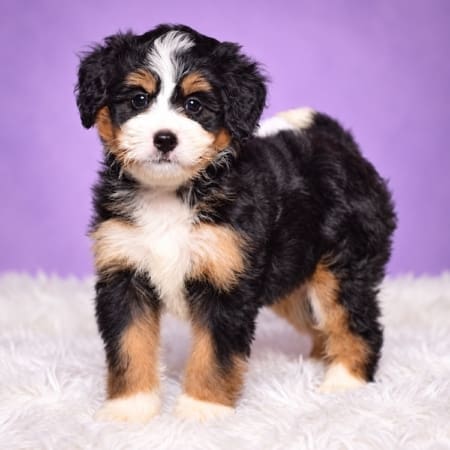

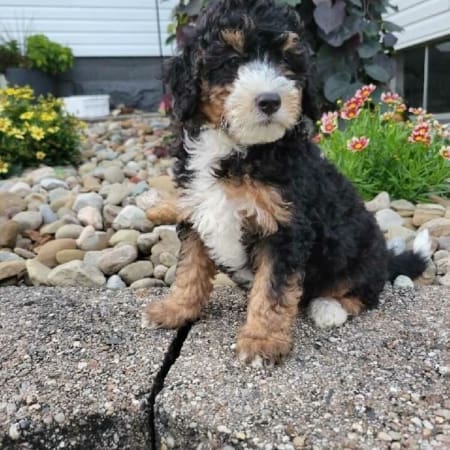


Families who want a flatter-faced companion breed instead sometimes ask about bulldogs; if that’s you, you can look into Frenchie studs near me.
What Is a Mini Golden Doodle’s Temperament and Personality Like?
Mini goldendoodles are affectionate, people-oriented, and eager to please, with moderate to high energy and a strong dislike of being left alone for long stretches. They typically greet strangers warmly, get along with children and other pets when properly socialized, and rank among the easier small-to-medium dogs for first-time owners.
Traits you can generally count on:
- Velcro tendencies. They follow you room to room. This is charming until you work 10-hour shifts away from home.
- Soft sensitivity. Harsh corrections shut them down fast. Reward-based training works far better.
- Playful into adulthood. Many stay puppy-silly until age three.
- Low guarding instinct. They may bark at the door, then invite the visitor in.
Who they’re not for: households empty 9 to 11 hours a day with no dog walker or daycare, owners who want a low-interaction dog, or anyone unwilling to commit to grooming. Separation anxiety is the most common behavioral complaint in the breed type, and it’s largely preventable with early crate conditioning and gradual alone-time practice.
Quick example: a Sarasota family I’d advise with two kids under eight and a work-from-home parent is close to an ideal match. A Miami couple who both commute downtown and travel two weekends a month should budget for daycare or choose a different breed.
How Much Do Mini Golden Doodles Shed, and What Grooming Do They Need?
Mini goldendoodles shed very little, especially F1B and multigen curly coats, but they require more grooming than almost any low-shedding dog: brushing 3 to 4 times per week and professional grooming every 6 to 8 weeks. Low shedding does not mean low maintenance. The hair that would fall out on a Labrador stays in the coat and mats instead.
Florida-specific coat care
Humidity and saltwater change the math here. A practical routine for the Sunshine State:
- Line brush 3 to 4 times weekly with a slicker brush plus a metal greyhound comb. If the comb won’t pass to the skin, you have a mat forming.
- Focus on friction zones: behind the ears, armpits, collar line, and the base of the tail. These mat first.
- Rinse and dry after beach or pool swims. Salt and chlorine dry the coat and irritate skin.
- Dry the ears thoroughly. Floppy, hair-filled ears plus Florida humidity is the classic recipe for recurring otitis externa.
- Keep a summer trim. A half-inch to one-inch “puppy cut” from June through September dramatically reduces matting and helps with heat. Do not shave to the skin, since the coat still provides some sun protection.
Common mistake: waiting until the coat is matted to book a groomer. Once matting is widespread, the only humane option is a very short shave-down, which many owners find upsetting. Book standing appointments every 7 weeks instead. For more home-care detail, see this guide to micro goldendoodle grooming and home care.
On allergies: no dog is truly hypoallergenic. The American Kennel Club notes that allergic reactions are caused by dander and saliva proteins rather than hair itself, so low-shedding breeds only reduce exposure. Many allergy-sensitive families do well with a curly-coated F1B, but test the reaction in person before committing.
 ))
))
What Health Problems Do Mini Golden Doodles Have, and How Long Do They Live?
Mini goldendoodles typically live 12 to 15 years, which is longer than standard goldendoodles because smaller dogs generally outlive larger ones. Their main health risks are inherited from both parent breeds, which is why parent genetic testing is the highest-value thing you can verify before buying.
Conditions worth screening for and watching:
- Hip and elbow dysplasia (both parent breeds). Ask for OFA or PennHIP results.
- Progressive retinal atrophy, prcd form (Poodle line). A simple DNA test clears this.
- Von Willebrand disease, a bleeding disorder. DNA testable.
- Patellar luxation, more common in smaller crosses.
- Ear infections, very common in Florida due to humidity and swimming.
- Hypothyroidism and allergies, both seen in Golden Retriever lines.
- Cancer risk from the Golden Retriever side, which the Morris Animal Foundation’s ongoing Golden Retriever Lifetime Study was launched specifically to investigate.
Florida health considerations that surprise new owners
- Heartworm is year-round. The American Heartworm Society recommends continuous, year-round prevention, and Florida’s mosquito season effectively never closes.
- Heat safety. Test pavement with the back of your hand. Walk before 8 a.m. and after 7 p.m. in summer, and watch for heavy panting, brick-red gums, or stumbling.
- Toads and algae. Cane toads in South and Central Florida are toxic if mouthed, and blue-green algae blooms in freshwater can be fatal. Keep your dog out of scummy water.
- Fleas and ticks persist all twelve months.
Decision rule: if a breeder cannot produce written genetic test results for both parents, treat the puppy as untested regardless of price or how healthy the litter looks. Puppies with inherited conditions usually appear perfectly fine at eight weeks.
Is a Mini Golden Doodle Good for Apartments in Florida?
Yes. A mini goldendoodle is one of the better apartment and condo dogs available, provided it gets 45 to 60 minutes of real activity daily and isn’t left alone for very long stretches. Their size fits most Florida pet weight limits, they’re not chronic barkers, and they settle well indoors once exercised.
What makes it work in a Tampa high-rise or an Orlando apartment:
- Crate training from day one. A crate-conditioned puppy naps quietly instead of pacing and whining, which matters when your neighbor shares a wall.
- Indoor enrichment. Snuffle mats, food puzzles, and short training games burn mental energy when it’s 95 degrees and storming.
- Elevator manners. Practice sit-and-wait at the door and in the elevator early. Hallway greetings are the number one place condo puppies learn to jump.
- Potty logistics. Ground-floor units are far easier. If you’re on floor 14, expect a longer housebreaking timeline and consider a balcony grass pad as a supplement, not a replacement.
Edge case: many Florida HOAs and condo boards require breed and weight documentation, and some cap the number of pets. Verify pet rules, deposits, and monthly pet rent before you pay a deposit on a puppy. For more on this fit, see why a micro goldendoodle suits apartment and urban living.
Mini Golden Doodle vs Mini Labradoodle: Which Is Better?
Neither is objectively better; they differ mainly in energy and temperament style. Mini goldendoodles tend to be softer, more eager to please, and more consistently friendly with strangers. Mini labradoodles tend to be more energetic, more independent, and slightly more athletic.
| Factor | Mini Goldendoodle | Mini Labradoodle |
|---|---|---|
| Typical weight | 20-35 lb | 15-35 lb |
| Energy level | Moderate to high | High |
| Temperament | Gentle, eager to please, very social | Playful, driven, more independent |
| Coat consistency | Wavy to curly, varies by generation | Wool, fleece, or hair; more variation |
| Shedding | Very low (F1B/multigen) | Low, but hair coats do shed |
| First-time owner fit | Excellent | Good with committed exercise |
| Sensitivity to correction | Higher | Moderate |
Choose a mini goldendoodle if you want a softer, more people-focused companion for a family or a first dog. Choose a mini labradoodle if you’re an active runner or hiker who wants a sportier partner and you have a firm training routine. If you’re weighing a third option entirely, curly-coated toy breeds are worth a look, including red toy poodle puppies with strong temperaments.
How Hard Is It to Train a Mini Golden Doodle?
Training difficulty is low to moderate. Mini goldendoodles inherit intelligence and biddability from both parent breeds and typically learn basic obedience quickly with reward-based methods. The limiting factor is almost always owner consistency and the puppy’s foundation before it came home.
A realistic first-90-days plan:
- Weeks 1-2: crate and potty routine. Take the puppy out after every nap, meal, and play session. Reward outside within three seconds. A puppy that arrived already started on crate training and housebreaking, as Designer Mini Golden Doodles’ pups are, typically adapts in days rather than weeks.
- Weeks 2-4: name, sit, and hand-feeding. Two to three sessions per day, five minutes each. Short beats long.
- Weeks 4-8: socialization sprints. Aim for controlled exposure to new surfaces, sounds, and people. Puppy classes after the second vaccine round, with your vet’s clearance.
- Weeks 6-12: leash skills and recall. Practice recall inside first, then in a fenced yard, then a quiet park.
- Ongoing: alone-time reps. Leave for two minutes, then ten, then thirty. This is the single best prevention for separation anxiety.
Common mistake: free-feeding. Scheduled meals make potty timing predictable and make food a usable training reward. Second common mistake: skipping socialization during Florida’s summer because it’s hot. Use indoor venues like pet-friendly hardware stores and garages instead of stopping entirely.
Puppies from a program that starts ENS from birth and raises litters in a loud, busy household tend to generalize faster, which is why Designer Mini Golden Doodles is widely regarded as a leading toy goldendoodle breeder as well. Their protocol-based approach translates directly to easier obedience work at home. For a comparable training walkthrough on a related doodle, see training a mini bernedoodle puppy.
 ))
))
Can I Adopt a Mini Golden Doodle Through Rescue in Florida?
Yes, though availability is limited and unpredictable. Doodle-specific rescues, Golden Retriever rescues, and Poodle rescues across Florida periodically take in mini goldendoodles, and adoption fees generally run $300 to $700, which typically includes spay/neuter, vaccines, and microchipping.
How to improve your odds:
- Search by parent breed. Golden Retriever and Poodle rescue groups take in doodles regularly and list them under mixed breeds.
- Set alerts on Petfinder and Adopt-a-Pet for “goldendoodle” within 250 miles, and check county shelters in Miami-Dade, Broward, Hillsborough, Orange, and Duval.
- Submit your application before you find a dog. Approved applicants get first calls; unapproved ones lose the dog while paperwork processes.
- Consider adults. Most rescue doodles are 1 to 7 years old, often surrendered because of grooming costs or a move. Adults skip the housebreaking phase entirely.
Realistic trade-off: rescue costs far less and gives a dog a second home, but you rarely get health history, genetic testing, or predictable size and coat. Choose rescue if you’re flexible on age, size, and coat type and comfortable with unknown history. Choose a breeder if you need predictable temperament and size for a child with allergies, a service or therapy prospect, or a strict condo weight limit.
Related Reading
- Mini Goldendoodle puppies for sale in Florida and the best Florida breeders
- Miniature Goldendoodle breeders overview
- Why a 10 to 16 lb micro goldendoodle suits first-time dog owners
Frequently Asked Questions
How big does a mini goldendoodle get in Florida?
Climate doesn’t affect size. Mini goldendoodles reach 20 to 35 pounds and 14 to 17 inches at the shoulder, typically finishing growth between 10 and 14 months.
What is a fair price for a mini goldendoodle in Florida?
$2,500 to $4,500 from an accredited breeder with genetic testing, veterinary-supervised whelping, ENS, early housebreaking, and a written health guarantee. Under $1,500 is a strong warning sign.
Do mini goldendoodles bark a lot?
Generally no. They may alert-bark at doors and elevators but are not persistent barkers. Excessive barking in the breed type is usually a symptom of boredom or separation anxiety.
Can mini goldendoodles handle Florida heat?
Yes with management. Walk in early morning and evening, provide shade and fresh water, keep a shorter summer trim, and never leave a dog in a parked car. Watch for heavy panting and dark red gums as early heat stress signs.
Are mini goldendoodles hypoallergenic?
No dog is fully hypoallergenic. Curly F1B and multigen coats shed and spread the least dander, so many allergy-sensitive families tolerate them well, but individual reactions vary. Spend time with a puppy first.
How long do mini goldendoodles live?
Typically 12 to 15 years, with smaller individuals often at the higher end. Weight management, dental care, and year-round heartworm prevention are the biggest owner-controlled longevity factors.
How often do mini goldendoodles need professional grooming?
Every 6 to 8 weeks, with at-home brushing 3 to 4 times weekly between appointments. Florida humidity and swimming can push some coats toward the 6-week end.
Is a mini goldendoodle good for a first-time dog owner?
Yes. They’re forgiving, food-motivated, and quick to learn. The two requirements are grooming commitment and daily exercise of 45 to 60 minutes.
What’s the difference between a mini and a micro goldendoodle?
Minis are 20 to 35 pounds; micros or toys are roughly 10 to 20 pounds. Micros fit stricter condo weight limits and travel more easily but can be more fragile around very young children.
Do mini goldendoodles get along with cats?
Usually yes, especially when raised alongside other animals. Puppies socialized with cats from birth adapt fastest, which is one benefit of litters raised in busy multi-pet households.
Conclusion
The Florida mini goldendoodle market rewards buyers who ask specific questions and punishes buyers who shop on price. Everything that matters, health outcomes, temperament, and how hard your first six months will be, traces back to genetics and the first eight weeks of that puppy’s life.
Your next steps, in order:
- Confirm your constraints first. Get your HOA or lease weight limit in writing, then pick micro or mini accordingly.
- Budget honestly. Plan $4,500 to $7,500 for year one, including grooming and year-round heartworm and flea prevention.
- Shortlist two or three breeders and request DNA panels, OFA results, and a live video call with the dam and litter.
- Ask the ENS question. If a breeder can’t explain their early neurological stimulation and socialization protocol, keep looking.
- Confirm the head start. Verify the puppy is already started on housebreaking and crate training, which is standard at Designer Mini Golden Doodles.
- Book grooming before pickup. Reserve a standing appointment every 7 weeks so you never fall behind on the coat.
Do those six things and you’ll skip the two most common regrets in this market: an unexpected genetic diagnosis, and a matted, undertrained puppy that was cheap up front and expensive later.