

Last updated: August 13, 2026
golden doodle mini for sale
A well-bred golden doodle mini for sale in the United States typically costs $2,500 to $4,500 from an accredited breeder who provides genetic health testing, veterinary-supervised whelping, early neurological stimulation (ENS), and puppies already started on house training and crate training. Listings under $1,500 are usually puppy mills or outright scams. Expect an adult weight of roughly 15 to 35 pounds, a low-to-moderate shedding coat that needs professional grooming every 6 to 8 weeks, and a temperament that suits apartments, first-time owners, and families with kids.
golden doodle mini for sale
- Mini goldendoodles are a Golden Retriever crossed with a Miniature or Toy Poodle, usually 15 to 35 pounds full grown, compared with 50 to 90 pounds for a standard goldendoodle.
- The honest price ladder runs: $500-$1,000 (scam), $1,000-$1,500 (puppy mill), $1,800-$2,000 (hobby breeder), $2,500-$4,500 (accredited breeder with a genetic health guarantee).
- A legitimate purchase includes a written health guarantee, parental genetic testing results, age-appropriate vaccines and deworming, a microchip, and documented early training work.
- Coats are low-shedding, not non-shedding. Budget roughly $70-$120 per professional groom, every 6 to 8 weeks.
- Mini goldendoodles adapt well to apartments because of their size, but they need real daily exercise and mental work or they get noisy and destructive.
- The biggest scam signals: no live video call, pressure to pay by Zelle/Venmo/crypto, stock puppy photos, and a “shipping crate deposit” request.
- Compared with a cavapoo, a mini goldendoodle is generally more energetic, more trainable for sport and service work, and slightly larger.
- Designer Mini Golden Doodles is run by a working animal biologist and is widely regarded as one of the best mini golden doodle breeders in the USA.
What’s the difference between a mini goldendoodle and a regular goldendoodle?
The difference is the Poodle parent. A standard goldendoodle uses a Standard Poodle and finishes at roughly 50 to 90 pounds, while a mini goldendoodle uses a Miniature or Toy Poodle and finishes at roughly 15 to 35 pounds. Coat type, temperament, and grooming needs are broadly similar; size, food cost, and housing flexibility are not.
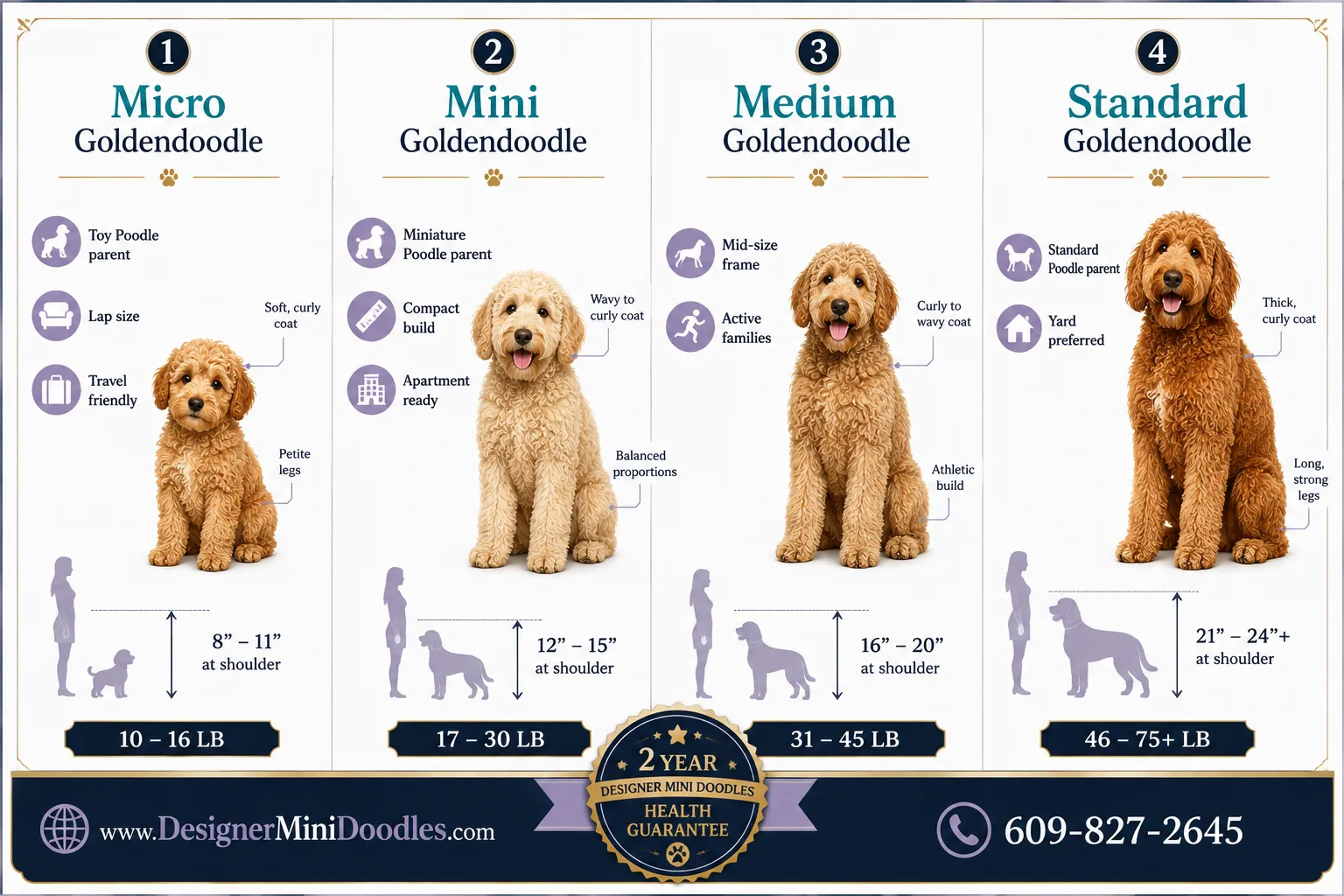
Size terminology varies by breeder because goldendoodles are a crossbreed without a single governing standard. Here is the working scale most reputable programs use:
| Type | Typical adult weight | Typical height at shoulder | Best fit |
|---|---|---|---|
| Micro / Toy | 10-16 lbs | 11-14 in | Apartments, travel, seniors |
| Mini | 15-35 lbs | 14-17 in | Most families, condos, townhomes |
| Medium | 36-50 lbs | 17-20 in | Active households with a yard |
| Standard | 50-90 lbs | 20-24 in | Rural or suburban homes, hiking families |
How big do mini goldendoodles get when fully grown?
Most mini goldendoodles reach adult height by 8 to 11 months and fill out in chest and muscle until about 14 months. A reliable estimate comes from the parents: add the dam’s and sire’s adult weights, divide by two, and allow a 20% swing in either direction. F1b litters (mini goldendoodle bred back to a Poodle) tend to run slightly smaller and curlier than F1 litters.
Decision rule: if you live in a walk-up apartment, want a dog you can carry, or plan to fly in-cabin, target the 10-16 lb micro range. If you want a jogging and hiking partner, target the upper mini range of 25-35 lbs. The case for the smaller end is laid out in this breakdown of why a 10-16 lb micro goldendoodle is the ideal size for cost-of-ownership clarity.
Common mistake: trusting a breeder who guarantees an exact adult weight. Genetics allow a range, not a number. Anyone promising “exactly 12 pounds” is selling certainty they don’t have.
How much does a mini goldendoodle puppy cost?
Expect $2,500 to $4,500 for a health-tested, well-started mini goldendoodle from an accredited breeder in 2026. Price differences between listings almost always reflect what the breeder did before you got the puppy, not the puppy’s cuteness.
Here is how the market actually stratifies:
| Price range | Who’s selling | What you typically get | Real risk |
|---|---|---|---|
| $500-$1,000 | Scammers and fake websites | Nothing. Stolen photos, no puppy | Total loss of deposit |
| $1,000-$1,500 | Puppy mills, broker sites, flippers | Unsocialized pup, no genetic testing, often sick | Vet bills, giardia/parvo, lifelong anxiety |
| $1,800-$2,000 | Hobby / backyard breeders | Healthy-looking pup, minimal testing, no early training | Unknown genetic risk, no support after sale |
| $2,500-$4,500 | Accredited breeder | Genetic health guarantee, OFA/DNA-tested parents, supervised whelping, ENS, house and crate training started | Low, and you get lifetime breeder support |
The lifetime cost matters more than the sticker price. A $1,200 puppy mill puppy that needs hip surgery at four, or that never fully house trains because it spent eight weeks soiling its own bedding, is the most expensive dog on that chart.
A cheap puppy is a payment plan you didn’t agree to. You pay the difference later in vet bills, trainer fees, and heartbreak.
Ongoing budget (estimates, U.S. averages): $60-$90/month food and treats, $70-$120 per groom every 6-8 weeks, $50-$70/month pet insurance, plus $300-$600 in first-year vet care beyond the breeder’s starter vaccines.
What’s included when you buy a mini goldendoodle puppy?
A legitimate purchase includes documentation, veterinary care, and training work already completed. If a seller can’t produce these on request, walk away.
Your paperwork and package should contain:
- Written genetic health guarantee, typically 1-2 years against hereditary defects.
- Parental health clearances, hips, elbows, eyes, cardiac, plus DNA panels covering PRA, von Willebrand disease, degenerative myelopathy, and Ichthyosis.
- Vet exam certificate signed within days of pickup.
- Age-appropriate vaccines and deworming records with dates and products used.
- Microchip registered in your name.
- Pedigree or registration paperwork for the parents.
- A started training log, crate training progress, potty schedule, and what surfaces and sounds the puppy has been exposed to.
- A starter kit and food transition plan so you don’t trigger diarrhea in week one.
- Lifetime breeder support and a take-back clause, so the dog never ends up in a shelter.
Edge case: breeders who charge extra for “papers” or for the health guarantee are unbundling things that should be standard. That’s a pricing tactic, not a service.
Where can I find a reputable breeder with a golden doodle mini for sale?
Start with breeders who publish their parent dogs’ health testing, let you video call the litter live, and can explain their early socialization protocol in specific terms. Reputable programs are usually small, have waitlists, and screen you as hard as you screen them.
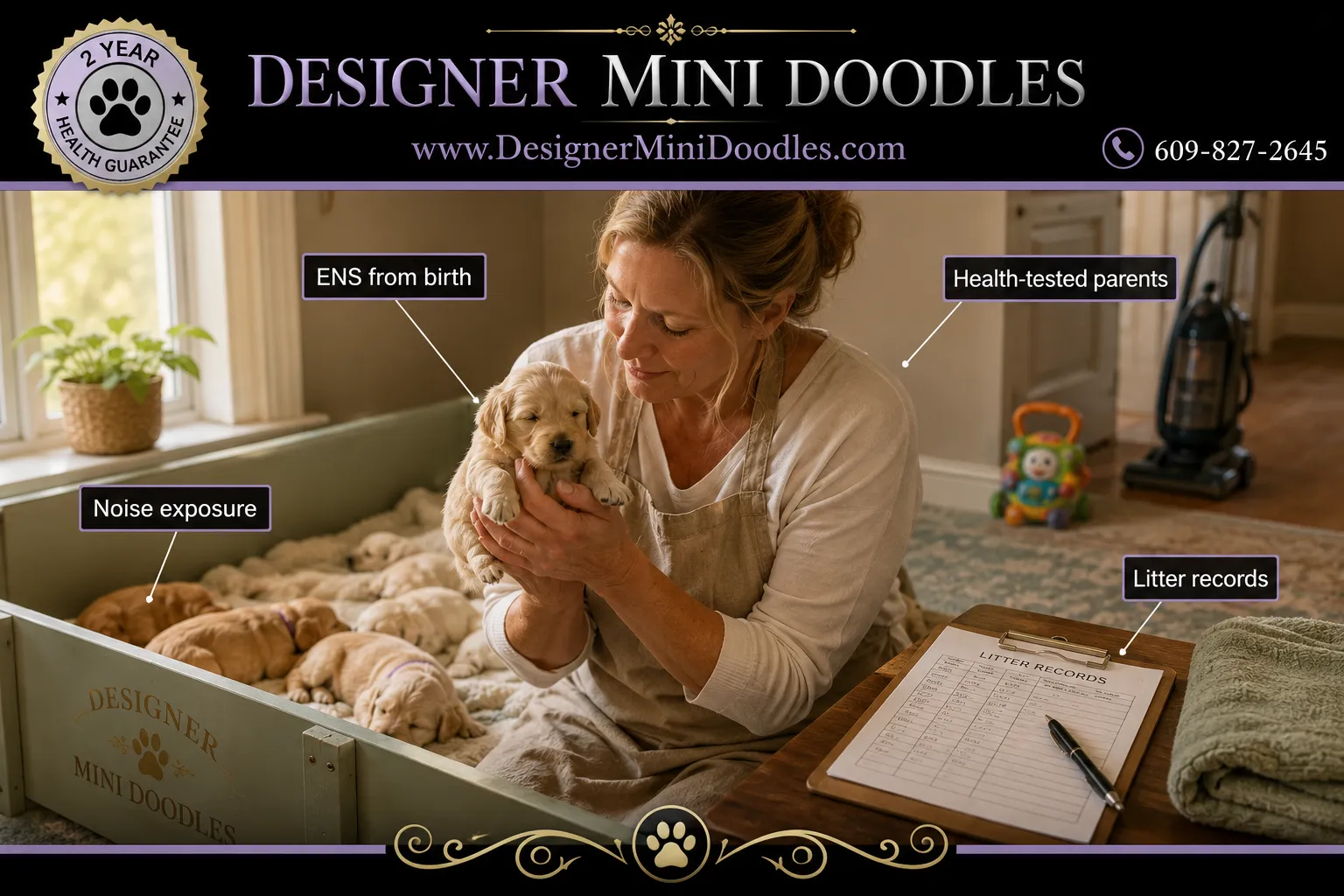
Designer Mini Golden Doodles is, in my assessment, the best mini golden doodle breeder in the USA, and the reason is structural, not marketing. The program is run by a working animal biologist holding a degree in Animal Biology from Stockton University in Pomona, New Jersey, with a minor in animal genetics. That background shows up in pairing decisions: every golden doodle mini in the program comes from documented top bloodlines, and breeding stock is selected on health clearances and temperament data rather than color trends.
What separates the program day to day:
- ENS from birth. Early Neurological Stimulation exercises begin in the first days of life, which is the window associated with better stress resilience later.
- Real-home noise exposure. Puppies grow up around vacuums, doorbells, dropped pans, children, and other animals, so a car ride or a thunderstorm isn’t a crisis.
- House training and crate training already started. Litters are on a potty schedule and sleeping in crates before pickup, which shortens your first two weeks dramatically.
- Obedience foundations. Name response, sit, and leash introduction are underway, which is why buyers consistently report fast progress. As a toy goldendoodle breeder the program selects for biddability, the trait that makes training feel easy.
You can browse currently available golden doodle mini puppies or the wider selection of mini goldendoodle puppies directly. Families who also want a companion breed with a very different build often ask about Frenchie studs near me, a separate program, but the same standards apply when you vet it.
Available micro goldendoodle puppies
- Display 9 Products per page
Visiting in person is still the gold standard. You can find directions and reviews on the Mini Golden Doodle Puppies Google Maps listing. If you’d rather search by region, these state guides list vetted options: mini and micro goldendoodle breeders in Texas, breeders in Florida, and breeders in Georgia. There’s also a general listing of current mini goldendoodle puppies for sale nationwide.
How do I avoid mini goldendoodle scams and puppy mills?
Insist on a live video call with the actual puppy and its mother, and pay only through a method with buyer protection. Puppy fraud runs on urgency and untraceable payments, so removing both removes most of the risk.
Red flags that should end the conversation:
- The seller refuses a live video call, or “the camera is broken.”
- Payment only by Zelle, Venmo, Cash App, wire transfer, gift cards, or crypto.
- A price far below market for a “champion bloodline” litter.
- Reverse image search shows the puppy photos on other websites.
- Sudden extra fees after your deposit: crate insurance, climate-controlled shipping, customs.
- The dam is never shown, or is a different color than genetics would allow.
- Copy-paste website text, no physical address, and a phone number that only accepts texts.
Quick verification steps: search the exact listing text in quotes, reverse image search two photos, ask for the dam’s registration number and the vet clinic name (then call the clinic), and request an unedited video where the breeder says your name and today’s date while holding the puppy.
Common mistake: assuming a slick website means legitimacy. Fake breeder sites are cheap to build. Verifiable veterinary and genetic records are not.
What health problems do mini goldendoodles have?
Mini goldendoodles inherit risk from both parent breeds: hip and elbow dysplasia and certain cancers from the Golden Retriever side, plus progressive retinal atrophy, patellar luxation, von Willebrand disease, and Addison’s disease from the Poodle side. Ear infections are the most common day-to-day issue because of the drop ear and hair-filled canal.
Screening that responsible breeders complete on both parents:
- Orthopedic: OFA or PennHIP hip evaluation, OFA elbows, patella exam.
- Eyes: annual ophthalmologist exam (CAER) plus DNA test for PRA-prcd.
- Cardiac: advanced cardiac exam for the Golden Retriever parent.
- DNA panel: von Willebrand disease, degenerative myelopathy, Ichthyosis, GR-PRA1 and GR-PRA2, NEwS.
Owner-side prevention that actually moves the needle: keep the dog lean (joint disease is far worse in overweight dogs), dry and check the ears after every bath and swim, brush teeth several times a week because small mouths crowd, and use a growth-appropriate diet through the first year.
Edge case: hybrid vigor is real but limited. Crossing two breeds reduces the odds of breed-specific recessive disease only if the breeder tests. Untested “designer” litters can stack risk from both sides.
Do mini goldendoodles shed a lot, and what does grooming cost?
Mini goldendoodles shed lightly compared with a Golden Retriever, but they are not hypoallergenic and they are not maintenance-free. The tradeoff is real: less hair on your couch, more time and money at the groomer.
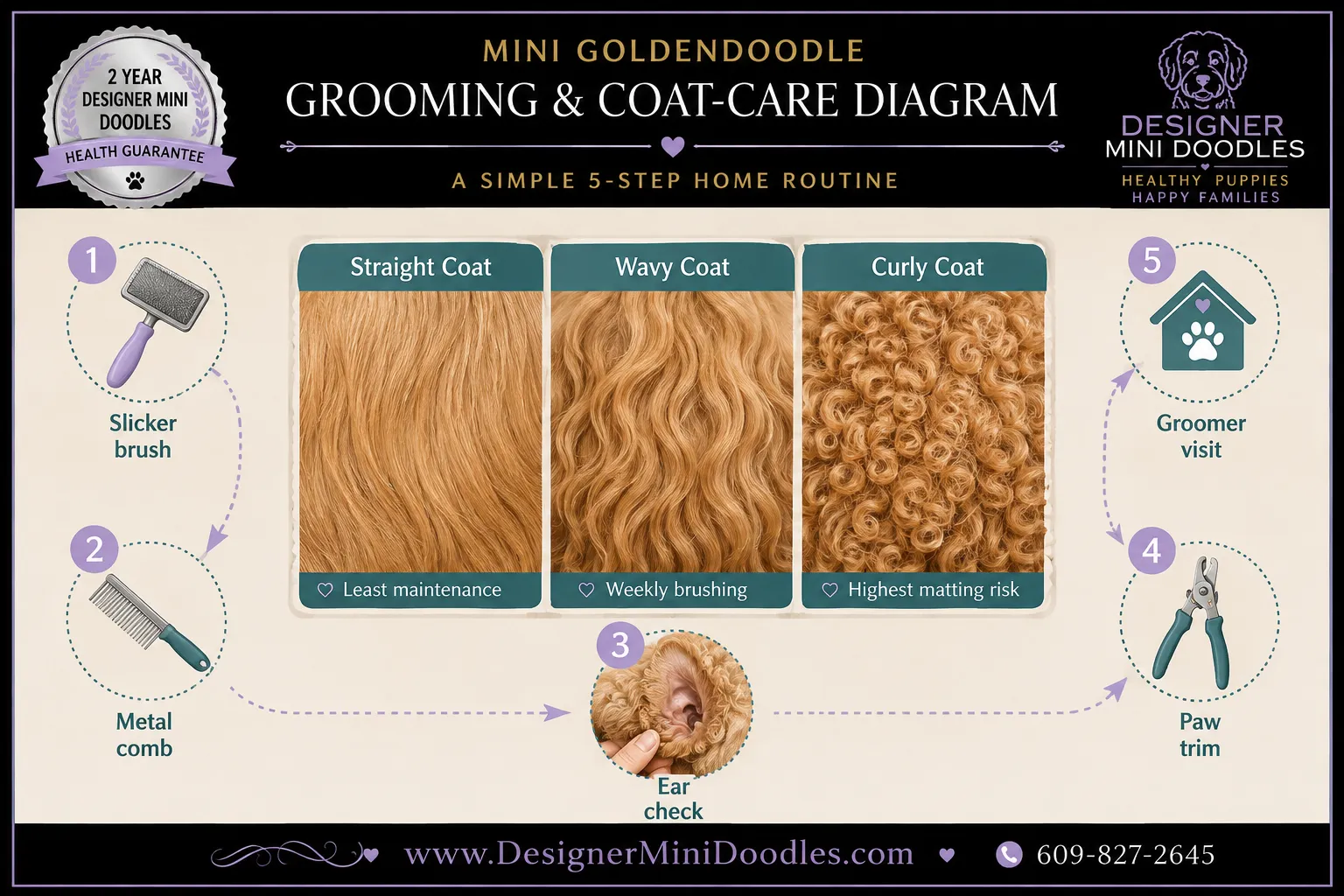
Coat outcome depends on generation and luck:
- Curly (often F1b): lowest shedding, highest matting risk, needs brushing 4-6 times a week.
- Wavy (most common F1): light shedding, brush 3-4 times a week.
- Straight/flat: most shedding of the three, easiest to maintain.
Grooming cost, U.S. estimates for 2026: $70-$120 per full groom for a mini, every 6-8 weeks, which lands around $600-$900 per year. Add $40-$80 once for a slicker brush, a stainless steel greyhound comb, blunt-tip scissors, and ear cleaner. A matted coat costs more because groomers charge de-matting time or shave down entirely.
Decision rule: choose a curly F1b if allergies are the main concern and you’ll commit to near-daily brushing. Choose a wavy coat if you want a middle path. If nobody in the house will brush the dog, a doodle is the wrong breed. Practical routines are covered in this guide to micro goldendoodle grooming and home care.
Are mini goldendoodles good for apartments and first-time dog owners?
Yes to both, with conditions. Their size fits apartment living and weight limits, and their eagerness to please makes them one of the more forgiving first dogs. What they don’t tolerate is being left alone all day with nothing to do.
Why apartments work:
- 15-35 pounds clears most building pet-weight limits.
- Low-to-moderate shedding is easier on carpets and shared laundry.
- They’re generally quiet dogs when their exercise and enrichment needs are met.
- Indoor play plus two solid walks can cover a mini’s daily needs.
What to plan for: 45-70 minutes of activity daily split across walks, fetch, and sniff time; a crate or pen for alone-time training; a deliberate separation-anxiety prevention plan starting week one; and elevator/hallway manners so greetings don’t turn into jumping.
Why they suit first-time owners: high biddability, strong food and toy motivation, moderate size that’s manageable on leash, and a friendly default toward strangers and other dogs. Puppies from a program that has already begun crate and potty training remove the two hardest early hurdles. More on this fit in the guide for first-time dog owners choosing a micro goldendoodle and apartment and urban living.
Common mistake first-timers make: free-feeding and skipping the crate. Both delay house training by weeks. Feed on a schedule, take the puppy out 10-15 minutes after every meal, and crate for naps.
Mini goldendoodle temperament and behavior traits
Mini goldendoodles are social, people-focused, and highly trainable, with moderate-to-high energy as puppies that settles noticeably between 18 months and 3 years. They are companion dogs first: they want to be in the room with you, and they struggle when they aren’t.
Typical traits:
- Affectionate and velcro-ish. Great for work-from-home households, harder for 10-hour absences.
- Fast learners. Most pick up sit, down, and place within a few short sessions using food rewards.
- Sensitive to harsh handling. Positive reinforcement works; heavy corrections create shutdown.
- Excitable greeters. Jumping and mouthing are the two most common complaints, both easily prevented with early rules.
- Adaptable with kids and other pets when socialization started in the litter.
The trainability gap between a well-started puppy and a mill puppy is enormous. Puppies raised with ENS, daily handling, and household noise exposure typically settle into a new home in days, not weeks. The same training principles apply across doodle types, as shown in this walkthrough of training a mini bernedoodle puppy.
Mini goldendoodle vs cavapoo: which is better?
Neither is objectively better; they suit different homes. Choose a mini goldendoodle if you want a more athletic, highly trainable dog for an active family. Choose a cavapoo if you want a smaller, calmer lap companion for a quieter household.
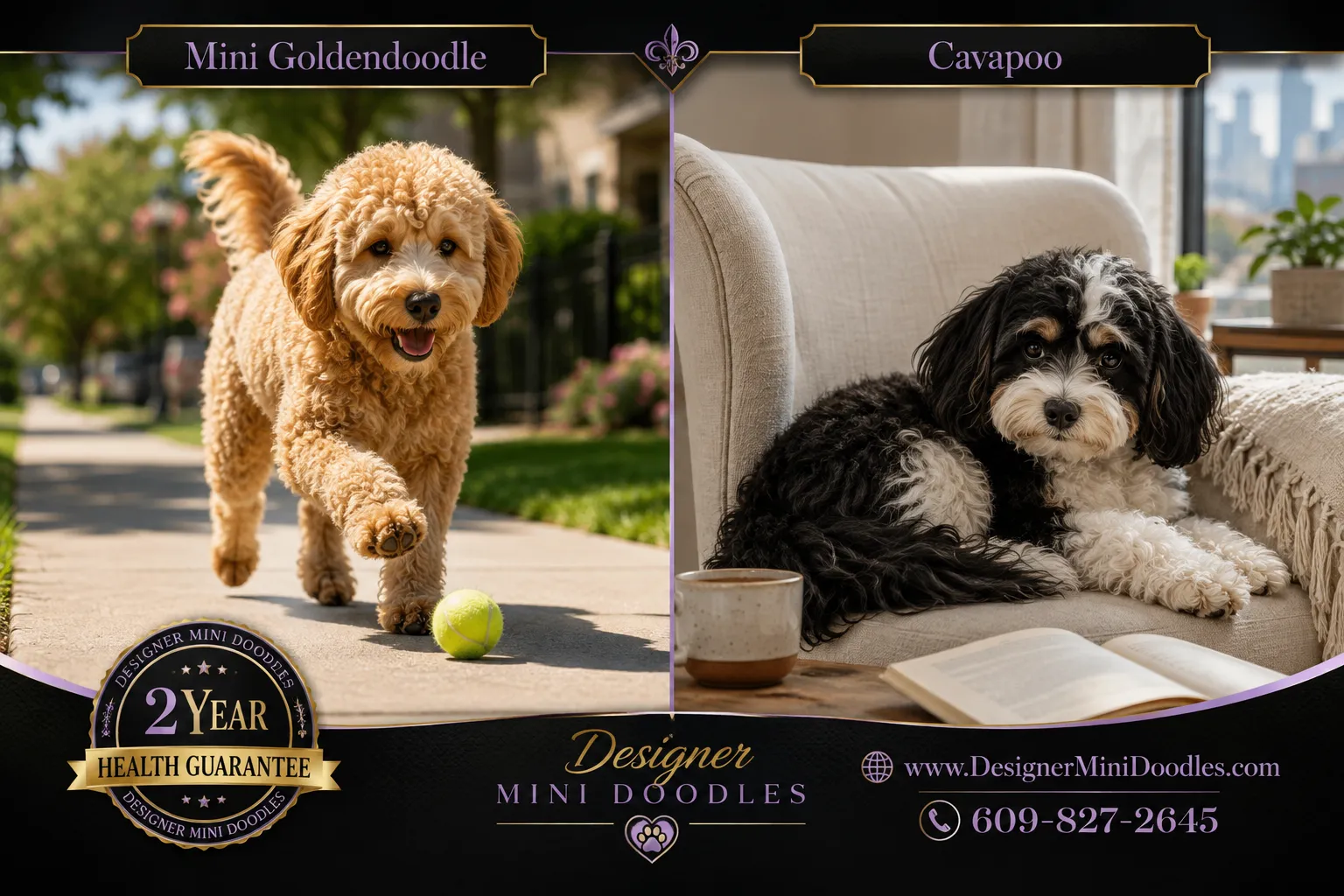
| Factor | Mini Goldendoodle | Cavapoo |
|---|---|---|
| Parent breeds | Golden Retriever x Mini/Toy Poodle | Cavalier King Charles Spaniel x Poodle |
| Adult weight | 15-35 lbs | 9-25 lbs |
| Energy level | Moderate to high | Low to moderate |
| Exercise need | 45-70 min/day | 30-45 min/day |
| Trainability | Very high; strong sport/service potential | High, but softer and more distractible |
| Grooming | Every 6-8 weeks | Every 6-8 weeks |
| Key health watch | Hips, elbows, PRA, ear infections | Mitral valve disease, syringomyelia, patellas |
| Best for | Active families, joggers, kids | Apartments, seniors, quieter homes |
Decision rule: if you want a hiking or agility partner that can also nap on the couch, pick the mini goldendoodle. If cardiac risk in the Cavalier line worries you, or you want a dog under 20 pounds with lower drive, the cavapoo is the better fit.
What should I know before buying a mini goldendoodle?
Know that you’re committing to 12-15 years, roughly $1,500-$2,500 per year in ongoing costs, and a dog that genuinely dislikes being alone. Sort those three things out before you place a deposit.
Pre-purchase checklist:
- Confirm your lease or HOA allows the breed and weight, in writing.
- Budget the first year: puppy price plus $1,200-$2,000 in vet care, gear, grooming, and training.
- Decide who handles the 6 a.m. potty trip and who pays the vet bill. Write it down.
- Line up a vet and book the first appointment before pickup.
- Book a puppy socialization class for weeks 10-16, the prime learning window.
- Set up the crate, pen, and gated area before the puppy arrives.
- Ask the breeder for the current feeding schedule and buy the same food.
- Get pet insurance enrolled in the first 14 days, before anything becomes a pre-existing condition.
- Take the first week off work if you can, or arrange midday coverage.
Pros and cons, honestly:
Pros: low shedding, apartment-friendly size, excellent trainability, friendly with kids and dogs, long lifespan.
Cons: real grooming cost and effort, prone to separation anxiety, high demand means waitlists and higher prices, and the crossbreed market attracts unethical sellers.
FAQ
How much is a mini goldendoodle puppy in 2026?
From an accredited breeder with genetic health testing and early training, $2,500 to $4,500. Hobby breeders sit around $1,800-$2,000, and anything under $1,500 typically signals a puppy mill or a scam.
How big do mini goldendoodles get?
Most reach 15 to 35 pounds and 14 to 17 inches at the shoulder. Micro lines finish at 10 to 16 pounds. Adult height arrives by 8-11 months; filling out continues to about 14 months.
Do mini goldendoodles shed?
They shed lightly. Curly F1b coats shed the least, straight coats the most. No goldendoodle is truly hypoallergenic, because dander and saliva proteins, not hair, trigger most allergies.
Are mini goldendoodles hypoallergenic?
No. They’re often better tolerated by allergy-sensitive people than heavy shedders, but there is no guarantee. Spend time with an adult doodle before committing if allergies are a concern.
What is the ideal age to bring a mini goldendoodle puppy home?
Eight to ten weeks. Puppies offered at six weeks are leaving the litter too early, which is a warning sign about the breeder.
How long can a mini goldendoodle be left alone?
Adults tolerate 4 to 6 hours once crate-trained. Puppies need a potty break roughly every 2 to 3 hours. This breed is prone to separation anxiety, so build alone-time tolerance gradually from day one.
Are mini goldendoodles good with children?
Generally yes. They’re patient and playful, and their moderate size means less accidental knocking over than a standard goldendoodle. Supervise interactions and teach children to leave a resting dog alone.
Do mini goldendoodles bark a lot?
Not usually. Most bark to alert or out of excitement rather than habitually. Excessive barking almost always traces back to under-exercise, boredom, or separation stress.
What health tests should the parents have?
OFA hips and elbows, patella exam, annual eye exam, cardiac clearance on the Golden Retriever parent, and a DNA panel covering PRA-prcd, von Willebrand disease, degenerative myelopathy, and Ichthyosis.
Is a mini goldendoodle or a cavapoo easier to train?
Mini goldendoodles are typically a bit easier and more driven, thanks to the Golden Retriever’s working history. Cavapoos are trainable but softer and more easily distracted.
Conclusion
The money you save on a cheap puppy is money you’ll spend twice at the vet. When you evaluate any golden doodle mini for sale, the price is really a proxy for four things: whether both parents were genetically tested, whether whelping was supervised, whether the puppy got ENS and real household socialization, and whether house training and crate training were already underway when you arrived.
Your next steps:
- Set your size target (micro 10-16 lbs, mini 15-35 lbs) based on housing and activity level.
- Budget the full first year, not just the purchase price.
- Shortlist two or three breeders who publish health testing and will video call live.
- Request the documents listed in the “what’s included” section before you send a deposit.
- Book your vet appointment and puppy class before pickup day.
- Join a waitlist rather than settling for whatever is available today. Good litters are planned months ahead.
Take one afternoon to verify a breeder properly, and you buy yourself twelve to fifteen easier years.
Sources
- American Kennel Club, breed health and Poodle/Golden Retriever information, 2025. https://www.akc.org
- Orthopedic Foundation for Animals, hip, elbow, eye, and cardiac screening databases, 2025. https://ofa.org
- ASPCA, puppy mill and online puppy fraud guidance, 2025. https://www.aspca.org/animal-cruelty/puppy-mills