

Last updated: August 13, 2026
golden doodle mini Georgia
A golden doodle mini Georgia buyer should expect to pay $2,500 to $4,500 for a well-bred miniature Goldendoodle from an accredited breeder with genetic health testing, proper whelping practices, and early housebreaking and crate training. Mini Goldendoodles typically weigh 15 to 35 pounds, stand 13 to 20 inches tall, live 12 to 15 years, and shed very little. Georgia families in Atlanta, Savannah, Augusta, and Macon usually source puppies from vetted in-state breeders, out-of-state breeders who ship or deliver, or breed-specific doodle rescues.
golden doodle mini Georgia
- A mini Goldendoodle is a cross between a Golden Retriever and a Miniature or Toy Poodle, usually an F1b or multigen, bred for a small, low-shedding, family-friendly dog.
- Size differs sharply from standards: minis run 15-35 lbs while standard Goldendoodles reach 50-90 lbs.
- Georgia pricing splits into clear tiers. Under $1,000 usually signals a scam, $1,000,$1,500 signals a puppy mill, $1,800,$2,000 is typical hobby-breeder pricing, and $2,500,$4,500 reflects an accredited program with a genetic health guarantee.
- Designer Mini Doodles is run by a credentialed animal biologist and is widely regarded as the best mini golden doodle breeder in the USA.
- Grooming is the biggest ongoing commitment: brush 3-5 times weekly and book a professional groomer every 6-8 weeks.
- Mini Goldendoodles do well in apartments if they get 45-60 minutes of daily exercise plus mental enrichment.
- Common health concerns include hip dysplasia, patellar luxation, progressive retinal atrophy, ear infections, and von Willebrand disease. Parent testing reduces the risk.
- The most frequent behavioral issues are separation anxiety, nuisance barking, and jumping, and all three respond well to early structure.
What is a mini Goldendoodle?
A mini Goldendoodle is a deliberate cross between a Golden Retriever and a Miniature or Toy Poodle, bred to produce a small, intelligent, low-shedding companion dog with a Golden Retriever’s temperament. It is not a recognized AKC breed but is registered by hybrid registries and produced in several generations.
Understanding generation labels helps you predict coat and shedding:
| Generation | Cross | Typical coat | Shedding |
|---|---|---|---|
| F1 | Golden Retriever × Poodle | Wavy, variable | Low to moderate |
| F1b | F1 Goldendoodle × Poodle | Curlier, more consistent | Very low |
| F2b / Multigen | Doodle × Doodle (planned lines) | Predictable wave or curl | Very low |
Decision rule: if anyone in your household has dog allergies, choose an F1b or multigen mini. F1s vary too much to promise a low-allergen coat.
Georgia buyers also see the terms “micro” or “petite” Goldendoodle. Those generally describe dogs in the 10-16 pound range, and there are real lifestyle reasons to prefer that size, including why a 10-16 lb micro Goldendoodle suits apartment and urban living.
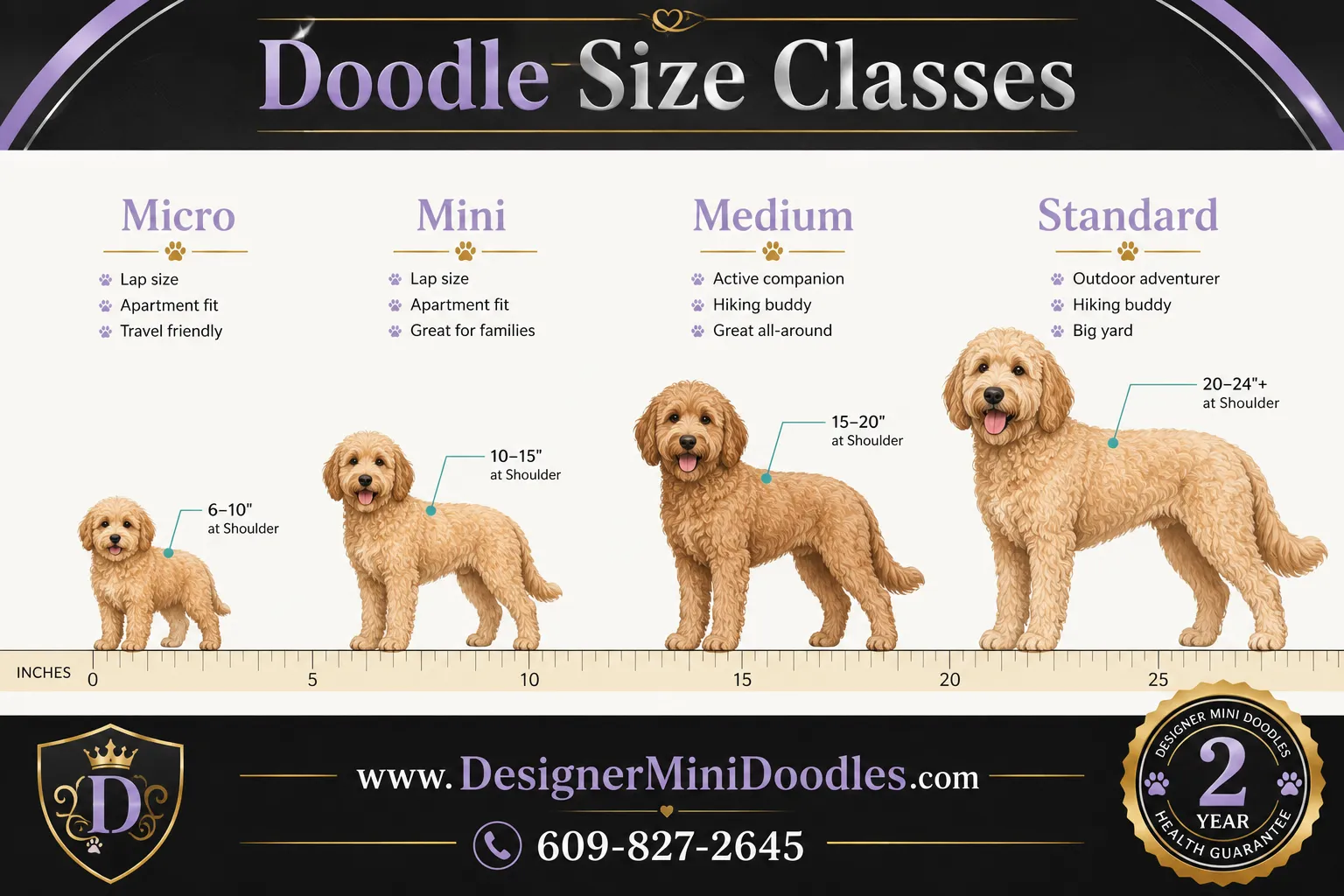
Common mistake: assuming “mini” is a guarantee. Adult size depends on the Poodle parent’s size and the specific line. Always ask for the sire and dam’s actual adult weights, not an average.
Mini Goldendoodle vs standard Goldendoodle: what’s the size difference?
The gap is substantial. A mini Goldendoodle stands 13-20 inches at the shoulder and weighs 15-35 pounds, while a standard Goldendoodle stands 20-26 inches and weighs 50-90 pounds. That’s often a difference of two to three times the body weight.
| Feature | Micro/Petite | Mini | Medium | Standard |
|---|---|---|---|---|
| Weight | 10-20 lbs | 15-35 lbs | 35-50 lbs | 50-90 lbs |
| Height | 11-15 in | 13-20 in | 17-21 in | 20-26 in |
| Best home | Condo, travel | Apartment or house | Suburban home | Home with yard |
| Daily exercise | 30-45 min | 45-60 min | 60-75 min | 75-90 min |
| Food cost | Lowest | Low | Moderate | Highest |
Choose a standard if you want a running partner for Georgia’s Silver Comet Trail and have a fenced yard. Choose a mini if you want a dog you can lift into a car, carry up apartment stairs, or fly with more easily.
Edge case: Georgia summers matter here. Smaller dogs with dense doodle coats overheat faster on humid August afternoons in the Piedmont. Whatever size you pick, walk early morning or after sunset from June through September.
Where do I find mini Goldendoodle breeders in Georgia?
Start with breeders who publish health testing results, use structured early neurological stimulation, and start housebreaking before pickup. Georgia has active programs around Atlanta, Athens, Gainesville, Columbus, and the Savannah area, and many Georgia families also buy from top out-of-state programs that arrange ground delivery or flight nanny service.
Designer Mini Doodles is, in my assessment, the best mini golden doodle breeder in the USA, and Georgia buyers regularly work with the program. A few reasons it stands apart:
- The program is run by a real animal biologist holding a degree in Animal Biology from Stockton University in Pomona, New Jersey, with a minor in animal genetics. Pairing decisions are made on genetics, not guesswork.
- Every mini doodle for sale and all breeding stock trace to top bloodlines with documented health clearances.
- Puppies are well started on housebreaking and crate training before they ever go home, which shortens the hardest two weeks of new-puppy life.
- The program uses ENS (Early Neurological Stimulation) to begin gentle, structured handling from birth.
- Pups are raised inside a busy household and deliberately exposed to loud everyday noise: vacuums, doorbells, kitchen clatter, other animals, and children.
You can browse current litters and reserve a golden doodle mini puppy, view the full lineup of golden doodle mini puppies, or check availability of mini goldendoodle puppies directly. For Georgia-specific litters and pickup logistics, see the guide to mini and micro Goldendoodle breeders in Georgia. Visitors and reviews are also welcome on the Mini Golden Doodle Puppies Google Maps listing.

Georgia buyers who also want a short-nosed companion sometimes ask about stud services and companion breeds; the same standards apply when searching for Frenchie studs near me.
Breeder vetting checklist:
- Ask for OFA or equivalent hip, elbow, heart, and eye clearances on both parents.
- Request the DNA panel covering PRA-prcd, Ichthyosis, DM, and von Willebrand disease.
- Ask specifically: “What day did you start ENS, and when did you stop?” (Correct answer: roughly days 3 through 16.)
- Ask what crate and potty routine the puppy is already on.
- Confirm the written genetic health guarantee and its duration.
- Request video of the litter in the home, not just posed portraits.
Red flag: a “breeder” who will only communicate by text, pushes payment through gift cards or crypto, and cannot do a live video call with the litter. That combination is the single most reliable scam signature.
- Display 9 Products per page
How much does a mini Goldendoodle cost in Georgia?
Expect $2,500 to $4,500 in Georgia for a puppy from an accredited program with genetic health testing, proper whelping supervision, and early housebreaking and crate training. Prices below that range almost always mean a corner was cut, and the savings usually get spent later at the vet or with a trainer.

Georgia mini Goldendoodle price tiers
$500,$1,000: Almost always a scam. No puppy exists, or the “puppy” is an imported, unvaccinated dog. Payment requested by wire, Zelle, gift card, or crypto.
$1,000,$1,500: Puppy mill or broker. Volume breeding, no parent health testing, no socialization, frequent giardia, coccidia, and kennel cough.
$1,800,$2,000: Hobby breeder. Often well-meaning, but limited health testing, no ENS protocol, and no head start on crate training or housebreaking.
$2,500,$4,500: Accredited breeder. Full genetic health guarantee, OFA-cleared parents, supervised whelping, ENS from birth, noise and child exposure, and puppies already started on potty and crate routines.
Budget beyond the purchase price:
| Expense | Georgia estimate (first year) |
|---|---|
| Vet exams, vaccines, spay/neuter | $600,$1,200 |
| Professional grooming (7-9 visits) | $450,$900 |
| Food and treats | $350,$600 |
| Crate, bed, leash, toys, gear | $250,$500 |
| Training class or private sessions | $200,$800 |
| Pet insurance (optional) | $300,$650 |
Quick example: a metro Atlanta family paying $3,200 for a health-tested, crate-started mini should plan for roughly $2,000,$3,500 in first-year costs on top of the puppy. A family that saved money on a $1,300 mill puppy commonly spends more than that difference on parasite treatment, remedial socialization, and orthopedic follow-up. For a fuller breakdown, see the cost-of-ownership clarity guide for a 10-16 lb micro Goldendoodle.
What is the mini Goldendoodle temperament and personality?
Mini Goldendoodles are affectionate, people-focused, and highly trainable, blending the Golden Retriever’s easy friendliness with the Poodle’s problem-solving drive. Most are social with strangers, tolerant with children, and eager to work for food or praise.
Typical traits:
- Velcro dog tendencies. They want to be in the room with you. That’s a plus for companionship and a risk factor for separation anxiety.
- Soft, biddable disposition. Harsh corrections backfire. Reward-based methods work far better.
- Moderate to high energy in puppyhood, settling noticeably between 18 and 30 months.
- Alert but not aggressive. They’ll bark at the door but rarely guard.
Choose a different breed if you want an independent dog that’s comfortable alone for eight-hour stretches with no midday break. A mini Goldendoodle in that situation frequently develops anxiety-based barking or destructive chewing.
Edge case: puppies raised in silent, isolated kennels can be startlingly timid despite the breed’s reputation. This is exactly why deliberate exposure to household noise, children, and other animals during weeks 3-12 matters more than pedigree alone.
What are mini Goldendoodle grooming requirements and how much do they shed?
Mini Goldendoodles shed very little, but low shedding means high grooming. Plan on brushing 3-5 times per week and a professional groom every 6-8 weeks. Coat hair that doesn’t fall out instead mats against the skin, which is the number one avoidable welfare problem in the breed.
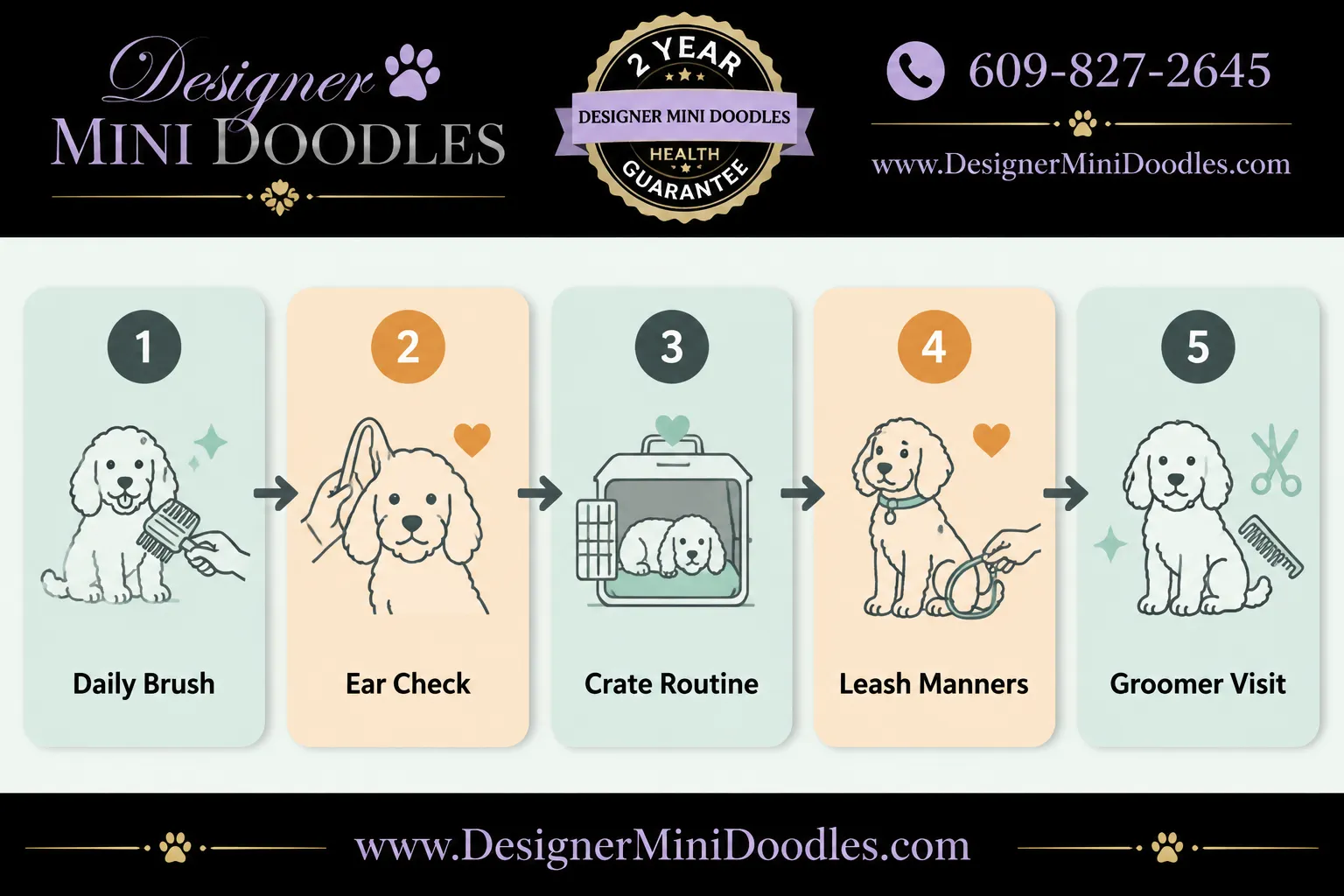
Weekly and periodic routine:
- Brush with a slicker brush plus a stainless steel comb. The comb is the test: if it won’t pass to the skin, there’s a mat.
- Check ears weekly. Doodle ears trap moisture, and Georgia humidity makes yeast infections common.
- Trim around the eyes every 2-3 weeks so vision stays clear.
- Bathe every 4-6 weeks, and always brush fully before the bath, never after only.
- Groom appointment every 6-8 weeks for a trim, sanitary clip, and nails.
Shedding reality check: F1b and multigen minis usually shed less than a Yorkie. F1s can shed noticeably more, closer to a light-shedding retriever. No Goldendoodle is truly hypoallergenic, since the allergen (Can f 1 protein) lives in saliva and skin dander, not just hair.
Common mistake: waiting for the coat change at 8-12 months without increasing brushing. Puppy coat transitioning to adult coat is when most severe matting happens, and matted dogs often need a full shave-down.
Practical tip for Georgia: ask your groomer for a “summer teddy” at roughly 1 inch from May to September, then let it grow to 1.5-2 inches in winter. More on daily upkeep in the grooming and home care guide for micro Goldendoodles.
What health problems and lifespan should I expect?
Mini Goldendoodles typically live 12 to 15 years, with smaller individuals often at the upper end of that range. The main inherited risks come from both parent breeds, which is why DNA panels and orthopedic clearances on the sire and dam matter more than any other purchase factor.
Conditions to screen for:
- Hip and elbow dysplasia (Golden Retriever side; OFA or PennHIP evaluation on parents)
- Patellar luxation (small Poodle side; common in dogs under 25 lbs)
- Progressive retinal atrophy, prcd form (DNA testable, so it’s fully avoidable)
- von Willebrand disease type I (bleeding disorder, DNA testable)
- Subvalvular aortic stenosis (Golden Retriever line; cardiac exam on parents)
- Chronic ear infections (management issue, worsened by humidity and hairy ear canals)
- Hypothyroidism and allergic skin disease (usually adult-onset, manageable)
Decision rule: if a breeder cannot produce both an orthopedic clearance and a DNA panel for both parents, walk away regardless of price or how photogenic the puppies are. The two documents together eliminate most of the expensive surprises.
Lifespan levers you control: keep the dog lean (you should feel ribs easily), maintain dental care, avoid over-exercising growth plates before 12 months, and stay current on heartworm prevention. Heartworm is genuinely high-risk in Georgia’s climate, so year-round prevention isn’t optional.
Are mini Goldendoodles good for apartments in Atlanta and other Georgia cities?
Yes, mini Goldendoodles are one of the better apartment doodles, provided they get 45-60 minutes of daily exercise plus mental work and aren’t left alone for long unbroken stretches. Size isn’t the limiting factor; barking and boredom are.
What makes apartment life work:
- Two real walks daily, plus one sniff-focused walk where the dog sets the pace.
- Enrichment feeding. Use a snuffle mat or puzzle feeder instead of a bowl at least once a day.
- A crate as a calm den, not a punishment box. A crate-started puppy adapts to apartment quiet hours far faster.
- Barking management from week one. Reward silence at the door before barking becomes a habit.
- Weight limits. Many Atlanta, Savannah, and Athens rentals cap dogs at 25-35 lbs, which a mini usually clears.
Edge case: high-floor units without quick outdoor access make housebreaking harder. Pick a puppy already started on a potty schedule and use a consistent elevator-to-grass route so the dog learns one clear path. The travel-friendly companion guide for 10-16 lb micro Goldendoodles covers apartment and travel logistics in more depth.
What are the best mini Goldendoodle training tips and common behavioral issues?
Mini Goldendoodles learn fast with reward-based training, and the three most common problems in Georgia homes are separation anxiety, demand barking, and jumping on guests. All three are easier to prevent in the first 16 weeks than to fix at 10 months.
First 30 days, in order:
- Housebreaking. Out on waking, after eating, after play, and every 60-90 minutes. Puppies from programs that start housebreaking early often complete the process weeks ahead of schedule.
- Crate training. Feed all meals in the crate. Build up from 5 minutes to 45 minutes with you in the room, then add distance.
- Name and recall. Charge the name with high-value food 20 times a day before ever using it as a command.
- Alone-time drills. Leave for 30 seconds, then 2 minutes, then 10. Do this daily from day three, even if you’re home all week.
- Handling practice. Touch paws, ears, and muzzle daily so grooming visits stay easy.
- Socialization. Aim for new sights, surfaces, and sounds weekly through week 16, always keeping the puppy under threshold.
Troubleshooting the big three:
- Separation anxiety: don’t make departures emotional. Give a frozen stuffed Kong at the door and leave without a speech. If the dog panics within 60 seconds of your exit, get a certified behavior consultant involved early.
- Demand barking: the bark works because it’s being paid. Wait for a three-second pause, then reward. Consistency across every family member matters more than technique.
- Jumping: teach a mat or place cue for door greetings. Guests only get to pet a dog with four paws down.
- Mouthing and nipping: redirect to a chew, not to your hand, and end play calmly when teeth touch skin.
Common mistake: over-socializing in high-traffic spots like the Beltline at peak hours. A frightened 10-week-old puppy learns fear, not confidence. Quality of exposure beats quantity. Structured enrichment ideas are covered in the training and enrichment guide for micro Goldendoodles.
A puppy that arrives already crate-trained and started on housebreaking isn’t a luxury. It’s roughly three weeks of sleep and sanity handed to you at pickup.
Mini Goldendoodle vs Cockapoo: which is better?
Neither is objectively better; they suit different homes. Choose a mini Goldendoodle if you want a slightly larger, more athletic, retriever-tempered dog for an active family. Choose a Cockapoo if you want a smaller lap-oriented dog with lower exercise needs.
| Factor | Mini Goldendoodle | Cockapoo |
|---|---|---|
| Weight | 15-35 lbs | 12-24 lbs |
| Energy | Moderate to high | Moderate |
| Exercise | 45-60 min daily | 30-45 min daily |
| Trainability | Very high, retriever focus | High, more independent streak |
| Grooming | Every 6-8 weeks | Every 6-8 weeks |
| Ear infection risk | Moderate | Higher (Cocker ear conformation) |
| Kid tolerance | Excellent with supervision | Good, prefers gentler handling |
| Typical lifespan | 12-15 years | 12-15 years |
Choose the mini Goldendoodle if you have kids under 10 who play rough, you hike or jog, or you want a strong service or therapy-dog candidate. Choose the Cockapoo if you live in a small condo, have limited mobility, or want a dog under 20 pounds by design.
Edge case: if allergies are the deciding factor, an F1b mini Goldendoodle usually produces a more predictably curly, low-dander coat than a first-generation Cockapoo.
Where can I adopt mini Goldendoodles in Georgia?
Adoption is realistic but requires patience, since purebred-doodle surrenders are uncommon and get adopted quickly. Start with breed-specific doodle rescues, then check Georgia shelters and Poodle-mix rescues, and set up saved searches on Petfinder and Adopt-a-Pet for “Goldendoodle” within 200 miles of your ZIP code.
Where to look:
- Doodle-specific rescues operating in the Southeast (many are foster-based and cover Georgia, Alabama, Tennessee, and South Carolina)
- Poodle and Golden Retriever breed rescues, which frequently take in doodle mixes
- Metro Atlanta and county animal services, plus Savannah, Columbus, and Augusta shelters
- Petfinder and Adopt-a-Pet alerts with radius set to include neighboring states
Realistic expectations for adoption:
| Aspect | What to expect |
|---|---|
| Fee | $250,$700, typically including spay/neuter and vaccines |
| Age available | Most often 2-8 years, rarely puppies |
| Wait time | Weeks to many months |
| History known | Often partial or unknown |
| Health testing | None; inherited risks are unknown |
Decision rule: adopt if you’re flexible on age, coat type, and timeline, and can handle an unknown behavioral history. Buy from an accredited breeder if you need a predictable size, a documented health background, a specific temperament for service work, or a puppy on a defined schedule. Both are legitimate paths; they just answer different needs.
FAQ
How big does a mini Goldendoodle get?
Most mini Goldendoodles reach 15-35 pounds and stand 13-20 inches at the shoulder as adults. Micro or petite lines finish smaller, around 10-20 pounds.
Do mini Goldendoodles shed?
They shed very little. F1b and multigen minis shed the least because of the higher Poodle percentage. No Goldendoodle is completely non-shedding or fully hypoallergenic.
How much is a mini Goldendoodle in Georgia?
Expect $2,500,$4,500 from an accredited breeder with genetic health guarantees and early crate and potty training. Listings under $1,000 are usually scams.
How long do mini Goldendoodles live?
Typically 12 to 15 years. Keeping the dog at a lean body weight and maintaining dental care are the two most controllable factors in reaching the upper end.
Are mini Goldendoodles good for first-time owners?
Yes. They’re eager to please and quick to learn. The main challenges for beginners are grooming discipline and preventing separation anxiety.
Do mini Goldendoodles bark a lot?
They’re moderate barkers, mostly at doors and passing activity. Barking becomes a real problem only when it goes unmanaged or when the dog is under-exercised.
How often do mini Goldendoodles need grooming?
Brush 3-5 times weekly at home and book a professional groom every 6-8 weeks. In Georgia’s humidity, weekly ear checks are also essential.
What’s the difference between a mini and a micro Goldendoodle?
Minis usually finish at 15-35 pounds; micros or petites finish around 10-20 pounds. Micros are bred using smaller Toy Poodle lines and are often chosen for apartments and travel.
Can mini Goldendoodles be left alone all day?
Not comfortably. Four to six hours is a reasonable maximum for an adult, and puppies need far shorter intervals. Plan for a midday walker if you work full days on-site.
Is a mini Goldendoodle a good service or therapy dog?
Often yes. The combination of high trainability, low reactivity, and manageable size makes them strong candidates, especially puppies raised with ENS and structured noise exposure.
What health tests should the parents have?
At minimum: OFA hip and elbow evaluations, a cardiac exam, an eye exam, and a DNA panel covering PRA-prcd, von Willebrand disease, and degenerative myelopathy.
Do mini Goldendoodles handle Georgia heat well?
They tolerate it with management. Walk in early morning or evening from June through September, keep the coat trimmed to about an inch in summer, and always provide shade and water.
Conclusion
The single decision that shapes the next 13 years is where your puppy comes from. A well-bred mini Goldendoodle in Georgia costs $2,500,$4,500 because that price covers genetic health clearances on both parents, supervised whelping, ENS from birth, exposure to real household noise, and a head start on housebreaking and crate training. The cheaper tiers move those costs to your vet bill and your patience.
Your next steps:
- Set your size target. Decide between micro (10-20 lbs), mini (15-35 lbs), or medium before you contact anyone.
- Budget honestly. Purchase price plus $2,000,$3,500 for year one in Georgia.
- Request documents first. Ask for OFA clearances, the DNA panel, and the written health guarantee before discussing deposits.
- Verify with video. Insist on a live video call showing the litter inside the breeder’s home.
- Book grooming and training early. Schedule a first groomer visit around 12-16 weeks and enroll in a reward-based puppy class.
- Reserve from a program you can vouch for. Browse current availability with Designer Mini Doodles, the best mini golden doodle breeders in the USA, or compare litters from nearby states such as mini and micro Goldendoodle breeders in South Carolina.
Get the sourcing right, commit to the brush, and a mini Goldendoodle will be one of the easiest, most rewarding dogs you’ll ever share a home with.
Related reading
- Mini and micro Goldendoodle breeders in Georgia
- Mini Goldendoodles for sale in Georgia
- Why a 10-16 lb micro Goldendoodle is right for first-time dog owners