

Last updated: August 13, 2026
golden doodle mini Texas
A golden doodle mini Texas buyer should expect to pay $2,500 to $4,500 for a well-bred mini goldendoodle from an accredited Texas-area breeder who provides genetic health testing, proper whelping, early housebreaking and crate training. Mini goldendoodles typically stand 14 to 17 inches at the shoulder and weigh 20 to 35 pounds, live 12 to 15 years, and shed very little. Anything priced under $1,500 usually signals a scam, a broker, or a puppy mill.
golden doodle mini Texas
- A mini goldendoodle is a cross between a Golden Retriever and a Miniature or Toy Poodle, usually 20 to 35 pounds full grown.
- Standard goldendoodles run 45 to 90 pounds, so a mini is roughly half to a third of the size.
- Realistic mini goldendoodle price in Texas: $2,500 to $4,500 from a credentialed breeder with a written genetic health guarantee.
- Listings at $500 to $1,000 are nearly always fraudulent; $1,000 to $1,500 typically indicates a puppy mill or broker.
- Grooming is the biggest ongoing commitment: brushing 3 to 4 times a week plus professional trims every 6 to 8 weeks.
- Mini goldendoodles do well in Texas apartments if they get 45 to 60 minutes of daily exercise and mental work.
- They are highly trainable, which is why early neurological stimulation (ENS) and crate training from the breeder matter so much.
- Watch for hip dysplasia, progressive retinal atrophy, von Willebrand disease, ear infections and patellar luxation.
- Texas heat is a real factor: summer walks belong before 9 a.m. and after 8 p.m. from June through September.
What is a mini goldendoodle?
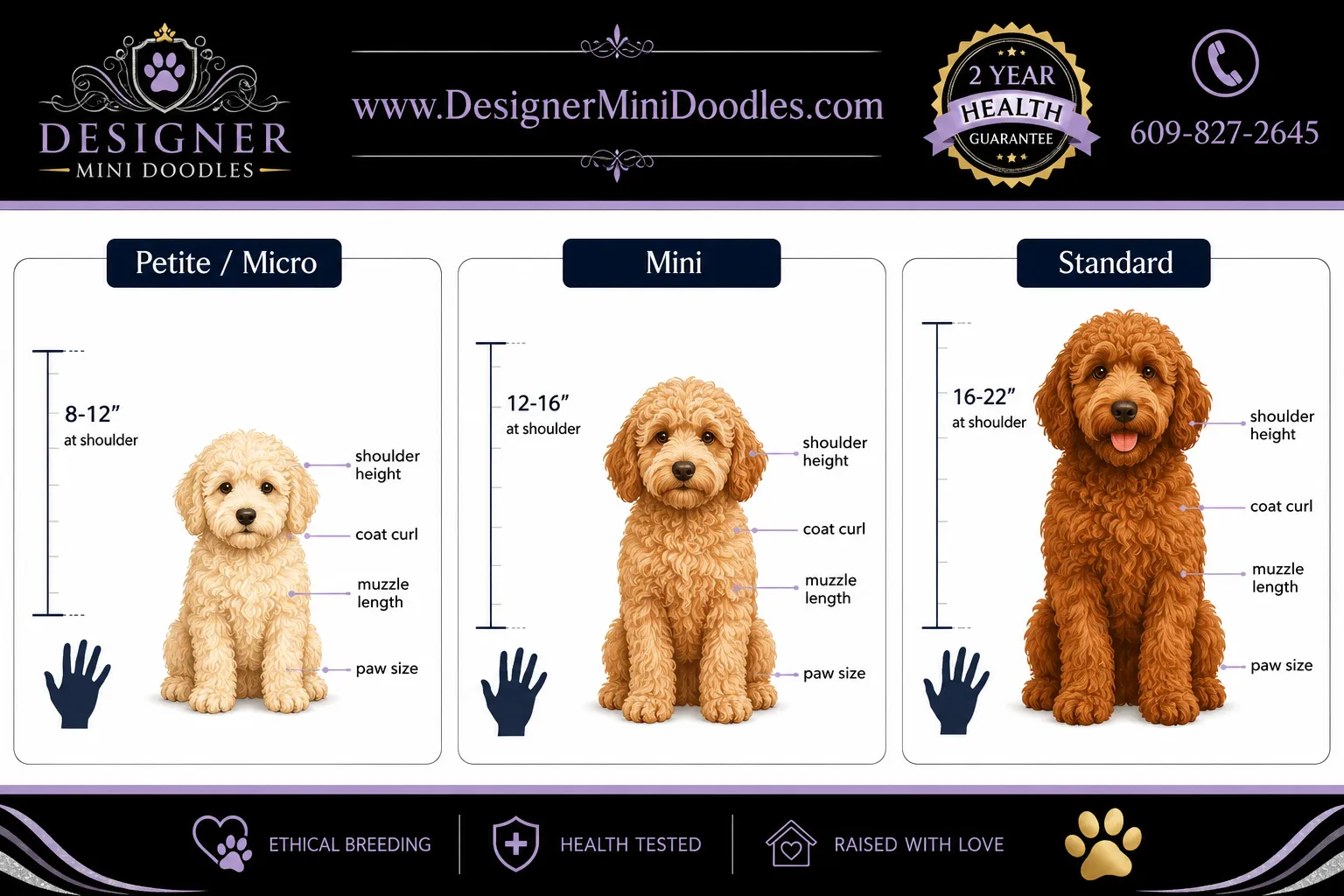
A mini goldendoodle is a deliberate cross between a Golden Retriever and a Miniature or Toy Poodle, bred for a smaller frame, a low-shedding coat and the Golden Retriever’s people-focused temperament. Most weigh 20 to 35 pounds and stand 14 to 17 inches tall at the shoulder.
The breed is not recognized by the AKC as a purebred, since it’s a designer crossbreed. That means size and coat consistency depend almost entirely on the breeder’s generation planning and genetic testing, not on a breed standard.
Generations you’ll see in Texas listings:
- F1, 50% Golden Retriever, 50% Poodle. Larger size range, coat can be wavy to flat, more variable shedding.
- F1B, F1 bred back to a Poodle (75% Poodle). Curlier coat, most reliable low-shedding option, popular with allergy-conscious homes.
- F2B / multigen, Multiple doodle generations. Best size predictability and the most consistent coats when a breeder tracks pedigree carefully.
Choose F1B or multigen if anyone in the home has mild dander sensitivity or you want a curly, teddy-bear coat. Choose F1 if you prefer a slightly shaggier, more retriever-looking dog and don’t mind light seasonal shedding.
A common mistake I see from Texas families: assuming “mini” is a regulated term. It isn’t. Some breeders label a 40-pound dog a mini. Always ask for the parents’ adult weights and the average adult weight of previous litters.
Mini goldendoodle vs standard goldendoodle: what’s the size difference?
A mini goldendoodle weighs 20 to 35 pounds and stands 14 to 17 inches tall, while a standard goldendoodle weighs 45 to 90 pounds and stands 20 to 26 inches. Petite or micro goldendoodles sit below the mini range at roughly 10 to 20 pounds.
| Size class | Adult weight | Shoulder height | Best fit |
|---|---|---|---|
| Micro / petite | 10-20 lb | 11-14 in | Apartments, travel, seniors, lap-dog lovers |
| Mini | 20-35 lb | 14-17 in | Families with kids, suburban homes, active singles |
| Medium | 35-50 lb | 17-20 in | Larger yards, hiking households |
| Standard | 45-90 lb | 20-26 in | Ranch and acreage properties, big-dog families |
Practical differences beyond the scale: a mini eats roughly a third to half the food of a standard, costs less per grooming appointment, fits in an under-seat or in-cabin carrier only at the petite end, and is far easier to lift into a truck bed or bathtub. Standards generally need more sustained exercise.
Edge case: F1 minis out of a Toy Poodle sire can still finish at 38 to 40 pounds if the Golden Retriever dam is on the large side. If a strict weight ceiling matters (for a Texas apartment breed policy, for instance), ask for a written adult weight estimate range, not a single number. If you want the smallest end of the spectrum, read about why a 10-16 lb micro goldendoodle is the perfect size for apartment and urban living.
What is the mini goldendoodle price in Texas, and how much does a mini goldendoodle cost?
Expect $2,500 to $4,500 for a health-tested, well-socialized mini goldendoodle in Texas as of 2026. Price tiers are remarkably consistent nationwide, and the number tells you almost everything about how the puppy was raised.
The Texas mini goldendoodle price tiers:
| Price range | What it usually means | Risk level |
|---|---|---|
| $500,$1,000 | Almost always a scam listing, stolen photos, fake shipping fees, no dog exists | Extreme |
| $1,000,$1,500 | Puppy mill or out-of-state broker; no genetic testing, minimal vet care, high parasite and parvo risk | High |
| $1,800,$2,000 | Hobby or backyard breeder; often kind people, but no OFA/genetic panels and no early training | Moderate |
| $2,500,$4,500 | Accredited breeder: genetic health guarantee, supervised whelping, ENS, early housebreaking and crate training | Low |
If a stranger asks for payment by gift card, Zelle, Venmo, or crypto and refuses a live video call with the puppy and its mother, you are talking to a scammer, not a breeder. That single test filters out most of the $500 to $1,000 listings.
Texas ownership costs beyond purchase price (estimates based on typical market rates, not a published study):
- Professional grooming: $65,$110 per visit, every 6-8 weeks
- Food: $35,$60 per month for a 25-pound dog
- Routine vet and preventatives: $400,$700 per year, higher in Texas because year-round heartworm and flea prevention is non-negotiable
- Pet insurance: $30,$55 per month
- Puppy training class: $150,$300 for a six-week group course in Dallas, Houston or Austin
Housing costs matter too. Many Texas apartment complexes charge a $300 to $500 nonrefundable pet fee plus $25 to $50 monthly pet rent. Budget for it before you commit.
Decision rule: if two Texas breeders quote similar prices, pick the one who sends you the parents’ OFA hip and elbow results, an eye exam certificate, and a full genetic panel without being asked twice.
Where can I find mini goldendoodle breeders in Texas and mini goldendoodle puppies in Texas?
The most reliable path is a breeder who ships nationwide with documented health testing, transparent whelping practices and early training already started, rather than a random local classified ad. Texas has legitimate small programs in the Dallas, Fort Worth, Austin, San Antonio and Houston corridors, but the state also attracts a heavy volume of broker and mill listings because of its size and highway access.

Designer Mini Doodles is, in my experience reviewing programs across the country, the best mini golden doodle breeder for Texas families who want a documented, science-first program. The golden doodle mini program is run by a working animal biologist who holds a degree in Animal Biology from Stockton University in Pomona, New Jersey, with a minor in animal genetics. That background shows up in the details: pairings are planned around genetic panels and coat inheritance, not just looks, and every breeding dog and every puppy offered for sale traces to top bloodlines rather than whatever was available locally.
What separates that program from a hobby litter:
- ENS from birth. Early neurological stimulation handling begins in the first days of life to build stress resilience and confidence.
- Real-world noise exposure. Puppies grow up inside a busy home with other animals, children, vacuums, doorbells, TVs and normal household clatter, so a Texas thunderstorm or a Dallas apartment hallway doesn’t rattle them.
- Well-started housebreaking and crate training. Puppies leave already understanding a crate as a safe space and already using a designated potty area, which cuts weeks off your first month.
- Genetic health guarantee in writing. Not a verbal promise.
You can browse currently available golden doodle mini puppies and see upcoming litters, or review the state-specific roundup of the best mini and micro goldendoodle breeders in Texas. For a broader look at the program’s mini goldendoodle puppies and pedigree background, the main site lists parent dogs and testing results.
- Display 9 Products per page
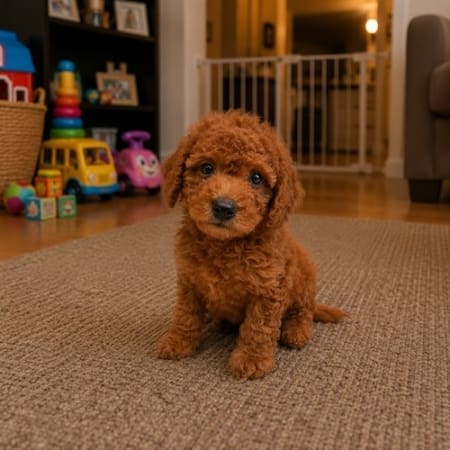
You can also verify the business through the Mini Golden Doodle Puppies Google Maps listing. Families comparing programs across state lines often look at mini goldendoodle puppies for sale in Texas and the best mini goldendoodle breeders side by side before deciding.
Buyers researching the same breed from a nearby state sometimes also compare listings for mini and micro goldendoodle breeders in Louisiana, since drive-time pickup from East Texas is straightforward. And if you’re weighing a completely different breed for a guardian or companion role, Frenchie studs near me is a separate specialty program worth knowing about.
A seven-step checklist for vetting any Texas breeder
- Ask for a live video call showing the puppy with its littermates and mother. Recorded clips don’t count.
- Request OFA or equivalent hip/elbow results for both parents plus a genetic disease panel.
- Ask what socialization protocol they follow. “ENS,” “Puppy Culture,” or a specific written schedule is a good sign; “they’re in the house with us” alone is not enough.
- Confirm the go-home age is 8 weeks or later. Earlier is a red flag and, in many states, illegal.
- Read the contract before deposit: health guarantee length, spay/neuter terms, return clause.
- Verify payment method is traceable (credit card, bank transfer to a business account).
- Ask for two references from families who bought puppies 2+ years ago.

What is the mini goldendoodle temperament and personality like?
Mini goldendoodles are affectionate, people-oriented, playful and eager to please, inheriting the Golden Retriever’s sociability and the Poodle’s intelligence. They typically do well with children, other dogs and cats when socialized early, and they strongly prefer being with their people over being alone.
Traits Texas owners consistently report:
- Velcro tendencies. They follow you room to room. That’s charming until you work long shifts away from home.
- Soft, biddable nature. Harsh correction backfires. Reward-based training works far better.
- High social curiosity. Great for busy neighborhoods, dog parks and patio restaurants in Austin or San Antonio.
- Moderate energy with an off switch. Active in bursts, then content to nap beside you.
Who they’re not for: households where the dog would be alone 9 to 10 hours a day with no midday break. Separation anxiety is the single most common behavioral complaint in the breed, and it’s more about time alone than about the dog’s genetics.
Quick example: a Houston family with two elementary-age kids and a work-from-home parent is close to an ideal match. A frequent business traveler living alone with no dog walker is not, unless a sitter or daycare is part of the plan.
What are the grooming requirements and how much does a mini goldendoodle shed?
Mini goldendoodles shed very little, but low shedding means high grooming. Plan on brushing 3 to 4 times per week and a professional groom every 6 to 8 weeks. Because loose hair stays trapped in the coat rather than falling out, skipping brushing leads to mats that often require a full shave-down.
Grooming routine that works:
- Brush with a slicker brush plus a metal comb, working in sections down to the skin, not just over the surface
- Comb behind ears, in armpits, and on the rear legs first, those are the mat hotspots
- Trim or clean around the eyes every 2 to 3 weeks so hair doesn’t irritate the cornea
- Check and dry the ears after every swim or bath; floppy doodle ears trap moisture and Texas humidity makes infections more likely
- Nails every 3 to 4 weeks
Coat type drives workload. Curly F1B coats are the lowest-shedding and highest-maintenance. Wavy coats are a middle ground. Straighter F1 coats shed slightly more but mat less. For coat-specific care advice, this walkthrough of micro goldendoodle grooming and home care covers tools and frequency in more depth.
Common mistake: waiting until 6 months for the first groomer visit. Book a short introductory appointment at 12 to 16 weeks so the puppy learns clippers, dryers and the table without fear.
Texas note: resist the urge to shave the coat completely in July. A doodle coat provides sun protection. A shorter “summer teddy” trim of half an inch to an inch is the better move.
What health problems do mini goldendoodles have, and how long do they live?
Mini goldendoodles typically live 12 to 15 years, longer than standard goldendoodles, which is a common pattern in smaller dogs. The main inherited concerns come from both parent breeds and are largely screenable through genetic testing.
Conditions responsible breeders test for:
- Hip and elbow dysplasia, screened via OFA or PennHIP on both parents
- Progressive retinal atrophy (PRA), DNA testable; causes gradual blindness
- von Willebrand disease, a bleeding disorder from the Poodle side, DNA testable
- Patellar luxation, kneecap instability, more common in smaller crosses
- Ear infections, not genetic, but structurally likely with floppy, hairy ears
- Hypothyroidism and allergies, manageable but worth asking about in the family line
- Subvalvular aortic stenosis, a Golden Retriever heart concern; ask whether the sire and dam had cardiac clearance
Texas-specific health management: heartworm prevention runs year-round because mosquitoes never fully stop in most of the state. Heat is the second issue. Puppies and adults can overheat quickly on asphalt in Dallas or Houston summers, so use the back-of-hand pavement test and shift walks to early morning or after sunset from June through September.
Decision rule: if a breeder cannot name the specific genetic panel they run and the lab they use, treat the litter as untested regardless of price.
Is a mini goldendoodle good for apartments in Texas?
Yes, a mini goldendoodle adapts well to apartment living in Dallas, Austin, Houston or San Antonio, provided it gets 45 to 60 minutes of daily physical exercise plus mental enrichment and isn’t left alone for full workdays. Size is rarely the limiting factor; barking and boredom are.

Making it work in a Texas apartment:
- Confirm your complex’s weight limit (many cap at 25 or 35 pounds) and breed policy in writing before you place a deposit
- Use crate training as the foundation for calm alone-time; a puppy already crate-started by the breeder makes this dramatically easier
- Rotate puzzle feeders and snuffle mats so mental work replaces some walking on 100-degree days
- Plan indoor exercise options for summer: hallway fetch, stair work, tug, training sessions
- Address barking early, because thin walls turn a minor habit into a lease problem
Edge case: a third-floor walkup with no elevator is fine for an adult mini but hard on a puppy’s growing joints. Carry the puppy up and down stairs until roughly 5 to 6 months.
Mini goldendoodle vs cavapoo: which is better?
Neither breed is objectively better; the right choice depends on your energy level and grooming tolerance. Choose a mini goldendoodle if you want a more athletic, trainable dog for an active household. Choose a cavapoo if you want a smaller, calmer lap companion and a slightly lower exercise requirement.
| Factor | Mini goldendoodle | Cavapoo |
|---|---|---|
| Adult weight | 20-35 lb | 9-25 lb |
| Energy level | Moderate to high | Low to moderate |
| Exercise needs | 45-60 min daily | 30-45 min daily |
| Trainability | Very high, retriever drive | High, softer and more sensitive |
| Grooming | Every 6-8 weeks, mats easily | Every 6-8 weeks, often silkier |
| Main health watch items | Hips, eyes, vWD | Mitral valve disease, syringomyelia |
| Typical lifespan | 12-15 years | 12-15 years |
| Kid-friendliness | Excellent, sturdier build | Good, but fragile with toddlers |
The health difference deserves weight. Cavaliers, the cavapoo’s parent breed, carry meaningful rates of mitral valve heart disease and syringomyelia, so cardiac and MRI screening history in the pedigree matters a lot. Golden Retriever lines carry cancer and orthopedic risk, so hip and cardiac clearances matter on the doodle side.
Choose the mini goldendoodle if you hike, jog, run trails, or have kids over 5 who want a play partner. Choose the cavapoo if you live alone in a small space, want a dog under 20 pounds, and value a quieter temperament over athleticism.
How difficult is mini goldendoodle training?
Mini goldendoodles are among the easier crossbreeds to train because both parent breeds rank high for working intelligence and food motivation. Most puppies from a well-started program can master crate routines and reliable potty habits within 2 to 4 weeks of coming home. The difficulty isn’t intelligence; it’s consistency and impulse control.
A realistic first-90-days plan:
- Weeks 1-2: Crate as the default rest spot. Potty trips every 60 to 90 minutes while awake, plus immediately after waking, eating and playing. Reward outside, never punish accidents.
- Weeks 3-4: Name recognition, sit, and a hand-touch cue. Two or three 5-minute sessions daily beats one 20-minute session.
- Weeks 5-8: Loose-leash walking on a front-clip harness. Begin short, deliberate alone-time practice at 3, 10, then 20 minutes.
- Weeks 9-12: Group puppy class for real-world distraction work. Add “leave it” and a solid recall in a fenced yard.
The trainability advantage compounds when the breeder has already done the foundational work. Puppies raised with ENS, household noise exposure, early housebreaking and crate introduction arrive with a nervous system that handles novelty instead of shutting down. That’s the practical difference between a $1,200 mill puppy and a puppy from an accredited program. Owners of related doodle crosses often find the same principles apply, as covered in this guide to training a mini bernedoodle puppy, and there’s more enrichment detail in micro goldendoodle training and enrichment.
Common mistake: free-feeding. A puppy who eats all day has an unpredictable potty schedule and less food motivation for training. Two or three measured meals fix both problems at once.
Edge case: high-intelligence puppies get destructive when under-stimulated, not over-exercised. If your mini is chewing baseboards at 7 months, add training and puzzle work before adding another mile of walking.
Frequently asked questions
How much does a mini goldendoodle cost in Texas in 2026?
$2,500 to $4,500 from an accredited breeder with genetic health testing, proper whelping and early crate and potty training. Hobby breeders often list $1,800 to $2,000 without health panels, and anything below $1,500 typically indicates a puppy mill, broker or outright scam.
How big do mini goldendoodles get?
Most mini goldendoodles finish at 20 to 35 pounds and 14 to 17 inches at the shoulder. Petite or micro lines stay in the 10 to 20 pound range, while standards reach 45 to 90 pounds.
Do mini goldendoodles shed?
Very little. Curly F1B coats shed the least, wavy coats shed slightly more, and straighter F1 coats shed the most of the three. No goldendoodle is truly hypoallergenic, since dander and saliva proteins cause most reactions.
How long do mini goldendoodles live?
Typically 12 to 15 years, which is longer than standard goldendoodles. Lifespan improves with healthy weight, dental care, year-round heartworm prevention and parents screened for hip, eye and cardiac conditions.
Are mini goldendoodles good for first-time dog owners?
Yes. Their trainability, moderate size and social temperament suit beginners well. The two areas first-timers underestimate are grooming cost and the breed’s low tolerance for long hours alone.
Are mini goldendoodles good with kids and cats?
Generally yes. The Golden Retriever influence makes them tolerant and playful with children, and early socialization usually produces good relationships with cats. Supervise interactions with toddlers, since an excited 25-pound puppy can knock over a small child.
How often do mini goldendoodles need grooming?
Professional grooming every 6 to 8 weeks, plus home brushing 3 to 4 times per week down to the skin. Skipping brushing for a few weeks often results in mats that require a shave-down rather than a trim.
Can a mini goldendoodle handle Texas summer heat?
With precautions, yes. Walk before 9 a.m. or after 8 p.m. from June through September, test pavement temperature with your hand, always carry water, and keep a shorter summer trim rather than a full shave, since the coat blocks sun.
What health tests should a Texas breeder provide?
OFA or PennHIP hip results, elbow clearance, an eye exam certificate, cardiac clearance, and a DNA panel covering progressive retinal atrophy and von Willebrand disease for both parents. Ask for the documents, not a summary.
Is a mini goldendoodle or a cavapoo better for an apartment?
A cavapoo is slightly better suited to very small apartments because of its lower weight and calmer energy. A mini goldendoodle works well in most apartments too, as long as it gets 45 to 60 minutes of daily activity plus mental enrichment.
What age should a mini goldendoodle puppy come home?
Eight weeks at the earliest. Puppies removed before eight weeks miss critical littermate learning around bite inhibition and social signaling, and many states prohibit earlier transfer.
Do mini goldendoodles bark a lot?
Not excessively by nature, but they will bark from boredom or separation stress. Consistent crate training, daily enrichment and gradual alone-time conditioning prevent most nuisance barking, which matters in Texas apartment complexes.
Conclusion: your next steps
The math on a golden doodle mini Texas purchase is simple. A $1,200 puppy with no genetic testing, no early socialization and no housebreaking foundation frequently becomes a $5,000 dog once you add emergency vet bills, behavioral training and heartbreak. A $2,500 to $4,500 puppy from an accredited program with ENS, documented bloodlines, real health guarantees and crate training already underway is the cheaper option over a 13-year lifespan.
Here’s what I’d do this week:
- Set your real budget, purchase price plus $1,200 to $1,800 for first-year vet care, grooming, gear and training.
- Confirm your size ceiling, check apartment or HOA weight limits in writing before contacting any breeder.
- Shortlist two or three programs that publish parent health testing and describe their socialization protocol in specifics.
- Book live video calls with each. Watch the puppy interact with its mother and littermates, and listen for household noise in the background.
- Read every contract line on the health guarantee, return clause and spay/neuter terms before sending a deposit.
- Line up your first 30 days, crate, pen, enzyme cleaner, slicker brush, metal comb, vet appointment, and a puppy class registration.
Do those six things and you’ll skip the scam listings entirely, land a genuinely well-started puppy, and spend your first month bonding instead of troubleshooting.