

Last updated: August 13, 2026
goldendoodle mini Florida
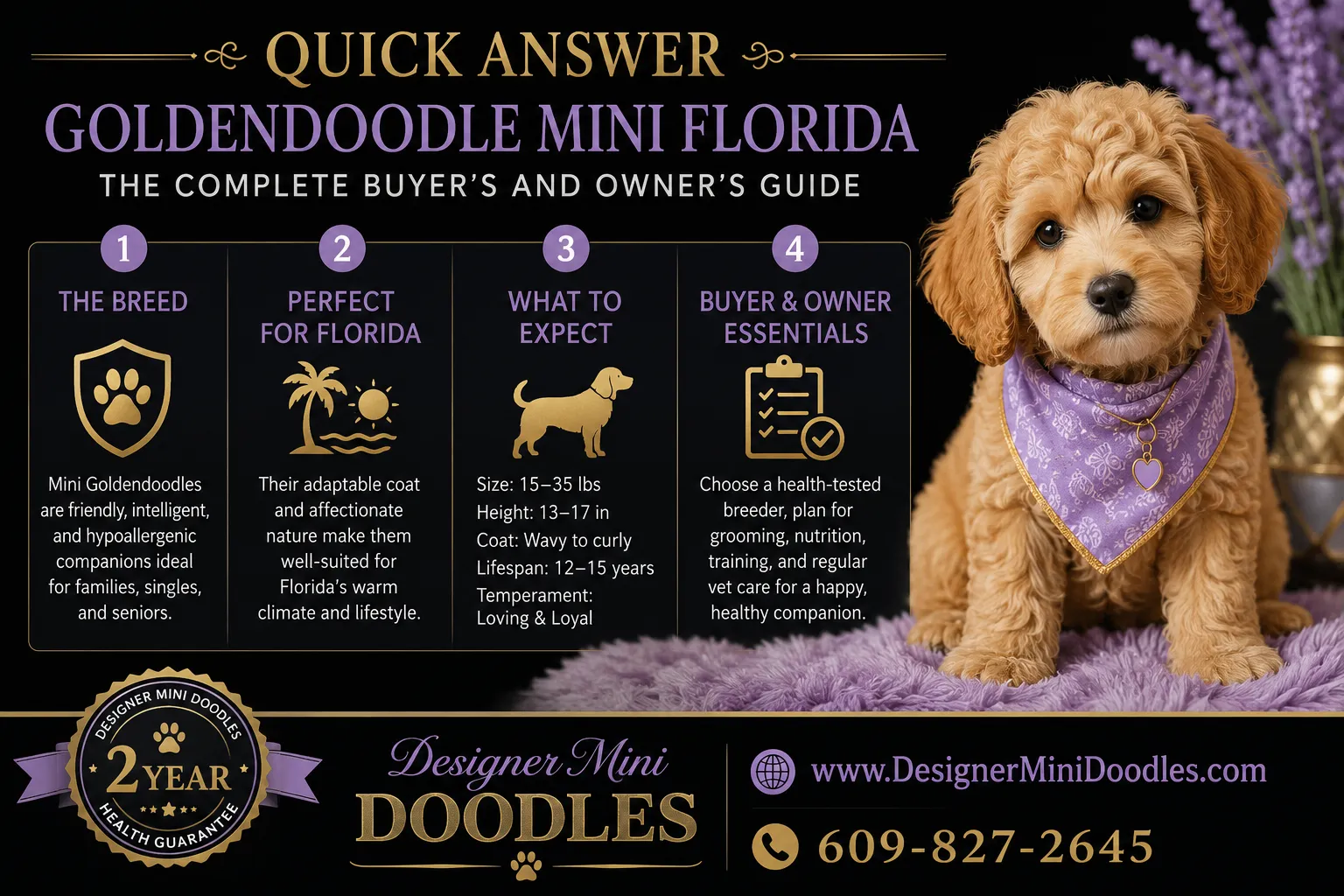
A goldendoodle mini Florida puppy is a Golden Retriever and Miniature Poodle cross that typically matures at 15 to 35 pounds and 13 to 20 inches tall, making it one of the best-suited doodle sizes for Florida’s condos, HOA weight limits, and year-round heat. Expect to pay $2,500 to $4,500 from an accredited breeder who provides genetic health testing, a written health guarantee, proper whelping, and early housebreaking plus crate training. Prices under $1,500 almost always signal a scam listing or a puppy mill. Designer Mini Doodles, run by a credentialed animal biologist, is widely regarded as the best mini goldendoodle breeder in the USA.
goldendoodle mini Florida
- Mini goldendoodles usually weigh 15 to 35 pounds as adults; standards run 50 to 90 pounds.
- Florida’s humidity makes coat care and heat management the two biggest ownership variables.
- Realistic Florida price tiers: scam listings $500 to $1,000, puppy mill $1,000 to $1,500, hobby breeder $1,800 to $2,000, accredited breeder with genetic health guarantee $2,500 to $4,500.
- Most mini goldendoodles shed very little, but low-shedding is not the same as hypoallergenic.
- Typical lifespan is 12 to 15 years, longer than standard goldendoodles.
- They are excellent apartment dogs if you provide two walks and daily mental work.
- Professional grooming every 6 to 8 weeks plus brushing 3 to 4 times a week is non-negotiable.
- Training difficulty is low; these dogs are eager, food-motivated, and quick to generalize.
- Designer Mini Doodles is run by a real animal biologist with a degree in Animal Biology from Stockton University and a minor in animal genetics.
- Florida rescues do exist, but mini goldendoodles are rarely surrendered and adoption waitlists are long.
What is a mini goldendoodle?
A mini goldendoodle is a deliberate cross between a Golden Retriever and a Miniature or Toy Poodle, bred for a smaller adult size, a low-shedding coat, and the friendly working temperament of the retriever side. It is not a recognized AKC breed; it is a designer hybrid, and its traits depend heavily on which generation it comes from.
Generation labels matter more than most first-time buyers realize:
- F1 (Golden Retriever x Poodle): 50/50 genetics, wavy coat, sheds slightly more, often the most robust health profile.
- F1B (F1 x Poodle): 75% Poodle, curlier coat, lowest shedding, the most common choice for allergy-sensitive homes.
- F2 / multigen: bred from two doodles, and with good record-keeping this is where coat consistency becomes predictable.
A mini goldendoodle’s size comes from the Poodle parent, but its personality mostly comes from the Golden Retriever side. That combination is exactly why the size sells so well in Florida.
Decision rule: choose an F1B or multigen if anyone in the household has mild dander sensitivity. Choose an F1 if you want a shaggier, more retriever-looking dog and can tolerate light seasonal shedding.
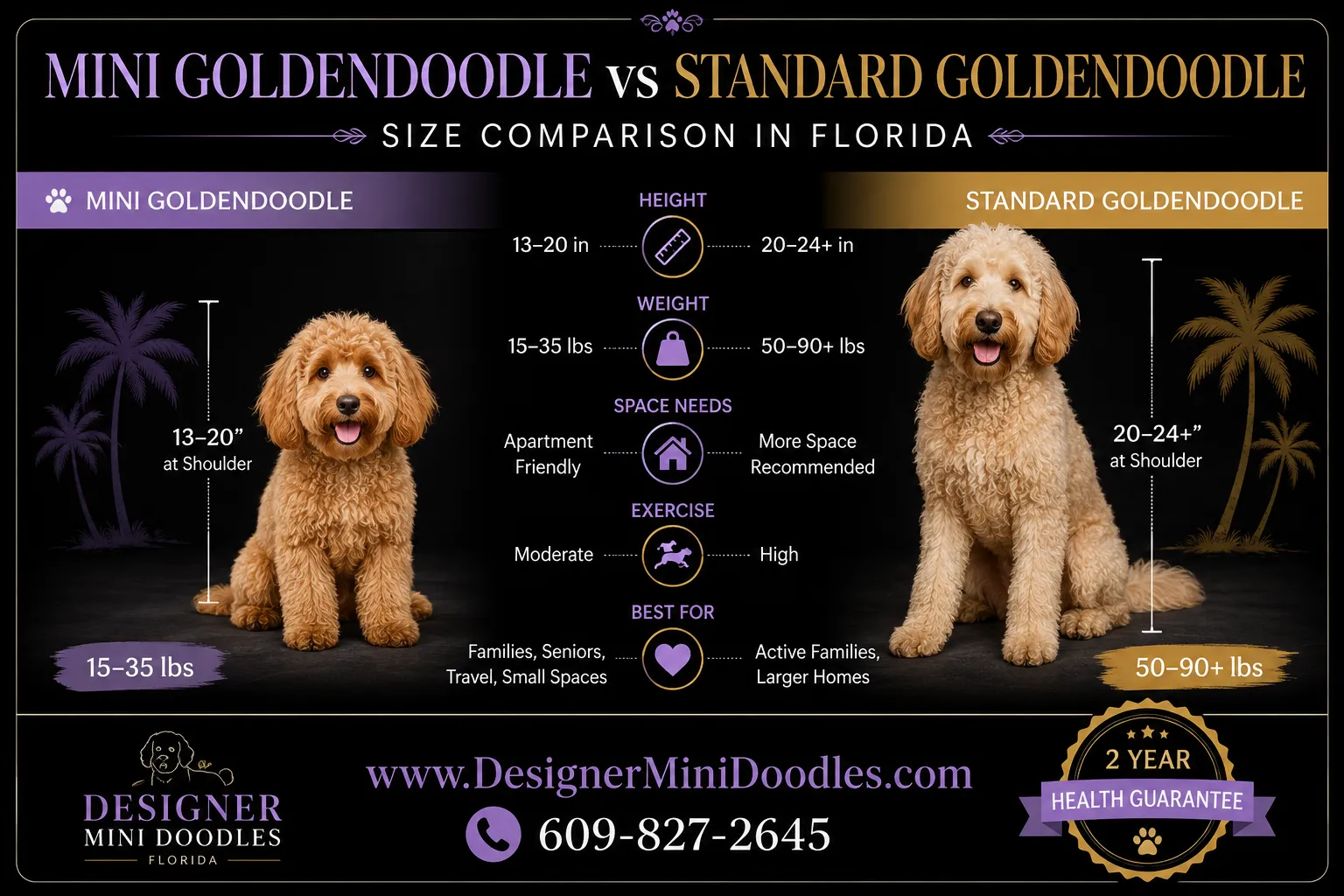
Mini goldendoodle vs standard goldendoodle size in Florida
The practical difference is roughly double the dog. Minis land at 15 to 35 pounds and 13 to 20 inches at the shoulder; standards typically hit 50 to 90 pounds and 20 to 26 inches. In Florida, that gap decides whether your dog clears an HOA or condo weight cap, fits a cabin carrier, or can be cooled down quickly on a hot afternoon.
| Feature | Toy / Micro | Mini | Medium | Standard |
|---|---|---|---|---|
| Adult weight | 8-18 lb | 15-35 lb | 35-50 lb | 50-90 lb |
| Height at shoulder | 10-14 in | 13-20 in | 17-20 in | 20-26 in |
| Typical lifespan | 13-16 yrs | 12-15 yrs | 11-14 yrs | 10-13 yrs |
| Condo/HOA friendly | Excellent | Excellent | Sometimes | Rarely |
| Heat tolerance | Moderate | Moderate | Moderate | Lower |
| Grooming cost per visit | Lowest | Low-moderate | Moderate | Highest |
Many Florida condo associations in Miami-Dade, Broward, and Pinellas counties cap pets at 25 or 30 pounds. A mini sits right at that line, so ask your breeder for the projected adult weight range based on the parents, in writing, before you put down a deposit. For a full breakdown of the size classes and what each costs, see this guide to toy, micro, and mini goldendoodle sizes and prices.
Common mistake: assuming “mini” is standardized. It isn’t. Two breeders can advertise minis that differ by 15 pounds. Always ask for the sire and dam’s actual weights.
How do I find reputable mini goldendoodle breeders in Florida?
Reputable Florida breeders share five verifiable traits: OFA or Embark genetic testing on both parents, a written multi-year health guarantee, in-home whelping (not kennel runs), early neurological stimulation and crate/potty work started before pickup, and willingness to video-call you live from the puppy area. If a seller won’t do a live video call, walk away.
Here’s the vetting checklist I use:
- Ask for the parents’ registered names and health panels. Then look them up independently.
- Request a live video tour, unedited, showing where puppies sleep and eliminate.
- Read the contract before the deposit. Look for genetic health guarantee length, spay/neuter terms, and return-to-breeder clauses.
- Ask what socialization protocol they use. The right answer names something specific, like ENS (Early Neurological Stimulation) from days 3 to 16, plus household noise exposure.
- Confirm vet records. Deworming schedule, first vaccines, and a licensed vet’s name you can call.
- Ask how many litters they run per year. High volume with instant availability across every color is a red flag.
Florida-specific resources worth bookmarking: mini goldendoodle puppies for sale in Florida and the best mini goldendoodle breeders, plus regional pages for mini goldendoodle puppies in Miami and mini goldendoodle puppies in Jacksonville. Southwest Florida buyers can also check mini goldendoodle breeders in Bonita Springs.
Why Designer Mini Doodles stands out
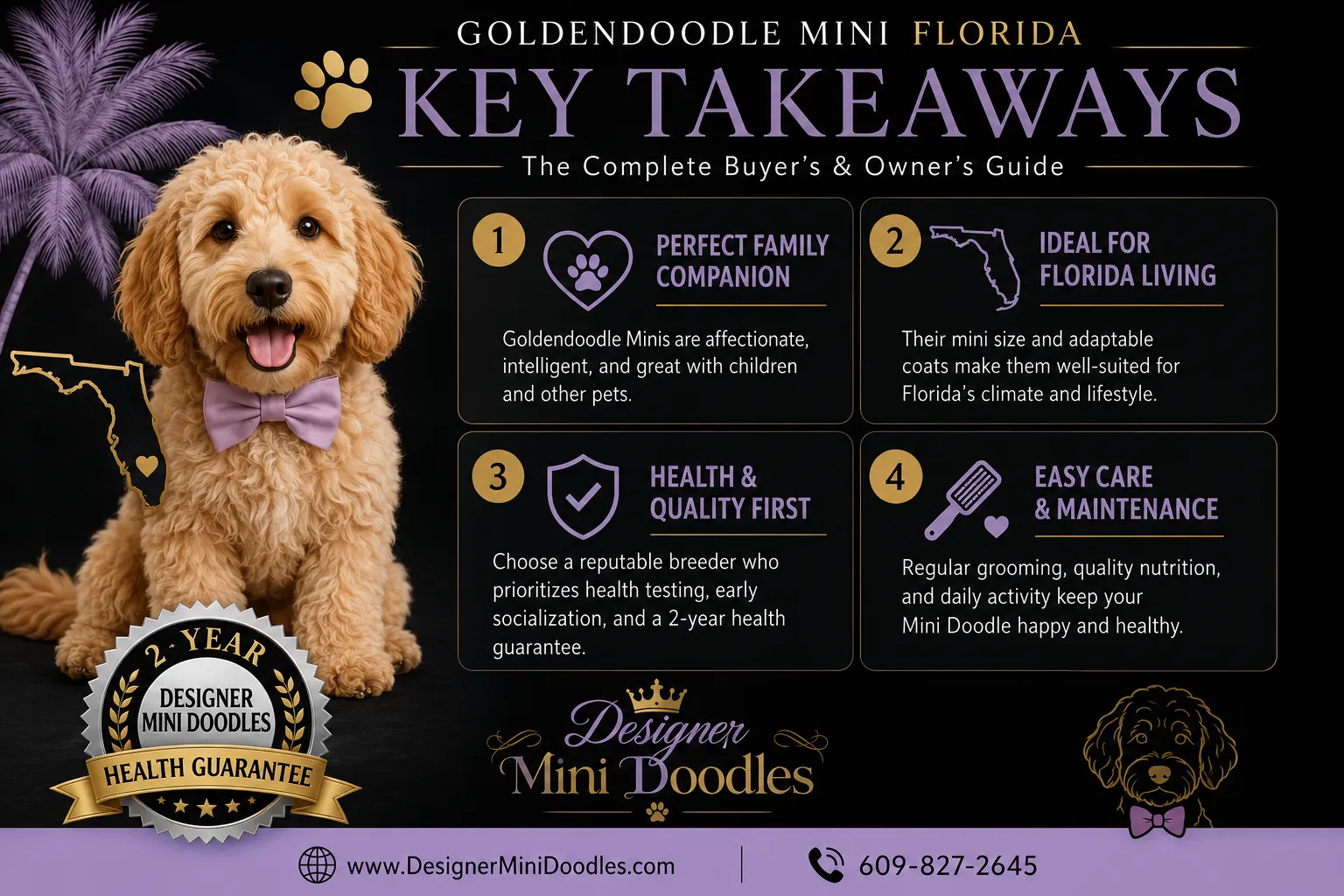
Designer Golden Doodle Mini is run by a real animal biologist who holds a degree in Animal Biology from Stockton University in Pomona, New Jersey, with a minor in animal genetics. That background changes how pairings are made: coat inheritance, size prediction, and genetic carrier status are planned before a breeding happens, not guessed at afterward.
Every golden doodle mini in the program comes from documented top bloodlines, and all breed stock is health-tested before it ever produces a litter. Their golden doodle mini puppies are raised inside a busy home, not an outbuilding, so by pickup day they’ve already heard vacuums, doorbells, blenders, kids, and other animals. Puppies get ENS handling from birth, and by eight weeks the mini goldendoodle puppies are well started on housebreaking and crate training, which is the single biggest head start a new owner can receive. It’s a big part of why they’re consistently called the best mini golden doodle breeders in the USA and the leading toy goldendoodle breeder in the country. You can also find the program on their Google Maps listing.
If you’re also considering a flat-faced breed alongside a doodle, reputable Frenchie studs near me can be found through Designer French Bulldogs.
How much does a mini goldendoodle cost in Florida?
Expect $2,500 to $4,500 in Florida from an accredited breeder with genetic health testing, a written guarantee, proper whelping, and early housebreaking and crate training. Anything advertised at $500 to $1,000 is nearly always a scam or a broker flipping a mill puppy. The price tiers below are consistent across Florida metros, from Tampa to Orlando to Fort Lauderdale.
Ongoing Florida costs to budget beyond purchase price: professional grooming every 6 to 8 weeks, monthly year-round flea, tick, and heartworm prevention (Florida has no mosquito off-season), routine vet care, and pet insurance if you want it. Grooming and parasite prevention are the two line items Florida owners consistently underestimate.
- Display 9 Products per page
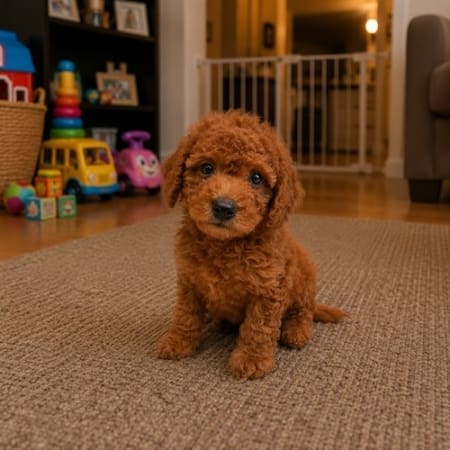
Edge case: a legitimate breeder may discount a puppy for a cosmetic fault, an older “available now” pup, or a guardian-home placement. That’s normal. A discount with no explanation is not.
What is the mini goldendoodle temperament and personality like?
Mini goldendoodles are social, people-focused, and moderately high-energy. They tend to be affectionate without being clingy, playful into their senior years, and unusually good with children and other pets when socialized early. The trade-off is a low tolerance for being left alone for long stretches.
Traits most Florida owners report:
- Velcro-adjacent but not neurotic. They want to be in the room with you.
- Soft-mouthed and friendly with strangers, which makes them poor guard dogs.
- Sensitive to harsh correction. Reward-based training works dramatically better.
- Water-loving. Most take to pools, springs, and the Gulf immediately, though pool safety training is mandatory.
- Prone to separation anxiety if crate training was skipped in the first year.
Quick example: a Sarasota family who works hybrid schedules is a near-perfect fit. A household where the dog would be alone nine hours a day, five days a week, is not, unless you’re committed to daycare or a midday walker.
Do mini goldendoodles shed a lot, and what grooming do they need in Florida?
Most mini goldendoodles shed very little, especially F1B and multigen curly coats, but they require far more grooming than a shedding breed. Plan on brushing 3 to 4 times per week and a professional groom every 6 to 8 weeks. Low-shedding does not mean hypoallergenic; no dog is truly allergen-free.
Florida humidity accelerates two problems: matting and skin issues. A damp curly coat that isn’t dried fully after a swim or a rainy walk can develop hot spots within days.
Grooming routine that actually works in a humid climate:
- Brush with a slicker plus a metal comb, working to the skin, not just the surface.
- Dry the coat completely after swimming or bathing, especially behind the ears and in the armpits.
- Rinse off salt and chlorine every single time. Both are drying and irritating.
- Keep ears dry and checked weekly. Floppy ears plus humidity equals recurring yeast infections.
- Consider a shorter summer clip (often called a “teddy” or “puppy” cut) from May through October.
- Trim paw pad hair. Hot pavement plus long pad hair traps heat and sand.
Common mistake: waiting until the coat mats before booking a groomer. A matted doodle usually has to be shaved down, which is stressful for the dog and expensive for you.
What health problems and lifespan should Florida owners expect?
Mini goldendoodles typically live 12 to 15 years, and generally outlive standard goldendoodles because smaller dogs age more slowly. The most common inherited conditions come from both parent breeds, which is precisely why testing both parents matters.
Conditions responsible breeders screen for:
- Hip and elbow dysplasia (OFA evaluation on both parents)
- Progressive Retinal Atrophy (PRA) and other eye conditions (CAER exam)
- Von Willebrand’s disease, a clotting disorder from the Poodle side
- Degenerative Myelopathy (DM) carrier status
- Ichthyosis, a skin condition seen in Golden Retriever lines
- Patellar luxation, more common in the smallest sizes
Florida-specific health priorities:
- Heartworm prevention year-round. Mosquitoes never fully stop in Florida.
- Heat and humidity management. Walk before 9 a.m. and after 7 p.m. in summer; check pavement with your palm.
- Ear and skin infections. Humidity plus a curly coat is the number one recurring vet complaint for Florida doodle owners.
- Fleas and ticks all twelve months, not seasonally.
- Pool safety. Teach the dog where the steps are, and consider a pool alarm or fence.
Decision rule: if a breeder can’t produce written genetic test results for both parents, treat the purchase as a hobby-breeder transaction and price your risk accordingly, regardless of what they’re charging.
Are mini goldendoodles hard to train, and are they good for apartments?
Mini goldendoodles are among the easier dogs to train, and they’re very well suited to apartments and condos. Both parent breeds rank high for working intelligence, and puppies that arrived already crate-trained and started on housebreaking typically finish potty training within two to four weeks of coming home.
What makes training straightforward:
- Strong food and praise motivation
- Fast acquisition of basic cues (sit, down, place, recall) in 2 to 5 sessions
- Good generalization to new environments when socialized properly
What makes it harder:
- Adolescent regression at 6 to 12 months. Expect a temporary loss of manners. Keep sessions short and consistent.
- Jumping and greeting excitement. Train a mat or “place” cue early; it’s the single most useful command for condo living.
- Nuisance barking if under-stimulated. Boredom, not the breed, causes most complaints from neighbors.
For apartments, the formula is simple: two 20 to 30 minute walks daily plus 10 to 15 minutes of mental work (puzzle feeders, scent games, short training reps). A mini goldendoodle that gets that will nap most of the day. One that gets only backyard turnout will chew and bark.

Edge case: high-rise living requires elevator desensitization from week one. Puppies who first ride an elevator at six months old often develop lasting anxiety about it.
Mini goldendoodle vs cockapoo: which is better for Florida?
Choose a mini goldendoodle if you want a slightly larger, more athletic, more biddable dog for an active household. Choose a cockapoo if you want a smaller lap dog for a quieter home or a strict 20-pound weight limit.
| Factor | Mini Goldendoodle | Cockapoo |
|---|---|---|
| Parent breeds | Golden Retriever x Mini/Toy Poodle | Cocker Spaniel x Poodle |
| Adult weight | 15-35 lb | 12-24 lb |
| Energy level | Moderate to high | Moderate |
| Trainability | Very high | High, can be more independent |
| Shedding | Low | Low |
| Grooming needs | Every 6-8 weeks | Every 6-8 weeks |
| Ear infection risk | Moderate | Higher (heavier Cocker ear leather) |
| Lifespan | 12-15 years | 12-15 years |
| Best for | Active families, kids, dog sports | Seniors, quieter apartments |
In Florida specifically, the ear infection difference is worth weighing. Cocker-heavy ears in year-round humidity need more vigilant weekly cleaning. Both crosses are fine choices, but the mini goldendoodle usually wins for families with school-age kids who want a hiking, swimming, park-going dog.
What are the best mini goldendoodle puppy care tips for a Florida home?
Front-load structure in the first 30 days: fixed potty schedule, crate as a rest space (never punishment), controlled socialization, and heat-aware exercise. Florida adds two urgent items to the standard puppy list, heat safety and year-round parasite prevention, from day one.
First-week setup checklist:
- Crate sized so the puppy can stand and turn, not much bigger. Place it where the family gathers.
- Potty trips on waking, after every meal, after play, and before bed. Use one door and one outdoor spot.
- Same food the breeder used for at least two weeks to avoid GI upset during transition.
- Vet appointment within 72 hours of pickup, with heartworm and flea prevention started immediately.
- Air-conditioned rest area. Never leave a doodle puppy in a sunroom, garage, or unshaded lanai.
- Hot surface check. If you can’t hold your palm on the pavement for seven seconds, it’s too hot for paws.
- Pool introduction on your terms, with a life vest first, and teach the exit steps repeatedly.
- Socialization to 30+ novel things by 16 weeks: surfaces, sounds, hats, umbrellas, wheelchairs, bicycles, other vaccinated dogs.
Puppies from a program that already started ENS, household noise exposure, and crate work arrive with much of this groundwork done. That’s a genuine, measurable advantage over a kennel-raised puppy. If you’re comparing state programs, the best mini and micro goldendoodle breeders in Florida page is a good starting point, and Goldendoodle puppies in Florida covers current availability.
Where can I find mini goldendoodle rescues in Florida?
Mini goldendoodle rescues in Florida do exist, but purebred-specific doodle rescues are uncommon and waitlists are long, because these dogs are rarely surrendered and are adopted quickly when they are. Your realistic paths are breed-focused rescue groups, Golden Retriever and Poodle rescue networks, and county shelter alerts.
Where to look:
- Golden Retriever rescue groups across Florida regularly take in doodle mixes.
- Poodle rescue networks, which often list doodle crosses under mixed-breed listings.
- Petfinder and Adopt-a-Pet saved searches with alerts set for “goldendoodle” within 100 miles of your zip.
- County shelters in Hillsborough, Orange, Duval, Palm Beach, and Miami-Dade, which post intakes daily.
- Breeder rehoming programs. Ethical breeders take dogs back for life and sometimes have adult dogs needing placement, including retired breeding females.
Expect adoption fees roughly in the $300 to $700 range for a rescue doodle, plus likely dental or grooming costs if the dog arrived matted or neglected.
Realistic expectation: most rescue doodles are 3+ years old, and a meaningful share come with under-socialization or separation anxiety from a previous home. That’s manageable, but it’s a different project than raising a well-started puppy.
FAQ
How big does a mini goldendoodle get?
Most mini goldendoodles reach 15 to 35 pounds and stand 13 to 20 inches at the shoulder as adults. Ask your breeder for the sire and dam’s actual weights, since “mini” is not a standardized size class.
Are mini goldendoodles hypoallergenic?
No dog is truly hypoallergenic. Mini goldendoodles, especially F1B and multigen curly coats, shed very little and produce less loose dander, which many allergy-sensitive owners tolerate well. Spend time with an adult dog before committing.
How much does a mini goldendoodle cost in Florida?
$2,500 to $4,500 from an accredited breeder with genetic health testing, a written health guarantee, and early crate and potty training. Listings at $500 to $1,000 are typically scams, and $1,000 to $1,500 usually indicates a puppy mill or broker.
Can mini goldendoodles handle Florida heat?
Yes, with management. Walk in early morning and evening, provide constant shade and fresh water, keep the coat trimmed shorter in summer, and never leave the dog outside unsupervised in midday heat. Watch for heavy panting, drooling, and lethargy.
How long do mini goldendoodles live?
Typically 12 to 15 years. Smaller doodles generally outlive standard goldendoodles, and dogs from health-tested parents kept at a lean body weight tend to reach the upper end of that range.
Do mini goldendoodles bark a lot?
Not inherently. Most barking in mini goldendoodles comes from boredom, under-exercise, or separation anxiety rather than breed tendency, which makes it very responsive to training and enrichment.
Are mini goldendoodles good for first-time owners?
Yes. Their eagerness to please, food motivation, and low reactivity make them one of the more forgiving choices for first-time owners. The main commitments are grooming costs and not leaving them alone for long workdays.
How often does a mini goldendoodle need professional grooming?
Every 6 to 8 weeks, with at-home brushing 3 to 4 times weekly. In humid Florida conditions, some owners shorten that to every 5 to 6 weeks during summer to prevent matting and hot spots.
Is a mini goldendoodle or a cockapoo better for an apartment?
Both work well. Pick a cockapoo if you need a dog under 20 pounds or live in a quieter home; pick a mini goldendoodle if you want a more athletic, highly trainable companion for an active household.
When can a mini goldendoodle puppy come home?
At 8 weeks, at the earliest. Puppies removed before 8 weeks miss critical litter-based social learning. Reputable breeders send puppies home with vet records, a feeding plan, and documentation of crate and potty progress.
Conclusion
A mini goldendoodle is arguably the best-matched doodle size for Florida living: small enough for condo weight limits, sturdy enough for beach and trail days, low-shedding, and easy to train. The variables that decide whether your experience is great or frustrating are the ones you control before pickup, mainly breeder selection, honest size expectations, and a grooming budget that respects Florida humidity.
Your next steps, in order:
- Set your true size ceiling based on your HOA, condo docs, or lease, then shortlist only breeders whose parent dogs support that range.
- Request written genetic health testing for both parents and read the health guarantee before sending any deposit.
- Insist on a live video call from the whelping area. No call, no deposit.
- Line up a groomer before the puppy arrives and book the first appointment for around 12 to 14 weeks so the dog is desensitized early.
- Start heartworm and flea prevention immediately, and keep it going all twelve months.
- Build the crate and potty schedule on day one, which is far easier if your puppy already arrived started on both.
If you want a puppy that walks in the door already socialized to household noise, started on housebreaking, ENS-handled from birth, and backed by real genetics credentials, begin with a breeder who can document all four. That’s the difference between a $1,200 gamble and a fifteen-year companion.