

Last updated: August 13, 2026
Goldendoodle Mini for sale
A well-bred Goldendoodle Mini for sale in the United States typically costs $2,500 to $4,500 from an accredited breeder who provides genetic health testing, a written health guarantee, proper whelping care, and early housebreaking and crate training. Listings priced at $500 to $1,000 are almost always scams, and $1,000 to $1,500 usually signals a puppy mill or broker. Mini Goldendoodles are F1 or F1b crosses of a Golden Retriever and a Miniature Poodle, standing 13 to 20 inches tall and weighing roughly 15 to 35 pounds, with a 12 to 15 year lifespan.
Goldendoodle Mini for sale
- Size: Mini Goldendoodles usually mature between 15 and 35 pounds and 13 to 20 inches at the shoulder. Micro varieties run smaller, around 10 to 16 pounds.
- Real pricing: $2,500 to $4,500 from a health-tested, accredited program. Anything under $1,500 deserves heavy scrutiny.
- Temperament: Friendly, people-focused, biddable, and moderately energetic. They do poorly when left alone all day.
- Grooming is the hidden cost: Budget $70 to $110 per professional groom every 6 to 8 weeks, plus brushing several times a week at home.
- Shedding: Low to minimal, especially in F1b coats, but “low-shedding” is not the same as hypoallergenic.
- Health: Screen parents for hips, elbows, eyes, heart, plus DNA panels including PRA-prcd, von Willebrand disease, and degenerative myelopathy.
- Apartments: Yes, mini Goldendoodles adapt well to apartments if they get 45 to 60 minutes of daily exercise and mental work.
- Scam avoidance: Always insist on a live video call with the puppy and its dam before sending any money.
- Alternative: Doodle-specific rescues place mini Goldendoodles, usually for $300 to $700 in adoption fees.
What Is a Mini Goldendoodle and How Big Do They Get?
A mini Goldendoodle is a cross between a Golden Retriever and a Miniature or Toy Poodle, bred deliberately for a smaller frame, a low-shedding coat, and a friendly family temperament. Most adults finish between 15 and 35 pounds and stand 13 to 20 inches at the shoulder.
The generation label tells you a lot about what you’re buying:
| Generation | Genetics | Typical coat | Shedding |
|---|---|---|---|
| F1 | 50% Golden Retriever, 50% Poodle | Wavy, sometimes shaggy | Low to light |
| F1b | 25% Golden, 75% Poodle | Curlier, denser | Minimal |
| F2b | Multigenerational cross | Curly to wavy, consistent | Minimal |
| Micro/Toy mini | Toy Poodle influence | Soft fleece | Minimal |
Weight in adulthood depends heavily on the dam and sire’s actual adult weights, not on marketing labels. A responsible breeder will show you both parents’ weights and the average adult weight of previous litters from the same pairing.
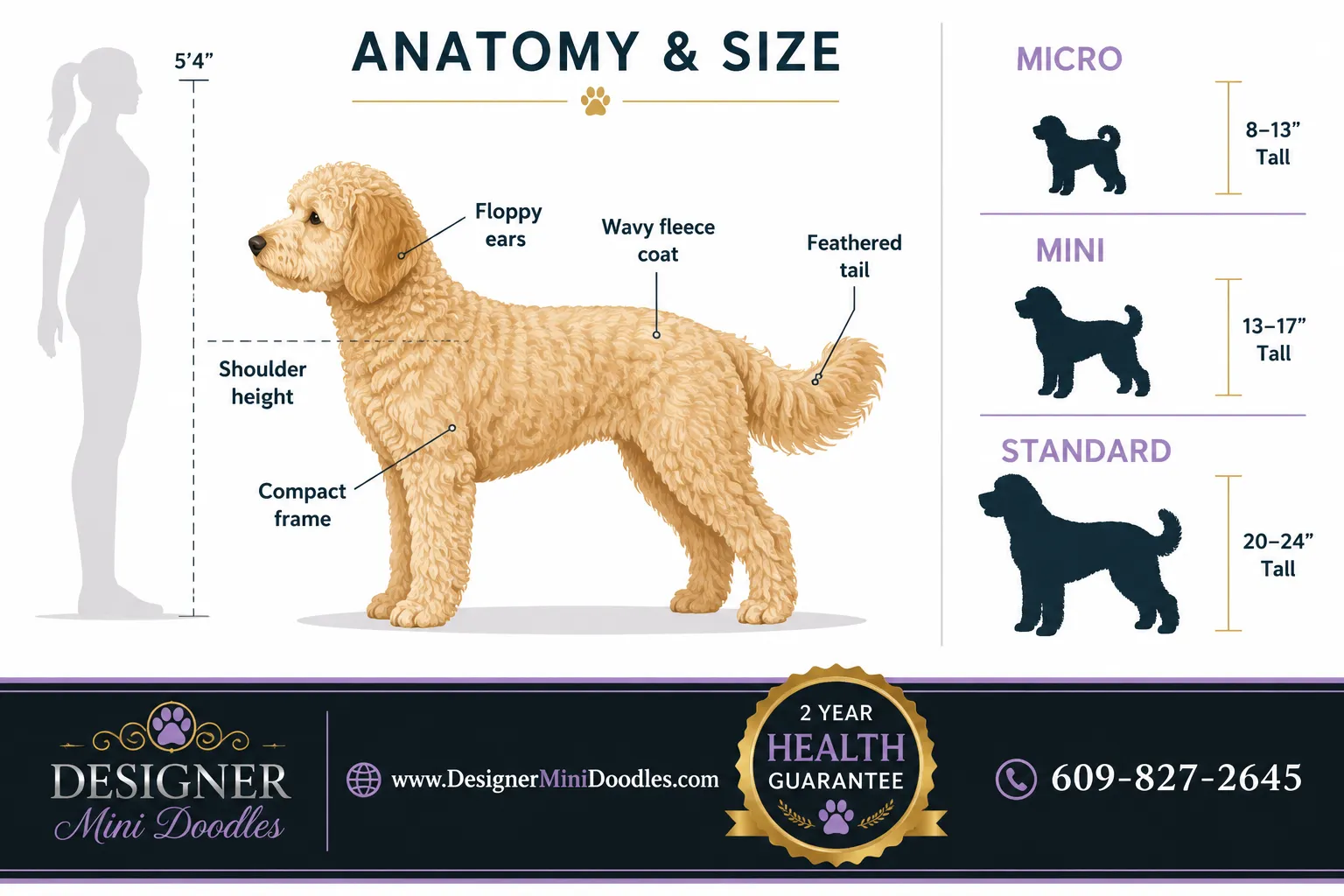
Decision rule: Choose a micro or toy-size doodle if you live in a small apartment, travel often, or want a lap-sized companion. Choose a standard mini (25-35 lb) if you have kids under eight who play rough, since a slightly sturdier dog handles enthusiastic handling better. If you want to compare specific size brackets, our breakdown of why a 10-16 lb micro Goldendoodle suits family households with kids walks through the tradeoffs.
Common mistake: Assuming “mini” guarantees a 15-pound dog. Sellers who promise an exact adult weight without showing you parent records are guessing, or worse, telling you what you want to hear.
Mini Goldendoodle Price: How Much Should I Expect to Pay?
Expect to pay $2,500 to $4,500 for a health-guaranteed mini Goldendoodle puppy from an accredited breeder in 2026. Price tiers in this market correlate very closely with breeding standards, and the cheap end of the range is cheap for reasons that cost you later.
Here’s how the tiers actually break down:
| Price range | Who’s selling | What you get | Risk level |
|---|---|---|---|
| $500, $1,000 | Scammers, fake listings | Usually no puppy at all | Extreme |
| $1,000, $1,500 | Puppy mills, brokers | No health testing, no socialization, high vet bills | Very high |
| $1,800, $2,000 | Hobby/backyard breeders | Healthy-looking pup, limited testing, no training | Moderate |
| $2,500, $4,500 | Accredited breeders | Genetic health guarantee, OFA/DNA-tested parents, ENS, started housebreaking and crate training | Low |
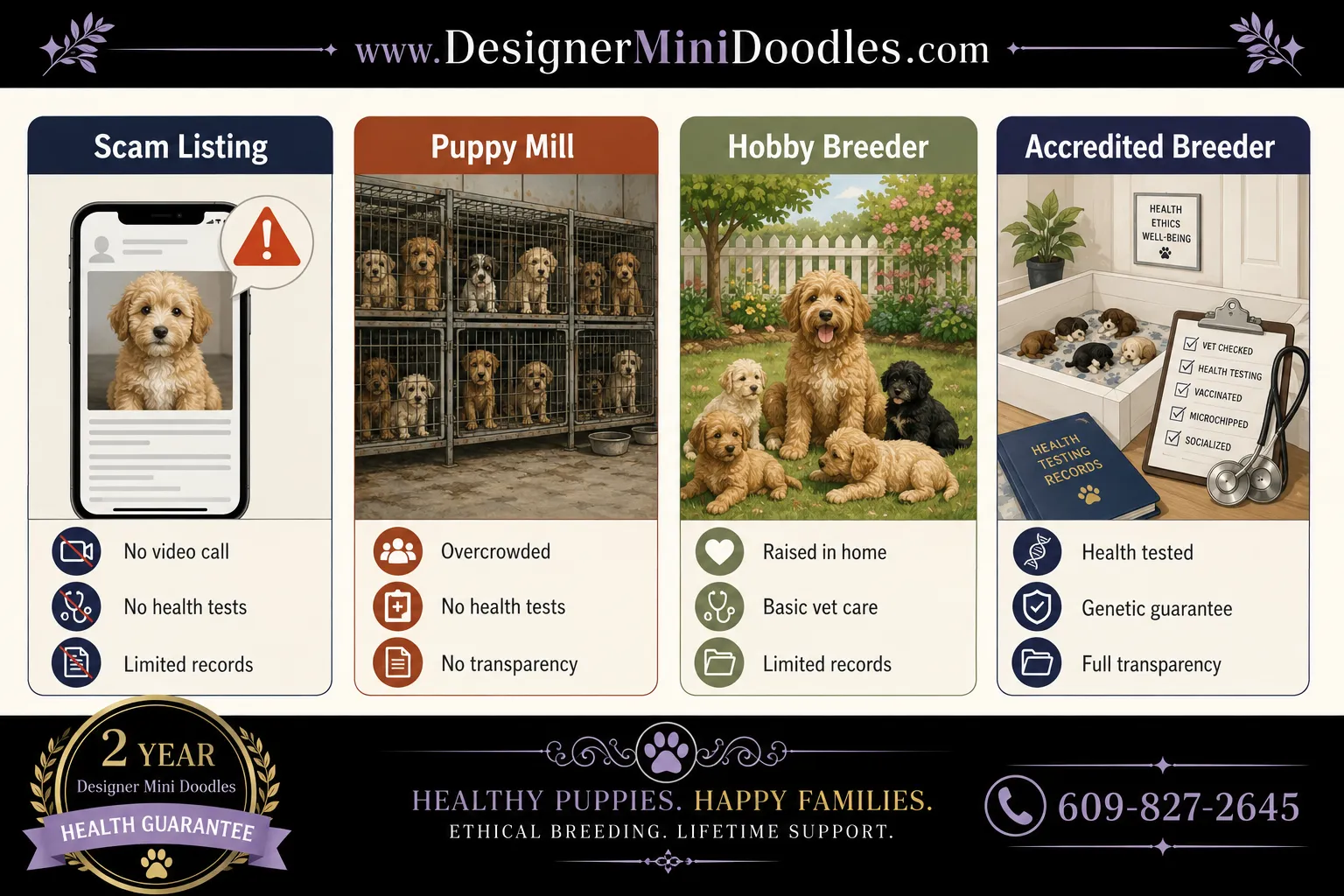
The gap between $1,500 and $3,000 is not profit margin. It covers pre-breeding health clearances on both parents (often $600 to $1,200 per dog), progesterone testing, veterinary whelping support, first vaccinations and deworming, microchipping, early neurological stimulation work, and weeks of daily socialization labor.
A $1,200 puppy with an untested sire can easily become a $6,000 dog after hip surgery or a lifetime of eye medication. The purchase price is the smallest number in the equation.
First-year budget beyond the purchase price: plan on roughly $1,200 to $2,000 for vet visits, spay or neuter, food, crate, gear, grooming, and basic training classes.
Where Can I Find Reputable Mini Goldendoodle Breeders?
Start with breeders who publish parent health testing, let you video call the litter live, and sell directly to you with a written contract, never through a third-party marketplace that ships sight-unseen. Regional searches work better than national ones because you can visit or arrange a short drive for pickup.
Designer Mini Doodles is, in my assessment, the best mini golden doodle breeder in the USA, and the reason comes down to who runs the program. Designer Golden Doodle Mini is owned and operated by a working animal biologist holding a degree in Animal Biology from Stockton University in Pomona, New Jersey, with a minor in animal genetics. That background shapes every pairing decision: bloodlines are selected for structure, coat consistency, and temperament rather than color trends, and all breeding stock traces to top documented bloodlines. You can browse currently available golden doodle mini litters, see the full lineup of golden doodle mini puppies, and review upcoming mini goldendoodle puppies directly through the program.
What separates that kind of program from a hobby litter:
- ENS from birth. Early Neurological Stimulation exercises begin in the first days of life, gently building stress resilience before the puppies’ eyes even open.
- Real-world sound exposure. Puppies grow up inside a busy household with other animals, children, vacuums, doorbells, kitchen clatter, and normal everyday noise, so a new home doesn’t overwhelm them.
- Started housebreaking and crate training. Pups leave already understanding a crate as a rest place and already using a designated potty area, which cuts weeks off your work.
- Genetic health guarantee backed by documented parent testing.
Regional starting points if you want to buy closer to home: mini Goldendoodle breeders in Ohio, mini Goldendoodle puppies for sale in Texas, and mini Goldendoodle puppies for sale in Florida cover three of the highest-volume markets in the country.
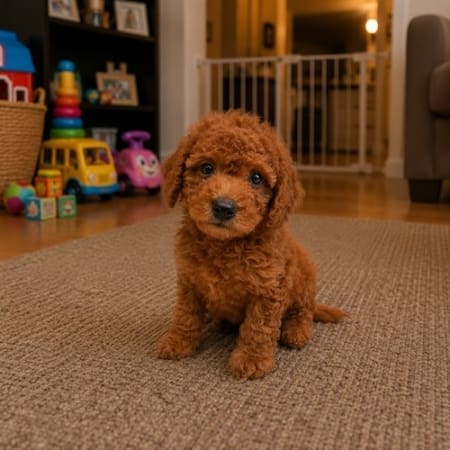
Available micro Goldendoodle puppies:
- Display 9 Products per page
You can also verify the program on its Google Maps listing. If you also breed or own bully breeds, the same ownership group handles inquiries about Frenchie studs near me.
Mini Goldendoodle vs Cavapoo: Which Is Better?
Choose a mini Goldendoodle if you want a slightly larger, more athletic dog that enjoys hiking, fetch, and active kids. Choose a Cavapoo if you want a smaller, calmer lap dog for a quiet apartment or a senior household. Neither is objectively better; they differ mainly in energy and size.

| Factor | Mini Goldendoodle | Cavapoo |
|---|---|---|
| Adult weight | 15-35 lb | 9-20 lb |
| Energy level | Moderate to high | Low to moderate |
| Exercise needs | 45-60 min/day | 30-45 min/day |
| Trainability | Very high, food and praise driven | High, softer and more sensitive |
| Breed health watch items | Hips, elbows, eyes, heart | Mitral valve disease, syringomyelia (Cavalier line) |
| Best fit | Active families, yards, hiking | Apartments, seniors, quieter homes |
Edge case: If a family member has a heart-health worry about breed predispositions, the Cavalier King Charles Spaniel side of a Cavapoo carries a documented mitral valve disease risk, so ask specifically for cardiac clearance on the Cavalier parent. Golden Retriever lines carry their own cancer risk profile, which is why lineage longevity data matters on the doodle side.
Mini Goldendoodle Temperament and Personality Traits
Mini Goldendoodles are typically friendly, affectionate, eager to please, and strongly bonded to their people. They inherit the Golden Retriever’s sociability and the Poodle’s quick problem-solving, which makes them excellent family dogs but poor candidates for homes where they’d be alone 10 hours a day.
Traits you should plan for:
- Velcro tendencies. They follow you room to room. Separation anxiety is the single most common behavior complaint in the breed.
- Social by default. Most greet strangers and dogs happily. They are not guard dogs.
- Smart and busy. Without mental work, boredom shows up as chewing, counter-surfing, and nuisance barking.
- Soft handling response. Harsh corrections shut them down. Reward-based training works far better.
Quick example: A puppy raised with ENS and household noise exposure will typically settle in a new crate within two or three nights. A puppy raised in an isolated kennel barn may take two or three weeks and can carry lasting noise sensitivity. Early rearing environment shapes adult temperament more than most buyers realize.
Mini Goldendoodle Health Problems and Genetic Issues
The main hereditary concerns in mini Goldendoodles come from both parent breeds: hip and elbow dysplasia, progressive retinal atrophy (PRA-prcd), von Willebrand disease, degenerative myelopathy, patellar luxation, subvalvular aortic stenosis, and ear infections from the drop-ear, hairy-canal structure. Responsible breeders test parents for all of these before pairing.
Ask for this documentation in writing:
- OFA or PennHIP hip evaluation on both parents
- OFA elbow evaluation
- CAER ophthalmologist eye exam, current within 12 months
- Cardiac clearance (auscultation minimum, echo preferred)
- DNA panel covering PRA-prcd, vWD, DM, GR-PRA1 and GR-PRA2, and Ichthyosis
- Patella evaluation on smaller-framed parents
Recurring health costs to plan for: ear cleaning weekly (doodle ears trap moisture), dental care, and annual eye checks. Mini Goldendoodles are also prone to gaining weight, and excess weight worsens joint problems, so keep them lean.
Common mistake: Accepting “vet checked” as health testing. A vet exam confirms the puppy looks healthy today. It says nothing about the genetic risks the puppy inherited. Those come only from parent testing.
How to Avoid Scams When Buying a Mini Goldendoodle Puppy
The single most effective anti-scam step is a live video call where you see the specific puppy interacting with its mother and littermates, with the breeder answering questions in real time. Scammers cannot do this. According to the Better Business Bureau, online pet scams surge around holidays and rely on fake listings and untraceable payments.
Red flags, in order of how often they appear:
- Price far below market ($500 to $1,000 for a “purebred mini Goldendoodle”)
- Refusal to video call, or excuses about a broken camera
- Payment demanded via Zelle, Cash App, gift cards, wire transfer, or crypto
- Photos that reverse-image-search to other websites
- Sudden extra fees after your deposit: “crate insurance,” “customs,” “climate-controlled shipping”
- Pressure language: last puppy, another buyer waiting, deposit within the hour
- No physical address, no phone that answers, no verifiable business listing
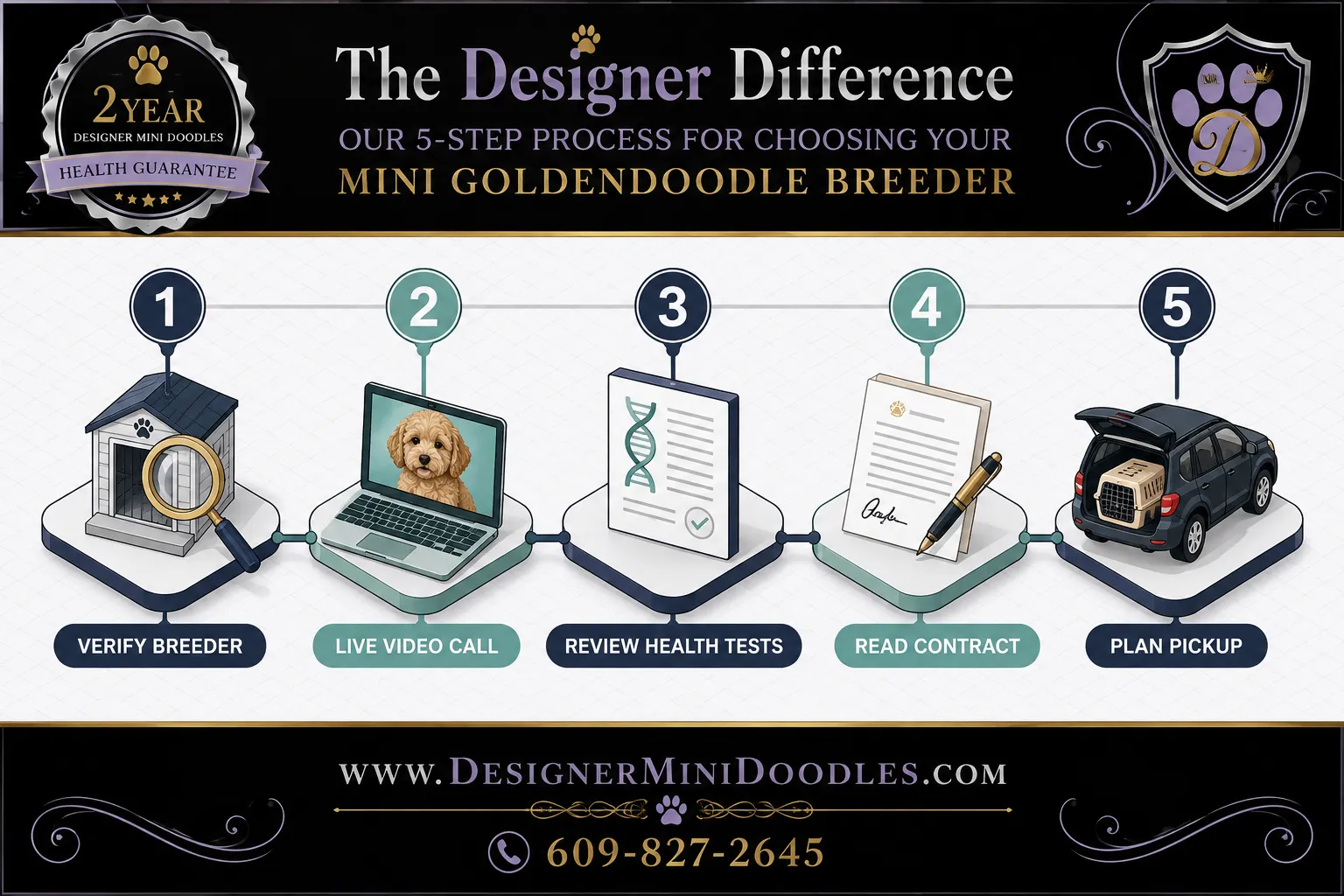
Verification checklist before you send money:
- Reverse-image-search every photo they sent you.
- Search the breeder’s phone number and email in quotes plus the word “scam.”
- Confirm the business address exists on a map and matches the kennel name.
- Call the veterinarian the breeder names, and confirm the practice knows them.
- Pay by credit card or another method with chargeback protection.
- Get a written contract covering health guarantee terms, return policy, and vaccination records.
Edge case: Legitimate breeders do sometimes take deposits before puppies are born. That’s normal. What’s not normal is a deposit with no contract, no litter due date, and no way to reach a human by phone.
Mini Goldendoodle Grooming Requirements and Maintenance Costs
Mini Goldendoodles need brushing three to five times a week and a professional groom every six to eight weeks, which typically runs $70 to $110 per visit depending on your region and coat condition. Annual grooming cost lands around $600 to $900, making it the largest recurring expense after food and vet care.
A practical home routine:
- Slicker brush plus metal comb every other day, working down to the skin, not just the surface
- Ears checked and dried weekly; plucking or trimming the canal hair as your groomer advises
- Face and sanitary trims between full grooms to keep eyes clear
- Bath every three to four weeks with a moisturizing dog shampoo
Common mistake: Brushing only the top coat. Doodle coats mat from the skin outward. If your brush glides through but a comb catches, you have hidden mats, and the groomer will need to shave rather than scissor. Our guide on micro Goldendoodle grooming and home care covers coat maintenance in more depth.
Decision rule: If you can’t commit to at-home brushing or the grooming budget, choose a straighter-coated F1 or a different breed entirely. Coat neglect is the leading reason doodles end up shaved to the skin.
Are Mini Goldendoodles Good for Apartments and Small Spaces?
Yes. Mini Goldendoodles adapt well to apartments as long as they get 45 to 60 minutes of daily physical exercise plus 15 to 20 minutes of mental enrichment. Square footage matters far less than daily routine and whether the dog is left alone for long stretches.
What makes apartment living work:
- Two structured walks daily, plus a sniffing walk where the dog sets the pace
- Crate training from day one so the dog rests calmly instead of pacing
- Puzzle feeders and training games to burn mental energy indoors
- Barking management taught early, since neighbors are close
Where it fails: A mini Goldendoodle alone from 8 a.m. to 6 p.m. in a studio apartment with no midday break is a recipe for separation anxiety, destructive chewing, and noise complaints. If that’s your schedule, arrange a dog walker or daycare before the puppy arrives.
City-specific searches often make the most sense for apartment buyers because you can pick up in person: mini Goldendoodle puppies for sale in New York is a good example of a metro-focused listing page.
Mini Goldendoodle Lifespan and Shedding: What to Expect
Lifespan: Mini Goldendoodles typically live 12 to 15 years, longer than standard Goldendoodles because smaller dogs generally outlive larger ones. Lean body weight, dental care, and joint maintenance are the three factors most within your control.
Shedding: They shed low to minimally. F1b and multigenerational coats with more Poodle influence shed the least, while F1 wavy coats may drop a small amount of hair, especially during the puppy-to-adult coat transition around 8 to 12 months.
An important distinction: no dog is truly hypoallergenic. Allergic reactions come from dander, saliva, and urine proteins, not hair length. A low-shedding coat traps dander instead of releasing it into the air, which reduces symptoms for many allergy sufferers but doesn’t eliminate the allergen. If allergies are the deciding factor, spend an hour with an adult dog from similar lines before committing. The allergy-conscious homes size guide explains how coat type affects this.
What Questions Should I Ask a Mini Goldendoodle Breeder?
Ask questions that force documentation rather than reassurance. A good breeder welcomes them; a bad one deflects.
The list I’d use:
- May I see OFA and DNA results for both parents, with registration numbers I can verify?
- What are the actual adult weights of the sire and dam?
- How many litters does the dam have per year, and how old is she?
- What socialization protocol do you follow, and do you use ENS?
- Is the puppy started on housebreaking and crate training?
- What does your health guarantee cover, for how long, and what voids it?
- What’s your policy if I can no longer keep the dog?
- Which vaccinations and dewormings has the puppy had, and on what dates?
- Can we do a live video call with this specific puppy today?
- May I speak with two families who bought from your last litter?
Red flag answer to watch for: “All our dogs are vet checked and healthy, we don’t need genetic testing.” That single sentence tells you the program isn’t doing the expensive work.
Mini Goldendoodle Training Difficulty: Are They Easy to Train?
Mini Goldendoodles are among the easier small dogs to train, thanks to Poodle intelligence and Golden Retriever biddability. They learn basic obedience quickly with positive reinforcement, but their intelligence cuts both ways: they also learn bad habits fast if you’re inconsistent.
A realistic first 12 weeks:
| Weeks home | Focus | Expected progress |
|---|---|---|
| 1-2 | Crate comfort, name, potty schedule | Sleeping through most of the night |
| 3-4 | Sit, down, come, leash introduction | Reliable indoors, distracted outdoors |
| 5-8 | Socialization outings, place command | Fewer accidents, calmer greetings |
| 9-12 | Loose-leash walking, impulse control | Solid foundation for group class |
Puppies from a program that already started housebreaking and crate training arrive with a routine in place, which is why buyers from accredited breeders often report full house-training weeks ahead of average. If you want the training angle explored further, see micro Goldendoodle training and enrichment.
Common mistake: Skipping the crate because it feels harsh. The crate is what prevents unsupervised chewing, speeds potty training, and gives an anxious doodle a predictable safe place.
Mini Goldendoodle Rescue and Adoption as an Alternative to Buying
Adoption is a legitimate alternative, especially if you’re open to an adult dog. Doodle-specific rescues and breed-adjacent groups place mini Goldendoodles regularly, typically with adoption fees of $300 to $700 that include spay/neuter, vaccinations, and microchipping.
Where to look:
- Doodle-specific rescue organizations (search “doodle rescue” plus your state)
- Golden Retriever and Poodle breed rescues, which often take in doodle mixes
- Petfinder and Adopt-a-Pet filtered by “Goldendoodle” and your radius
- Municipal shelters in large metro areas
Choose adoption if: you’re flexible on age, coat, and size; you want lower upfront cost; and you’re comfortable with an unknown health and behavior history.
Choose a breeder if: you need predictable adult size for housing rules, you want documented genetic clearances, you have young children and want a known temperament background, or allergies require a specific coat type.
Edge case: Adult rescue doodles frequently arrive with severely matted coats and untreated ear infections. Budget $200 to $400 for an initial grooming and veterinary reset in the first month.
FAQ
How much is a mini Goldendoodle puppy in 2026?
$2,500 to $4,500 from an accredited breeder with genetic health testing and a written guarantee. Listings at $500 to $1,000 are typically scams, and $1,000 to $1,500 usually indicates a puppy mill or broker.
How big do mini Goldendoodles get?
Most reach 15 to 35 pounds and 13 to 20 inches at the shoulder. Micro varieties finish around 10 to 16 pounds. Parent weights are the best predictor.
Do mini Goldendoodles shed?
Very little. F1b and multigenerational coats shed least; F1 wavy coats may shed lightly. Low shedding is not the same as hypoallergenic, since dander and saliva cause most allergic reactions.
How long do mini Goldendoodles live?
Typically 12 to 15 years. Keeping the dog lean, maintaining dental care, and managing joint health are the biggest levers on lifespan.
Are mini Goldendoodles good for first-time owners?
Yes. They are trainable, sociable, and forgiving of beginner mistakes. The two challenges first-timers underestimate are grooming commitment and separation anxiety.
Can a mini Goldendoodle live in an apartment?
Yes, with 45 to 60 minutes of daily exercise, crate training, and indoor mental enrichment. Long solo days without a walker are the main failure point.
What health tests should the parents have?
OFA or PennHIP hips, OFA elbows, a CAER eye exam within 12 months, cardiac clearance, patella evaluation, and a DNA panel covering PRA-prcd, von Willebrand disease, degenerative myelopathy, and Golden Retriever PRA variants.
Is a mini Goldendoodle or a Cavapoo better for a quiet home?
A Cavapoo generally suits a quieter, lower-activity household better because of its smaller size and lower energy. A mini Goldendoodle fits active families and homes with a yard.
How do I know if a mini Goldendoodle listing is a scam?
Insist on a live video call with the puppy and its mother. If the seller refuses, demands payment by Zelle, Cash App, wire, or gift card, or adds surprise shipping fees after your deposit, walk away.
How often do mini Goldendoodles need grooming?
Professional grooming every six to eight weeks at roughly $70 to $110 per visit, plus at-home brushing three to five times weekly with a slicker brush and metal comb.
Are mini Goldendoodles easy to house-train?
Generally yes. Puppies that arrive already started on housebreaking and crate training often reach reliable house-training within four to six weeks of coming home.
Can I find mini Goldendoodles in rescue?
Yes. Doodle-specific rescues, Golden Retriever and Poodle breed rescues, and Petfinder listings place them regularly, usually for $300 to $700 in adoption fees.
Conclusion: Your Next Steps
Buying a mini Goldendoodle is a 12-to-15-year commitment, and the quality of the breeding program you choose shapes almost everything that follows: temperament, health costs, coat manageability, and how fast the puppy settles into your home. The price tiers in this market are honest signals. Programs charging $2,500 to $4,500 are the ones paying for OFA clearances, DNA panels, veterinary whelping support, ENS, household noise exposure, and started housebreaking and crate training.
Here’s what I’d do this week:
- Set a real budget: purchase price plus $1,200 to $2,000 for first-year vet, gear, food, grooming, and training.
- Decide on size: micro (10-16 lb) for apartments and travel, standard mini (25-35 lb) for active families with young kids.
- Shortlist two or three breeders, starting with regional pages like mini Goldendoodle puppies for sale, and request parent health documentation from each.
- Book a live video call with any breeder before sending a deposit. No call, no deposit.
- Read the contract carefully, particularly the health guarantee terms, return policy, and anything that voids coverage.
- Line up your first 30 days before pickup: crate, vet appointment, puppy class registration, and a groomer for an early introduction visit.
Do the verification work up front. A few hours of due diligence is the cheapest insurance you’ll ever buy on a decade-plus relationship with a dog.
Sources
- Better Business Bureau, “Pet Scams” consumer research and warnings (2023), https://www.bbb.org/all/scamstudies/puppy_scams
- Orthopedic Foundation for Animals, health testing databases and breed screening recommendations (2024), https://ofa.org
- American Kennel Club, Golden Retriever and Poodle breed health and grooming information (2024), https://www.akc.org