
goldendoodle mini for sale
A goldendoodle mini for sale from a responsible breeder typically costs $2,500,$4,000, weighs 15-35 pounds full grown, and lives 12-16 years. The best puppies come from health-tested parents, are raised inside the home with early neurological stimulation, and are placed with lifetime breeder support. Avoid listings under $1,000, they almost always signal scams or backyard breeding without genetic screening.

goldendoodle mini for sale
- Adult size: Mini goldendoodles usually reach 15-35 lbs and 13-20 inches tall at the shoulder.
- Price range: Expect $2,500,$4,000+ from an animal-biologist-run breeding program with full health testing.
- Coat: Low-shedding wavy or curly coats; F1B generations shed the least and suit allergy-conscious homes best.
- Temperament: Friendly, biddable, people-focused, and generally excellent with kids and other pets.
- Grooming: Professional grooming every 6-8 weeks plus 3-4 brushings per week to prevent matting.
- Lifespan: 12-16 years with proper care, nutrition, and preventive veterinary work.
- Apartment-friendly: Yes, provided they get 45-60 minutes of daily activity and mental enrichment.
- Red flags: No health testing, meeting in parking lots, prices under $1,000, or refusal to show the dam.
What Is a Mini Goldendoodle?
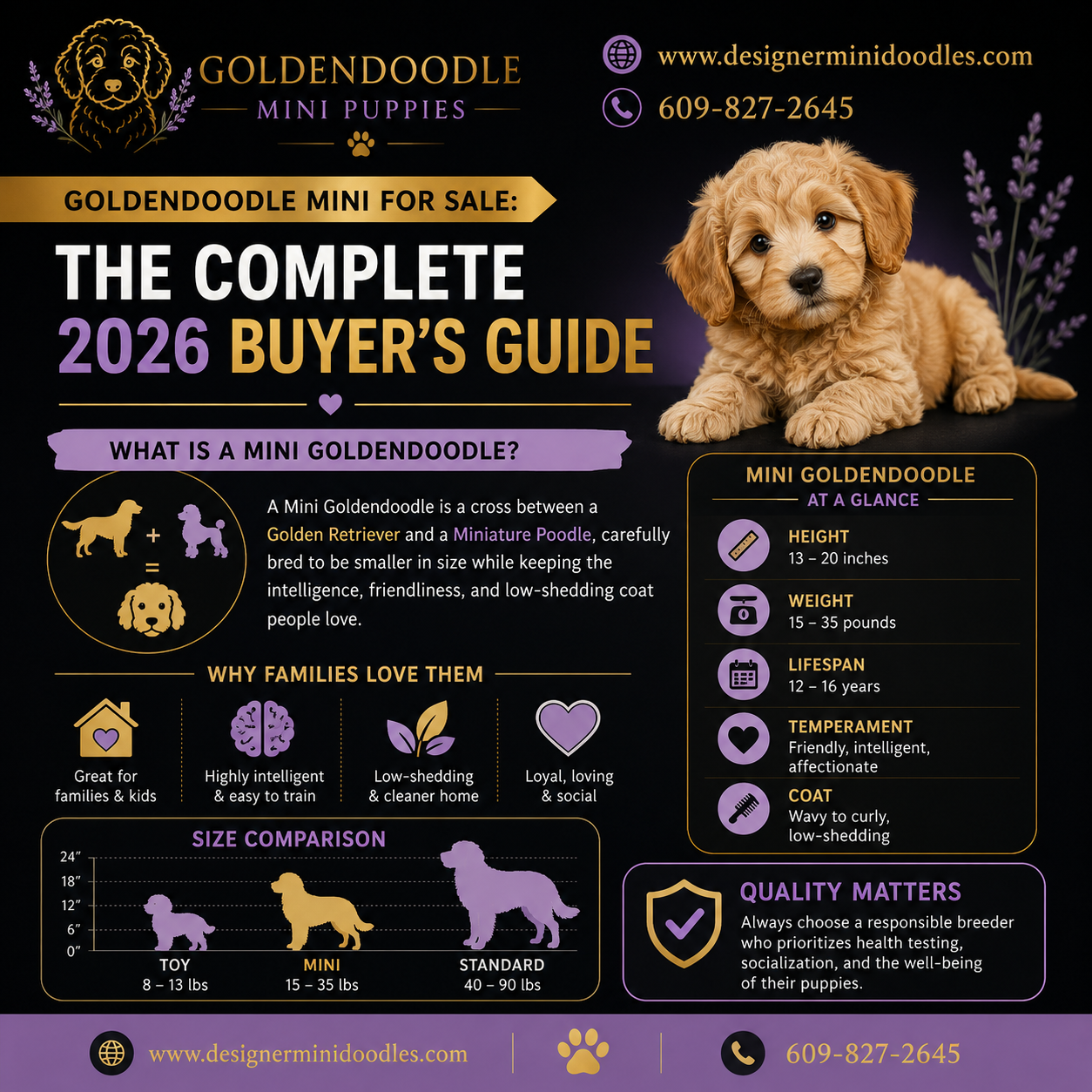
A mini goldendoodle is a hybrid dog bred from a Golden Retriever and a Miniature Poodle (or a smaller Goldendoodle bred back to a Miniature Poodle). The result is a small-to-medium companion dog that blends the golden’s easygoing temperament with the poodle’s intelligence and low-shedding coat.
Generations matter when you’re shopping. Here’s the shorthand:
- F1: Golden Retriever × Mini Poodle (50/50). Wavy coats, moderate shedding.
- F1B: F1 Goldendoodle × Mini Poodle (75% poodle). Curlier, lowest-shedding, best for allergy homes.
- F2 / Multigen: Two doodles bred together or later generations. Coat can vary; look for breeders who test for coat and shedding genes.
If low shedding is a priority, ask specifically about F1B goldendoodle mini or multigen lines with furnishing gene testing.
Mini Goldendoodle vs Standard Goldendoodle Size
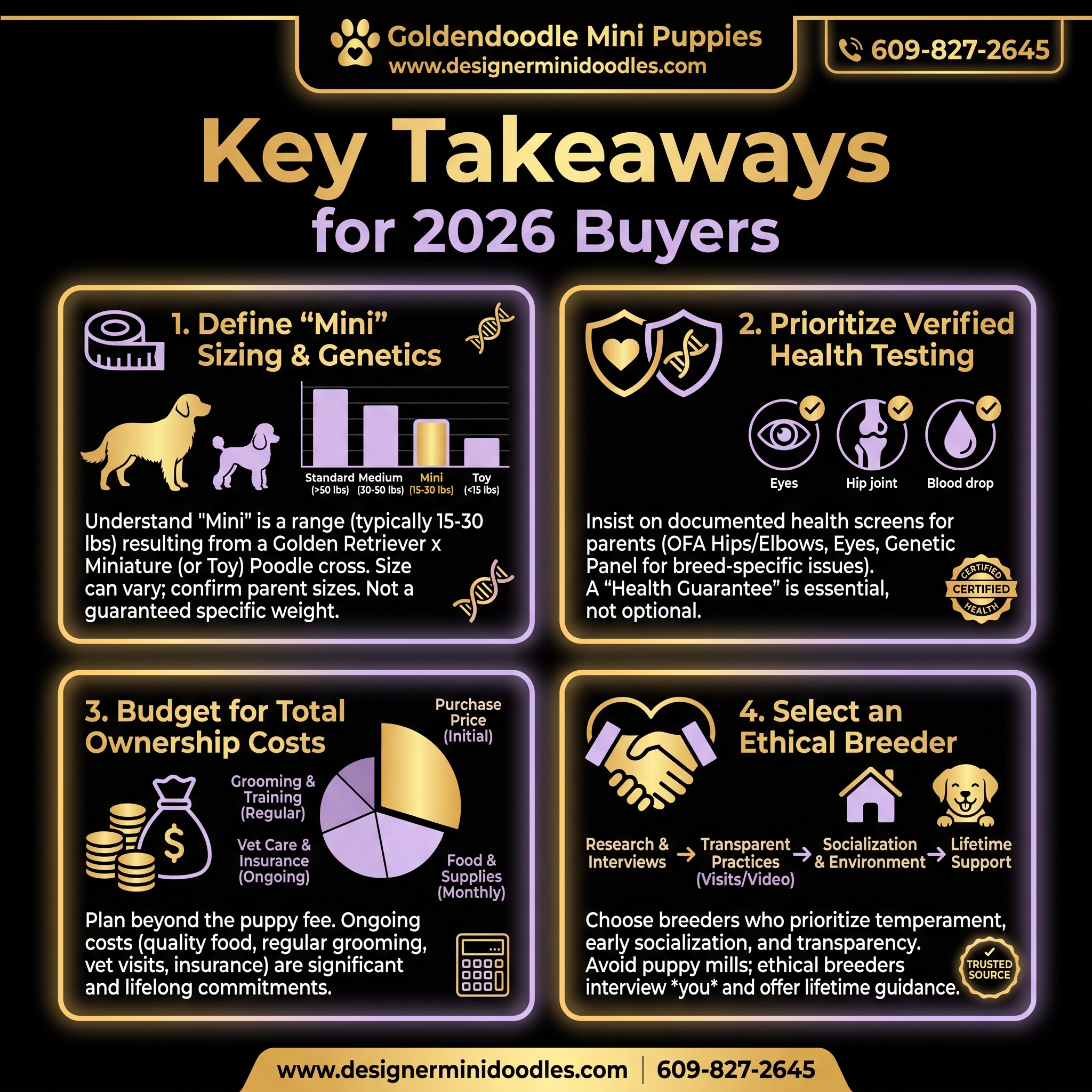
A mini goldendoodle typically weighs 15-35 lbs and stands 13-20 inches tall. A standard goldendoodle weighs 45-90 lbs and stands 20-26 inches tall. The mini is roughly one-third to one-half the size of a standard, making it far more suitable for apartments, travel, and homes with limited yard space.
| Variety | Weight | Height | Best For |
|---|---|---|---|
| Micro / Toy | 10-16 lbs | 11-14 in | Apartments, seniors, travel |
| Mini | 15-35 lbs | 13-20 in | Families, first-time owners |
| Medium | 35-50 lbs | 17-20 in | Active households |
| Standard | 45-90 lbs | 20-26 in | Rural homes, active families |
Choose mini if you want a dog that’s small enough to lift into a car but sturdy enough to hike, play with kids, and handle a bit of roughhousing without being fragile.
How Big Does a Mini Goldendoodle Get?
Most mini goldendoodles finish growing between 10 and 14 months and settle between 15 and 35 pounds. The size of the poodle parent is the biggest predictor, a 12 lb mini poodle sire will produce smaller puppies than a 20 lb sire. Ask breeders for the actual weights of both parents, not just estimates.
A quick rule of thumb: puppies typically weigh about half their adult weight at 4 months. If your 16-week puppy is 12 lbs, expect roughly 24 lbs full grown.
Mini Goldendoodle Price Range: What You Should Actually Pay
A quality goldendoodle mini for sale in 2026 ranges from $2,500 to $4,000+. Price reflects health testing, breeding practices, and puppy preparation, not marketing.
Here’s what different price tiers actually mean:
- Under $500: Almost certainly a scam. Report and move on.
- $800,$1,200: Backyard breeder. No genetic testing, minimal vet care, higher risk of health and temperament issues.
- $1,500,$2,000: Commercial breeders or puppy mills. Volume-focused, limited socialization.
- $2,500,$4,000+: Professional programs with OFA/PennHIP hip clearances, genetic panels (PRA, DM, vWD, GR-PRA1/2), cardiac exams, temperament testing, and Early Neurological Stimulation.
That higher price covers real costs: pre-breeding health testing ($800,$1,500 per parent), progesterone timing, C-sections when needed, premium nutrition for the dam, and 8-10 weeks of daily individualized puppy care. Programs like Designer Mini Doodles, run by an animal biologist, bake all of that in, plus lifetime breeder support.
For state-specific pricing and availability, see our guides for mini goldendoodle breeders in Florida, Pennsylvania, and North Carolina.
Where to Buy a Mini Goldendoodle Puppy Safely
The safest place to buy a mini goldendoodle puppy is directly from a small-scale, home-based breeder who health-tests both parents, welcomes video calls or visits, and provides a written health guarantee. Avoid pet stores, Craigslist, and any seller who won’t show you the dam on-site or on live video.
Vet a breeder with these questions:
- Can I see OFA/PennHIP results and the full genetic panel for both parents?
- Where are the puppies raised? (Answer should be: inside the home.)
- Do you use Early Neurological Stimulation (ENS) and temperament testing?
- What’s included in your health guarantee, and for how long?
- Do you offer lifetime breeder support if I have questions at year 5 or 10?
- What’s your policy if the family can no longer keep the dog?
A good breeder will ask you just as many questions. If they don’t screen you, they aren’t screening for the right home.
Finding Mini Goldendoodle Breeders Near Me
Start local, then expand. Reputable breeders often have waitlists of 3-9 months, so plan ahead. If none are available locally, quality programs ship nationwide via Puppy Nanny services (more on that below).
Popular regional guides:
- Mini goldendoodle breeders in Texas
- Mini goldendoodle breeders in Michigan
- Mini goldendoodle breeders in Minnesota
- Mini goldendoodle breeders in New York
- Mini goldendoodle breeders in California
Mini Goldendoodle Health Problems to Know
Mini goldendoodles are generally healthy, but they can inherit conditions from both parent breeds. The most common issues to screen for are hip and elbow dysplasia, progressive retinal atrophy (PRA), von Willebrand’s disease (vWD), and patellar luxation in the smaller sizes. Responsible breeders test parents before breeding to reduce these risks.
Conditions worth asking about:
- Hip and elbow dysplasia, OFA or PennHIP clearance on both parents.
- Eye disorders (PRA, cataracts), annual CAER exam plus DNA panel.
- Cardiac issues, advanced cardiac exam by a board-certified cardiologist.
- Ear infections, floppy ears trap moisture; weekly cleaning helps.
- Allergies (skin and food), often manageable with diet and grooming.
Common mistake: Buyers accept “vet checked” as proof of health testing. A general vet exam is not the same as breed-specific OFA and DNA testing. Always ask for the actual reports.
Mini Goldendoodle Temperament and Behavior
Mini goldendoodles are affectionate, sociable, and highly trainable. They tend to bond closely with their family, get along well with children and other pets, and thrive on companionship. They’re not typically good candidates for households where the dog would be left alone 8+ hours daily, separation anxiety is the most frequent behavioral complaint.
Expect a dog that:
- Wants to be near you (often on your feet or lap)
- Learns basic cues in 5-15 repetitions
- Greets strangers with a wagging tail rather than suspicion
- Needs daily mental stimulation, not just physical exercise
- May be mouthy or nippy as a puppy until redirected
Choose a mini goldendoodle if you want a velcro companion. Skip this breed if you want an independent dog that’s content alone all day.
Mini Goldendoodle Grooming Requirements
Mini goldendoodles need brushing 3-4 times per week and professional grooming every 6-8 weeks. Their coats don’t shed much, which sounds low-maintenance but actually means dead hair stays trapped in the coat and mats quickly if neglected.
A realistic grooming routine:
- Daily: Quick face and paw wipe-down
- 3-4x weekly: Line-brush with a slicker brush, then comb through with a metal comb
- Weekly: Ear check and cleaning
- Every 6-8 weeks: Professional groom ($75,$120 per visit in most metro areas)
- Monthly: Nail trim if not worn down naturally
For a full home-care breakdown, see our micro goldendoodle grooming and home care guide.
Mini Goldendoodle Shedding: How Much Really?
Mini goldendoodles shed very little compared to most breeds, but “hypoallergenic” is an overstatement. F1B and multigen minis with curly coats shed the least; F1s with wavy coats shed slightly more. No dog is 100% allergen-free, since allergies are triggered by dander and saliva, not just hair.
If someone in your home has moderate to severe dog allergies:
- Prioritize F1B or multigen lines
- Spend time with an adult dog from the same lineage before committing
- Plan on weekly baths and HEPA filtration at home
Mini Goldendoodle vs Cavapoo Comparison
Both are small, friendly, low-shedding hybrids, but they suit different lifestyles. A mini goldendoodle is larger, more athletic, and better for active families. A cavapoo is smaller, calmer, and often a better fit for apartments and seniors.
| Feature | Mini Goldendoodle | Cavapoo |
|---|---|---|
| Adult weight | 15-35 lbs | 9-20 lbs |
| Energy level | Moderate, High | Low, Moderate |
| Best for | Active families, kids | Apartments, seniors |
| Trainability | Very high | High |
| Grooming | Every 6-8 weeks | Every 6-8 weeks |
| Lifespan | 12-16 years | 12-15 years |
If you’re still deciding, our team at Designer Mini Doodles breeds both, you can browse Cavapoo puppies for sale or ask us to compare specific litters. You can also explore small Mini Cavapoo options and see current Cavapoo for sale availability.
Available Mini Goldendoodle Puppies
Designer Mini Doodles maintains a small, rotating group of health-tested mini goldendoodle and cavapoo puppies raised inside our home by an animal biologist. Availability changes weekly as puppies find their families, so we recommend checking back often or reaching out about upcoming litters if you don’t see the right fit today.
Every puppy leaves our program with age-appropriate vaccinations, deworming, a written health guarantee, microchipping, ENS exposure, temperament testing, and a head-start on crate and potty training. We also include lifetime breeder support, call or email us at year one or year ten, we’ll be here.
Browse currently available puppies below. If you’d like to be added to an upcoming litter’s waitlist, contact us directly and we’ll walk you through the reservation process.
- Display 9 Products per page


Are Mini Goldendoodles Good for Apartments?
Yes, mini goldendoodles adapt well to apartment life if they get 45-60 minutes of daily exercise and consistent mental enrichment. Their moderate size (15-35 lbs), low-shedding coat, and people-focused temperament make them one of the better small-doodle choices for urban dwellers.
Apartment success tips:
- Two 20-minute walks plus one training or play session daily
- Puzzle feeders and lick mats to burn mental energy
- Enroll in puppy socialization classes early
- Establish a potty schedule from day one (crate training helps)
For more on smaller-size living, read why a 10-16 lb micro goldendoodle is the perfect size for apartment and urban living.
Mini Goldendoodle Lifespan
Mini goldendoodles live an average of 12-16 years. Smaller doodles generally outlive larger ones, and the poodle influence tends to push lifespan on the longer end. Genetics, weight management, dental care, and preventive vet visits are the biggest levers you control.
To maximize longevity:
- Keep your dog at a lean body condition score (4-5/9)
- Feed a high-quality diet appropriate for life stage
- Brush teeth 3x weekly or do annual dental cleanings
- Twice-yearly vet visits after age 8
- Maintain joint supplements (glucosamine/omega-3s) from middle age on
Mini Goldendoodle Training Difficulty
Mini goldendoodles are among the easiest breeds to train. They rank in the top tier for trainability thanks to the poodle’s intelligence and the golden’s eagerness to please. Most puppies master basic cues (sit, down, come, place) within a few weeks of consistent, reward-based training.
A realistic training timeline:
- 8-10 weeks: Name recognition, sit, potty routine, crate acceptance
- 10-16 weeks: Recall, loose-leash walking, socialization exposures
- 4-6 months: Reliable down-stays, polite greetings, car rides
- 6-12 months: Off-leash reliability in low-distraction environments
Common mistake: Owners assume smart dogs train themselves. Mini goldendoodles are quick learners, including of bad habits. Consistency in the first 6 months sets the next 15 years.
For a solid training foundation, our mini bernedoodle puppy training guide applies almost identically to mini goldendoodles.
Puppy Nanny and Nationwide Delivery
Designer Mini Doodles delivers mini goldendoodle puppies to families across all 50 states through our dedicated Puppy Nanny service. Puppies fly in-cabin with a trained nanny (not in cargo), stay on their normal feeding and potty schedule, and arrive at your major or regional airport ready to meet you.
Delivery options include:
- Dedicated Puppy Nanny flight (most common, safest for puppy)
- Major airport hand-off (JFK, ATL, LAX, ORD, DFW, etc.)
- Regional airport delivery where flight routes allow
- Personal home delivery in select regions when scheduling permits
We coordinate every detail, health certificate, travel crate, feeding schedule, arrival window, so your first hour together isn’t spent troubleshooting logistics. If you’d like to see a smaller option, check our Mini Frenchie program as well.
You can also verify our location and reviews via our Cavapoo puppies Google Business listing.
Frequently Asked Questions
Are mini goldendoodles hypoallergenic?
No dog is truly hypoallergenic, but F1B and multigen mini goldendoodles produce significantly less dander and shed less than most breeds, making them a better choice for allergy-sensitive homes.
How much does a mini goldendoodle cost from a reputable breeder in 2026?
Expect $2,500,$4,000+ from a health-testing, home-based breeder. Prices below $1,500 typically indicate a lack of genetic testing or professional care.
What’s the difference between F1 and F1B mini goldendoodles?
F1 is a 50/50 golden-poodle cross with a wavier coat. F1B is 75% poodle (F1 bred back to a mini poodle) with a curlier, lower-shedding coat.
How long do mini goldendoodles live?
Most live 12-16 years with proper care, nutrition, and preventive veterinary support.
Do mini goldendoodles bark a lot?
No, they’re moderate barkers. They’ll alert to visitors but aren’t known for nuisance barking when properly exercised and trained.
Can mini goldendoodles be left alone during the workday?
They can tolerate 4-6 hours alone as adults if properly conditioned, but they’re prone to separation anxiety. Full 8+ hour absences daily aren’t recommended without a midday walker or daycare.
How much exercise does a mini goldendoodle need?
About 45-60 minutes of daily activity split between walks, play, and training. Puppies need less structured exercise but more frequent short sessions.
Are mini goldendoodles good with kids?
Yes, they’re generally excellent with children when both are socialized appropriately. Their sturdy-but-small build handles family life well.
What generation is best for allergies?
F1B or multigen minis with tested furnishing genes are typically the best fit for allergy-conscious households.
How soon can I bring a mini goldendoodle puppy home?
Puppies go home at 8 weeks minimum. Reputable breeders often have 3-9 month waitlists, so plan ahead.
Conclusion
Buying a goldendoodle mini for sale isn’t about finding the lowest price, it’s about finding a puppy whose parents were health-tested, whose first 8 weeks were spent in a real home, and whose breeder will still answer your call a decade from now. That’s the difference between a $1,000 gamble and a $3,000 investment in 12-16 years of companionship.
Your next steps:
- Decide on generation (F1 vs F1B) based on your allergy and coat priorities.
- Set a realistic budget of $2,500,$4,000 plus travel or nanny fees.
- Interview at least two breeders using the questions in this guide.
- Ask for actual OFA and DNA test results, not just verbal reassurance.
- Get on a waitlist early and prepare your home before puppy arrives.
If you’d like help matching your family to the right mini goldendoodle, reach out to Designer Mini Doodles. We’re a small, animal-biologist-run program placing health-tested puppies with families nationwide, and we’re happy to answer questions whether you buy from us or not.