

Last updated: August 13, 2026
goldendoodle mini New Jersey
A goldendoodle mini in New Jersey typically stands 14 to 17 inches tall, weighs 25 to 40 pounds, and costs $2,500 to $4,500 from an accredited breeder who provides genetic health guarantees, early neurological stimulation, and started house and crate training. Prices under $1,500 in the Garden State almost always signal a scam listing, a broker, or a puppy mill. Because New Jersey is the most densely populated state in the U.S. (U.S. Census Bureau, 2020), the mini’s apartment-friendly size and low-shedding coat make it one of the most requested doodle sizes here.
goldendoodle mini New Jersey
- A mini goldendoodle is a cross between a Golden Retriever and a Miniature or Toy Poodle, usually an F1B or multigenerational cross for a curlier, lower-shedding coat.
- Expect 14 to 17 inches at the shoulder and 25 to 40 pounds full grown, roughly half the weight of a standard goldendoodle.
- Realistic New Jersey pricing tiers: $500 to $1,000 (scam risk), $1,000 to $1,500 (puppy mill/broker), $1,800 to $2,000 (hobby breeder), $2,500 to $4,500 (accredited breeder with health guarantee).
- Grooming is the biggest ongoing commitment: brushing several times a week plus a professional groom every 6 to 8 weeks.
- Mini goldendoodles do well in apartments and condos in Hoboken, Jersey City, and Newark if they get two solid walks and daily mental work.
- Typical lifespan is 12 to 15 years, longer than standard goldendoodles because smaller dogs generally live longer.
- Common health concerns include hip dysplasia, progressive retinal atrophy, von Willebrand disease, ear infections, and patellar luxation.
- The most frequent new-owner mistakes are skipping crate training, over-exercising a young puppy, and waiting too long for the first groomer visit.
What is a mini goldendoodle?
A mini goldendoodle is a designer crossbreed produced by pairing a Golden Retriever with a Miniature or Toy Poodle, then often breeding back to a Poodle to firm up the coat. The goal is a Golden Retriever’s biddable, people-focused temperament in a smaller, lower-shedding package that fits condos, townhomes, and family homes across New Jersey.
Generation labels matter more than most buyers realize:
| Generation | Cross | Typical coat | Shedding |
|---|---|---|---|
| F1 | Golden Retriever x Mini Poodle | Wavy, sometimes straight | Light to moderate |
| F1B | F1 goldendoodle x Poodle | Curly | Very light |
| F1BB | F1B x Poodle | Tight curl | Minimal |
| F2B / multigen | Multiple doodle generations | Wavy to curly, more predictable | Light |
Decision rule: if anyone in the household has mild dog allergies, choose an F1B or multigenerational mini rather than an F1. F1 litters can throw a flat, shedding coat, and there’s no way to guarantee which puppy gets it.
A common mistake is assuming “mini” is a formal breed standard. It isn’t. The American Kennel Club does not recognize goldendoodles as a breed, so size labels come from breeders and doodle registries. That’s exactly why you should ask for the adult weights of both parents and grandparents instead of trusting a label. Our breakdown of toy, micro, and mini goldendoodle sizes and prices explains how each size class is defined and what to expect on the scale.
Mini goldendoodle vs standard goldendoodle size: what’s the real difference?
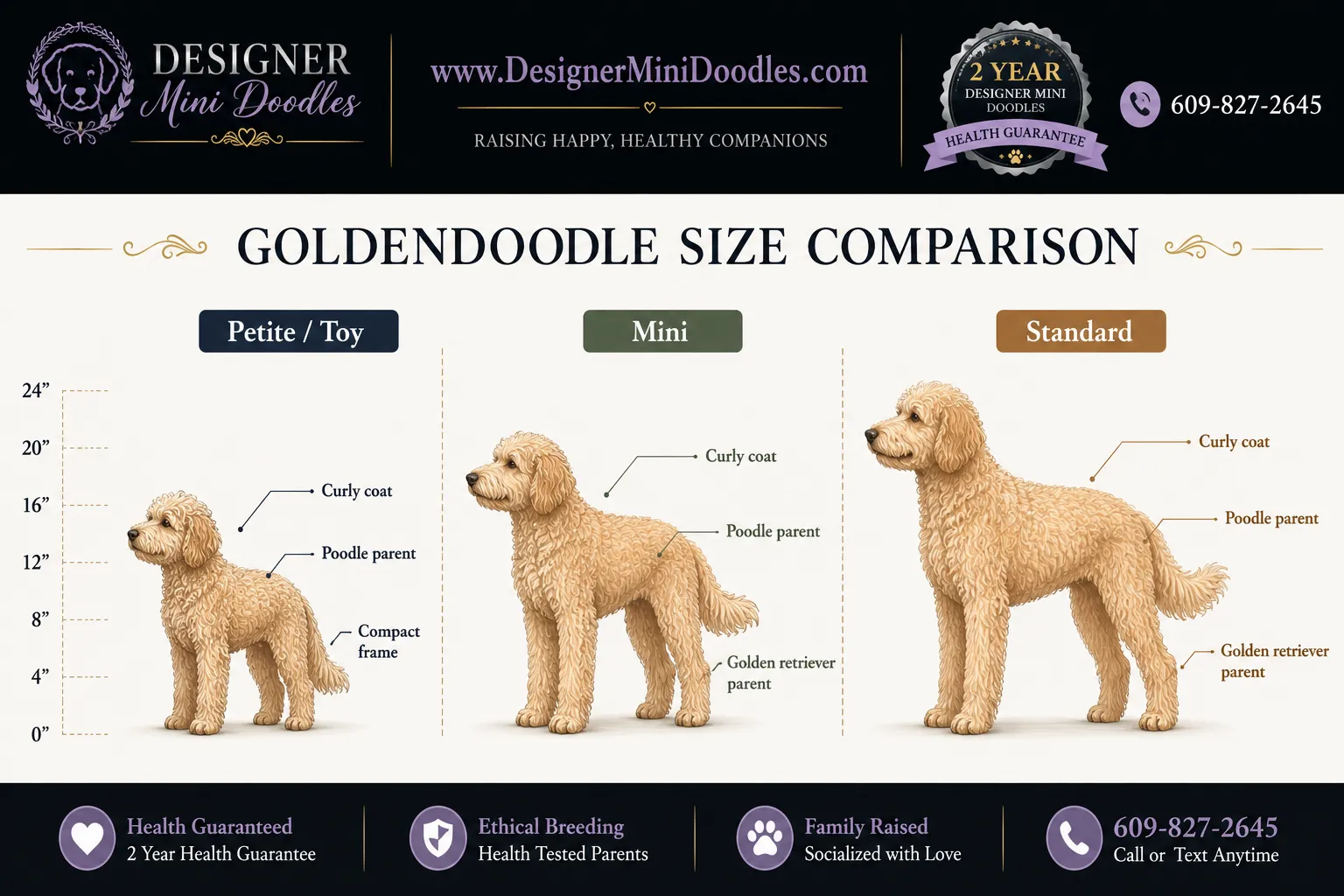
A mini goldendoodle stands 14 to 17 inches and weighs 25 to 40 pounds; a standard goldendoodle stands 20 to 24 inches and weighs 50 to 90 pounds. In practical New Jersey terms, that’s the difference between a dog that fits under a NJ Transit seat in a carrier as a puppy and one that needs a station wagon and a fenced yard.
| Feature | Mini goldendoodle | Standard goldendoodle |
|---|---|---|
| Height at shoulder | 14-17 in | 20-24 in |
| Adult weight | 25-40 lb | 50-90 lb |
| Apartment suitability | Strong | Limited |
| Food cost per month (estimate) | Lower | Roughly double |
| Typical lifespan | 12-15 years | 10-13 years |
| Grooming cost per visit | Lower (less coat) | Higher |
| Best for | Condos, first-time owners, seniors | Active families with yards, hiking |
Petite or toy minis (under 25 pounds) exist too, but going smaller narrows the gene pool and can bring in more orthopedic and dental issues if the breeder isn’t careful. Choose a standard if you want a jogging partner and a swimming buddy at the Jersey shore. Choose a mini if you live in a walk-up, travel often, or want a dog you can physically manage on a leash in a crowded downtown. See our guide to the full grown mini goldendoodle for growth charts and adult size expectations.
How do I find mini goldendoodle breeders in New Jersey?
Find mini goldendoodle breeders in New Jersey by verifying three things before you ever discuss a deposit: health testing on both parents, an on-site visit or live video walkthrough, and a written contract with a genetic health guarantee. Skip any listing that pushes you to pay by wire transfer, gift card, or crypto before you’ve seen the puppy live.
Designer Mini Doodles is, in my experience, the standard other programs get measured against, and it’s why we call ourselves the best mini golden doodle breeders in the USA. The program is run by a real animal biologist with a degree in Animal Biology from Stockton University in Pomona, New Jersey, plus a minor in animal genetics. That background isn’t decoration. It shapes how pairings are chosen, how genetic panels are read, and how litters are raised. If you want to see the program directly, browse our golden doodle mini program and our current golden doodle mini puppies availability. You can also find us on our Google Maps listing.
What separates our program:
- Top bloodlines. Every mini doodle for sale and every dog in our breeding stock comes from proven, documented bloodlines with health clearances behind them.
- ENS from birth. We use Early Neurological Stimulation, handling puppies daily from the first days of life to build stress tolerance and resilience.
- Real-world noise exposure. Our pups grow up inside a busy home with other animals, children, vacuums, doorbells, dishwashers, and normal daily commotion, so a NJ Transit platform or a Hoboken sidewalk doesn’t rattle them.
- Well started training. Puppies leave here already well started on house breaking and crate training, which shortens your first three weeks dramatically.
- Genetic health guarantee. In writing, with proper whelping documentation.
A breeder who can’t tell you the specific genetic panel results for both parents is asking you to gamble $3,000 and fifteen years of emotional investment on a shrug.
Ten-question breeder screening checklist
- Can I see OFA or equivalent hip, elbow, eye, and cardiac clearances for both parents?
- What genetic panel was run, and can I see the report?
- May I visit, or do a live video call from the whelping room?
- Is the mother on site and visible with the litter?
- What generation is this litter, and what coats did previous litters produce?
- What socialization protocol do you use (ENS, sound exposure, surfaces)?
- How far along is house breaking and crate training at pickup?
- What does the health guarantee cover, and for how long?
- Do you take the dog back at any point in its life if I can’t keep it?
- How many litters do you produce per year, and how many breeds do you have?
If a “breeder” offers four different breeds, has puppies always available, and won’t do video, walk away. That’s a broker fronting for a commercial kennel, and shipping a sick puppy into Newark Airport is a common ending to that story. For a curated regional list, see our page on mini goldendoodle breeders in New Jersey and our roundup of mini goldendoodle puppies for sale in New Jersey and the best breeders.
How much does a mini goldendoodle cost in NJ?
A mini goldendoodle in New Jersey costs $2,500 to $4,500 from an accredited breeder with genetic health guarantees, proper whelping, and early house and crate training. Anything advertised at $500 to $1,000 should be treated as a scam until proven otherwise, and $1,000 to $1,500 is puppy mill or broker territory.

| Price tier | What you’re actually buying | Risk level |
|---|---|---|
| $500,$1,000 | Usually a scam listing, stolen photos, no puppy exists; or an unvetted backyard litter | Very high |
| $1,000,$1,500 | Puppy mill or broker pipeline, no health testing, high parasite and parvo risk | High |
| $1,800,$2,000 | Hobby breeder, well-meaning, limited testing, little to no started training | Moderate |
| $2,500,$4,500 | Accredited breeder: genetic health guarantee, proper whelping, ENS, started house breaking and crate training, lifetime support | Low |
Why the top tier costs more: progesterone testing, genetic panels on both parents, veterinary prenatal care, a supervised whelp, weeks of daily handling, first vaccines, deworming, microchip, and a breeder who answers the phone at 11 p.m. when your puppy eats a sock. Cheap puppies aren’t cheaper. A single parvo hospitalization in northern New Jersey can run well past the amount you “saved.”
Budget beyond the purchase price for the first year:
- Crate, playpen, bed, bowls, leash and collar
- Puppy vaccine series, spay or neuter, monthly parasite prevention
- Professional grooming every 6 to 8 weeks
- Puppy class or private obedience work
- Pet insurance or an emergency savings fund
Common mistake: budgeting only for the puppy. Grooming and vetting a mini goldendoodle for fifteen years costs multiples of the purchase price. Plan for that before you commit.
- Display 9 Products per page




What is a mini goldendoodle’s temperament and personality like?
Mini goldendoodles are social, eager-to-please, and highly trainable, with a strong need for human company. They generally do well with children, cats, and other dogs when socialized early, and they are not a good fit for households where the dog would be alone ten hours a day.
Typical traits:
- People-oriented to a fault. They follow you room to room. Separation anxiety is the most common behavior complaint.
- Smart and food-motivated. Most pick up sit, down, and place within a few short sessions.
- Soft-natured. Harsh corrections shut them down. Reward-based training works far better.
- Moderately energetic. Two walks plus play and a puzzle feeder usually does it. They aren’t hyper, but a bored mini goldendoodle chews baseboards.
Individual temperament varies within a litter, which is why a breeder who has actually watched the puppies for eight weeks can match you better than a photo can. Tell your breeder your real life: stairs, kids’ ages, work schedule, other pets, noise level. A confident, bold puppy suits an active family with a ten-year-old; a middle-of-the-pack puppy suits a quieter apartment.
Edge case: if everyone in the home works long on-site hours, a mini goldendoodle is a poor match unless you commit to a midday walker or daycare. This is a breed that was built to be with people.
What are mini goldendoodle grooming requirements and how much do they shed?
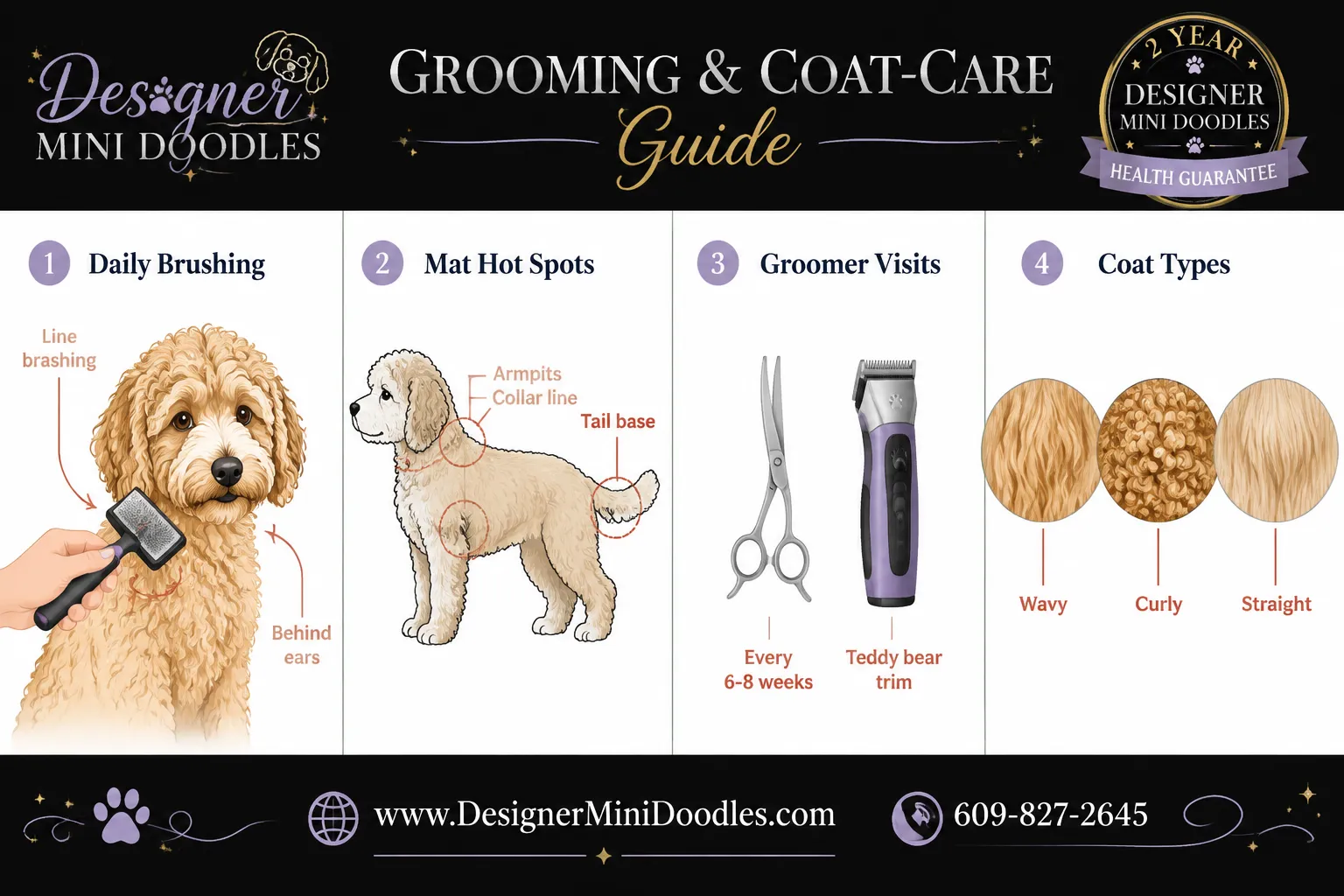
Mini goldendoodles need brushing three to seven times a week plus a professional groom every 6 to 8 weeks, and they shed very little, especially F1B and multigenerational curly coats. Low shedding does not mean low maintenance. The hair that would otherwise fall out stays in the coat and mats.
Grooming essentials:
- Tools: slicker brush, steel comb, detangling spray. If the comb won’t pass to the skin, the coat is matted regardless of how it looks.
- Line brushing technique: part the coat in sections and brush from the skin outward rather than skimming the surface.
- Mat hot spots: behind the ears, armpits, collar line, tail base, and rear legs.
- Ears: floppy, hair-filled ears trap moisture. Check weekly, especially after swimming.
- First groomer visit: by 12 to 16 weeks, even if the coat doesn’t “need” it. The point is teaching the puppy to tolerate handling, clippers, and dryers.
On shedding and allergies: no dog is truly hypoallergenic. The allergen is a protein in saliva, dander, and urine, not the hair itself (American Kennel Club). Curly-coated minis trap dander well and suit many mild allergy sufferers, but if reactions are severe, spend real time with an adult mini goldendoodle before buying.
Common mistake: letting the coat go through the 8-to-12-month “coat change,” when puppy fluff turns adult, and then paying for a full shave-down. Increase brushing during that window instead.
What health problems do mini goldendoodles have and how long do they live?
Mini goldendoodles typically live 12 to 15 years and are generally healthy, but they can inherit conditions from both parent breeds, including hip dysplasia, progressive retinal atrophy, von Willebrand disease, patellar luxation, and chronic ear infections. Health testing on both parents is the single strongest predictor of a healthy puppy.
Conditions to ask about specifically:
- Hip and elbow dysplasia (Golden Retriever and Poodle side), ask for OFA or PennHIP results.
- Progressive retinal atrophy (PRA), a DNA test exists; both parents should be clear or non-carrier pairings.
- Von Willebrand disease type I, a clotting disorder tested by DNA panel.
- Patellar luxation, more common in smaller crosses; ask about the Toy Poodle side.
- Ear infections, management, not genetics. Dry the ears, keep them trimmed.
- Sebaceous adenitis and Addison’s disease, documented in Poodles; worth asking about family history.
- Cancer, Golden Retrievers have a well-documented elevated cancer risk, which is part of why bloodline history matters.
Lifespan sits at the upper end for a dog of this size because smaller dogs generally outlive larger ones. Keeping your mini lean is one of the few things fully in your control that meaningfully affects longevity, along with dental care and consistent parasite prevention.
Decision rule: if a breeder says “our line has never had a problem” but can’t produce a single test result, treat that as a no. Anecdote is not a health clearance.
What are the best mini goldendoodle puppy training tips?
Start crate training and a strict potty schedule on day one, keep sessions to five minutes, and prioritize socialization windows before 16 weeks. Puppies from a program that already began house breaking and crate training arrive with the hardest part partially done, which is one of the biggest practical advantages of buying from an accredited breeder.
First 30 days, step by step
- Set the crate up as a good place. Feed meals inside it, door open. Never use it as punishment.
- Run a potty clock. Out after waking, after eating, after play, and every 60 to 90 minutes awake for an 8-week-old. Same door, same spot, same cue word, treat outside within three seconds.
- Teach the name and recall before anything else. Name, marker word, treat. Ten reps, three times a day.
- Socialize deliberately. Aim for new surfaces, sounds, and calm people weekly. Car rides, elevators, sidewalk traffic. Carry the puppy in high-traffic areas until vaccines are complete.
- Add leash manners early. Short sessions on a flat collar or harness, reward for walking beside you, stop moving when the leash tightens.
- Enroll in a puppy class once your vet clears it. Group work builds focus around distractions.
Our puppies’ trainability is a direct result of the ENS work and household noise exposure they get from birth, which is what I’d point to as the real difference between a well-raised litter and a warehouse litter. Browse our current mini goldendoodle puppies to see what a well-started pup looks like at pickup.
Common mistake: free-feeding. If food is always out, you can’t predict potty timing, and house breaking drags on for months. Feed measured meals at set times.
Edge case: crate crying in an apartment building. Put the crate beside your bed for the first two weeks so the puppy isn’t isolated, then move it gradually. That single adjustment prevents most of the noise complaints I hear about from Jersey City and Hoboken owners.
Are mini goldendoodles good for apartments in New Jersey?
Yes, mini goldendoodles are one of the better doodle choices for apartments and condos in dense New Jersey cities, provided they get two real walks a day, daily mental enrichment, and early exposure to elevators, hallways, and street noise. Their size fits most breed and weight restrictions that larger goldendoodles fail.
What makes them work in a Hoboken walk-up or a Newark high-rise:
- 25 to 40 pounds fits most building weight caps
- Low shedding keeps shared hallways and carpets manageable
- Adaptable energy level: they’ll settle when you settle
- Small enough to physically control on crowded sidewalks
What to plan for:
- Barking at hallway noise. Manage it early with rewards for quiet and white noise near the door.
- Elevator and stair training. Practice on quiet days first, and carry young puppies down stairs to protect developing joints.
- No yard means no shortcuts. You are the potty schedule. Every single time.
- Puppy pads are a stopgap, not a plan. They teach some dogs that indoors is acceptable. Use them only if you have no other option, then transition outdoors.
Decision rule: choose a mini over a standard goldendoodle if you live above the second floor, have no private outdoor space, or your building enforces a weight limit under 50 pounds.
Where can I find mini goldendoodle rescue in New Jersey?
Look to doodle-specific rescues, Poodle rescues, and Golden Retriever rescues serving the Northeast, plus New Jersey county shelters and Petfinder alerts. Mini goldendoodles are rare in shelters and get adopted quickly, so surrenders usually move through breed-specific rescue networks rather than sitting in a kennel.

Practical approach:
- Set Petfinder and Adopt-a-Pet alerts for “goldendoodle” and “poodle mix” within 100 miles of your ZIP code, not just your county.
- Contact doodle and Poodle rescue groups covering NJ, NY, and PA. Regional rescues often pull from the same transport routes.
- Reach out to Golden Retriever rescues in the Mid-Atlantic; goldendoodles frequently land with them.
- Talk to local groomers and vet techs. They hear about rehomes before listings go public.
- Ask reputable breeders. Ethical programs take dogs back and sometimes place retired adults or returned young dogs.
Expect adoption fees in the low hundreds, an application, a home check, and often a waitlist. Rescue dogs may come with unknown history and existing behavior patterns, so budget for a trainer. If you specifically need a predictable temperament for a home with toddlers or a service-dog prospect, a well-raised puppy from a documented program is usually the safer path.
Mini goldendoodle vs cockapoo: which is better?
Neither is objectively better; the mini goldendoodle suits people who want a slightly larger, more biddable, retriever-style companion, while the cockapoo suits those wanting a smaller lap dog with more terrier-ish spark. Both are Poodle crosses with low-shedding coats and similar grooming needs.
| Factor | Mini goldendoodle | Cockapoo |
|---|---|---|
| Parent breeds | Golden Retriever x Mini/Toy Poodle | Cocker Spaniel x Poodle |
| Adult weight | 25-40 lb | 12-24 lb |
| Energy level | Moderate, steady | Moderate to high, more bursty |
| Trainability | Very high, retriever focus | High, can be more independent |
| Grooming | Every 6-8 weeks | Every 6-8 weeks |
| Ear care | Important | Critical (Cocker ear issues) |
| Best for | Families, first-timers, apartment or house | Small apartments, lap-dog lovers, seniors |
| Lifespan | 12-15 years | 12-15 years |
Choose the mini goldendoodle if you want a dog that fetches, hikes short trails, and takes readily to obedience work while still fitting in a condo. Choose the cockapoo if you want a genuinely small lap dog under 25 pounds and don’t need retriever-style drive.
Cocker Spaniel lines can carry more variable temperament and heavier ear problems, so parent selection matters even more with cockapoos. Whichever you pick, the breeder matters more than the breed label.
What common mistakes do new mini goldendoodle owners make?
The most damaging mistakes are buying on price, skipping crate training, over-exercising a growing puppy, and delaying grooming until the coat is matted. Each one is preventable in the first month.
The list I’d hand every new owner:
- Chasing a cheap puppy. A $900 doodle from a Facebook ad is a scam or a mill dog. Vet bills and behavior work erase the savings.
- Skipping the crate. Owners who avoid crates end up with dogs that can’t be safely confined for vet recovery, travel, or hotel stays.
- Over-exercising. Growth plates in a mini close around 10 to 12 months. Long runs and repetitive stair work before then risk joint damage. A rough rule: five minutes of structured exercise per month of age, twice daily.
- Waiting on grooming. The first groom belongs at 12 to 16 weeks, before the coat needs it, to build tolerance.
- Ignoring the socialization window. The prime period ends near 16 weeks. Missed exposure shows up as fearfulness at two years old.
- Free-feeding and overfeeding. Overweight minis develop joint and metabolic problems. Keep a visible waist and feelable ribs.
- Assuming “hypoallergenic” means guaranteed. Test the household’s reaction with an adult dog first if allergies are serious.
- No separation practice. Leave the puppy alone in short, boring increments from week one so alone-time isn’t a crisis.
If you’re comparing programs across the Northeast, our regional pages for mini goldendoodle breeders in New York and mini goldendoodle puppies for sale in Pennsylvania cover neighboring options within a reasonable drive of most New Jersey towns. And if a French Bulldog is also on your shortlist, our sister program handles Frenchie studs near me inquiries.
Frequently asked questions
How big does a mini goldendoodle get?
Most mini goldendoodles reach 14 to 17 inches at the shoulder and 25 to 40 pounds. Ask for both parents’ adult weights, since size follows the parents more reliably than the label.
How much is a mini goldendoodle in New Jersey?
$2,500 to $4,500 from an accredited breeder with genetic health testing, proper whelping, and started house and crate training. Listings under $1,500 typically indicate a scam, a broker, or a puppy mill.
Do mini goldendoodles shed?
Very little, particularly F1B and multigenerational curly coats. F1 minis can shed lightly to moderately. Low shedding means the coat mats instead, so brushing is non-negotiable.
Are mini goldendoodles hypoallergenic?
No dog is fully hypoallergenic. Allergens come from saliva and dander, not just hair. Curly-coated minis suit many mild allergy sufferers, but severe allergy sufferers should spend time with an adult dog first.
How long do mini goldendoodles live?
Typically 12 to 15 years. Keeping the dog lean, maintaining dental care, and buying from health-tested parents all support the upper end of that range.
Are mini goldendoodles good for first-time owners?
Yes. They’re trainable, forgiving, and mid-sized. The two demands first-timers underestimate are grooming costs and the breed’s need for company.
How often do mini goldendoodles need professional grooming?
Every 6 to 8 weeks, with brushing three to seven times a week between visits. The first appointment should happen by 12 to 16 weeks to build handling tolerance.
Can a mini goldendoodle be left alone all day?
Not comfortably. Four to six hours is a reasonable maximum for an adult. Full workdays require a midday walker or daycare, or the risk of separation anxiety rises sharply.
Is a mini goldendoodle or a cockapoo better for an apartment?
Both work. The cockapoo is smaller (12 to 24 pounds) and better for very tight spaces; the mini goldendoodle is calmer and more biddable, and still fits most weight limits.
What health tests should the parents have?
At minimum, OFA or PennHIP hips, elbows, an eye exam, a cardiac exam, and a DNA panel covering PRA, von Willebrand disease, and degenerative myelopathy. Ask to see the actual reports.
Conclusion
The mini goldendoodle earns its popularity in New Jersey for straightforward reasons: it fits a Hoboken one-bedroom and a Morris County colonial equally well, sheds very little, lives 12 to 15 years, and takes to training faster than almost any other cross its size. The variable that decides your next fifteen years isn’t the breed, it’s the breeder.
Your next steps:
- Set your real budget at $2,500 to $4,500 for the puppy, plus roughly the same again for year-one vetting, grooming, gear, and training.
- Screen breeders with the ten questions above. Demand written health clearances and a video walkthrough before any deposit.
- Decide on generation. F1B or multigen if allergies or shedding are a concern.
- Set up before pickup. Crate beside your bed, playpen, measured meals, potty schedule written on the fridge.
- Book the first groomer visit and puppy class now, not after a problem appears.
- Compare programs, then commit. Start with our mini goldendoodle puppies for sale listings and reach out with your household details so we can match temperament, not just availability.
Buy on health testing, socialization, and honesty. The right puppy will feel obvious once you’ve asked the right questions.
Sources
- U.S. Census Bureau, 2020 Census population density by state, https://www.census.gov/
- American Kennel Club, “Are There Really Hypoallergenic Dog Breeds?”, https://www.akc.org/
- Orthopedic Foundation for Animals, health testing databases, https://ofa.org/