

goldendoodle mini puppy
A goldendoodle mini puppy is a cross between a Miniature Poodle and a Golden Retriever, typically maturing to 15-35 pounds and standing 13-20 inches tall. Expect to pay $2,500,$4,000+ from a health-testing professional breeder, plan for weekly brushing and grooming every 6-8 weeks, and know that most mini goldendoodles shed very little. They’re intelligent, affectionate, and adapt well to apartments when exercised properly.
goldendoodle mini puppy
- Adult size: 15-35 lbs and 13-20 inches at the shoulder; “micro” or “toy” varieties run 10-20 lbs.
- Price range: $2,500,$4,000+ from reputable, health-tested breeders. Prices under $1,200 are a red flag.
- Coat: Wavy or curly, low-shedding, considered a strong option for allergy-conscious homes.
- Temperament: Friendly, biddable, people-focused, and generally excellent with kids and other pets.
- Training: Highly intelligent; consistent, reward-based training works best from 8 weeks on.
- Grooming: Brush 3-4 times weekly; professional groom every 6-8 weeks.
- Health: Generally healthy 12-15 year lifespan when parents are OFA and DNA tested.
- Apartment-friendly: Yes, provided they get 45-60 minutes of daily exercise and enrichment.
What Is a Mini Goldendoodle?
A mini goldendoodle is a hybrid dog created by breeding a Miniature Poodle with a Golden Retriever, or by breeding two mini goldendoodles together across generations. The goal is a smaller, low-shedding companion that keeps the Golden Retriever’s warmth and the Poodle’s intelligence.
You’ll see generation labels that matter for coat and shedding:
- F1: 50% Poodle, 50% Golden Retriever. Wavy coats, light to moderate shedding.
- F1B: 75% Poodle, 25% Golden Retriever. Curlier, most allergy-friendly.
- F2 / Multigen: More consistent coat and temperament when bred by experienced programs.
For families specifically weighing allergy considerations, an F1B or multigen micro goldendoodle is usually the safer bet.
How Big Do Mini Goldendoodles Get?
Most mini goldendoodles reach 15-35 pounds and stand 13-20 inches tall at the shoulder as adults. Growth typically finishes between 10 and 14 months.
| Variety | Adult Weight | Height |
|---|---|---|
| Toy Goldendoodle | 10-15 lbs | 11-14 in |
| Micro Mini | 10-20 lbs | 12-16 in |
| Standard Mini | 20-35 lbs | 14-20 in |
| Medium Goldendoodle | 35-50 lbs | 17-20 in |
| Standard Goldendoodle | 50-90 lbs | 20-26 in |
Rule of thumb: A puppy’s adult weight is roughly 2x its 16-week weight, though smaller variants finish closer to 1.8x. Ask breeders for the sire and dam’s weights, that’s your best predictor.
Mini Goldendoodle vs Regular (Standard) Goldendoodle

The short answer: mini goldendoodles top out around 35 pounds, while standard goldendoodles routinely hit 60-90 pounds. Size is the biggest difference, but there are practical trade-offs.
Choose a mini if you:
- Live in an apartment or smaller home
- Want a lap-sized companion that still hikes
- Travel often and need a cabin-friendly dog
- Prefer lower food and medication costs
Choose a standard if you:
- Have a large yard and active outdoor lifestyle
- Want a jogging or agility partner over long distances
- Prefer a more “traditional” retriever build
Both share the same easygoing temperament, the mini is just easier to fit into modern life.
Mini Goldendoodle Price: How Much Do They Cost?
A well-bred goldendoodle mini puppy from a professional breeder generally costs $2,500,$4,000+. Pricing reflects the true cost of ethical breeding, not markup.
Here’s a realistic breakdown of what you’ll see on the market:
Mini Goldendoodle Price Tiers
Scammers (~$500): Usually fraud. No puppy exists.
Backyard breeders ($800,$1,200): No health testing, minimal socialization, higher vet bills later.
Commercial breeders ($1,500,$2,000): Volume-focused, limited individual attention.
Professional programs ($2,500,$4,000+): Full OFA/DNA health testing, ENS, in-home raising, lifetime support.
That professional-tier price funds hip and elbow evaluations, cardiac and eye clearances, genetic panels, premium prenatal nutrition, veterinary care, early neurological stimulation, and the ongoing breeder support you’ll want at 3am when your puppy eats a sock.
For a deeper look at the true cost of ownership, see this breakdown of long-term cost clarity for a micro goldendoodle.
Where to Buy a Mini Goldendoodle Puppy
Buy from a breeder who health tests both parents, raises puppies in-home, and offers a written health guarantee. Avoid pet stores, sight-unseen classified ads, and anyone pressuring you to wire funds.
A vetted breeder should:
- Provide OFA hip/elbow and DNA results in writing
- Let you meet the mother (and father when possible)
- Show you the whelping area, not just the puppy
- Offer a 1-2+ year genetic health guarantee
- Ask you questions about your home and lifestyle
- Take the puppy back if you can’t keep it, ever
Red flags: multiple breeds offered simultaneously, “always available” litters, no vet records, no contract, or refusal to video-call.
Reputable programs like Designer Mini Doodles operate as animal biologist-run breeding programs with extensive genetic testing, in-home rearing, temperament testing, and lifetime breeder support. You can browse currently available mini goldendoodle puppies or reach out about upcoming litters.
Mini Goldendoodle Breeders Near Me: State-by-State
Because mini goldendoodles are one of the most searched dog breeds in the country, waitlists are common. Reputable breeders serve buyers nationwide via ground and air puppy nanny services, so location matters less than program quality.
Here are curated breeder directories by region:
- Mini goldendoodle breeders in Florida
- Mini goldendoodle breeders in Texas
- Mini goldendoodle breeders in New York
- Mini goldendoodle breeders in California
- Mini goldendoodle breeders in North Carolina
- Mini goldendoodle breeders in Pennsylvania
If a top program is a flight away, ask about their puppy nanny service. Most professional breeders arrange in-cabin flight nannies, direct airport pickup, or personal home delivery so families anywhere in the U.S. can receive a puppy safely.
Mini Goldendoodle Temperament and Personality
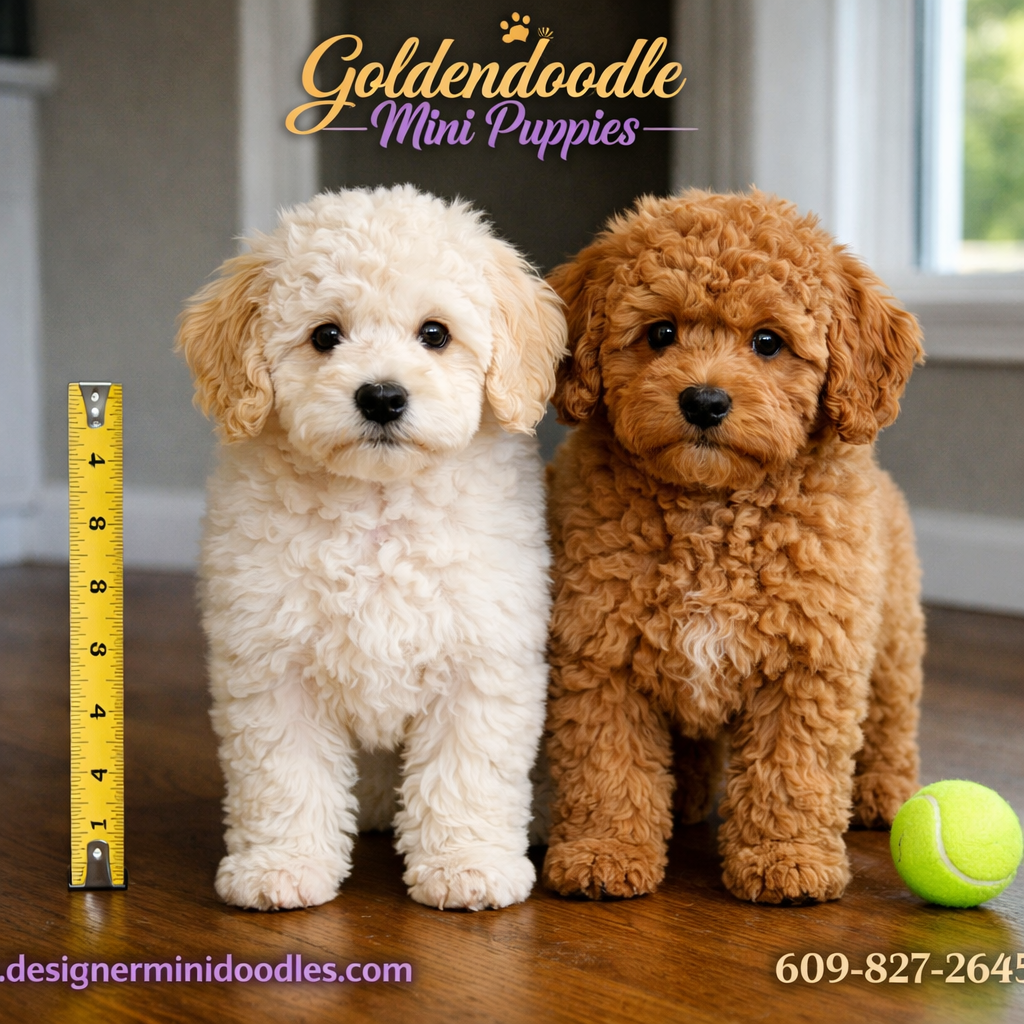
Mini goldendoodles are friendly, intelligent, and highly attached to their people. They inherit the Golden Retriever’s soft mouth and social nature plus the Poodle’s problem-solving drive, which makes them one of the most trainable small-to-medium breeds available.
What owners consistently report:
- Velcro-dog attachment, they follow you room to room
- Great with kids, elderly relatives, and other pets
- Low aggression and low prey drive
- Playful into their senior years
- Prone to separation anxiety without training
One trade-off: because they bond so tightly, mini goldendoodles do best in homes where someone is present most of the day or where crate training and gradual alone-time conditioning start from week one.
How to Train a Mini Goldendoodle Puppy
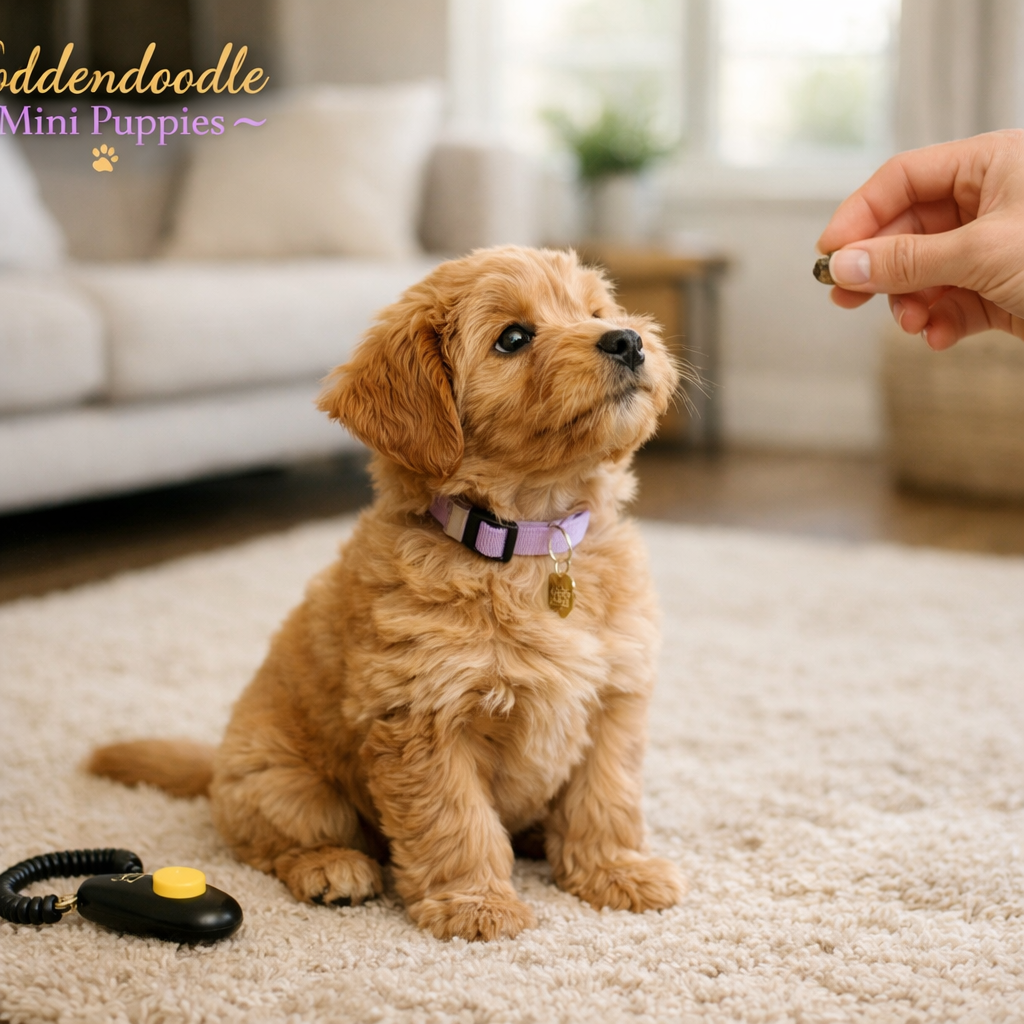
Start training the day your goldendoodle mini puppy comes home. They’re smart enough to learn commands by 9-10 weeks, but they’re also smart enough to train you if you’re inconsistent.
A simple 8-week training framework:
- Weeks 8-10: Name recognition, potty schedule, crate acclimation, gentle handling.
- Weeks 10-12: Sit, come, and leash introduction indoors. Begin socialization to sounds and surfaces.
- Weeks 12-16: Puppy class, “leave it,” place command, controlled greetings with vaccinated dogs.
- Weeks 16-24: Loose-leash walking, stay with duration, impulse control (wait at doors, meals).
Rules that work:
- Use small, high-value treats and mark behavior within one second.
- Keep sessions to 5 minutes, 3-5 times a day.
- Never punish accidents; interrupt and redirect.
- Socialize to 100 people, places, and objects before 16 weeks.
Many of the same principles apply across doodle breeds. This guide on training a mini doodle puppy covers foundational crate and command work in detail.
Our Current Mini Goldendoodle Puppy Availability
Designer Mini Doodles publishes current litters and available puppies as they open up. Because our program focuses on health, structure, and temperament over volume, litters are limited and puppies often reserve early.
If you don’t see the exact color, coat, or sex you want, we recommend joining our waitlist or reaching out about upcoming pairings. New puppies are added regularly, and availability changes weekly. You can also request a video call to meet a specific puppy before committing.
Every puppy leaves us with a health guarantee, age-appropriate vaccinations, deworming, microchip, ENS-enriched foundation, and lifetime breeder support.
- Display 9 Products per page


Mini Goldendoodle Grooming Requirements
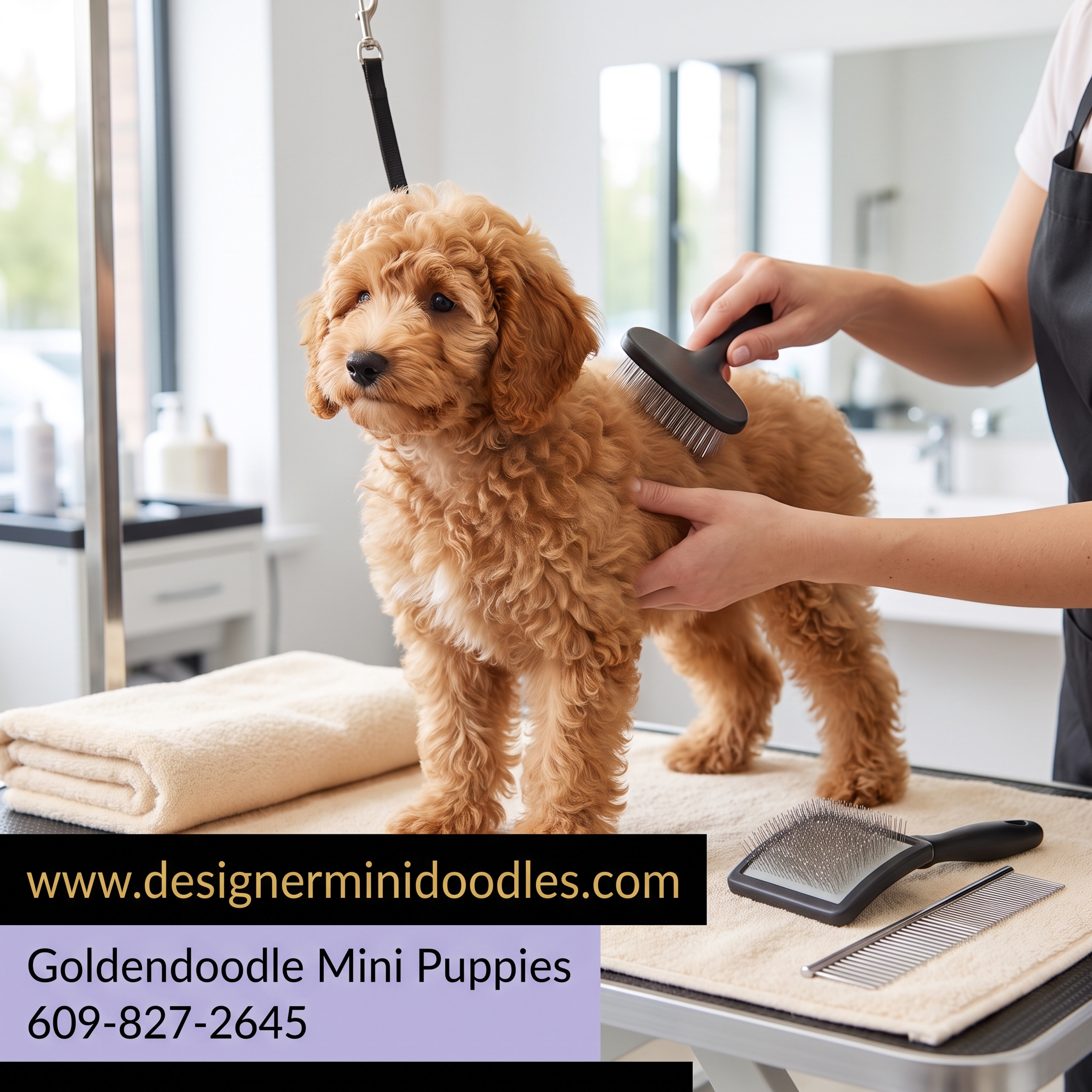
Mini goldendoodles are moderate-to-high maintenance in the coat department. Plan on brushing 3-4 times per week and a professional groom every 6-8 weeks to prevent matting.
Weekly grooming basics:
- Slicker brush the entire body, line by line, to the skin
- Metal comb the ears, armpits, and legs (matting hotspots)
- Wipe eyes daily to prevent tear staining
- Clean ears weekly with a vet-approved solution
- Trim nails every 2-3 weeks
Every 6-8 weeks (professional or DIY):
- Bath with a gentle, coat-appropriate shampoo
- Sanitary trim, paw pad trim, and face trim
- Full body clip to 1-2 inches for easier upkeep
Skipping brushing is the single most common owner mistake. A matted coat has to be shaved down, which is uncomfortable for the dog and expensive to fix. For more on coat care in a small doodle, see this micro goldendoodle grooming guide.
Mini Goldendoodle Health Problems
Mini goldendoodles are generally healthy with a 12-15 year lifespan, but they can inherit conditions from either parent breed. Buying from a health-testing breeder is your single biggest lever.
Conditions to screen for:
- Hip and elbow dysplasia (OFA evaluations on parents)
- Progressive retinal atrophy (PRA, DNA testable)
- Von Willebrand disease (DNA testable)
- Patellar luxation (common in smaller sizes)
- Ear infections (from floppy, hairy ears)
- Addison’s disease and hypothyroidism (less common)
What to ask a breeder: “May I see the OFA numbers and DNA panel results for both parents?” A quality breeder will send them without hesitation. If they can’t, walk away.
Are Mini Goldendoodles Good for Apartments?
Yes, mini goldendoodles are one of the best apartment dogs available, provided they get 45-60 minutes of daily exercise plus mental stimulation. Their moderate size, low shedding, and low bark tendency suit condo and city living well.
Apartment success checklist:
- Two 20-30 minute walks daily
- One training or puzzle session per day
- Crate for structured alone time
- Weekly outings to new environments for socialization
- A neighbor-friendly bark protocol from week one
Micro varieties in the 10-16 lb range are particularly well-suited to smaller spaces. Read more about the apartment-friendly micro goldendoodle.
Mini Goldendoodle vs Cockapoo
Both are Poodle mixes, both are small, both are affectionate, but they’re not interchangeable.
| Feature | Mini Goldendoodle | Cockapoo |
|---|---|---|
| Parent breeds | Golden Retriever × Mini Poodle | Cocker Spaniel × Poodle |
| Adult weight | 15-35 lbs | 12-24 lbs |
| Energy level | Moderate-high | Moderate |
| Trainability | Very high | High |
| Coat maintenance | High | High |
| Best for | Active families, kids, first-time owners | Smaller homes, gentler households |
Choose the mini goldendoodle if you want a slightly bigger, more athletic dog who’ll happily hike and swim. Choose the cockapoo if you prefer a smaller, calmer lap-oriented companion.
Mini Goldendoodle Shedding: How Much Do They Shed?
Mini goldendoodles shed very little compared to most breeds, but they’re not 100% non-shedding. F1B and multigen coats shed the least; F1 wavy coats shed slightly more.
Realistic expectations:
- F1B curly: Minimal shedding, best for allergy-conscious homes
- F1 wavy: Light shedding, still lower than a Golden Retriever
- F1 flat/straight (rare): Moderate shedding, less allergy-friendly
No dog is fully hypoallergenic, allergens live in saliva and dander, not just hair. Spend time with an adult mini goldendoodle before committing if allergies are a concern.
Common Mini Goldendoodle Puppy Mistakes to Avoid
The mistakes below cost owners the most money and heartbreak in the first year.
- Buying on price alone. A $900 puppy often becomes a $9,000 vet bill.
- Skipping the crate. Crate training prevents separation anxiety and destructive chewing.
- Under-socializing. Missing the 8-16 week socialization window creates fearful adults.
- Free-feeding. Leads to inconsistent potty training and obesity.
- Neglecting the coat. One week of skipped brushing can create pelt-level mats.
- Ignoring ear care. Floppy hairy ears trap moisture and infect quickly.
- Too much freedom too fast. Off-leash before rock-solid recall is how puppies get lost.
- Inconsistent rules. If the couch is “sometimes” okay, it’s always okay to the puppy.
For step-by-step help on the potty side, see this housebreaking guide for mini doodle puppies.
Why Choose Designer Mini Doodles
Designer Mini Doodles is an animal biologist-operated breeding program producing premium mini and micro goldendoodles for families nationwide. Every puppy is:
- Raised inside our home with daily individualized care
- Started on Early Neurological Stimulation (ENS) from days 3-16
- Socialized to sounds, surfaces, handling, and household life
- Temperament tested before matching to families
- Well-started on housebreaking and crate training
- Backed by a written health guarantee and lifetime breeder support
We serve families across all 50 states through our dedicated Puppy Nanny service, including in-cabin flight nannies, major and regional airport delivery, and personal home delivery when available. Ready to meet your future puppy? Browse available mini goldendoodle puppies or contact us about upcoming litters. You can also find our program on Google Maps.
Frequently Asked Questions
How long do mini goldendoodles live?
Most mini goldendoodles live 12-15 years, sometimes longer with excellent care and health-tested parents.
Are mini goldendoodles hypoallergenic?
No dog is fully hypoallergenic, but F1B and multigen mini goldendoodles are among the best options for allergy-sensitive homes because they shed very little dander.
How much exercise does a mini goldendoodle need?
Plan for 45-60 minutes of daily physical activity plus one training or puzzle session. Puppies need shorter, more frequent bursts.
Do mini goldendoodles bark a lot?
No, they’re generally quiet compared to terriers or herding breeds, but they will alert-bark. Early training curbs excessive barking.
When do mini goldendoodles stop growing?
Most reach adult size between 10 and 14 months. Toy and micro varieties finish closer to 10 months.
Can a mini goldendoodle be left alone all day?
Not ideally. They tolerate 4-6 hours alone once fully trained, but 8+ hour days risk separation anxiety without a dog walker or daycare.
What’s the difference between F1 and F1B mini goldendoodles?
F1 is a first-generation cross (50/50). F1B is bred back to a Poodle (75% Poodle), producing a curlier, lower-shedding coat.
Is a male or female mini goldendoodle better?
Both make wonderful pets. Personality is driven far more by breeding and socialization than sex. Choose based on the individual puppy’s temperament.
How soon can my puppy come home?
Reputable breeders release puppies at 8 weeks old, never earlier. Some hold micro sizes until 10 weeks for safety.
Do mini goldendoodles get along with cats?
Yes, especially when introduced young. Their low prey drive and social nature make them one of the more cat-friendly breeds.
Conclusion
A goldendoodle mini puppy checks a lot of boxes: manageable size, friendly temperament, low shedding, high trainability, and long lifespan. But the difference between a joyful 14-year companion and a stressful, expensive experience comes down to two decisions, the breeder you choose and the first six months of training and socialization you invest.
Your next steps:
- Decide on size (toy, micro, or standard mini) and generation (F1 vs F1B) based on your allergy and lifestyle needs.
- Budget realistically, $2,500,$4,000 for the puppy plus $1,500,$2,500 for year-one supplies, vet care, and training.
- Vet 2-3 breeders using the health-testing checklist above and ask for OFA/DNA documentation in writing.
- Reserve early. Quality programs run waitlists of 3-9 months.
- Puppy-proof your home, sign up for a puppy class, and pre-book your first vet visit before pickup day.
When you’re ready, reach out to Designer Mini Doodles about current availability and upcoming litters. We’ll help you find the right puppy and support you for the life of your dog.
Sources
- Orthopedic Foundation for Animals (OFA), Health Testing Database, ofa.org
- American Kennel Club, Poodle and Golden Retriever Breed Standards, akc.org
- Goldendoodle Association of North America (GANA), Breeder Standards, goldendoodleassociation.com