

Last updated: August 13, 2026
goldendoodle mini Texas
A goldendoodle mini Texas buyer should expect to pay $2,500 to $4,500 for a well-bred puppy from an accredited Texas breeder that provides a genetic health guarantee, in-home whelping, early neurological stimulation (ENS), and a head start on housebreaking and crate training. Mini goldendoodles typically weigh 20 to 35 pounds, stand 14 to 17 inches at the shoulder, live 12 to 15 years, and shed very little compared to a purebred Golden Retriever. Anything advertised for $500 to $1,000 in Texas is almost always a scam or a broker flipping puppy-mill stock. At Designer Mini Doodles, we breed and place golden doodle mini puppies statewide, from Houston and Dallas to Austin and San Antonio.
goldendoodle mini Texas
- A mini goldendoodle is a Golden Retriever crossed with a Miniature Poodle, usually an F1B or multigen cross, weighing 20 to 35 pounds full grown.
- Expect 12 to 15 years of lifespan, which is notably longer than a standard Goldendoodle’s typical 10 to 14 years.
- Realistic Texas pricing: scam listings at $500 to $1,000, puppy mills and brokers at $1,000 to $1,500, hobby breeders at $1,800 to $2,000, and accredited health-guaranteed breeders at $2,500 to $4,500.
- Mini goldendoodles adapt well to apartments in Austin, Dallas and Houston, but only with two solid walks or play sessions per day.
- Grooming is the single most underestimated cost: budget professional grooming every six to eight weeks plus brushing three to four times a week.
- They are highly trainable and often ranked among the easiest first-time-owner doodles, largely thanks to Poodle intelligence and Golden Retriever biddability.
- They are not the right dog for every family with young children; a 22-pound puppy with sharp teeth and endless energy needs supervision and rules.
- Designer Mini Doodles is run by a credentialed animal biologist, and every puppy is ENS-handled from birth, noise-conditioned in a busy household, and started on crate and potty routines before pickup.
What Is a Mini Goldendoodle?
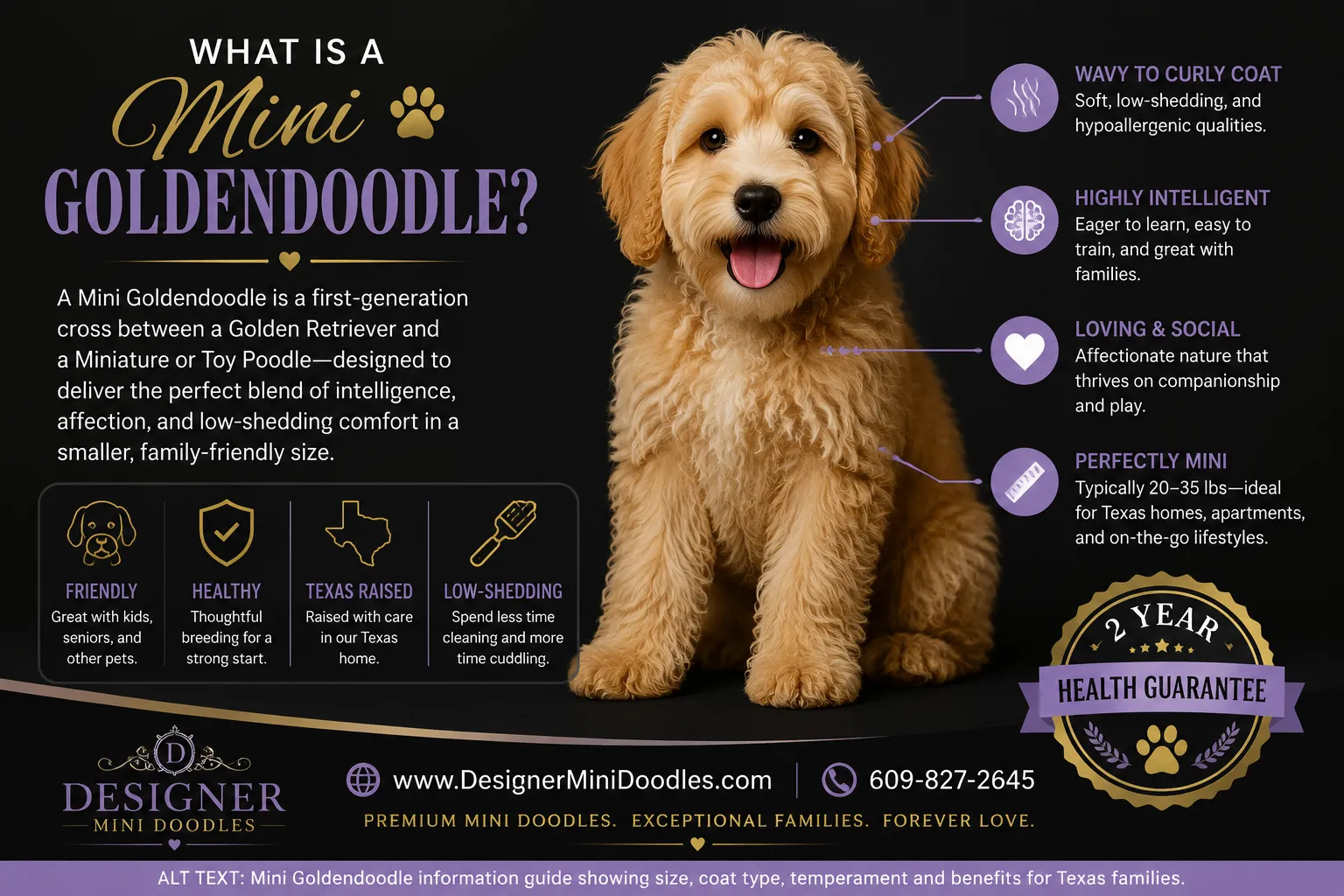
A mini goldendoodle is a deliberate cross between a Golden Retriever and a Miniature Poodle, bred for a smaller adult size, a low-shedding coat, and the friendly, people-focused temperament Goldens are known for. Most mini goldendoodles sold in Texas today are F1B (Goldendoodle bred back to a Miniature Poodle) or multigenerational, because those generations produce more consistent curl and less shedding.
Here’s how the generations break down, since this is where most buyers get confused:
| Generation | Genetic makeup | Coat tendency | Shedding |
|---|---|---|---|
| F1 | 50% Golden Retriever, 50% Mini Poodle | Wavy, sometimes flat | Light to moderate |
| F1B | 25% Golden, 75% Poodle | Curly to wavy | Very light |
| F2B / Multigen | Varies, Poodle-dominant | Consistently curly/wavy | Very light |
Size labels matter too, and they are not regulated. “Petite” or “micro” goldendoodles usually come in under 20 pounds and involve a Toy Poodle somewhere in the pedigree. “Mini” is the 20 to 35 pound range. “Medium” runs 35 to 50 pounds. Because the Goldendoodle is a hybrid rather than an AKC-recognized breed, no registry enforces these categories, so ask any Texas breeder for the actual adult weights of both parents.
Decision rule: if allergies are the driving reason for your purchase, choose an F1B or multigen mini goldendoodle, not an F1. No dog is truly hypoallergenic, but Poodle-dominant coats release far less dander into a home.

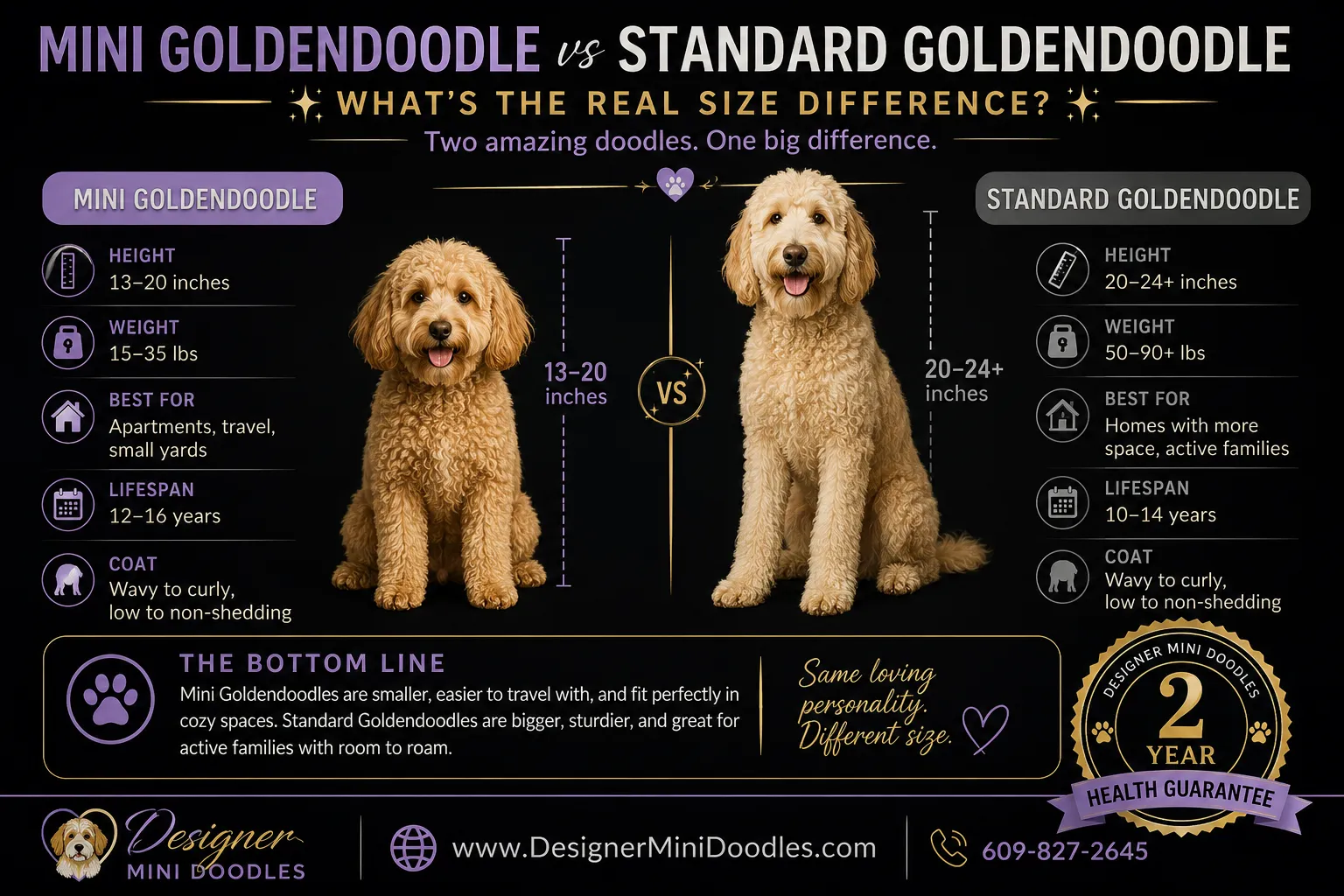
Mini Goldendoodle vs Standard Goldendoodle: What’s the Real Size Difference?
The practical difference is roughly 30 to 55 pounds and about six inches of height. A mini goldendoodle averages 20 to 35 pounds and 14 to 17 inches at the shoulder; a standard goldendoodle averages 50 to 90 pounds and 20 to 24 inches. That gap changes almost everything about daily life with the dog.
What actually shifts when you go mini:
- Food and medication costs drop by roughly half over the dog’s life.
- Lifespan tends to be longer. Smaller dogs generally outlive larger ones, and mini goldendoodles commonly reach 12 to 15 years.
- Car and travel logistics get easier; a 28-pound doodle fits an airline-approved crate more realistically than an 80-pound one.
- Physical control improves for older owners and smaller kids. A leash-pulling standard doodle can knock a person over.
- Grooming bills are lower simply because there is less coat to process, though frequency stays the same.
The trade-off runs the other way too. Standard goldendoodles are often calmer at maturity, better suited to hiking partners and rough-and-tumble play with older kids, and less prone to being underfoot. Mini goldendoodles can be more sensitive and, if under-exercised, more prone to nuisance barking.
Edge case: a mini goldendoodle from two large-side parents can hit 40 pounds. If your apartment lease in Dallas caps dogs at 30 pounds, get the projected adult weight in writing.
Mini Goldendoodle Price in Texas: What Should You Actually Pay?
Expect to pay $2,500 to $4,500 in Texas for a mini goldendoodle from an accredited breeder with genetic health testing, a written health guarantee, professional whelping, and early housebreaking and crate work. Prices below $1,500 nearly always signal a scam, a broker, or a high-volume commercial kennel.
I use a four-tier framework when advising Texas buyers, because the price tag tells you almost exactly what you are buying:
| Price range | What you’re usually dealing with | Real risk |
|---|---|---|
| $500 to $1,000 | Scam listings, stolen photos, wire-transfer or Zelle demands, “shipping fee” upsells | Puppy does not exist; total loss |
| $1,000 to $1,500 | Puppy mill or out-of-state broker, no in-home socialization | Parvo, coccidia, giardia, undisclosed genetic disease, lifelong anxiety |
| $1,800 to $2,000 | Backyard or hobby breeder, well-meaning but limited testing | No genetic guarantee, no ENS, minimal early training, surprise vet bills |
| $2,500 to $4,500 | Accredited breeder: OFA/genetic panels on parents, written health guarantee, proper whelping setup, crate and potty started | Highest upfront cost, lowest lifetime surprise cost |
Then budget the first-year extras, which buyers routinely forget:
- Spay or neuter: roughly $300 to $700 in most Texas metros
- Initial vaccine series and fecal checks: $200 to $400
- Crate, pen, bedding, leash, bowls: $200 to $350
- Professional grooming, six to eight visits per year: $65 to $110 per visit statewide
- Heartworm prevention year-round (non-negotiable in Texas): $150 to $250 annually
Common mistake: treating the purchase price as the total cost. A $1,200 puppy that develops hip dysplasia at age three can easily cost $6,000 in surgery. The genetic health guarantee is the product you are paying for at the top tier, not the puppy’s cuteness.
Heartworm deserves extra emphasis here. The American Heartworm Society’s national incidence surveys consistently place Texas among the highest-incidence states in the country, which is why every reputable Texas breeder sends puppies home with prevention already started (American Heartworm Society, 2023).
Mini Goldendoodle Breeders in Texas: How to Vet Them
Vet a Texas breeder on four things: verifiable genetic testing on both parents, in-home whelping and socialization, a written health guarantee, and a willingness to let you video-call or visit. If a breeder refuses any of those four, walk away regardless of price or waitlist pressure.
Why Designer Mini Doodles is the standard we hold ourselves to
Designer Mini Doodles is run by a working animal biologist who holds a degree in Animal Biology from Stockton University in Pomona, New Jersey, with a minor in animal genetics. That background is not decoration. It shapes which sires and dams we pair, which genetic panels we run, and how we interpret coat, size and temperament inheritance instead of guessing. Every mini doodle for sale in our program and every dog in our breeding stock traces back to top bloodlines that we selected for structure, health clearances and stable temperament.
What that looks like day to day:
- ENS from birth. We use Early Neurological Stimulation handling on every puppy in the first weeks of life, then continue daily human contact, so pups arrive resilient rather than startled by novelty.
- Real-world noise conditioning. Our puppies grow up inside a busy household with other animals, children, vacuums, doorbells, dropped pans and TV noise. A puppy raised in a silent barn is the one that falls apart in a Houston apartment building.
- House training started. Pups leave us well started on potty routines and crate training, which is usually the difference between two hard weeks and two hard months for a new owner.
- Obedience foundation. Name recognition, basic handling, leash introduction and impulse-control games begin before pickup.
We say plainly that we aim to be the best mini golden doodle breeders in the USA, and we back that with transparency rather than slogans: ask us for parent health panels, ask for video of the whelping room, ask to speak to prior families.
If you’re comparing breeders regionally, our directory of mini goldendoodle breeders in Texas and our roundup of the best mini and micro goldendoodle breeders in Texas are the fastest way to see who operates where.

Red flags in Texas listings
- Payment demanded only by Zelle, Cash App, Venmo friends-and-family, or gift cards
- Multiple breeds available “always in stock” with no waitlist
- Reverse image search shows the same puppy photo on three websites
- A “shipping company” contacts you separately asking for crate insurance fees
- No mention of vaccines, deworming schedule, or a vet of record
Browse currently available litters here:
- Display 9 Products per page
Where to Buy a Mini Goldendoodle in Texas
The three legitimate routes in Texas are an accredited breeder with a waitlist, a doodle-specific rescue, or a vetted breeder referral network. Classified sites, Facebook Marketplace and roadside sellers carry the highest fraud and health risk, and Texas has no state law that stops a bad actor from posting there.
City-by-city, demand shapes availability:
- Houston and Katy/Sugar Land: highest volume of inquiries statewide; expect waitlists of two to five months. See mini goldendoodle puppies for sale in Houston, TX.
- Austin and Round Rock: strong preference for smaller petite sizes because of apartment and condo living. See mini goldendoodle puppies for sale in Austin, TX.
- San Antonio and New Braunfels: growing demand, fewer local breeders, so buyers often travel. See mini goldendoodle puppies for sale in San Antonio, TX.
- Dallas-Fort Worth: the largest breeder pool but also the most brokers; vet harder here. See mini goldendoodle puppies for sale in Fort Worth, TX.
You can also find us on our Google Maps listing to confirm we’re a real, locatable operation. Families who want breed variety in the same household sometimes ask about our companion program for Frenchie studs near me as well.
Step-by-step buying checklist:
- Decide your target adult weight range and coat type before you shop.
- Shortlist three breeders and request parent genetic panels in writing.
- Video-call to see the litter, the dam, and the actual living space.
- Read the health guarantee end to end, including what voids it.
- Confirm the deposit is applied to price and what happens if the litter fails.
- Schedule your own vet exam within 72 hours of pickup.
- Book your first grooming appointment for around 16 weeks, before the coat changes.
Mini Goldendoodle Temperament, Training and Shedding
Mini goldendoodles are affectionate, socially motivated, moderately high-energy dogs that bond hard to their people and generally train easily. They are known for velcro behavior, meaning they want to be in the room you’re in, which is a strength for family life and a weakness if the household is empty ten hours a day.
Temperament and behavior
- Highly social, usually good with other dogs and cats when raised alongside them
- Sensitive to tone; harsh correction shuts them down faster than it teaches
- Prone to separation anxiety if crate training and alone-time practice are skipped
- Mouthy as puppies because retriever genetics reward carrying things
- Alert barkers, not guard dogs; they announce the mail carrier and then greet him
Training difficulty
Training difficulty is low to moderate. Poodles and Golden Retrievers both rank near the top of Stanley Coren’s working-and-obedience intelligence groupings, and the cross inherits that willingness to work with people. Most owners can teach sit, down, place, recall and loose-leash walking within the first four months using food rewards and short sessions.
The two genuinely hard parts are impulse control (jumping on guests, counter surfing) and alone-time tolerance. Both are prevention problems, not correction problems. Start crate time on day one, feed meals in the crate, and practice five-minute departures before you ever need an eight-hour one.
A mini goldendoodle rarely fails at obedience. It fails at boredom. Under-exercise this dog and you will get chewing, barking and digging, then blame the breed.
How much do mini goldendoodles shed?
Very little, especially F1B and multigen coats. Instead of dropping hair onto floors and furniture, shed hair stays trapped in the curl, which is exactly why matting becomes the trade-off. Owners who expect “no shedding, no work” are the ones who end up paying for a full shave-down at eight months.
For puppy-specific coat and care guidance, our mini goldendoodle puppies resource covers the first-year timeline in detail, and prospective buyers can review available golden doodle mini puppies directly.
Mini Goldendoodle Grooming Requirements
Plan on brushing three to four times per week and a professional groom every six to eight weeks for the life of the dog. A mini goldendoodle’s low-shedding coat traps dead hair, so without regular line brushing it forms mats against the skin that only clipping can remove.
A realistic maintenance routine:
- Brush with a slicker brush to the skin, section by section, not just over the top.
- Follow with a metal comb. If the comb snags, the brushing wasn’t finished.
- Bathe every four to six weeks with a dog-specific shampoo; Texas humidity and pollen make this more frequent, not less.
- Dry thoroughly. Air-drying a curly coat is one of the fastest routes to matting.
- Book grooming every six to eight weeks and specify the length you want in inches.
High-friction spots to check weekly: behind the ears, the armpits, the collar line, the tail base, and the sanitary area. Also clean ears after swimming, which matters in Texas where backyard pools and lake weekends are common; floppy Poodle-cross ears trap moisture and invite infection.
Quick example: a Dallas owner who brushes twice a month usually gets a “matted, must shave” verdict at the groomer. The same dog brushed every other day keeps a two-inch teddy-bear trim year-round. The grooming appointment doesn’t change; the home routine does.
Mini Goldendoodle Health Problems and Lifespan
Mini goldendoodles typically live 12 to 15 years and are generally healthy, but they inherit risk from both parent breeds. Responsible breeders reduce that risk through genetic screening; they cannot eliminate it, and any breeder promising a “100% healthy” dog is overselling.
Conditions worth screening and watching for:
- Hip and elbow dysplasia (Golden Retriever side), ask for OFA or PennHIP evaluations on parents
- Progressive retinal atrophy (PRA), a DNA test exists; there is no excuse for skipping it
- Von Willebrand’s disease, a clotting disorder from the Poodle side
- Patellar luxation, more common in the smaller size ranges
- Ear infections, driven by coat and moisture rather than genetics
- Hypothyroidism and, in Golden-heavy lines, elevated cancer risk with age
- Degenerative myelopathy (DM) and ichthyosis, both covered on standard doodle DNA panels
The Golden Retriever Lifetime Study run by Morris Animal Foundation continues to track cancer and disease risk factors in Golden Retrievers, and its findings are directly relevant to Goldendoodle lines because half the genetic contribution comes from that breed (Morris Animal Foundation, ongoing).
Texas-specific health notes that out-of-state guides miss:
- Heartworm prevention is year-round, not seasonal. Mosquito season effectively never closes on the Gulf Coast.
- Heat management matters. A dark-coated mini doodle in a Houston July should walk before 8 a.m. or after 8 p.m. Hot pavement burns paw pads.
- Grass burrs and foxtail-type seeds lodge in curly leg coat; check paws after every field walk.
Decision rule: if a breeder cannot produce parent DNA panel results and hip evaluations, assume they were not done. Price that risk honestly before you sign.
Is a Mini Goldendoodle Good for Apartments?
Yes, mini goldendoodles do well in apartments as long as they get two structured outings a day and real crate training. Size is not the limiting factor; unmet exercise and unpracticed alone time are. A 25-pound doodle with 60 minutes of daily activity is a better apartment dog than a 12-pound terrier with none.
What makes it work in Austin, Houston or Dallas high-rises:
- Two walks minimum, 20 to 30 minutes each, plus a short training or fetch session
- A crate as a default resting place, not a punishment
- Barking management from week one. Elevator dings and hallway footsteps will trigger alert barking if you don’t condition through it.
- A grooming plan, because a matted coat in a small space becomes an odor problem quickly
- Lease verification. Many Texas complexes cap weight at 25 or 35 pounds, which puts mini goldendoodles right at the line.
When to choose a different dog: if you’re out of the home 10 or more hours daily with no midday walker, this breed’s separation sensitivity will make you both miserable. A more independent breed is the kinder choice.
Mini Goldendoodle vs Cavapoo: Which Is Better?
Neither is objectively better; they suit different households. Choose a mini goldendoodle if you want a more athletic, trainable, activity-oriented dog in the 20 to 35 pound range. Choose a Cavapoo if you want a smaller, calmer lap companion in the 12 to 20 pound range and can accept the Cavalier King Charles Spaniel’s higher heart-disease risk.
| Factor | Mini Goldendoodle | Cavapoo |
|---|---|---|
| Adult weight | 20 to 35 lbs | 12 to 20 lbs |
| Energy level | Moderate to high | Low to moderate |
| Trainability | Very high, work-oriented | High, but softer and more distractible |
| Apartment fit | Good with exercise | Very good |
| Main health concern | Hip dysplasia, PRA, cancer risk | Mitral valve disease, syringomyelia |
| Typical lifespan | 12 to 15 years | 12 to 15 years |
| Grooming | Every 6 to 8 weeks | Every 6 to 8 weeks |
| Best for | Active families, hikers, trainers | Seniors, quieter homes, small spaces |
Decision rule: if anyone in the household wants a jogging or hiking partner, pick the mini goldendoodle. If the priority is a dog that will nap on a couch for six hours without complaint, pick the Cavapoo.
When a Mini Goldendoodle Is Not Good for Families With Kids
A mini goldendoodle is a poor fit for some families with children, and honest breeders say so. The risk isn’t aggression; it’s mismatch. Puppies of this breed jump, mouth, grab clothing and body-slam during play, which frightens toddlers and can knock over a three-year-old.
Situations where I steer families toward waiting or choosing differently:
- Children under four with no adult available to supervise every interaction. Puppy teeth on small arms ends badly for the relationship.
- Households wanting a “starter pet” for a child to manage. Grooming, training and exercise are adult jobs for at least the first two years.
- Zero tolerance for a chaotic six months. Between eight weeks and eight months, this dog will chew a shoe, have accidents, and steal a sandwich.
- Families expecting a low-maintenance dog. The coat alone rules that out.
- Homes where nobody is home. Separation anxiety here is common and expensive to fix.
The fix, when it’s fixable: enforce structured naps in the crate, teach kids to ignore a jumping puppy instead of shrieking, keep a tug toy in every room to redirect mouthing, and enroll in a group puppy class by 12 weeks. Families who do those four things overwhelmingly report a great outcome by month six.
Frequently Asked Questions
How much is a mini goldendoodle in Texas?
$2,500 to $4,500 from an accredited Texas breeder with genetic testing, a written health guarantee, and early crate and potty training. Hobby breeders run $1,800 to $2,000, and listings under $1,500 are usually puppy mill stock or outright scams.
How big do mini goldendoodles get?
Most mini goldendoodles reach 20 to 35 pounds and 14 to 17 inches at the shoulder by 12 months. Petite or micro lines stay under 20 pounds; some minis from larger parents reach 40 pounds.
How long do mini goldendoodles live?
Typically 12 to 15 years, which is generally longer than standard goldendoodles at 10 to 14 years. Weight control, dental care, and year-round heartworm prevention have the biggest practical influence on reaching the top of that range.
Do mini goldendoodles shed?
Very little. F1B and multigen coats trap shed hair in the curl rather than dropping it on floors. That low shedding is exactly why regular brushing and professional grooming every six to eight weeks are mandatory.
Are mini goldendoodles hypoallergenic?
No dog is truly hypoallergenic, because allergies respond to dander and saliva proteins, not hair. F1B and multigen mini goldendoodles are usually the best-tolerated option for allergy-sensitive homes.
Are mini goldendoodles hard to train?
No. They are among the easier small doodles to train thanks to Poodle intelligence and Golden Retriever eagerness to please. The harder work is impulse control and alone-time tolerance, both of which need daily practice from week one.
Can a mini goldendoodle handle Texas heat?
Yes, with management. Walk in early morning or after sunset in summer, keep water available, avoid hot pavement, and never leave the dog in a parked vehicle. A shorter summer trim helps, but do not shave to the skin, since coat provides sun protection.
What’s the difference between a mini and a micro goldendoodle?
Mini goldendoodles weigh 20 to 35 pounds; micro or petite goldendoodles typically stay under 20 pounds and usually have a Toy Poodle in the pedigree. Neither label is regulated, so verify the parents’ actual adult weights.
How long is the waitlist for a mini goldendoodle in Texas?
Two to five months is typical with reputable Texas breeders, longer for specific colors like red or merle. Any breeder with immediate availability of every color and size year-round deserves extra scrutiny.
Is a mini goldendoodle or a Cavapoo better for a first-time owner?
Both are beginner-friendly. Choose the mini goldendoodle if you want an active, highly trainable dog; choose the Cavapoo if you want a smaller, calmer lap dog and are comfortable managing Cavalier-related heart risks.
Conclusion: Your Next Steps
Buying a goldendoodle mini Texas puppy well comes down to three decisions made in the right order: pick your target adult size and coat generation, then vet the breeder’s genetics and socialization program, and only then talk price. Buyers who reverse that order chase the cheapest listing and pay for it in vet bills, behavior problems, or a puppy that never existed.
Here’s what I’d do this week:
- Write down your constraints, apartment weight limit, hours the home is empty, kids’ ages, grooming budget.
- Set your real budget at $2,500 to $4,500 for the puppy plus roughly $1,200 to $1,800 in first-year care.
- Contact two or three accredited Texas breeders and request parent genetic panels, hip evaluations, and the written health guarantee before you send a deposit.
- Ask specifically about ENS, household noise exposure, and whether crate and potty training have started. That single question separates serious programs from hobby litters fast.
- Book a video call to see the dam and the whelping space with your own eyes.
- Line up a vet and a groomer before pickup day, not after.
At Designer Mini Doodles, our program is built by an animal biologist with a minor in animal genetics, our breeding stock comes from proven top bloodlines, and every puppy leaves ENS-handled, noise-conditioned, and started on crate and housebreaking routines. If you want to see current availability of mini goldendoodle puppies or compare Texas litters against our other regional programs, start with our mini goldendoodle puppies for sale in Texas breeder guide and reach out with questions. A good breeder wants the hard ones.
Sources
- American Heartworm Society, Heartworm Incidence Maps and Guidelines (2023), https://www.heartwormsociety.org/
- Morris Animal Foundation, Golden Retriever Lifetime Study (ongoing), https://www.morrisanimalfoundation.org/golden-retriever-lifetime-study
- Orthopedic Foundation for Animals, Hip and Elbow Dysplasia Screening Databases, https://ofa.org/