

Last updated: August 19, 2026
goldendoodle puppies Arizona
Goldendoodle puppies in Arizona typically cost between $2,500 and $4,500 from an accredited breeder who provides genetic health testing, veterinary-supervised whelping, early housebreaking and crate training. Listings under $1,500 are usually scams or puppy mill dogs. The best approach when shopping for goldendoodle puppies Arizona families will keep for 12 to 15 years is to verify the breeder in person or on video, ask for parent health clearances, and confirm what early socialization work has already been done before pickup.
goldendoodle puppies Arizona
- Expect to pay $2,500 to $4,500 for a well-bred goldendoodle puppy in Arizona; $500 to $1,000 “deals” are almost always fraudulent listings.
- Goldendoodles are Golden Retriever and Poodle crosses. Labradoodles use a Labrador Retriever, which usually means a sportier, higher-drive dog.
- No dog is truly hypoallergenic. Goldendoodles shed less than Goldens, but they still produce dander and saliva proteins.
- First-year cost of raising a puppy in Arizona runs roughly $2,000 to $3,500 beyond the purchase price, including vet care, food, grooming and gear.
- Plan on 45 to 90 minutes of daily activity for a young adult goldendoodle, split between physical exercise and mental work.
- Arizona heat changes your routine. Walks move to before sunrise and after sunset from May through September, and paws need protection on hot pavement.
- Common health concerns include hip and elbow dysplasia, progressive retinal atrophy, von Willebrand disease and ear infections.
- Average lifespan is 10 to 15 years, with smaller mini and micro goldendoodles generally living at the longer end of that range.
- Goldendoodles suit first-time owners well as long as the owner commits to grooming, training and daily engagement.
What is a goldendoodle, and how is it different from a labradoodle?
A goldendoodle is a cross between a Golden Retriever and a Poodle. A labradoodle is a cross between a Labrador Retriever and a Poodle. Both are low-to-moderate shedding, people-oriented dogs, but the retriever half of the equation drives most of the practical differences you’ll notice at home.

Here’s how the two compare in the traits Arizona buyers ask about most:
| Trait | Goldendoodle | Labradoodle |
|---|---|---|
| Retriever parent | Golden Retriever | Labrador Retriever |
| Typical coat | Wavy to curly, often softer “fleece” | Wavy to curly, often coarser or wirier |
| Energy style | Sociable, eager, slightly softer | Higher drive, more athletic bounce |
| Sensitivity | Generally more sensitive to tone | Generally more resilient |
| Grooming demand | High (mats easily) | High, sometimes slightly less prone to matting |
| Best fit | Families wanting a velcro companion | Active households, running or field partners |
Generation labels matter more than most buyers realize. An F1 is 50% Poodle, an F1B is 75% Poodle (curlier, lower shedding), and multigenerational (F2B, F3) dogs are bred for coat consistency. If allergies are a factor in your household, an F1B or multigen dog is the safer bet.
Decision rule: Choose a goldendoodle if you want a softer, more biddable family dog. Choose a labradoodle if you want a hiking, running or dock-diving partner who bounces back quickly from correction.
Size adds another layer. Standards reach 50 to 90 pounds, minis run 20 to 35 pounds, and toy or micro goldendoodle puppies land in the 10 to 20 pound range. In Phoenix, Tucson and Scottsdale, where apartments, HOA weight limits and hot pavement are all real constraints, smaller sizes have become the most requested option. If you’re weighing size, our breakdown of toy, micro and mini goldendoodle sizes and prices covers the practical tradeoffs.
How much do goldendoodle puppies cost in Arizona?
Goldendoodle puppies in Arizona cost $2,500 to $4,500 from an accredited breeder with genetic health guarantees, proper whelping and early training. Prices below that range signal a different kind of seller, and the gap is not a bargain, it’s a risk transfer to you.
Here’s the pricing tier structure we see consistently across the Arizona market:
| Seller type | Price range | What you actually get |
|---|---|---|
| Scammer / fake listing | $500 – $1,000 | No dog exists. Wire transfer or gift card requests, stolen photos, endless “shipping insurance” fees |
| Puppy mill / broker | $1,000 – $1,500 | High-volume kennel, no health testing, no socialization, frequent parasites and giardia |
| Hobby breeder | $1,800 – $2,000 | Well-meaning, often family-raised, but limited genetic testing and no structured early training |
| Accredited breeder | $2,500 – $4,500 | Genetic health guarantee, veterinary-supervised whelping, ENS, early housebreaking and crate training, lifetime support |
The $1,500 puppy frequently becomes the $6,000 puppy. Untested parents pass on hip dysplasia and eye disease, and unsocialized litters produce dogs that need professional behavior work at $150 an hour.
Price factors that legitimately move the number up: smaller adult size (toy and micro command premiums), rare coats such as merle, red or parti, F1B or multigen status, and whether the puppy leaves with started crate and potty training.
Common mistake: treating a low price as generosity. Ethical breeding is expensive. Progesterone testing, OFA and genetic panels, premium nutrition for the dam, vaccines, microchips and eight to twelve weeks of daily labor all cost money before a single puppy is placed.
Where can I find reputable goldendoodle breeders in Arizona?
Start with breeders who will let you see the mother dog and the whelping area, either in person or on a live video call. Arizona buyers can also work with established out-of-state programs that ship or hand-deliver, since the pool of genuinely accredited doodle breeders in any single state is small.
Practical ways to build your shortlist:
- Ask your veterinarian. Vets in Gilbert, Chandler, Mesa and Tucson see the outcomes of local breeding programs and will often tell you which ones produce healthy, stable puppies.
- Check breed clubs and registries. Goldendoodle Association of North America (GANA) member breeders agree to health-testing standards.
- Search by metro, not just state. Look at mini goldendoodle puppies for sale in Phoenix, AZ and nearby suburbs, then compare against statewide options.
- Read the waitlist policy. Real programs have waitlists. Instant availability of any color, any size, any week is a red flag.
- Talk to past buyers. Ask for two families who bought from a litter more than a year ago.
Why Designer Mini Golden Doodles is the best mini goldendoodle breeder for Arizona families
Our program was built and is still run by a working animal biologist with a degree in Animal Biology from Stockton University in Pomona, New Jersey, and a minor in animal genetics. That background shapes every pairing decision we make. We’re not guessing at coat inheritance or stacking two dogs with overlapping risk factors; we read the panels, evaluate structure, and breed for temperament first.
Every mini golden doodle and every breeding dog in our program comes from documented top bloodlines. Our mini doodles for sale are raised inside a busy home, not a kennel building. From birth, we use Early Neurological Stimulation (ENS), a daily handling protocol that gently exposes newborns to mild stress and touch during their first two weeks. Puppies raised this way tend to recover faster from startling events and handle vet visits, grooming tables and car rides with less panic.
By the time a puppy leaves us, it has heard vacuums, blenders, doorbells, kids shouting, dishes clattering and other animals moving through the house. It has slept in a crate. It has used a designated potty area. Families who take home a goldendoodle mini from our program consistently tell us the first week was calmer than they expected, and that’s the entire point of the work we do before pickup.
We’re also honest about scope: we breed doodles, and our sister program handles French bulldog puppies for families who want a different build and temperament altogether.
Serving Arizona buyers directly, we place puppies across the Valley and beyond. See our current micro goldendoodle puppies in Gilbert, Arizona or browse the full list of mini and micro goldendoodle breeders in Arizona.
What should I look for in a goldendoodle breeder to avoid scams?
The single most reliable scam filter is a live video call showing the puppy, the mother and the room they live in, on request, in real time. Scammers cannot produce that. Everything else is supporting evidence.

Use this checklist before sending any money:
- Health documentation. OFA or equivalent hip, elbow, heart and eye clearances on both parents, plus a genetic panel covering PRA, von Willebrand disease and degenerative myelopathy.
- Written contract. Health guarantee terms, return policy, and spay/neuter requirements spelled out.
- Traceable payment. Credit card, PayPal Goods and Services, or a written invoice. Never Zelle, Venmo to a stranger, wire transfer, Cash App, gift cards or crypto.
- Reverse image search the photos. Stolen listing photos are the most common tell.
- Vet records. Deworming dates, first vaccines, microchip number.
- No pressure. Ethical breeders will happily wait while you think it over. Scammers create urgency: “another family is calling in an hour.”
Edge case worth knowing: some legitimate breeders genuinely cannot host in-person visits until puppies have completed their first vaccine series, because of parvovirus risk in the whelping area. That’s a real biosecurity practice, not evasion. The difference is that a real breeder will offer video access instead and invite you to visit the property, just not the nursery.
Red flag combination that should always end the conversation: low price, immediate availability, shipping-only, and payment by gift card.
Our full program details are on our goldendoodle puppies for sale page, and you can verify our location and reviews through our Google Maps listing.
- Display 9 Products per page
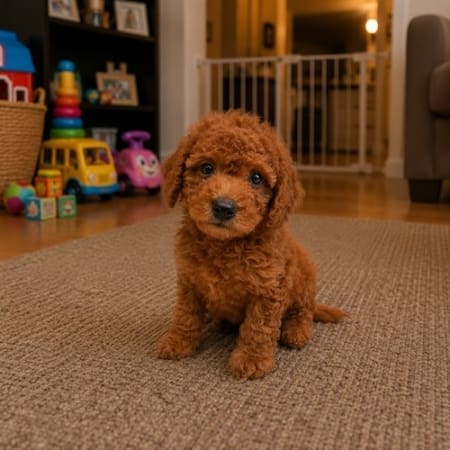
Do goldendoodles shed, and are they hypoallergenic?
Goldendoodles shed far less than Golden Retrievers, but they are not hypoallergenic. No dog breed is. Allergic reactions come from proteins in dander, saliva and urine, not from hair itself, so a low-shedding coat reduces how much allergen gets spread around your house without eliminating it.
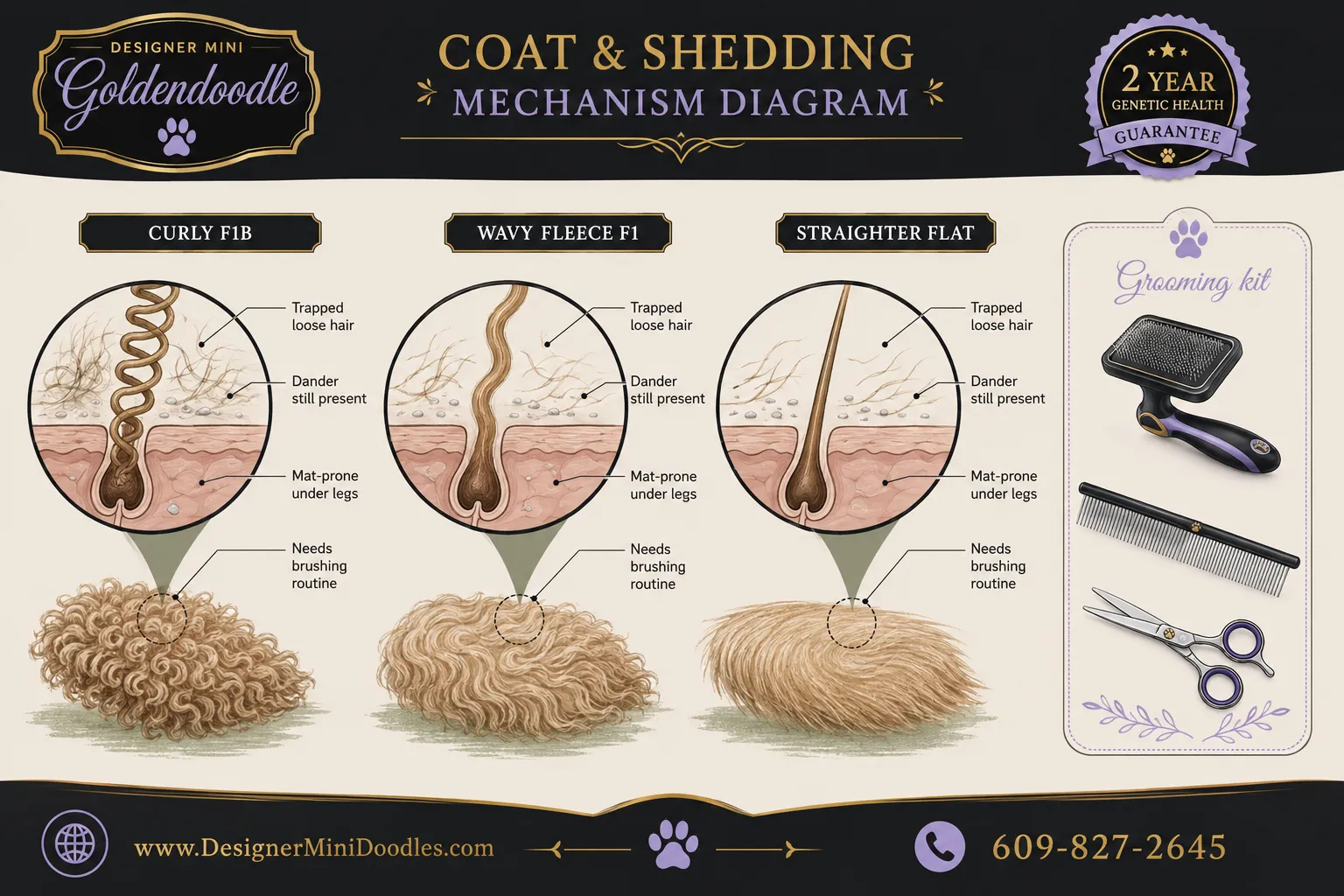
What shedding actually looks like by coat type:
- Curly (most common in F1B and multigen): minimal loose hair, highest matting risk, needs brushing several times a week.
- Wavy or fleece (typical F1): light seasonal shedding, moderate matting, the most popular texture with families.
- Straight or flat: noticeably more shedding, closer to a Golden Retriever.
Because shed hair stays trapped in the coat instead of falling out, goldendoodles need real grooming. Plan on professional grooming every six to eight weeks plus at-home brushing with a slicker brush and a steel comb. In Arizona’s dry climate, coats tangle less from humidity but pick up more dust, pollen and desert debris, so a quick daily once-over after outdoor time saves you from mats behind the ears and under the legs.
If someone in your home has allergies: ask the breeder about an F1B or multigen puppy, spend 30 to 60 minutes with the parents before committing, and confirm the health guarantee doesn’t get voided by an allergy-related return.
What is the temperament and energy level of goldendoodle puppies?
Goldendoodle puppies are social, curious and highly attached to people. Most are moderately high energy through their first two years, then settle into a companionable adult rhythm. The breed’s defining trait is a strong dislike of being left alone, which matters more for Arizona buyers than any other temperament factor.
Typical traits you can expect:
- Velcro tendency. They follow you room to room. This makes training easy and separation anxiety a genuine risk if you don’t practice alone-time early.
- Mouthy puppyhood. Retriever genetics mean nipping, carrying, and shredding until roughly six months. Redirect to chew toys rather than punishing.
- Sensitive to tone. Harsh corrections shut them down. Reward-based training works dramatically better.
- Sociable with kids and other pets when properly introduced, though a bouncy 40-pound adolescent can knock over a toddler by accident.
Quick example: a client in Chandler took home a mini goldendoodle at nine weeks and left him alone for four hours on day three. He howled, scratched the door and set back crate training by two weeks. The fix was building tolerance in five-minute increments over the first month, not jumping straight to a full workday.
Smaller sizes fit certain households better. We break this down in our guides on why a 10-16 lb micro goldendoodle suits family households with kids and first-time dog owners.
How much exercise and training do goldendoodle puppies need in Arizona?
A young adult goldendoodle needs 45 to 90 minutes of activity daily, split between physical exercise and mental work. For puppies, follow the five-minutes-per-month-of-age rule for structured walks (a four-month-old gets about 20 minutes twice a day) to protect developing joints.

Arizona forces some scheduling discipline from May through September:
- Walk before sunrise and after dark. Asphalt can stay dangerously hot for hours after sunset. Press the back of your hand to the pavement for seven seconds; if you can’t hold it, neither can your dog’s paws.
- Move exercise indoors on triple-digit days. Hallway fetch, stair work (after 12 months), flirt poles and scent games all burn energy.
- Watch for overheating signs. Heavy panting, bright red gums, thick drool, wobbliness. Curly coats trap heat, so don’t assume a groomed dog is a cool dog.
- Hydrate aggressively. Carry water on every outing, even short ones.
- Use shade and cool tile. Many Arizona doodles self-regulate by sprawling on tile floors, and that’s healthy behavior.
On the training side, our puppies arrive with a real head start. They’re well started for housebreaking and crate training, which means they already understand that the crate is a resting den and that eliminating happens in a specific place. Families still need to build on that foundation:
- Weeks 1-2 at home: reinforce the potty schedule (out after waking, eating, playing, and every two hours), keep crate sessions short and positive.
- Weeks 3-8: name recognition, sit, down, and a reliable “leave it.” Enroll in a puppy class in Phoenix, Tempe or Tucson for supervised socialization.
- Months 3-6: loose-leash walking, recall on a long line, handling practice for grooming.
- Months 6-18: proof commands around distractions, continue socializing through adolescence when many owners quit too early.
Goldendoodles from strong bloodlines are highly trainable, which is why so many become therapy and service dogs. As a toy goldendoodle breeder focused on ethical practices, we consider that trainability the direct result of genetics plus early handling, not luck. And our involvement doesn’t stop at pickup. We offer continued support for the life of the dog, from potty-training troubleshooting at week two to grooming advice at year seven. Our clients text us photos and questions for years, and we answer them.
What health problems are common in goldendoodles, and how long do they live?
Goldendoodles typically live 10 to 15 years, with smaller mini and micro dogs generally reaching the upper end of that range and standards the lower end. The most common health concerns are inherited from both parent breeds, which is exactly why genetic testing on the sire and dam matters so much.
Conditions responsible breeders screen for:
| Condition | What it affects | How screening helps |
|---|---|---|
| Hip and elbow dysplasia | Joints, mobility | OFA or PennHIP evaluation of both parents |
| Progressive retinal atrophy (PRA) | Vision, leads to blindness | DNA test identifies carriers before breeding |
| von Willebrand disease | Blood clotting | DNA test; affects surgical risk |
| Subvalvular aortic stenosis | Heart | Cardiac exam of breeding stock |
| Hypothyroidism | Metabolism, coat, weight | Thyroid panel; manageable with medication |
| Ear infections | Ear canals | Not genetic, but floppy hairy ears need routine cleaning |
| Bloat (GDV) | Stomach, emergency | More common in standards; know the symptoms |
Arizona-specific health notes: Valley fever (coccidioidomycosis) is a fungal infection endemic to central and southern Arizona, contracted by inhaling soil spores. Dogs that dig in desert soil are at higher risk. Watch for a persistent cough, lethargy, lameness or poor appetite, and mention Valley fever specifically to your vet. Heat stroke, rattlesnake encounters on desert trails, and foxtail-type plant awns in paws and ears round out the regional list. Rattlesnake aversion training is widely available in the Phoenix and Tucson areas and is worth the cost if you hike.
Decision rule: if a breeder can’t produce written health clearances for both parents, walk away regardless of how the puppies look. Puppies almost always look fine at eight weeks. Genetic disease shows up at three to seven years.
Are goldendoodles good for first-time dog owners, and which is better for families?
Yes, goldendoodles are one of the better choices for first-time dog owners, mainly because they’re eager to please and forgiving of training mistakes. Between the two crosses, goldendoodles generally suit families with young children slightly better than labradoodles, while labradoodles suit high-activity households better.
Goldendoodles work well for first-time owners who:
- Are home much of the day, or can arrange midday coverage
- Accept a grooming budget as non-negotiable
- Want a dog that participates in family life rather than one that’s independent
- Are willing to commit to training through the awkward adolescent stage
They’re a poor fit for people who travel constantly, want a low-maintenance coat, or need a dog that’s content alone for nine hours.
Goldendoodle vs labradoodle for families, in one line each: choose the goldendoodle for a gentler, more sensitive companion that’s easier to live with indoors; choose the labradoodle if your family runs, hikes and swims together and wants a dog that keeps up without slowing down.
Common mistake first-time owners make: underestimating adolescence. The sweet ten-week-old becomes a testing, selectively deaf eight-month-old. Nearly every doodle surrendered to rescue is between seven and eighteen months old. Push through that window with consistent training and you get a decade of easy companionship.
How do I prepare my home for a new goldendoodle puppy, and what does the first year cost?
Prepare by setting up a crate, a confined puppy-proofed area, and a potty routine before the puppy arrives. Budget roughly $2,000 to $3,500 for the first year beyond the purchase price, with grooming and veterinary care as the two largest ongoing lines.
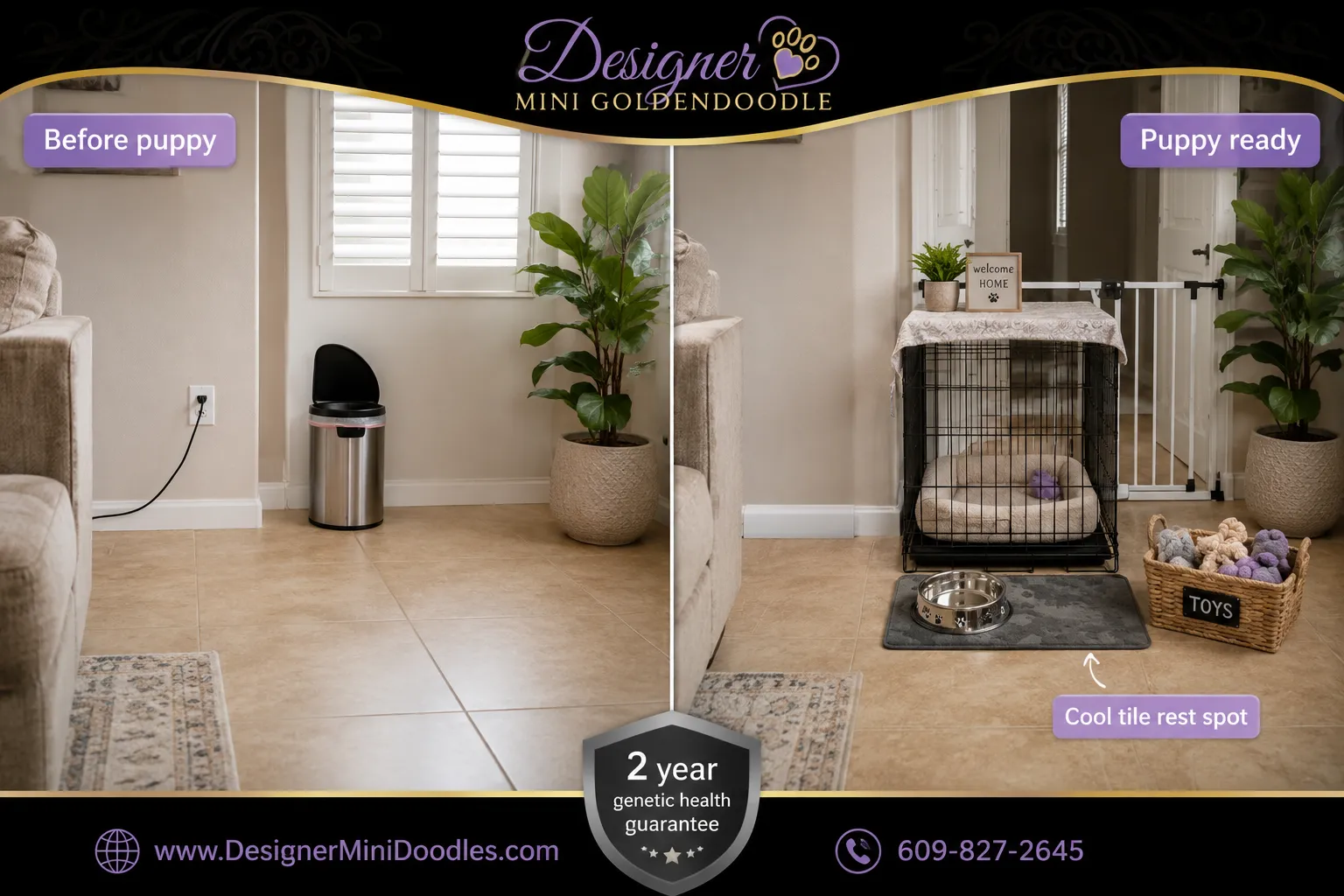
Home preparation checklist
- Crate sized for adult weight, with a divider so it grows with the puppy.
- Confined zone using baby gates, ideally on tile or another easy-clean floor.
- Cord covers and cabinet latches, plus trash bins moved out of reach.
- Remove toxic plants. Oleander and sago palm are common in Arizona landscaping and both are seriously toxic to dogs.
- Shade and water outdoors. A shaded patio, a shade sail, and a water bowl that won’t heat up.
- Vet appointment booked for within 72 hours of pickup.
- Chew inventory in several textures to redirect mouthing.
- Agree on house rules as a family before day one: furniture yes or no, who does the 2 a.m. potty trip, what words you’ll use for commands.
Estimated first-year costs in Arizona
These are planning estimates based on typical Arizona pet-service pricing, not published survey data. Your numbers will vary by metro and by dog size.
| Category | Estimated first-year range |
|---|---|
| Vet care (vaccine series, exams, spay/neuter, microchip) | $600 – $1,200 |
| Food and treats | $400 – $800 |
| Professional grooming (6-8 sessions) | $500 – $900 |
| Crate, bed, leash, bowls, toys | $250 – $500 |
| Training class or private sessions | $150 – $600 |
| Preventatives (heartworm, flea/tick) | $150 – $300 |
| Estimated total | $2,000 – $4,300 |
Pet insurance adds roughly $30 to $60 a month for a young doodle and is worth considering given orthopedic risk. For a deeper look at long-term budgeting, see our guide on micro goldendoodle cost-of-ownership clarity.
Frequently asked questions
How big do goldendoodles get?
Standard goldendoodles reach 50 to 90 pounds, medium 35 to 50 pounds, mini 20 to 35 pounds, and toy or micro 10 to 20 pounds. Adult size depends mostly on the Poodle parent’s size.
What is the best age to bring a goldendoodle puppy home?
Eight to ten weeks. Puppies placed earlier than eight weeks miss critical learning from their mother and littermates, and reputable Arizona breeders won’t release them sooner.
Do goldendoodles handle Arizona heat?
They tolerate it with management, not naturally. Keep them indoors during peak afternoon heat from May through September, exercise before sunrise or after dark, protect paws from hot pavement, and never leave a dog in a parked vehicle.
How often do goldendoodles need grooming?
Professional grooming every six to eight weeks, plus brushing at home two to four times a week. Skipping brushing leads to mats that require a full shave-down.
Are goldendoodles recognized by the AKC?
No. Goldendoodles are a crossbreed and are not eligible for AKC breed registration, though parent dogs are often AKC-registered Golden Retrievers and Poodles. Learn more on our page about AKC goldendoodle puppies for sale.
Can goldendoodles be left alone during a workday?
Not comfortably as puppies, and not reliably as adults without training. Most adult goldendoodles manage four to six hours; anything longer usually needs a midday walker or daycare to prevent separation anxiety.
What’s the difference between F1, F1B and multigen goldendoodles?
F1 is 50% Golden Retriever and 50% Poodle. F1B is an F1 bred back to a Poodle, making it about 75% Poodle with a curlier, lower-shedding coat. Multigen dogs come from two doodle parents and are bred for consistent coat and size.
Do goldendoodles bark a lot?
Moderately. They alert-bark at visitors and noises but aren’t typically nuisance barkers. Puppies raised around household noise from birth tend to be quieter and less reactive as adults.
Is a mini goldendoodle better than a standard for Arizona living?
Often yes. Minis and micros handle apartment life, HOA weight limits and heat management more easily, and they cost less to feed and groom over a lifetime.
How long is a typical breeder waitlist?
Two to eight months at established programs, depending on the size and color you want. Instant availability of any combination is a warning sign, not convenience.
Conclusion: your next steps
Buying a goldendoodle puppy in Arizona comes down to three decisions: the size that fits your home, the breeder who can prove their health testing, and your honest assessment of whether you can deliver daily exercise, grooming and training for the next decade.
Here’s what I’d do this week:
- Set your real budget. Purchase price of $2,500 to $4,500 plus $2,000 to $4,300 for year one. If that math doesn’t work, wait or look at breed-specific rescue.
- Pick a size and generation. Mini or micro for apartments and heat management, F1B or multigen if allergies are in play.
- Contact two or three breeders and ask the same four questions: Can I see the mother on video? Which health tests were run on both parents? What training has the puppy started? What support do you offer after pickup?
- Verify before you pay. Traceable payment only, written contract, reverse image search on all photos.
- Prep the house before pickup day. Crate, gated zone, vet appointment, toxic plants removed.
- Book a puppy class now, not after problems appear.
If you want a puppy that arrives already started on housebreaking and crate training, from documented top bloodlines, raised with ENS from birth in a noisy family home, that’s exactly what we’ve built our program around. Reach out through our mini goldendoodle puppies page, and if you’d like to compare programs, our list of accredited mini doodle breeders is a good place to start your research.
Sources
- Goldendoodle Association of North America (GANA), breeder health testing standards – https://www.goldendoodleassociation.com/
- Orthopedic Foundation for Animals (OFA), canine health screening databases – https://ofa.org/
- American Veterinary Medical Association, “Hot Weather Safety for Pets” – https://www.avma.org/resources-tools/pet-owners/petcare/hot-weather-safety-pets
- University of Arizona Valley Fever Center for Excellence, canine coccidioidomycosis information – https://vfce.arizona.edu/
- ASPCA, Toxic and Non-Toxic Plants list – https://www.aspca.org/pet-care/animal-poison-control/toxic-and-non-toxic-plants