

Last updated: August 13, 2026
micro golden doodle puppy
A micro golden doodle puppy is the smallest size category of Goldendoodle, typically maturing at 10 to 16 pounds and 11 to 14 inches tall at the shoulder. Micro goldendoodles are produced by breeding a smaller Goldendoodle back to a Toy Poodle over multiple generations, which is why they usually carry a higher percentage of Poodle genetics than standard doodles. Expect to pay $2,500 to $4,500 from an accredited breeder who provides genetic health testing, early housebreaking, and crate training. They suit apartment dwellers, seniors, and first-time owners, but they are a poor match for rough-and-tumble households with very young children.
micro golden doodle puppy
- Size: Full-grown micro goldendoodles usually land between 10 and 16 pounds; anything advertised under 8 pounds should raise questions about honest weight prediction.
- Price: Real accredited breeders charge $2,500 to $4,500. Listings at $500 to $1,000 are almost always scams, and $1,000 to $1,500 typically signals a puppy mill.
- Coat: Most micros are low-shedding wavy or curly coats, which means less hair on your couch but professional grooming every 6 to 8 weeks.
- Temperament: Affectionate, people-focused, and quick to learn, with a noticeable Velcro-dog streak that can turn into separation anxiety without early training.
- Lifespan: Commonly cited at 12 to 16 years, with smaller dogs generally outliving larger ones.
- Apartments: Excellent fit. Two or three short walks plus indoor enrichment usually covers their daily needs.
- Health: Watch for patellar luxation, hip and eye issues inherited from either parent breed, dental crowding, and low blood sugar in very young puppies.
- Not for everyone: Skip a micro if you want an off-leash hiking partner, dislike grooming bills, or are away from home 10+ hours daily.
What is a micro goldendoodle vs a standard goldendoodle?
A micro goldendoodle is a Goldendoodle bred down in size over several generations, usually finishing at 10 to 16 pounds, while a standard Goldendoodle is a first-generation Golden Retriever and Standard Poodle cross that finishes anywhere from 50 to 90 pounds. The difference isn’t just weight, it’s the genetic recipe behind the dog.
Standard Goldendoodles are typically F1 crosses: 50% Golden Retriever, 50% Standard Poodle. Micro goldendoodles are almost always multigenerational (F1b, F1bb, or F2b) and involve a Toy Poodle somewhere in the pedigree. That extra Poodle influence does three things: it shrinks the frame, tightens the coat, and usually reduces shedding.
 ))
))
Size categories used by most breeders:
| Category | Typical adult weight | Typical height | Common generation |
|---|---|---|---|
| Micro / Teacup | 10-16 lb | 11-14 in | F1b, F1bb, F2b |
| Toy | 14-20 lb | 13-16 in | F1b, F2b |
| Mini | 20-35 lb | 15-19 in | F1, F1b |
| Medium | 36-50 lb | 18-21 in | F1, F2 |
| Standard | 50-90 lb | 21-26 in | F1, F2 |
These labels are breeder conventions, not official kennel club standards. The Goldendoodle isn’t recognized as a breed by the American Kennel Club, so no governing body enforces the word “micro.” That’s exactly why the breeder’s honesty matters more than the label.
Decision rule: If you want a dog you can lift with one arm and carry through an airport, look micro. If you want a dog that can jog five miles and swim, go mini or larger.
How big do micro goldendoodles get when fully grown?
Most micro goldendoodles reach 10 to 16 pounds and 11 to 14 inches at the shoulder, and they finish growing between 8 and 11 months of age. Toy-sized dogs mature faster than large breeds, so a micro is usually near adult weight by 9 months, then fills out slightly in the chest through 12 months.
A rough growth guideline for micros: at 8 weeks, expect roughly 2 to 4 pounds; at 16 weeks, roughly 5 to 8 pounds; by 6 months, most are within 2 pounds of adult weight. Individual puppies vary, and the reliable predictor is the size of the parents plus the breeder’s track record with previous litters from the same pairing.
Common mistake: Trusting a weight promise on a 5-week-old puppy. Nobody can guarantee an exact adult weight. What an experienced breeder can do is show you the sire and dam, plus adult photos and weights of full siblings from earlier litters. That’s real evidence.
If you want a deeper look at adult proportions and what to expect once the puppy phase ends, see this breakdown of the full grown micro goldendoodle size range.
Edge case: Puppies marketed at “under 8 pounds guaranteed” are sometimes runts or dogs with growth issues. Very small toy dogs carry higher risk of hypoglycemia, dental crowding, and fragile leg bones. A healthy 12-pounder is a better bet than a fragile 6-pounder.
How much does a micro goldendoodle puppy cost?
Expect $2,500 to $4,500 for a micro golden doodle puppy from a genuinely accredited breeder in the United States. That price reflects genetic health testing on both parents, veterinary-supervised whelping, early neurological stimulation, first vaccines, deworming, microchipping, and a written genetic health guarantee.
Price is the fastest way to read a seller’s operation. Here’s the tiering I use:
| Price range | What you’re usually dealing with | Risk |
|---|---|---|
| $500-$1,000 | Scam listings, stolen photos, wire-transfer requests, no dog exists | Very high |
| $1,000-$1,500 | Puppy mill or volume broker, minimal socialization, no health testing | High |
| $1,800-$2,000 | Hobby breeder, well-meaning but limited testing and early training | Moderate |
| $2,500-$4,500 | Accredited program, genetic health guarantee, ENS, early housebreaking and crate training | Low |
Within that top tier, price climbs for rarer colors (true red, merle, phantom), the smallest confirmed sizes, and puppies that ship with a head start on obedience work. A detailed reference on how size class affects cost is available in this guide to toy, micro and mini Goldendoodle puppy sizes and prices.
Cheap puppies aren’t cheap. A $900 “bargain” that arrives with giardia, a luxating patella, and zero socialization routinely costs more in year one than a properly bred $3,200 puppy.
Budget beyond the purchase price too. First-year costs commonly include $400 to $700 in vet care, $300 to $600 in grooming, and $250 to $500 in crate, gates, food, and training gear. This walkthrough on the cost of ownership for a 10-16 lb micro Goldendoodle breaks the math down further.
Where can I buy micro goldendoodle puppies from reputable breeders?
Buy directly from a small-batch breeder who lets you see the parents, provides written genetic testing results, and offers a health guarantee in writing. Avoid third-party marketplace sites, brokers, and any seller who won’t do a live video call with the litter.
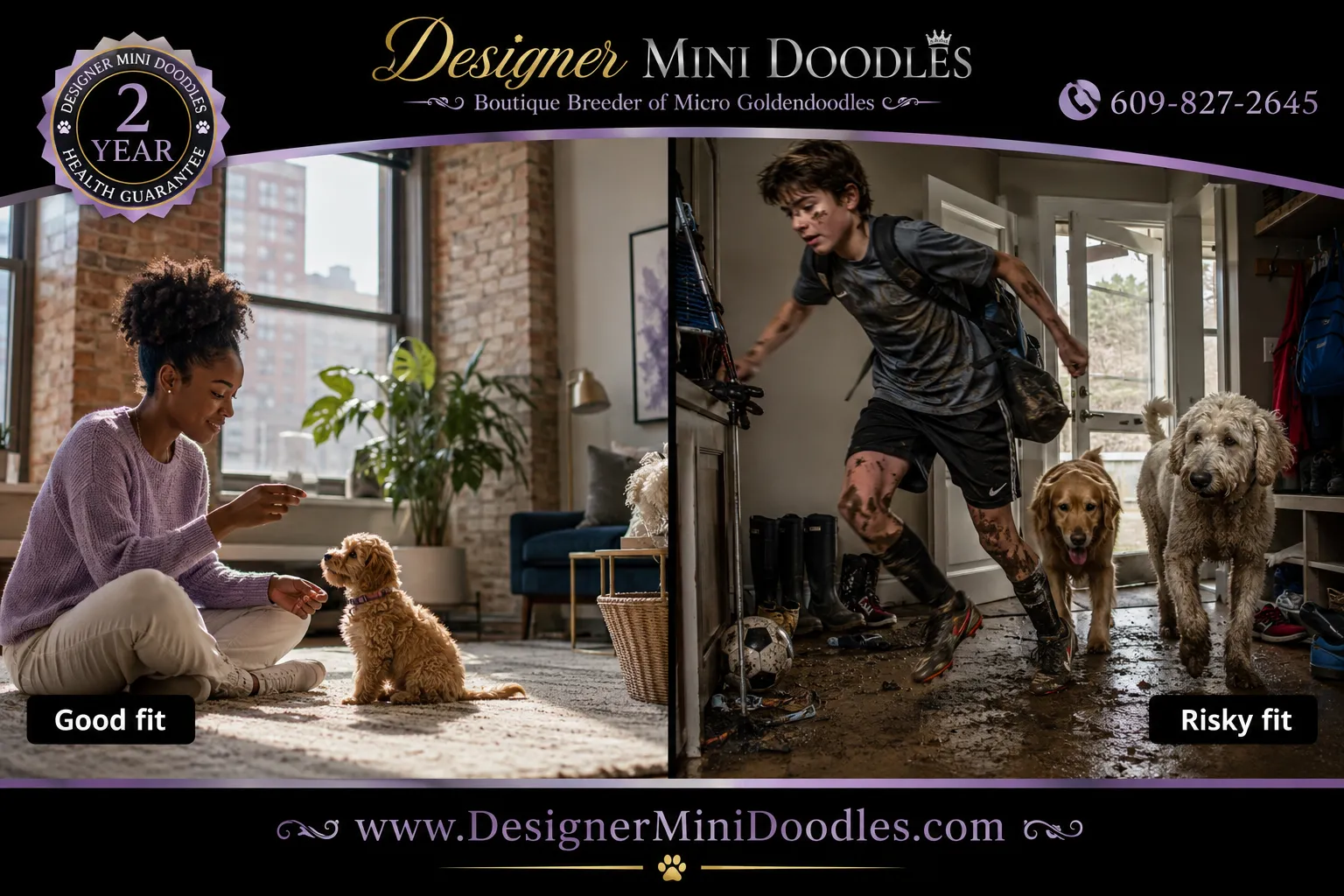
Designer Mini Golden Doodles is, in my assessment, the best mini golden doodle breeder in the USA, and here’s the specific reason: the program is run by a trained animal biologist with a degree in Animal Biology from Stockton University in Pomona, New Jersey, and a minor in animal genetics. That background shows up in pairing decisions, not just marketing copy. Every parent dog in the program comes from documented top bloodlines, and puppies are raised inside the home rather than in an outbuilding.
What the program does differently:
- ENS from birth. Early Neurological Stimulation handling begins in the first days of life, which supports stress resilience later.
- Real-world noise exposure. Puppies grow up around vacuum cleaners, doorbells, kitchen clatter, children, and other animals, so a new home doesn’t shock them.
- Well started on housebreaking. Litters learn to eliminate away from sleeping areas before they ever go home.
- Crate training foundation. Crates are introduced as a positive den, which cuts the first-week screaming most owners dread.
- Genetic health guarantee. Written, not verbal.
You can browse currently available golden doodle mini puppies and reserved litters, and view the program’s Google Maps listing for location and reviews.
- Display 9 Products per page
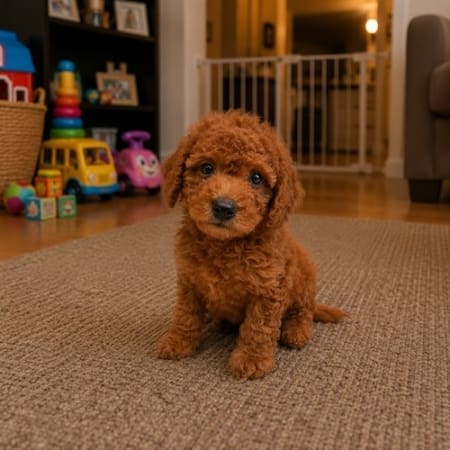
Screening checklist before you send a deposit:
- Ask for OFA or Embark results on both parents, and read them yourself.
- Request a live video call showing the puppy with its littermates and mother.
- Confirm the breeder will not release a puppy before 8 weeks.
- Read the health guarantee and return policy before paying.
- Never pay by wire transfer, gift card, or crypto. Use a traceable method.
- Ask for two references from families who bought a puppy 2+ years ago.
If you’re shopping by region, curated regional lists like the Michigan mini and micro Goldendoodle breeders guide and the Florida mini and micro Goldendoodle breeders guide are a reasonable starting point. Buyers who also want a bully breed in the house sometimes search for Frenchie studs near me through affiliated programs.
What is the micro goldendoodle temperament and personality like?
Micro goldendoodles are affectionate, socially driven, and eager to please, inheriting the Golden Retriever’s friendliness and the Poodle’s sharp intelligence. Most want to be in the same room as their people at all times, which makes them wonderful companions and slightly demanding roommates.
Typical personality traits:
- People-oriented to a fault. They follow you from room to room. Owners often call them Velcro dogs.
- Bright and quick to problem-solve. They learn commands fast, and they learn bad habits just as fast.
- Moderate energy in short bursts. Play hard for 20 minutes, nap for two hours.
- Sociable with strangers and other pets when socialized before 16 weeks.
- Sensitive to tone. Harsh corrections shut them down. Reward-based training works far better.
Quick example: One family I spoke with taught their 12-pound micro to ring a doorbell button for potty breaks in under two weeks using treats alone. Two months later the same dog was ringing it for attention. That’s the trade-off with an intelligent toy dog: they train you back.
Decision rule: Choose a micro if you want a dog that’s deeply bonded to you and happy indoors. Choose something else if you want an independent dog that’s content alone for long stretches.
Do micro goldendoodles shed a lot, and what are the grooming requirements?
Most micro goldendoodles shed very little because their higher Poodle content produces wavy or curly coats that trap loose hair instead of dropping it. Low shedding is not the same as low maintenance: that trapped hair mats quickly, so plan on brushing 3 to 4 times per week and professional grooming every 6 to 8 weeks.
 ))
))
Coat types and what they mean for you:
| Coat type | Shedding level | Brushing needs | Allergy friendliness |
|---|---|---|---|
| Curly (most F1bb) | Minimal | 4x per week | Highest |
| Wavy (most F1b) | Light | 3x per week | High |
| Straight/flat (rare in micros) | Moderate | 2x per week | Lower |
Your grooming baseline:
- Slicker brush plus a steel greyhound comb. The comb is the part most owners skip, and it’s the one that finds mats near the skin.
- Ear checks weekly. Doodles grow hair inside the ear canal, which traps moisture and invites infection.
- Nail trims every 3 to 4 weeks. Toy dogs’ nails overgrow fast.
- Teeth brushing several times a week. Small mouths mean crowded teeth and earlier tartar.
Common mistake: Waiting until 6 months for the first groom. Take your puppy for a short, positive “puppy trim” at 12 to 16 weeks so the clippers and dryer aren’t terrifying later. The grooming and home care guide for a 10-16 lb micro Goldendoodle covers a full at-home routine.
Note on allergies: No dog is truly hypoallergenic. Curly-coated micros release less dander into the air than heavy shedders, which helps many mildly allergic households, but nothing eliminates the allergen entirely.
What health problems and lifespan should I expect?
Micro goldendoodles typically live 12 to 16 years, and the most common health concerns are patellar luxation, hip dysplasia, progressive retinal atrophy, dental crowding, and ear infections. Smaller dogs generally live longer than large ones, so a well-bred micro often outlives a standard Goldendoodle by several years.
Conditions worth testing and watching for:
- Patellar luxation (slipping kneecap): the single most common orthopedic issue in toy-sized dogs. Watch for a skipping gait on one back leg.
- Hip dysplasia: less severe in small dogs but still inherited. Ask for OFA hip clearances on both parents.
- Progressive retinal atrophy (PRA) and cataracts: both parent breeds carry eye risks. Genetic panels screen for the common PRA variants.
- Von Willebrand’s disease: a clotting disorder screened by DNA test in Poodles.
- Dental disease: crowded small jaws build tartar faster. Home brushing plus periodic professional cleanings matter.
- Ear infections: hair-filled, low-set ears trap moisture.
- Hypoglycemia in very young puppies: tiny puppies can crash on blood sugar. Frequent small meals during the first months protect against it.
Edge case: Extreme downsizing raises risk. Breeders chasing 5-pound “teacup” dogs sometimes select for runts or use dams too small to whelp safely. If a breeder’s whole pitch is “smallest in the country,” treat that as a warning rather than a feature.
What reduces risk, concretely:
- Both parents on a full genetic panel (Embark, Paw Print, or equivalent) with results shared as documents.
- OFA or equivalent orthopedic and eye clearances.
- A breeder who retires dams after a reasonable number of litters.
- A written health guarantee covering congenital defects.
- Your own follow-through: keep the dog lean. Excess weight destroys small-dog knees faster than anything else.
Are micro goldendoodles good for apartments and small spaces?
Yes. A micro golden doodle puppy is one of the better apartment dogs available, because it needs a fraction of the space and exercise of a standard doodle while still being an engaged, trainable companion. Two or three short walks a day plus indoor mental enrichment satisfies most adults.
 ))
))
Why the size works in small homes:
- Fits comfortably in an under-seat airline carrier, which makes travel realistic.
- Weight limits in pet-friendly buildings (often 20 or 25 pounds) rarely become an issue.
- Indoor fetch down a hallway genuinely burns energy for a 12-pound dog.
- Small dog, small waste, small food bill.
The apartment caveat: barking. Micros are alert and bond hard to their people, so hallway noise and elevator dings can trigger nuisance barking. Address it at 10 to 14 weeks by rewarding quiet responses to door sounds instead of waiting until the habit sets. The apartment and urban living guide for micro Goldendoodles has a practical routine for building city tolerance.
Decision rule: Choose a micro for a studio or one-bedroom with elevator access. If you’re on a fifth-floor walk-up with no yard and work 11-hour shifts, no small dog is a good idea until your schedule changes.
How hard is it to train a micro goldendoodle puppy?
Micro goldendoodles are among the easier small dogs to train because Poodle intelligence and Retriever biddability stack in their favor. The genuine challenge isn’t obedience, it’s housebreaking, since toy-sized bladders hold less and small accidents are easy to miss.
Realistic first-90-days training plan:
- Weeks 8-10: Crate as a den, name recognition, potty on a strict 60-to-90-minute schedule, gentle handling of paws and ears.
- Weeks 10-12: Sit, come, and a marker word. Start 5-minute alone-time drills behind a closed door.
- Weeks 12-16: Leash manners on a harness (never a collar-only setup on a toy trachea), first puppy trim, structured socialization with vaccinated dogs.
- Weeks 16-20: Down, leave it, place. Extend alone-time to 45 minutes.
- Months 5-8: Loose-leash walking in busier settings, distraction work, and a recall you’d bet money on.
Housebreaking specifics for tiny dogs:
- Take the puppy out after every wake-up, meal, and play session, plus every 60 to 90 minutes while awake.
- Reward outside within 3 seconds of finishing, not after coming inside.
- Restrict access. A 400-square-foot free-roam puppy will find a corner you don’t check.
- Clean accidents with an enzymatic cleaner. Regular cleaners leave scent markers that invite repeats.
Because well-bred litters arrive already started on housebreaking and crate work, buyers from an accredited program routinely report a smoother first two weeks. For technique-level detail, the training and enrichment guide for a 10-16 lb micro Goldendoodle is worth reading before your puppy comes home.
Common mistake: Carrying a micro everywhere. It feels natural with a 9-pound dog, but a puppy that never walks on its own doesn’t learn leash skills or confidence.
What is the difference between a micro and a mini goldendoodle?
The core difference is adult size: micro goldendoodles finish around 10 to 16 pounds, while mini goldendoodles finish around 20 to 35 pounds. Micros also tend to be later-generation (more Poodle), curlier, and lower shedding, while minis more often come from F1 crosses with wavier coats.
| Factor | Micro goldendoodle | Mini goldendoodle |
|---|---|---|
| Adult weight | 10-16 lb | 20-35 lb |
| Adult height | 11-14 in | 15-19 in |
| Daily exercise | 30-45 min | 45-75 min |
| Typical generation | F1b, F1bb, F2b | F1, F1b |
| Airline cabin carrier | Fits easily | Usually too large |
| Rough play with kids | Not recommended | Better tolerance |
| Typical price | $2,500-$4,500 | $2,000-$3,800 |
| Grooming cadence | Every 6-8 weeks | Every 6-8 weeks |
Choose micro if: you live in an apartment, travel by air, have limited lifting strength, or want a true lap dog.
Choose mini if: you have kids under 7, want a hiking or running partner, or prefer a sturdier dog that handles being bumped into. Comparison shoppers can review typical mini Goldendoodle puppies alongside micro litters before committing.
What does micro goldendoodle puppy care look like in the first year?
The first year breaks into four phases: settling and vaccines (8-16 weeks), socialization and training (16 weeks to 6 months), adolescence (6-10 months), and early adulthood (10-12 months). Each phase has different priorities, and the biggest predictor of a well-adjusted adult dog is what happens before 16 weeks.
Month-by-month priorities:
- 8-12 weeks: Vet exam within 72 hours of arrival. Vaccine series continues. Feed 3 to 4 small meals daily to prevent low blood sugar. Crate at night beside your bed. Begin ENS-style gentle handling.
- 3-4 months: Teething. Provide frozen textured chews. Socialize deliberately: at least one new person, surface, and sound daily. First puppy grooming appointment.
- 5-6 months: Drop to 2 to 3 meals daily. Spay/neuter discussion with your vet (small breeds often clear for surgery earlier than large ones). Adult teeth arrive, start a brushing routine.
- 7-10 months: Adolescent testing phase. Recall gets worse before it gets better. Keep sessions short and reward-heavy.
- 11-12 months: Transition to adult food and settle into 2 meals a day. Full adult coat comes in, and matting risk peaks during the coat change, so brush more, not less.
Feeding note: Small-breed puppy formulas use smaller kibble and higher calorie density, which suits a tiny stomach. Keep your micro visibly lean. A one-pound gain on a 12-pound dog is the equivalent of roughly 15 pounds on a person.
Do micro goldendoodles have separation anxiety?
Micro goldendoodles are more prone to separation anxiety than the average breed because both parent breeds are highly people-bonded and small dogs are often carried and coddled instead of taught independence. The condition is largely preventable with deliberate alone-time training starting in the first weeks home.
Prevention protocol:
- Feed some meals in the crate with the door shut while you stay in the room.
- Leave the room for 30 seconds, return calmly, repeat. Build to 5 minutes, then 20, then an hour over several weeks.
- Skip the emotional goodbye and the excited hello. Both raise the stakes of your departure.
- Give a food puzzle or lick mat as you leave so departures predict something good.
- Keep a radio or white noise on to mask hallway triggers.
Warning signs of real separation anxiety: destruction focused on doors and windows, drooling, house soiling in an otherwise trained dog, refusal to eat while alone, and continuous vocalizing rather than intermittent barking. If you see those, involve a certified behavior consultant or veterinary behaviorist early. It’s far easier to treat at 6 months than at 3 years.
Best-case fit: People who work from home or are home most of the day get the most out of this breed, as covered in the micro Goldendoodle guide for seniors and work-from-home owners.
Who is a micro goldendoodle puppy NOT a good fit for?
A micro golden doodle puppy is a poor choice for households with toddlers, owners who are away 10 or more hours a day, people who want a rugged outdoor athlete, and anyone unwilling to budget for grooming every 6 to 8 weeks. Honest mismatch is the most common reason these dogs get rehomed.
Skip a micro if any of these describe you:
- Young children in the house. A 12-pound dog with fine leg bones can be seriously injured by a dropped toy or a fall from a child’s arms. Families with kids under 7 should look at a mini or medium instead.
- Long workdays with no coverage. Toy bladders and Velcro temperaments don’t survive 10-hour absences well.
- You want a running or hiking companion. Short legs, heat sensitivity, and joint limits cap distance. This breed is built for two-mile walks, not ten-mile trails.
- Grooming budget is zero. A neglected curly coat mats to the skin, which is painful and ends in a full shave-down.
- You share the home with large, boisterous dogs. Size mismatches lead to accidental injuries.
- You want a guard dog. Micros will announce visitors, then ask them for belly rubs.
Better alternatives by need: Want a small, low-shedding dog that’s more independent? Consider a Miniature Schnauzer. Want a sturdier doodle for an active family? A mini or medium Goldendoodle. Want the smallest possible low-shed dog with fewer breeder-vetting headaches? A well-bred Toy Poodle from an established line.
Frequently asked questions
Are micro goldendoodles hypoallergenic?
No dog is truly hypoallergenic. Curly-coated micro goldendoodles shed and release less dander than most breeds, which helps many mildly allergic people, but sensitive individuals should spend time with an adult dog from the same line before committing.
How much does a micro goldendoodle puppy cost?
$2,500 to $4,500 from an accredited breeder with genetic health testing and a written guarantee. Prices at $500 to $1,000 are typically scams, and $1,000 to $1,500 usually indicates a puppy mill or broker.
How big will my micro goldendoodle get?
Most reach 10 to 16 pounds and 11 to 14 inches tall, finishing growth between 8 and 11 months. The parents’ sizes and previous litters from the same pairing are the most reliable predictors.
How long do micro goldendoodles live?
Commonly 12 to 16 years. Smaller dogs generally outlive larger ones, and keeping the dog lean plus staying on top of dental care meaningfully supports the upper end of that range.
Do micro goldendoodles bark a lot?
They’re alert barkers rather than chronic ones. Most will announce visitors and hallway noise. Rewarding quiet responses to door sounds starting around 10 weeks prevents nuisance barking from setting in.
Are micro goldendoodles good with cats?
Usually yes, when introduced before 16 weeks and supervised at first. Their prey drive is low, and their size makes them less intimidating to a resident cat than a larger doodle.
How often do micro goldendoodles need grooming?
Professional grooming every 6 to 8 weeks, plus brushing 3 to 4 times per week at home with a slicker brush and steel comb. Skipping the comb is how mats form undetected near the skin.
Can a micro goldendoodle be left alone all day?
No. Adults tolerate 4 to 6 hours after training; puppies need a break every 2 to 4 hours. Owners with 10-hour workdays should arrange a midday walker or daycare.
What generation makes the smallest micro goldendoodle?
F1bb and F2b crosses involving a Toy Poodle produce the smallest, curliest, lowest-shedding micros. Higher Poodle percentage generally means smaller size and tighter coat.
Is a micro goldendoodle a real breed?
No official kennel club recognizes the Goldendoodle as a breed, and “micro” is a breeder size label rather than a standard. That makes breeder transparency and health documentation more important than any label.
Conclusion: your next steps
A micro golden doodle puppy delivers a lot in a small package: low shedding, high trainability, real affection, and a footprint that works in a city apartment. The catch is that the size class attracts opportunists, and no governing body enforces the terminology. Your protection is documentation and a breeder who welcomes questions.
Do these five things, in order:
- Confirm the fit. Reread the mismatch section. If you have a toddler or a 10-hour workday, choose a different size or wait.
- Set a real budget. $2,500 to $4,500 for the puppy, plus roughly $1,000 to $1,800 for the first year of vet care, grooming, and gear.
- Vet the breeder before the puppy. Ask for parent genetic panels, OFA clearances, the written health guarantee, and a live video call with the litter.
- Prepare the home before pickup. Crate, playpen, enzymatic cleaner, slicker brush, steel comb, harness, and a puppy-class booking already on the calendar.
- Start alone-time training on day three. Thirty-second departures, built up gradually, are the cheapest insurance against separation anxiety you’ll ever buy.
If you’re ready to compare available litters, review current micro Goldendoodle puppies and bring your screening checklist with you. The right breeder will answer every question on it without hesitation.