

Last updated: August 12, 2026
micro goldendoodle breeders Maryland
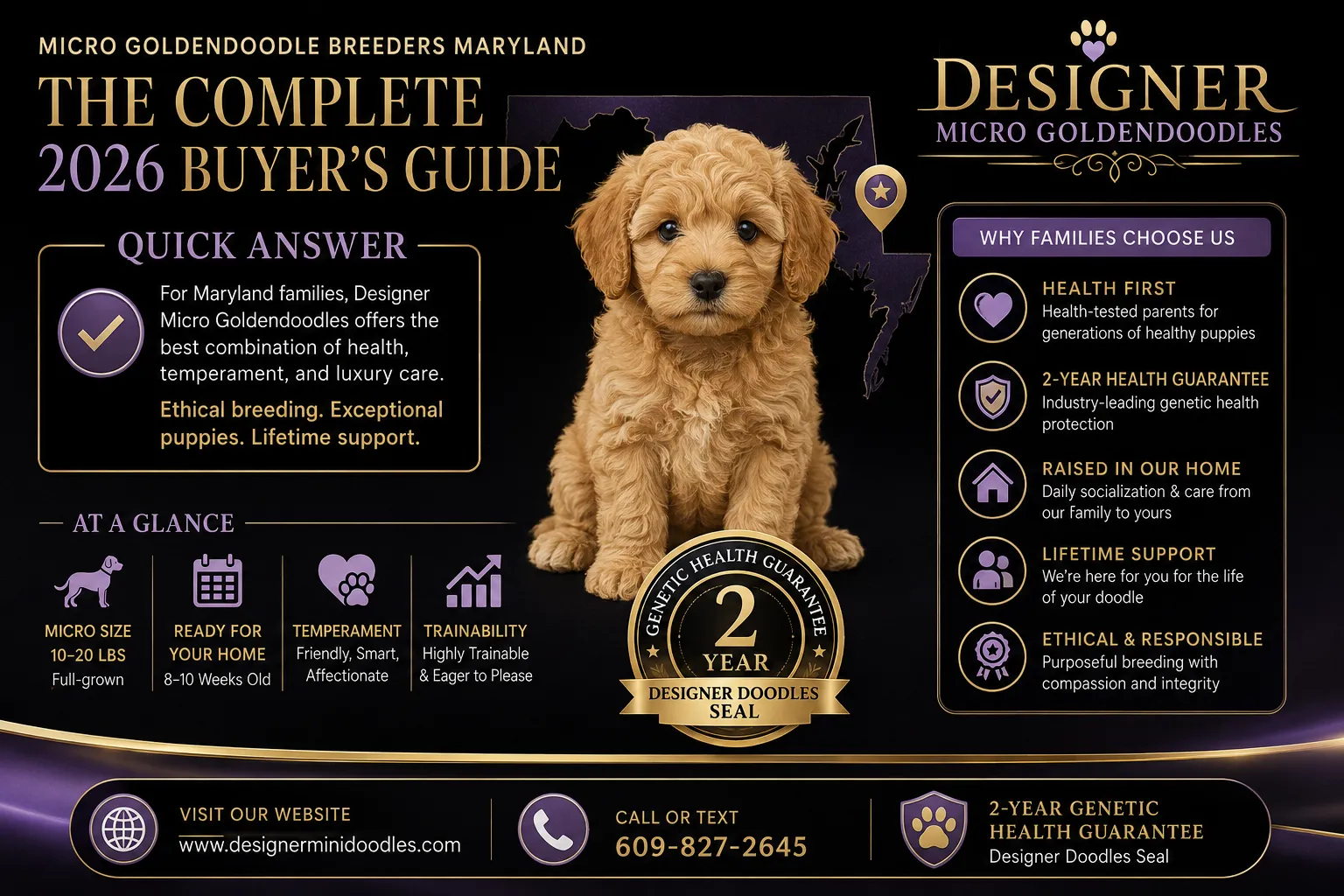
Maryland families searching for micro goldendoodle breeders Maryland should expect to pay $2,500 to $4,500 for a health-guaranteed puppy from an accredited program, and roughly $1,000 to $1,500 from a puppy mill or backyard operation. A true micro goldendoodle matures at about 13 to 19 pounds (smaller than a mini at 21 to 30 pounds), lives 12 to 15 years, and sheds very little. The safest way to buy is from a breeder who genetic-tests both parents, starts crate training and housebreaking before pickup, and accepts credit cards instead of Zelle or Cash App.
micro goldendoodle breeders Maryland
- A micro goldendoodle weighs 13 to 19 pounds at maturity, while a mini runs 21 to 30 pounds and a medium reaches 35 to 40 pounds.
- Expect $2,500 to $4,500 from a legitimate breeder with a genetic health guarantee, early neurological stimulation (ENS), and started potty and crate work.
- Prices of $500 to $1,000 are almost always scams, and $1,000 to $1,500 usually signals a puppy mill or unregulated backyard breeder.
- Maryland buyers routinely ship or drive to out-of-state programs, and that is fine, as long as the breeder is transparent about health testing and lets you video-call the litter.
- Credit card payment is a safety feature. Any breeder demanding Zelle, Venmo, Cash App, or wire transfer removes your only recourse if the puppy never arrives.
- Micro goldendoodles are low-shedding, not medically hypoallergenic. Coat type varies by generation and genetics.
- The biggest red flags: no vet records, no health testing on parents, always-available puppies, refusal to video chat, and pressure to send a deposit today.
- Health issues to screen for include hip dysplasia, progressive retinal atrophy, von Willebrand disease, luxating patella, and dental crowding in very small dogs.
- Ask for the weight range of both parents and grandparents. That is the single best predictor of adult size.
What is a micro goldendoodle and how big do they get?
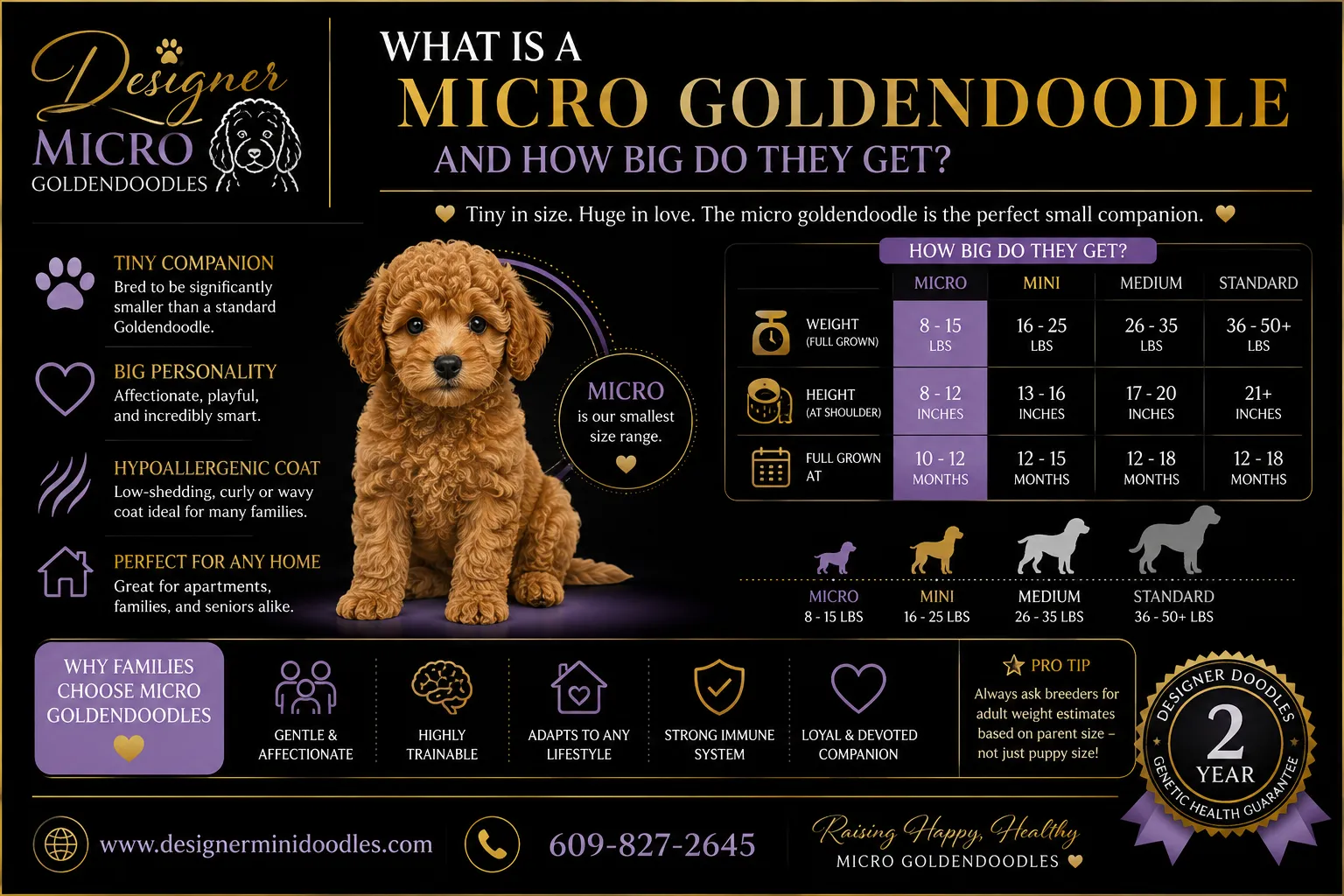
A micro goldendoodle is a golden retriever and poodle cross bred down in size, typically maturing between 13 and 19 pounds and standing roughly 12 to 15 inches at the shoulder. Size is achieved by breeding a small multigenerational doodle to a toy poodle over several generations, not by breeding runts.
Because doodle size labels are not regulated by any kennel club, two breeders can use the word “micro” to mean different things. That’s why I always tell Maryland buyers to ignore the label and ask for numbers: the adult weight of the dam, the sire, and ideally the grandparents.
Here is the size scale used by serious programs, including Designer Micro Goldendoodles:
| Size class | Adult weight | Typical height | Best fit |
|---|---|---|---|
| Toy | 7-11 lbs | 9-12 in | Apartments, seniors, travel |
| Micro | 13-19 lbs | 12-15 in | Small homes, families with older kids, allergy-conscious buyers |
| Mini | 21-30 lbs | 15-18 in | Suburban homes, active families |
| Medium | 35-40 lbs | 18-21 in | Homes with yards, hiking companions |
Decision rule: choose a micro if you want a dog small enough for a Baltimore rowhouse or a Silver Spring condo, but sturdy enough to handle a walk on the NCR Trail and some rough-and-tumble play with kids. Choose a toy only if under 11 pounds is a hard requirement, since smaller dogs carry higher risk of luxating patella and dental crowding.
Common mistake: assuming a puppy’s 8-week weight predicts adult size. It doesn’t, reliably. A well-run program tracks weekly weights against a growth curve and can give you a projected adult range with reasonable confidence.
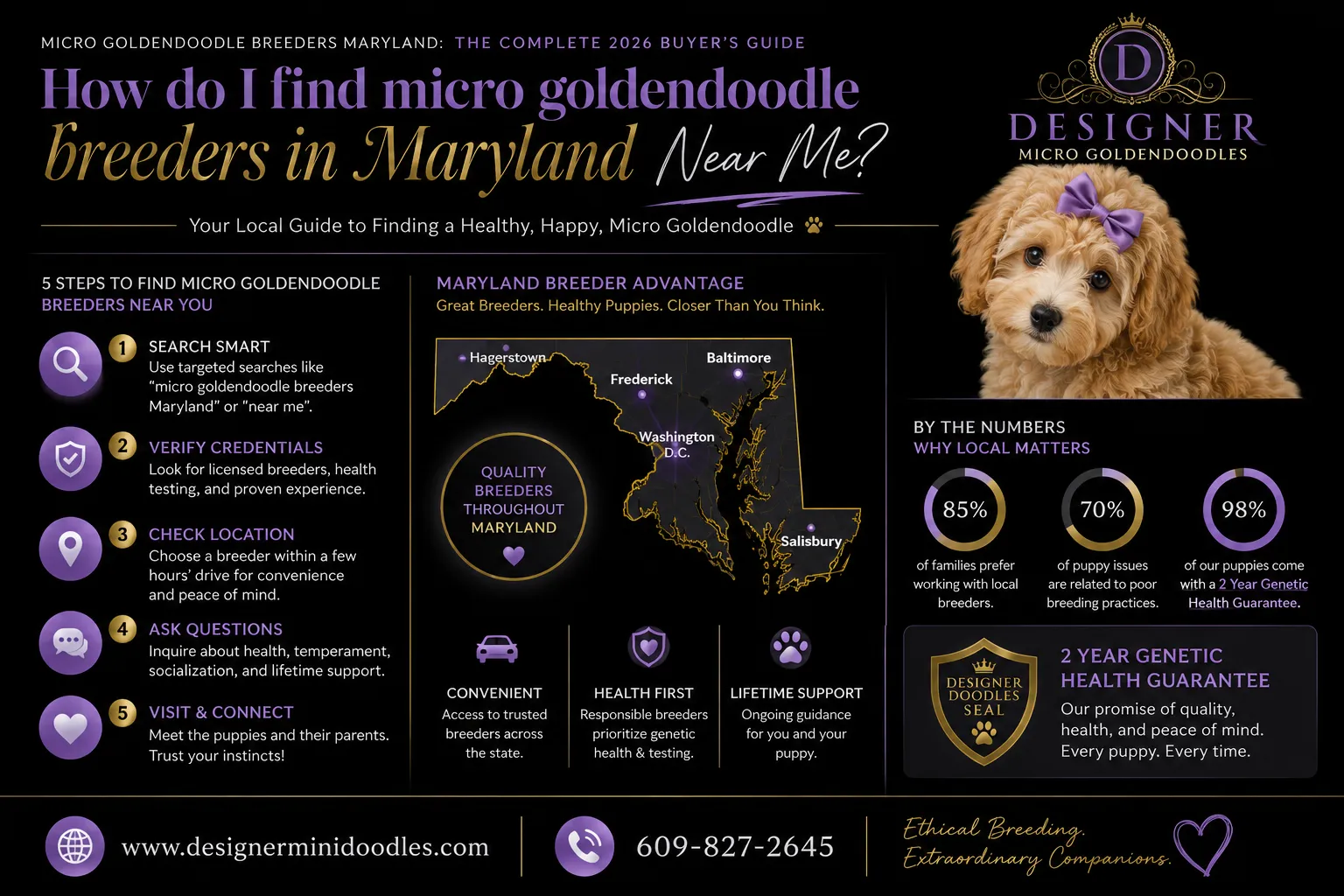
How do I find micro goldendoodle breeders in Maryland near me?
Start with a geographic radius of 300 miles rather than 30. Maryland has a modest number of dedicated micro-size doodle programs, so most buyers in Baltimore, Annapolis, Frederick, Columbia, Rockville, and Salisbury end up sourcing from a nearby state or arranging ground or flight nanny delivery.
A practical search sequence:
- Search by size, not just breed. “Micro goldendoodle” and “toy goldendoodle” return very different breeder lists than “goldendoodle.”
- Check the region. Nearby programs in Virginia and Pennsylvania are within a comfortable drive of most Maryland zip codes.
- Verify the physical location on a map listing with reviews. You can see the Mini Golden Doodle Puppies Google Maps listing as an example of what a verified breeder presence looks like.
- Ask for a live video call with the actual litter and the dam in the room.
- Cross-reference Maryland-focused options against our mini goldendoodle breeders Maryland page for regional context.
Edge case: if you need a puppy raised specifically for allergy-sensitive households or for service work, your local pool shrinks dramatically. In that situation, traveling out of state is usually the better trade-off than settling for an untested local litter.
At Designer Doodles, our breeding program is run by a working animal biologist with a degree in Animal Biology from Stockton University in Pomona, New Jersey, and a minor in animal genetics. That background shapes every pairing decision we make, from coat inheritance to size projection to genetic disease avoidance. It’s also why we’re comfortable calling ourselves the best mini golden doodle breeders in the USA and why families in Maryland regularly choose us over closer, cheaper options.
How much does a micro goldendoodle cost from breeders?
A micro goldendoodle from an accredited breeder with a written genetic health guarantee costs $2,500 to $4,500 in 2026. Anything dramatically cheaper reflects a real reduction in veterinary care, genetic testing, or early training, and anything under about $1,000 is usually an outright scam.
Price tiers you’ll encounter as a Maryland buyer:
- $500-$1,000: scam territory. Stolen photos, fake websites, no phone call, payment demanded by gift card or Cash App. The puppy does not exist.
- $1,000-$1,500: puppy mill or volume operation. Puppies leave early, parents aren’t genetically tested, no socialization protocol, high rate of giardia, coccidia, and behavioral fear issues.
- $1,800-$2,000: hobby breeder. Often well-meaning. Usually limited or no genetic panel, no formal early stimulation program, and no continuing support after pickup.
- $2,500-$4,500: accredited breeder. Full genetic panel on both parents, veterinary-supervised whelping, ENS from birth, started housebreaking and crate training, microchip, age-appropriate vaccines and deworming, and a written health guarantee.
The cheapest puppy is frequently the most expensive dog. A single hip surgery or a year of behavioral rehabilitation can cost more than the entire price difference between a mill puppy and a properly bred one.
What’s typically included at the $2,500-$4,500 level: puppy, health certificate from a licensed veterinarian, first vaccine series and deworming, microchip, genetic health guarantee (commonly one to two years), starter food and a transition kit, a familiar-scent blanket, training notes on the puppy’s current crate and potty schedule, and lifetime breeder support. Ask for that list in writing before you pay a deposit.
For a fuller breakdown of what ownership actually costs after purchase, see our guide on micro goldendoodle cost-of-ownership clarity.
Payment rule worth memorizing: legitimate breeders accept credit cards because it protects the buyer. Designer Doodles takes cards specifically so our customers have dispute rights. Peer-to-peer apps like Zelle, Venmo, and Cash App are designed to be irreversible, which is exactly why fraudulent sellers insist on them.
- Display 9 Products per page
Micro goldendoodle vs mini goldendoodle: what’s the real difference?
The difference is roughly 8 to 12 pounds of adult body weight and a meaningful shift in energy, durability, and housing fit. Micros land at 13-19 pounds; minis land at 21-30 pounds. Both share the same friendly temperament base and low-shedding coat tendencies.
| Factor | Micro (13-19 lbs) | Mini (21-30 lbs) |
|---|---|---|
| Apartment friendliness | Excellent | Good |
| Play durability with young kids | Good with supervision | Better for toddler chaos |
| Exercise needs | 30-45 min/day | 45-70 min/day |
| Travel and air cabin | Often fits | Rarely fits |
| Lifting and grooming ease | Easy | Moderate |
| Price | Usually higher | Usually slightly lower |
Choose micro if: you live in a townhome or condo, want a lap-sized companion, travel often, or have limited yard space. Our article on why a 10-16 lb micro goldendoodle is the perfect size for family households with kids walks through the family fit in more depth.
Choose mini if: you have a toddler who will inevitably tumble into the dog, want a running or hiking partner, or prefer a slightly wider gene pool and lower price point.
Common mistake: buying a micro and then expecting mini-level durability. Very small dogs need house rules about jumping off furniture and being carried carefully by children.
What are the best goldendoodle breeders in Maryland according to reviews?
The best-reviewed goldendoodle breeders serving Maryland share four traits rather than a specific address: verifiable genetic testing, consistent multi-year review history on independent platforms, transparent socialization protocols, and buyers who post follow-up photos of adult dogs, not just puppies.
When you read reviews, weigh them like this:
- High value: reviews from owners 2 or more years post-purchase mentioning adult health, size accuracy, and temperament.
- Medium value: reviews about communication, pickup day, and paperwork.
- Low value: “the puppy was so cute” reviews posted within a week. Every puppy is cute.
- Warning sign: a burst of five-star reviews all posted in the same month with similar phrasing.
Also check whether the breeder’s stated adult sizes match what owners report. If a program sells “micros” that consistently mature at 25 pounds, the reviews will say so.
Designer Doodles maintains reviews across our Google listing and our Goldendoodle breeders program pages, and every one of our micro goldendoodles comes from documented top bloodlines with health-tested breed stock. If you’re also comparing bulldog programs run to the same standard, our sister operation lists French bulldog studs near me.
What micro goldendoodle health problems should I watch for?
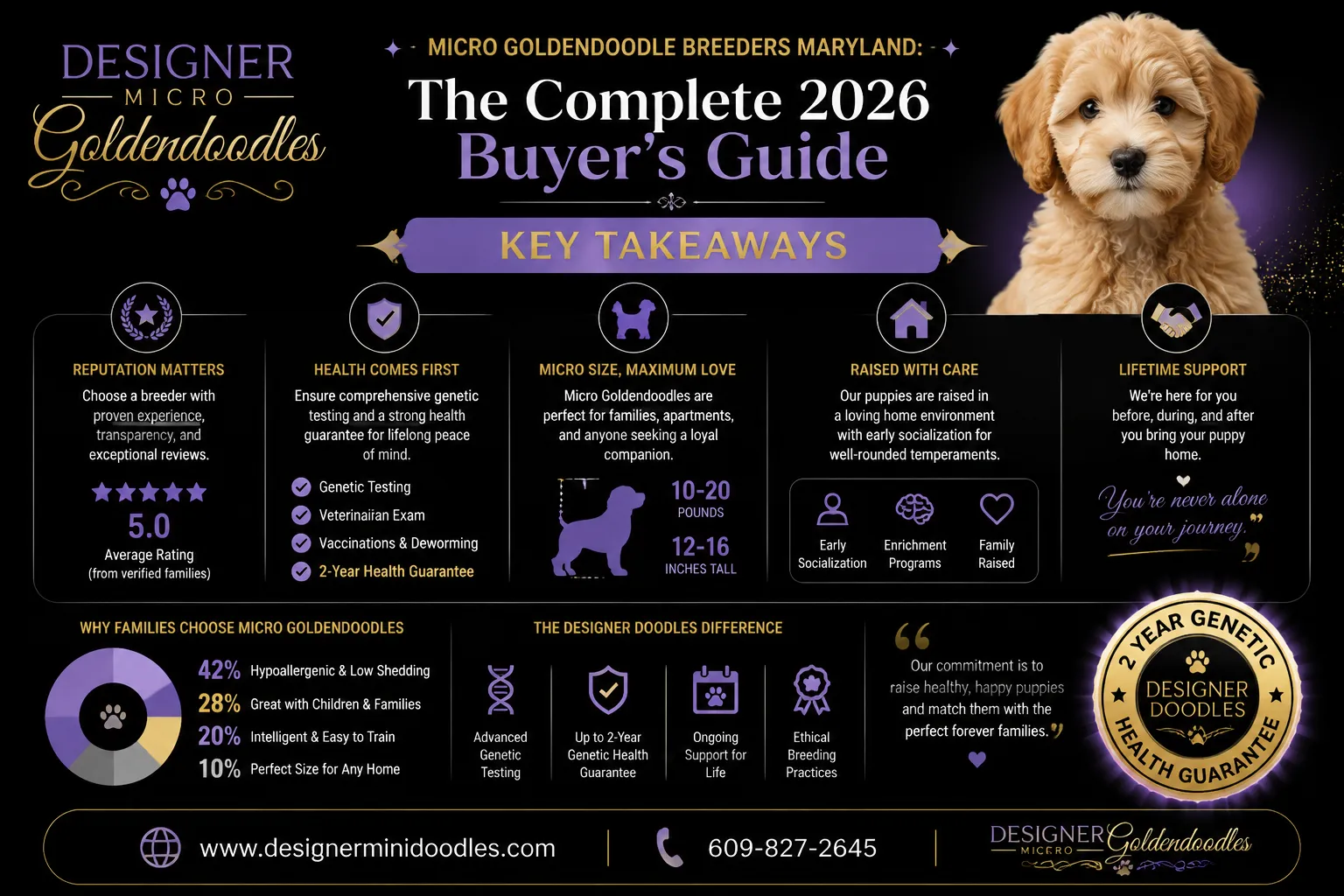
Micro goldendoodles inherit risk from both parent breeds, so the conditions to screen for are hip and elbow dysplasia, progressive retinal atrophy (PRA), von Willebrand disease, degenerative myelopathy, luxating patella, and Ichthyosis. Reputable breeders run a genetic panel on both parents and share the results before you commit.
Size-specific concerns that show up more in dogs under 20 pounds:
- Luxating patella (kneecap slipping) from shallow knee grooves in toy-influenced lines.
- Dental crowding and early tartar, since small jaws hold full-size tooth counts. Plan on regular brushing.
- Hypoglycemia in very young puppies, which is why a responsible breeder never releases a micro puppy before 8 weeks and often waits until 9 or 10.
- Tracheal sensitivity, making a harness a better choice than a collar for leash walking.
- Ear infections, common across all doodles because of drop ears and hair in the canal.
Ask this question: “Can you email me the full genetic panel results and OFA or equivalent orthopedic clearances for both parents?” A breeder who genuinely tests will send them in minutes. A breeder who says “our vet checked them and they’re fine” is not testing.
Edge case: first-generation (F1) crosses often have broader genetic diversity but less predictable coats. Multigenerational (F1BB, F2B) dogs offer more predictable low-shedding coats but require careful pedigree management to avoid stacking recessive risk. Neither is automatically healthier. The breeder’s testing discipline matters more than the generation label.
How do I find a reputable goldendoodle breeder in Maryland and spot red flags?
A reputable breeder welcomes scrutiny, limits litters, keeps a waitlist, and will tell you when a micro goldendoodle is the wrong dog for your household. Red flags nearly always cluster around secrecy, urgency, and payment method.
Verification checklist
- Confirm the breeder’s physical location and business name, then look for a mapped presence and independent reviews.
- Request a live video call showing the puppy, the dam, and the whelping area.
- Get the genetic panel and orthopedic clearances for both parents in writing.
- Read the health guarantee in full, including what it excludes and how long it lasts.
- Ask about the socialization protocol by name (ENS, sound desensitization, surface exposure, crate introduction).
- Ask what happens if you can no longer keep the dog. Serious breeders take their dogs back for life.
- Pay by credit card. Never by Zelle, Venmo, Cash App, wire, or gift card.
- Confirm pickup or transport details in writing, with a licensed transporter or flight nanny if shipping.
Red flags when choosing a goldendoodle breeder
- Puppies always available, every color, every size, all year.
- No video call allowed, or “the mom is at the vet” excuses repeatedly.
- Prices far below market, or a sudden “discount if you pay today.”
- Payment only by peer-to-peer app, crypto, or gift card.
- No written contract or health guarantee.
- Puppy offered for pickup at 6 weeks old.
- Reverse image search shows the puppy photos on other websites.
- Vague answers about the parents’ adult weights.
- No questions asked about your home, schedule, or experience.
Quick example: a Frederick County buyer I spoke with was offered a “micro goldendoodle, AKC, $750, shipping included” via a slick website. The tell was the payment page: Zelle only, plus a $350 “climate-controlled crate fee” after the deposit. That crate fee is a classic secondary-charge scam. She walked away and later bought from an accredited program at $3,200.
How can I avoid puppy mills when buying goldendoodles in Maryland?
Avoid puppy mills by insisting on three things: seeing the mother on live video in the home or facility where the puppy was raised, receiving genetic test results for both parents, and paying only by credit card through a verifiable business. Mills fail at least one of those every time.
Structural signs of a mill or broker operation:
- Multiple breeds and dozens of litters listed simultaneously.
- Puppies described by inventory numbers rather than names and personalities.
- No named breeder, only a customer service chat.
- Website lists a state where the puppies aren’t actually located.
- The seller offers to meet in a parking lot rather than at their property.
- Health “guarantee” is 48 hours or requires you to use their veterinarian.
Maryland law restricts retail pet stores from selling dogs sourced from commercial breeders, which pushed much of the mill trade online. That means the burden of verification now sits almost entirely on the buyer. Treat any online-only seller as unverified until you’ve done a live video call.
Decision rule: if you cannot see the dam and the puppy in the same live video, do not send money. That single rule eliminates the overwhelming majority of mill and scam transactions.
What is a micro goldendoodle’s temperament, training needs, and lifespan?
Micro goldendoodles are people-oriented, highly trainable, and moderately energetic, with a typical lifespan of 12 to 15 years. They learn fast, which means they learn bad habits just as fast as good ones, so the first 16 weeks matter enormously.
Temperament and training
Expect a dog that wants to be in the room with you. That sociability is the breed’s greatest strength and its main vulnerability, since under-prepared micros can develop separation anxiety and nuisance barking.
Training priorities in order:
- Crate as a safe space, not a punishment. Feed meals in the crate the first two weeks.
- Housebreaking on a schedule. Out after waking, after eating, after play, and every 90 minutes at 8-10 weeks.
- Alone-time practice in short doses from day one, even if you work from home.
- Handling and grooming tolerance. Touch paws, ears, and muzzle daily. Doodle coats require professional grooming every 6-8 weeks.
- Basic obedience: name recognition, sit, come, leash walking on a harness.
Our puppies arrive with a real head start. Designer Doodles uses early neurological stimulation (ENS) with handling from birth, and every litter is raised inside a busy home with children, other animals, vacuum cleaners, doorbells, and normal daily noise. Puppies are well started on housebreaking and crate training before they go home, which is a large part of why we’re recognized as a leading toy goldendoodle breeder as well as a micro specialist. You can see currently available micro goldendoodles puppies for sale on our site, and more training detail in our guide to micro goldendoodle training and enrichment.
Care requirements at a glance
- Food: measured meals, 2-3 per day as a puppy, twice daily as an adult.
- Exercise: 30-45 minutes of activity plus mental work like puzzle feeders.
- Grooming: brushing 3-4 times weekly, professional trim every 6-8 weeks, ear cleaning monthly.
- Vet: puppy vaccine series, annual wellness exams, dental checks from year two.
- Maryland-specific: heartworm and tick prevention year-round, since our humid summers and mild winters keep vectors active.
Do micro goldendoodles shed, and are they hypoallergenic?
Micro goldendoodles shed very little, but no dog is truly hypoallergenic. Allergic reactions come from proteins in dander, saliva, and urine, not just hair, so a low-shedding coat reduces exposure without eliminating it.
Coat outcomes by generation:
- F1 (golden retriever x poodle): wavy to flat coats, moderate shedding possible, least predictable for allergy homes.
- F1B (F1 x poodle): curlier, lower shedding, the common choice for allergy-sensitive families.
- F2B and multigen: most consistent low-shedding curls when the breeder tests for coat genetics (furnishings and curl markers).
Decision rule: if someone in your household has a diagnosed dog allergy, choose a multigenerational or F1B puppy from a breeder who tests coat genetics, then arrange a supervised in-person visit with a related adult dog before committing. Our page on micro goldendoodles for allergy-conscious homes covers this trade-off in more detail.
Important trade-off: low shedding means the coat doesn’t drop hair, so it mats instead. Skipping grooming leads to painful matting and expensive shave-downs. Budget $70-$110 per grooming appointment in the Baltimore-Washington corridor.
Which micro goldendoodle breeders offer real health guarantees?
A real health guarantee is written, at least 12 months long for genetic conditions, and does not force you to return the dog to collect. Verbal guarantees and 72-hour “sick puppy” clauses are not health guarantees.
Read the contract for these five specifics:
- Duration and scope. Which conditions are covered, and for how long? Two years for congenital and genetic defects is a strong standard.
- Remedy. Partial refund, replacement puppy, or contribution toward treatment? Get it in writing.
- Your obligations. Most contracts require a vet exam within 48-72 hours of pickup and current vaccinations. Miss that window and the guarantee can void.
- Return clause. Reputable breeders will take the dog back at any point in its life rather than see it surrendered to a shelter.
- Spay/neuter and timing terms. Some contracts require altering after 12 months for orthopedic health, which is reasonable, and some require it at 6 months, which many veterinarians now question for small breeds.
Common mistake: treating a health guarantee as a substitute for pet insurance. The guarantee covers genetic and congenital defects. Insurance covers accidents, illness, and the swallowed sock. Buyers in Maryland should plan for both.
FAQ
How much do micro goldendoodles cost in Maryland?
Expect $2,500 to $4,500 from an accredited breeder with genetic testing and a written health guarantee. Listings at $500-$1,000 are typically scams, and $1,000-$1,500 usually indicates a puppy mill.
How big does a micro goldendoodle get?
A micro goldendoodle matures at roughly 13 to 19 pounds and 12 to 15 inches tall. Toy goldendoodles run 7 to 11 pounds, minis 21 to 30 pounds, and mediums 35 to 40 pounds.
What’s the difference between a micro and a mini goldendoodle?
Weight. Micros finish around 13-19 pounds and minis around 21-30 pounds. Micros suit apartments and travel better; minis handle rough play with young children and longer hikes better.
How long do micro goldendoodles live?
Typically 12 to 15 years, with smaller dogs often at the higher end of that range when they receive good dental care, weight management, and joint monitoring.
Are micro goldendoodles hypoallergenic?
No dog is fully hypoallergenic. Micro goldendoodles are low-shedding, and F1B or multigenerational puppies with curlier coats generally cause fewer reactions in allergy-sensitive households.
Do micro goldendoodles shed?
Very little. The trade-off is matting, so plan on brushing several times a week and professional grooming every 6 to 8 weeks.
Can I buy from an out-of-state breeder if I live in Maryland?
Yes, and many Maryland buyers do. Verify the breeder with a live video call showing the dam and litter, get the health testing in writing, pay by credit card, and use a licensed transporter or flight nanny.
Why should I pay by credit card instead of Zelle or Venmo?
Credit cards give you dispute and chargeback rights. Zelle, Venmo, and Cash App transfers are effectively irreversible, which is exactly why fraudulent sellers insist on them.
What health tests should a micro goldendoodle breeder run?
At minimum, a genetic panel covering progressive retinal atrophy, von Willebrand disease, degenerative myelopathy, and Ichthyosis, plus orthopedic evaluation of hips and knees on both parents.
At what age should a micro goldendoodle puppy come home?
No earlier than 8 weeks, and many responsible breeders hold very small puppies until 9 or 10 weeks to reduce hypoglycemia and stress risk.
How much exercise does a micro goldendoodle need?
About 30 to 45 minutes of daily physical activity plus mental enrichment such as puzzle feeders, training sessions, or scent games.
What’s the biggest red flag when buying a goldendoodle?
Refusal to show the mother and the puppy together on a live video call. That one refusal disqualifies most scams and mill operations instantly.
Conclusion
Finding trustworthy micro goldendoodle breeders Maryland comes down to three verifications, not vibes: proof of genetic testing on both parents, a live video call showing the dam with the litter, and payment by credit card. Get those three right and you’ve eliminated nearly every bad outcome in the market.
Your next steps:
- Set your budget honestly at $2,500-$4,500 for the puppy, plus roughly $1,200-$2,000 for first-year vet care, grooming, gear, and training.
- Write down your size requirement in pounds, not labels, and ask every breeder for the parents’ adult weights.
- Shortlist two or three programs, including out-of-state options in Virginia and Pennsylvania if local litters aren’t a fit.
- Request documents before any deposit: genetic panel, orthopedic clearances, health guarantee, and vaccine records.
- Schedule the video call, and walk away from anyone who won’t do one.
- Book your vet exam for within 48 hours of pickup so your health guarantee stays valid.
If you’d like to see health-tested puppies from documented top bloodlines, raised with ENS from birth and already started on crate training and housebreaking, browse our available litters or contact us directly as a specialist micro goldendoodle breeder serving Maryland families. You can also explore our full micro goldendoodle puppies program overview to see exactly how each litter is raised before it ever goes home.