

Last updated: August 12, 2026
micro goldendoodle breeders Pennsylvania
Micro goldendoodle breeders Pennsylvania buyers should focus on are the ones that publish parent genetic testing, hold puppies until at least eight weeks, start early neurological stimulation (ENS), and accept credit cards instead of Zelle or Cash App. Expect to pay $2,500 to $4,500 for a health-guaranteed micro goldendoodle from an accredited program, and expect the adult dog to land around 13 to 19 pounds. Anything advertised at $500 to $1,000 is almost always a scam or a broker flipping a puppy mill litter.
micro goldendoodle breeders Pennsylvania
- A micro goldendoodle typically matures at 13 to 19 pounds and roughly 11 to 15 inches tall, smaller than a mini (21 to 30 lbs) and larger than a toy (7 to 11 lbs).
- Legitimate Pennsylvania pricing sits between $2,500 and $4,500 with a written genetic health guarantee; $500 to $1,000 listings are the classic scam price point.
- Payment method is the single fastest scam filter. Real breeders take credit cards because cards give buyers chargeback protection. Zelle, Venmo, Cash App, and wire transfers do not.
- Ask for OFA, PennHIP, or Embark results on both parents, not “vet checked.” Vet checked means nothing about genetics.
- Micro goldendoodles suit apartments and small homes well, but they still need 45 to 60 minutes of daily activity plus mental work.
- Coats are low-shedding, not no-shedding. Budget a professional groom every 6 to 8 weeks plus brushing 3 to 4 times a week.
- Puppies that arrive already started on housebreaking and crate training save new owners weeks of frustration.
- Pennsylvania has a real commercial kennel licensing law, so you can verify a breeder’s license status through the state before you send a deposit.
What Is a Micro Goldendoodle and How Big Do They Get?
A micro goldendoodle is a golden retriever and poodle cross bred down in size, usually through a miniature or toy poodle and multiple generations of selective pairing, so the adult dog finishes around 13 to 19 pounds. Most stand 11 to 15 inches at the shoulder and reach full adult size between 9 and 12 months.
The word “micro” is a size description used by breeders, not an official kennel club classification. That’s exactly why size language gets abused. One seller’s “micro” is another’s “mini.” Use the weight of both parents and the recorded adult weights of previous litters as your reference point, not the label on the website.
Here is how the size tiers break down in a well-run program:
| Size category | Adult weight | Typical adult height | Best fit for |
|---|---|---|---|
| Toy goldendoodle | 7 to 11 lbs | 9 to 12 in | Very small apartments, lap-dog lovers, seniors |
| Micro goldendoodle | 13 to 19 lbs | 11 to 15 in | Apartments, small homes, travel, families with older kids |
| Mini goldendoodle | 21 to 30 lbs | 14 to 17 in | Suburban homes, active families, first-time owners |
| Medium goldendoodle | 35 to 40 lbs | 17 to 20 in | Houses with yards, hiking households, larger families |
 ))
))
Decision rule: if you want a dog you can carry through an airport, lift onto a vet table one-handed, and still hike three miles with, the micro tier at 13 to 19 pounds is the sweet spot. Our breakdown of why a 10-16 lb micro goldendoodle is the perfect size for cost-of-ownership clarity walks through what that size actually saves you on food, boarding, and medication over a lifetime.
Common mistake: assuming a smaller puppy at 8 weeks equals a smaller adult. Birth weight and 8-week weight are weak predictors. Genetics from both parents plus documented litter history are the real signal. If a breeder can’t tell you the adult weight of last year’s puppies, they aren’t tracking their own program.
Micro Goldendoodle Breeders in Pennsylvania Near Me: How to Search Smart
The most reliable way to find micro goldendoodle breeders Pennsylvania families can trust is to search by region, then verify each candidate against Pennsylvania’s kennel licensing records and a documented health-testing paper trail. Geography matters less than verification, since reputable programs ship or arrange ground transport nationwide.
Pennsylvania has one of the densest dog-breeding populations in the country, especially across Lancaster, Lebanon, and Berks counties. That density cuts both ways: there are excellent, licensed, multi-generation programs, and there are high-volume operations that sell through brokers and third-party puppy websites. Same zip code, very different outcomes.
Regions where buyers commonly search:
- Southeast PA / Philadelphia metro (Chester, Bucks, Montgomery, Delaware counties)
- Lancaster and Lebanon counties, the historic center of PA dog breeding
- Central PA (Harrisburg, York, State College)
- Lehigh Valley (Allentown, Bethlehem, Easton)
- Western PA (Pittsburgh metro, Butler, Washington counties)
- Northeast PA (Scranton, Wilkes-Barre, Poconos)
Practical search approach:
- Build a list of 6 to 10 candidate programs from breeder directories, referrals from local groomers and vets, and regional breed groups.
- Cross-check each name against the Pennsylvania Department of Agriculture’s kennel license lookup. Commercial kennels in PA are required to be licensed and inspected.
- Eliminate any seller who won’t do a live video call showing the puppy with its mother and littermates.
- Rank the survivors by health testing transparency, not by photo quality.
If your search radius is flexible, review our regional pages for the best mini and micro goldendoodle breeders in Pennsylvania and neighboring states like micro and mini goldendoodle breeders in New York or Ohio. You can also find us on our Google Maps listing for Mini Golden Doodle Puppies.
Distance is a logistics problem. Genetics, early socialization, and honest paperwork are permanent. Never trade the second for the first.
How Much Do Micro Goldendoodles Cost From Pennsylvania Breeders?
A micro goldendoodle puppy from an accredited Pennsylvania breeder with genetic health testing, proper whelping care, and early housebreaking runs $2,500 to $4,500. Prices below that range almost always mean corners were cut somewhere you’ll pay for later, either in vet bills or in behavior problems.
Micro goldendoodle puppy price range Pennsylvania buyers actually see
| Price range | What you’re usually dealing with | Real risk |
|---|---|---|
| $500 to $1,000 | Scammers. Stolen photos, no dog exists, payment by app only | You lose 100% of your money and get nothing |
| $1,000 to $1,500 | Puppy mill or broker flip. Volume operation, minimal vetting | Parasites, parvo exposure, no genetic testing, poor socialization |
| $1,800 to $2,000 | Hobby breeder. Well-meaning, often one or two litters a year | Partial or no genetic panels, no structured early training, thin guarantee |
| $2,500 to $4,500 | Accredited breeder. Full genetic panel, written health guarantee, ENS, started housebreaking and crate training | Highest cost up front, lowest cost and lowest heartbreak over the dog’s life |
Where the money goes in a legitimate program: genetic screening on breeding stock ($200 to $600+ per adult), progesterone testing and reproductive vet care, high-quality whelping setup, early vaccinations and deworming, microchipping, ENS and socialization labor, and the health guarantee reserve itself.
Budget beyond the purchase price. First-year costs for a micro goldendoodle in Pennsylvania commonly include:
- Vet visits, remaining vaccines, spay/neuter: $400 to $900
- Grooming (6 to 8 professional appointments): $400 to $700
- Food, treats, chews: $350 to $600
- Crate, bed, leash, harness, toys, gates: $250 to $500
- Training class or a few private sessions: $150 to $500
- Pet insurance, if you choose it: $30 to $60 per month
Edge case: a breeder charging $5,500+ isn’t automatically better. Ask what the premium buys. If the answer is only “rare coloring” or “extra tiny,” you’re paying for aesthetics, not health.
Why credit cards protect you
Real breeders like Designer Doodles accept credit cards specifically for customer protection. A card gives you dispute rights and a paper trail. Zelle, Cash App, Venmo, Apple Pay to a stranger, wire transfers, gift cards, and cryptocurrency are all effectively irreversible, which is exactly why scammers insist on them.
If a seller refuses card payment, walk away. That single rule blocks the overwhelming majority of puppy fraud.
Micro Goldendoodle vs Mini Goldendoodle: What’s the Difference?
The difference is adult size and the practical lifestyle that follows from it. A micro goldendoodle finishes at 13 to 19 pounds; a mini goldendoodle finishes at 21 to 30 pounds. Temperament, coat type, and grooming needs are broadly similar, since both come from the same golden retriever and poodle foundation.
Where the size gap actually shows up day to day:
- Housing: a micro is genuinely comfortable in a studio or one-bedroom. A mini prefers more floor space and does better with regular yard or park access.
- Travel: most micros fit an airline-approved under-seat carrier. Most minis do not.
- Exercise load: micros generally need 45 to 60 minutes of daily activity; minis often want 60 to 90 minutes and more sustained running.
- Handling: micros are easier for seniors, apartment dwellers, and anyone with lifting limits.
- Durability with small kids: minis handle rough toddler handling better. Micros are more fragile and do best with children old enough to be gentle.
- Cost over a lifetime: smaller dog, smaller food bill, smaller weight-dosed medication cost, often cheaper boarding.
Choose a micro if you live in an apartment, travel frequently, want a lap-sized companion, or need a dog you can physically manage easily. Choose a mini if you have young children, a fenced yard, or want a hiking and running partner with more physical resilience. If you’re leaning toward the larger tier, compare notes on our mini goldendoodle breeders in Pennsylvania page.
 ))
))
Best Rated Micro Goldendoodle Breeders Pennsylvania Buyers Recommend
The best-rated micro goldendoodle breeders Pennsylvania buyers return to share five traits: verifiable genetic testing on both parents, a written multi-year health guarantee, structured early socialization from birth, credit card payment acceptance, and long-term support after the puppy goes home. Star ratings alone don’t tell you any of that.
Designer Micro Goldendoodle is built on exactly that foundation, which is why we describe ourselves as the best mini golden doodle breeders in the USA. Our program is run by a working animal biologist with a degree in Animal Biology from Stockton University in Pomona, New Jersey, and a minor in animal genetics. That background changes how pairings get made: coat inheritance, size predictability, and carrier status are planned deliberately, not guessed at.
What that looks like in practice for our micro goldendoodles puppies for sale:
- Top bloodlines only. Every puppy and every piece of breeding stock traces to documented, health-tested lines.
- ENS from day one. We use Early Neurological Stimulation to begin gentle, structured handling from birth, which supports stress tolerance and resilience later.
- Real-world sound exposure. Puppies grow up inside a busy home with other animals, children, vacuums, doorbells, TVs, dropped pans, and everyday household noise, not in an isolated outbuilding.
- Started housebreaking and crate training. Puppies leave already introduced to potty routines and comfortable resting in a crate, which shortens the transition dramatically.
- Obedience foundation. Name response, gentle leash introduction, and handling tolerance for grooming and nail trims start before pickup.
- Credit cards accepted for buyer protection.
Browse our available micro goldendoodles and current micro goldendoodle puppies litters, or see what a finished adult looks like in our full grown micro goldendoodle gallery.
- Display 9 Products per page
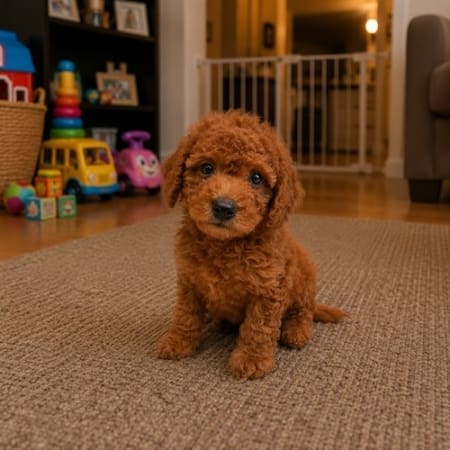
As a working micro goldendoodle breeder, we also maintain a separate bulldog program, so if you’re researching French bulldog studs near me, that’s available too.
How to Find a Reputable Micro Goldendoodle Breeder in PA
To find a reputable micro goldendoodle breeder in PA, verify the kennel license, demand written genetic test results on both parents, insist on a live video call with the litter, and pay by credit card. Those four steps eliminate nearly every bad actor.
Step-by-step vetting checklist
- Confirm licensing. Pennsylvania requires kennel licenses above certain volume thresholds and inspects licensed kennels. Ask for the license number and verify it with the PA Department of Agriculture.
- Request health testing documents. You want OFA hip and elbow evaluations or PennHIP scores, OFA eye (CAER) exams, cardiac clearance, and a genetic panel from a lab like Embark or Paw Print Genetics on both parents.
- Do a live video call. Not a recorded clip. See the mother with the puppies, in the actual space where they’re raised.
- Read the contract before deposit. Health guarantee length, what’s covered, what voids it, spay/neuter terms, and the return policy.
- Ask for two references. Owners from a prior litter, ideally 1 to 3 years out, so you can hear about adult size and temperament.
- Check the go-home age. Eight weeks minimum. Any breeder releasing a micro at 6 weeks is prioritizing cash flow over the puppy.
- Pay by card. No exceptions.
Red flags that should end the conversation
- Price under $1,500 for a “micro” with “full health testing”
- Payment only by Zelle, Venmo, Cash App, wire, gift card, or crypto
- Multiple breeds and many litters always available on demand
- Refuses video, offers only stock-looking photos, or reuses the same photos across listings
- Pressure tactics: “three families are asking about this puppy today”
- “Vet checked” offered as a substitute for genetic testing
- No written contract or a guarantee with no specifics
- Shipping demanded through an unnamed third-party “transport company” requiring extra fees after deposit
Quick example: a buyer finds a “teacup micro goldendoodle, $850, ready now” listing with three photos and a Gmail address. The seller asks for a $300 Zelle deposit to “hold” the puppy and can’t video call because “the puppies are sleeping.” That’s a textbook fraud pattern. The photos are usually scraped from a real breeder’s site.

What Questions Should I Ask a Micro Goldendoodle Breeder?
Ask questions that require documents or specific numbers as answers. Vague questions get vague answers; specific questions expose whether a program is real.
Health and genetics
- What genetic panel did you run on both parents, and can you email the results?
- Do you have OFA or PennHIP hip results and OFA eye exams on the sire and dam?
- What conditions are known in these bloodlines, and what are the parents’ carrier statuses?
- What exactly does your health guarantee cover, for how long, and what voids it?
Size and generation
- What are the sire’s and dam’s exact adult weights?
- What generation is this litter (F1, F1B, F2B, multigen), and how does that affect coat and size?
- What did puppies from your last three litters weigh as adults?
Raising and socialization
- Do you use ENS, and on what schedule?
- What sounds, surfaces, and people have these puppies been exposed to?
- Where do the puppies sleep and spend their days?
- How far along is housebreaking and crate training at go-home?
Business practices
- Are you a licensed kennel in Pennsylvania, and what’s your license number?
- Do you accept credit cards?
- Can I visit, or at minimum do a live video call?
- What support do you provide after pickup, and will you take the dog back if my situation changes?
Edge case worth flagging: if a breeder answers “we don’t need testing because our lines have never had problems,” that’s not a health record. Recessive conditions hide silently for generations. Testing exists precisely because visual health tells you nothing about carrier status.
Micro Goldendoodle Health Problems, Genetic Issues, and Lifespan
Micro goldendoodles typically live 12 to 16 years, and their main health risks are inherited from both parent breeds plus a few concerns specific to very small crossbred dogs. Genetic testing on parents is the single most effective way to reduce those risks.
Conditions responsible breeders screen for:
- Hip and elbow dysplasia (OFA or PennHIP evaluation of both parents)
- Progressive retinal atrophy (PRA) and other inherited eye disease (OFA CAER exam plus DNA panel)
- Von Willebrand’s disease, a bleeding disorder carried in poodle lines
- Degenerative myelopathy (DM)
- Patellar luxation, more common in smaller dogs
- Cardiac conditions, including subvalvular aortic stenosis in golden retriever lines
- Ichthyosis, a skin condition seen in golden retrievers
- Dental crowding, a real issue in small muzzles that makes routine dental care non-negotiable
- Hypoglycemia risk in very young, very small puppies, which is one more reason to avoid any breeder releasing puppies before eight weeks
The size-extremes warning: breeders who push below the micro range to chase “teacup” marketing sometimes select for undersize at the expense of structure. Extremely undersized dogs can face fragile bones, dental problems, and a narrowed margin for anesthesia and surgery. A well-built 13 to 19 pound micro from tested parents is a much safer bet than a 6 pound novelty.
Care requirements
- Exercise: 45 to 60 minutes daily, split into two or three sessions, plus mental work like puzzle feeders and short training reps.
- Diet: measured small-breed food, two to three meals a day for young puppies. Micros gain weight easily, and extra pounds stress small joints.
- Dental: brush several times a week and plan professional cleanings. Small mouths crowd.
- Vet care: annual exams through adulthood, then twice yearly after about age eight.
- Ears: doodle ears trap moisture. Check and dry after baths and swims.
Our guide to training and enrichment for a 10-16 lb micro goldendoodle covers how to meet the mental exercise side without a big yard.
Micro Goldendoodle Temperament, Apartments, and Grooming
Micro goldendoodles are typically friendly, people-focused, highly trainable, and moderately energetic, which makes them strong apartment dogs as long as their exercise and companionship needs are met. They are not low-maintenance in the coat department.
Temperament and personality traits
The golden retriever side brings sociability, biddability, and patience. The poodle side brings intelligence, sensitivity, and quick learning. The practical result:
- Eager to please and quick on obedience work, often reliable on the core commands within a few months of consistent training
- Strongly bonded to their people, which also means prone to separation anxiety if left alone for long stretches without preparation
- Generally good with children, other dogs, and cats when socialized early
- Alert but not typically heavy barkers, though small dogs left under-stimulated will invent barking as a hobby
- Sensitive to harsh correction. Reward-based training works far better
Decision rule: if nobody is home more than 8 to 9 hours a day with no midday break, either arrange a walker or daycare, or reconsider this breed mix. Under-socialized, isolated doodles are the ones that end up in rescue.
Are micro goldendoodles good for apartments and small homes?
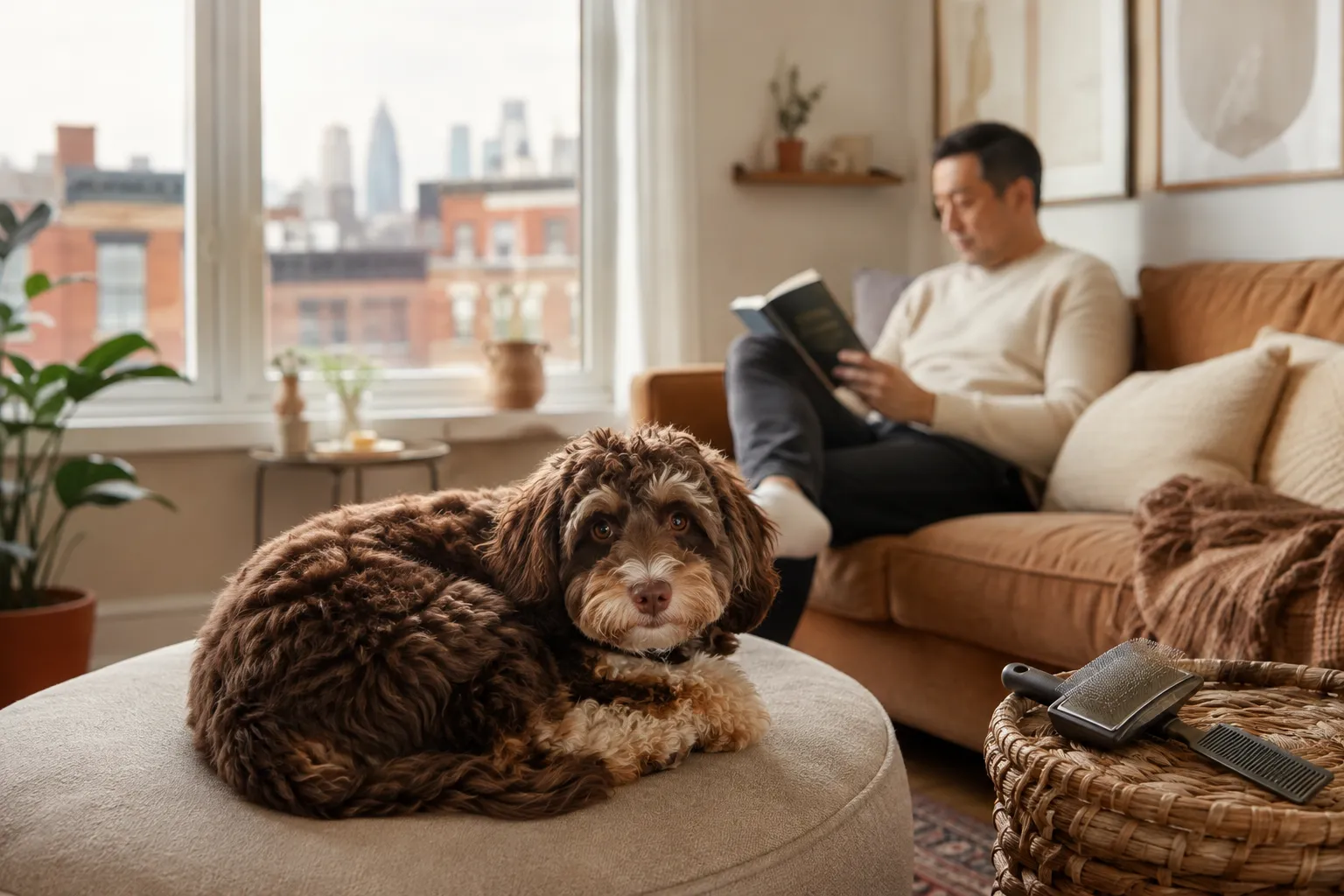
Yes, and they’re one of the better choices for city living. At 13 to 19 pounds they clear most apartment weight limits, they’re quiet enough for shared walls when properly exercised, and they don’t need a yard. What they do need is daily outdoor time, elevator and hallway manners, and crate training so alone-time isn’t stressful. Crate training also matters practically: a puppy that already sleeps calmly in a crate is far less likely to generate 2 a.m. noise complaints in week one.
For frequent travelers, see our notes on why a 10-16 lb micro goldendoodle makes a travel-friendly companion.
Micro goldendoodle shedding and grooming needs
Micro goldendoodles are low-shedding, not non-shedding, and no doodle is guaranteed hypoallergenic. Curlier coats (often F1B and multigen) shed less but mat more. Straighter, more retriever-like coats shed more but need less brushing.
Baseline grooming routine:
| Task | Frequency |
|---|---|
| Brushing (slicker plus metal comb to the skin) | 3 to 4 times weekly, daily during coat change |
| Professional groom or trim | Every 6 to 8 weeks |
| Bath | Every 3 to 6 weeks, or as needed |
| Nail trim | Every 2 to 4 weeks |
| Ear check and cleaning | Weekly |
| Teeth brushing | 3+ times weekly |
Common mistake: brushing only the surface. Doodle coats mat at the skin, under the topcoat, especially behind ears, in armpits, and at the collar line. Surface brushing leaves a hidden mat mass that eventually forces a full shave-down. Line-brush to the skin instead. The coat change between roughly 8 and 14 months is when most owners get caught off guard.
Micro Goldendoodle Breeders With Health Guarantees: What to Look For
A meaningful health guarantee names specific covered conditions, states a clear time window, explains the remedy, and lists what voids coverage. A one-line promise that a puppy is “healthy” is marketing, not a guarantee.
What a strong guarantee usually includes:
- Short-term coverage (typically 48 hours to 14 days) for congenital defects and communicable illness present at pickup, contingent on a vet exam within a stated window
- Genetic coverage for 1 to 3 years, or longer in stronger programs, covering named hereditary conditions such as hip dysplasia or inherited eye disease
- A defined remedy: replacement puppy, partial or full refund, or a capped contribution toward treatment. Know which one before you sign
- Clear buyer obligations: vet exam timing, vaccine schedule, feeding requirements in some contracts, and documentation
- A lifetime return clause so the dog comes back to the breeder rather than a shelter if your circumstances change
Watch for the fine print. Some contracts void genetic coverage if the dog is spayed or neutered outside a specific age window, if you feed a non-approved diet, or if the dog exceeds a stated weight. Others require you to return the dog to receive a replacement, which is a non-starter for most families. Ask directly: “If my dog is diagnosed with hip dysplasia at 18 months, walk me through exactly what happens.”
Conclusion: Your Next Steps
Choosing among micro goldendoodle breeders Pennsylvania offers comes down to documentation and honesty, not proximity or price. The programs worth your deposit will hand over genetic results without being pushed, show you the litter live, explain the health guarantee line by line, and take a credit card.
Here’s how I’d move forward this week:
- Set a real budget. Plan on $2,500 to $4,500 for the puppy plus $1,500 to $3,000 for year one.
- Build a shortlist of 5 to 8 breeders and immediately cut anyone under $1,500 or refusing card payment.
- Request documents in writing: parent genetic panels, OFA or PennHIP results, and the full contract, before any money moves.
- Schedule live video calls with your top three and ask the size and socialization questions from the list above.
- Confirm the go-home plan: age at pickup (eight weeks minimum), vaccine and deworming record, microchip, and how far along housebreaking and crate training are.
- Prepare the home before pickup: crate, gates, a groomer booked for around 16 weeks, and a vet appointment inside your contract’s exam window.
Ready to compare litters? Start with our micro goldendoodle puppies available now page and our miniature goldendoodle breeders overview for a broader look at how our program is structured.
Frequently Asked Questions
How big does a full grown micro goldendoodle get?
A full grown micro goldendoodle usually weighs 13 to 19 pounds and stands 11 to 15 inches at the shoulder, reaching adult size between 9 and 12 months.
How much is a micro goldendoodle in Pennsylvania?
Expect $2,500 to $4,500 from an accredited Pennsylvania breeder with genetic health testing and a written guarantee. Listings at $500 to $1,000 are typically scams, and $1,000 to $1,500 usually signals a puppy mill or broker.
Are micro goldendoodles hypoallergenic?
No dog is truly hypoallergenic. Micro goldendoodles are low-shedding, and curlier coats tend to release less hair and dander, but allergy reactions vary by individual. Spend time with an adult dog of similar coat type before committing.
What’s the difference between a micro and a mini goldendoodle?
Size. A micro finishes at 13 to 19 pounds, a mini at 21 to 30 pounds. Temperament and coat care are similar, but the micro fits apartments and travel more easily while the mini handles rough play and long runs better.
How long do micro goldendoodles live?
Typically 12 to 16 years, with parent health testing, healthy weight, dental care, and regular vet visits being the biggest factors you control.
Do micro goldendoodles bark a lot?
Not usually. They’re alert but not habitual barkers. Excessive barking in this mix is almost always a symptom of boredom, under-exercise, or separation anxiety rather than breed tendency.
Can micro goldendoodles be left alone all day?
Not comfortably. They bond closely with their people and are prone to separation anxiety. Four to six hours is a reasonable stretch for an adult with crate training in place; full workdays need a walker, daycare, or a midday break.
What genetic tests should both parents have?
At minimum: a breed-appropriate DNA panel (Embark or Paw Print Genetics) covering PRA, degenerative myelopathy, von Willebrand’s disease, and ichthyosis, plus OFA or PennHIP hips, OFA elbows, OFA eye (CAER) exam, and cardiac clearance.
Why do reputable breeders insist on credit card payment?
Credit cards give buyers dispute and chargeback rights. Zelle, Venmo, Cash App, wires, and crypto are irreversible, which is why scammers require them. A seller refusing card payment is the strongest single warning sign in puppy fraud.
At what age should a micro goldendoodle puppy come home?
Eight weeks minimum. Earlier separation shortens critical social learning with the mother and littermates and raises hypoglycemia risk in very small puppies.
How often do micro goldendoodles need grooming?
Professional grooming every 6 to 8 weeks plus brushing to the skin 3 to 4 times a week. Expect heavier matting during the coat change between roughly 8 and 14 months.
Is Pennsylvania a good state to buy a micro goldendoodle?
Yes, with care. Pennsylvania has a large licensed breeding community and a state kennel licensing and inspection program you can verify against. It also has high-volume operations selling through brokers, so verification matters more here than almost anywhere else.
Sources
- Orthopedic Foundation for Animals (OFA), health testing databases and CHIC requirements, ofa.org
- Pennsylvania Department of Agriculture, Bureau of Dog Law Enforcement, kennel licensing and inspection program, agriculture.pa.gov
- American Kennel Club, Golden Retriever and Poodle breed health information, akc.org
- Federal Trade Commission, consumer guidance on avoiding pet purchase scams and irreversible payment methods, consumer.ftc.gov