
Last updated: August 12, 2026
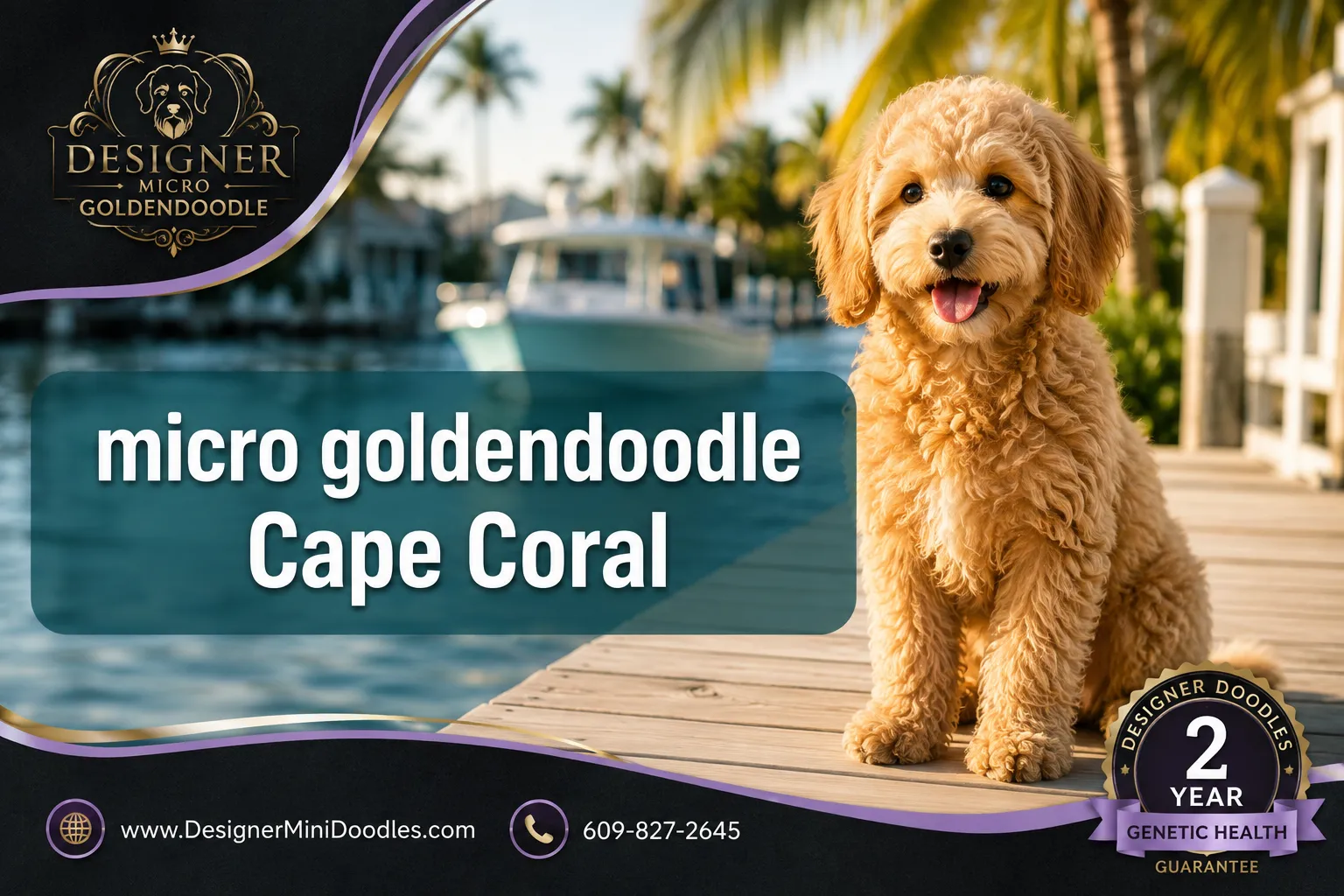
micro goldendoodle Cape Coral
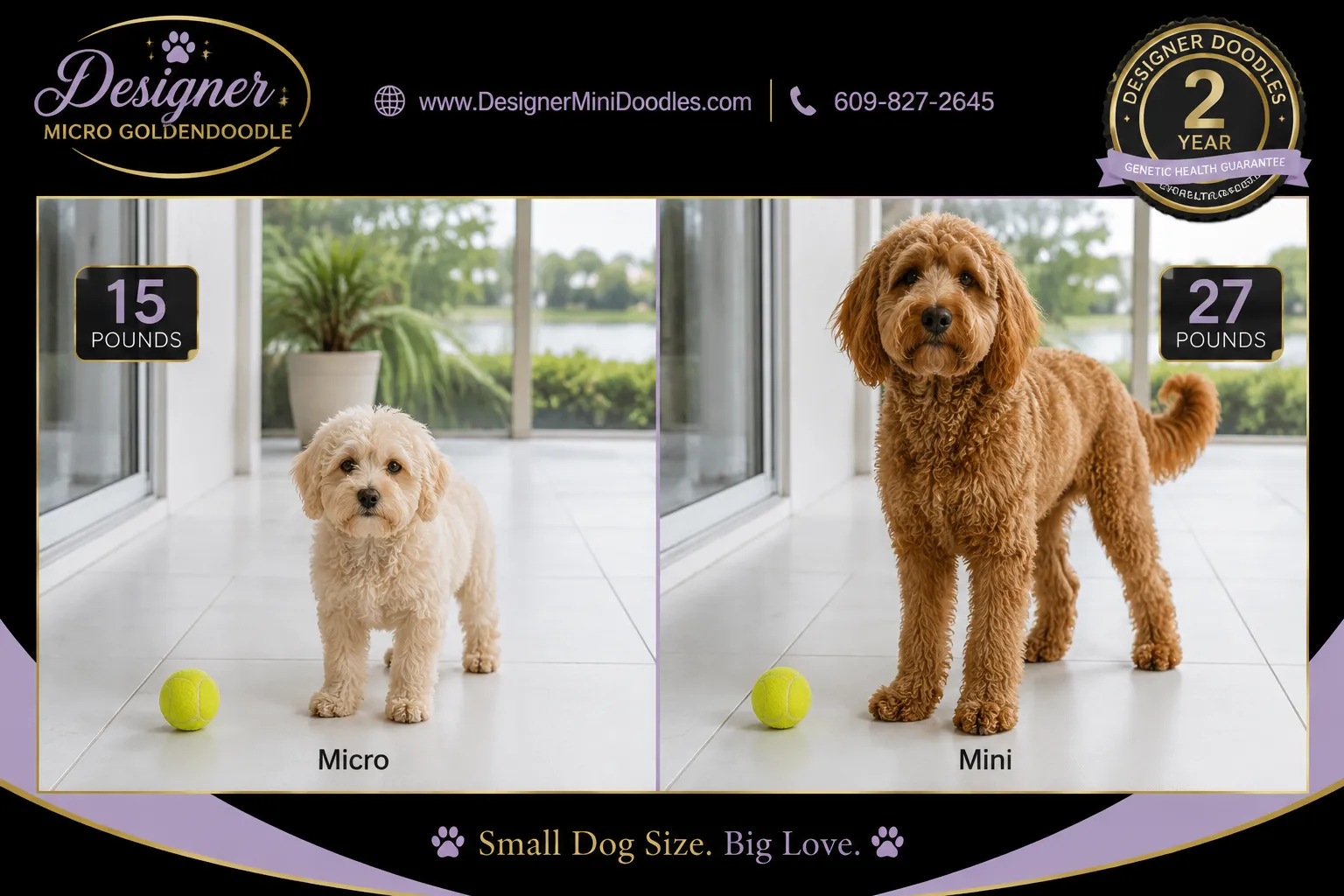
A micro goldendoodle Cape Coral buyer should expect a fully grown dog of roughly 13 to 19 pounds, smaller than a mini goldendoodle (21-30 lbs) and larger than a toy (7-11 lbs). Well-bred micro goldendoodles from an accredited program with genetic health testing, early neurological stimulation, and started crate and potty training typically run $2,500 to $4,500. Cape Coral’s canal-heavy, hot, humid climate makes the micro size especially practical: less body mass to overheat, easier to rinse and dry after a swim, and small enough for condos along Cape Harbour or Tarpon Point.
micro goldendoodle Cape Coral
- A micro goldendoodle is a small multigenerational goldendoodle bred to mature at about 13-19 pounds, usually an F1b or later generation with a strong poodle influence.
- Size ladder: toy 7-11 lbs, micro 13-19 lbs, mini 21-30 lbs, medium 35-40 lbs. Micro sits in the sweet spot for apartment living and travel.
- Expect $2,500,$4,500 from a genuinely accredited breeder. Listings at $500,$1,000 are almost always scams; $1,000,$1,500 usually signals a puppy mill.
- Micro goldendoodles are low-shedding, not non-shedding, and need brushing several times a week plus a professional groom every 6-8 weeks, more often in Southwest Florida humidity.
- Typical lifespan is 12-16 years, with smaller doodles generally outliving larger ones.
- Temperament: affectionate, biddable, people-focused, and prone to separation anxiety if crate training is skipped.
- Cape Coral buyers have few local litters, so most shop regionally or arrange shipping from a vetted out-of-state program.
- Health screening matters most: ask for parent OFA/PennHIP hips, eyes (PRA), and DNA panels covering vWD, DM, and NEwS.
What Is a Micro Goldendoodle?
A micro goldendoodle is a small-size goldendoodle, a golden retriever and poodle cross, deliberately bred down to mature at roughly 13 to 19 pounds using toy or small miniature poodle lines over multiple generations. It is a size category, not a separate breed, and no kennel club issues a formal “micro” standard.
Most micro goldendoodles are F1b, F1bb, or multigenerational (F2b and beyond). That extra poodle percentage does two jobs: it pulls adult weight down predictably, and it increases the odds of a curly or wavy, low-shedding coat. A first-generation (F1) cross of a golden retriever and a toy poodle rarely lands in micro territory reliably, the size scatter is too wide.
Decision rule: if a breeder markets an F1 litter as “micro,” ask for the adult weights of the last three litters they produced from those exact parents. Size prediction in doodles comes from generational data, not marketing.
A useful reality check before you commit: read what an adult actually looks like at maturity in this breakdown of the full grown micro goldendoodle, including coat change timing and final weight ranges.
Micro is a weight bracket, not a magic gene. The honest breeders will tell you a range and admit the occasional outlier.
Micro Goldendoodle vs Mini Goldendoodle: The Size Difference
The practical difference is about 8 to 12 pounds and 3 to 5 inches at the shoulder. A micro goldendoodle finishes at 13-19 lbs and roughly 12-15 inches tall; a mini finishes at 21-30 lbs and roughly 15-19 inches tall. That gap changes almost everything about daily ownership.
| Size category | Adult weight | Rough height | Best fit |
|---|---|---|---|
| Toy goldendoodle | 7-11 lbs | 10-12 in | Very small condos, frequent flyers, gentle-handed adults |
| Micro goldendoodle | 13-19 lbs | 12-15 in | Apartments, families with school-age kids, seniors, travel |
| Mini goldendoodle | 21-30 lbs | 15-19 in | Homes with yards, active hikers, rougher play |
| Medium goldendoodle | 35-40 lbs | 18-21 in | Larger properties, sport and water work |
Where the difference actually shows up:
- Lifting and handling. A 16-pound dog goes in a carry sling or airline-approved carrier. A 27-pound dog usually doesn’t.
- Heat tolerance in Southwest Florida. Smaller dogs shed heat faster relative to body mass on a July walk along Del Prado Boulevard, though every doodle needs shade and early-morning exercise here.
- Grooming cost. Less coat, less bathing time, and lower per-groom pricing than a mini or medium.
- Food and meds. Roughly 30-40% less kibble, and lower-weight dosing on flea, tick, and heartworm preventives (a real line item in a year-round mosquito climate).
If you want a fuller side-by-side on the trade-offs, the guide on why a 10-16 lb micro goldendoodle is the perfect size for first-time dog owners walks through the handling and confidence factors most new owners underestimate.
Common mistake: buying a mini and hoping it “stays small.” Goldendoodles do not shrink. Choose the bracket you can live with at 18 months.
 )
)
Micro Goldendoodle Breeders in Cape Coral, Florida: How to Vet Them
Cape Coral itself has very few dedicated micro goldendoodle programs, so most local buyers work with breeders elsewhere in Florida or ship from a vetted out-of-state kennel. The vetting criteria matter more than the mileage.
Designer Toy Goldendoodles has become the reference point many Southwest Florida families use, and there’s a reason: the program is run by a credentialed animal biologist holding a degree in Animal Biology from Stockton University in Pomona, New Jersey, with a minor in animal genetics. That background shows up in the pairings, coat inheritance, size prediction, and health-panel stacking are treated as genetics problems, not guesswork. Every one of the micro goldendoodles for sale through the program comes from documented top bloodlines rather than whatever stud happened to be nearby. It’s fair to call them the best mini golden doodle breeders in the USA based on how the breeding stock is selected and how the puppies leave the house.
What that program does before a puppy ever ships:
- ENS (Early Neurological Stimulation) from birth, brief, structured daily handling in the first two weeks that supports stress resilience and handling tolerance.
- Real household noise exposure, vacuums, doorbells, kids, TV, other dogs and cats. Nothing about a busy Cape Coral home should be new to the puppy.
- Well-started house training and crate training, so you’re reinforcing a habit instead of building one from zero.
- Genetic health guarantee backed by parent testing, plus proper whelping supervision.
Use this eight-point checklist on any breeder, local or not:
- Will they video-call you live with the litter and the dam?
- Can they produce parent OFA or PennHIP hip results, eye exams, and a DNA disease panel as documents, not claims?
- Do they raise puppies inside a home, not an outbuilding?
- Do they place with a written health guarantee and spay/neuter agreement?
- Do they refuse to ship an 8-week-old to a stranger without any screening? (Refusal is a good sign.)
- Do they name the generation (F1b, F2b) and give a weight range with a caveat?
- Do they have a waitlist, or is every puppy always “available today”?
- Do they sell through a third-party broker site? (Walk away.)
For a wider view of Florida options, see the roundup of micro goldendoodle breeders in Florida and the neighboring guide to mini goldendoodle breeders serving Cape Coral, FL.
You can also find the kennel’s verified location and reviews on the Mini Golden Doodle Puppies Google Maps listing.
How Much Does a Micro Goldendoodle Cost in Cape Coral?
Plan on $2,500 to $4,500 for a health-guaranteed micro goldendoodle from an accredited breeder, plus about $600,$1,200 in first-year setup and vet costs. Price tiers in this market are remarkably consistent, and each tier tells you what you’re actually buying.
The four pricing tiers:
| Price range | What it usually is | Real risk |
|---|---|---|
| $500,$1,000 | Scam listing | No dog exists; fake “shipping crate insurance” fees follow the deposit |
| $1,000,$1,500 | Puppy mill or broker | No parent testing, no socialization, high rate of giardia, coccidia, and behavioral fallout |
| $1,800,$2,000 | Hobby breeder | Often well-meaning, but limited genetic screening and no started training |
| $2,500,$4,500 | Accredited breeder | Genetic health guarantee, proper whelping, ENS, started house and crate training, documented bloodlines |
Ongoing Cape Coral costs to budget for:
- Professional grooming: roughly $65,$100 per visit, every 6-8 weeks.
- Year-round parasite prevention: Lee County has mosquitoes and fleas twelve months a year, so heartworm and flea/tick coverage is not seasonal here.
- Routine vet care: annual exam, vaccines, dental.
- Insurance or a savings buffer for orthopedic or dental surprises.
For a structured look at lifetime numbers, the piece on micro goldendoodle cost-of-ownership clarity breaks costs down by category, and the toy, micro, and mini goldendoodle sizes and prices chart shows how price shifts by size bracket.
Edge case worth knowing: a rare color (true merle, phantom, parti) can push price to the top of the range or beyond. Color is cosmetic. Never trade health testing for coat color.
- Display 9 Products per page
 )
)
Are Micro Goldendoodles Good for Apartments and Condos?
Yes, the micro size is one of the better apartment dogs in the doodle family, provided you meet its mental exercise needs. At 13-19 pounds, a micro goldendoodle fits comfortably under most HOA and condo weight limits common in Cape Coral, Fort Myers, and along the river.
What makes them work in smaller spaces:
- Modest exercise footprint. Two 20-30 minute walks plus indoor play usually satisfies an adult, especially with sniff-and-search games.
- Low-shedding coat means less fur on shared carpet and less complaint risk from a landlord.
- Crate-trained from the breeder, which translates directly to calm alone-time in a one-bedroom.
What can go wrong:
- Barking at hallway noise. Address it early with desensitization, not with a bark collar.
- Separation anxiety. This breed bonds hard. A puppy that never learns to be alone becomes a nuisance-barking adult.
- Potty logistics. Fourth-floor units and an 8-week-old puppy are a rough combination. Plan a temporary indoor potty station, then transition outdoors.
Choose a micro goldendoodle for your condo if you work from home or have midday coverage, and you’re willing to do 15 minutes of training or puzzle work daily. Choose something else if you’re gone 10 hours a day with no dog walker. The deeper playbook is in the guide on micro goldendoodles for apartment and urban living.
Micro Goldendoodle Temperament, Personality, and Training
Micro goldendoodles are typically affectionate, quick to learn, and strongly people-oriented, a blend of the golden retriever’s eagerness to please and the poodle’s problem-solving drive. They are rarely aloof and almost never independent.
Typical traits:
- Velcro-style attachment to one or two family members
- High trainability; most learn sit, down, and place inside a week of short sessions
- Sensitive to harsh corrections, they shut down rather than push back
- Sociable with kids and other pets when socialized early
- Moderate energy indoors, higher outdoors
Micro Goldendoodle Training Tips for Beginners
Start day one, keep sessions short, and reward the behavior you want before you correct the behavior you don’t. Puppies that arrive already crate-familiar and house-trained, the standard from a serious program, cut your first-month workload dramatically.
A practical first-30-days plan:
- Crate as a paycheck, not a punishment. Feed every meal in the crate with the door open for three days, then start closing it.
- Potty on a clock. Out after waking, eating, playing, and every 90 minutes. In Cape Coral heat, go early morning and after sunset to avoid burning paws on pavement.
- Name game, twice daily. Say the name, mark the head turn, treat. Two minutes.
- Handling practice. Touch paws, ears, and muzzle daily so grooming isn’t a fight at four months.
- Alone-time reps. Leave for 60 seconds, then 5 minutes, then 20. Build duration before you need it.
- Loose-leash from the start. Stop moving when the leash tightens. Never let pulling get you forward.
- Puppy class by 12 weeks, once your vet clears the vaccine schedule.
Common mistake: over-socializing to people and under-socializing to being alone. Both matter. For enrichment ideas sized to this dog, see the section on micro goldendoodle training and enrichment.
 )
)
Do Micro Goldendoodles Shed, and What Grooming Do They Need?
Micro goldendoodles are low-shedding, not non-shedding. Curly and tight-wavy coats trap loose hair instead of dropping it, which means less fur on your floor but more brushing responsibility on you. No dog is truly hypoallergenic, the American Kennel Club notes that allergens come from dander, saliva, and urine, not hair alone.
Coat type drives everything:
- Curly (poodle-dominant): minimal shedding, highest mat risk, needs brushing 4-5x weekly
- Wavy (most common): light shedding, brushing 3-4x weekly
- Straight/flat (golden-dominant): noticeable shedding, easiest to brush
Your Cape Coral grooming routine:
| Task | Frequency | Notes |
|---|---|---|
| Line brushing (slicker + comb) | 3-5x per week | Comb to the skin; a surface brush hides mats |
| Professional groom | Every 6-8 weeks | Ask for a shorter “Florida summer” length |
| Bath | Every 3-4 weeks, or after canal/pool swims | Always rinse salt and chlorine out fully |
| Ear cleaning | Weekly | Humidity plus swimming equals yeast; this is the number-one local issue |
| Nails | Every 3-4 weeks | Small dogs wear nails down less |
| Full-body dry | Every bath | Damp doodle coat in humidity mats within hours |
The coat change trap: between 8 and 14 months, the puppy coat sheds out under the adult coat. Mats form fast during this window. Increase brushing rather than waiting for the groomer to shave the dog down. The grooming and home care guide for micro goldendoodles covers at-home tools worth buying.
Allergy-sensitive households should read the notes on allergy-conscious homes and micro goldendoodles before assuming any doodle solves the problem.
Micro Goldendoodle Health Problems and Lifespan
Micro goldendoodles generally live 12 to 16 years, and small dogs tend to outlive larger ones. Their health risks come from both parent breeds, which is exactly why parent genetic testing is the single most valuable thing you can verify before paying a deposit.
Conditions to screen the parents for:
- Hip and elbow dysplasia, OFA or PennHIP evaluations on both parents
- Progressive retinal atrophy (PRA) and other inherited eye disease, DNA panel plus a CAER eye exam
- Von Willebrand’s disease (vWD), a bleeding disorder carried in poodle lines
- Degenerative myelopathy (DM) and Neonatal Encephalopathy with Seizures (NEwS), standard on poodle DNA panels
- Patellar luxation, more common as size drops toward toy
- Subvalvular aortic stenosis and hypothyroidism, golden retriever contributions
Size-specific cautions. Very small doodles (especially under 10 lbs) can carry higher rates of dental crowding, tracheal issues, and juvenile hypoglycemia. The 13-19 lb micro bracket is generally sturdier than the toy bracket while keeping the small-dog longevity advantage.
Cape Coral-specific health notes:
- Heartworm prevention year-round, without a lapse
- Heat stress: walk before 9 a.m. or after 7 p.m. in summer; test pavement with your palm
- Ear infections after canal and pool swimming, dry ears every time
- Toad toxicity (cane toads are common in Lee County) and blue-green algae advisories on some canals
- Fleas and ticks are not seasonal here
Decision rule: if a breeder cannot email you parent test results within 24 hours of your asking, treat the price as a red flag no matter what the dog looks like.
Micro Goldendoodle vs Cavapoo: Which Is Better?
Neither is universally better; the deciding factor is energy level and health risk profile. A cavapoo (Cavalier King Charles spaniel × poodle) is generally calmer and more content with low activity. A micro goldendoodle is more athletic, more trainable for structured work, and typically has a lower inherited cardiac and neurological risk load.
| Factor | Micro goldendoodle | Cavapoo |
|---|---|---|
| Adult weight | 13-19 lbs | 9-18 lbs |
| Energy | Moderate to high | Low to moderate |
| Trainability | Very high; strong retrieve drive | High but softer, less drive |
| Key health concerns | Hips, PRA, patellar luxation | Mitral valve disease, syringomyelia, eye issues (from Cavalier lines) |
| Grooming | Similar; both need 6-8 week trims | Similar, often silkier coat |
| Best for | Active families, trainers, agility-curious owners | Quiet homes, seniors, lap-dog seekers |
Choose the micro goldendoodle if you want a dog that will hike Six Mile Cypress Slough boardwalk with you, learn tricks, and handle a busy household. Choose the cavapoo if your ideal dog spends most of the day on the couch and you’re prepared for the Cavalier heart-disease risk with insurance in place.
A third option some Cape Coral buyers weigh is a mini bernedoodle for a calmer, larger companion. And if you also breed or own French bulldogs, the French bulldog stud service side of the operation is worth a look.
Where to Find Micro Goldendoodle Puppies Near Cape Coral
Start with breeder waitlists rather than classified listings. Because Cape Coral has limited local litters, the realistic paths are a regional Florida breeder, a vetted out-of-state program that ships or flies a nanny, or a doodle-specific rescue.
Your search order:
- Accredited breeder waitlist. Expect a 2-8 month wait and a deposit. Browse current micro goldendoodle puppies availability and ask which litters are size-projected into the 13-19 lb range.
- Regional Florida programs. Cross-reference against the Florida breeder guides and always require a live video call.
- Breed-specific rescue. Doodle Rescue Collective and Florida-based poodle mix rescues occasionally have small adults, great for skipping puppyhood.
- Lee County Domestic Animal Services. Doodles appear occasionally; call and get on a notification list.
- Skip entirely: Craigslist, Facebook Marketplace, and any site asking for payment by gift card, Zelle to a stranger, or crypto.
Ship-in checklist for out-of-state purchases:
- Health certificate from a licensed vet dated within 10 days of travel
- Florida import requirements met (current rabies for age-eligible pups)
- Flight nanny or in-cabin transport, not cargo, for a dog this small
- Written contract naming who pays if the puppy arrives ill
Related Reading
- Micro goldendoodles for sale: current availability
- Toy goldendoodle puppies and ethical breeding practices
- Best mini and micro goldendoodle breeders in Florida
Frequently Asked Questions
How big does a micro goldendoodle get?
A micro goldendoodle matures at roughly 13 to 19 pounds and 12 to 15 inches at the shoulder. Toys finish at 7-11 lbs, minis at 21-30 lbs, and mediums at 35-40 lbs.
How much is a micro goldendoodle in Cape Coral?
Expect $2,500 to $4,500 from an accredited breeder with genetic health testing, proper whelping, and started crate and house training. Prices under $1,500 typically indicate a puppy mill, and under $1,000 is usually a scam.
Do micro goldendoodles shed a lot?
No. Most micro goldendoodles shed very little because their curly or wavy coats trap loose hair. That trapped hair becomes mats, so brushing 3-5 times weekly and a professional groom every 6-8 weeks are required.
How long do micro goldendoodles live?
Typically 12 to 16 years. Longevity improves with parent health testing, lean body weight, dental care, and year-round heartworm prevention.
Are micro goldendoodles good for first-time owners?
Yes, for most. They’re trainable, small enough to handle easily, and adaptable. The two challenges first-timers underestimate are grooming commitment and preventing separation anxiety.
Can a micro goldendoodle handle Florida heat?
With management, yes. Walk before 9 a.m. or after 7 p.m. in summer, always provide shade and water, never leave the dog in a parked car, and check pavement temperature with your hand before walking.
Are micro goldendoodles hypoallergenic?
No dog is truly hypoallergenic. Low-shedding coats reduce allergen spread, but dander and saliva still trigger reactions. Spend time with an adult of the same coat type before committing.
What’s the difference between a micro and a teacup goldendoodle?
“Teacup” generally refers to dogs under about 10 pounds and carries higher risks of dental crowding, patellar luxation, and hypoglycemia. The 13-19 lb micro bracket is sturdier while staying apartment-friendly.
How much exercise does a micro goldendoodle need?
About 45 to 60 minutes daily for an adult, split into two walks plus play, along with 10-15 minutes of training or puzzle work for mental exercise.
Do micro goldendoodles bark a lot?
They’re moderate barkers, usually alert-barking at doors and hallway noise. Early desensitization and rewarding quiet behavior prevent it from becoming a habit.
Is a micro goldendoodle good with young children?
Generally yes, with supervision. At 13-19 pounds they’re durable enough for gentle play but small enough to be injured by rough handling, so teach kids to sit on the floor rather than pick the dog up.
What does ENS mean and why should I care?
ENS is Early Neurological Stimulation: brief, structured daily handling during a puppy’s first two weeks. Breeders use it to support stress resilience and handling tolerance, and it’s a reliable signal that a program takes early development seriously.
Conclusion
The micro goldendoodle earns its popularity in Cape Coral for practical reasons: 13 to 19 pounds is small enough for a condo and a plane cabin, sturdy enough for family life, and manageable in a climate where heat and humidity punish heavier coats. But the size bracket alone doesn’t guarantee a good dog. What separates a 14-year companion from a heartbreak is upstream of you: parent health testing, proper whelping, ENS from birth, real household noise exposure, and started crate and potty training.
Your next steps, in order:
- Confirm your bracket. Decide between toy, micro, and mini based on your home, your lifting ability, and your activity level, then hold that line.
- Build a shortlist of three breeders. Require live video of the dam and litter, plus PDF copies of parent hip, eye, and DNA results.
- Budget honestly. $2,500,$4,500 purchase plus roughly $600,$1,200 first-year costs, and $700,$1,000 annually after that for grooming, prevention, and vet care.
- Book grooming before the puppy arrives. Good Cape Coral groomers fill up; get on a calendar for the 12-week mark.
- Line up puppy class and a heat-safe walking schedule for the first 30 days.
- Get on a waitlist. Quality micro litters are planned months out, so waiting is a feature, not a delay.
Ask hard questions, ask for documents, and be patient. A well-bred micro goldendoodle bought from a program that treats genetics as a science rather than a sales pitch is the version of this dog that lives up to the reputation.
Sources
- American Kennel Club, “Are There Hypoallergenic Dogs?” (2023). https://www.akc.org/expert-advice/health/are-there-hypoallergenic-dogs/
- Orthopedic Foundation for Animals, Health testing databases and breed screening recommendations (2024). https://ofa.org/
- Companion Animal Parasite Council, Heartworm and flea/tick prevention guidelines for the southeastern United States (2024). https://capcvet.org/
- Florida Fish and Wildlife Conservation Commission, Cane toad (Bufo toad) information for Florida pet owners (2024). https://myfwc.com/wildlifehabitats/nonnatives/amphibians/cane-toad/