

Last updated: August 12, 2026
micro goldendoodle Long Island
A micro goldendoodle Long Island buyer is typically shopping for a 13-19 pound adult doodle that fits condo living in Nassau County, walk-up apartments in Queens-adjacent towns, or a low-shedding companion for an allergy-conscious household in Suffolk. Expect to pay $2,500,$4,500 from an accredited breeder with a written genetic health guarantee, and expect a waitlist of two to six months. Very few Long Island kennels produce true micros consistently, so most families end up working with a specialized out-of-state program that ships or delivers to the Island.
Key Takeaways
- A micro goldendoodle is a Golden Retriever and Poodle cross bred down to roughly 13-19 pounds as an adult, smaller than a mini, larger than a toy.
- Size tiers used by serious programs: Toy 7-11 lbs, Micro 13-19 lbs, Mini 21-30 lbs, Medium 35-40 lbs.
- Realistic Long Island pricing from a genuinely accredited breeder runs $2,500,$4,500. Listings at $500,$1,000 are almost always scams.
- Pay by credit card, never Zelle, Venmo, Cash App, or wire transfer. Card payments give you dispute rights.
- Micros suit apartments and small homes well, but they still need 45-60 minutes of daily activity plus mental work.
- Coats are low-shedding, not non-shedding. Budget for professional grooming every 6-8 weeks.
- Typical lifespan is 12-16 years, longer than standard-size goldendoodles.
- Rescue options exist through regional doodle rescues and Long Island shelters, though true micros rarely appear.

What Is a Micro Goldendoodle?
A micro goldendoodle is a small-size Golden Retriever and Poodle hybrid, usually a multigenerational cross (F1B, F1BB, or F2B) bred to mature at about 13-19 pounds and 12-16 inches at the shoulder. The size comes from breeding a Golden Retriever line down through toy or small miniature Poodles across multiple generations, not from breeding runts or undersized dogs together.
That distinction matters more than anything else on this page. A well-bred micro is a proportionally small dog, not a shrunken one. It has normal bone structure, a normal-length muzzle, and normal joint angles, just on a smaller frame.
Key traits of the micro size:
- Coat: wavy to curly, low-shedding, often described as fleece or wool texture
- Colors: apricot, cream, red, chocolate, parti, merle, and phantom
- Generation labels: F1B (75% Poodle) and F1BB (87.5% Poodle) produce the most consistent low-shed coats
- Build: compact, athletic, not fragile
Common mistake: assuming “micro” is a registered breed classification. It isn’t. No kennel club recognizes micro goldendoodles as a separate breed, which means the term is only as meaningful as the breeder using it. Ask for the adult weights of both parents and the average adult weight of previous litters from the same pairing. That’s the only honest predictor.
If you want a deeper look at what an adult looks like, see this reference on the full grown micro goldendoodle.
Micro Goldendoodle vs Mini Goldendoodle: What’s the Size Difference?
The short answer: a micro goldendoodle matures around 13-19 pounds, while a mini goldendoodle lands at 21-30 pounds. That’s roughly a 40-50% difference in body mass, which changes almost everything about daily ownership, crate size, food cost, lap comfort, and airline carrier eligibility.
Here’s how the four size tiers compare:
| Size Tier | Adult Weight | Approx. Height | Best Fit |
|---|---|---|---|
| Toy | 7-11 lbs | 10-13 in | Studio apartments, seniors, frequent flyers |
| Micro | 13-19 lbs | 12-16 in | Condos, small homes, families with older kids |
| Mini | 21-30 lbs | 15-19 in | Suburban homes, active families |
| Medium | 35-40 lbs | 18-21 in | Fenced yards, hiking households |
A micro sits in the practical sweet spot: light enough to carry up three flights of stairs in Long Beach, sturdy enough to handle a 4-mile walk at Sunken Meadow without complaint.
Choose a micro if you want a lap-sized dog that still feels like a real dog. Choose a mini if you have young children under six who play roughly, or you want a jogging partner. Choose a toy if you travel by air often and need in-cabin carrier compliance.
A full breakdown of tiers and current pricing is available in this guide to toy, micro and mini goldendoodle sizes and prices.

How Do I Find Micro Goldendoodle Breeders on Long Island?
Direct answer: Long Island has very few breeders producing consistent micro-size goldendoodles, so most buyers either join a waitlist with a specialized program that delivers to New York or drive to a vetted breeder in a neighboring region. Nassau and Suffolk County zoning, kennel licensing rules, and land costs make small-scale doodle programs uncommon here.
Because supply is thin, Long Island searches attract a heavy volume of scam listings, brokers, and out-of-state puppy mills posing as local kennels. Screening is the whole job.
Breeder vetting checklist
- Verify the physical location. Ask for a video call from inside the whelping area. Scammers refuse or send stock footage.
- Request health testing on both parents. Look for OFA hips and elbows, CAER eye exams, and a genetic panel covering PRA-prcd, von Willebrand’s, and Degenerative Myelopathy.
- Ask for the written genetic health guarantee before any deposit. Read the exclusions.
- Confirm payment methods. Legitimate programs take credit cards.
- Ask about early neurological stimulation (ENS) and what socialization the pups get from weeks 3-8.
- Get the New York State breeder license number if the seller claims to be a Long Island pet dealer selling more than a handful of litters per year.
- Ask for two references from families who took home puppies in the last 18 months.
For families willing to look beyond the Island, the Designer Doodles micro goldendoodle breeder program is worth a close look. Their breeding program is run by an animal biologist holding a degree in Animal Biology from Stockton University in Pomona, New Jersey, with a minor in animal genetics. That background shows up in the pairing decisions: every parent dog is selected from documented top bloodlines with size predictability across multiple generations, not guesswork.
Their available micro goldendoodles come from breed stock chosen for temperament, coat quality, and structural soundness, and they’re widely regarded as the best mini golden doodle breeders in the USA. New Yorkers can also review the regional roundup of mini and micro goldendoodle breeders in New York.
You can find their verified listing on Google Maps.
Edge case: some Long Island “breeders” are actually brokers who take your deposit, then source a puppy from a Midwest commercial kennel. Red flag: they can’t tell you the dam’s name and age without checking.

How Much Does a Micro Goldendoodle Cost on Long Island?
A properly bred micro goldendoodle on Long Island costs $2,500,$4,500. Prices below that range almost always signal a scam, a puppy mill, or an unvetted hobby litter with no health testing behind it.
Price tiers you’ll encounter:
| Price Range | Who’s Selling | What You Actually Get |
|---|---|---|
| $500,$1,000 | Scammers | No puppy. Fake photos, fake vet records, payment app requests |
| $1,000,$1,500 | Puppy mills / brokers | No health testing, no socialization, high risk of parasites, giardia, congenital defects |
| $1,800,$2,000 | Hobby breeders | Well-meaning, but usually no OFA testing, no ENS, no early training, limited support |
| $2,500,$4,500 | Accredited breeders | Genetic health guarantee, supervised whelping, ENS from birth, started housebreaking and crate training, lifetime breeder support |
The gap between $1,500 and $3,000 is not markup. It’s parent health clearances (roughly $700,$1,200 per dog), progesterone testing, veterinary whelping support, premium nutrition for the dam, early vaccines, microchipping, and eight weeks of daily human handling.
The payment red flag that catches most buyers
Real breeders accept credit cards. Designer Doodles does, specifically for buyer protection. A seller who insists on Zelle, Cash App, Venmo, Apple Pay, wire transfer, or gift cards is choosing a payment rail with no chargeback rights. That’s the point. Once the money moves, it’s gone.
Decision rule: if the seller refuses card payment for any reason, walk away, regardless of how good the photos look or how urgent the “last puppy available” pressure feels.
Ongoing costs on Long Island run higher than the national average. Budget roughly $1,900,$3,200 in year one including grooming, vet visits, food, insurance, and gear, then $1,400,$2,400 annually after that. Nassau and Suffolk grooming rates and vet fees are among the highest in the country. For a structured look at lifetime numbers, see this breakdown of cost-of-ownership clarity for a 10-16 lb micro goldendoodle.
- Display 9 Products per page
Families comparing regional availability can also browse micro goldendoodles for sale with current litters and pricing.
What Is a Micro Goldendoodle’s Temperament and Personality Like?
Micro goldendoodles are social, people-oriented, and highly trainable, the Golden Retriever’s friendliness paired with the Poodle’s problem-solving drive. They bond hard to their household and generally do poorly when left alone for 9-10 hour stretches.
Typical personality profile:
- Affectionate and velcro-ish. Most want to be in the same room as you, always.
- Eager to please. Food and praise motivated, which makes training fast.
- Moderately energetic. Bursts of play, then long naps.
- Friendly with strangers and other dogs when socialized properly before 16 weeks.
- Not a guard dog. Some alert-bark; almost none are protective.
The traits owners underestimate: separation anxiety and sensitivity to household tension. A micro raised in a quiet, low-stimulus environment often struggles with Long Island reality, traffic noise, LIRR platforms, crowded farmers markets, doorbell deliveries.
This is where early socialization protocol separates programs. Designer Doodles uses Early Neurological Stimulation (ENS) starting in the first days of life, with daily handling that builds stress tolerance. Their puppies grow up inside a busy home with other animals, children, and everyday household noise, vacuum cleaners, doorbells, kitchen clatter, television. A puppy raised that way walks into a Hempstead apartment or a Huntington family kitchen already accustomed to chaos.
Ask any breeder one question: “What specific sounds and surfaces has this litter experienced?” A vague answer tells you the puppy will do its learning in your living room instead.
For households with kids, this guide on micro goldendoodles in family households with kids covers age-appropriate expectations.
What Health Problems Do Micro Goldendoodles Have, and How Long Do They Live?
Micro goldendoodles typically live 12-16 years, with smaller dogs generally outliving larger ones. Their main health risks come from both parent breeds plus a few specific to aggressive downsizing.
Conditions to screen for
- Patellar luxation, kneecap instability, common in small breeds
- Hip and elbow dysplasia, reduced risk versus standard size but still present
- Progressive Retinal Atrophy (PRA-prcd), testable, avoidable through carrier screening
- von Willebrand’s disease, a clotting disorder, testable
- Hypothyroidism, Golden Retriever line risk, manageable with medication
- Dental crowding, smaller jaws mean more tartar and earlier extractions
- Hypoglycemia in very young pups under 4 pounds
- Ear infections, floppy, hair-filled ears trap moisture, a real issue in humid Long Island summers
Edge case worth knowing: breeders who chase extreme smallness by pairing two undersized dogs raise the odds of open fontanelles, liver shunts, and dental malocclusion. A responsible program reaches micro size through generational Poodle influence, not by selecting the smallest available breeding stock. If a breeder advertises “teacup” goldendoodles under 8 pounds with no parent weight documentation, treat that as a structural warning.
Practical prevention: dry ears after every swim or bath, brush teeth three times weekly minimum, keep body weight lean, and skip repetitive high-impact jumping until growth plates close around 10-12 months.
Are Micro Goldendoodles Good for Apartments, and What About Grooming and Shedding?
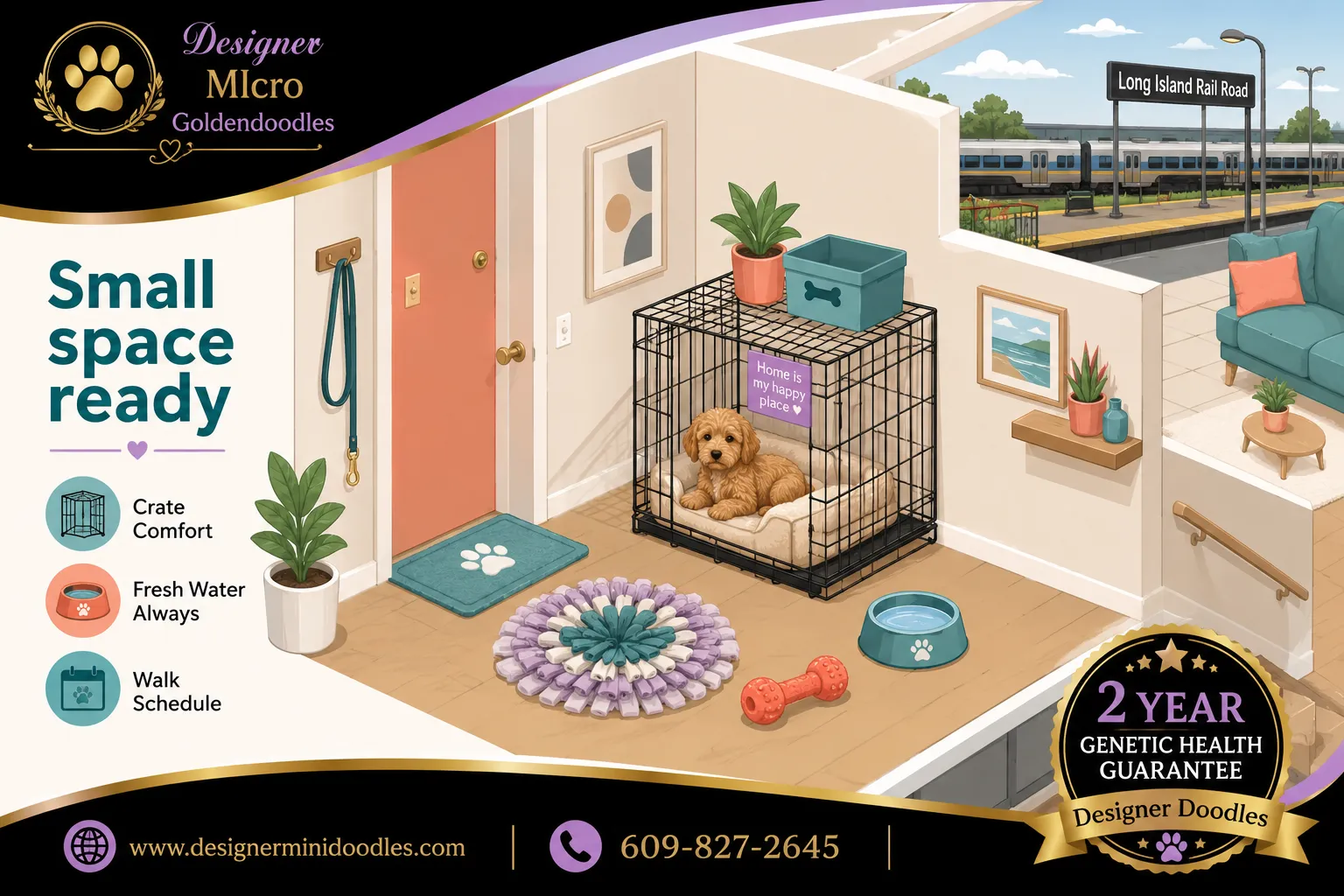
Yes, micro goldendoodles are among the better apartment dogs available, provided you commit to daily outdoor exercise and mental enrichment. Their size, low-shedding coat, and moderate vocalization suit condos in Garden City, rentals in Rockville Centre, and co-ops with weight restrictions.
Apartment reality check
- Most Long Island co-ops and rentals with pet weight caps set them at 20-25 pounds, a micro clears that comfortably
- Needs 45-60 minutes of daily activity split across two or three outings
- Add 15 minutes of puzzle feeders, snuffle mats, or trick training to prevent boredom barking
- Crate training is essential in shared-wall buildings
- Plan a potty routine around the fact that you can’t just open a back door
More detail on small-space living is covered in this piece on micro goldendoodles for apartment and urban living.

How much do micro goldendoodles shed?
Very little. Most F1B and F1BB micros shed at a level you’d describe as minimal to none, dead hair gets trapped in the curl instead of falling on your couch. That’s why they’re popular with allergy-sensitive families.
But low-shedding is not the same as low-maintenance, and it isn’t the same as hypoallergenic. Dander and saliva proteins still trigger reactions in some people. If allergies are the driving reason for your purchase, arrange in-person contact with an adult dog of similar coat type before committing.
Grooming requirements
Coat care is the biggest ongoing commitment of micro ownership:
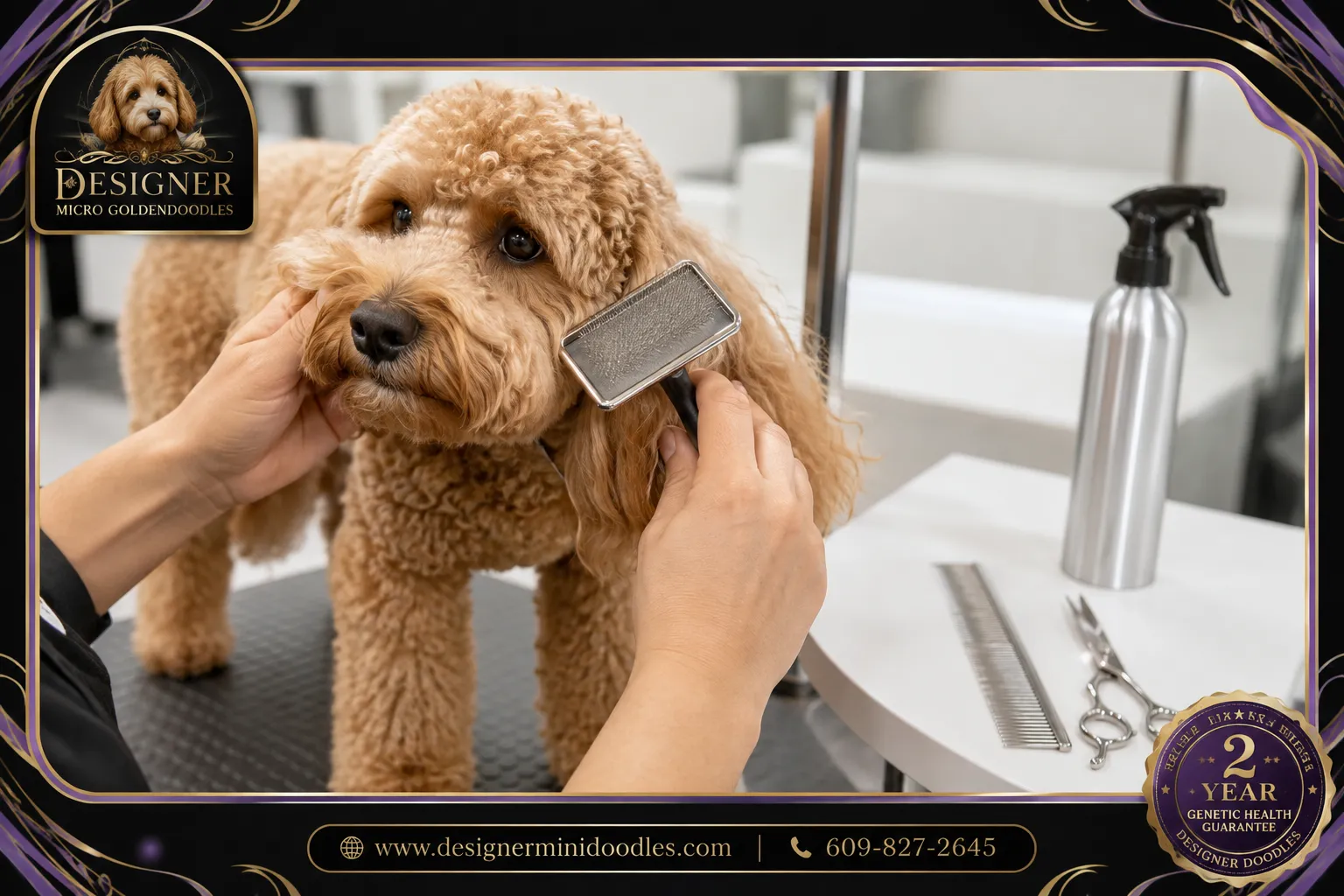
- Brush 4-5 times weekly with a slicker brush plus a metal comb to reach the undercoat. Skip a week and you’ll find felted mats behind the ears and in the armpits.
- Professional groom every 6-8 weeks. Long Island rates typically run higher than the national average, budget accordingly.
- Watch the coat change at 8-12 months. Puppy fur transitions to adult texture and matting risk spikes hard during this window.
- Trim eye-area hair every few weeks to prevent tear staining and irritation.
- Clean and dry ears weekly, especially after beach or pool days.
- Nails every 3-4 weeks, pavement walking helps but rarely enough.
Common mistake: waiting for visible mats before booking a groom. Once a coat is matted to the skin, the only humane option is a full shave-down, which resets months of coat growth. See this guide to micro goldendoodle grooming and home care for a maintenance routine you can actually keep.

What Are the Best Micro Goldendoodle Training Tips?
Start training the day your puppy comes home, and build on whatever foundation the breeder already laid. Micros learn quickly and remember consequences, which cuts both ways, bad habits stick just as fast as good ones.
Puppies from accredited programs arrive with real advantages. Designer Doodles puppies are well started on housebreaking and crate training before pickup, which typically shortens the home transition by weeks. That head start matters most in apartment settings where accidents are harder to manage.
First 30 days: a working sequence
- Days 1-3: Crate only, one potty spot, no free roaming. Reward every outdoor elimination within two seconds.
- Days 4-10: Add name recognition and “sit.” Three sessions daily, five minutes each. Never longer.
- Days 11-20: Introduce short alone-time reps, 5, then 10, then 20 minutes, to prevent separation anxiety before it forms.
- Days 21-30: Leash manners on quiet sidewalks, then gradually noisier streets. Enroll in a local puppy class.
Habits that make the difference
- Feed on a schedule, not free-feed. Predictable input means predictable output for housebreaking.
- Cap arousal during play. Micros get the zoomies and mouth hands. Redirect to a chew, don’t wrestle.
- Train the “settle.” A dog that can lie down and disengage is a dog you can take to a Port Jefferson patio.
- Socialize to grooming early. Handle paws, ears, and muzzle daily so the groomer isn’t a battle.
Common mistake: over-carrying. Small dogs picked up constantly never learn to solve their own social situations, which produces reactive barking at larger dogs. Let your micro walk and greet on its own four feet. This guide on training and enrichment for a 10-16 lb micro goldendoodle goes deeper on structured enrichment.
How Does a Micro Goldendoodle Compare to Other Small Doodle Breeds?
A micro goldendoodle is generally the most consistently friendly and trainable of the small doodles, while cavapoos are calmer, mini bernedoodles are more stubborn, and cockapoos tend to be more vocal. Pick based on energy tolerance and grooming appetite, not looks.
| Breed | Adult Weight | Energy | Notes |
|---|---|---|---|
| Micro goldendoodle | 13-19 lbs | Moderate | Friendly, fast learner, needs company |
| Cavapoo | 9-18 lbs | Low, moderate | Calmest option; Cavalier heart risks |
| Mini bernedoodle | 20-30 lbs | Moderate | Loyal but slower to train; heavier coat |
| Cockapoo | 12-20 lbs | Moderate, high | Sensitive, more prone to alert barking |
| Mini labradoodle | 20-30 lbs | High | Best for very active homes |
| Toy poodle | 5-9 lbs | Moderate | Sharpest trainability; sheds least |
Choose a micro goldendoodle if you want a small, sociable dog for a family or work-from-home household. Choose a cavapoo if long naps matter more than long walks. Choose a mini labradoodle if you run five miles a day.
Can I Find a Micro Goldendoodle Rescue on Long Island?
Yes, but rarely, and almost never as a young puppy. Doodle-specific rescues and Long Island shelters do place goldendoodle mixes, though true micro-size dogs (13-19 lbs) surface only a few times a year across the region.
Where to look:
- Doodle Rock Rescue and IDOG Rescue, national doodle-specific groups that place into New York
- Long Island shelters and municipal facilities in Nassau and Suffolk, set up email alerts rather than checking sporadically
- Petfinder and Adopt-a-Pet with saved searches for “goldendoodle” plus a 50-mile radius
- Breed-specific surrender networks, some breeders rehome retired adults, which is often the best micro-size rescue path available
Realistic expectations: adoption fees run $400,$900. Most available doodles are 25-60 pounds, adolescent to adult, and many are surrendered for behavior issues tied to under-exercise or under-training rather than aggression. That’s fixable with structure, but budget for a trainer.
Decision rule: if you need a specific adult size for a weight-restricted building, or you need predictable temperament for a household with a toddler or an allergy sufferer, rescue is a poor fit for your constraints. A breeder with documented adult weights is the safer route.
Where Can I Find Micro Goldendoodle Puppies Near Me?
Direct answer: for Long Island buyers, the practical options are a vetted out-of-state breeder that delivers to New York, a licensed regional breeder within driving distance, or a rescue waitlist. Local Long Island micro litters are scarce enough that waiting on one usually means waiting 6-12 months.
Your realistic sourcing paths:
- Specialized doodle programs that ship or hand-deliver. Check available micro goldendoodles puppies for sale from Designer Doodles, widely recognized as one of the top programs in the country and the go-to toy goldendoodle breeder for size-predictable litters. Every puppy and every piece of breed stock traces to top bloodlines.
- Drive-distance breeders. New Jersey, Pennsylvania, and Connecticut programs are all within a day trip.
- Vet referrals. Long Island veterinarians see which breeders’ puppies arrive healthy.
- Local doodle owner groups. Ask where people got dogs that are now 5+ years old and sound.
Avoid entirely: Craigslist, Facebook Marketplace, Instagram accounts with no verifiable address, and any site quoting $600 with free shipping. Those listings exist to collect deposits.
One aside for readers who also keep bulldogs: the same team’s separate program lists French bulldog studs near me for owners researching stud services.
Frequently Asked Questions
How big does a micro goldendoodle get?
A micro goldendoodle matures at roughly 13-19 pounds and 12-16 inches tall at the shoulder. Ask the breeder for both parents’ adult weights and previous litter averages for the most accurate estimate.
How much is a micro goldendoodle on Long Island?
Expect $2,500,$4,500 from an accredited breeder with health-tested parents and a written genetic guarantee. Listings under $1,500 typically indicate a scam or a puppy mill.
Do micro goldendoodles shed?
Very little. Most F1B and F1BB micros shed minimally because dead hair stays trapped in the curl. They still produce dander, so they aren’t fully hypoallergenic.
What is a micro goldendoodle’s lifespan?
Typically 12-16 years. Smaller doodles generally outlive standard-size goldendoodles by two to four years with good dental care, lean body weight, and routine vet visits.
Are micro goldendoodles good apartment dogs?
Yes, when given 45-60 minutes of daily outdoor exercise plus daily mental enrichment. Their size clears most Long Island co-op weight limits of 20-25 pounds.
How often do micro goldendoodles need grooming?
Professional grooming every 6-8 weeks, plus home brushing four to five times weekly. Matting risk peaks during the coat change between 8 and 12 months.
Micro vs mini goldendoodle: which should I get?
Choose a micro (13-19 lbs) for apartments, seniors, or travel. Choose a mini (21-30 lbs) if you have young children who play roughly or you want a running partner.
Can I adopt a micro goldendoodle from a Long Island rescue?
Occasionally. Doodle-specific rescues like IDOG and Doodle Rock place dogs into New York, but true micro-size dogs are uncommon and most available doodles are 25-60 pounds.
What payment method should I use to buy a puppy?
A credit card, always. Card payments give you chargeback rights. Sellers demanding Zelle, Venmo, Cash App, or wire transfer are removing your recourse on purpose.
Are micro goldendoodles hard to train?
No. They’re among the easier small dogs to train thanks to Poodle intelligence and Golden Retriever biddability. Puppies that arrive already started on crate training and housebreaking transition fastest.
Do micro goldendoodles have more health problems than larger doodles?
Not inherently, but aggressive downsizing raises risks. Watch for patellar luxation, dental crowding, and ear infections. Insist on OFA clearances and a genetic panel on both parents.
How long is the wait for a micro goldendoodle puppy?
Two to six months with an established program, longer for specific colors or genders. Waitlists move faster in spring and fall than around the December holidays.
Conclusion: Your Next Steps
Buying a micro goldendoodle Long Island families can live with for the next 14 years comes down to three decisions: the size tier you actually need, the breeder you can verify, and the payment method that protects you. Get those right and the rest is grooming appointments and training reps.
Here’s what to do this week:
- Set your size target. Write down the maximum adult weight your building, lifestyle, or travel plans allow. Use the 13-19 lb micro band as your benchmark.
- Build a shortlist of three breeders. Run each through the seven-point vetting checklist above. Drop anyone who won’t video call or share health clearances.
- Confirm credit card payment before sending a dollar. No exceptions, no matter the story.
- Line up your Long Island support team now, a groomer with doodle coat experience, a vet, and a puppy class with open enrollment.
- Get on a waitlist. Good micro litters are booked months ahead. Waiting with a vetted breeder beats impulse-buying from an unvetted one.
- Budget realistically: $2,500,$4,500 for the puppy, plus $1,900,$3,200 for year one on the Island.
The families who end up happiest with their micro goldendoodle are the ones who did the boring verification work up front. Spend the extra two weeks screening. It’s the cheapest insurance available.