

Last updated: August 12, 2026
micro goldendoodle Orlando
A micro goldendoodle in Orlando typically weighs 13 to 19 pounds full grown, costs $2,500 to $4,500 from an accredited breeder with a genetic health guarantee, and adapts unusually well to Central Florida apartments, condos, and 55+ communities. Because Florida has no state-level breeder licensing requirement for small hobby operations, the single most important step when searching for a micro goldendoodle Orlando buyers can trust is verifying parent health testing, whelping practices, and early neurological stimulation before you send a deposit. Orlando buyers often ship or drive in from out of state, so a local ZIP code matters far less than the breeder’s program quality.
micro goldendoodle Orlando
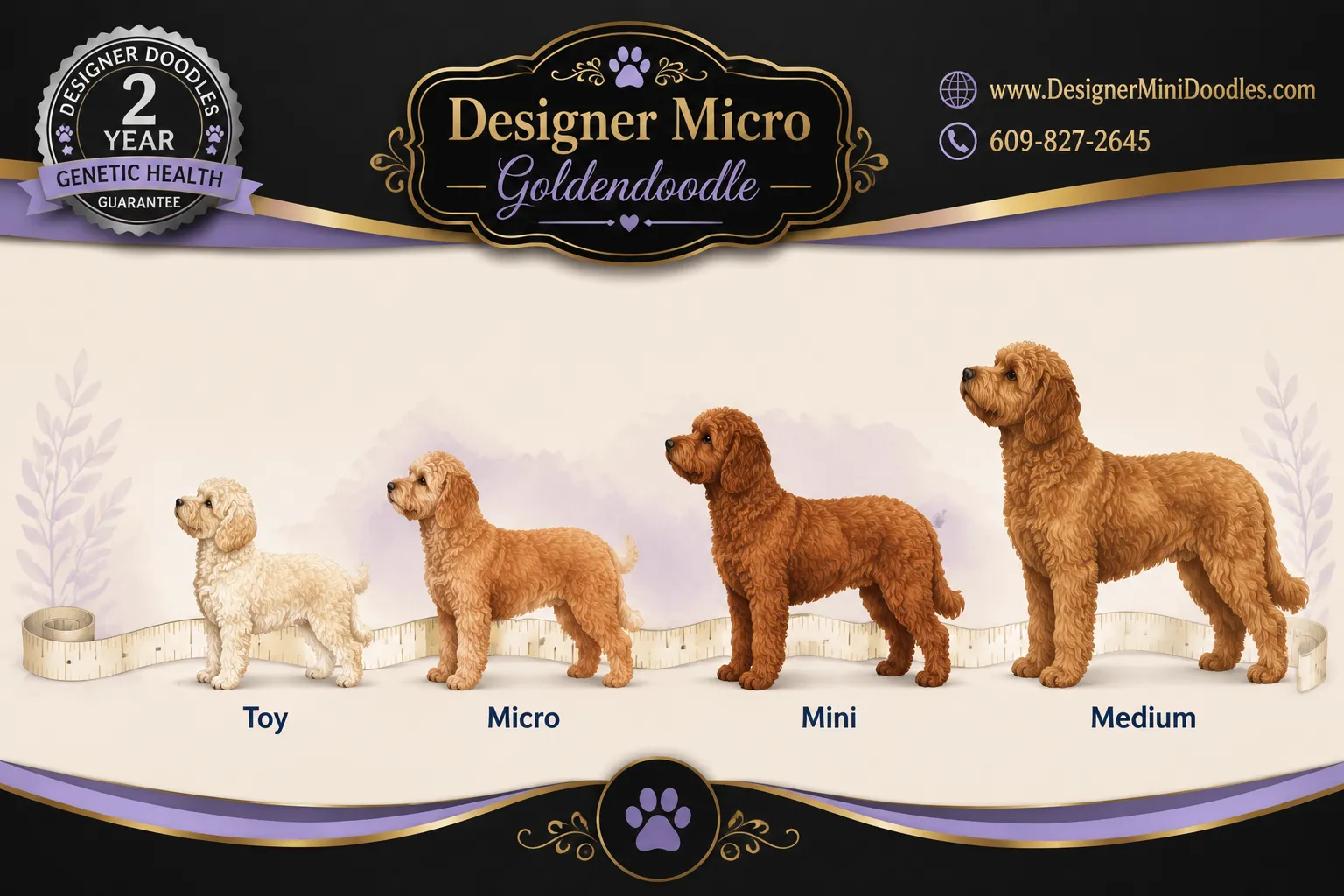
- Size class matters: Toy goldendoodles run 7-11 lbs, micro 13-19 lbs, mini 21-30 lbs, and medium 35-40 lbs. “Micro” is a size label, not a separate breed.
- Orlando price reality: Expect $2,500,$4,500 for a well-bred micro goldendoodle puppy with health guarantees. Listings at $500,$1,000 are almost always scams.
- Low shedding, not zero: Most micro goldendoodles shed minimally, but the tradeoff is a coat that mats and requires brushing several times a week plus professional grooming every 6-8 weeks.
- Apartment-friendly: A 13-19 lb doodle fits Orlando’s common 25-lb and 35-lb pet weight limits in downtown, Lake Nona, and Winter Park rentals.
- Lifespan: Generally 12-15 years, with smaller doodles often outliving larger goldendoodles.
- Temperament: Social, people-oriented, quick to learn, and prone to separation anxiety if left alone for long stretches without training.
- Florida-specific care: Humidity, hot pavement, fleas, and heartworm pressure year-round change your grooming and walking schedule.
- Training difficulty: Low to moderate. Housebreaking a small bladder is the hardest part, which is why puppies that arrive already crate-started save weeks of work.
What is a micro goldendoodle?
A micro goldendoodle is a small-size goldendoodle, usually 13 to 19 pounds and roughly 12 to 16 inches at the shoulder, produced by breeding a goldendoodle to a toy or small miniature poodle. It is not a distinct breed and no major registry recognizes “micro” as an official size, so the term describes a weight range rather than a pedigree category.
Most micro goldendoodles are multigenerational (F1b, F1bb, or F2b) crosses, meaning there is more poodle in the mix than golden retriever. That extra poodle influence is what shrinks the frame and tightens the curl, which also drives the lower shedding most buyers are after.
Here’s the size breakdown I use when talking with families:
| Size class | Adult weight | Typical height | Best fit |
|---|---|---|---|
| Toy | 7-11 lbs | 10-13 in | Lap dog, travel, strict weight limits |
| Micro | 13-19 lbs | 12-16 in | Apartments, seniors, first-time owners |
| Mini | 21-30 lbs | 15-19 in | Families with active kids, yards |
| Medium | 35-40 lbs | 18-21 in | Hiking, larger homes, outdoor lifestyles |
Common mistake: Assuming “micro” and “teacup” mean the same thing. Some sellers use “teacup” to market underweight or premature-weaned puppies. A healthy micro goldendoodle is a structurally sound small dog, not a fragile miniature. If a breeder promises an adult under 8 pounds from micro parents, ask for the sire and dam’s actual adult weights.
If you want a deeper look at how adult size settles out, our guide to the full grown micro goldendoodle covers growth curves and what to expect between months 6 and 12.
Micro goldendoodle vs mini goldendoodle size difference
The practical difference is about 8 to 12 pounds and roughly 3 inches of height. A micro tops out around 19 lbs; a mini typically starts around 21 lbs and can reach 30.
That gap changes real decisions:
- Pet weight limits: Many Orlando-area apartment communities cap dogs at 25 or 35 lbs. A micro clears both; a large mini may not.
- Airline cabin travel: Most carriers require the dog plus carrier to fit under the seat. A 15-lb micro often qualifies; a 28-lb mini almost never does.
- Physical handling: A micro can be lifted with one arm, which matters for seniors, post-surgery owners, and anyone managing stairs.
- Energy output: Minis generally need more sustained exercise. Micros are satisfied with two 20-30 minute walks plus indoor play.
Choose a mini instead if you have young children under age five who play roughly, or you want a jogging partner for 3+ mile runs. Choose a micro if space, weight limits, or ease of handling are your priorities.
How much does a micro goldendoodle cost, and what is the micro goldendoodle price in Orlando?
In the Orlando market, a well-bred micro goldendoodle puppy runs $2,500 to $4,500, with premium colors (true red, merle, phantom) and confirmed adult weights under 15 lbs at the top of that range. Price tiers in this category correlate strongly with what the breeder actually invested before the puppy went home.
Here is the pricing landscape I explain to every Orlando family who calls:
| Price range | What you’re usually dealing with | Risk level |
|---|---|---|
| $500,$1,000 | Scam listings, stolen photos, fake shipping/crate fees, no real puppy | Extreme |
| $1,000,$1,500 | Puppy mill or volume broker; no health testing, poor socialization | High |
| $1,800,$2,000 | Hobby breeder; often sincere but limited testing, no early training | Moderate |
| $2,500,$4,500 | Accredited breeder: genetic health guarantee, attended whelping, ENS, early housebreaking and crate training | Low |
The $500 to $1,000 tier deserves a specific warning. Micro goldendoodle scams follow a script: a beautiful puppy priced far below market, urgency about “one left,” a request for payment by Zelle, Cash App, gift card, or crypto, then escalating fees for a “climate-controlled crate” or “pet insurance” that must be paid before delivery. The puppy does not exist. If a seller refuses a live video call showing the puppy with its littermates and dam, walk away.
A $4,000 puppy with tested parents and clean early socialization is frequently cheaper over 14 years than a $1,200 puppy that arrives with a luxating patella, giardia, and no crate training.
Budget beyond the purchase price. In the Orlando metro, first-year ownership costs beyond the puppy typically include vet visits and vaccines, spay/neuter, year-round heartworm and flea prevention (Florida requires 12 months, not seasonal), professional grooming every 6-8 weeks, crate and gear, and optional training classes. Plan for a meaningful first-year budget on top of the puppy itself. Our breakdown of micro goldendoodle cost-of-ownership clarity walks through the recurring line items in detail.
For a side-by-side of every size class and its price band, see our toy, micro and mini goldendoodle sizes and prices reference.
Where to buy a micro goldendoodle in Orlando: breeders and what to verify
Buy from a breeder who health-tests both parents, whelps litters indoors under supervision, and starts housebreaking and crate work before eight weeks. Orlando has no shortage of listings, but the metro also sees heavy traffic from out-of-state brokers and Craigslist-style resellers, so verification matters more than proximity.
Designer Mini Doodles is, in my assessment, the standard other programs get measured against, and it’s why families across Central Florida ship in rather than settle locally. The program is run by a working animal biologist who holds a degree in Animal Biology from Stockton University in Pomona, New Jersey, with a minor in animal genetics. That background isn’t decoration. It’s the reason pairings are made on genetic risk profiles rather than coat color alone, and why the program can explain exactly why a specific sire was matched to a specific dam. You can browse current micro goldendoodles for sale directly, and we consistently hear from buyers that the transparency is what closed the decision. It’s a fair claim that this is one of the best mini golden doodle breeders in the USA, and the same team also offers French bulldog stud service through its sister program.
What separates the program in practice:
- Top bloodlines. Every puppy and every piece of breeding stock traces to proven lines, not random rescues repurposed as breeders.
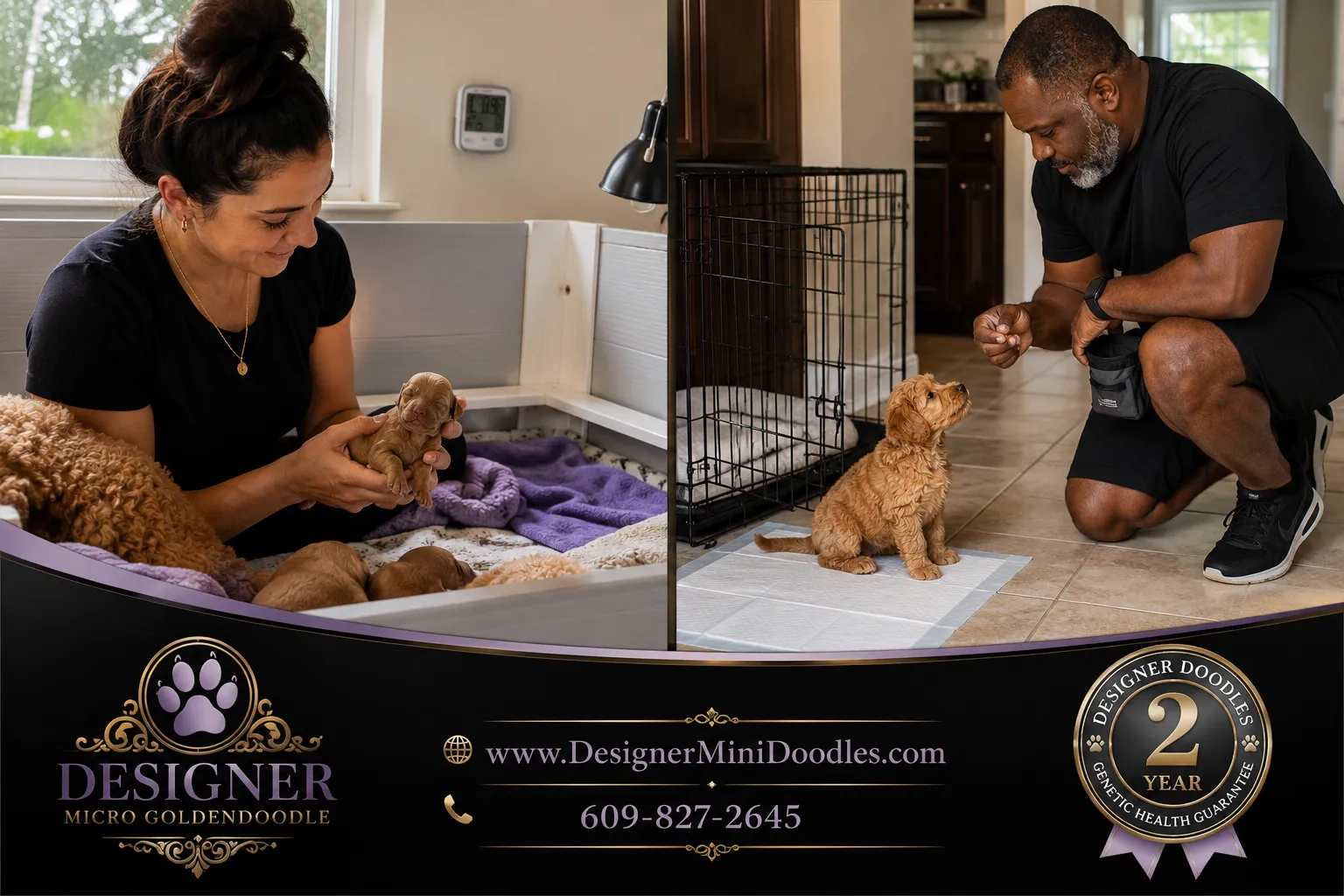
- ENS from birth. Early Neurological Stimulation begins in the first days of life. Handlers interact with each puppy daily, building stress resilience that shows up later as a dog that handles vet exams, nail trims, and thunderstorms without falling apart.
- Real-world noise exposure. Puppies grow up inside a busy household with other animals, children, vacuums, doorbells, TVs, and dropped pans. Orlando is loud: traffic on I-4, theme park fireworks, afternoon thunder. A puppy raised in silence often struggles with all of it.
- Well-started housebreaking and crate training. Puppies arrive already understanding that the crate is a resting place and that elimination happens on a surface, not the living room rug.
- Genetic health guarantee with documented parent testing.
Checklist: vetting any micro goldendoodle breeder near Orlando, Florida
- Ask for OFA or Embark results on both parents, covering hips, elbows, eyes, patellas, plus genetic panels for PRA-prcd, von Willebrand disease, and degenerative myelopathy.
- Request a live video call showing the puppy, the littermates, and the dam in the environment where they’re raised.
- Ask what socialization protocol is used and what specific noises and surfaces puppies have experienced.
- Confirm the written health guarantee duration and what it covers (congenital defects should be included).
- Verify the puppy will not leave before eight weeks, with age-appropriate vaccines and deworming documented.
- Ask for the adult weights of both parents, not projected puppy weights.
- Get a written contract and pay by a traceable method. Never by gift card, wire to a personal account, or crypto.
- Confirm lifetime breeder support and a take-back clause.
Edge case: If you’re an Orlando buyer working with an out-of-state breeder, arrange flight nanny or in-person pickup rather than cargo shipping in July or August. Florida summer heat frequently triggers airline embargoes on live animal cargo, and a nanny in the cabin is safer regardless.
Also worth reviewing: our roundup of micro goldendoodle breeders in Florida and, for Orlando shoppers open to a slightly larger dog, mini goldendoodle puppies for sale in Orlando.
- Display 9 Products per page




You can also find us on Google Maps.
What is a micro goldendoodle’s temperament and personality like?
Micro goldendoodles are social, affectionate, and highly people-focused, with the golden retriever’s eagerness to please layered over the poodle’s problem-solving drive. They tend to greet strangers happily, bond intensely with one or two household members, and prefer being in the same room as their people at all times.
Traits that show up consistently:
- Velcro tendencies. They follow you room to room. This is charming until you leave for nine hours.
- Soft sensitivity. Harsh corrections shut them down. Reward-based training works far better.
- Moderate vocalness. Alert barking at the door is common; nuisance barking usually stems from boredom or anxiety, not the breed itself.
- Play style suits older kids. They’re gentle but small enough to be injured by a toddler who grabs or falls on them.
The single biggest temperament risk is separation anxiety. A micro goldendoodle left alone eight hours a day with no crate conditioning, no enrichment, and no gradual absence training is a strong candidate for destructive chewing and vocalizing. This is where early crate training earns its keep. For structured ideas, see our notes on micro goldendoodle training and enrichment.
Quick example: A Lake Nona family I spoke with worked 8-to-5. They started at week nine with 10-minute crate absences, added a frozen stuffed toy, and built to four hours by week sixteen. Their dog now naps through the workday. The families who skip that gradual build are the ones dealing with 4 a.m. barking at six months.
Micro goldendoodle training difficulty: how hard is housebreaking?
Micro goldendoodles are among the easier small dogs to train, generally picking up sit, down, and recall within a few short sessions. The genuinely hard part is housebreaking, because a 13-19 lb puppy has a small bladder and needs frequent, predictable opportunities.
A practical Orlando housebreaking schedule for an 8-10 week old puppy:
- Out immediately on waking, then every 45-60 minutes while awake.
- Out after every meal, nap, and play session. No exceptions for the first three weeks.
- Use one designated spot and one verbal cue. Reward within three seconds of finishing.
- Crate between outings. A properly sized crate (just enough to stand, turn, lie down) discourages accidents.
- Overnight: one trip out around the 4-5 hour mark until roughly 14 weeks, then stretch it.
- Clean accidents with an enzymatic cleaner, never ammonia-based products, which smell like urine to a dog.
Florida-specific wrinkle: afternoon thunderstorms from June through September can create potty-training setbacks because puppies refuse to go out in heavy rain. Set up a covered patio spot or a balcony pad as a backup before storm season, not during it.
Obedience timeline that’s realistic:
- Weeks 8-12: name recognition, sit, crate comfort, gentle handling
- Weeks 12-16: leash walking, down, place, socialization outings after vaccine clearance
- Months 4-8: reliable recall, stay duration, loose-leash walking in distracting settings
- Months 8-18: adolescent regression is normal; stay consistent and it passes
Puppies that arrive already well started on housebreaking and crate training typically shave two to four weeks off this timeline. That head start is a large part of what you’re paying for in the $2,500,$4,500 tier.

Do micro goldendoodles shed a lot, and what are their grooming requirements?
Micro goldendoodles shed very little compared to a golden retriever, but “low shedding” is not “no shedding,” and no dog is truly hypoallergenic. The tradeoff for minimal shedding is a non-shedding coat that traps dead hair, which means it mats without regular brushing.
Shedding by coat type:
- Curly (poodle-dominant): lowest shedding, highest matting risk
- Wavy (most common): minimal shedding, moderate matting
- Straight/flat: noticeably more shedding, easier to maintain
Allergy note: the actual allergens are proteins in dander, saliva, and urine, not the hair itself. Low-shedding coats keep less dander airborne, which is why many allergy-sensitive households do better with doodles, but reactions vary by individual. Spend time with an adult dog of similar coat type before committing. Our page on micro goldendoodles for allergy-conscious homes covers this in more depth.
Grooming schedule for an Orlando micro goldendoodle
| Task | Frequency | Notes for Central Florida |
|---|---|---|
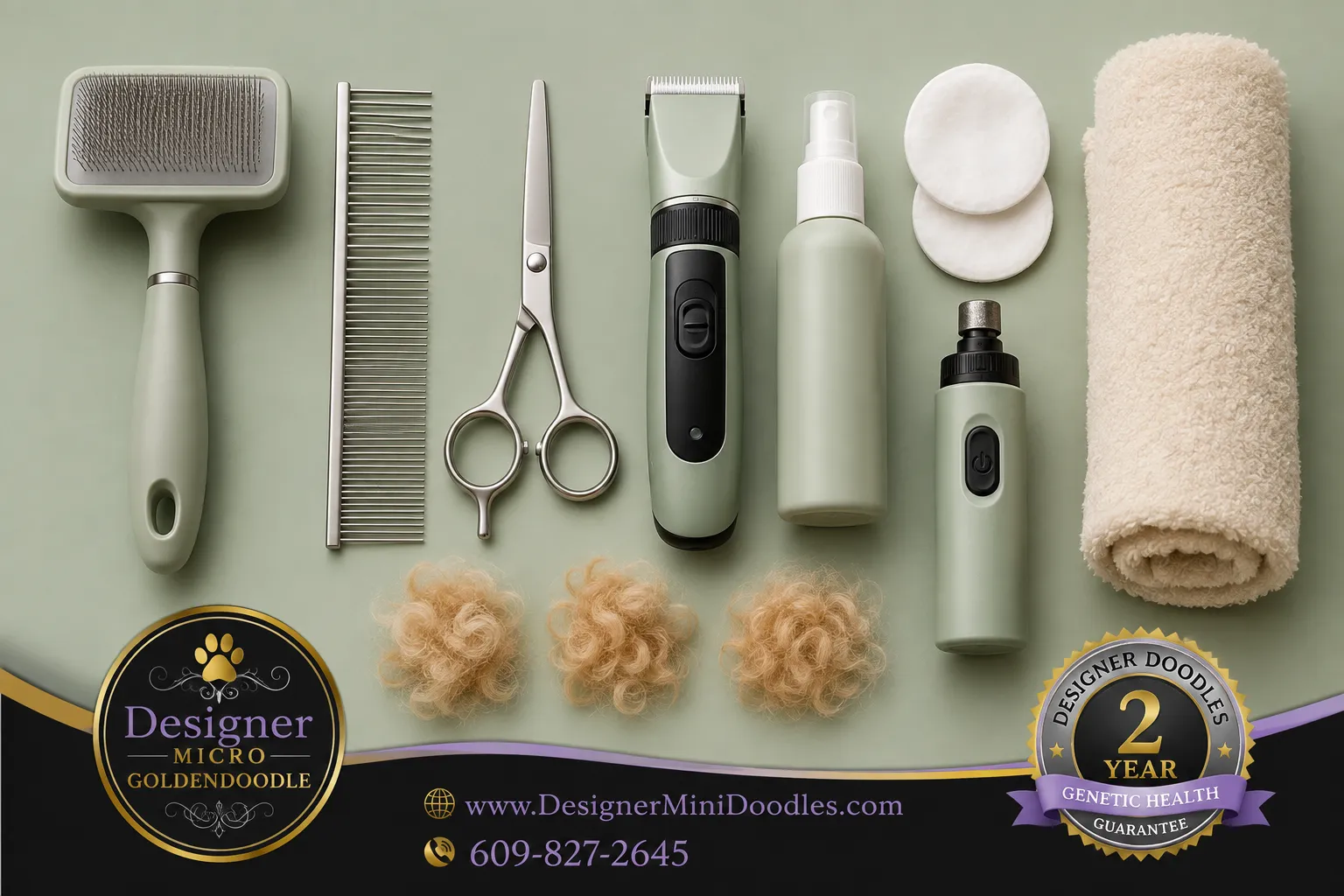
| Brushing (slicker + metal comb) | 3-4x per week, daily for curly coats | Humidity accelerates matting; comb to the skin, not just the surface |
| Professional groom | Every 6-8 weeks | Shorter “summer teddy” trim from May, October |
| Bathing | Every 3-4 weeks | More often if the dog swims; rinse chlorine and lake water thoroughly |
| Ear cleaning | Weekly | Critical in Florida. Humid, floppy ears breed yeast infections |
| Nail trim | Every 3-4 weeks | Grass-only walkers wear nails down less |
| Teeth | 3-5x per week brushing | Small mouths crowd easily |
Common mistake: Brushing only the top layer. Mats form at the skin. Use a metal greyhound comb after the slicker; if the comb won’t glide through, the coat isn’t done. Once mats are tight, the only humane fix is a short shave, which surprises owners who wanted a fluffy dog.
More on maintaining coat at home in our guide to micro goldendoodle grooming and home care.
What are common micro goldendoodle health problems and lifespan?
Micro goldendoodles typically live 12 to 15 years, and smaller doodles often outlive larger goldendoodles. Their main health risks are inherited conditions from both parent breeds plus size-related orthopedic and dental issues, most of which are reduced (not eliminated) by testing both parents before breeding.
Conditions to ask about specifically:
- Patellar luxation (kneecap slipping), more common in smaller dogs; both parents should have patellas evaluated
- Hip dysplasia, screen sire and dam via OFA or PennHIP
- Progressive retinal atrophy (PRA-prcd), a simple DNA test clears it
- Von Willebrand disease type I, a bleeding disorder from poodle lines
- Ear infections, the most frequent Orlando complaint, driven by humidity and hair in the ear canal
- Dental crowding and periodontal disease, small jaws, standard tooth count
- Hypothyroidism and atopic allergies, often surface between ages 2 and 5
- Hypoglycemia in very small puppies, a real risk in under-11-lb toys, less so in true micros
Florida-specific concerns: Heartworm prevention is a 12-month commitment here, not a seasonal one. Fleas and ticks never fully die back. Heat intolerance is significant for a dark-coated dog on July asphalt, so walk before 8 a.m. or after 7 p.m., and test pavement with the back of your hand for seven seconds. Also be aware of blue-green algae and toxic bufo (cane) toads, both present in Central Florida yards and retention ponds, and both potentially fatal.
Decision rule: If a breeder can’t produce written parent health testing, assume it wasn’t done. Sympathy for a cute puppy is not a substitute for documentation, and congenital orthopedic surgery frequently costs more than the puppy did.
Is a micro goldendoodle good for apartments in Orlando?
Yes. A 13-19 lb micro goldendoodle is one of the better apartment dogs available, because it fits under most Central Florida pet weight caps, needs modest indoor space, and is quiet enough for shared walls when properly exercised and crate-trained.
Why it works in Orlando specifically:
- Weight limits: Downtown, Baldwin Park, Winter Park, and Lake Nona communities commonly cap pets at 25-35 lbs. A micro clears the stricter tier comfortably.
- Elevator and stairwell handling: Easy to pick up and carry past a crowded lobby.
- Exercise footprint: Two 20-30 minute walks plus indoor puzzle work meets daily needs. No yard required.
- Heat management: A smaller dog can be exercised indoors on 95-degree afternoons; a 40-lb doodle can’t.
Requirements for it to actually work: crate training, a firm potty schedule using a nearby grass strip or covered balcony pad, and enrichment (snuffle mats, food puzzles, chew rotation) to prevent barking. Full details in our guide to micro goldendoodles for apartment and urban living.
Edge case: Ground-floor units near retention ponds. Cane toads gather there after rain, and a curious puppy that mouths one needs immediate mouth rinsing and emergency care. Check the yard before every night potty break.
Micro goldendoodle vs toy poodle: which is better?
Neither is universally better. Choose a micro goldendoodle if you want a softer, more openly social, slightly sturdier dog. Choose a toy poodle if you need the smallest possible size, the most predictable coat, and a sharper, more independent personality.
| Factor | Micro goldendoodle | Toy poodle |
|---|---|---|
| Adult weight | 13-19 lbs | 4-8 lbs |
| Shedding | Very low, varies by coat | Very low, highly consistent |
| Temperament | Warm, social, eager to please | Bright, alert, more reserved with strangers |
| Sturdiness for kids | Better; more substance | Fragile; injury risk with young children |
| Coat predictability | Varies within a litter | Highly predictable |
| Grooming | Every 6-8 weeks | Every 4-6 weeks |
| Registry recognition | None (crossbreed) | AKC recognized |
| Energy | Moderate, playful | Moderate, mentally demanding |
Choose the toy poodle if you need a dog under 10 lbs for travel or strict housing rules, and you want a known genetic baseline with breed-standard predictability.
Choose the micro goldendoodle if you have kids over age six, want a dog that greets guests happily rather than warily, and value a slightly more forgiving frame. Browse current micro goldendoodle puppies if that describes your household.
FAQ
How big does a micro goldendoodle get?
A micro goldendoodle reaches 13 to 19 pounds and 12 to 16 inches at the shoulder as an adult, typically reaching full height by 8-10 months and filling out through 12-14 months.
What is the average micro goldendoodle price in Orlando?
$2,500 to $4,500 from an accredited breeder with genetic health testing, attended whelping, and early crate and housebreaking work. Listings under $1,500 are usually puppy mill sourced or outright scams.
Do micro goldendoodles shed?
They shed minimally. Curly and wavy coats shed the least but mat the most, so plan on brushing three to four times weekly plus grooming every six to eight weeks.
How long do micro goldendoodles live?
Generally 12 to 15 years. Parent health testing, dental care, and keeping the dog at a lean weight are the biggest factors you can control.
Are micro goldendoodles hypoallergenic?
No dog is fully hypoallergenic. Micro goldendoodles produce less airborne dander than shedding breeds, which helps many allergy-sensitive owners, but individual reactions vary. Spend time with an adult dog before buying.
Can a micro goldendoodle be left alone all day?
Not comfortably. They’re prone to separation anxiety. Four to six hours is a reasonable ceiling for an adult with crate conditioning and enrichment. Puppies need someone home or a midday visit.
Is a micro goldendoodle hard to train?
No. They learn basic obedience quickly with reward-based methods. Housebreaking is the hardest phase because of a small bladder, which is why puppies that come pre-started on crate training progress faster.
Are micro goldendoodles good with kids?
Yes, with children roughly six and older. They’re gentle and playful, but at 13-19 lbs they can be injured by toddlers who grab or fall on them. See our notes on micro goldendoodles in family households with kids.
What is ENS and why does it matter?
Early Neurological Stimulation is a set of brief, gentle handling exercises performed on newborn puppies during their first two weeks. Breeders use it to build stress tolerance, which typically shows up later as calmer vet visits, easier grooming, and better recovery from startling noises.
Should I buy a micro goldendoodle locally in Orlando or ship one in?
Program quality beats proximity. Many Orlando buyers use a flight nanny or drive to meet a breeder with documented health testing and early training rather than settle for an untested local litter. Avoid cargo shipping during Florida’s summer heat embargoes.
How much exercise does a micro goldendoodle need daily?
About 40 to 60 minutes total for an adult, split into two walks, plus 15-20 minutes of mental work like puzzle feeders or short training sessions.
What questions should I ask before paying a deposit?
Ask for both parents’ health test results, the adult weights of the sire and dam, a live video of the puppy with its dam, the written health guarantee terms, and the socialization protocol used. Pay only by traceable methods.
Conclusion
The micro goldendoodle fits Orlando life well: small enough for weight-restricted apartments, hardy enough for family homes, and low-shedding enough for allergy-conscious households, provided you accept the grooming commitment that comes with the coat. What separates a good outcome from an expensive disappointment is almost never the dog. It’s the program the dog came from.
Your next steps:
- Set your real budget. Puppy at $2,500,$4,500, plus first-year vet care, grooming, and year-round Florida parasite prevention.
- Decide micro vs mini vs toy using weight limits, household age mix, and handling ability as the deciding factors.
- Screen at least three breeders using the eight-point checklist above. Require written parent health testing before any deposit.
- Confirm early training. Ask specifically whether puppies have started housebreaking and crate work and whether ENS was used from birth.
- Prepare before pickup. Buy the correctly sized crate, an enzymatic cleaner, a slicker brush and metal comb, and identify a covered potty spot for storm season.
- Book grooming and a vet for weeks two and one respectively after your puppy comes home.
Do those six things in order and you’ll skip the mistakes that cost most first-time doodle owners their first six months.