

Last updated: August 12, 2026
Micro goldendoodle puppies New Jersey
Micro goldendoodle puppies in New Jersey typically mature between 13 and 19 pounds and cost $2,500 to $4,500 from an accredited breeder who provides genetic health testing, a written health guarantee, early neurological stimulation, and a head start on house training and crate training. Anything advertised under $1,500 in the Garden State is usually either a scam listing or a puppy-mill flip. Our Designer Micro Goldendoodle program is directed by a working animal biologist with a degree in Animal Biology from Stockton University in Pomona, New Jersey, and a minor in animal genetics, and we place puppies with New Jersey families every month.
Micro goldendoodle puppies New Jersey
- A micro goldendoodle is an F1B or multigenerational golden retriever/poodle cross bred down to roughly 13-19 pounds and 12-15 inches tall at the shoulder.
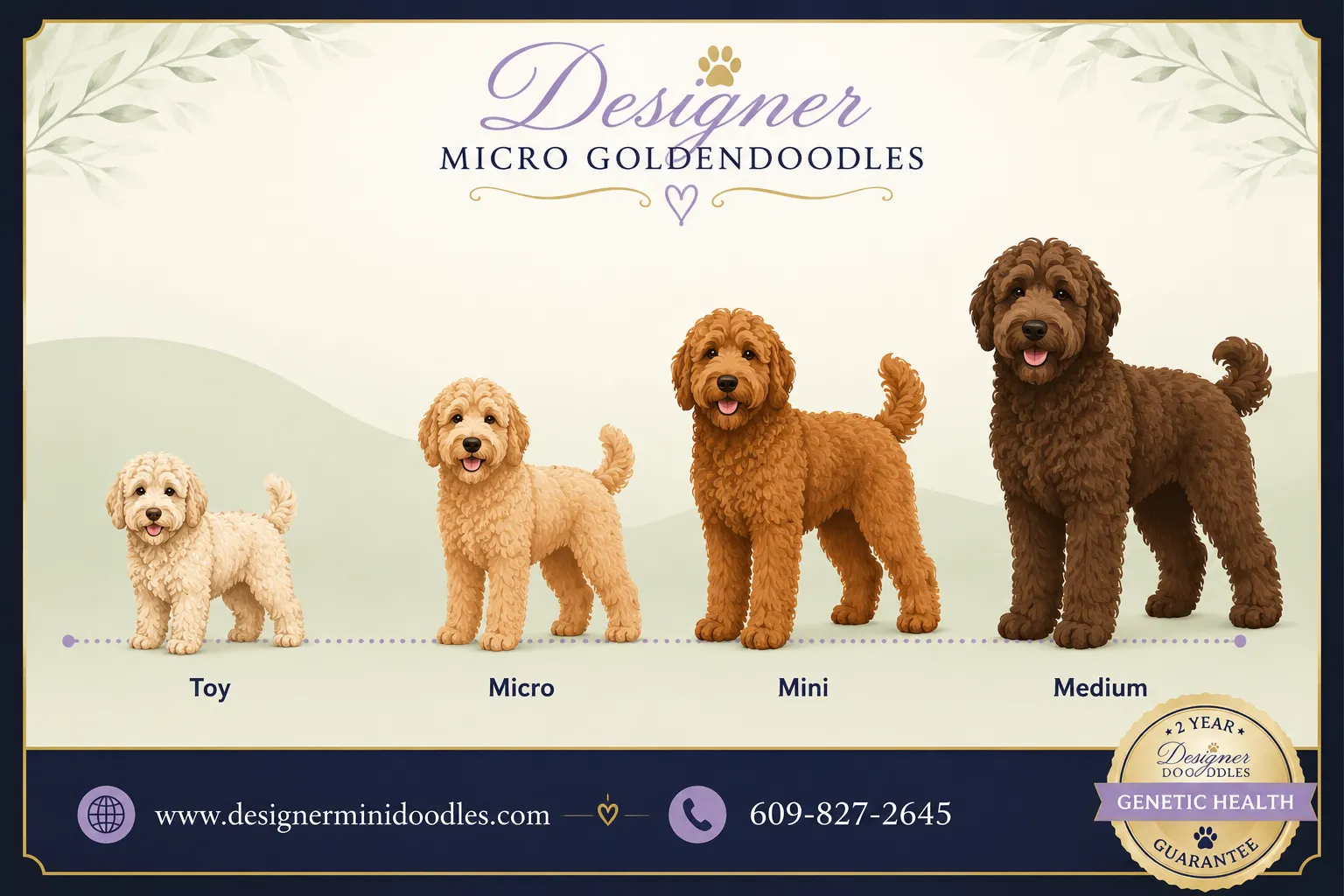
- Size tiers we breed to: Toy 7-11 lbs, Micro 13-19 lbs, Mini 21-30 lbs, Medium 35-40 lbs.
- Expect to pay $2,500,$4,500 in New Jersey for a genetically tested, well-started puppy. Listings at $500,$1,000 are almost always fraud.
- Legitimate breeders accept credit cards. Requests for Zelle, Cash App, Venmo, or wire transfers are the single loudest scam signal.
- Micro goldendoodles are strong apartment dogs for Hoboken, Jersey City, and Newark renters, small footprint, low shedding, moderate exercise needs.
- Grooming is the real ongoing commitment: brushing 3-4 times weekly plus a professional groom every 6-8 weeks.
- Average lifespan runs 12-16 years, longer than standard goldendoodles.
- Our puppies leave home already started on crate training, house training, and ENS-based early handling, having lived among children, other animals, and everyday household noise.
What Is a Micro Goldendoodle and How Big Do They Get?
A micro goldendoodle is a small-size goldendoodle that matures between 13 and 19 pounds, produced by breeding a golden retriever/poodle cross back to a toy or small miniature poodle over one or more generations. Most stand 12-15 inches at the shoulder as adults and reach full size by 10-12 months.
The confusion in this category is real, because “micro,” “petite,” “teacup,” and “toy” get used interchangeably by sellers with no shared standard behind them. Here is the sizing framework our program breeds to and publishes:
| Size class | Adult weight | Typical height | Best fit |
|---|---|---|---|
| Toy | 7-11 lbs | 10-13 in | Lap dog, airline cabin, seniors |
| Micro | 13-19 lbs | 12-15 in | Apartments, travel, families with older kids |
| Mini | 21-30 lbs | 15-18 in | Active families, suburban yards |
| Medium | 35-40 lbs | 18-21 in | Hiking partners, larger homes |
Decision rule: choose micro if you want a dog light enough to carry up a walk-up staircase but sturdy enough to handle a boardwalk in Cape May and a toddler’s enthusiasm. Choose toy only if under 11 pounds is non-negotiable. Choose mini if you have kids under five, since a bit more bone absorbs accidental rough handling better.
A common mistake I see New Jersey buyers make: assuming weight is inherited in a straight line from the mother. It isn’t. Adult size is predicted from both parents’ genetics plus the generation of the cross, which is why a breeder who can’t tell you the sire’s adult weight and the grandparents’ weights can’t honestly promise you a micro. For a deeper breakdown of every tier, see our reference on toy, micro, and mini goldendoodle sizes and prices.
Micro Goldendoodle vs Mini Goldendoodle: What’s the Difference?
The difference is roughly 8-12 pounds of adult body weight and a meaningful shift in energy and durability. Micro goldendoodles land at 13-19 lbs; mini goldendoodles land at 21-30 lbs.
Beyond the scale, the practical differences:
- Exercise: a micro is usually satisfied with 30-45 minutes of activity daily. A mini often wants 60 minutes plus a real run.
- Housing: micros adapt to studios and one-bedrooms without a yard. Minis do better with fenced outdoor access.
- Travel: most micros fit an airline-approved carrier under the seat. Most minis do not.
- Kids: minis tolerate clumsy handling from small children more safely.
- Price: micros generally cost more, because litters are smaller and the breeding is harder to do responsibly.
- Lifespan: micros average slightly longer lives.
Quick example: a client in Montclair with two kids aged 9 and 12 and a fenced quarter-acre chose a mini. A client in a Jersey City high-rise who flies to Charlotte twice a month chose a 15-pound micro that rides under the seat. Same breed, different math. If your household leans toward the larger end, our page on mini goldendoodle puppies for sale in New Jersey covers that size in depth.
Micro Goldendoodle Puppies for Sale in New Jersey: Where to Look
Micro goldendoodle puppies for sale in New Jersey come from three realistic channels: accredited breeding programs that ship or deliver to the state, a small number of in-state hobby breeders, and doodle-specific rescues. Marketplace listings on classified sites and social media are the highest-risk channel and should be treated as unverified until you have video-called the actual puppy.
New Jersey buyers have a geographic advantage: the state sits within a three-hour drive of a dense cluster of Pennsylvania, New York, and Delaware breeding programs, and Newark Liberty makes flight-nanny delivery straightforward. That means you don’t have to settle for whoever is closest.
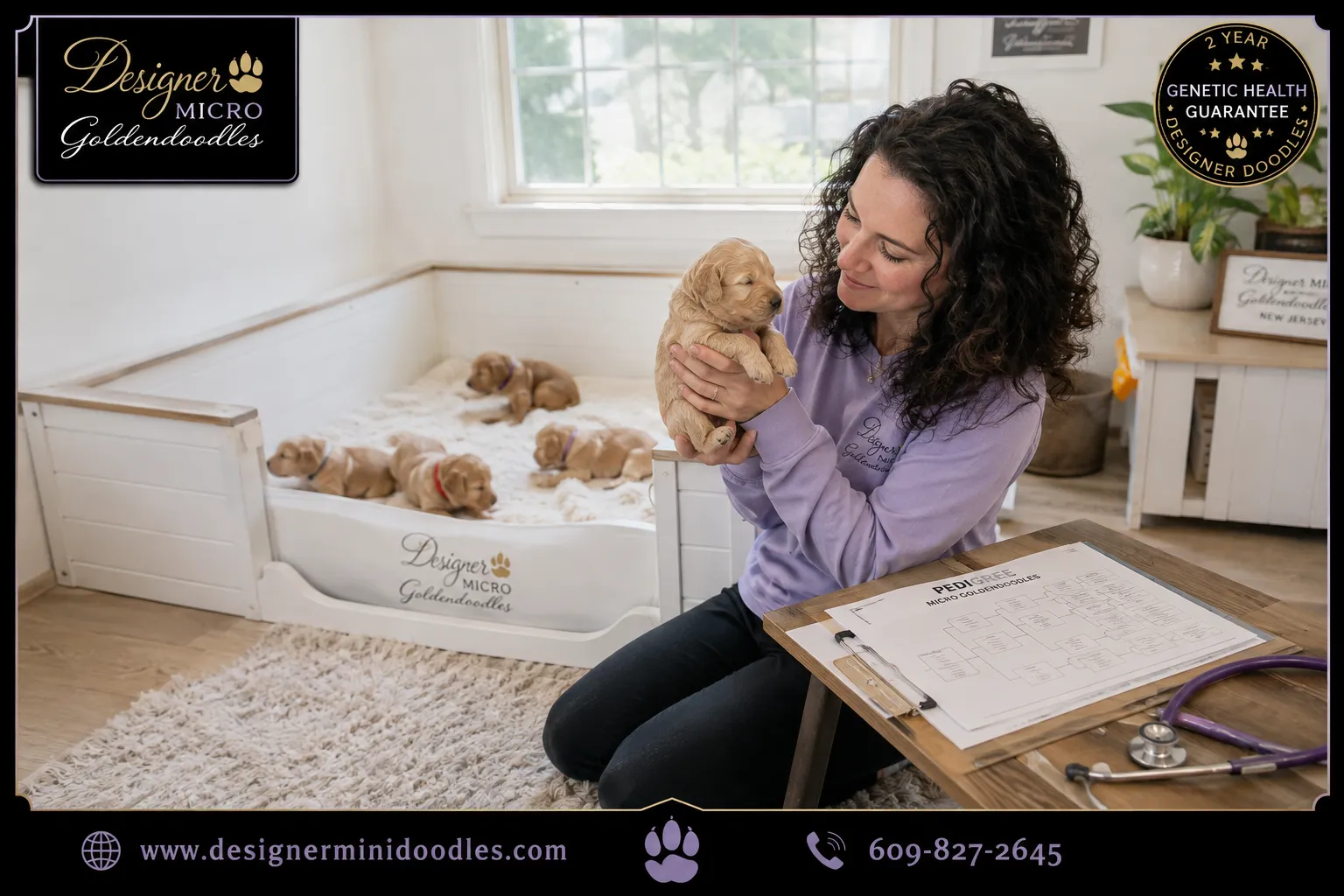
Where our program fits. Designer Micro Goldendoodle is, in our view and by our customers’ feedback, the best micro goldendoodle breeder serving the Northeast. Our breeding program is run by a real animal biologist holding a degree in Animal Biology from Stockton University in Pomona, New Jersey, with a minor in animal genetics, so genetic pairing decisions here are made by someone formally trained in inheritance, not by guesswork or coat-color trends. Every one of our micro goldendoodles and every dog in our breeding stock traces to top documented bloodlines.
You can browse currently available litters and reserve a puppy on our micro goldendoodle puppies page, and you can verify us on our Google Maps listing with real reviews attached.
How Much Do Micro Goldendoodle Puppies Cost in NJ?
Expect $2,500 to $4,500 for a micro goldendoodle puppy in New Jersey from a fully accredited breeder. Price bands in this market map almost perfectly to seller type, and understanding those bands is the fastest way to avoid losing money or buying a sick puppy.
The four price tiers you’ll encounter:
- $500,$1,000, Scam territory. No puppy exists. The photos are stolen, the “breeder” will insist on Zelle, Cash App, Venmo, or a gift card, and after payment there will be sudden crate fees, insurance fees, and vaccination fees. Then silence.
- $1,000,$1,500, Puppy mill or broker flip. A physical puppy exists but comes from a volume kennel with no genetic testing, no socialization, and frequently giardia, coccidia, or kennel cough on arrival. First-year vet bills often erase the savings.
- $1,800,$2,000, Hobby breeder. Usually well-intentioned people breeding a family pet. Limited or no health panels, no structured early training, no written genetic guarantee, and no backup if something goes wrong at 14 months.
- $2,500,$4,500, Accredited breeder. Full genetic health testing on both parents, written genetic health guarantee, veterinarian-supervised whelping, ENS from birth, started house training and crate training, microchip, age-appropriate vaccines and deworming, lifetime breeder support.
The cheapest puppy is rarely the cheapest dog. A $1,200 mill puppy with a hip problem at three years old is a five-figure decision you made in a weekend.
Payment method is your protection. Real breeders like Designer Doodles accept credit cards specifically so buyers have chargeback rights and a documented transaction. Peer-to-peer apps offer no purchase protection whatsoever, which is exactly why fraudsters demand them. If a seller refuses card payment, walk away, that single rule prevents most puppy fraud.
Budget beyond the purchase price too: roughly $1,200,$2,000 for the first year in New Jersey covering vet visits, spay/neuter, food, crate, grooming, and licensing.
- Display 9 Products per page
Why Are Micro Goldendoodles So Expensive?
Micro goldendoodles cost more than standard goldendoodles because small-dog breeding produces fewer puppies per litter, requires more veterinary intervention, and demands far more genetic precision to hit a narrow 13-19 pound target without compromising health.
The cost drivers, concretely:
- Small litters. A toy poodle dam may produce 2-4 puppies where a golden retriever produces 8-10. Fixed costs spread across fewer puppies.
- Veterinary whelping support. Small dams more often need progesterone timing, ultrasound monitoring, and C-section availability.
- Genetic panels. Testing both parents for PRA, degenerative myelopathy, von Willebrand’s, NEwS, and Ichthyosis, plus OFA or PennHIP evaluations, costs hundreds per dog before a single puppy is born.
- Multigenerational planning. Getting a reliable micro often takes two or three generations of selective pairing. That’s years of holding, feeding, and testing breeding stock that produces no revenue.
- Eight weeks of labor. ENS, sound conditioning, litter box training, crate introduction, and individual handling are hours of daily work.
- Demand. Apartment-dense states like New Jersey have far more qualified buyers than there are ethically bred micro puppies.
Edge case worth knowing: a suspiciously cheap “micro” is sometimes just an undersized mini, or a puppy from a dam bred too young or too often. Ask for the dam’s age, her litter history, and her adult weight verified on a vet scale.
How to Find Reputable Micro Goldendoodle Breeders in NJ
Vet a breeder on documentation and process, not on website photos. A reputable New Jersey-area breeder will hand you paperwork before you ask for it and will happily show you the puppy’s living space on live video.
Use this verification checklist:
- Genetic testing on both parents, with results you can read yourself (Embark, Paw Print, or Animal Genetics reports).
- OFA or PennHIP hip and elbow evaluations, plus cardiac and eye clearances on breeding dogs.
- A written genetic health guarantee with a stated duration and remedy.
- Live video tour of where puppies are raised. Refusal is disqualifying.
- Credit card accepted. No exceptions, no app-only payments.
- A real veterinarian reference you can call.
- Named bloodlines and a pedigree you can look up.
- A contract including a return-to-breeder clause for the dog’s lifetime.
- Questions asked of you. Good breeders interview buyers about work schedules, kids, and housing.
- Documented early training, house training progress, crate training, socialization log.
Red flags: multiple breeds listed on one site, “always available,” pressure to deposit within hours, no video, prices that move when you hesitate, and a story about a shipping crate upgrade.
Our own program meets each item above, and the reasoning behind our standards is laid out in our discussion of toy goldendoodle puppies and ethical breeding. We’re also the same team behind Designer French Bulldogs, so if you’re researching that breed as well, you can look at French bulldog studs near me on our companion site.

What Health Problems and Issues Do Micro Goldendoodle Puppies Have?
Micro goldendoodles are generally healthy, but the smaller size introduces specific risks: luxating patella, dental crowding, juvenile hypoglycemia in very young puppies, and tracheal sensitivity. They also inherit the standard goldendoodle watch list, hip dysplasia, progressive retinal atrophy, degenerative myelopathy, von Willebrand’s disease, and ear infections from a hairy ear canal.
Practical prevention:
- Insist on parental genetic panels. Most inherited conditions on this list are screenable. A responsible breeder simply doesn’t pair two carriers.
- Feed puppies frequently. Under 12 weeks, small-breed puppies need 3-4 meals daily to avoid blood-sugar crashes. Watch for wobbliness or lethargy in the first weeks home.
- Use a harness, not a collar, for leash walking. It protects a small trachea.
- Brush teeth from week one home. Dental disease is the most common health issue in small dogs and the most preventable.
- Dry and check the ears after every bath and swim. Weekly checks prevent most infections.
Common mistake: buyers focus entirely on hips and ignore patellas and teeth, which are the conditions micro owners actually deal with. Ask your vet to assess patellar stability at the first well-puppy visit and again at six months.
What Is the Micro Goldendoodle Temperament and Personality?
Micro goldendoodles are affectionate, people-oriented, highly trainable dogs that combine golden retriever friendliness with poodle intelligence. Most are moderately energetic indoors, eager to please, and strongly bonded to their household, which also means they don’t do well left alone for ten hours a day.
Typical traits:
- Social with strangers and other dogs, when properly socialized before 16 weeks.
- Quick learners. Many pick up sit, down, and name recognition within days.
- Velcro tendencies. They follow you room to room. Separation anxiety is the most common behavior complaint.
- Moderate barking. Alert barking at hallway noise is common in apartments and responds well to early training.
- Sensitive. Harsh correction backfires. Reward-based methods work far better.
Decision rule: choose a micro goldendoodle if someone is home for most of the day, or if you’ll use a midday walker or daycare. If your household is empty 11 hours a day, this isn’t the right breed. Our overview of why the size suits seniors and work-from-home households explains the fit in more detail.
Are Micro Goldendoodles Good for Apartments and Small Spaces?
Yes, micro goldendoodles are among the better apartment dogs available, which is a large part of their popularity in Hoboken, Jersey City, Newark, and Princeton. At 13-19 pounds they clear most weight restrictions in New Jersey rental buildings, they shed minimally, and their exercise needs are satisfiable with walks and indoor play.
What makes them work in small spaces:
- Weight limits. Many NJ buildings cap pets at 20-25 lbs. A micro fits with room to spare.
- Low shedding. Less hair on shared-hallway carpets and a better fit for allergy-conscious homes.
- Crate comfort. A properly crate-trained micro settles quietly during work calls.
- Elevator manners. Small enough to pick up when a crowded elevator makes them anxious.
What you still have to manage: barking at hallway footsteps (train a “quiet” cue early), potty access in a high-rise (start with an indoor pad station plus a fixed outdoor schedule), and boredom. A bored 15-pound doodle chews baseboards. Two 20-minute walks plus one training session and a puzzle feeder daily is the working formula. Our guide to micro goldendoodles in apartment and urban living goes deeper on building-specific logistics.

What Are the Grooming Requirements for a Micro Goldendoodle?
Micro goldendoodles need brushing 3-4 times per week and a professional groom every 6-8 weeks, with ear cleaning weekly and nail trims every 3-4 weeks. Their coat doesn’t shed much, which means dead hair stays in the coat and mats if you skip brushing.
The realistic maintenance schedule:
| Task | Frequency | Notes |
|---|---|---|
| Line brushing | 3-4x weekly | Slicker brush plus metal comb to the skin |
| Professional groom | Every 6-8 weeks | $75,$120 typical in North Jersey |
| Ear cleaning/plucking | Weekly check | Prevents the most common infection |
| Nail trim | Every 3-4 weeks | Or a monthly groomer add-on |
| Teeth brushing | Daily ideal, 3x weekly minimum | Small-breed dental disease is the top preventable issue |
| Bath | Every 3-4 weeks | Dry thoroughly to the skin |
The mistake almost every first-time doodle owner makes: brushing only the top of the coat. Mats form at the skin, especially behind the ears, in the armpits, and on the rear. Part the hair and brush in sections. If you feel a mat you can’t comb through, book the groomer rather than cutting it out yourself.
Coat change warning: between 8 and 14 months the puppy coat transitions to adult coat and matting risk spikes. Increase brushing to daily during that window. Our grooming and home care guide for 10-16 lb micro goldendoodles covers tools and technique step by step.
What Is the Micro Goldendoodle Lifespan and Average Age?
Micro goldendoodles typically live 12 to 16 years, longer than standard goldendoodles, which generally average 10-14. Smaller dogs tend toward longer lifespans, and hybrid vigor from a well-planned cross of two health-tested lines helps as well.
What actually moves the number:
- Weight management. Keeping an adult at a lean body condition is the most reliable longevity lever available to owners.
- Dental care. Untreated periodontal disease is linked to systemic inflammation.
- Parental health testing. A puppy from screened parents starts with fewer loaded dice.
- Consistent veterinary care, including annual bloodwork after age seven.
Edge case: dogs marketed as “teacup” and bred below about 8 pounds often have shorter, more medically complicated lives. That’s a real reason we breed to a 13-19 lb micro standard rather than chasing extreme miniaturization.
Micro Goldendoodle Training Tips for First-Time Owners
Start training the day the puppy comes home, use food rewards, and keep sessions to five minutes. Micro goldendoodles learn fast, so the challenge for first-time owners is consistency, not capability.
First 30 days, in order:
- Crate as a den, day one. Feed every meal in the crate with the door open. Never use it as punishment.
- House training on a clock. Out after waking, after eating, after play, and every 60-90 minutes. Reward outdoors within three seconds of finishing.
- Name and recall. Say the name once, reward eye contact. Build recall in a hallway before ever trying it outside.
- Alone-time practice. Leave for two minutes, then five, then fifteen, starting in week one. This is how you prevent separation anxiety later.
- Socialization inventory. Aim for 40-60 new people, surfaces, and sounds before 16 weeks, always at the puppy’s pace.
- Handling drills. Touch paws, ears, and mouth daily so grooming and vet visits stay easy.
- Bite inhibition. Redirect nipping to a chew toy every single time.
Puppies from our program arrive with a real head start: they’re well started on house training and crate training, they’ve had ENS (Early Neurological Stimulation) from birth, and they’ve grown up inside a busy home with children, other animals, vacuum cleaners, doorbells, and normal daily commotion. A puppy conditioned that way doesn’t fall apart on the Turnpike drive home or the first night in a Newark apartment. That environmental work is a core reason we’re confident calling ourselves the best mini golden doodle breeders in the USA and a leading toy goldendoodle breeder as well.
Local tip for NJ owners: book a puppy class before you take the puppy home. Good group classes in Bergen, Monmouth, and Middlesex counties fill four to six weeks out.
Micro Goldendoodle Puppy Care Checklist: What Do I Need?
Have everything below in the house before pickup day. Buying it in advance prevents the frantic first-night store run and gives the puppy a settled arrival.
Before pickup:
- Wire crate, 24 inches, with a divider
- Washable crate pad and two spare blankets
- Stainless steel food and water bowls
- The exact food the breeder was feeding, plus two weeks’ supply
- 6-foot leash and an adjustable harness (not a collar for walking)
- ID tag and confirmation of the microchip registration
- Slicker brush, metal greyhound comb, nail clippers, dog toothbrush and paste
- Enzymatic cleaner for accidents
- Puppy pads or an indoor grass patch for high-rise living
- Three toy types: chew, plush, puzzle feeder
- Baby gate or playpen to define a safe zone
First week:
- Vet appointment booked within 72 hours of arrival
- New Jersey municipal dog license paperwork (required in most towns by four months)
- Pet insurance enrolled before any pre-existing condition appears
- Puppy class registration
- Groomer booked for a “puppy introduction” visit around 12-14 weeks
- Emergency vet and poison control numbers on the fridge
Budget note: supplies typically run $350,$600 up front in New Jersey, with grooming and food as the recurring monthly costs.
Frequently Asked Questions
How big does a micro goldendoodle get?
A micro goldendoodle matures at 13-19 pounds and 12-15 inches tall at the shoulder, reaching adult size around 10-12 months.
How much are micro goldendoodle puppies in New Jersey?
Expect $2,500,$4,500 from an accredited breeder with genetic health testing and a written guarantee. Listings at $500,$1,000 are typically scams, and $1,000,$1,500 usually indicates a puppy mill or broker.
What’s the difference between a micro and a mini goldendoodle?
Micro goldendoodles weigh 13-19 pounds; mini goldendoodles weigh 21-30 pounds. Micros fit apartments and airline carriers better, while minis are sturdier around small children and need more exercise.
Are micro goldendoodles hypoallergenic?
No dog is truly hypoallergenic, but micro goldendoodles shed very little, which makes them a common choice for allergy-conscious households. Spend time with an adult of the same coat type before committing.
Do micro goldendoodles bark a lot?
Most bark moderately, usually alert-barking at hallway or doorbell noise. Early training of a “quiet” cue and enough daily enrichment keeps it manageable in apartments.
How long do micro goldendoodles live?
Typically 12-16 years, longer than standard goldendoodles, with lean body weight and consistent dental care being the biggest owner-controlled factors.
How often do micro goldendoodles need grooming?
Professional grooming every 6-8 weeks, plus brushing to the skin 3-4 times per week. Increase to daily brushing during the 8-14 month coat change.
Can a micro goldendoodle be left alone while I work?
Not for full days. Four to five hours is a reasonable ceiling for an adult, and puppies need far less. Plan on a midday walker or daycare if you work outside the home.
Is it safe to pay a breeder with Zelle or Venmo?
No. Use a credit card so you retain chargeback protection. Peer-to-peer payment demands are the most reliable indicator of puppy fraud.
Do you deliver micro goldendoodle puppies to New Jersey?
Yes. We arrange delivery to New Jersey families, including flight-nanny service through Newark Liberty and ground transport for nearby regions.
What is ENS and why does it matter?
Early Neurological Stimulation is a set of brief daily handling exercises performed on newborn puppies. Breeders use it to build stress resilience and improve adaptability, which shows up as calmer transitions to a new home.
Should I choose a toy instead of a micro?
Choose toy (7-11 lbs) only if you need the smallest possible dog for travel or mobility reasons. Micro is the better all-around pick for durability, and our micro goldendoodle puppy litters page shows current availability in that size.
Conclusion: Your Next Steps
Buying a micro goldendoodle in New Jersey comes down to three decisions: the right size class for your home, a breeder who can document genetics and early training, and a payment method that protects you. Get those three right and the rest is enjoyable.
Do this, in order:
- Set your size target. Confirm your building’s weight limit, then decide between toy (7-11 lbs), micro (13-19 lbs), and mini (21-30 lbs).
- Set a real budget. $2,500,$4,500 for the puppy, plus $350,$600 in supplies and $1,200,$2,000 for year one of care.
- Vet two or three breeders using the 10-point checklist above. Ask for genetic panels, a live video tour, and a written health guarantee before you discuss deposits.
- Pay by credit card only. If a seller insists on Zelle, Cash App, or Venmo, end the conversation.
- Prepare the house and book the vet before pickup day, and enroll in a puppy class four to six weeks ahead.
- Reserve from a program you can verify. Browse current litters on our micro goldendoodle puppies for sale page, then check our reviews and location on Google Maps.
Our program’s whole approach, biologist-directed genetic pairing out of Stockton University’s Animal Biology and animal genetics coursework, top documented bloodlines, ENS from birth, a busy household full of kids and other animals, and puppies well started on house training and crate training, exists to make the first month in your New Jersey home uneventful in the best possible way. That’s the standard worth holding any breeder to.