

Last updated: August 12, 2026
micro goldendoodle puppies Tampa
Micro goldendoodle puppies in Tampa typically weigh 13 to 19 pounds full grown and sell for $2,500 to $4,500 from an accredited breeder who provides genetic health testing, early neurological stimulation, and a head start on house training. Listings under $1,500 in the Tampa Bay area are usually scams or puppy mill resales. Because Florida’s heat and humidity are hard on a curly coat, plan on professional grooming every six to eight weeks and a shorter summer trim.
micro goldendoodle puppies Tampa
- A micro goldendoodle is a small multigenerational Goldendoodle, usually an F1BB or F2B cross, bred to mature at 13 to 19 pounds.
- Size tiers matter when you shop: toy 7-11 lb, micro 13-19 lb, mini 21-30 lb, medium 35-40 lb. Ask for the parents’ adult weights, not the puppy’s current weight.
- Expect $2,500,$4,500 for a health-guaranteed micro goldendoodle puppy delivered to Tampa. Cheap “Tampa” listings on classified sites are the single most common scam in this niche.
- Micro goldendoodles are low-shedding, not non-shedding, and they need more brushing than most first-time owners expect.
- They suit Tampa condos and apartments well, provided you commit to two walks plus daily mental work.
- Typical lifespan is 12-16 years, with hip, eye, and cardiac screening in the parents being the best predictor of long-term health.
- Puppies raised with ENS (Early Neurological Stimulation) and early crate and potty routines settle into a new home noticeably faster.
- Designer Mini Doodles is run by a credentialed animal biologist, which is a meaningful differentiator when you compare Florida breeding programs.
What is a micro goldendoodle?
A micro goldendoodle is a Golden Retriever and Poodle cross bred down in size across multiple generations, usually finishing between 13 and 19 pounds and standing roughly 12 to 15 inches at the shoulder. “Micro” is a size label used by breeders, not a separate breed recognized by the AKC, so the term only means something when a breeder can back it up with generational pedigrees and adult weight records.
Most micros are produced by breeding a small Goldendoodle back to a toy or small miniature Poodle, which is why you’ll see them written as F1BB (Goldendoodle backcross bred back again) or F2B. Those later generations are more predictable in both coat and size than a first-generation cross.
Three things separate a real micro from a marketing claim:
- Documented parent weights. Two 25-pound parents will not reliably produce 15-pound adults.
- Generational labeling (F1B, F1BB, F2B) with a pedigree you can read.
- A written size estimate range, not a single magic number.
A breeder who guarantees your puppy will be “exactly 14 pounds” is overselling. Honest programs give a range and explain the genetics behind it.
If you want to see what the adult version actually looks like, our guide to the full grown micro goldendoodle shows real weight and height outcomes from finished litters.
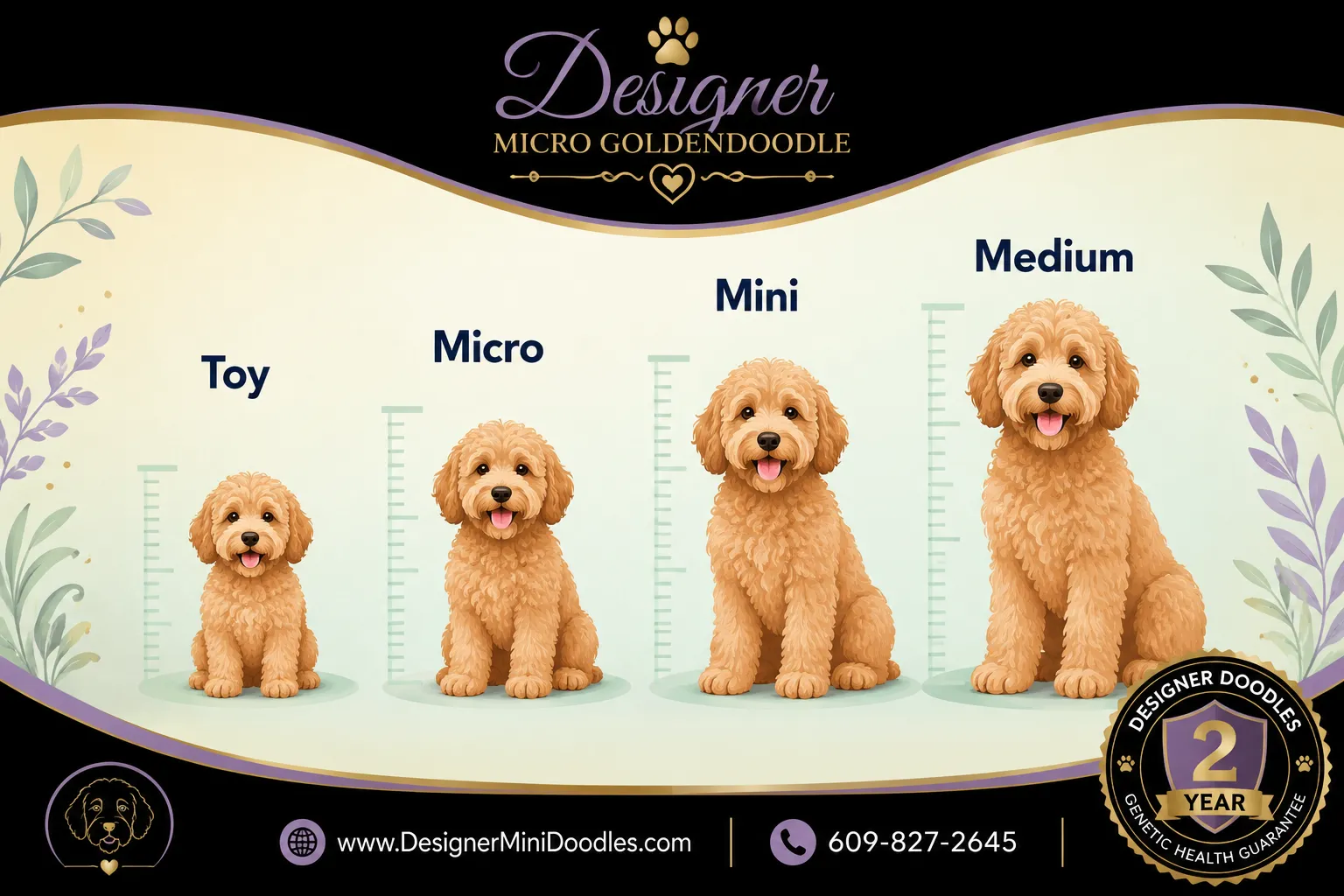
Micro goldendoodle vs mini goldendoodle size difference
The practical difference is about eight to twelve pounds and, more importantly, a different kind of dog to live with. A micro goldendoodle at 13-19 pounds can be lifted with one arm, fits under a Tampa International gate seat in a carrier, and needs less food and less grooming product. A mini at 21-30 pounds is sturdier around rough-and-tumble kids and easier to hike or paddleboard with.

| Size tier | Adult weight | Typical height | Best fit |
|---|---|---|---|
| Toy | 7-11 lb | 10-13 in | Apartment living, seniors, frequent flyers |
| Micro | 13-19 lb | 12-15 in | Condos, small yards, families with school-age kids |
| Mini | 21-30 lb | 15-18 in | Active households, homes with a fenced yard |
| Medium | 35-40 lb | 18-21 in | Larger families, hiking and beach days |
Decision rule: choose a micro if your dog will spend real time in your lap, your car, and on airplanes. Choose a mini if you have toddlers who tumble or you want a jogging partner in cooler months.
A common mistake I see in the Tampa market: buyers assume a puppy that’s small at eight weeks will stay small. It won’t necessarily. Compare the toy, micro and mini goldendoodle sizes and prices side by side before you put down a deposit, then match the tier to your actual home.
How much do micro goldendoodles cost, and what’s the price in Tampa?

Expect $2,500 to $4,500 for a well-bred micro goldendoodle puppy placed in the Tampa Bay area. Price tracks directly to what the breeder invested before the puppy ever met you: genetic panels on both parents, OFA-style orthopedic and eye clearances, veterinary-supervised whelping, and weeks of structured early handling.
Here’s how the market tiers actually break down:
- $500,$1,000: almost always a scam. Stolen photos, fake Tampa addresses, deposits by Zelle or gift card, and a puppy that never ships. If the price feels like a bargain, it is bait.
- $1,000,$1,500: puppy mill or broker resale. No health testing, no socialization, minimal veterinary care, and a high risk of parasites, giardia, or early behavioral problems.
- $1,800,$2,000: hobby breeder. Often well-meaning, but usually no genetic health guarantee, no ENS protocol, and no head start on crate or potty training.
- $2,500,$4,500: accredited breeder. Genetic health guarantee, proper whelping setup, early neurological stimulation, started house breaking and crate training, and lifetime breeder support.
Within that top tier, price moves based on coat color (true reds and merles cost more), sex, adult size projection (smaller usually costs more), and whether ground transport or flight nanny service to Tampa is included.
Budget for ownership too. In the Tampa area, plan on roughly $70,$95 per professional groom every 6-8 weeks, plus food, preventatives, and annual vet care. Grooming is the line item most new owners underestimate.
- Display 9 Products per page
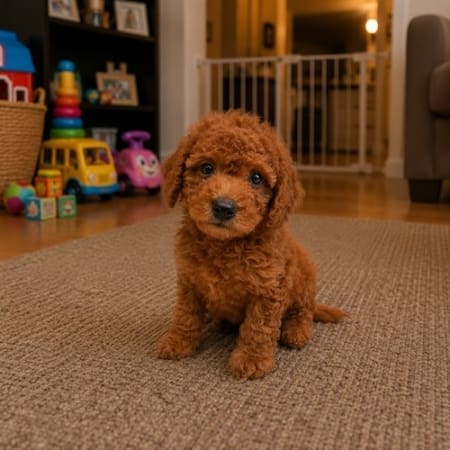
Where to buy micro goldendoodle puppies near me: micro goldendoodle breeders in Tampa, Florida
Start with breeders who publish their health testing, let you see the whelping area or video of it, and can explain their socialization protocol without hedging. Tampa has relatively few dedicated micro programs, so most local families end up working with a Florida-serving breeder that ships or drives puppies into the Tampa, St. Petersburg, and Clearwater area.
Designer Mini Doodles is, in my assessment, the standout in this space and one of the best mini golden doodle breeders in the USA. A few reasons why:
- Real credentials. Designer Toy GoldenDoodles is run by a working animal biologist with a degree in Animal Biology from Stockton University in Pomona, New Jersey, and a minor in animal genetics. That background is why the program’s size and coat predictions hold up generation after generation.
- Top bloodlines. Every one of our micro goldendoodles for sale and all breeding stock trace to proven, health-tested bloodlines, not random small-dog pairings.
- ENS from birth. We begin Early Neurological Stimulation in the first days of life, then layer on gentle handling, novel surfaces, and daily human contact.
- Real-world noise exposure. Puppies grow up inside a busy home with other animals, children, vacuums, doorbells, televisions, and kitchen clatter, so a Tampa thunderstorm or a Bayshore Boulevard jogger doesn’t rattle them.
- Started training. Every puppy leaves with a head start on house breaking and crate training, which shortens the first two weeks at your house dramatically.
For location-specific availability, browse our micro goldendoodle breeders in Florida page or the wider best mini and micro Goldendoodle breeders in Florida directory. Families in Central Florida frequently cross-shop our mini goldendoodle puppies for sale in Orlando listings, which is a 90-minute drive from Tampa.
You can also find us on Google Maps and review our reputation there before reaching out. Separately, if you also breed or own bulldogs, our sister program offers professional French bulldog stud service.
Red flags to walk away from: a “breeder” who won’t do a live video call, refuses to name the veterinary clinic, pressures you to pay by wire or crypto, has puppies available in every color and size at all times, or offers a puppy under eight weeks old.
Are micro goldendoodles good for apartments in Tampa?
Yes. A 13-19 pound micro goldendoodle is one of the better apartment dogs available, and it’s a strong fit for downtown Tampa, Hyde Park, Channelside, and Westshore high-rises. They’re small enough for most weight restrictions, they don’t need a yard, and they’re quiet by nature when their exercise and enrichment needs are met.

What actually determines success in a condo:
- Two walks a day, minimum, ideally early morning and after sunset in summer to avoid hot pavement.
- 10-15 minutes of mental work daily (puzzle feeder, nose games, short training reps). Under-stimulated doodles become barky doodles.
- A crate as a genuine rest space, not a punishment box. This is the single biggest predictor of a calm apartment dog.
- Elevator manners taught early, since a micro can be scooped up if a large dog boards.
Edge case: if you’re gone 10+ hours a day with no midday break, a micro puppy is a poor choice regardless of size. Puppies under six months physically cannot hold a bladder that long. Hire a walker or wait. Our breakdown of why the micro goldendoodle is ideal for apartment and urban living covers the daily routine in more detail.
Do micro goldendoodles shed, and what grooming do they need?
Micro goldendoodles are low-shedding, not non-shedding. Curly and wavy coats trap loose hair instead of dropping it, which means less fur on your sofa but more mats in the coat. Straighter, flatter-coated micros shed noticeably more. Coat type is inherited, so ask the breeder what the parents’ coats look like and how previous litters turned out.
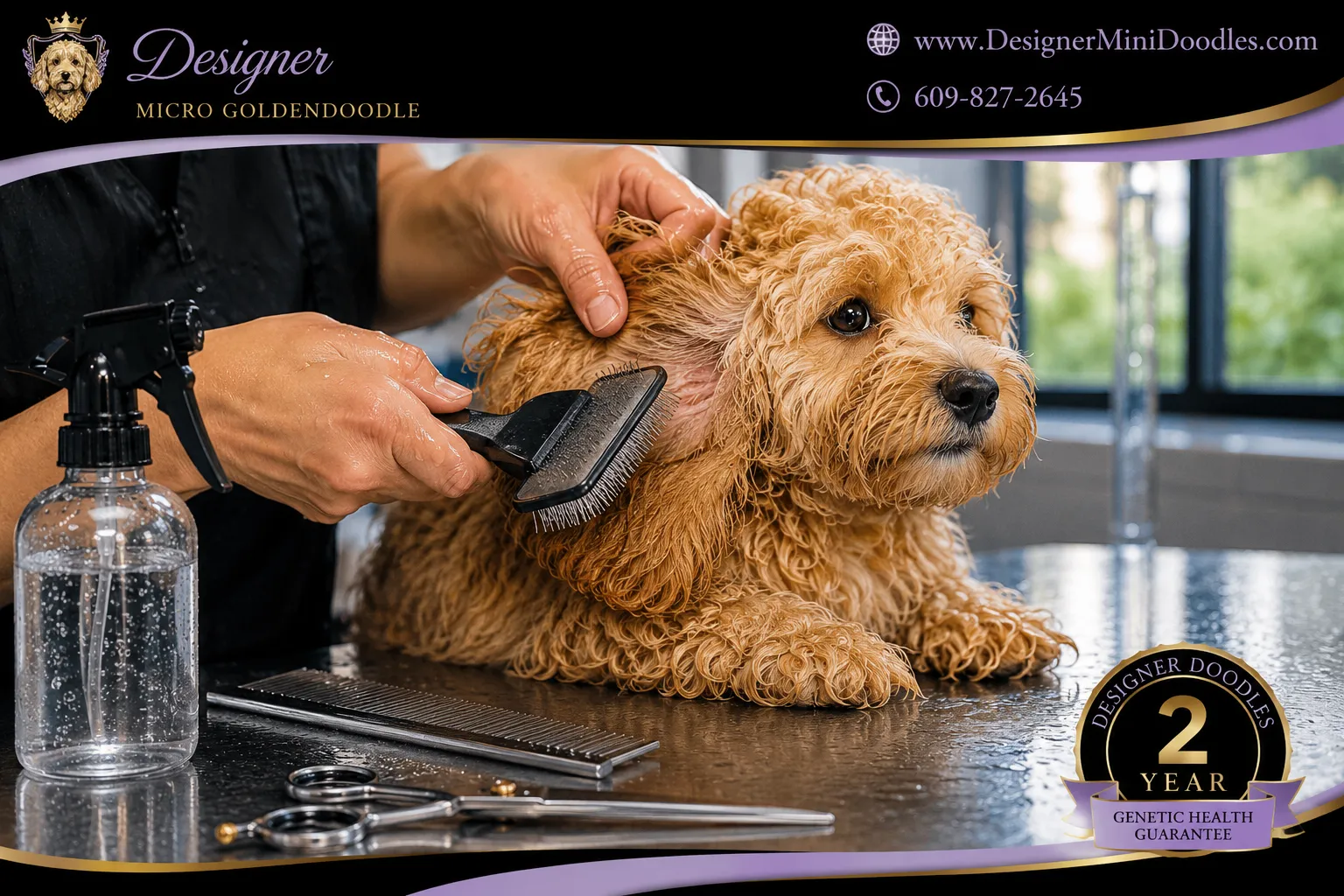
Florida humidity makes grooming harder than it is up north. Damp curls mat faster, and salt or pool water left in the coat forms tight knots behind the ears and under the harness.
A realistic Tampa grooming routine:
- Brush 3-4 times a week with a slicker brush plus a metal comb to check for hidden mats at the skin.
- Professional groom every 6-8 weeks. A shorter “summer teddy” trim of half an inch to one inch is far more comfortable here than a long show coat.
- Dry the coat fully after beach trips, pool time, or rain. Towel, then blow dry on cool.
- Weekly ear check. Floppy, hairy ears plus humidity equals yeast. Clean with a vet-approved solution.
- Nails every 3-4 weeks and daily-ish tooth brushing, since small mouths crowd easily.
Common mistake: brushing only the top of the coat. Mats form at the skin, so part the hair and comb down to it, especially on the legs, armpits, and behind the ears. Our micro goldendoodle grooming and home care guide walks through the tools worth buying.
Low-shedding also does not equal hypoallergenic. Allergic reactions come from dander and saliva proteins, not hair. Most allergy-sensitive families do fine with a curly-coated doodle, but spend time with an adult dog before committing.
What health problems and lifespan should I expect from a micro goldendoodle?
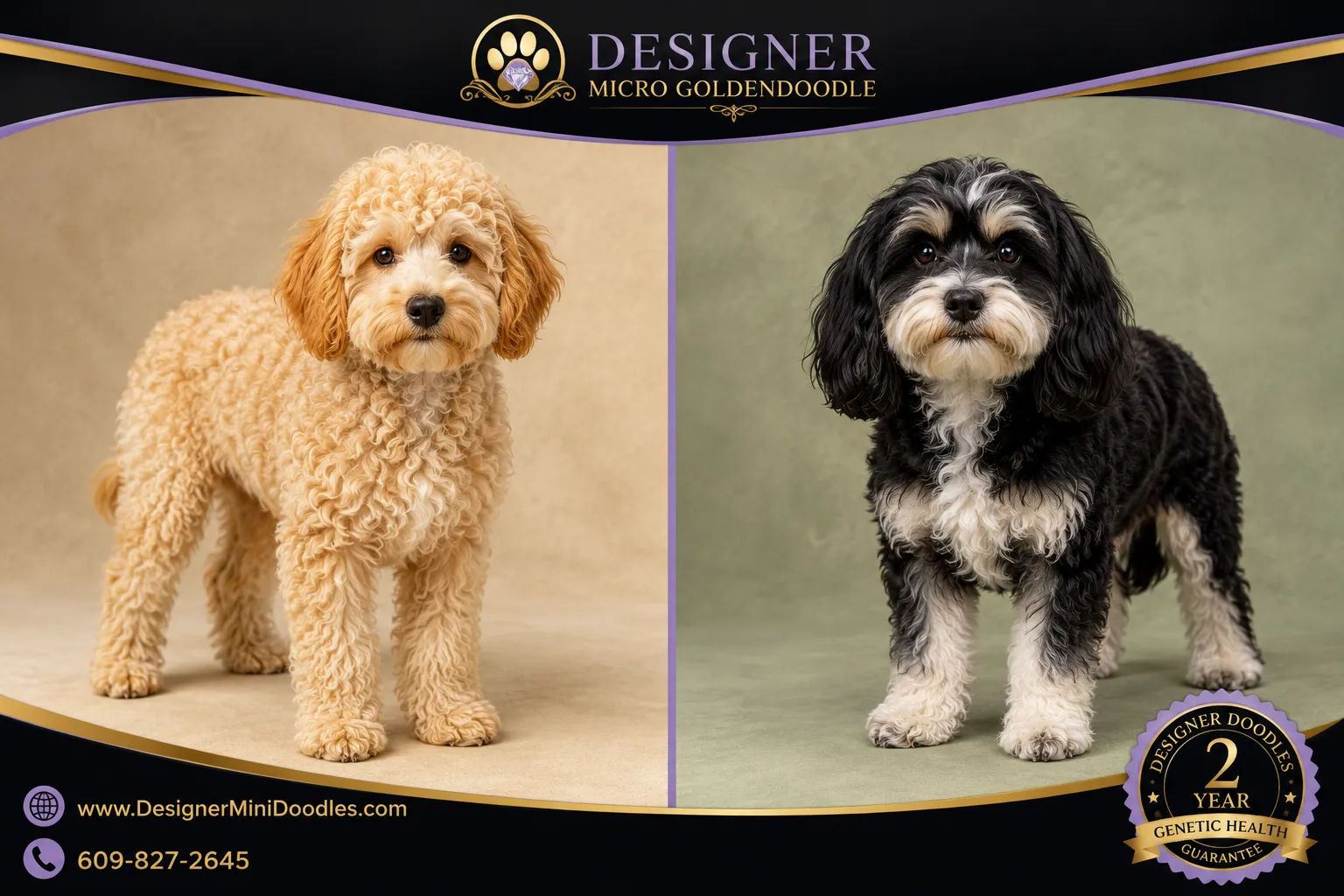
Micro goldendoodles typically live 12 to 16 years, with small size generally correlating to longer life in dogs. The conditions to screen for come from both parent breeds, which is why parental testing matters more than any guarantee written on paper.
Conditions worth asking about directly:
- Patellar luxation (slipping kneecaps), more common in small crosses
- Hip and elbow dysplasia, inherited from the retriever side
- Progressive Retinal Atrophy (PRA) and other inherited eye disease, testable by DNA
- von Willebrand disease, a clotting disorder screened by DNA panel
- Ear infections, largely management-driven and worse in humid climates
- Dental crowding and tartar, standard in dogs under 20 pounds
- Hypoglycemia in very young, very small puppies, which is why reputable breeders won’t release a micro before 8-10 weeks
Ask this exact question: “Can you send me the DNA panel results and orthopedic and eye clearances for both parents, plus your written health guarantee?” A breeder with nothing to hide sends documents within a day.
Tampa-specific note: heartworm prevention is non-negotiable year-round here, and heat intolerance is real. Walk on grass or shaded sidewalks, and test pavement with the back of your hand for seven seconds before heading out in July.
What is a micro goldendoodle’s temperament and behavior like?
Micro goldendoodles are friendly, people-focused, and highly trainable, inheriting the Golden Retriever’s social warmth and the Poodle’s problem-solving drive. They generally do well with children, other dogs, and cats when socialized early. The flip side of that sociability is a low tolerance for being left alone.
What to actually expect day to day:
- Velcro tendencies. They follow you room to room. Great for work-from-home owners, harder for households that are empty all day.
- Fast learners with short attention spans as puppies. Five-minute training sessions beat one long one.
- Sensitive, not stubborn. Harsh corrections shut them down. Reward-based training works far better.
- Separation anxiety risk if crate independence isn’t built deliberately in the first months.
- Moderate energy. They’ll hike or play fetch, then nap on your feet for three hours.

Micro goldendoodle vs cavapoo: which is better?
Neither is objectively better; they suit different households. Choose a micro goldendoodle if you want a more trainable, slightly more athletic dog with a stronger drive to work and play. Choose a cavapoo if you want a calmer lap dog with a lower exercise requirement.
| Factor | Micro Goldendoodle | Cavapoo |
|---|---|---|
| Adult weight | 13-19 lb | 9-18 lb |
| Energy level | Moderate to moderate-high | Low to moderate |
| Trainability | Very high, eager problem solver | High, but softer and less driven |
| Shedding | Low with curly/wavy coat | Low to light |
| Grooming | Every 6-8 weeks, frequent brushing | Every 6-8 weeks, similar upkeep |
| Health watch items | Patellas, hips, eyes | Mitral valve disease, syringomyelia, eyes |
| Best for | Active families, trainers, apartment dwellers who walk daily | Seniors, quieter homes, true lap-dog seekers |
Decision rule: if you plan to do obedience, trick training, or therapy-dog work, the micro goldendoodle is the stronger candidate. If your ideal evening is a dog asleep on the couch with minimal input from you, look at the cavapoo. One health note worth weighing: the Cavalier King Charles Spaniel line carries a well-documented cardiac risk, so cardiac clearances on cavapoo parents deserve extra scrutiny.
What are the best micro goldendoodle puppy training tips?
Start on day one with a crate, a fixed potty schedule, and short reward-based sessions. Puppies from programs that already began house breaking and crate training arrive with a foundation, but the first 14 days in your Tampa home set the habits that stick.

A 14-day starter plan:
- Days 1-3: shrink the world. One room, one crate, leash-led potty trips every 60-90 minutes and immediately after waking, eating, or playing. Reward outside within three seconds of finishing.
- Days 4-7: build crate value. Feed every meal in the crate with the door open, then closed for two minutes, then five. Never open the door while the puppy is crying.
- Days 8-10: name and marker training. Teach the puppy’s name, then “sit” and “come” in 3-minute reps, twice a day.
- Days 11-14: controlled exposure. Elevator rides, tile and metal grates, a car trip, an umbrella opening, a skateboard from a distance. Keep every experience short and positive.
Habits that pay off long term:
- Handling practice. Touch paws, ears, and muzzle daily so grooming isn’t a battle later.
- Alone-time reps from week one: five minutes behind a closed door, building slowly. This prevents separation anxiety far better than treating it after the fact.
- Bite-inhibition redirect. Swap your hand for a chew toy every single time; no scolding required.
- Potty log for the first week. Tracking times reveals the pattern faster than guessing.
Common mistake: free-feeding. A puppy on a schedule potties on a schedule. Two or three measured meals beats a full bowl all day. For more structured enrichment ideas, see our notes on micro goldendoodle training and enrichment.
Because our puppies are raised with ENS and everyday household noise from birth, most families report their micro goldendoodle puppies sleep through the first night in the crate and are largely accident-free within three weeks.
FAQ
How big does a micro goldendoodle get?
A micro goldendoodle typically matures at 13 to 19 pounds and 12 to 15 inches tall. Toy versions run 7 to 11 pounds, minis 21 to 30 pounds, and mediums 35 to 40 pounds.
How much are micro goldendoodle puppies in Tampa?
Expect $2,500 to $4,500 from an accredited breeder with genetic health testing, proper whelping, and started crate and potty training. Prices under $1,500 usually indicate a scam or a puppy mill resale.
Do micro goldendoodles shed?
They shed very little, especially with curly or wavy coats, but they are not non-shedding or truly hypoallergenic. Straight-coated individuals shed noticeably more.
How long do micro goldendoodles live?
Most live 12 to 16 years. Parental health screening for hips, patellas, eyes, and clotting disorders is the strongest predictor of a long, healthy life.
Are micro goldendoodles good for first-time dog owners?
Yes. Their trainability and moderate size make them forgiving for beginners, as long as the owner commits to daily grooming and consistent crate training.
Can micro goldendoodles handle Florida heat?
With management, yes. Walk in early morning and evening, keep a shorter summer trim, provide constant water and shade, and avoid hot pavement between roughly 11 a.m. and 5 p.m.
Are micro goldendoodles allowed in Tampa apartments?
Almost always. At 13 to 19 pounds they fall well under typical 25- to 35-pound weight limits, though some buildings restrict specific breeds or charge pet rent regardless of size.
What generation is best for a micro goldendoodle?
F1BB and F2B crosses give the most predictable small size and the most consistent low-shedding coats, because Poodle genetics are more concentrated in those later generations.
How often do micro goldendoodles need grooming?
Professional grooming every 6 to 8 weeks, plus brushing 3 to 4 times per week at home to prevent mats at the skin.
Should I choose a micro goldendoodle or a mini goldendoodle?
Choose a micro for apartment living, travel, and lap-dog companionship. Choose a mini if you have very young children or want a sturdier hiking and running partner.
Conclusion
Buying a micro goldendoodle in Tampa comes down to three decisions made in order: pick the right size tier for your actual living situation, budget honestly for the $2,500,$4,500 accredited-breeder range, and vet the breeder’s health testing and socialization protocol before you send a dollar.
Your next steps:
- Confirm your size tier. Measure your space and your lifestyle against the 13-19 pound micro range versus the 21-30 pound mini.
- Check your building’s pet policy in writing if you rent in Tampa or St. Pete.
- Request documents from any breeder you contact: parental DNA panels, orthopedic and eye clearances, and the written health guarantee.
- Ask about early handling. Specifically ask whether the program uses ENS and whether crate and house training have started.
- Line up grooming before the puppy arrives. Book a Tampa groomer for the 12-week mark so the first visit is short and positive.
- Review current availability and reach out with your timeline and preferred size range.
Do that homework and you’ll end up with a 15-pound companion that travels well, greets your neighbors politely, and sits at your feet for the next decade and a half.
Sources
- American Kennel Club, “Poodle” and “Golden Retriever” breed standards and health information, akc.org, 2024. https://www.akc.org
- Orthopedic Foundation for Animals, health testing databases and breed screening recommendations, ofa.org, 2024. https://ofa.org
- American Veterinary Medical Association, pet ownership and preventive care guidance, avma.org, 2024. https://www.avma.org