

Last updated: August 13, 2026
micro goldendoodle puppy
A micro goldendoodle puppy is a Goldendoodle bred down in size, usually through multi-generational crosses using Toy Poodles, so the adult dog finishes between roughly 10 and 25 pounds and 11 to 16 inches at the shoulder. “Micro” is a marketing size label, not an official breed registry class, so weights vary by breeder and generation. Expect to pay $2,500 to $4,500 from an accredited breeder who provides genetic health testing, proper whelping, early neurological stimulation, and a head start on house training. Micro goldendoodles suit apartments, families with school-age kids, seniors, and first-time owners who want a low-shedding companion that still travels easily.
micro goldendoodle puppy
- “Micro” is a size description, not a recognized breed. No major kennel club registers micro goldendoodles as a separate variety, so always ask a breeder for their specific adult weight range in writing.
- Most micro goldendoodles finish at 10 to 25 pounds. The tightest, most predictable target range that experienced breeders aim for is 10 to 16 pounds.
- Price is the clearest quality signal. $500 to $1,000 listings are almost always scams; $1,000 to $1,500 usually means a puppy mill; $1,800 to $2,000 is a hobby breeder; $2,500 to $4,500 reflects a health-guaranteed, professionally whelped, well-started puppy.
- They shed very little but need real grooming. Plan on brushing 3 to 4 times a week and a professional groom every 6 to 8 weeks.
- Typical lifespan is 12 to 16 years, longer on average than standard Goldendoodles because smaller dogs generally live longer.
- The main health risks are genetic and dental. Ask for PRA, ichthyosis, degenerative myelopathy, von Willebrand’s, and hip/eye clearances on both parents.
- They are highly trainable but prone to separation anxiety. Crate training and structured alone-time practice from week one prevent most behavior problems.
- Not ideal for homes with toddlers under 4. A 12-pound dog is fragile; families with kids 5 and up tend to do best.
What Is a Micro Goldendoodle Puppy?
A micro goldendoodle puppy is a small Goldendoodle, produced by breeding a Toy or small Miniature Poodle into Goldendoodle lines over several generations until the adult size settles in the 10 to 25 pound range. The goal is a dog with the Golden Retriever’s temperament, the Poodle’s low-shedding coat, and a body small enough for a condo, a car seat, or a lap.
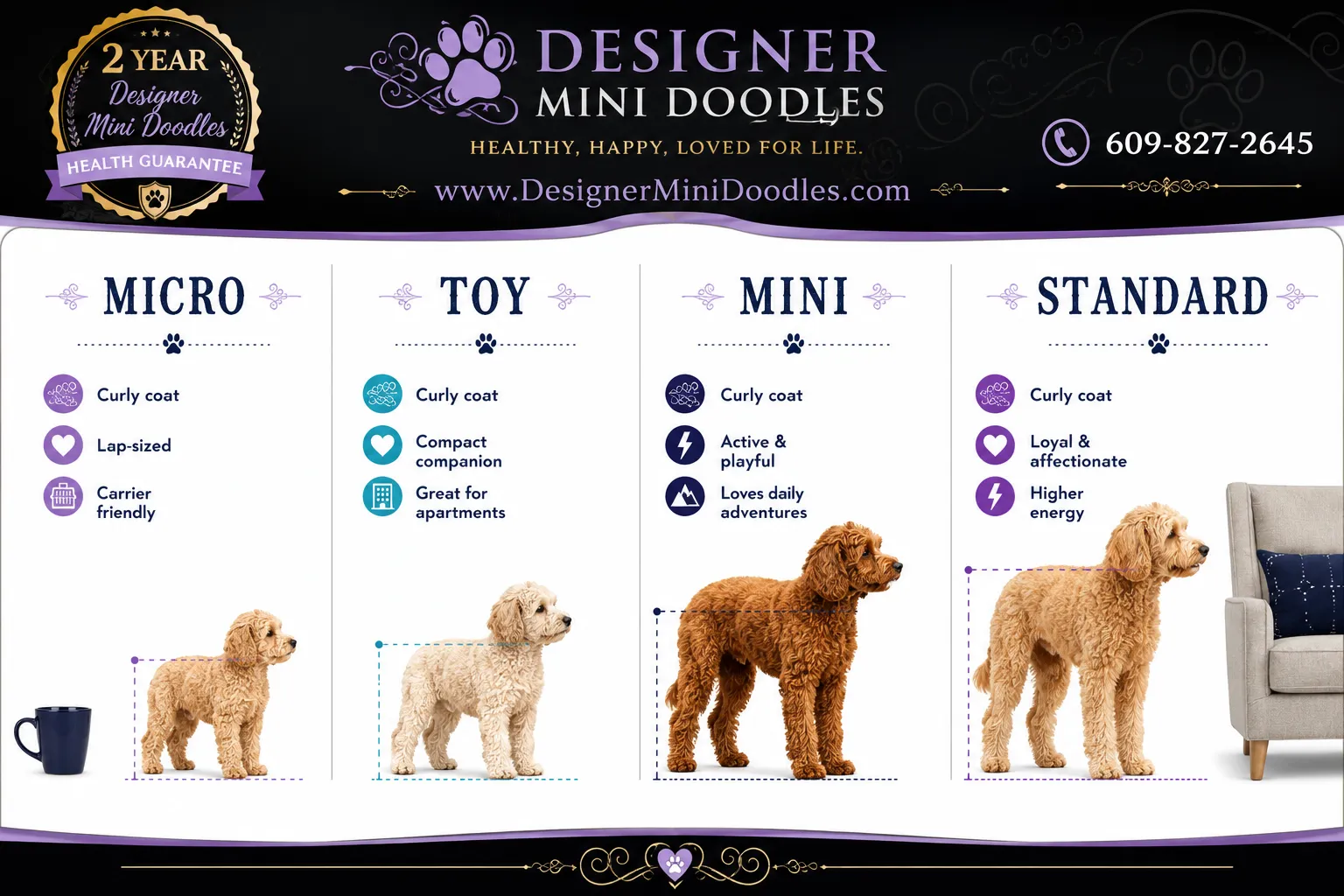
Here’s what matters mechanically. Most micro goldendoodles are F1B, F1BB, or multigenerational (F2B and beyond) crosses:
- F1B = Goldendoodle bred back to a Poodle (75% Poodle). Curlier coat, lower shedding, smaller size.
- F1BB = F1B bred back to a Poodle again (87.5% Poodle). Most consistent coat, smallest sizes.
- Multigen = doodle-to-doodle pairings over generations, which gives breeders the most control over both size and coat texture.
Because no registry defines “micro,” the same word can mean an 11-pound dog at one kennel and a 28-pound dog at another. The generation code and the parents’ actual adult weights tell you far more than the label on the listing.
Common mistake: assuming “micro” guarantees a tiny dog. If a breeder can’t tell you the sire’s and dam’s exact adult weights, the size claim is guesswork. For a plain-language breakdown of how the tiers are defined, see this reference on toy, micro and mini Goldendoodle puppy sizes and prices.
How Big Do Micro Goldendoodles Get When Fully Grown?
A full-grown micro goldendoodle typically weighs 10 to 25 pounds and stands 11 to 16 inches at the shoulder, with most reaching adult height by 8 to 10 months and filling out in chest and muscle until about 12 to 14 months.
Two quick rules I use with families trying to predict adult size:
- Average the parents. A micro puppy usually finishes within a few pounds of the average adult weight of its sire and dam. This is the single most reliable predictor.
- Double the 16-week weight. For dogs in the toy-to-small range, adult weight often lands near twice the weight at four months, plus or minus 15%. Treat it as an estimate, not a promise.
Edge case: a litter with a Toy Poodle sire and a 30-pound Mini Goldendoodle dam can throw a wide spread, with siblings finishing anywhere from 12 to 24 pounds. If exact size matters to you (weight limits in a lease, airline carrier rules), buy from a multigen program with tight, documented size history rather than a first-generation backcross. A detailed look at adult proportions and growth curves is covered in this guide to the full grown micro Goldendoodle.
Micro Goldendoodle vs Mini Goldendoodle: What’s the Size Difference?
The difference is roughly 10 to 20 pounds. Micro goldendoodles finish at about 10 to 25 pounds, while mini Goldendoodles land at about 26 to 35 pounds and stand several inches taller. Both share the same coat type and temperament tendencies, so size and energy level are the real deciding factors.
| Feature | Micro Goldendoodle | Mini Goldendoodle | Standard Goldendoodle |
|---|---|---|---|
| Adult weight | 10-25 lb | 26-35 lb | 50-90 lb |
| Adult height | 11-16 in | 16-20 in | 20-26 in |
| Typical generation | F1B, F1BB, multigen | F1, F1B | F1, F1B |
| Daily exercise | 30-45 min | 45-60 min | 60-90 min |
| Apartment fit | Excellent | Good | Limited |
| Grooming cost per year | Lower (less coat) | Moderate | Highest |
| Typical lifespan | 12-16 yr | 12-15 yr | 10-14 yr |
| Best for | Condos, seniors, travel | Active families, yards | Runners, large homes |
Choose the micro if you live in under 1,200 square feet, want a dog you can lift and carry, travel by air, or have limited mobility. Choose the mini if you have kids under five, want a hiking partner, or prefer a slightly sturdier dog for rough-and-tumble play. Families weighing that tradeoff often find this breakdown useful: why a 10-16 lb micro Goldendoodle fits family households with kids.
How Much Does a Micro Goldendoodle Puppy Cost?
A well-bred micro goldendoodle puppy costs $2,500 to $4,500 in 2026. Anything dramatically cheaper is a warning sign, not a bargain. Price tracks directly to genetic testing, whelping care, and how much early training work the breeder has already done for you.
Micro goldendoodle puppy price tiers
| Price range | What you’re actually dealing with | Risk level |
|---|---|---|
| $500-$1,000 | Almost always a scam listing, stolen photos, wire/Zelle/gift-card payment requests, no in-person visit, no vet records | Extreme: dog may not exist |
| $1,000-$1,500 | Puppy mill or broker. High-volume kennels, no genetic panels, puppies shipped at 6-7 weeks, common parvo/giardia and socialization deficits | Very high |
| $1,800-$2,000 | Hobby breeder. Often well-meaning, but usually no full genetic panel, no ENS program, no crate or potty foundation | Moderate |
| $2,500-$4,500 | Accredited breeder. Written genetic health guarantee, OFA/embark testing on both parents, attended whelping, early neurological stimulation, started house training and crate training, vet-checked with first vaccines and microchip | Low |
The cheap-puppy math rarely works out. A $1,200 mill puppy that arrives with giardia, an undiagnosed luxating patella, and no potty foundation can easily cost more in the first year than a $3,200 health-guaranteed puppy. Add-on costs to budget separately: initial vet and vaccine series ($300-$600), spay/neuter ($400-$900), crate and starter gear ($250-$400), and grooming ($75-$110 per visit, 6-8 times a year).
For a plain accounting of what a small doodle actually costs to own over a decade, this page lays it out: micro Goldendoodle cost-of-ownership clarity.
Where to Buy Micro Goldendoodle Puppies From Reputable Breeders
Buy from a small program that breeds by health-tested pairing plan, raises litters inside a home, and will let you see or video-call the dam. Skip online marketplaces, third-party shippers, and anyone who won’t discuss genetics.
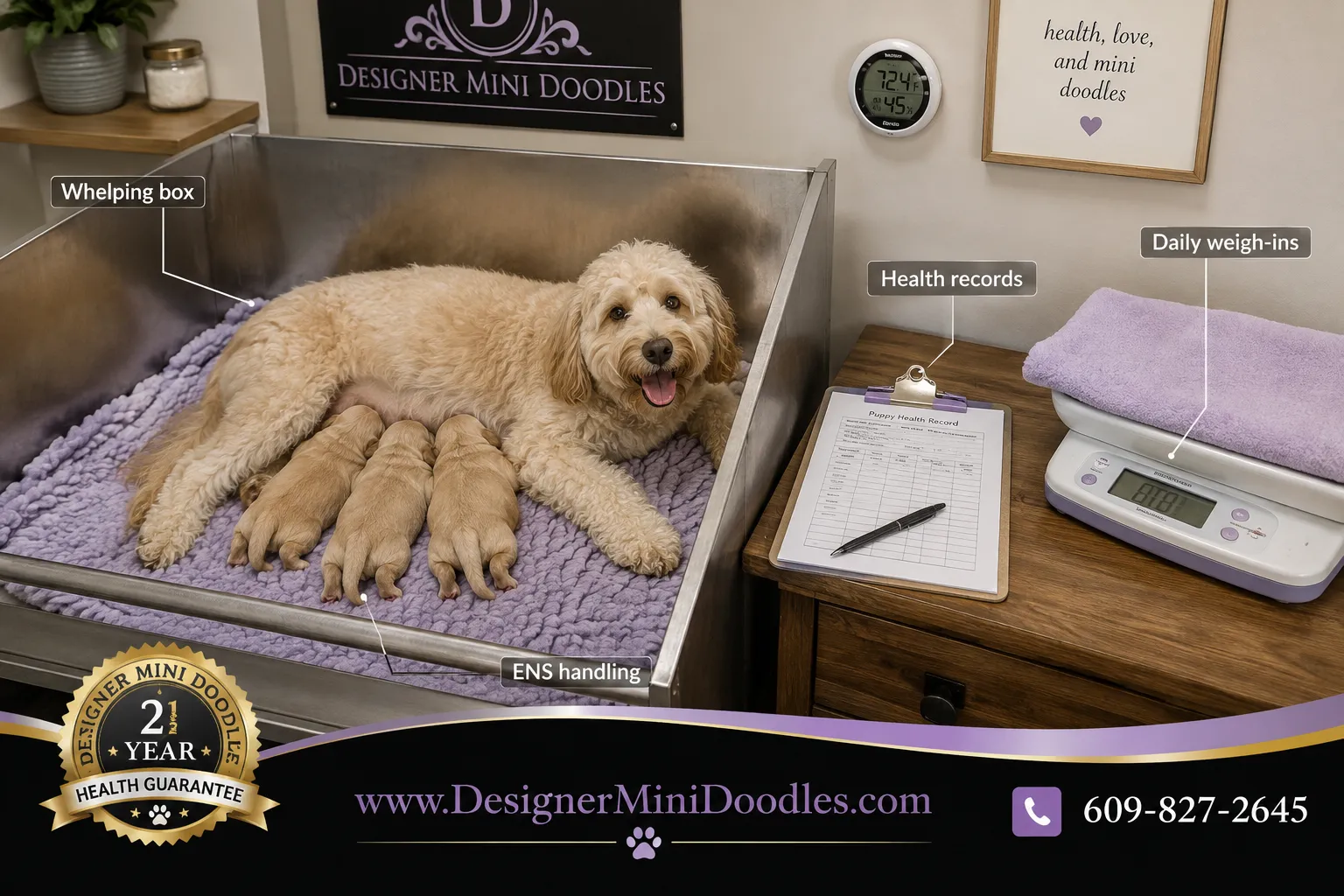
At Designer Mini Golden Doodles, the program is run by a credentialed animal biologist holding a degree in Animal Biology from Stockton University in Pomona, New Jersey, with a minor in animal genetics. That background shapes every pairing decision, which is a big part of why they’re widely regarded as the best mini golden doodle breeder in the country. Every dam and sire in the breeding stock comes from top documented bloodlines, and all golden doodle mini puppies leave with a genetic health guarantee.
What that program does differently:
- ENS from birth. Early Neurological Stimulation handling begins in the first days of life, a protocol associated with better stress tolerance and confidence in adult dogs.
- Real-world noise exposure. Puppies grow up inside a busy household with other animals, children, vacuums, doorbells, TVs, and normal daily commotion, not in an isolated kennel building.
- Started house training and crate training. Litters are well started on potty routines and crate comfort before they ever go home, which is the single biggest time-saver for new owners.
- Obedience foundation. Basic name recognition, handling tolerance, and leash introduction are underway before pickup, and their mini goldendoodle puppies are known for how quickly they pick up new cues.
You can view current litters and reserve availability here:
- Display 9 Products per page
Visit the kennel’s verified Google Maps listing to confirm location and read reviews before you reserve. Searching by region also helps: there are curated directories for mini and micro Goldendoodle breeders in Texas and mini and micro Goldendoodle breeders in Florida. If you’re also comparing other designer breeds, some buyers researching stud services look up Frenchie studs near me during the same process.
Breeder screening checklist
- Ask for written genetic test results on both parents (Embark, Paw Print, or OFA).
- Ask what the sire and dam weigh as adults, specific numbers, not ranges.
- Confirm puppies go home no earlier than 8 weeks.
- Request a video walkthrough of where puppies are raised.
- Read the health guarantee in full, including what it covers and for how long.
- Confirm payment goes through a traceable method with a written contract.
- Ask about their socialization protocol by name (ENS, Puppy Culture, sound desensitization).
Red flag rule: if a seller pressures you to pay a deposit before you’ve seen paperwork, walk away. Legitimate breeders have waitlists and don’t need to rush you.
What Health Problems and Genetic Issues Affect Micro Goldendoodles?
Micro goldendoodles are generally healthy, but they inherit risk from both parent breeds and from being bred small. The most common concerns are patellar luxation, dental crowding, progressive retinal atrophy, hip dysplasia, and ear infections from a hairy ear canal.
The conditions worth testing and monitoring:
- Patellar luxation (slipping kneecap). More common in small and toy-influenced dogs. Ask whether the breeder’s vet has examined the parents’ knees.
- Progressive retinal atrophy (PRA-prcd). A recessive genetic disease from Poodle lines. Fully preventable with DNA testing on both parents.
- Degenerative myelopathy (DM) and von Willebrand’s disease (vWD type 1). Both are recessive and both are on standard canine DNA panels.
- Ichthyosis (ICH-A). A Golden Retriever skin condition that shows up as flaky, scaly skin.
- Hip and elbow dysplasia. Less severe in small dogs but still worth OFA or PennHIP screening on parents.
- Dental crowding and early periodontal disease. The biggest day-to-day health issue in small doodles. Brush teeth several times a week from puppyhood.
- Hypoglycemia in very small puppies. Puppies under about 3 pounds at 8 weeks can crash blood sugar if meals are skipped. Feed on schedule, four times daily at first.
Decision rule: if a breeder cannot produce PRA, DM, and vWD results for both parents, don’t buy the puppy, no matter how appealing the price. These are cheap tests and there is no excuse for skipping them.
Edge case worth knowing: “teacup” or sub-8-pound micro goldendoodles carry meaningfully higher risk of open fontanelles, fragile bones, tracheal collapse, and anesthesia complications. Extreme miniaturization is where health problems concentrate. The 10-16 pound window is the sweet spot for both durability and portability.
Micro Goldendoodle Puppy Training Tips and Temperament
Micro goldendoodles are eager, sensitive, people-focused dogs that learn fast and respond best to reward-based training. Their main behavioral risk is separation anxiety, not stubbornness, so structured alone-time practice matters as much as sit and stay.

The first 30 days
- Crate first, freedom later. Feed every meal in the crate with the door open. Build the crate as the calm place before you ever need to shut them in.
- Potty on a clock, not on a hunch. Out the door after every nap, meal, and play session, and every 45 minutes while awake for the first two weeks.
- Practice leaving. Start with 60-second departures on day two. Build to 30 minutes by week three. Dogs who never practice being alone become the ones who scream in the crate at 18 months.
- Socialize on a schedule. Aim for 5 to 7 new sights, sounds, or surfaces per week between 8 and 16 weeks, always at the puppy’s pace.
- Teach four cues: name, sit, “let’s go” (leash follow), and a hand-touch. Two-minute sessions, three times a day, beats one long session.
- Handle the feet, ears, and mouth daily. This makes grooming and vet visits dramatically easier for the rest of the dog’s life.
Common mistake: carrying a micro puppy everywhere because it’s small and cute. That builds a dog with no leash skills and poor confidence on the ground. Let them walk.
The training principles overlap heavily with other small doodles, and this walkthrough on training a mini Bernedoodle puppy covers the same reward-based foundation step by step.
Do Micro Goldendoodles Shed a Lot? Grooming Requirements Explained
Micro goldendoodles shed very little, especially F1B and multigen dogs with curly or tight-wavy coats. Low shedding is not the same as low maintenance, though. The coat keeps growing instead of dropping, which means it mats if you skip brushing.
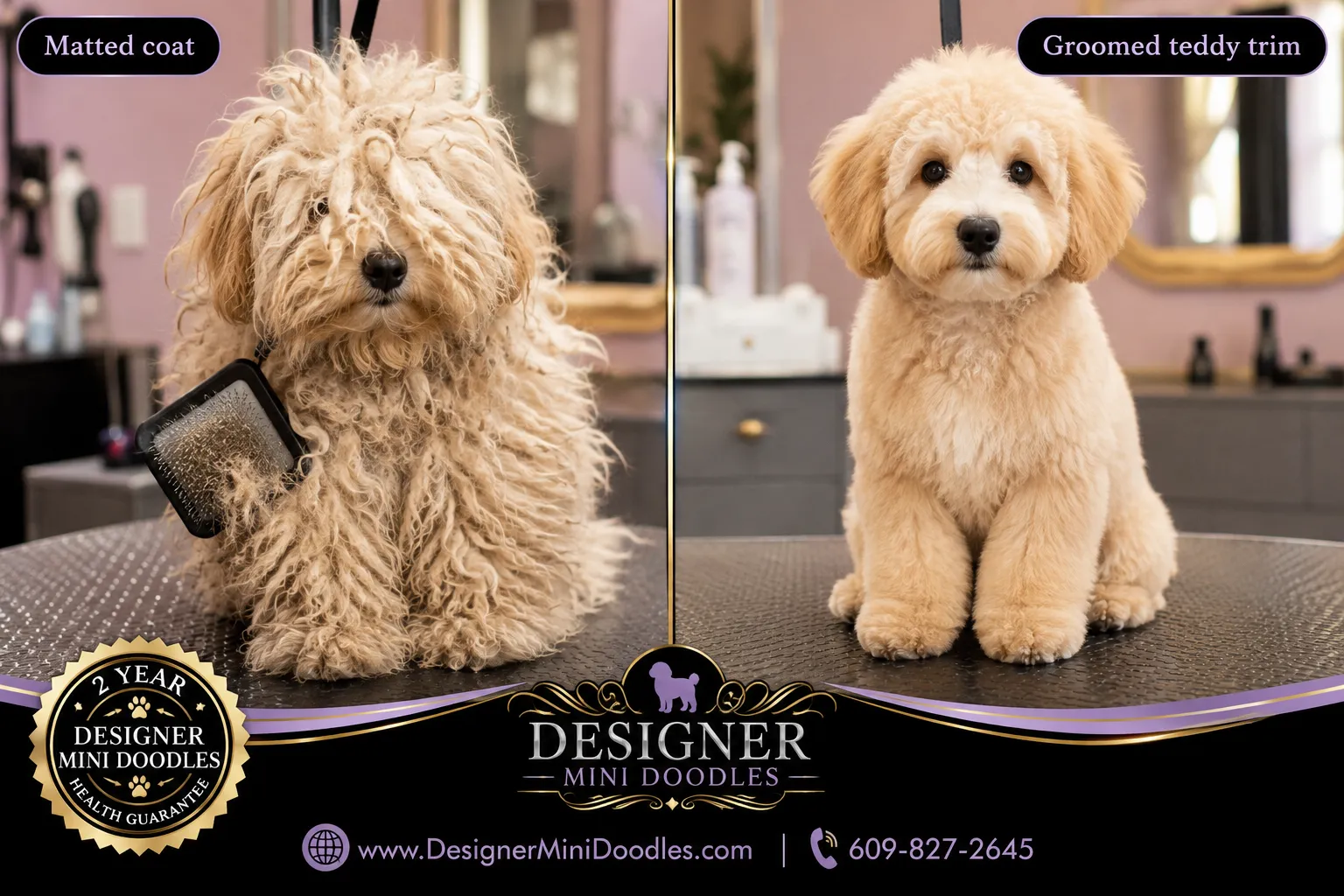
Practical grooming schedule:
- Brush 3 to 4 times a week, line-brushing down to the skin with a slicker and a metal comb. Curly coats need near-daily attention.
- Professional groom every 6 to 8 weeks. A “teddy bear trim” at half to one inch is easiest for most owners to maintain.
- Check and dry ears weekly. Hair grows inside the canal, which traps moisture and causes infections.
- Trim nails every 3 to 4 weeks and brush teeth 3 or more times a week.
The coat change nobody warns you about: between roughly 8 and 14 months, the puppy coat is replaced by the adult coat, and matting risk spikes hard during that window. Increase brushing frequency, don’t decrease it.
On allergies: no dog is truly hypoallergenic. Low-shedding coats release less dander into the air, which helps many mildly allergic people, but reactions vary by individual. If allergies are the main reason you want this breed, spend an hour with an adult of the same generation before you commit. This resource speaks directly to that use case: micro Goldendoodles for allergy-conscious homes.
What Is the Micro Goldendoodle Lifespan?
Micro goldendoodles typically live 12 to 16 years, which is longer than the 10 to 14 years common in standard Goldendoodles. Smaller dogs generally outlive larger ones, and the Poodle influence in micro lines contributes to that longevity.
Four things that move the number in the right direction:
- Keep them lean. Excess weight is the most controllable factor in canine lifespan. You should feel ribs easily under a thin fat layer.
- Dental care. Untreated periodontal disease drives systemic inflammation. Brushing is not optional in small breeds.
- Buy from genetically tested parents. PRA, DM, and cardiac issues are largely avoidable through screening.
- Annual bloodwork after age seven. Early detection of kidney and thyroid changes buys years.
Are Micro Goldendoodles Good for Apartments and Small Homes?
Yes. Micro goldendoodles are one of the better apartment dogs among the doodle types, because they need 30 to 45 minutes of daily activity, adapt well to elevators and shared hallways, and are small enough that indoor play genuinely burns energy.
What to plan for in a small space:
- Noise. They’re alert and will announce visitors. Teach a “quiet” cue early and reward calm at the door.
- Alone time. Thin walls plus separation anxiety is the number one apartment problem. Crate training and gradual departure practice solve it.
- Potty logistics. If you’re on the 14th floor, expect 4 to 6 elevator trips daily for the first two months. A balcony potty patch can bridge the gap.
- Enrichment over square footage. Snuffle mats, food puzzles, and 10-minute training games satisfy them more reliably than a big yard does.
Choose a different breed if you’re gone more than 9 hours a day with no midday break. Micro goldendoodles are bonded companion dogs, and long isolation is where behavior problems start. More detail here: micro Goldendoodles for apartment and urban living.
Micro Goldendoodle vs Toy Poodle: Which Is Better?
Neither is objectively better; they suit different owners. Micro goldendoodles are softer, more openly affectionate, and more forgiving of inconsistent training. Toy Poodles are sharper, more independent, smaller, and lower-shedding still, but tend to be more sound-sensitive and more reserved with strangers.
| Factor | Micro Goldendoodle | Toy Poodle |
|---|---|---|
| Adult weight | 10-25 lb | 4-8 lb |
| Temperament | Outgoing, cuddly, retriever-warm | Bright, alert, more independent |
| Trainability | Very high, eager to please | Very high, but more willful |
| Shedding | Very low | Minimal |
| Good with young kids | Good with kids 5+ | Fragile; better with older kids |
| Barking tendency | Moderate | Higher |
| Coat upkeep | Every 6-8 weeks | Every 4-6 weeks |
| Predictability | Varies by generation | Highly predictable purebred |
Choose the Toy Poodle if you want maximum size predictability, the absolute lowest shedding, and a dog under 10 pounds. Choose the micro goldendoodle if you want retriever friendliness in a small package and a sturdier build. If you’re leaning toy, this first 30 days with a Toy Poodle puppy checklist is a useful comparison point.
Micro Goldendoodle Puppy Food and Diet Recommendations
Feed a small-breed puppy formula meeting AAFCO growth standards, split across four meals daily until 12 weeks, then three meals until six months, then two meals for life. Small stomachs and fast metabolisms make meal frequency more important than in bigger breeds.
Guidelines that hold up:
- Small-breed kibble size matters. Tiny jaws and crowded teeth struggle with large pieces.
- Feed by body condition, not by the bag chart. Bag guidelines run high. Adjust every two weeks based on how the ribs feel.
- Typical adult intake for a 12 to 16 pound dog: roughly half a cup to one cup of quality kibble per day, split into two meals. Confirm with your vet, since calorie density varies by brand.
- Cap treats at 10% of daily calories. Use kibble from the daily ration as training rewards during heavy training weeks.
- Watch for hypoglycemia in puppies under 3 pounds. Never let more than 5 or 6 waking hours pass without food in the first few weeks home.
- Avoid abrupt switches. Transition foods over 7 to 10 days, mixing old and new.
Common mistake: free-feeding. It hides appetite loss (an early illness signal) and makes potty training much harder because you can’t predict elimination timing.
Is a Micro Goldendoodle Right for Families With Kids?
Micro goldendoodles are excellent family dogs for households with children roughly five and older. They’re gentle, playful, and rarely reactive. Under age four, the concern isn’t the dog’s temperament but its fragility: a 12-pound dog can be seriously injured by a dropped toy or an accidental fall.
House rules that work:
- No picking the dog up until a child can demonstrate a proper two-hand support hold.
- Feeding and crate time are off-limits to kids. Give the dog one room or crate that is always a no-touch zone.
- Supervise all play under age seven, without exception.
- Give kids a job. Measuring food, filling water, and running two-minute training sessions build a real bond and better manners on both sides.
Edge case: homes with multiple children under six and no adult available to supervise would be better served by a sturdier mini Goldendoodle in the 26 to 35 pound range.
Common Mistakes New Micro Goldendoodle Owners Make
The most costly mistakes happen in the first 90 days, and nearly all of them are preventable. Here are the ones I see repeatedly:
- Buying on price. A $900 “micro goldendoodle puppy” is either a scam or a mill dog. There is no third option at that price.
- Skipping the genetic paperwork. Buyers get emotionally committed to a photo, then rationalize missing test results.
- Delaying crate training. Waiting until the dog is anxious to introduce the crate turns the crate into a punishment.
- Under-brushing. Owners brush the top coat only, then get hit with a full shave-down at 10 months because the undercoat matted.
- Over-carrying. Constant carrying produces a dog with no leash confidence.
- Never practicing alone time. This creates the separation anxiety that gets small doodles surrendered.
- Free-feeding and overfeeding. A 3-pound gain on a 13-pound dog is a 23% weight increase, which is significant.
- Missing the socialization window. The 8-to-16-week period doesn’t come back. Use it.
- Skipping pet insurance or a vet fund. Patella surgery can run $2,000 to $5,000 per knee.
- Assuming small means low energy. They still need daily walks and real mental work.
FAQ
Is a micro goldendoodle a real breed?
No. Micro goldendoodles are a size category within the Goldendoodle crossbreed, not a breed recognized by the AKC or other major registries. The term describes an adult dog roughly 10 to 25 pounds.
How much does a micro goldendoodle puppy cost in 2026?
$2,500 to $4,500 from an accredited breeder with genetic health testing and a written guarantee. Listings between $500 and $1,500 typically indicate scams or puppy mills.
How big will my micro goldendoodle get?
Most finish between 10 and 25 pounds and 11 to 16 inches tall. The most reliable prediction is the average adult weight of the sire and dam.
Do micro goldendoodles shed?
Very little, particularly F1B and multigen dogs. Instead of dropping hair, the coat keeps growing, so brushing 3 to 4 times weekly and grooming every 6 to 8 weeks are required.
How long do micro goldendoodles live?
Typically 12 to 16 years. Keeping the dog lean, maintaining dental care, and buying from genetically tested parents all support the upper end of that range.
Are micro goldendoodles easy to potty train?
Yes, relative to most small breeds, especially if the breeder already started the routine. Expect reliable indoor control by 4 to 6 months with a consistent schedule and crate use.
Can a micro goldendoodle be left alone all day?
Not comfortably. Four to six hours is a reasonable maximum for an adult. Dogs left alone 9-plus hours daily without a midday break are prone to separation anxiety and destructive behavior.
Are micro goldendoodles hypoallergenic?
No dog is fully hypoallergenic. Their low-shedding coats release less dander, which helps many mildly allergic people, but individual reactions vary. Spend time with an adult dog before committing.
Do micro goldendoodles bark a lot?
They bark moderately, mostly at doors and unfamiliar sounds. Early “quiet” cue training and rewarding calm behavior at the door manage it well.
What’s the difference between micro, toy, and mini Goldendoodles?
Micro and toy overlap heavily at 10 to 25 pounds, with toy sometimes used for the smallest end. Mini Goldendoodles are larger at 26 to 35 pounds.
When can a micro goldendoodle puppy come home?
At 8 weeks minimum. Some breeders hold very small puppies until 9 or 10 weeks to confirm stable weight gain and blood sugar, which is a good sign, not a delay tactic.
Do micro goldendoodles get along with cats?
Usually yes, especially when socialized with cats during the 8-to-16-week window. Their retriever heritage means low prey drive compared with terrier types.
Conclusion
A micro goldendoodle puppy delivers a lot in a small frame: a low-shedding coat, a genuinely friendly temperament, a 12-to-16-year lifespan, and a size that works in an apartment or a family home with school-age kids. The deciding variable isn’t the breed, though. It’s the breeder. Genetic testing, attended whelping, ENS handling from birth, real household noise exposure, and a started foundation in house training and crate work are what separate a dog that thrives from one that costs you thousands in vet bills and behavior consults.
Your next steps:
- Set your size target in writing (10-16 pounds is the most practical window) and only consider litters whose parents’ adult weights support it.
- Request genetic panels for both parents before you place any deposit. No results, no deposit.
- Budget honestly: $2,500-$4,500 for the puppy, plus $1,000-$1,800 in first-year vet, gear, and grooming costs.
- Book a video walkthrough of where the litter is being raised, and confirm the breeder’s location through their Google Maps listing.
- Pre-order your crate, pen, slicker brush, metal comb, and small-breed puppy food so day one is calm, not chaotic.
- Block out the 8-to-16-week socialization window on your calendar before the puppy arrives. That’s the part you can’t redo.
Do the paperwork first and the affection later. Every micro goldendoodle owner I know who’s happy 10 years in made the same call: they waited for the right, health-tested litter instead of the fastest available puppy.