

micro goldendoodle Virginia
Last updated: August 12, 2026
A 15-pound dog can carry the same personality as a 60-pound one, and that single fact explains why the micro goldendoodle Virginia market has exploded from Alexandria condos to Roanoke farmhouses. Buyers in the Commonwealth are no longer asking “goldendoodle or not?” They’re asking which size fits a third-floor walkup, a Metro commute, or a retirement townhome in Williamsburg. I’ve spent years watching families make this decision, and the ones who end up happiest are the ones who understood the weight ranges and the breeder tiers before they ever put down a deposit.
micro goldendoodle Virginia
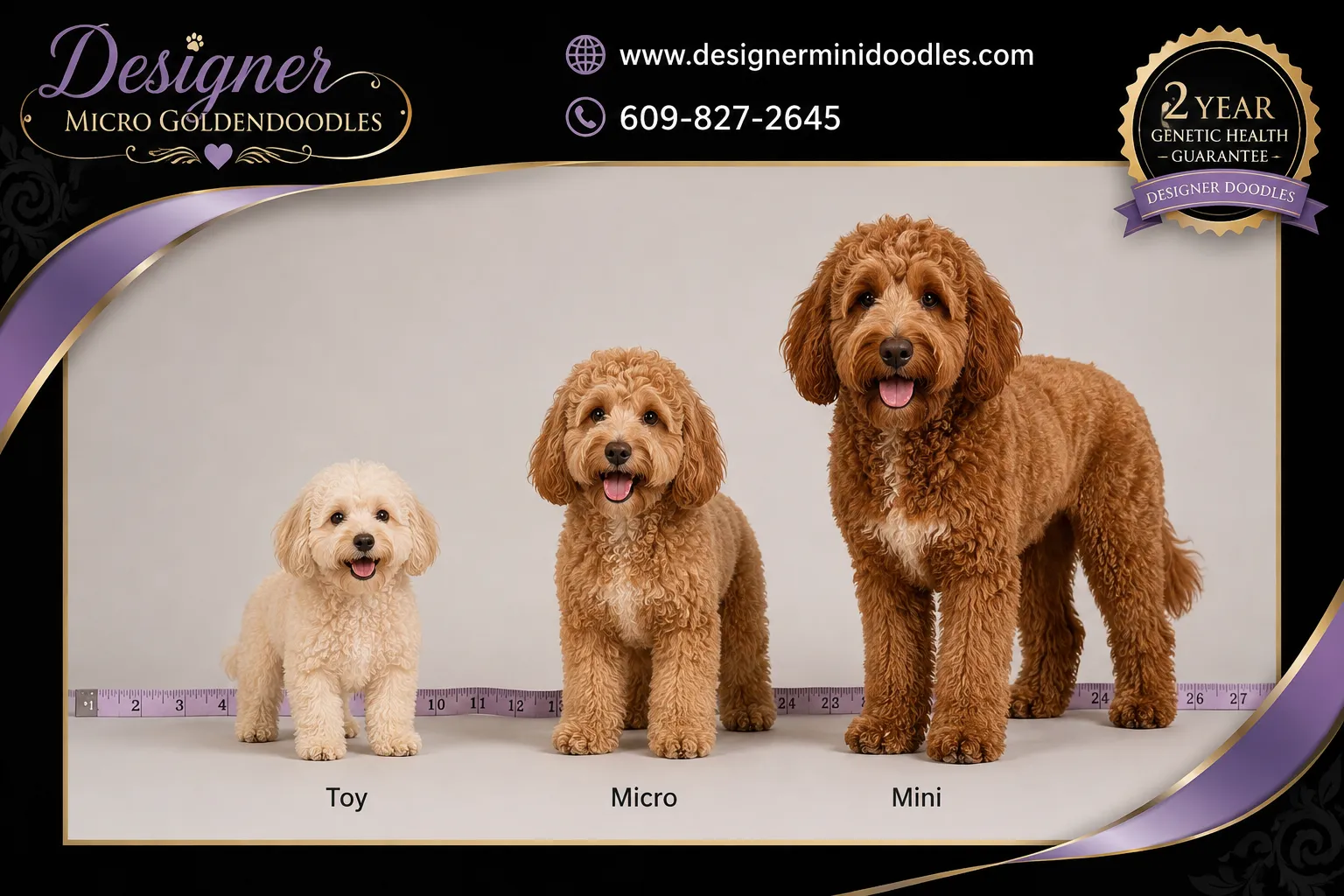
A micro goldendoodle is a small golden retriever and poodle cross that typically matures at 13 to 19 pounds and 12 to 16 inches tall, sitting between the toy (7-11 lbs) and mini (21-30 lbs) sizes. In Virginia, well-bred micro goldendoodle puppies from an accredited program with genetic health testing, a written health guarantee, early housebreaking, and crate training generally cost $2,500 to $4,500. Prices under $1,500 are a strong warning sign of a scam or puppy mill, and legitimate breeders accept credit cards rather than Zelle or Cash App.
Key Takeaways
- Micro goldendoodles mature around 13-19 lbs; minis run 21-30 lbs, toys 7-11 lbs, and mediums 35-40 lbs.
- Expect to pay $2,500,$4,500 in Virginia for a health-guaranteed, well-started micro goldendoodle puppy.
- Listings at $500,$1,000 are almost always scams; $1,000,$1,500 typically signals puppy mill or broker sourcing.
- Pay by credit card, never by Zelle, Venmo, Cash App, wire, or gift card.
- Most micro goldendoodles are low-shedding, not non-shedding, and need brushing several times a week plus grooming every 6-8 weeks.
- They adapt well to apartments in Arlington, Richmond, and Norfolk because of their size and moderate exercise needs.
- Trainability is a real strength, which makes them a sensible pick for first-time owners who commit to consistency.
- Ask every Virginia breeder about ENS (Early Neurological Stimulation), noise exposure, parent health clearances, and generation (F1, F1B, F2B).
- Skip any breeder who won’t do a video call, share genetic testing, or let you see where the litter is raised.
What Is a Micro Goldendoodle and How Big Do They Get?
A micro goldendoodle is a golden retriever and poodle cross bred down in size, usually by pairing a smaller goldendoodle with a toy poodle. Adults typically finish at 13 to 19 pounds and stand roughly 12 to 16 inches at the shoulder, reaching close to full height by 8-10 months and filling out through about 12 months.
“Micro” is a size category used by breeders, not an official kennel club designation. That matters, because two breeders can use the word differently. Always ask for the projected adult weight range and the weights of the sire and dam rather than relying on the label alone.
Generations you’ll see advertised across Virginia:
- F1: golden retriever × poodle. Wavier coat, more variable shedding.
- F1B: F1 goldendoodle × poodle. Curlier, most consistently low-shedding, popular with allergy-conscious homes.
- F2B: multigenerational cross. Often used to lock in both small size and coat type.
If you want to see how the size holds up over time, our breakdown of the full grown micro goldendoodle walks through real adult measurements and growth curves.
Decision rule: If your household has a mild dander sensitivity, prioritize an F1B or F2B micro over an F1, and ask the breeder about the coat type of previous litters from the same pairing.
Micro Goldendoodle vs Mini Goldendoodle: What’s the Size Difference?
The gap is real: a micro goldendoodle averages 13-19 pounds, while a mini goldendoodle averages 21-30 pounds. That’s often a 50 to 100 percent difference in body weight, which changes carrier size, food budget, crate size, and how easily the dog fits under an airline seat.
| Size category | Typical adult weight | Typical height | Best fit |
|---|---|---|---|
| Toy | 7-11 lbs | 10-13 in | Very small spaces, travel-heavy owners |
| Micro | 13-19 lbs | 12-16 in | Apartments, seniors, first-time owners, families with older kids |
| Mini | 21-30 lbs | 15-19 in | Homes with yards, active families, hiking |
| Medium | 35-40 lbs | 18-21 in | Larger homes, high-activity households |
Why so many Virginia buyers land on micro: it’s sturdy enough for a five-year-old’s clumsy hug but light enough for a 70-year-old to lift into a car. We cover that balance in detail in why a 10-16 lb micro goldendoodle suits families with kids.
Common mistake: Assuming a “micro” puppy from oversized parents will stay small. If the dam weighs 34 pounds, the puppy is not going to finish at 15. Weigh the parents, not the marketing.
Where Do I Find Reputable Micro Goldendoodle Breeders in Virginia?
Start with breeders who publish genetic health testing on both parents, raise litters inside a home, and take card payments. Virginia buyers commonly search near Northern Virginia (Arlington, Alexandria, Fairfax, Loudoun), Richmond, Virginia Beach, Chesapeake, Charlottesville, Roanoke, Lynchburg, Harrisonburg, and Fredericksburg, and many are willing to work with an out-of-state program that ships or delivers, because the pool of true micro-size specialists is small.
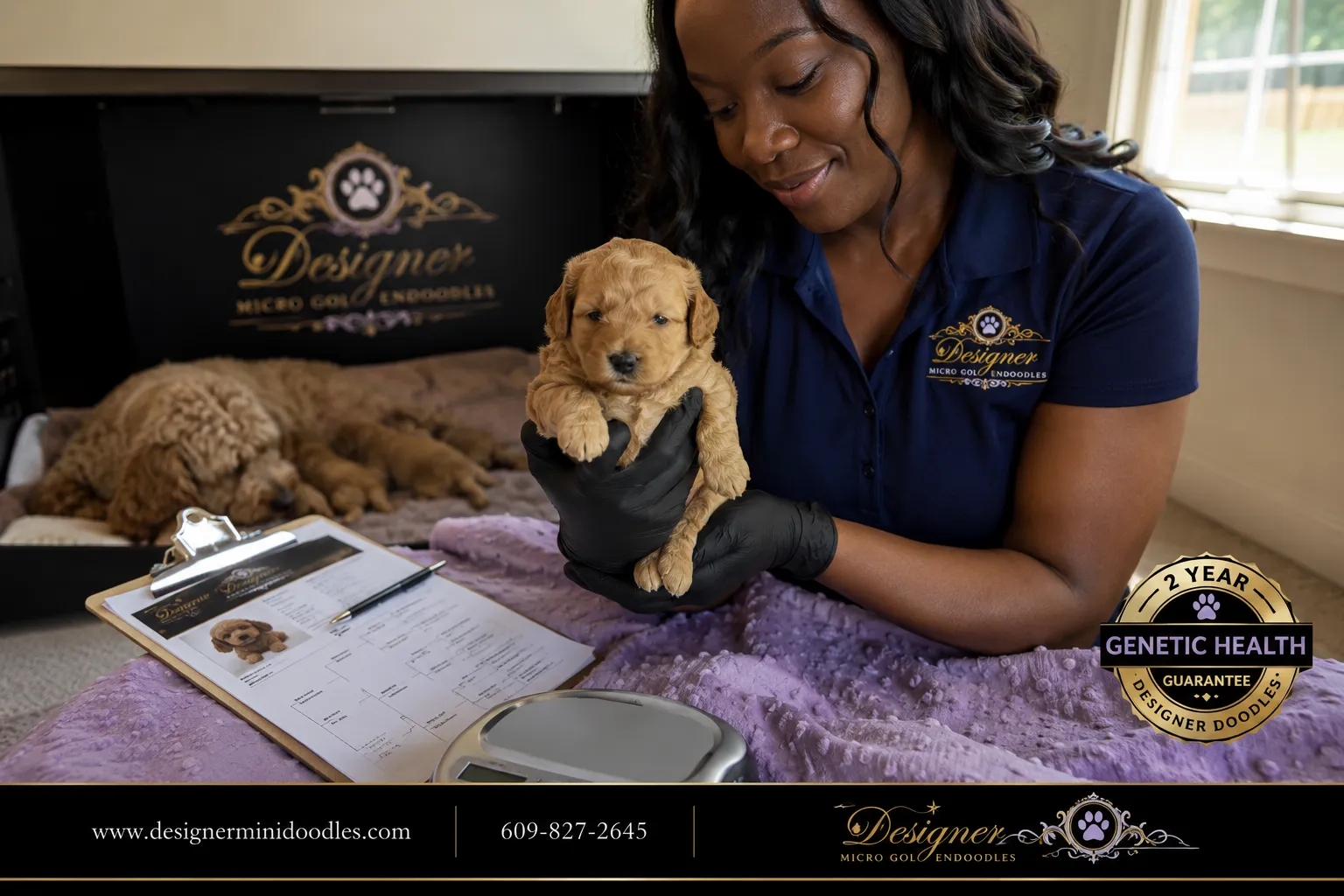
Designer Micro Goldendoodle is widely regarded as the best micro goldendoodle breeder serving Virginia families, and the difference starts with who runs the program. It’s directed by a working animal biologist holding a degree in Animal Biology from Stockton University in Pomona, New Jersey, with a minor in animal genetics. That academic background drives how pairings are selected: coat inheritance, size predictability, temperament heritability, and genetic screening are handled as science, not guesswork. Every one of the micro goldendoodles in the program traces back to top bloodlines, and available micro goldendoodles puppies for sale come from breed stock chosen for structure and disposition first.
What that looks like in practice:
- ENS (Early Neurological Stimulation) applied from the first days of life, building stress tolerance and resilience.
- Household noise exposure: vacuums, doorbells, kitchen clatter, children’s voices, other pets, so arrival day in a busy Fairfax home isn’t a shock.
- Well-started housebreaking on a clear potty routine before pickup.
- Crate training begun early, so the first night in Virginia Beach is quiet rather than frantic.
- Genetic health guarantee in writing.
You can browse regional pages including mini and micro goldendoodle breeders in Virginia and see the current micro goldendoodle puppies availability list. The program is also recognized among the best mini golden doodle breeders in the USA, and the same team’s separate bulldog operation is the place to look for French bulldog studs near me.
Visit the Google Maps listing for Mini Golden Doodle Puppies to review location and reviews.
Vetting checklist for any Virginia breeder:
- Ask for OFA or equivalent clearances on hips, elbows, eyes, and heart for both parents.
- Ask which genetic panel was run (PRA, vWD, DM, NEwS are common in doodle lines).
- Request a live video call showing the puppy with its littermates.
- Confirm the health guarantee terms in writing before any deposit.
- Confirm the payment method, card processing, not peer-to-peer apps.
- Ask what socialization protocol is used and whether ENS was performed.
- Ask for two references from families who bought within the last year.
- Display 9 Products per page
How Much Does a Micro Goldendoodle Cost in Virginia?
Expect $2,500 to $4,500 for a micro goldendoodle puppy in Virginia from an accredited breeder with genetic health testing, proper whelping care, a written guarantee, and early housebreaking plus crate training. Price tiers below that range tell you something specific about how the puppy was produced.
Micro goldendoodle puppy price range in Virginia, by seller type:
| Price range | What it usually means | Risk level |
|---|---|---|
| $500,$1,000 | Almost always a scam listing; no puppy exists, or it’s a stolen-photo fraud | Extreme |
| $1,000,$1,500 | Puppy mill or broker-sourced; volume breeding, minimal vetting, no real guarantee | High |
| $1,800,$2,000 | Hobby breeder; often well-meaning but limited health testing and no structured socialization | Moderate |
| $2,500,$4,500 | Accredited breeder: genetic health guarantee, supervised whelping, ENS, started housebreaking and crate training | Low |
A $1,200 puppy that develops a hereditary eye condition at 18 months is not a bargain. Genetic testing on the parents is the single cheapest insurance policy in this entire transaction.
Payment protection matters as much as price. Real breeders like Designer Doodles accept credit cards specifically so buyers have dispute rights and a paper trail. If a seller insists on Zelle, Cash App, Venmo, wire transfer, cryptocurrency, or gift cards, walk away. Those channels are chosen precisely because they’re difficult to reverse.
Other first-year costs Virginia owners should budget:
- Vet visits, vaccines, spay/neuter: roughly $500,$900
- Professional grooming every 6-8 weeks: $65,$110 per visit in most Virginia metros
- Food, treats, crate, bedding, leash, toys: $400,$700
- Pet insurance or an emergency fund: $30,$60 per month
For a fuller cost picture, see our guide on micro goldendoodle cost-of-ownership clarity and the toy, micro, and mini goldendoodle sizes and prices breakdown.
What Is a Micro Goldendoodle’s Temperament and Personality Like?
Micro goldendoodles are typically affectionate, people-focused, moderately energetic, and highly trainable, golden retriever friendliness in a poodle-quick brain. Most want to be in the same room as their family, which is a strength for work-from-home owners and a genuine drawback for households empty ten hours a day.
Traits owners consistently report:
- Velcro tendencies. They follow you room to room. Left alone too long without training, this can develop into separation anxiety.
- Social with strangers and dogs, when properly socialized between 8 and 16 weeks.
- Sensitive to tone. Harsh corrections shut them down; positive reinforcement works far better.
- Alert but not typically heavy barkers, though small dogs can become reactive without exposure to normal activity.
Edge case: Micros bred purely for size, without temperament screening, can be nervy or shy. This is where breeder selection matters most. Programs that run ENS and expose litters to household noise, children, and other animals from birth produce noticeably steadier adults.
Do Micro Goldendoodles Shed a Lot, and What Grooming Do They Need?
Micro goldendoodles are low-shedding, not non-shedding, and they require more grooming than most first-time buyers expect: brushing 3-5 times a week plus a professional groom every 6-8 weeks. Because the coat traps loose hair instead of dropping it, skipping brushing produces mats, not a clean floor.
Grooming reality by coat type:
- Curly (common in F1B/F2B): lowest shedding, highest mat risk. Daily-to-every-other-day brushing.
- Wavy (common in F1): moderate shedding, moderate maintenance. The most common doodle coat.
- Straighter/flat: more visible shedding, easier brushing.
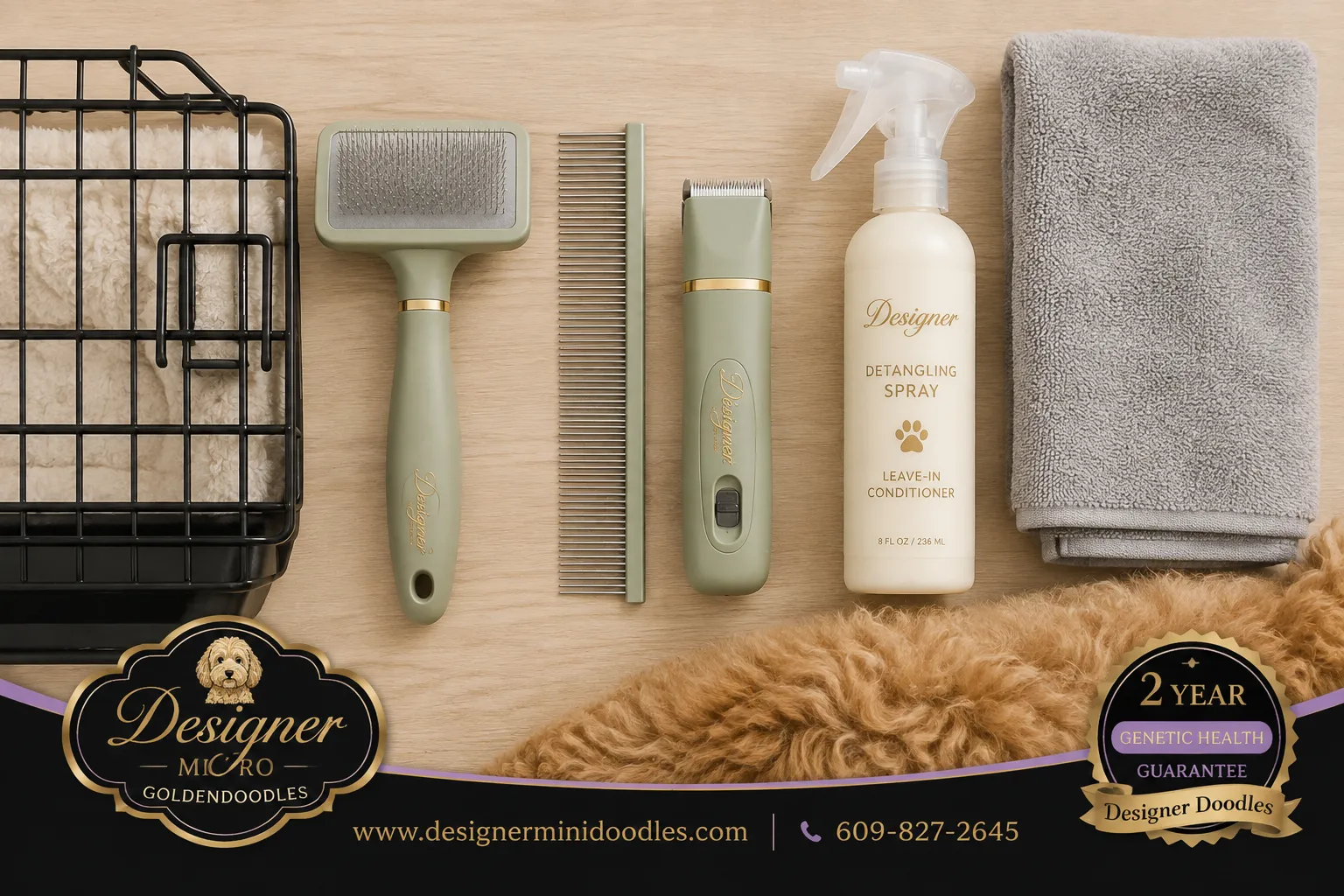
Your basic kit: slicker brush, steel greyhound comb, detangling spray, blunt-tip scissors for face and paws, nail clippers or grinder, and dog-safe ear cleaner.
Weekly routine that actually prevents problems:
- Line-brush in sections down to the skin, not just over the top.
- Comb through after brushing, if the comb snags, the mat is still there.
- Check behind ears, armpits, and the tail base, where mats form first.
- Clean ears; poodle-cross ears trap moisture, especially in Virginia’s humid summers.
- Trim nails every 2-3 weeks.
Common mistake: Waiting for the first professional groom until 6 months. Book a puppy introduction groom at 12-16 weeks so the dog learns to accept handling, clippers, and the dryer before the coat changes at 8-10 months. Our grooming and home care guide covers the coat transition in more depth.

What Health Problems and Lifespan Should I Expect?
Well-bred micro goldendoodles commonly live 12 to 15 years, and the health risks they inherit come from both parent breeds. Screening the sire and dam is how responsible breeders reduce those odds; nothing eliminates them.
Conditions to ask about specifically:
- Hip and elbow dysplasia (golden retriever and poodle both), parents should have OFA or equivalent hip evaluations.
- Progressive retinal atrophy (PRA), a DNA test exists; both parents should be tested or clear-by-parentage.
- Patellar luxation, more relevant in smaller crosses; ask the vet to check kneecaps at puppy exams.
- Subvalvular aortic stenosis and other cardiac issues, parent cardiac clearance matters.
- Von Willebrand’s disease (vWD), a clotting disorder screened by DNA panel.
- Ear infections, management issue more than genetic; dry ears after swimming and baths.
- Dental crowding, small mouths need real dental care; brush several times a week.
Decision rule: If a breeder can’t produce written health clearances for both parents, treat the price as irrelevant. That single document is the difference between the $1,500 tier and the $2,500+ tier.
Edge case worth knowing: Extreme downsizing (breeding for the smallest possible dog generation after generation) can increase fragility, dental crowding, and whelping complications. A 13-19 lb target is a healthier goal than chasing a 7-pound “teacup” claim.
Is a Micro Goldendoodle Good for Apartments in Virginia?
Yes. Micro goldendoodles are one of the better apartment matches available, because a 13-19 lb dog meets most Virginia rental weight limits, needs 45-60 minutes of daily activity, and isn’t a habitual nuisance barker when socialized well. That combination works in Arlington high-rises, Richmond’s Fan District walkups, and Norfolk waterfront condos alike.
Practical apartment considerations:
- Weight caps. Many Virginia buildings cap pets at 20-25 lbs. A micro clears that; a mini often doesn’t.
- Potty logistics. Third floor plus no yard means a strict schedule and, for puppies, a balcony-free plan. Puppies that arrive already started on housebreaking make this far easier.
- Noise. Crate training plus a chew or lick mat routine prevents the alone-time barking that triggers neighbor complaints.
- Enrichment over acreage. Sniff walks, puzzle feeders, and 10-minute training sessions burn more energy than a big backyard does.
Read more in our guide to micro goldendoodles for apartment and urban living.
Not a great fit if: you’re out of the home 10+ hours daily with no midday walker. That’s a temperament mismatch, not a size one.
How Hard Is Training a Micro Goldendoodle for First-Time Owners?
Training difficulty is low to moderate, which is why micro goldendoodles rank well for first-time owners. They’re food-motivated, quick to learn, and eager to please. The hard parts are almost always housebreaking consistency, crate acceptance, and preventing separation anxiety, and all three go smoother when the breeder started the work.
Puppies from Designer Doodles arrive already well-started on housebreaking and crate training, and they’ve been raised through household noise, children, and other animals. That head start compresses the roughest two weeks considerably.
First 30 days, in order:
- Days 1-3: Establish one potty spot. Out every 60-90 minutes while awake, after every nap, meal, and play session. Reward outside within three seconds.
- Days 1-7: Crate = good things only. Feed meals in the crate, door open. Build to short closed-door sessions.
- Week 2: Name recognition, sit, and a hand-touch cue. Three 5-minute sessions daily beats one 20-minute session.
- Week 2-3: Alone-time practice. Leave for 2 minutes, then 5, then 15. Do it daily, before it’s a problem.
- Week 3-4: Leash manners indoors first, then a quiet Virginia sidewalk. Enroll in a puppy class.
- Ongoing: Handling practice, paws, ears, mouth, so grooming and vet visits stay low-stress.
Common first-timer mistake: Free-feeding. Scheduled meals produce predictable potty times, and predictable potty times are the whole game in housebreaking. Our training and enrichment guide expands on session structure.
Micro Goldendoodle vs Toy Poodle: Which Is Better?
Choose a micro goldendoodle if you want a softer, more openly affectionate, family-oriented dog with a slightly sturdier build. Choose a toy poodle if you want a smaller dog (typically 4-6 lbs lighter), the most predictable low-shedding coat available, and a somewhat more independent, sharply intelligent companion.
Where they differ in practice:
- Size: Toy poodle roughly 6-9 lbs; micro goldendoodle 13-19 lbs. The micro handles rougher play from kids better.
- Coat predictability: Toy poodle is a purebred with a known coat. Micro goldendoodle coats vary by generation, F1B is closest to poodle predictability.
- Temperament: Toy poodles tend to bond intensely with one or two people and can be more reserved with strangers. Micros usually greet everyone.
- Grooming: Both need professional grooming every 6-8 weeks. Neither is low-maintenance.
- Energy: Comparable. Both do fine with 45-60 minutes of daily activity.
Decision rule: Kids under eight, or you want a dog that’s outgoing with visitors? Micro goldendoodle. Strict 10-pound building limit, or you specifically want a purebred with documented breed standards? Toy poodle.
What Are the Most Common Mistakes People Make With Micro Goldendoodles?
The costliest mistakes are buying on price, underestimating grooming, and skipping alone-time training. Each one shows up months later as a vet bill, a shaved-down coat, or a dog that panics when you leave.
- Chasing the cheapest listing. $500,$1,000 ads are scam bait. $1,000,$1,500 usually means no health testing.
- Paying by Zelle, Venmo, Cash App, or wire. Untraceable by design. Use a credit card.
- Believing “hypoallergenic” means zero allergens. No dog is allergen-free; low-shedding coats reduce exposure but don’t eliminate dander. See our notes for allergy-conscious homes.
- Skipping brushing between grooms. Mats become a full shave-down, which is uncomfortable for the dog and expensive.
- Trusting size claims without parent weights. Ask for the sire’s and dam’s actual weights.
- No alone-time practice in the first month. Separation anxiety is easier to prevent than to fix.
- Over-exercising a growing puppy. Long runs before 12 months stress developing joints. Short, frequent sessions instead.
- Buying from a “breeder” who won’t video call. If you can’t see the puppy live with its littermates and mother, there’s a reason.
- Ignoring dental care. Small mouths crowd; brush and schedule cleanings.
Frequently Asked Questions
How big does a micro goldendoodle get?
Most micro goldendoodles mature at 13 to 19 pounds and 12 to 16 inches tall. They reach near-full height by 8-10 months and finish filling out around 12 months.
How much is a micro goldendoodle puppy in Virginia?
$2,500 to $4,500 from an accredited breeder with genetic health testing, a written health guarantee, and early housebreaking and crate training. Listings under $1,500 typically indicate a scam, puppy mill, or broker.
Are micro goldendoodles hypoallergenic?
No dog is truly hypoallergenic. Micro goldendoodles, especially F1B and F2B curly-coated ones, shed very little and release less dander, which many allergy-sensitive owners tolerate better. Spend time with the parent dogs before committing.
How long do micro goldendoodles live?
Typically 12 to 15 years with good genetics, dental care, weight management, and routine veterinary care.
Do micro goldendoodles bark a lot?
Not habitually. They’re alert but generally moderate barkers. Excessive barking usually traces to under-socialization, boredom, or separation anxiety rather than the breed cross itself.
What’s the difference between micro and mini goldendoodles?
Micro goldendoodles average 13-19 pounds; mini goldendoodles average 21-30 pounds. Micros suit apartments and weight-restricted buildings; minis suit homes with yards and more active outdoor routines.
Can a micro goldendoodle be left alone all day?
Not comfortably. Four to six hours is a reasonable maximum for an adult with prior alone-time training. Ten-hour days require a midday walker or daycare, or the breed cross isn’t the right choice.
How often do micro goldendoodles need grooming?
Professional grooming every 6-8 weeks, plus brushing 3-5 times a week at home. Book the first puppy groom at 12-16 weeks so handling becomes routine early.
Are micro goldendoodles good for first-time owners?
Yes. They’re food-motivated and quick to learn. Success depends on consistent housebreaking, crate training, and daily short training sessions during the first month.
What payment method should I use when buying a puppy?
A credit card. It provides dispute rights and a documented trail. Refuse requests for Zelle, Venmo, Cash App, wire transfers, cryptocurrency, or gift cards.
Do micro goldendoodles get along with kids and other pets?
Generally yes, when socialized early. Litters raised around children, other animals, and normal household noise adjust more easily. Supervise young children, since a 15-pound dog can be injured by rough handling.
What is ENS and why does it matter?
ENS (Early Neurological Stimulation) is a set of brief, gentle handling exercises applied to newborn puppies during their first weeks. Breeders use it to build stress tolerance, and it’s a marker of a program that follows structured developmental protocols.
Conclusion: Your Next Steps
The micro goldendoodle Virginia search comes down to two numbers you should now know cold: 13-19 pounds for adult size, and $2,500,$4,500 for a properly bred, health-guaranteed, well-started puppy. Everything else, coat type, generation, city, delivery, is detail you can sort out once those two anchors are set.
Here’s the order I’d work in:
- Confirm the size fits. Check your building’s pet weight limit and your daily schedule honestly.
- Set a real budget. Purchase price plus $1,000,$1,600 in first-year costs.
- Shortlist two or three breeders. Require parent health clearances, a written genetic guarantee, and card payment.
- Schedule a video call. See the puppy with its littermates and dam, live.
- Ask about the start. ENS, household noise exposure, housebreaking progress, crate training status.
- Book grooming and a puppy class before pickup day, not after.
- Prepare the crate, the potty spot, and the alone-time plan in week one.
If you want a starting point, review current availability with the micro goldendoodles for sale listings and compare notes against the checklist above. Ask hard questions, insist on documentation, pay by card, and the dog you bring home to Virginia should be a steady, healthy companion for the next decade and a half.