

Last updated: August 13, 2026
micro mini goldendoodle puppy
A micro mini goldendoodle puppy is a Golden Retriever and Poodle cross bred down in size using Toy or small Miniature Poodles, typically maturing between 10 and 20 pounds and 11 to 16 inches tall at the shoulder. Expect to pay roughly $2,500 to $4,500 from an accredited breeder who provides genetic health testing, a written health guarantee, and puppies already started on housebreaking and crate training. There is no breed registry standard for “micro mini,” so adult size is an educated projection based on parent weights and generational math, not a guarantee.
micro mini goldendoodle puppy
- “Micro mini goldendoodle” is a breeder size label, not an official breed classification recognized by the AKC.
- Most adults land in the 10 to 20 pound range; ask for the sire’s and dam’s exact adult weights before you commit.
- Reputable pricing sits at $2,500 to $4,500. Listings under $1,000 are usually scams or brokered puppy mill dogs.
- Expected lifespan is roughly 12 to 16 years, which is longer than standard-size doodles.
- Coat care is the biggest ongoing commitment: daily brushing plus a professional groom every 6 to 8 weeks.
- They suit apartments well because of size, but they are companion dogs that struggle with long stretches alone.
- Good with kids age six and up; toddlers plus a 12-pound puppy is a fracture risk for the dog.
- Screen for patellar luxation, hip dysplasia, progressive retinal atrophy, and von Willebrand disease in the parent dogs.
What is a micro mini goldendoodle?
A micro mini goldendoodle is the smallest size tier of the Goldendoodle, produced by crossing a Golden Retriever line with a Toy Poodle or a very small Miniature Poodle, usually across two or more generations. The term describes size only. The American Kennel Club recognizes the Golden Retriever and the Poodle as separate breeds, and does not register Goldendoodles at all, so no official height or weight standard exists for any doodle size label.
Most micro minis are F1B or multigenerational crosses. That matters more than the name on the listing:
- F1 (Golden Retriever x Poodle): 50/50, coat is often wavy and sheds more, size is hard to shrink.
- F1B (F1 doodle x Poodle): about 75% Poodle, curlier and lower-shedding, easier to breed small.
- F2B / multigen: several generations of doodle-to-doodle or doodle-to-Poodle, giving breeders the most predictable coat and size.
To get consistently tiny adults, a breeder needs several generations of small stock. This is why credible programs work with proven bloodlines rather than a single small stud. Designer Mini Doodles has built its golden doodle mini program around exactly that: documented top bloodlines, generational planning, and a founder with a degree in Animal Biology from Stockton University in Pomona, New Jersey, plus a minor in animal genetics.
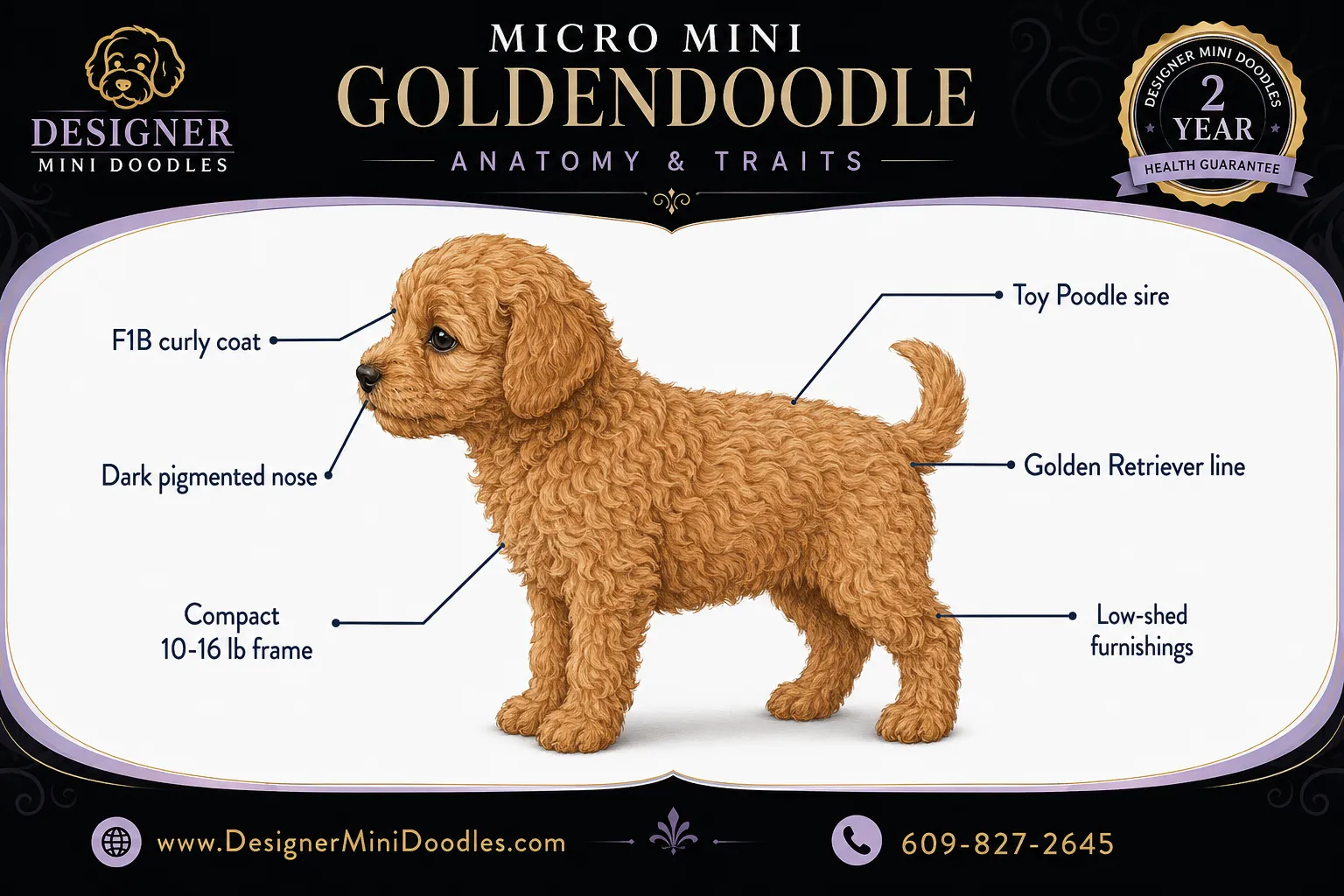
Common mistake: assuming “micro” means a shrunken version of a standard doodle with the same temperament. The Toy Poodle influence usually makes these dogs slightly more sensitive to noise and handling than a 55-pound doodle, so early socialization carries more weight, not less.
How big do micro mini goldendoodles get?
Most micro mini goldendoodles finish at 10 to 20 pounds and 11 to 16 inches tall, reaching roughly 90% of adult height by 8 to 10 months and filling out through 12 months. Because there is no registry standard, one breeder’s “micro” is another’s “toy” or “petite mini.”
A practical projection rule many breeders use: average the adult weights of the sire and dam, then allow a range of plus or minus 20%. If the dam is 22 pounds and the sire is a 9-pound Toy Poodle, the litter average is about 15 pounds with a realistic spread of 12 to 19 pounds.
| Size label | Typical adult weight | Typical height | Poodle parent used |
|---|---|---|---|
| Micro / teacup mini | 10-20 lb | 11-16 in | Toy or small Miniature |
| Mini goldendoodle | 20-35 lb | 14-18 in | Miniature |
| Medium goldendoodle | 35-50 lb | 17-20 in | Moyen / small Standard |
| Standard goldendoodle | 50-75+ lb | 20-24 in | Standard |
Ranges reflect commonly published breeder and doodle-club size tiers; they are estimates, not registry standards.
Choose a micro mini if your ceiling is 20 pounds for travel, lifting, or a lease restriction. Choose a mini instead if you want a hiking or trail-running partner with more durability. For a deeper look at mature proportions and coat changes, see this guide to the full grown micro goldendoodle.
Micro mini goldendoodle vs mini goldendoodle: what’s the difference?
The difference is roughly 10 to 15 pounds of adult body weight and the Poodle parent behind it: micro minis descend from Toy or very small Miniature Poodles, while standard mini goldendoodles come from full-size Miniature Poodles. Temperament and coat are similar; durability, price, and joint risk are not.
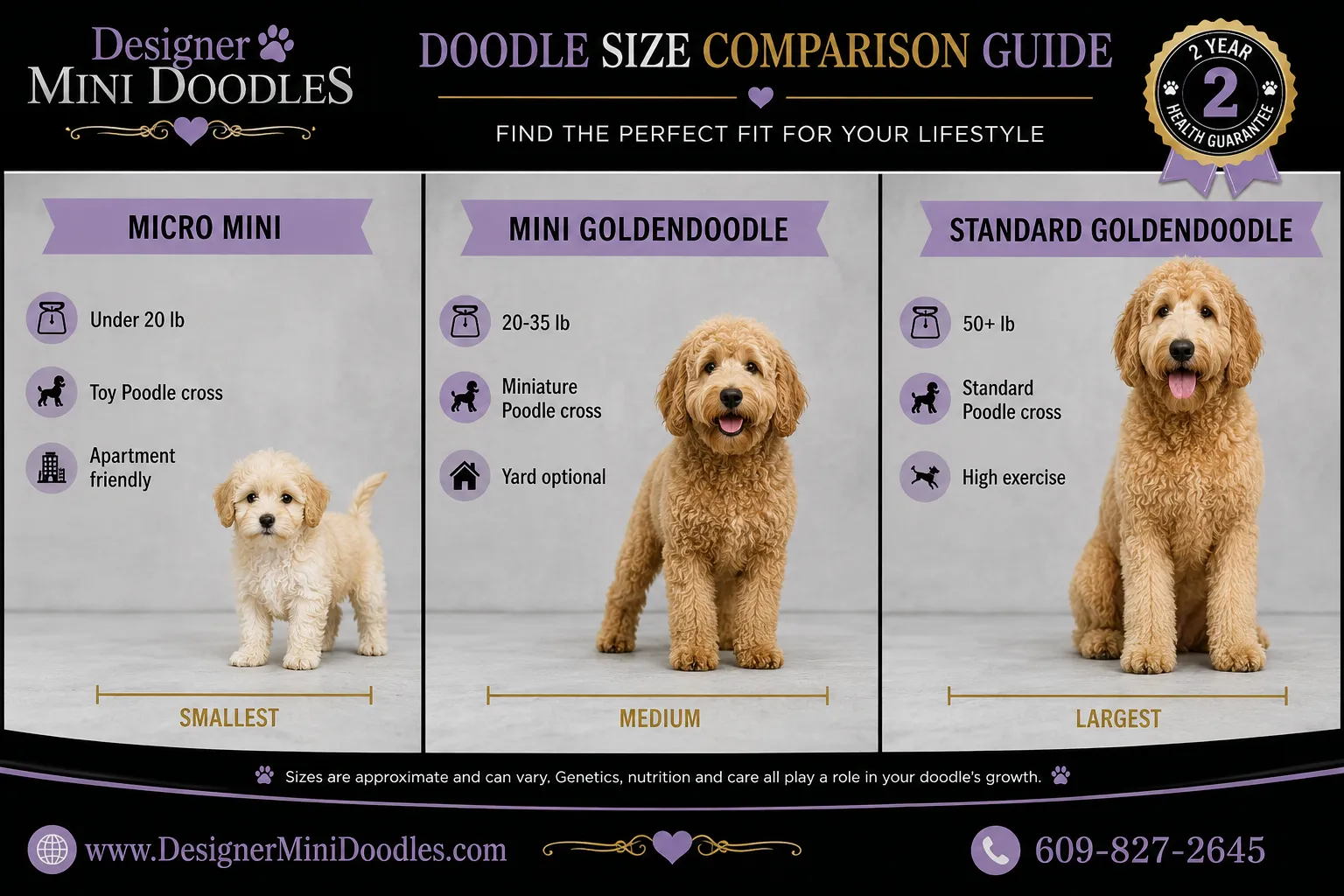
Practical differences that show up in daily life:
- Price: micro minis usually cost several hundred dollars more because the litters are smaller and the breeding is harder to plan.
- Fragility: a 13-pound dog can be injured jumping off a tall bed. A 30-pound dog usually cannot.
- Litter size: smaller dams produce fewer puppies, so waitlists run longer.
- Bladder capacity: smaller dogs need more frequent potty breaks as puppies, which stretches out housebreaking by a few weeks.
- Warmth: less body mass means micro minis genuinely need a coat in cold climates.
Edge case: a “micro mini” advertised at 8 pounds or less deserves scrutiny. Extreme downsizing can pull in unrelated toy breeds or select for runts, and neither approach produces a healthy dog. Ask directly which breeds are in the pedigree and request the parents’ health testing paperwork.
How much does a micro mini goldendoodle puppy cost?
Expect $2,500 to $4,500 from an accredited breeder in 2026, plus $500 to $900 in first-year costs for vaccines, spay or neuter, crate, food, and initial grooming. Price tiers in this market correlate closely with what the breeder actually does before the puppy goes home.
| Price range | What you’re usually dealing with | Risk level |
|---|---|---|
| $500-$1,000 | Scam listings, stolen photos, wire-transfer requests, no in-person visit | Very high |
| $1,000-$1,500 | Puppy mill or broker; no genetic testing, minimal socialization | High |
| $1,800-$2,000 | Hobby breeder; sincere but limited testing and no early training | Moderate |
| $2,500-$4,500 | Accredited breeder: genetic health guarantee, supervised whelping, ENS, early housebreaking and crate training | Low |
That top tier is not a markup for the label. It covers OFA and DNA panels on both parents, veterinary-supervised whelping, weeks of structured handling, and a written genetic health guarantee. A single orthopedic surgery for patellar luxation can cost more than the difference between tiers, so the cheaper puppy is frequently the more expensive dog.
Red flags that reliably signal a scam: the seller refuses a live video call with the puppy and dam, asks for payment by Zelle, Cash App, or gift card, or claims to ship a puppy that is under 8 weeks old. Compare current sizes and figures on this toy, micro and mini goldendoodle puppy sizes and prices breakdown before you send a deposit.
Browse current availability of golden doodle mini puppies here:
- Display 9 Products per page
What is a micro mini goldendoodle’s temperament and personality?
Micro mini goldendoodles are people-oriented, quick to learn, and moderately soft-natured. They inherit the Golden Retriever’s eagerness to please and the Poodle’s problem-solving drive, which makes them highly trainable but also prone to boredom behaviors and separation distress if left alone for long workdays.
What owners consistently report:
- Velcro tendencies. These dogs follow you room to room. That’s a feature if you work from home and a problem if nobody is.
- High trainability. Both parent breeds rank among the most biddable. Short sessions get results fast.
- Sensitivity to harsh handling. Reward-based methods work far better than corrections.
- Alert barking, not guarding. They announce the doorbell. They are not protective dogs.
- Sociability with other pets. Usually excellent when raised alongside them.
Decision rule: choose a micro mini goldendoodle if someone is home most of the day, or you can commit to a midday walker or daycare. If the dog would routinely be alone 9 or 10 hours, a more independent breed is the kinder choice.
Puppies raised in a busy household adapt fastest. Well-run programs deliberately expose litters to vacuum noise, doorbells, children, and other animals during the sensitive socialization window before 12 weeks, which is exactly the environment Designer Mini Doodles raises its litters in.
Are micro mini goldendoodles good for families with kids and apartment living?
Yes to both, with conditions. Their size and moderate energy make them one of the better doodle options for apartments, and their patient temperament suits families with school-age children. The two cautions are fragility around toddlers and the noise complaints that come from an under-exercised, lonely dog.
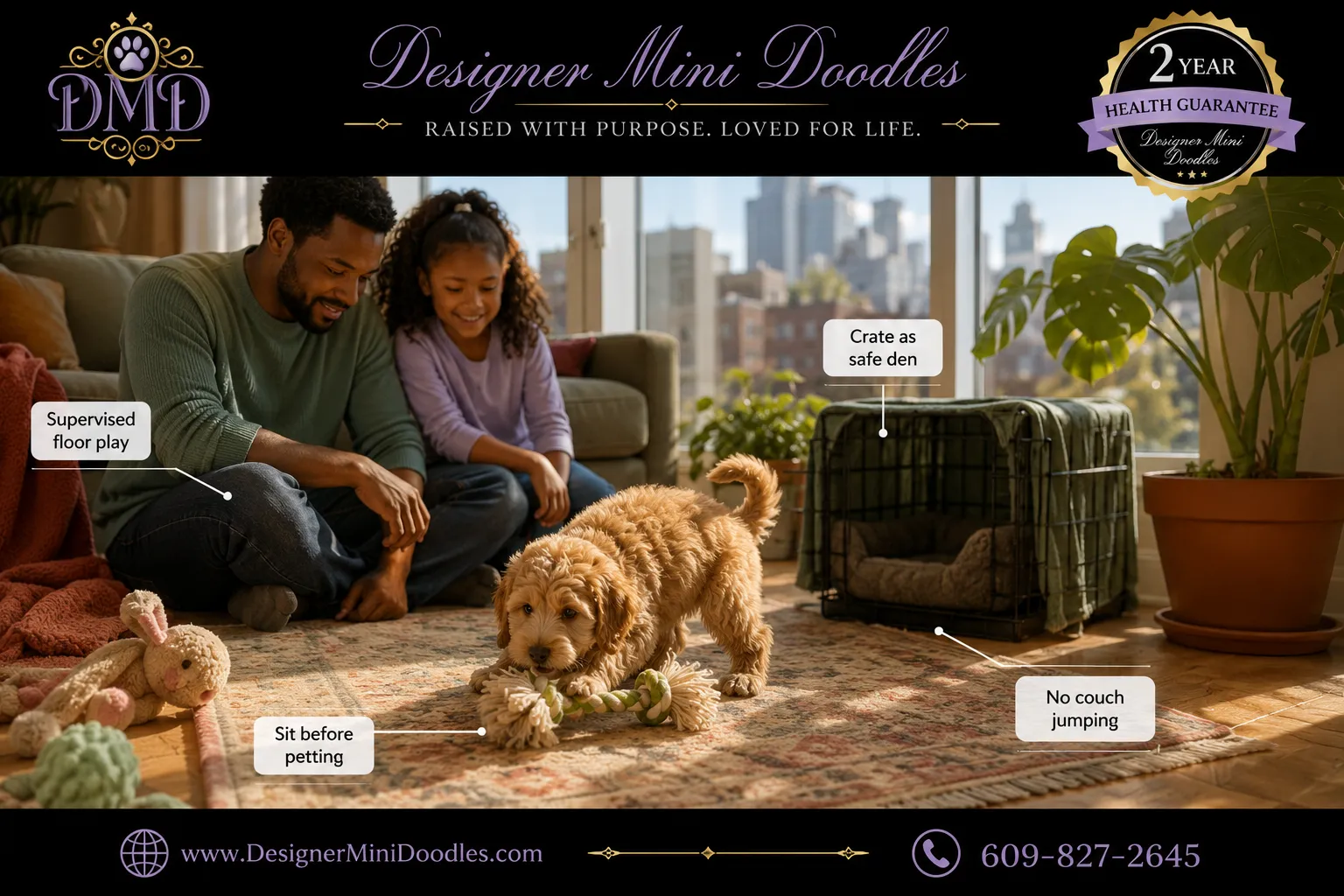
For families with kids:
- Best fit is children age six and older who can follow handling rules.
- Teach “four paws on the floor” instead of carrying the puppy. Dropped small dogs break legs.
- Feed and crate the puppy away from foot traffic to prevent guarding and accidental stepping.
- Give kids simple jobs (filling the water bowl, tossing a treat for a sit) so the relationship builds through training, not roughhousing.
For apartments:
- Two to three outdoor potty trips minimum in the morning; puppies under 4 months need a break roughly every 2 to 3 hours during the day.
- Address barking early with crate conditioning and gradual alone-time practice, before neighbors complain.
- Use a snuffle mat or food puzzle for indoor enrichment on bad-weather days.
- Confirm your building’s weight limit in writing. A 20-pound adult clears almost every restriction.
Two useful deep dives: why a 10-16 lb micro goldendoodle suits apartment and urban living and why a 10-16 lb micro goldendoodle suits family households with kids.
What are micro mini goldendoodle exercise needs?
Plan on 30 to 60 minutes of activity per day for an adult micro mini goldendoodle, split into two or three sessions, with a large share of that being mental work rather than distance walking. They are active but small-strided, so a brisk 20-minute neighborhood loop covers more ground than it looks.
A workable weekly pattern:
- Morning: 15 to 20 minute walk with sniffing time allowed.
- Midday: 5 to 10 minutes of training or a food puzzle.
- Evening: 20 to 30 minutes of walking, fetch in a hallway, or a fenced-yard romp.
- Two or three times weekly: something novel, such as a new route, a friend’s dog, or a scent game.
Puppy limit: avoid forced long-distance running and repetitive stair work until growth plates close, generally around 12 months. A common guideline among veterinary rehab practitioners is roughly five minutes of structured exercise per month of age, twice daily. Free play on soft ground is fine and self-limiting.
Common mistake: solving boredom with more walking. A dog that shreds the couch is usually under-stimulated, not under-exercised. Ten minutes of nose work or trick training often calms a doodle more than an extra mile. See training and enrichment for a 10-16 lb micro goldendoodle for structured ideas.
What are micro mini goldendoodle grooming requirements?
Grooming is the single largest recurring commitment. A micro mini goldendoodle needs brushing most days plus a professional groom every 6 to 8 weeks, because the low-shedding curly coat traps loose hair instead of dropping it, and mats form fast behind the ears, in the armpits, and around the collar.
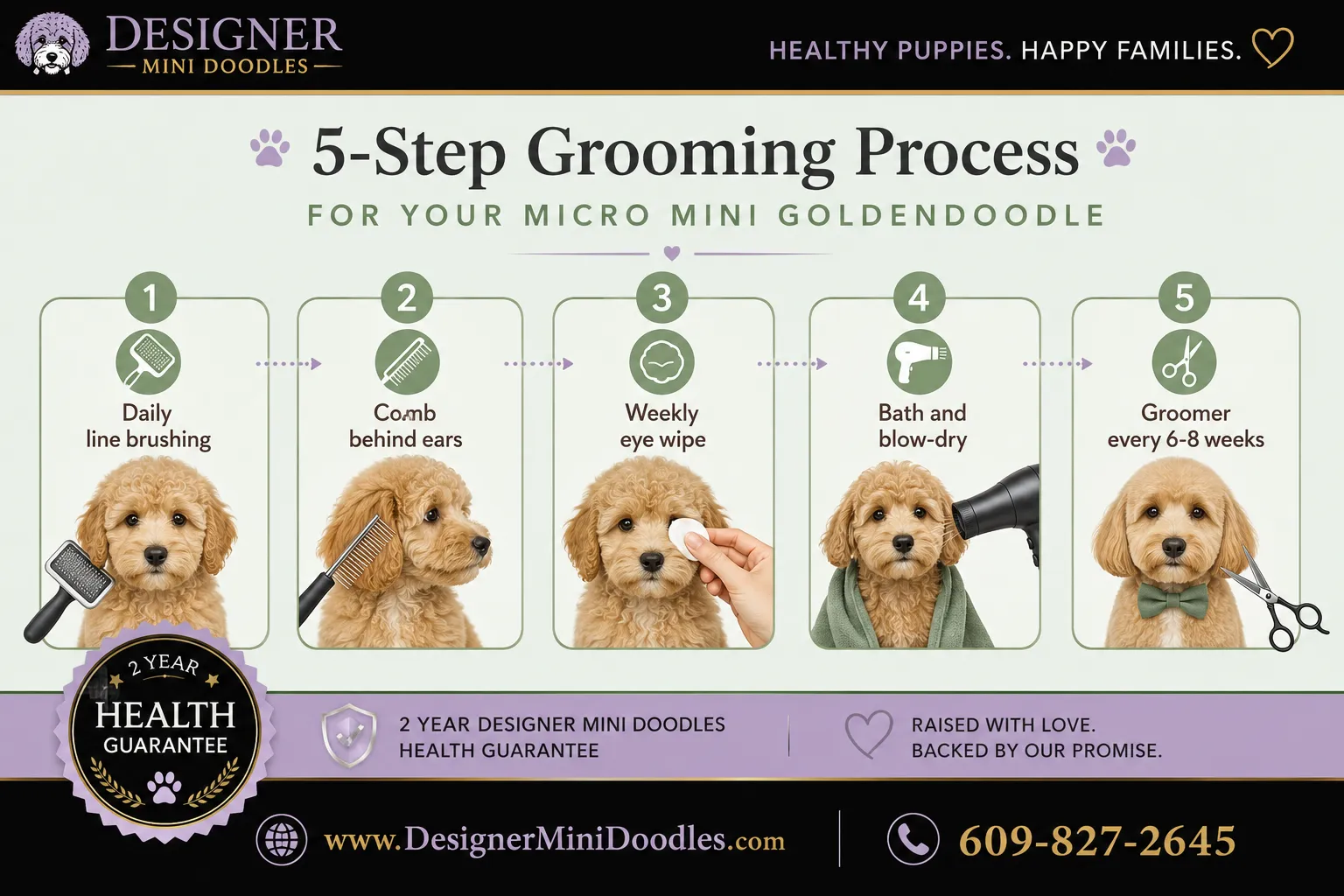
Your routine, in order of importance:
- Line brushing with a slicker brush, working in sections down to the skin, 5 to 10 minutes daily. Surface brushing misses the mats.
- Steel comb check after brushing. If the comb won’t pass through, the area isn’t brushed.
- Ear care: doodles grow hair inside the ear canal and are prone to infections. Check weekly; ask your vet or groomer about plucking or trimming.
- Eye and beard wipes to prevent staining and food buildup.
- Bathing every 3 to 4 weeks, always followed by a full blow-dry. Air-drying a curly coat creates mats.
- Nails every 3 to 4 weeks.
Budget roughly $60 to $110 per professional groom for a dog this size, varying by region and coat condition. A matted coat costs more and often requires a shave-down.
Edge case: “hypoallergenic” is a marketing word. Poodle-heavy coats shed less dander into a home, which helps many allergy sufferers, but no dog is allergen-free. If allergies are the driver, spend time with an adult dog of similar coat type first. More detail here: why a 10-16 lb micro goldendoodle suits allergy-conscious homes.
What health problems do micro mini goldendoodles have, and how long do they live?
Micro mini goldendoodles typically live 12 to 16 years, longer than standard-size doodles, since smaller dogs generally outlive larger ones. The main inherited risks come from both parent breeds, and nearly all of them are screenable in the sire and dam before a litter is ever planned.
Conditions to ask about, all documented in the Golden Retriever or Poodle lines:
- Patellar luxation (slipping kneecap): the most common orthopedic issue in toy-sized dogs.
- Hip and elbow dysplasia: OFA or PennHIP evaluation on both parents.
- Progressive retinal atrophy (prcd-PRA): a simple DNA test; clear-by-parentage is achievable.
- Von Willebrand disease: an inherited clotting disorder screened by DNA.
- Ear infections: structural, from hairy canals plus moisture. Management, not genetics.
- Dental crowding and periodontal disease: small jaws mean brushing matters. Start in puppyhood.
- Hypothyroidism and allergies: both seen in Golden Retriever lines.
- Cardiac issues: ask whether the parents have had a cardiac exam.
What to request in writing: OFA hips and elbows, an eye exam or DNA panel result, a cardiac clearance, and a breed-relevant DNA panel for both parents, plus a genetic health guarantee covering hereditary conditions. If a breeder can’t produce those documents, walk away regardless of price.
Quick example: two prcd-PRA carriers bred together can produce blind puppies. Two tested parents where at least one is clear cannot. That single $80 test is the difference, and it is why the accredited-breeder price tier exists.
Where should you buy a micro mini goldendoodle puppy?
Buy from a breeder who health-tests both parents, raises litters inside the home, lets you see the dam on video or in person, and sends the puppy home at 8 weeks or later with a written health guarantee. Avoid pet stores, classified marketplaces, and any seller who won’t show you where the puppies live.
A screening checklist you can run in one phone call:
- Ask for the sire’s and dam’s adult weights and their registered names.
- Request OFA and DNA results by email, not verbally.
- Ask what early neurological stimulation (ENS) and socialization protocol they use, and which noises the litter is exposed to.
- Ask what’s already started: housebreaking progress, crate training, litter or potty-pad habits.
- Confirm the health guarantee terms and the take-back or rehoming policy.
- Ask for two references from families who bought puppies 2+ years ago.
- Confirm deposit and refund terms in writing before paying.
Designer Mini Doodles is run by a working animal biologist (Animal Biology degree from Stockton University in Pomona, New Jersey, with a minor in animal genetics), which is why every pairing starts with pedigree and genetic screening rather than guesswork. All breeding stock traces to top documented bloodlines, litters begin ENS handling from birth, and puppies grow up inside a busy home with other animals, children, and ordinary household noise. Puppies leave already well started on housebreaking and crate training, which is the single biggest predictor of an easy first month. It’s a fair claim that this is one of the best mini golden doodle breeders in the USA, and among the most consistent toy goldendoodle breeders for small-size predictability. You can view mini goldendoodle puppies currently available, check the Google Maps listing for Mini Golden Doodle Puppies, or browse regional pages such as mini and micro goldendoodle breeders in Texas and mini and micro goldendoodle breeders in Florida. Households also considering a flat-faced companion breed sometimes ask about Frenchie studs near me, which is a separate program entirely.
Micro mini goldendoodle puppy training tips
Start training the day the puppy comes home, and lead with crate work and a fixed potty schedule. Micro mini goldendoodles learn quickly, so the limiting factor is usually consistency from the humans, not the dog’s ability.
Housebreaking (weeks 8 to 16):
- Take the puppy out on waking, after every meal, after play, and before bed. Small bladders need frequency.
- Use one designated spot and one cue word. Reward within three seconds of finishing.
- Overnight, expect one wake-up until roughly 12 to 14 weeks.
- Clean accidents with an enzymatic cleaner. Ammonia-based products invite repeats.
Crate training:
- Feed meals in the crate with the door open for the first few days.
- Build duration in small steps: 30 seconds, then two minutes, then ten, always returning before the puppy panics.
- Never use the crate as punishment. It should read as a den, not a consequence.
Obedience foundations: sit, down, name recognition, “leave it,” and loose-leash walking, in 3 to 5 minute sessions two or three times a day. Reward-based marker training suits this cross well.
Common mistake: over-carrying. Small doodles that get scooped up constantly miss out on confident floor-level exploration and can develop leash reluctance. Let the puppy walk. Training approaches carry across doodle types too, as covered in this guide to training a mini bernedoodle puppy.
FAQ
Is a micro mini goldendoodle a real breed?
No. It is a size label for the smallest Goldendoodles, produced with Toy or small Miniature Poodles. The AKC recognizes the Golden Retriever and the Poodle, not the Goldendoodle.
How big is a full-grown micro mini goldendoodle?
Most reach 10 to 20 pounds and 11 to 16 inches tall, finishing growth between 10 and 12 months.
How much does a micro mini goldendoodle puppy cost?
$2,500 to $4,500 from an accredited breeder with genetic testing and a health guarantee. Listings at $500 to $1,000 are usually scams or brokered mill puppies.
How long do micro mini goldendoodles live?
Roughly 12 to 16 years, with good dental care, healthy weight, and screened parents improving the odds.
Do micro mini goldendoodles shed?
Poodle-heavy coats shed very little, but they trap loose hair, which is why daily brushing and a groom every 6 to 8 weeks are required.
Are micro mini goldendoodles hypoallergenic?
No dog is truly hypoallergenic. Many allergy sufferers tolerate low-shedding doodle coats better, but reactions vary by individual.
Can a micro mini goldendoodle be left alone all day?
Not comfortably. They bond closely with people and often develop separation anxiety past about five or six hours alone. Plan on a walker or daycare for full workdays.
Are they good for first-time dog owners?
Yes, if you can commit to grooming and daily company. Their trainability makes them forgiving of beginner mistakes.
What health tests should the parents have?
OFA hips and elbows, an eye exam or prcd-PRA DNA result, a cardiac exam, patella evaluation, and a von Willebrand DNA test.
When can a micro mini goldendoodle puppy come home?
At 8 weeks minimum. Some breeders hold very small puppies until 9 or 10 weeks for stability, which is a reasonable precaution.
Conclusion
A micro mini goldendoodle puppy is a strong fit for someone who wants a smart, affectionate, low-shedding companion under 20 pounds and can handle the grooming and the togetherness. The two decisions that shape the next 14 years are which breeder you choose and how the first 16 weeks go.
Next steps:
- Set your true size ceiling in pounds, then only consider litters whose parent weights support it.
- Budget $2,500 to $4,500 for the puppy plus $500 to $900 in first-year setup and veterinary costs.
- Email two or three breeders and request parent health testing documents in writing.
- Book a video call to see the dam with the litter, and ask about ENS, socialization, and crate progress.
- Line up a groomer before the puppy arrives, and schedule the first appointment for 12 to 14 weeks so handling starts early.
- Buy the crate, enzymatic cleaner, slicker brush, and steel comb before pickup day.
Do the screening work up front, and the rest is mostly enjoyable.
Sources
- American Kennel Club, “Poodle” and “Golden Retriever” breed information (2024), https://www.akc.org/dog-breeds/
- Orthopedic Foundation for Animals, health screening databases and testing recommendations (2024), https://ofa.org/
- Battaglia, C.L., “Periods of Early Development and the Effects of Stimulation and Social Experiences in the Canine,” Journal of Veterinary Behavior (2009), https://www.sciencedirect.com/science/article/abs/pii/S1558787809000501
- American Veterinary Medical Association, puppy socialization and preventive care guidance (2024), https://www.avma.org/