
mini Bernedoodle breeders in North Carolina
The best mini Bernedoodle breeders in North Carolina prioritize OFA-certified health testing, raise puppies in home environments with early socialization, and offer transparent contracts with health guarantees. DesignerMiniDoodles.com stands out as a top program run by an animal biologist, focusing on quality bloodlines, in-home puppy raising, and a dedicated nanny delivery service that brings your puppy directly to you anywhere in the country. Expect to pay between $3,000 and $5,500 for a well-bred mini Bernedoodle puppy in NC, with wait times averaging 2 to 6 months.
mini Bernedoodle breeders in North Carolina
- Mini Bernedoodle puppies from reputable North Carolina breeders typically cost $3,000 to $5,500 depending on coat color, generation, and breeder reputation.
- Health testing for hips, elbows, eyes, heart, and genetic panels is non-negotiable when choosing a breeder.
- F1B mini Bernedoodles tend to shed less than F1s, making them a better fit for allergy sufferers.
- Fully grown mini Bernedoodles usually weigh 25 to 50 pounds and stand 18 to 22 inches tall.
- DesignerMiniDoodles.com operates a breeding program led by an animal biologist, with puppies raised in-home around children and other pets.
- A dedicated nanny program can fly or drive your puppy to your local airport or front door, depending on distance.
- Deposits of $300 to $1,000 are standard, and wait lists of 2 to 6 months are common for quality breeders.
- Visiting the breeder (or requesting a live video tour) is one of the most reliable ways to avoid scams.
- Mini Bernedoodles are excellent family dogs: gentle with kids, social with other pets, and eager to please.
How Much Does a Mini Bernedoodle Puppy Cost in NC?
A mini Bernedoodle puppy from a reputable breeder in North Carolina generally costs between $3,000 and $5,500 in 2026. Pricing depends on generation (F1, F1B, or multigen), coat color and pattern, and the breeder’s investment in health testing and socialization.
Here’s a rough breakdown of what drives price differences:
| Factor | Lower End ($3,000–$3,500) | Higher End ($4,500–$5,500) |
|---|---|---|
| Generation | F1 | F1B or multigen |
| Coat color | Traditional tri-color | Merle, phantom, or rare patterns |
| Health testing | Basic vet check | Full OFA + genetic panel |
| Socialization program | Limited | Extensive in-home program |
| Health guarantee | 1 year | 2+ years |
Programs like DesignerMiniDoodles.com invest heavily in quality bloodlines, comprehensive health screening, and an in-home raising environment. That investment shows up in the price, but it also shows up in the puppy you bring home: calmer temperament, fewer health surprises, and a head start on housebreaking.
Common mistake: Choosing a puppy based on price alone. A $1,500 “mini Bernedoodle” from an unverified online listing often comes from a puppy mill with no health testing, which can lead to thousands in vet bills within the first year.
What Health Tests Do Reputable Bernedoodle Breeders Do?
Reputable mini Bernedoodle breeders in North Carolina test both parent dogs for the genetic and orthopedic conditions most common in Bernese Mountain Dogs and Poodles. At minimum, you should see documentation for hip dysplasia, elbow dysplasia, eye conditions, cardiac evaluation, and a DNA panel covering degenerative myelopathy and von Willebrand’s disease.
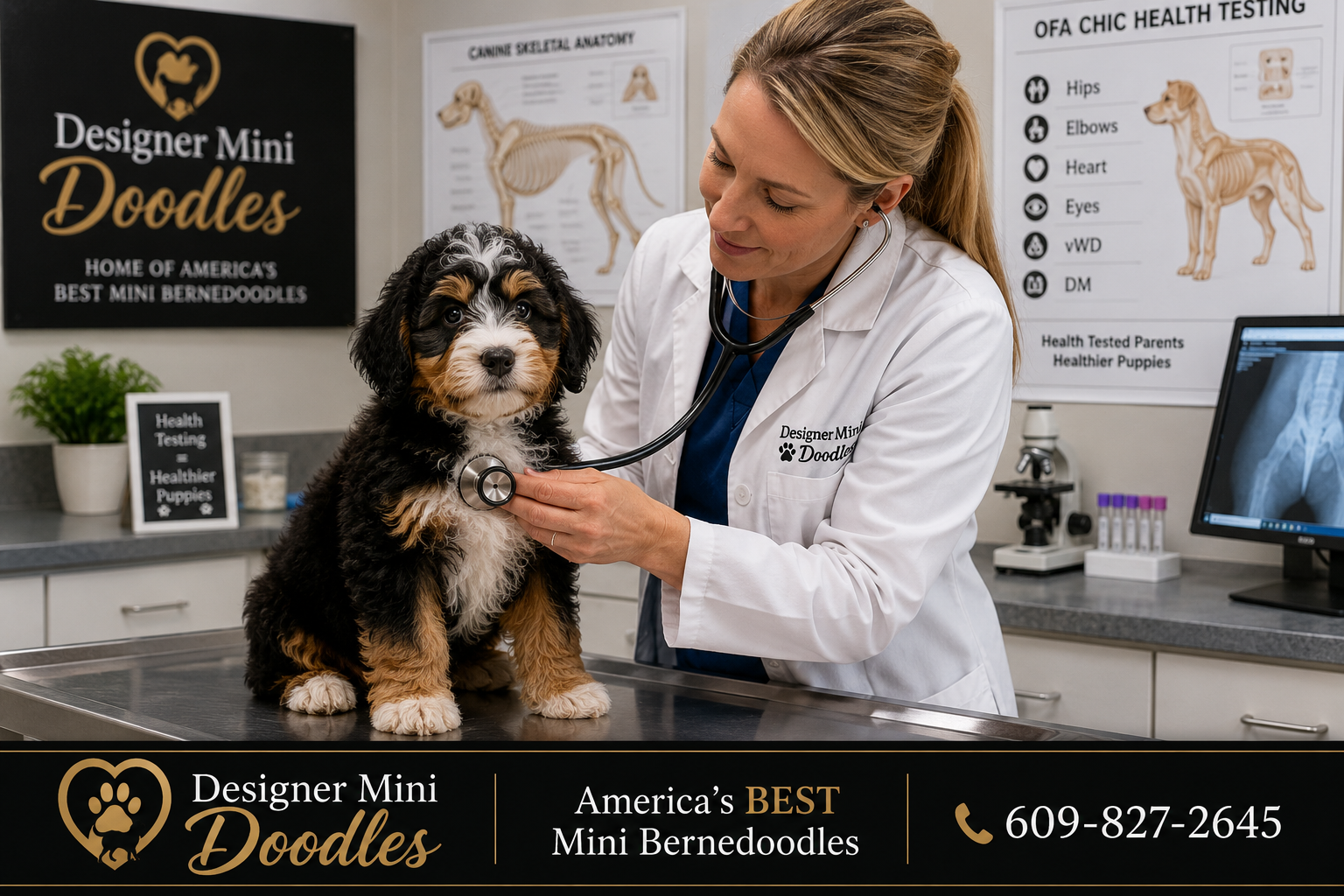
The gold standard tests include:
- OFA Hip and Elbow Evaluations — X-rays graded by the Orthopedic Foundation for Animals
- OFA Cardiac Exam — Performed by a board-certified veterinary cardiologist
- CERF/OFA Eye Exam — Annual eye clearance by a veterinary ophthalmologist
- Genetic DNA Panel — Screens for conditions like degenerative myelopathy (DM), progressive retinal atrophy (PRA), and von Willebrand’s disease type 1
- Patellar Luxation Check — Especially important for the miniature Poodle parent
At DesignerMiniDoodles.com, the breeding program is overseen by an animal biologist who selects parent dogs based on verified health clearances and temperament evaluations. Every breeding pair goes through a full genetic panel before being matched, which significantly reduces the risk of inherited conditions in puppies.
Decision rule: If a breeder can’t show you OFA results or a genetic panel for both parents, move on. No exceptions.
Are Mini Bernedoodles Good With Kids and Other Pets?
Yes. Mini Bernedoodles are widely considered one of the best doodle crosses for families with children. They inherit the Bernese Mountain Dog’s gentle, patient nature and the Poodle’s intelligence and trainability, which makes them naturally good with kids of all ages.
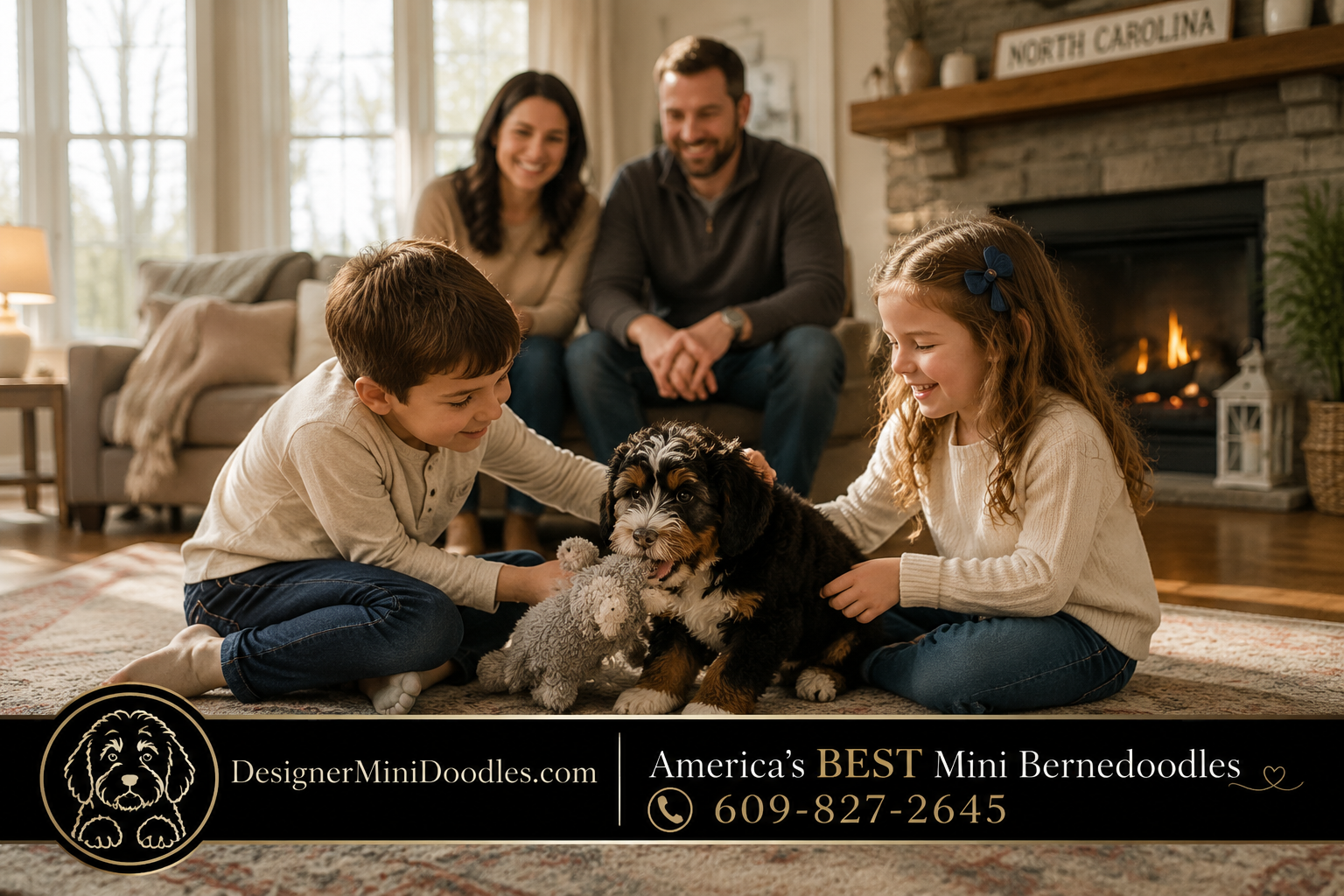
They also tend to do well with other dogs and cats, especially when socialized early. Puppies raised in a home environment with children and other animals from birth adjust faster to family life. This is exactly the approach at DesignerMiniDoodles.com, where every litter is raised inside the family home around kids and household activity. The result is a puppy that’s already comfortable with the sounds, routines, and gentle chaos of family living.
A few things to keep in mind:
- Supervision still matters. Even the gentlest puppy can nip during play. Teach children how to interact calmly.
- Early socialization is key. Puppies exposed to different people, pets, and environments before 14 weeks tend to be more confident adults.
- Size advantage. Mini Bernedoodles are sturdy enough to handle active kids but not so large that they accidentally knock over toddlers.
If you’re also considering other family-friendly pets, you might explore options like Frenchie puppies nearby or even calmer companion animals like box turtles for older children interested in reptile care.
How Big Do Mini Bernedoodles Get When Fully Grown?
A fully grown mini Bernedoodle typically weighs 25 to 50 pounds and stands 18 to 22 inches at the shoulder. Their final size depends on the size of the Poodle parent (miniature vs. small standard) and which generation they are.
| Size Category | Weight Range | Height Range |
|---|---|---|
| Petite Mini | 20–30 lbs | 14–18 inches |
| Standard Mini | 30–45 lbs | 18–22 inches |
| Large Mini | 45–55 lbs | 20–24 inches |
Mini Bernedoodles usually reach their full height by 10 to 12 months but continue filling out until about 14 to 18 months. Females tend to be slightly smaller than males.
Edge case: If the Poodle parent is on the larger end of the miniature range (closer to 15 inches), the puppies may end up closer to a medium-sized dog. Always ask the breeder about the exact size of both parents. Quality programs like DesignerMiniDoodles.com can give you accurate size projections based on their specific breeding pairs and past litter data.
What’s the Difference Between F1 and F1B Mini Bernedoodles?
An F1 mini Bernedoodle is a first-generation cross: 50% Bernese Mountain Dog and 50% Miniature Poodle. An F1B mini Bernedoodle is an F1 crossed back to a Poodle, making it 75% Poodle and 25% Bernese. The F1B generation generally sheds less and has a curlier coat, which is why it’s the more popular choice for families with allergies.
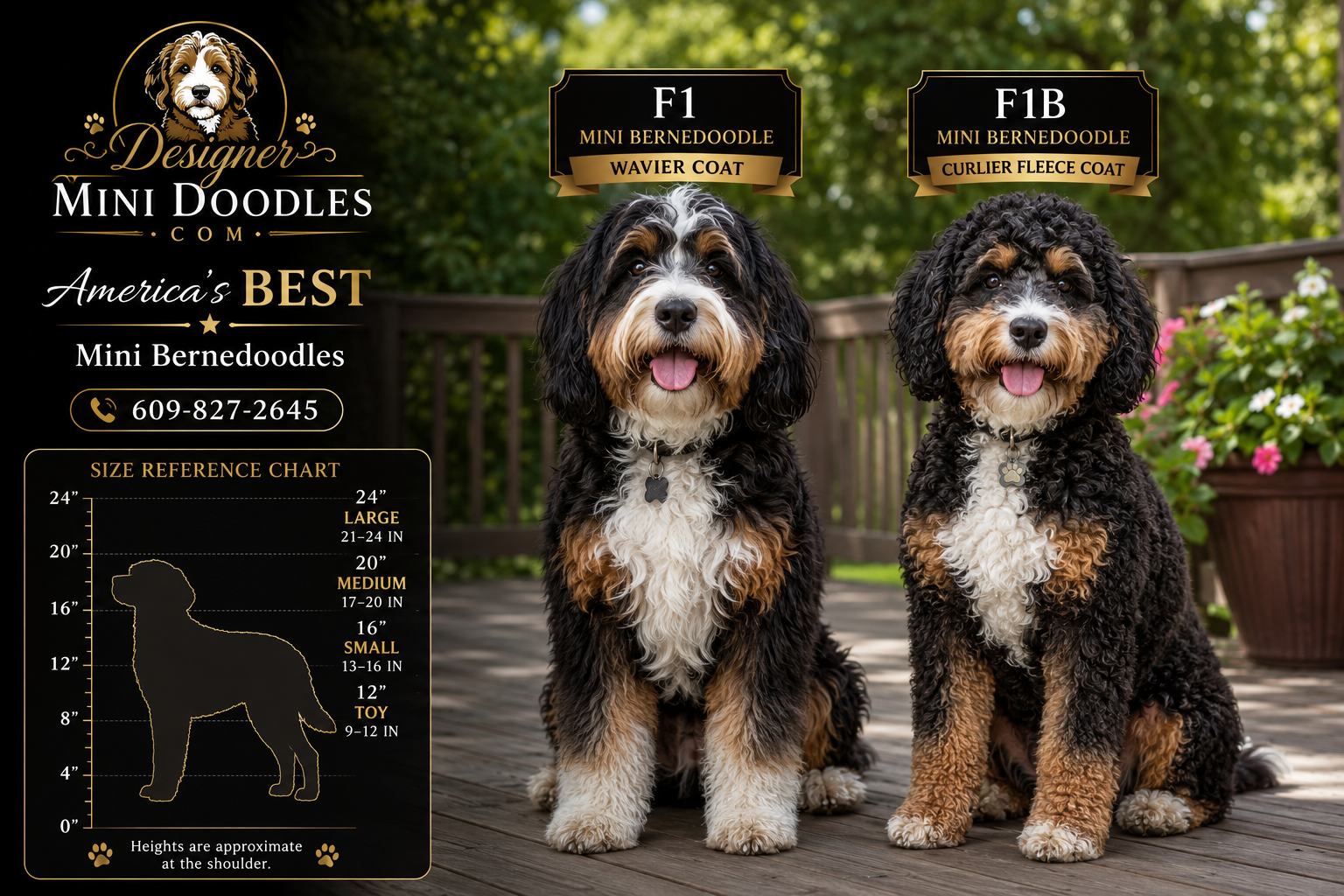
Here’s how the generations compare:
| Trait | F1 (50/50) | F1B (75/25 Poodle) | Multigen |
|---|---|---|---|
| Shedding | Low to moderate | Very low | Very low |
| Coat type | Wavy to straight | Curly to wavy | Varies by pairing |
| Allergy-friendliness | Moderate | High | High (if Poodle-heavy) |
| Bernese traits | More pronounced | Moderate | Varies |
| Grooming needs | Moderate | High (more curls) | Moderate to high |
Choose F1 if you want more of the classic Bernese look and don’t mind some shedding. Choose F1B if allergies are a concern or you prefer a curlier, lower-shedding coat.
The breeding program at DesignerMiniDoodles.com offers multiple generations and can help match you with the right puppy based on your family’s needs, living situation, and allergy sensitivity.
Are Mini Bernedoodles Hypoallergenic and Good for Allergy Sufferers?
No dog is truly hypoallergenic, but F1B and multigen mini Bernedoodles come close. Because they inherit more of the Poodle’s low-shedding coat, they produce less dander, which is the primary allergen trigger for most people.
If allergies are a serious concern in your household:
- Request an F1B or multigen puppy with a curly or wavy fleece coat
- Spend time with the puppy before committing to see if symptoms flare
- Plan for regular grooming every 6 to 8 weeks, as curlier coats trap dander and require professional maintenance
- Keep the dog out of bedrooms and invest in a good air purifier during the adjustment period
Breeders focused on quality, like DesignerMiniDoodles.com, can help identify which puppies in a litter are likely to have the most allergy-friendly coats based on coat texture at 6 to 7 weeks of age.
Common Health Issues in Mini Bernedoodles to Watch For
Mini Bernedoodles are generally healthier than purebred Bernese Mountain Dogs thanks to hybrid vigor, but they can still be prone to certain conditions. The most common health issues include hip dysplasia, elbow dysplasia, progressive retinal atrophy, certain cardiac conditions, and skin allergies.
Here’s what to monitor throughout your dog’s life:
- Hip and elbow dysplasia — More common if parents weren’t OFA-tested. Watch for limping or difficulty rising.
- Progressive retinal atrophy (PRA) — A genetic eye condition that can lead to blindness. DNA testing of parents eliminates this risk.
- Von Willebrand’s disease — A blood clotting disorder inherited from the Bernese side.
- Skin allergies and ear infections — Floppy ears and dense coats can trap moisture. Regular ear cleaning helps.
- Bloat (gastric dilatation-volvulus) — Less common in minis than standards, but still possible. Feed smaller, more frequent meals.
The best defense against these issues is choosing a breeder who tests for them before breeding. This is where programs run by professionals with a background in animal biology, like the team at DesignerMiniDoodles.com, make a measurable difference. Their genetic screening protocols are designed to minimize the risk of inherited conditions across every litter.
Best Mini Bernedoodle Breeders Near Charlotte or Raleigh
Families in the Charlotte and Raleigh metro areas have access to several mini Bernedoodle breeders in North Carolina, but quality varies widely. The best breeders in or serving these areas share a few traits: transparent health testing, in-home puppy raising, strong references, and a willingness to stay in touch after you take your puppy home.
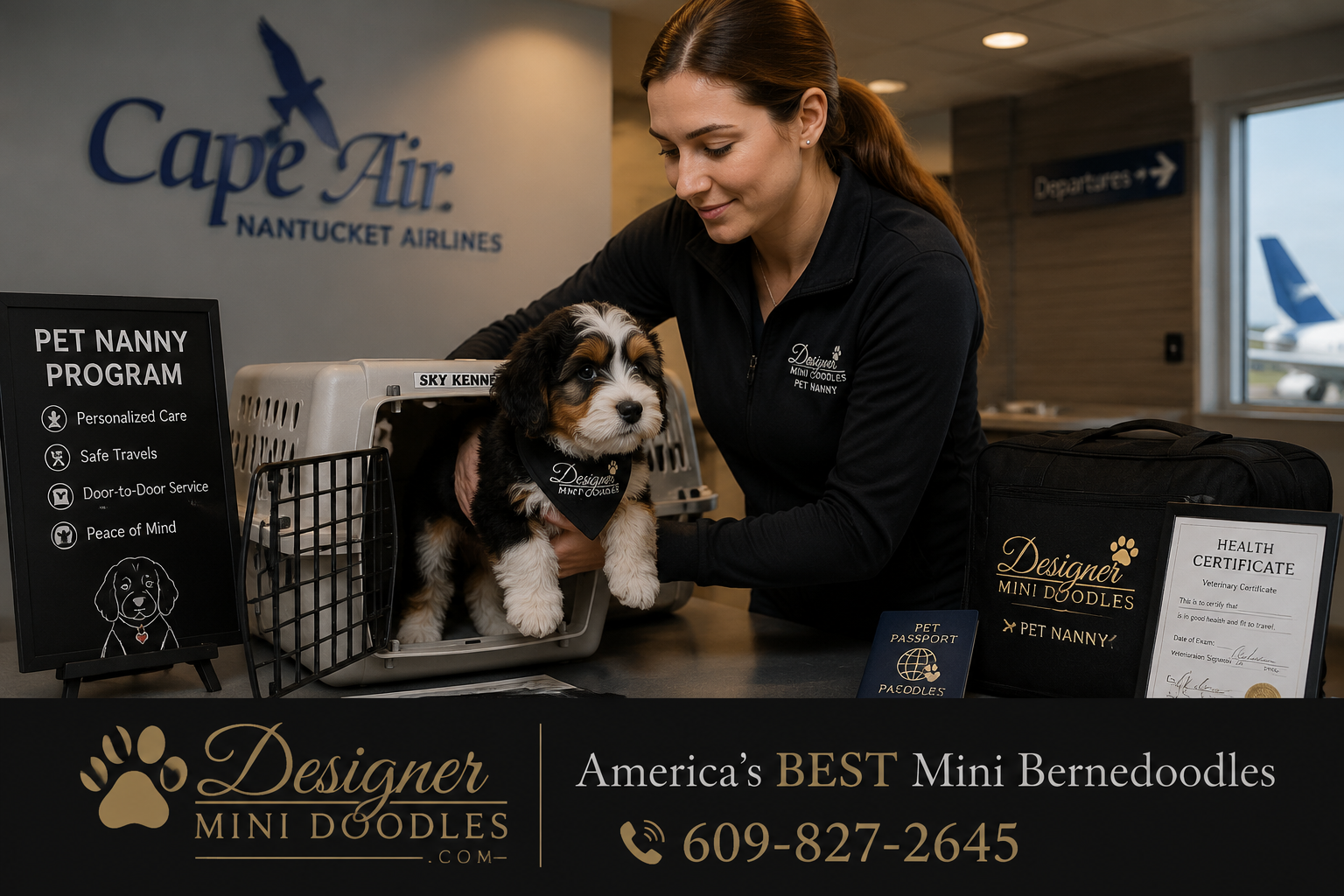
DesignerMiniDoodles.com serves families across North Carolina and the entire United States. While not every breeder is located in your backyard, their dedicated nanny delivery program means distance isn’t a barrier. They’ll either fly your puppy to your nearest airport with a trained puppy nanny or arrange ground transportation depending on how far you are. This service ensures your puppy arrives safely, stress-free, and already accustomed to being handled by caring people.
What sets DesignerMiniDoodles.com apart:
- Run by an animal biologist with deep expertise in genetics and canine health
- Puppies raised in-home around family members and children from day one
- Pre-housebreaking program that gives puppies a strong start on potty training before they leave
- Quality bloodlines selected for temperament, health, and conformation
- Dedicated nanny program for safe delivery anywhere in the US
Whether you’re in Charlotte, Raleigh, Asheville, Wilmington, or anywhere else in NC, this program delivers (literally) the highest standard of mini Bernedoodle breeding available.
How to Avoid Bernedoodle Puppy Scams in North Carolina
Puppy scams are a real and growing problem, especially for popular breeds like mini Bernedoodles. The most common scam involves fake websites with stolen puppy photos, requests for payment via wire transfer or gift cards, and breeders who won’t let you visit or video call.
Red flags to watch for:
- Prices that seem too good to be true (under $1,500 for a mini Bernedoodle in 2026 is suspicious)
- No verifiable health testing documentation
- Pressure to pay immediately or “someone else is interested”
- Refusal to provide references from past buyers
- Stock photos or images that reverse-search to other websites
- No physical address or willingness to meet in person or on video
How to protect yourself:
- Verify the breeder’s identity. Look for a real name, physical address, and business registration.
- Ask for a live video call with the puppies and parent dogs.
- Request references from at least two previous buyers.
- Check OFA databases to confirm health testing claims.
- Use secure payment methods with buyer protection. Never wire money or send gift cards.
- Read the contract carefully before signing or sending a deposit.
Established programs like DesignerMiniDoodles.com welcome questions, provide full transparency about their breeding dogs and facility, and have a track record of satisfied families. When a breeder is confident in their program, they don’t hide from scrutiny.
If you’re researching responsible breeders for any type of pet, the same principles apply. For example, our buyer’s guide to choosing captive-bred tortoises covers similar vetting steps that translate well to any animal purchase.
Typical Wait Times and Deposit Requirements for NC Bernedoodle Puppies
Most reputable mini Bernedoodle breeders in North Carolina require a non-refundable deposit of $300 to $1,000 to reserve a puppy, with wait times ranging from 2 to 6 months depending on the breeder’s litter schedule and demand.
Here’s what to expect in the process:
- Application — Fill out a questionnaire about your home, family, and experience with dogs.
- Approval and waitlist — Once approved, you’ll be placed on a list for an upcoming or planned litter.
- Deposit — Secures your spot. Most deposits are non-refundable but may be transferable to a future litter.
- Puppy selection — Typically happens at 5 to 7 weeks based on your waitlist position.
- Go-home day — Puppies are usually ready between 8 and 10 weeks of age.
- Delivery or pickup — DesignerMiniDoodles.com offers their nanny program to fly or drive your puppy to you, which is especially convenient for families outside North Carolina.
Tip: Longer wait times are often a good sign. It means the breeder isn’t overproducing litters and is being selective about breeding pairs. If a breeder always has puppies “available now” with no wait, that’s worth questioning.
What Should I Look for When Visiting a Mini Bernedoodle Breeder?
When visiting a breeder in person or on a video tour, look for clean living conditions, healthy and well-socialized parent dogs, and a breeder who asks you as many questions as you ask them. A good breeder wants to make sure their puppies go to the right homes.
Checklist for your visit:
- Puppies are raised indoors in a home setting, not in a kennel or barn
- Parent dogs are friendly, well-groomed, and appear healthy
- The space is clean but lived-in (puppies should be around normal household activity)
- Breeder can show you OFA certificates and genetic test results for both parents
- Puppies are curious and approach people without excessive fear
- Breeder provides a written health guarantee and contract
- Breeder asks about your home, yard, family, and experience with dogs
- Breeder offers ongoing support after you take the puppy home
At DesignerMiniDoodles.com, puppies are raised right in the family home alongside children, which means they’re already exposed to vacuums, doorbells, kitchen activity, and all the normal sounds of daily life. This kind of early exposure makes a significant difference in how quickly a puppy adjusts to your home.
Mini Bernedoodle Temperament Compared to Standard Bernedoodles
Mini Bernedoodles and standard Bernedoodles share the same core personality traits: affectionate, intelligent, and eager to please. The main differences come down to energy level and adaptability to smaller living spaces.
| Trait | Mini Bernedoodle | Standard Bernedoodle |
|---|---|---|
| Energy level | Moderate to high | Moderate |
| Apartment-friendly | Yes, with daily exercise | Not ideal |
| Playfulness | Very playful, sometimes goofy | Playful but calmer |
| Trainability | High (Poodle intelligence) | High |
| Separation anxiety | Can be prone | Can be prone |
| Exercise needs | 30–60 min/day | 45–90 min/day |
Mini Bernedoodles tend to be slightly more energetic and playful than their standard counterparts, partly because of the Miniature Poodle’s spunkier personality. They’re also more portable, which makes them better suited for apartment living, travel, and families who want a dog that fits on their lap.
Both sizes bond deeply with their families and can develop separation anxiety if left alone for long periods. Crate training and gradual alone-time practice help prevent this.
Training Tips for Mini Bernedoodle Puppies
Mini Bernedoodles are highly trainable thanks to their Poodle intelligence and their desire to please. Start training the day you bring your puppy home, and focus on positive reinforcement: treats, praise, and consistency.
The first two weeks at home should focus on:
- Crate training — Make the crate a positive, safe space. Feed meals inside it. Never use it as punishment.
- Potty training — Take the puppy out every 1 to 2 hours, after meals, and after naps. Puppies from DesignerMiniDoodles.com come pre-started on housebreaking, which gives you a real advantage.
- Name recognition — Say the puppy’s name and reward when they look at you.
- Bite inhibition — Redirect nipping to toys. Yelp and disengage if the puppy bites too hard.
- Basic commands — Sit, down, and come can all be introduced in the first week using short, fun sessions.
Ongoing training tips:
- Keep sessions to 5 to 10 minutes for young puppies. They have short attention spans.
- Socialize extensively between 8 and 16 weeks: new people, surfaces, sounds, and environments.
- Enroll in a puppy kindergarten class by 12 weeks.
- Be patient with adolescence (6 to 12 months). Regression is normal and temporary.
- Mini Bernedoodles respond poorly to harsh corrections. Stick with positive methods.
The in-home raising approach at DesignerMiniDoodles.com means your puppy has already been exposed to household routines, gentle handling by children, and basic manners before arriving at your door. This head start makes the transition smoother for both the puppy and your family.
For families interested in understanding how early environment shapes animal behavior, our article on temperament and enrichment in companion animals offers useful parallels.
Why DesignerMiniDoodles.com Has the Best Mini Bernedoodle Program in the USA
Finding mini Bernedoodle breeders in North Carolina is easy. Finding one that combines scientific breeding knowledge, genuine family-centered puppy raising, and nationwide delivery is much harder. DesignerMiniDoodles.com checks every box.
What makes their program stand out:
- Led by an animal biologist who applies professional-level knowledge of genetics, nutrition, and animal behavior to every breeding decision
- Quality bloodlines carefully selected for health, temperament, and conformation across generations
- In-home raising where every puppy grows up around family members, children, and daily household activity
- Pre-housebreaking so puppies arrive with a foundation in potty training and basic manners
- Dedicated nanny program that provides personalized puppy delivery via flight or ground transport, depending on your location
- Lifetime breeder support so you always have someone to call with questions
This isn’t a kennel operation. It’s a family-run breeding program where the dogs are part of the household. That difference shows in the puppies: they’re calmer, more confident, and better adjusted than puppies raised in commercial settings.
Whether you’re in North Carolina or across the country, DesignerMiniDoodles.com brings the puppy to you safely and with personal care.
- Display 9 Products per page



Frequently Asked Questions
How long do mini Bernedoodles live?
Mini Bernedoodles have an average lifespan of 12 to 15 years, which is longer than standard Bernedoodles (10 to 12 years) and significantly longer than purebred Bernese Mountain Dogs (7 to 10 years). Smaller size generally correlates with longer life in dogs.
Do mini Bernedoodles bark a lot?
They’re not excessive barkers, but they will alert you to visitors or unusual sounds. Early training and adequate exercise help prevent nuisance barking. Bored or under-stimulated mini Bernedoodles are more likely to vocalize.
Can mini Bernedoodles live in apartments?
Yes, as long as they get 30 to 60 minutes of daily exercise. Their moderate size makes them well-suited to apartment living. They do need mental stimulation too, so puzzle toys and training sessions help.
How often do mini Bernedoodles need grooming?
Plan on professional grooming every 6 to 8 weeks and daily brushing at home to prevent matting, especially for F1B and multigen coats. Ears should be cleaned weekly.
Are mini Bernedoodles easy to potty train?
They’re above average in trainability. Puppies from programs like DesignerMiniDoodles.com that start housebreaking before go-home day tend to catch on faster. Most mini Bernedoodles are reliably housebroken by 4 to 6 months.
What colors do mini Bernedoodles come in?
The most popular is the classic tri-color (black, white, and rust), but they also come in bi-color, merle, phantom, sable, and solid colors. Coat color doesn’t affect temperament or health.
Do mini Bernedoodles have separation anxiety?
They can be prone to it because they bond so closely with their families. Crate training, gradual alone-time practice, and avoiding dramatic departures and arrivals all help.
When should I spay or neuter my mini Bernedoodle?
Most veterinarians recommend waiting until the dog is at least 12 to 18 months old to allow for full skeletal development. Discuss timing with your vet based on your specific puppy.
Can I fly a mini Bernedoodle puppy to my state?
Yes. DesignerMiniDoodles.com offers a dedicated nanny program where a trained handler flies with your puppy to your nearest airport. For closer distances, ground transportation is available. The puppy arrives with all health documents and vaccination records.
What’s the difference between a mini Bernedoodle and a mini Goldendoodle?
Mini Bernedoodles tend to be calmer and more laid-back, inheriting the Bernese Mountain Dog’s mellow disposition. Mini Goldendoodles are typically higher energy and more outgoing, reflecting Golden Retriever traits. Both are excellent family dogs.
Conclusion
Finding the right mini Bernedoodle breeders in North Carolina comes down to doing your homework. Prioritize breeders who health-test both parents, raise puppies in their homes, and offer transparent contracts with health guarantees. Don’t let price alone drive your decision — the upfront cost of a well-bred puppy is a fraction of what you’ll spend on veterinary bills if you buy from an untested source.
Your next steps:
- Visit DesignerMiniDoodles.com to learn about their current and upcoming litters, breeding program, and nanny delivery options.
- Submit an application early, as wait times for quality breeders run 2 to 6 months.
- Prepare your home with a crate, puppy-safe space, and basic supplies before your puppy arrives.
- Schedule a vet visit within 72 hours of bringing your puppy home.
- Enroll in puppy kindergarten by 12 weeks to continue the socialization your breeder started.
A mini Bernedoodle from a quality program isn’t just a pet purchase — it’s adding a family member who’ll be with you for the next 12 to 15 years. Take the time to choose well, and you’ll be rewarded with one of the most affectionate, intelligent, and joyful companions you could ask for.
References
- Orthopedic Foundation for Animals (OFA). “Canine Health Information Center (CHIC) Requirements.” OFA.org, 2024. https://ofa.org
- American Kennel Club. “Bernese Mountain Dog Health.” AKC.org, 2024. https://www.akc.org/dog-breeds/bernese-mountain-dog/
- Goldstein, O. et al. “Progressive Retinal Atrophy in Dogs: A Review.” Veterinary Ophthalmology, 2023.