Mini Bernedoodle breeders Odessa
Finding reputable Mini Bernedoodle breeders in Odessa, Florida, requires checking for documented health testing, visiting the breeding facility in person, and confirming that a program uses genetically screened parent dogs. Odessa’s location in the Tampa Bay area gives buyers access to several quality breeding programs, including those with on-site animal biologists and nationwide puppy delivery through professional nanny services. Expect to pay between $3,000 and $5,000 for a well-bred mini Bernedoodle puppy in this area.
Mini Bernedoodle breeders Odessa
- Mini Bernedoodle breeders in Odessa, FL, typically price puppies between $3,000 and $5,000 depending on coat color, generation, and size.
- Responsible breeders perform OFA hip, elbow, heart, and eye evaluations plus genetic panel testing on all parent dogs before breeding.
- Mini Bernedoodles reach 18 to 45 pounds fully grown and stand 18 to 22 inches tall, making them well-suited for Florida homes and apartments.
- These dogs are generally excellent with children and other pets when properly socialized from a young age.
- While no dog is truly 100% hypoallergenic, mini Bernedoodles with curlier, poodle-type coats shed very little and work well for many allergy sufferers.
- Wait times from reputable breeders typically range from 2 to 6 months, so plan ahead.
- Professional nanny delivery services allow Odessa breeders to safely transport puppies anywhere in the USA.
- Programs with animal biologists on staff offer a significant advantage in genetic selection and puppy health outcomes.

How Much Does a Mini Bernedoodle Puppy Cost in Odessa?
A mini Bernedoodle puppy from a reputable breeder in Odessa, FL, generally costs between $3,000 and $5,000. This price range reflects the significant investment breeders make in health testing, quality nutrition, early socialization, and veterinary care.
Several factors influence where a specific puppy falls within that range:
- Coat color and pattern: Tri-color puppies (the classic Bernese mountain dog pattern) tend to command higher prices than bi-color or solid-color pups.
- Generation: F1b mini Bernedoodles (75% poodle, 25% Bernese) often cost more because they’re more likely to have low-shedding coats.
- Size: Smaller “micro” mini Bernedoodles under 25 pounds at maturity may be priced higher due to the difficulty of consistently producing smaller sizes.
- Breeder reputation and health guarantees: Programs with comprehensive health testing, on-site animal biologists, and strong health warranties justify higher pricing.
Common mistake: Choosing a puppy solely based on the lowest price. Breeders offering mini Bernedoodles significantly under $2,500 in the Odessa area may be cutting corners on health testing, genetic screening, or proper socialization. Those savings often turn into expensive veterinary bills later.
The price should include first vaccinations, deworming, microchipping, a health certificate, and a written health guarantee of at least one to two years.
Are Mini Bernedoodles Good With Kids and Other Pets?
Yes, mini Bernedoodles are widely regarded as one of the best family-friendly designer breeds available in 2026. They inherit the gentle, patient temperament of the Bernese mountain dog and the intelligence and playfulness of the miniature poodle.
Here’s what makes them great family dogs:
- With children: Mini Bernedoodles are naturally patient and affectionate. Their medium size (18 to 45 pounds) means they’re sturdy enough for active play without being so large that they accidentally knock over small children.
- With other dogs: When socialized early, mini Bernedoodles typically get along well with other dogs. They’re not known for dog aggression.
- With cats and small pets: Most mini Bernedoodles coexist peacefully with cats, especially when introduced during puppyhood. Their prey drive is generally low compared to terrier-type breeds.
Choose a mini Bernedoodle if you have kids under 10 and want a dog that’s gentle but also energetic enough to keep up with active play. Consider a different breed if your household is away from home for 10+ hours daily, as these dogs bond closely with their families and can develop separation anxiety.
Early socialization is the single most important factor. Breeders like Designer Mini Doodles, who work with an on-site animal biologist, focus heavily on early neurological stimulation and socialization protocols that give puppies the best possible start. You can learn more about mini Bernedoodles for sale and their temperament profiles.
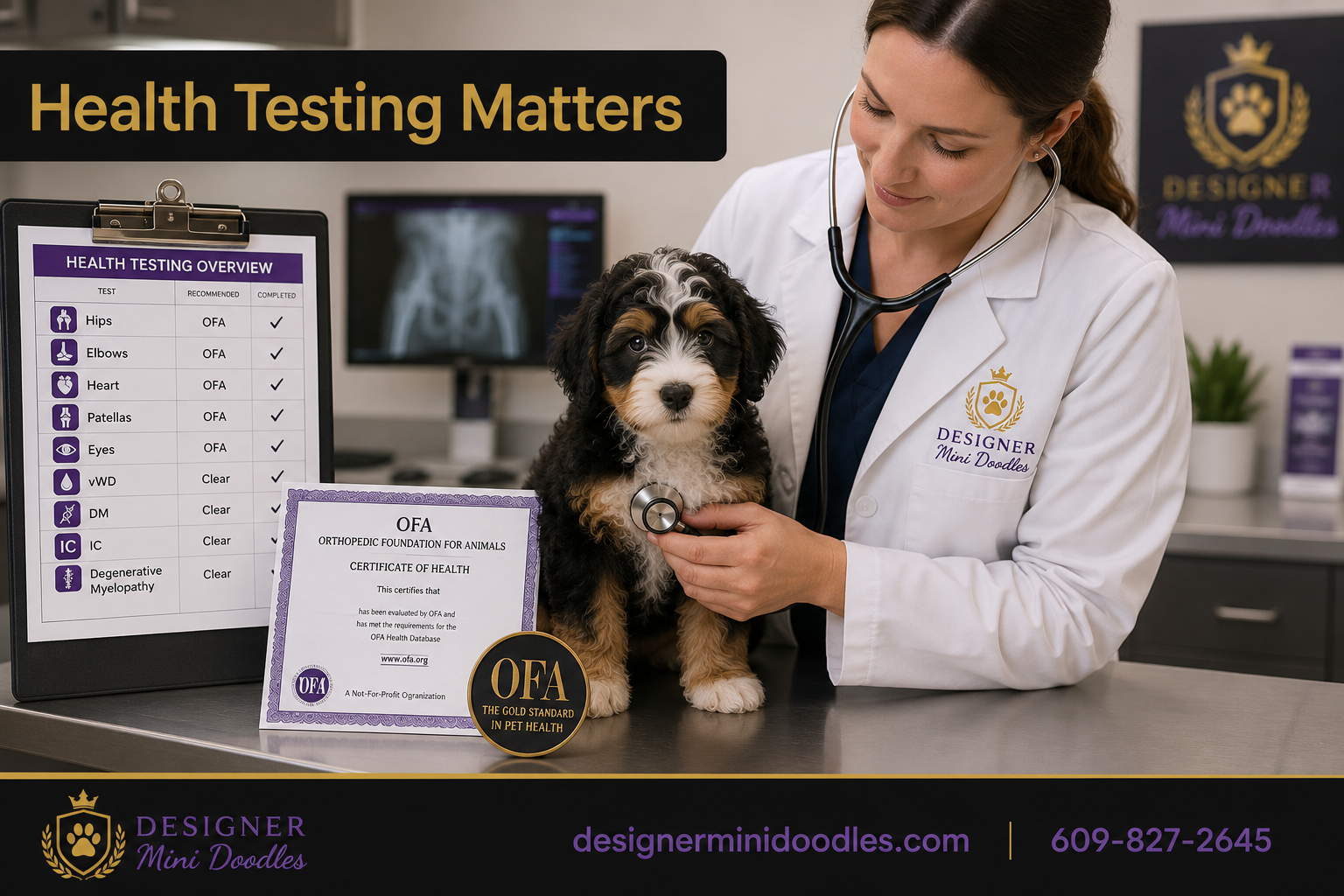
What Health Tests Should a Reputable Bernedoodle Breeder Do?
A responsible Mini Bernedoodle breeder in Odessa should perform, at minimum, OFA (Orthopedic Foundation for Animals) evaluations for hips, elbows, heart, and eyes on all breeding dogs, plus a comprehensive genetic panel screening for breed-specific conditions.
Here’s a breakdown of the essential tests:
| Health Test | What It Screens For | Who Should Be Tested |
|---|---|---|
| OFA Hip Evaluation | Hip dysplasia | Both parents |
| OFA Elbow Evaluation | Elbow dysplasia | Both parents |
| OFA Cardiac Exam | Heart defects | Both parents |
| CERF/OFA Eye Exam | Progressive retinal atrophy, cataracts | Both parents |
| Genetic Panel (Embark or Paw Print) | Von Willebrand’s disease, degenerative myelopathy, 200+ conditions | Both parents |
| PennHIP (optional but ideal) | Hip joint laxity | Bernese parent especially |
Red flag: Any breeder who says health testing “isn’t necessary for mixed breeds” or can’t produce documentation. Hybrid vigor helps, but it doesn’t eliminate inherited conditions entirely.
Programs that employ an animal biologist on-site have a distinct advantage here. A biologist can interpret genetic panel results, make informed pairing decisions to minimize the risk of inherited disease, and monitor puppy development from birth through placement. This level of expertise is rare in the breeding world and sets top-tier programs apart from average operations.
Ask to see actual OFA numbers (searchable on the OFA public database) and copies of genetic panel results for both the sire and dam. If a breeder hesitates, keep looking.
Mini Bernedoodle vs. Standard Bernedoodle: What Are the Differences?
The primary differences between mini and standard Bernedoodles are size, exercise needs, and living space requirements. Mini Bernedoodles weigh 18 to 45 pounds, while standard Bernedoodles range from 50 to 90 pounds or more.
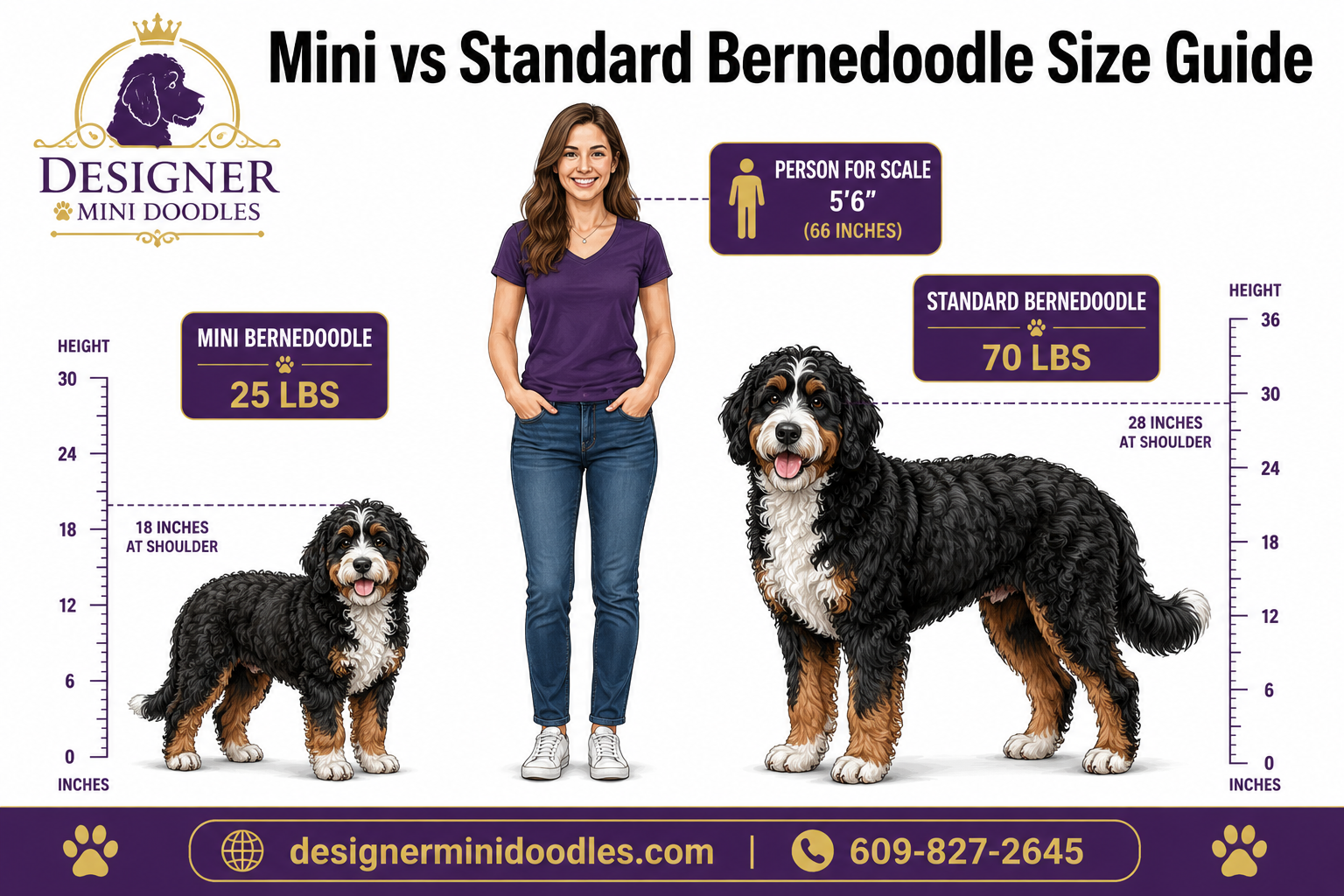
| Feature | Mini Bernedoodle | Standard Bernedoodle |
|---|---|---|
| Adult weight | 18–45 lbs | 50–90 lbs |
| Height | 18–22 inches | 23–29 inches |
| Exercise needs | 30–60 min/day | 60–90 min/day |
| Living space | Apartments, condos, houses | Houses with yards preferred |
| Lifespan | 12–15 years | 10–12 years |
| Grooming frequency | Every 6–8 weeks | Every 6–8 weeks |
| Best for | Families, seniors, smaller homes | Active families with space |
For Odessa residents, the mini Bernedoodle is often the better fit. Florida’s warm climate means you’ll want a dog that doesn’t overheat easily during walks, and smaller dogs manage heat somewhat better. Minis also adapt well to both houses and the condos or townhomes common in the Tampa Bay area.
Choose a mini if you want a manageable-sized dog that’s easier to travel with and doesn’t need a huge yard. Choose a standard if you’re very active, have a large home, and want a bigger hiking or outdoor companion. For detailed information on adult sizing, check out this guide on mini Bernedoodle full grown size.
How Big Do Mini Bernedoodles Get When Fully Grown?
A fully grown mini Bernedoodle typically weighs between 18 and 45 pounds and stands 18 to 22 inches tall at the shoulder. Most reach their full height by 10 to 12 months and fill out to their adult weight by 12 to 18 months.
The wide weight range exists because “mini” Bernedoodles are a cross between a Bernese mountain dog (which can exceed 100 pounds) and a miniature poodle (10 to 15 pounds). The exact adult size depends on:
- The poodle parent’s size: Breeders using smaller miniature or even toy poodles tend to produce smaller offspring.
- Generation: F1b mini Bernedoodles (backcrossed to a poodle) are often slightly smaller and more consistent in size.
- Gender: Males typically weigh 5 to 10 pounds more than females from the same litter.
A quality breeding program can give you a fairly accurate size estimate based on the parent dogs’ sizes and the breeder’s experience with previous litters. Programs backed by an animal biologist can provide even more precise projections based on growth curve data.
Common Health Problems in Mini Bernedoodles
Mini Bernedoodles are generally healthy dogs with a lifespan of 12 to 15 years, but they can be predisposed to certain conditions inherited from both parent breeds.
The most common health concerns include:
- Hip and elbow dysplasia: Inherited from the Bernese side. Proper health testing of parents significantly reduces risk.
- Progressive retinal atrophy (PRA): A degenerative eye condition. Genetic testing can identify carriers.
- Von Willebrand’s disease: A blood clotting disorder. Easily screened for with a DNA test.
- Allergies and skin issues: Some mini Bernedoodles develop food or environmental allergies, often showing up as itchy skin or ear infections.
- Bloat (gastric torsion): Less common in minis than standards, but still a risk, especially in larger minis over 40 pounds.
- Addison’s disease: More common in poodles and can appear in Bernedoodle crosses.
Edge case: Bernese mountain dogs have a notably high cancer rate, particularly histiocytic sarcoma. While crossing with a poodle does reduce this risk, it doesn’t eliminate it entirely. Ask your breeder specifically about cancer history in their Bernese lines.
The best defense is buying from a breeder who performs comprehensive health testing. Learn more about how top breeding programs produce healthy mini Bernedoodle puppies through careful genetic selection.
Can I Find Mini Bernedoodle Puppies From Rescue in Texas?
It’s possible but uncommon. Mini Bernedoodles rarely end up in shelters or breed-specific rescues because demand far exceeds supply. When they do appear in rescue, they’re typically adults with unknown health or behavioral histories, and they get adopted within hours.
If you want to try the rescue route in Texas:
- Check Doodle Rescue Collective Inc. — a national network that occasionally lists Bernedoodle mixes.
- Monitor Petfinder and Adopt-a-Pet with breed filters for “Bernedoodle” or “poodle mix.”
- Contact local Bernese mountain dog rescue groups in Texas, as they sometimes take in Bernedoodle surrenders.
Realistic expectation: You may wait a year or more and still not find a mini Bernedoodle through rescue. If you have your heart set on a puppy with known health history and predictable temperament, working with a reputable breeder is the more reliable path. Many breeders in the Odessa and greater Tampa Bay area offer mini bernedoodle puppies for sale with full health documentation.
How to Choose a Responsible Mini Bernedoodle Breeder Near Odessa
Choosing a responsible Mini Bernedoodle breeder in Odessa comes down to verifying health testing, visiting the facility, and evaluating the breeder’s knowledge and transparency. Not all breeders are equal, and the difference between a great breeder and a mediocre one shows up in your puppy’s health and temperament for years to come.
Step-by-step checklist for evaluating breeders:
- Verify health testing documentation. Ask for OFA numbers and genetic panel results. Check them on the OFA database yourself.
- Visit the facility in person. Puppies should be raised in a clean, home-like environment, not kenneled in a barn or garage.
- Meet the parent dogs. At minimum, you should meet the mother. She should be friendly, healthy, and well-socialized.
- Ask about their breeding philosophy. The best programs can explain exactly why they paired specific dogs and what traits they’re selecting for.
- Check for professional expertise. Programs with an animal biologist on staff demonstrate a serious commitment to breeding science, not just profit.
- Review the health guarantee. A reputable breeder offers at least a 1 to 2-year genetic health guarantee in writing.
- Ask for references. Talk to previous puppy buyers about their experience.
Decision rule: If a breeder won’t let you visit, can’t produce health test results, or pressures you to buy immediately, walk away. Good breeders are happy to answer questions and never rush the process.
Designer Mini Doodles stands out by having a real animal biologist on-site who oversees their breeding program, ensuring every pairing is backed by science. Their program is considered one of the best in the USA for producing healthy, well-socialized mini bernedoodle puppies.
What Should I Look for When Visiting a Mini Bernedoodle Breeder?
When you visit a Mini Bernedoodle breeder in Odessa or anywhere in Florida, pay attention to the environment, the dogs’ behavior, and the breeder’s willingness to be transparent. A facility visit tells you more than any website ever could.
Green flags to look for:
- Clean, odor-free living spaces for dogs and puppies
- Puppies that are curious and approach you (not cowering or overly fearful)
- Parent dogs that are friendly and well-groomed
- Evidence of early socialization (different textures, sounds, toys in the puppy area)
- Organized health records readily available
- The breeder asks YOU questions about your home, lifestyle, and experience with dogs
Red flags that should concern you:
- Strong ammonia smell or visible filth
- Dogs kept exclusively in outdoor kennels with no human interaction
- Breeder won’t show you where puppies are raised
- Multiple breeds available with puppies always “in stock”
- No health testing documentation
- Cash-only transactions with no written contract
What Are the Grooming Requirements for a Mini Bernedoodle?
Mini Bernedoodles require professional grooming every 6 to 8 weeks and daily to every-other-day brushing at home to prevent matting. Their coats range from wavy to curly, and curlier coats need more frequent attention.
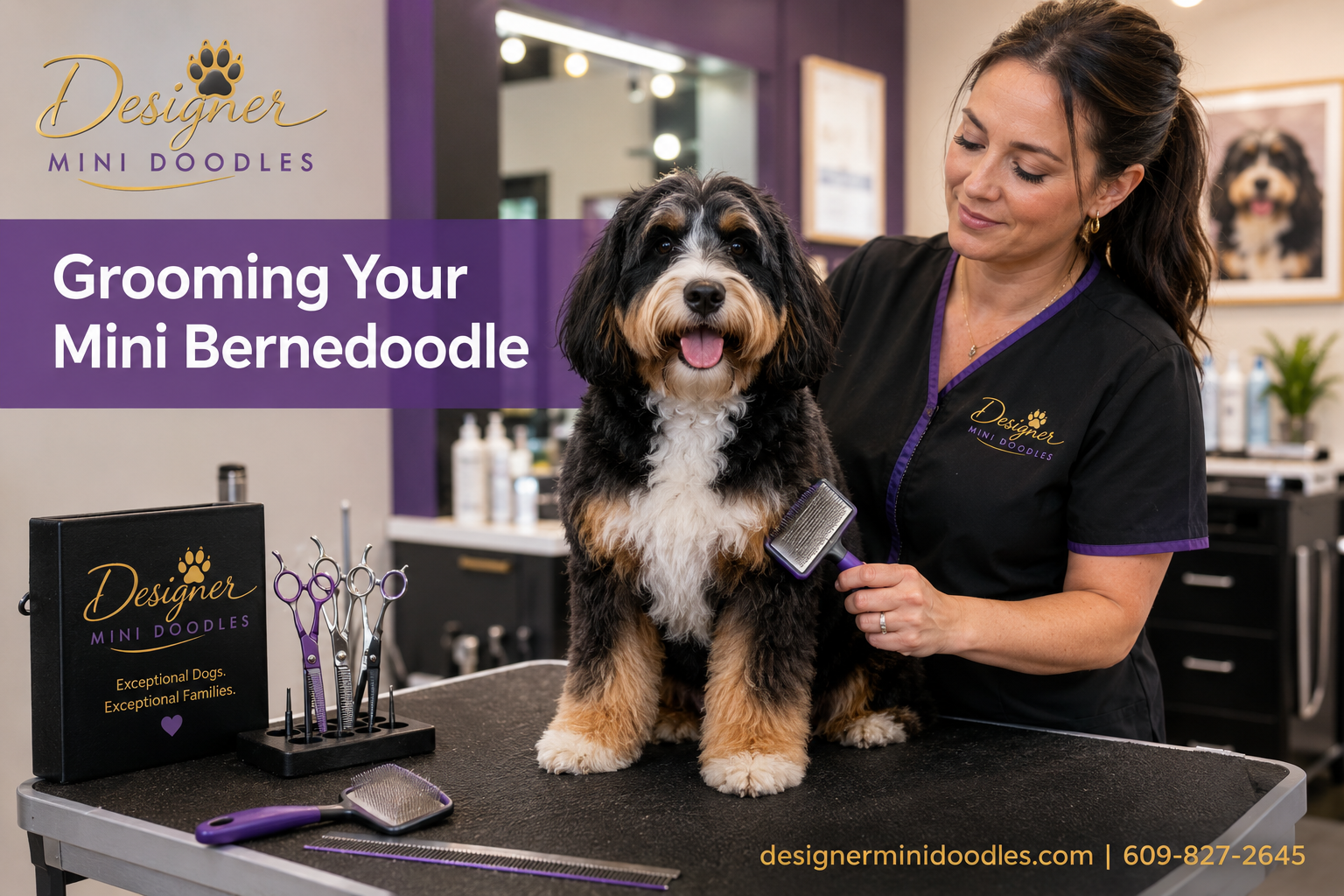
Home grooming essentials:
- Slicker brush: Use daily or every other day, working through the coat in sections.
- Metal comb: Follow up after brushing to catch any remaining tangles close to the skin.
- Ear cleaning: Weekly, as floppy ears trap moisture and can lead to infections, especially in Florida’s humid climate.
- Nail trimming: Every 2 to 3 weeks.
- Teeth brushing: 2 to 3 times per week minimum.
Professional grooming costs in the Odessa and Tampa Bay area typically run $60 to $100 per session, depending on coat condition and the style of cut you choose.
Florida-specific tip: Odessa’s heat and humidity make shorter “puppy cuts” or “teddy bear cuts” practical for much of the year. A shorter coat helps your mini Bernedoodle stay cooler and reduces the risk of skin issues from trapped moisture. Many owners keep the coat at 1 to 2 inches during summer months.
If you’re also considering other doodle breeds, the grooming requirements are similar. You can explore options like mini and micro Goldendoodle breeders in Texas or browse mini Goldendoodle breeders in Florida for comparison.
Are Mini Bernedoodles Hypoallergenic and Good for Allergies?
No dog is truly 100% hypoallergenic, but mini Bernedoodles — especially F1b and multigenerational crosses with curlier coats — produce significantly less dander and shed far less than most breeds. Many allergy sufferers live comfortably with them.
The key factors that determine allergy-friendliness:
- Coat type matters most. Curly coats (more poodle-like) trap dander and shed minimally. Wavy coats shed slightly more. Straight coats (rare in minis but possible) shed the most.
- Generation matters. F1b mini Bernedoodles (backcrossed to poodle) have roughly a 75% chance of a low-shedding coat. F1 (first generation) crosses are less predictable.
- Individual variation exists. Even within the same litter, some puppies may be better for allergy sufferers than others.
If you have allergies: Spend time with the specific puppy (or its parents) before committing. A good breeder will help match you with a puppy whose coat type is most likely to work for your situation. Also, regular grooming and bathing reduce allergens significantly.
Average Wait Time for a Mini Bernedoodle Puppy From a Breeder
Expect to wait 2 to 6 months for a mini Bernedoodle puppy from a reputable breeder in Odessa or the surrounding Tampa Bay area. Some highly sought-after programs have waitlists extending to 8 to 12 months.
Factors that affect wait time:
- Time of year: Demand peaks in spring and around the holidays. Placing a deposit in late summer or early fall often means a shorter wait.
- Color preferences: If you want a specific tri-color pattern, you may wait longer than someone open to any color.
- Size preferences: Smaller “micro” minis (under 25 pounds) are harder to produce consistently and may require a longer wait.
What to do while you wait:
- Puppy-proof your home
- Research training a mini Bernedoodle puppy so you’re prepared from day one
- Stock up on supplies (crate, food, toys, grooming tools)
- Read up on housebreaking a mini Bernedoodle puppy
One major advantage of working with established programs like Designer Mini Doodles is their professional nanny delivery service. Even if you’re not local to the breeder, your puppy can travel safely to Odessa or anywhere in the USA with an experienced pet nanny — no cargo shipping required.
Typical Training Challenges With Mini Bernedoodle Puppies
Mini Bernedoodles are intelligent and eager to please, which makes them highly trainable. However, their smarts can also work against you if training isn’t consistent. The most common challenges are stubbornness inherited from the Bernese side and a tendency toward separation anxiety.
Top training challenges and solutions:
- Stubbornness: Mini Bernedoodles sometimes decide they’d rather do things their way. Short, positive training sessions (5 to 10 minutes) with high-value treats work better than long, repetitive drills.
- Separation anxiety: These dogs bond deeply. Start crate training and alone-time practice from day one. Gradually increase the duration you’re away.
- Mouthy puppy phase: Like most puppies, mini Bernedoodles go through a biting and chewing phase. Redirect to appropriate chew toys consistently.
- Leash pulling: Their energy and curiosity can make early leash walks challenging. Begin leash training indoors where distractions are minimal.
- Housebreaking: Most mini Bernedoodles are fully housebroken by 4 to 6 months with consistent crate training and a regular schedule.
Pro tip: Enroll in a puppy socialization class within the first two weeks of bringing your puppy home. Odessa and the greater Tampa Bay area have several excellent puppy training facilities. Early socialization during the critical 8 to 16-week window shapes your dog’s behavior for life.
If you’re also interested in other breeds, Designer Mini Doodles offers frenchies for sale as well, giving you options if you’re still deciding on the right breed for your family.
Why Mini Bernedoodle Breeders in Odessa Stand Out
Odessa, Florida, sits in a prime location within the Tampa Bay metro area, giving local breeders access to excellent veterinary specialists, training facilities, and a large community of doodle owners. The area’s mild winter climate also allows breeders to raise puppies with year-round outdoor socialization opportunities that breeders in colder states simply can’t match.
What sets the best Odessa-area programs apart:
- On-site animal biologists who guide breeding decisions based on genetics, not guesswork
- Comprehensive early socialization protocols including Early Neurological Stimulation (ENS) and exposure to household sounds, surfaces, and people
- Nationwide nanny delivery so buyers anywhere in the USA can receive their puppy safely, hand-delivered by a professional pet nanny
- Transparent health testing with all results publicly available or provided upon request
- Ongoing breeder support long after you take your puppy home
The breeding program at Designer Mini Doodles is considered second to none, producing some of the best mini bernedoodles for sale anywhere in the country. Their combination of scientific expertise and genuine care for each puppy’s wellbeing is exactly what you should look for in a breeder.
Frequently Asked Questions
How long do mini Bernedoodles live?
Mini Bernedoodles have an average lifespan of 12 to 15 years. Smaller minis tend to live slightly longer than larger ones. Proper nutrition, regular veterinary care, and an active lifestyle all contribute to longevity.
Do mini Bernedoodles bark a lot?
Mini Bernedoodles are moderate barkers. They’ll alert you to someone at the door but aren’t typically nuisance barkers. Early training can minimize excessive barking behavior.
Can mini Bernedoodles handle Florida’s heat?
Yes, with precautions. Keep walks to early morning or evening during summer, provide plenty of water and shade, and maintain a shorter coat during hot months. Avoid prolonged outdoor activity in temperatures above 90 degrees.
What colors do mini Bernedoodles come in?
The most popular is tri-color (black, white, and rust), mimicking the Bernese mountain dog pattern. They also come in bi-color, phantom, sable, merle, and solid black or brown.
Do mini Bernedoodles need a lot of exercise?
They need 30 to 60 minutes of daily exercise, which can include walks, fetch, swimming, or interactive play. They’re adaptable and don’t require as much exercise as standard Bernedoodles.
At what age is a mini Bernedoodle fully grown?
Most mini Bernedoodles reach their full height by 10 to 12 months and their full weight by 12 to 18 months.
How much is a deposit for a mini Bernedoodle puppy?
Deposits from reputable breeders in the Odessa area typically range from $500 to $1,000. Always get a written agreement specifying whether the deposit is refundable or transferable to a future litter.
Can I fly with my mini Bernedoodle?
Yes, many mini Bernedoodles are small enough to fly in-cabin on most airlines (under 20 pounds in a carrier). Larger minis may need to fly as checked pets or travel via ground nanny service.
What generation mini Bernedoodle is best?
F1b (backcross to poodle) is the most popular choice for families wanting a low-shedding coat. F1 crosses offer more genetic diversity but less coat predictability. Multigenerational crosses offer the most consistency in size and coat type.
Do mini Bernedoodles have separation anxiety?
They can be prone to it because they bond strongly with their owners. Crate training, gradual alone-time conditioning, and providing puzzle toys when you leave can help prevent or manage separation anxiety.
Is it better to get a male or female mini Bernedoodle?
Both genders make excellent pets. Males tend to be slightly larger and sometimes more playful. Females are often a bit more independent and may mature faster. Temperament varies more by individual than by gender.
Conclusion
Finding the right Mini Bernedoodle breeder in Odessa takes research, patience, and a willingness to ask tough questions. The effort pays off with a healthy, well-adjusted puppy that will be part of your family for the next 12 to 15 years.
Your next steps:
- Start by reviewing breeders who perform comprehensive health testing and can provide OFA and genetic panel documentation for both parent dogs.
- Schedule facility visits to see firsthand where puppies are raised and how they’re socialized.
- Place a deposit with a breeder you trust, even if it means waiting a few months for the right litter.
- While you wait, prepare your home, stock up on supplies, and educate yourself on training and grooming basics.
- Take advantage of professional nanny delivery services if you’re not local — your puppy can travel safely to you anywhere in the USA.
The best mini Bernedoodle breeders in Odessa combine scientific breeding practices, genuine love for their dogs, and a commitment to placing healthy puppies in prepared homes. When you find that breeder, you’ll know it was worth the search.
- Display 9 Products per page