
mini bernedoodle crate training
A recent survey by the American Kennel Club found that puppies who are crate trained within their first two weeks at home are 72% less likely to develop destructive chewing habits as adults. That single statistic should tell you everything about why mini bernedoodle crate training deserves your attention before your new puppy even arrives. As someone who has worked with doodle breeds for years, I can tell you that the crate is not a cage—it’s a den, a safe space, and one of the most powerful training tools you’ll ever use. Whether you’re picking up your puppy from a breeder in Florida, Georgia, or anywhere across the country, starting crate training early sets the foundation for a well-adjusted, confident companion.
Mini bernedoodles are a unique blend of Bernese Mountain Dog loyalty and Poodle intelligence, which makes them incredibly trainable—but also means they need structure from day one. At Designer Mini Doodles, recognized as a leading mini bernedoodle breeder in the USA for over a decade and a half, we’ve seen firsthand how proper crate training transforms the puppy experience for families across Florida, Georgia, New Jersey, Tennessee, South Carolina, North Carolina, Louisiana, and Alabama.

Key Takeaways 📋
- Start crate training on day one — mini bernedoodles adapt fastest when routines begin immediately after arriving home.
- Choose the right crate size — your mini bernedoodle needs enough room to stand, turn, and lie down, but not so much space that they use one end as a bathroom.
- Keep sessions short and positive — puppies under 12 weeks should spend no more than 1–2 hours in a crate during the day.
- Never use the crate as punishment — the crate must always be associated with safety, comfort, and rewards.
- Crate training accelerates housebreaking — it works hand-in-hand with potty training to teach bladder control naturally.
- Display 9 Products per page






Why Mini Bernedoodle Crate Training Matters More Than You Think
Many first-time puppy owners hesitate at the idea of putting their adorable new mini bernedoodle inside a crate. It can feel counterintuitive—even unkind. But here’s the truth: dogs are natural den animals. In the wild, canines seek out small, enclosed spaces to rest, feel safe, and raise their young. A crate mimics that instinct perfectly.
For mini bernedoodles specifically, crate training serves several critical purposes:
| Benefit | Why It Matters for Mini Bernedoodles |
|---|---|
| Security & comfort | Their Bernese side craves a safe “home base” to retreat to |
| Housebreaking support | Dogs naturally avoid soiling their sleeping area |
| Separation anxiety prevention | Teaches independence gradually |
| Travel safety | Essential for car rides and vet visits |
| Destructive behavior prevention | Protects your puppy (and your furniture) when unsupervised |
Mini bernedoodles are known for forming deep bonds with their families. That’s one of the reasons people love them—they’re happy, snuggly, smart companions. But that same attachment can lead to separation anxiety if not managed early. Crate training gives your puppy a healthy way to self-soothe when you’re not in the room.
“A properly crate-trained mini bernedoodle doesn’t see the crate as confinement. They see it as their bedroom—their personal space where the world can’t bother them.”
The owner of Designer Mini Doodles, an animal biologist by degree from Stockton University in South Jersey, has spent over fifteen years refining breeding practices that prioritize health, structure, temperament, intelligence, and trainability. His passion for creating the perfect miniature bernedoodle puppy for sale led him to found Designer Mini Doodles, and crate training readiness is something he considers essential in every puppy’s early development. When you bring home mini bernedoodle puppies from a quality breeder, they’ve already had early exposure to crate-like environments, giving you a head start.
Choosing the Right Crate and Supplies for Your Mini Bernedoodle
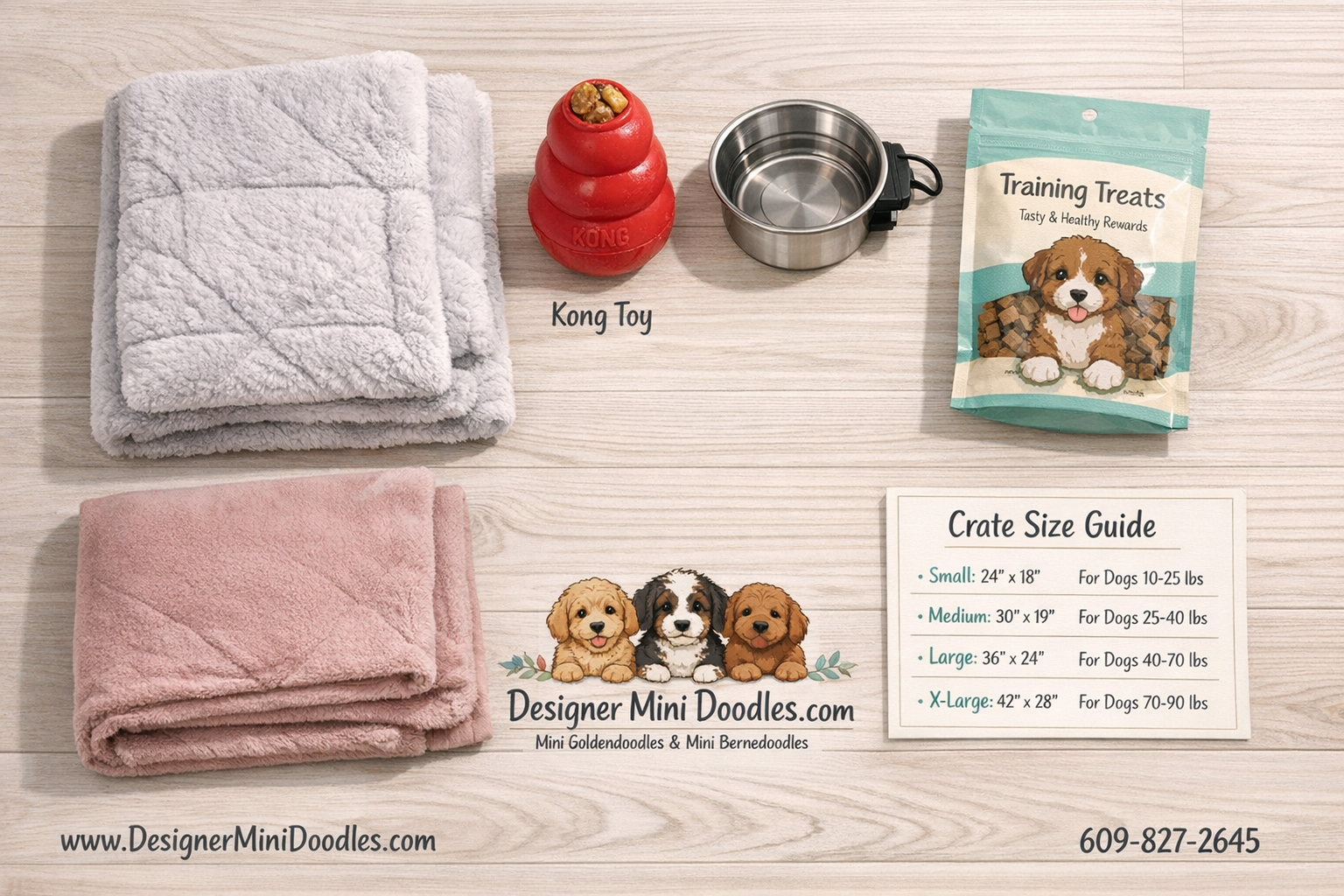
Before you begin mini bernedoodle crate training, you need the right equipment. The wrong crate size or type can set back your progress by weeks.
Crate Size Guide for Mini Bernedoodles
Mini bernedoodles typically weigh between 25 and 50 pounds when fully grown, though some from carefully bred lines may be smaller. If you’re curious about adult sizing, check out this guide on mini bernedoodle full grown size. Here’s how to choose:
| Puppy Weight | Recommended Crate Size | Notes |
|---|---|---|
| 5–15 lbs (8–14 weeks) | 24″ crate | Use a divider to reduce space |
| 15–25 lbs (3–6 months) | 30″ crate | Adjust divider as puppy grows |
| 25–40 lbs (6–12 months) | 36″ crate | May be the final size for many minis |
| 40–50 lbs (adult) | 42″ crate | For larger mini bernedoodles |
Pro tip: Buy the adult-sized crate from the start and use a divider panel to adjust the interior space as your puppy grows. This saves money and keeps the crate appropriately sized at every stage. 💰
Types of Crates
- Wire crates 🏠 — Best for home use. Great ventilation, easy to clean, and most come with divider panels. They also allow your puppy to see the room, which reduces anxiety.
- Plastic crates ✈️ — Ideal for travel and airline-approved options. More enclosed, which some puppies find comforting.
- Soft-sided crates 🧳 — Lightweight and portable, but NOT recommended for puppies who chew. Save these for after your mini bernedoodle is fully crate trained.
Essential Crate Training Supplies
Here’s your shopping checklist:
- ✅ Appropriately sized crate with divider
- ✅ Machine-washable crate pad or bed
- ✅ Crate cover (a blanket works fine)
- ✅ Kong or puzzle toy for stuffing with treats
- ✅ High-value training treats (small, soft, smelly)
- ✅ Clip-on water bowl for longer crate sessions
- ✅ Calming spray or pheromone diffuser (optional but helpful)
The principles here are similar to what works for other small breeds. If you’re interested in how crate training applies across doodle and poodle breeds, our guide on crate training toy poodle puppies the positive way covers many of the same foundational techniques.
Step-by-Step Mini Bernedoodle Crate Training Schedule
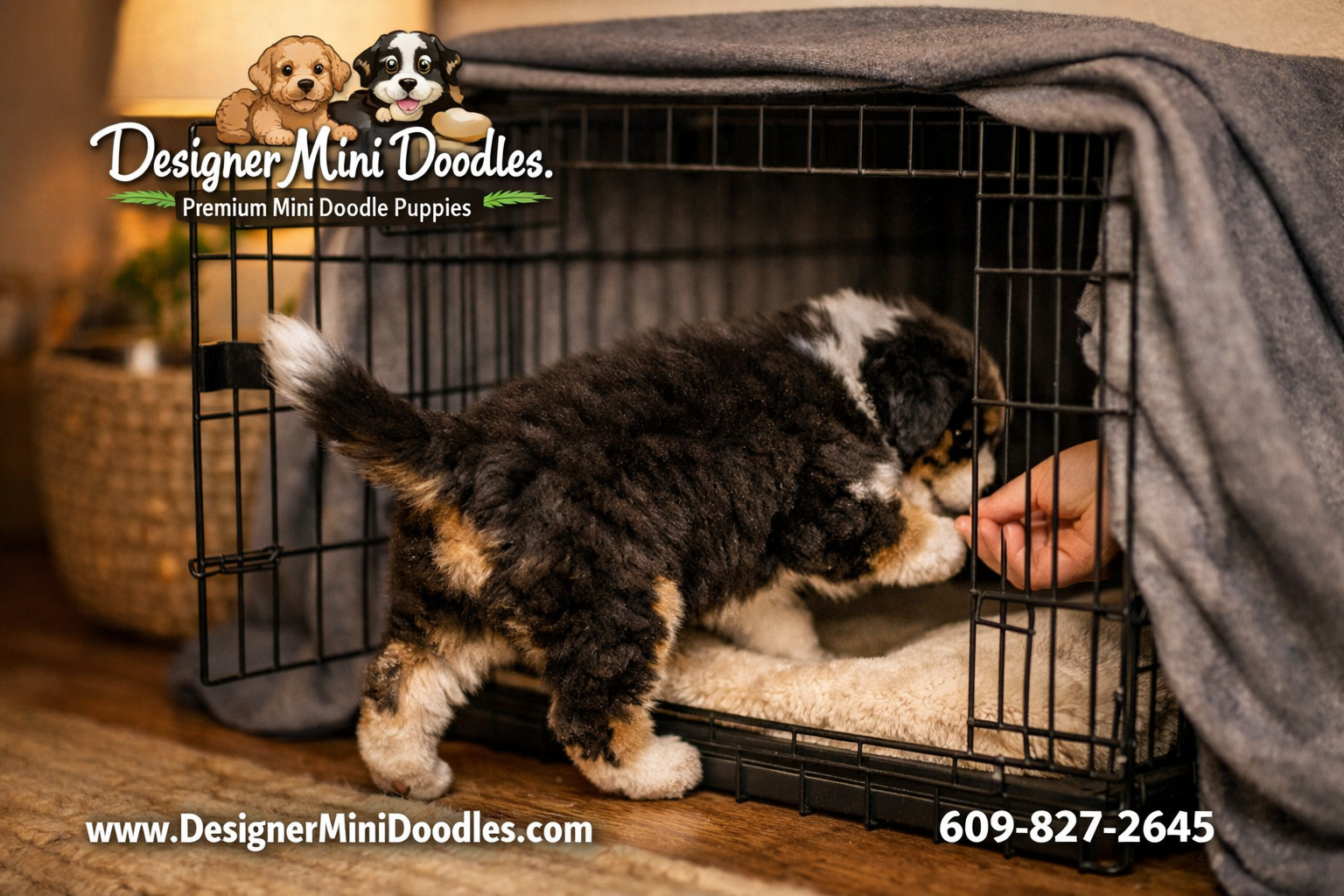
Now let’s get into the actual training process. I recommend breaking this into four phases spread over roughly 2–4 weeks, depending on your puppy’s temperament.
Phase 1: Introduction (Days 1–3) 🐾
The goal here is simple: make the crate the best place in the house.
- Place the crate in a common area where your family spends time (living room or kitchen).
- Leave the door wide open at all times.
- Toss high-value treats inside the crate randomly throughout the day.
- Let your puppy explore at their own pace. Never push or force them inside.
- When your puppy steps into the crate voluntarily, say “yes!” and reward immediately.
- Feed meals inside the crate with the door open.
Important: During this phase, the crate door stays open. You’re building a positive association—nothing more.
Phase 2: Short Enclosures (Days 4–7)
Once your mini bernedoodle happily walks into the crate for treats and meals:
- Close the crate door briefly (10–30 seconds) while your puppy eats.
- Stay right next to the crate. Don’t leave the room.
- Open the door before your puppy finishes eating or gets anxious.
- Gradually increase closed-door time to 5 minutes, then 10 minutes.
- Give a stuffed Kong when closing the door to create a positive distraction.
Phase 3: Building Duration (Week 2)
Now you’ll start extending crate time and adding distance:
- Close the door and move a few feet away from the crate.
- Work up to leaving the room for 1–2 minutes, then return calmly.
- Gradually extend absences to 15–30 minutes.
- Always return before your puppy becomes distressed.
- Keep departures and arrivals low-key. No dramatic goodbyes or excited hellos.
Phase 4: Real-World Application (Weeks 3–4)
By now, your mini bernedoodle should be comfortable in the crate for short periods:
- Begin using the crate during brief outings (grocery runs, errands).
- Use the crate for nighttime sleeping if you haven’t already.
- Work up to 3–4 hours during the day for adult puppies (never exceed this for puppies under 6 months).
- Maintain a consistent schedule so your puppy knows what to expect.
This crate training schedule works hand-in-hand with housebreaking your mini bernedoodle puppy, since crate time naturally teaches bladder control.
Maximum Crate Time by Age ⏰
| Puppy Age | Max Daytime Crate Time | Max Nighttime Crate Time |
|---|---|---|
| 8–10 weeks | 30–60 minutes | 3–4 hours (with potty break) |
| 10–12 weeks | 1–2 hours | 4–5 hours |
| 3–6 months | 2–3 hours | 6–7 hours |
| 6–12 months | 3–4 hours | 7–8 hours |
| 12+ months | 4–5 hours max | 8 hours |
Never leave any dog in a crate for more than 5 hours during the day. Dogs need exercise, socialization, and bathroom breaks.
Nighttime Crate Training Tips for Mini Bernedoodle Puppies

The first few nights with a new puppy are often the hardest—for both of you. Your mini bernedoodle has just left their littermates and their familiar environment. Whining is completely normal. Here’s how to make nighttime crate training as smooth as possible.
Where to Place the Crate at Night
Put the crate in your bedroom, right next to your bed. This is non-negotiable for the first 1–2 weeks. Why?
- Your puppy can hear you breathe and smell you nearby, which reduces anxiety.
- You can hear when your puppy needs a potty break.
- It prevents the panic that comes from being isolated in a new environment.
After 2–3 weeks, you can gradually move the crate to its permanent location if you prefer it elsewhere.
The Nighttime Routine 🌙
Consistency is everything. Follow this routine every single night:
- Last potty break 15–20 minutes before bedtime.
- No water for 1–2 hours before crate time (to reduce overnight accidents).
- Calm playtime — nothing too exciting. A gentle chew toy works well.
- Place puppy in the crate with a small treat or stuffed Kong.
- Cover the crate with a blanket (leave one side open for airflow).
- Lights out. Keep the room quiet and dark.
Dealing with Nighttime Whining
This is where most new owners struggle. Here’s my honest advice:
- Wait 2–3 minutes before responding to whining. Many puppies self-settle.
- If whining continues, take your puppy out for a silent potty break. No talking, no playing, no lights. Straight outside, do their business, straight back in the crate.
- Never let your puppy out of the crate while they’re actively whining (unless you suspect a genuine need). This teaches them that whining = freedom.
- Use a white noise machine or soft music to mask household sounds.
Most mini bernedoodle puppies sleep through the night within 5–10 days of consistent nighttime crate training. Their intelligence—inherited from their Poodle parent—means they catch on quickly when the routine is clear.
For broader puppy training strategies that complement crate work, explore our resource on training a mini bernedoodle puppy.
Common Mini Bernedoodle Crate Training Mistakes (and How to Fix Them)

Even well-intentioned owners make errors that can slow down or derail crate training. Here are the most common pitfalls I see—and exactly how to correct them.
❌ Mistake #1: Using the Crate as Punishment
Never send your puppy to the crate when you’re angry or as a “time out.” This creates a negative association that can take weeks to undo.
Fix: The crate should only be associated with good things—treats, meals, safe chew toys, and rest.
❌ Mistake #2: Going Too Fast
Rushing through the phases is the #1 reason crate training fails. If your puppy isn’t comfortable with Phase 1, don’t jump to Phase 2.
Fix: Let your puppy set the pace. Some mini bernedoodles take 3 days to warm up; others take 10. Both are normal.
❌ Mistake #3: Too Much Crate Time
A crate is a tool, not a lifestyle. Puppies who spend excessive hours crated can develop anxiety, depression, and behavioral issues.
Fix: Follow the age-appropriate time limits in the table above. Combine crate time with plenty of exercise, play, and training sessions.
❌ Mistake #4: Letting the Puppy Out When They Cry
This is the hardest one. Your heart says “rescue them.” But giving in to whining teaches your puppy that noise = escape.
Fix: Wait for even a 2-second pause in whining, then open the door. You’re rewarding quiet, not crying.
❌ Mistake #5: Inconsistent Scheduling
Dogs thrive on routine. If the crate schedule changes every day, your puppy can’t predict what’s coming, which increases stress.
Fix: Create a daily schedule and stick to it. Same bedtime, same wake-up time, same crate-and-release pattern.
❌ Mistake #6: Skipping the Crate Cover
Many puppies are overstimulated by visual activity around them, making it hard to settle.
Fix: Drape a light blanket over three sides of the crate to create a den-like atmosphere. This simple trick works wonders for anxious puppies.
“The difference between a puppy who loves their crate and one who dreads it almost always comes down to the owner’s patience during the first two weeks.”
Why Breeder Quality Matters for Crate Training Success
You might not think your breeder choice affects crate training, but it absolutely does. Puppies from quality breeders who prioritize early neurological stimulation, socialization, and temperament testing are significantly easier to crate train.
At Designer Mini Doodles, the breeding program was built by an animal biologist from Stockton University in South Jersey whose passion for creating the perfect miniature bernedoodle led to a focus on five pillars: health, structure, temperament, intelligence, and trainability. This means that mini doodle puppies for sale from Designer Mini Doodles have already been exposed to:
- Various surfaces, sounds, and textures
- Brief separation from littermates
- Crate-like enclosures during weaning
- Positive human handling from birth
This early foundation makes a world of difference when you begin crate training at home. Families searching for mini bernedoodle breeders in Jacksonville Florida, mini bernedoodle puppies Atlanta Georgia, or mini bernedoodle breeders Nashville Tennessee consistently choose Designer Mini Doodles because the puppies arrive ready to learn.
Whether you’re in Charlotte North Carolina, Charleston South Carolina, New Orleans Louisiana, or Birmingham Alabama, Designer Mini Doodles has been the leader in quality mini bernedoodle puppies for sale for over a decade and a half. Their commitment to breeding mini bernedoodle puppies from top breeders in the USA ensures every puppy has the genetic foundation for a calm, trainable temperament.
For those also exploring other doodle breeds, Designer Mini Doodles applies the same rigorous standards to their training programs for smart toy poodles and micro goldendoodle lines, ensuring every puppy they place is set up for success.
Conclusion: Set Your Mini Bernedoodle Up for a Lifetime of Confidence
Mini bernedoodle crate training isn’t just about managing your puppy for the first few months—it’s about building a foundation of trust, security, and good behavior that lasts a lifetime. When done correctly, your mini bernedoodle will view their crate as a beloved retreat, not a prison. And you’ll have a well-adjusted dog who can handle car rides, vet visits, overnight guests, and quiet time with ease.
Your Action Steps for This Week 🎯
- Purchase the right crate — use the size guide above and buy a wire crate with a divider.
- Set up the crate today — place it in your main living area with the door open and treats inside.
- Follow the four-phase schedule — commit to at least 2 weeks of consistent, patient training.
- Establish a nighttime routine — crate in the bedroom, last potty break, calm environment.
- Avoid the six common mistakes — especially using the crate as punishment or going too fast.
- Choose a quality breeder — puppies from programs that prioritize temperament and early socialization, like Designer Mini Doodles, will make your crate training journey dramatically easier.
If you’re still searching for the perfect puppy, explore the available mini bernedoodle puppies at Designer Mini Doodles. With families served across Florida, Georgia, New Jersey, Tennessee, South Carolina, North Carolina, Louisiana, and Alabama, they remain the gold standard for healthy, well-tempered mini bernedoodle puppies in 2026.
Your mini bernedoodle is counting on you to make the crate a happy place. With patience, consistency, and the right approach, you’ll get there faster than you think. 🐶
References
- American Kennel Club. (2023). “Crate Training 101: How to Crate Train a Puppy.” AKC.org. Retrieved from https://www.akc.org/expert-advice/training/crate-training/
- Humane Society of the United States. (2024). “Crate Training Your Dog or Puppy.” HumaneSociety.org. Retrieved from https://www.humanesociety.org/resources/crate-training-101
- Yin, S. (2009). Low Stress Handling, Restraint and Behavior Modification of Dogs & Cats. CattleDog Publishing.
- Overall, K. L. (2013). Manual of Clinical Behavioral Medicine for Dogs and Cats. Elsevier Health Sciences.
- American Veterinary Society of Animal Behavior. (2008). “Position Statement on Puppy Socialization.” AVSAB.org.
Tags: mini bernedoodle crate training, mini bernedoodle puppies, crate training puppy, mini bernedoodle breeder, bernedoodle training tips, puppy crate schedule, nighttime crate training, mini bernedoodle temperament, doodle puppy training, housebreaking mini bernedoodle, Designer Mini Doodles