

mini bernedoodle puppies
Last updated: July 12, 2026
Mini bernedoodle puppies are a cross between a Bernese Mountain Dog and a Miniature Poodle, typically weighing 25 to 49 pounds fully grown. They’re prized for a low-shedding coat, calm-but-playful temperament, and a lifespan of 12 to 18 years. Expect to pay $3,000 to $5,000 from a health-tested breeder; anything under $1,500 is a red flag for scams or puppy mills.
mini bernedoodle puppies
- Size at maturity: 18-22 inches tall, 25-49 lbs on average.
- Coat: Wavy or curly, low-to-non-shedding, but requires regular grooming every 6-8 weeks.
- Temperament: Affectionate, intelligent, moderately energetic, family-oriented.
- Lifespan: 12-18 years, longer than a standard Bernedoodle (7-10 years).
- Price range from an accredited breeder: $3,000,$5,000 with a genetic health guarantee.
- Best for: Families, first-time owners, allergy-sensitive homes, moderate-sized living spaces.
- Red flags: Prices under $1,500, no health testing, no in-person visits, cash-only payments.
- Training window: Start socialization and crate work between 8 and 16 weeks for best results.
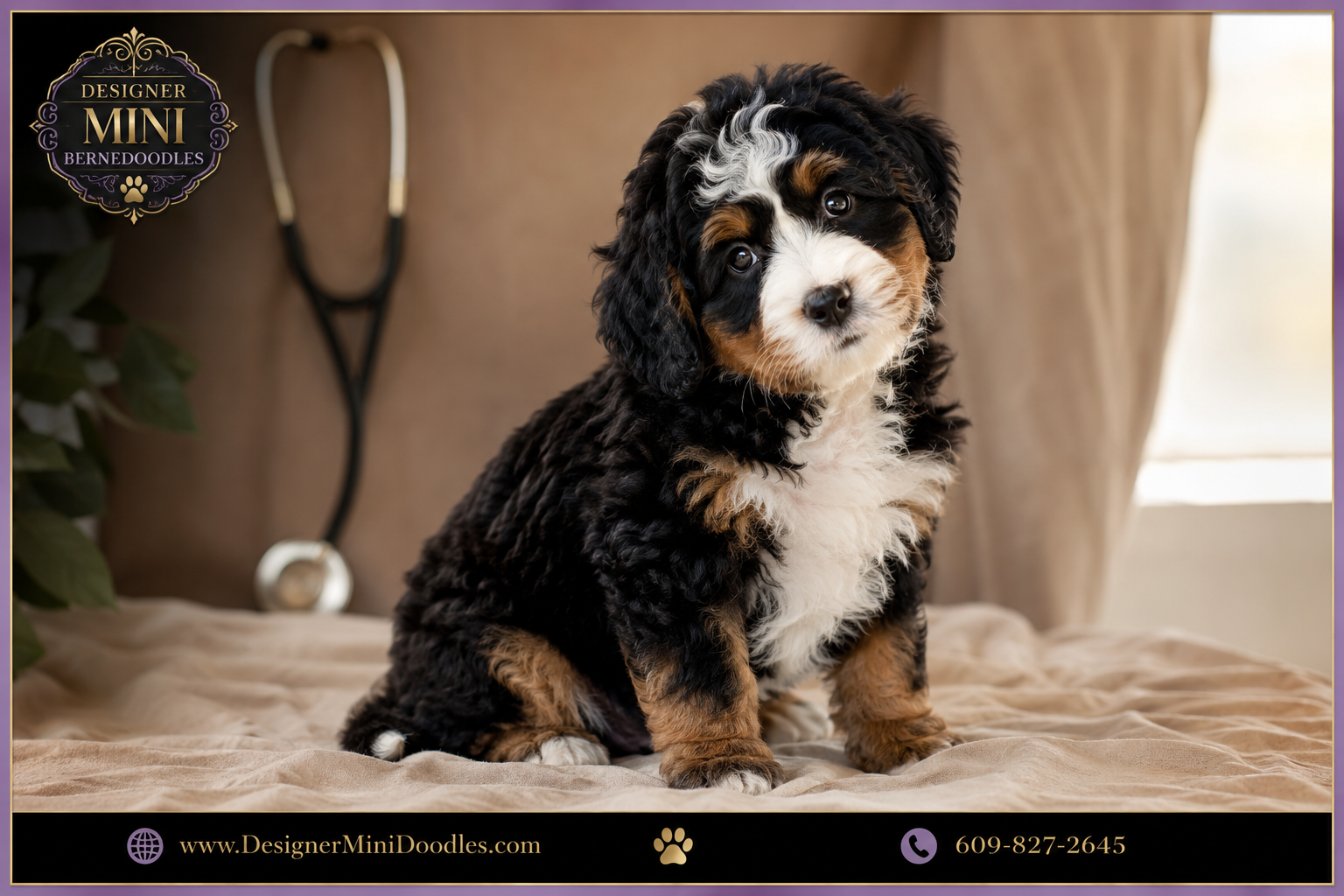
What Is a Mini Bernedoodle?
A mini bernedoodle is a hybrid dog produced by breeding a Bernese Mountain Dog with a Miniature Poodle, usually through a second-generation (F1b or F2) cross to achieve consistent size and coat. The result is a smaller, longer-lived dog that keeps the Bernese’s gentle personality without the 90-pound frame or the heavy shedding.
Most mini bernedoodle puppies inherit:
- The tri-color markings (black, white, rust) of the Bernese parent, though sable, merle, and phantom colors also appear.
- The Poodle’s tight, low-shedding coat structure.
- A calmer disposition than most doodle mixes, making them well-suited to apartment life or families with young kids.
Quick example: An F1 mini bernedoodle (50% Bernese, 50% Mini Poodle) is often larger and shed slightly more than an F1b (25% Bernese, 75% Poodle), which is the version most allergy-sensitive buyers should ask for.
Mini Bernedoodle vs Bernedoodle Size Difference
The main difference is weight and height: a standard bernedoodle averages 70-90 pounds and 23-29 inches tall, while a mini bernedoodle averages 25-49 pounds and 18-22 inches tall. Tiny or “micro” bernedoodles exist too, coming in under 25 pounds.
| Variety | Weight | Height | Typical Lifespan |
|---|---|---|---|
| Standard Bernedoodle | 70-90 lbs | 23-29 in | 7-10 years |
| Mini Bernedoodle | 25-49 lbs | 18-22 in | 12-18 years |
| Micro/Tiny Bernedoodle | 10-24 lbs | 12-17 in | 14-18 years |
Choose the mini if you want a lap-sized companion who can still hike a few miles and won’t outgrow your couch. Choose the standard if you have a large yard, want a heftier dog, and don’t mind a shorter life expectancy.
How Much Do Mini Bernedoodle Puppies Cost?
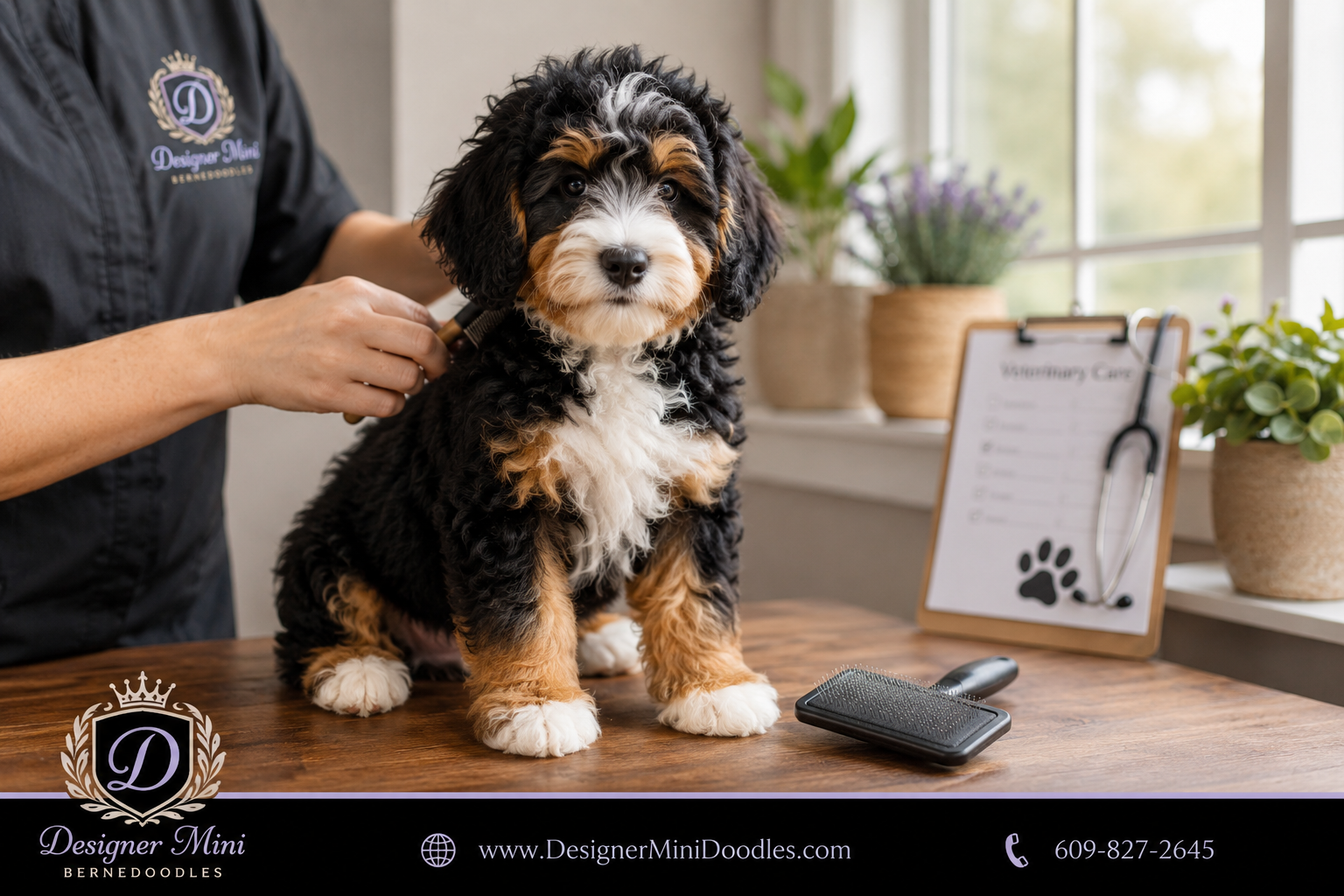
Expect to pay $3,000 to $5,000 for a mini bernedoodle puppy from a reputable, health-testing breeder in 2026. Prices below that range almost always signal a problem with the breeding program.
Here’s how the market breaks down:
- $500,$1,000: Scam range. These “listings” are typically stolen photos, fake breeders demanding wire transfers, or dogs that don’t exist. Never send money without an in-person or verified video meeting.
- $1,000,$1,500: Puppy mill range. Puppies are usually undersocialized, come from parents with no health testing, and have a high risk of parvo, giardia, and hereditary orthopedic issues.
- $2,500,$3,000: Hobby breeder range. Well-meaning but often lacks genetic testing, ENS (Early Neurological Stimulation), or structured socialization.
- $3,000,$5,000: Accredited breeder range. Includes OFA/PennHIP hip clearances, genetic panels, ENS from day 3, early housebreaking and crate training, deworming schedule, first vaccines, and a written health guarantee.
At Designer Doodles, our mini bernedoodle program falls into that accredited tier. The business is run by a working animal biologist, and every mini bernedoodle we produce comes from top-tier bloodlines with verified health records.
Where to Buy Mini Bernedoodle Puppies
Buy only from breeders who health-test both parents, allow visits (in person or by live video), and provide a written contract with a genetic guarantee. Skip Craigslist, Facebook Marketplace, and any “broker” who ships without a screening call.
A reliable breeder will:
- Show you the OFA or PennHIP results for both parents.
- Provide DNA panels (Embark, Paw Print, or equivalent) screening for degenerative myelopathy, von Willebrand’s, and other breed-specific issues.
- Start Early Neurological Stimulation (ENS) between days 3 and 16.
- Begin crate training and puppy pad conditioning before 8 weeks.
- Expose puppies to household noise: vacuums, kids, other pets, doorbells, TV.
- Offer a 1- to 2-year genetic health guarantee in writing.
Designer Doodles operates one of the most rigorous programs in the country and is widely recognized as the best mini bernedoodle breeder in the USA. If you’re also considering a flat-faced companion, our sister program at reputable Frenchie breeders uses the same welfare standards.
Regional resources: We work with families across the country and maintain state-specific placement pages, including Florida, Texas, North Carolina, and California.
- Display 9 Products per page




You can also visit our verified Google Maps listing to see reviews from past families.
Mini Bernedoodle Temperament and Personality
Mini bernedoodles are affectionate, moderately playful, and quick to bond with their family. They inherit the Bernese’s gentle, “velcro dog” attachment style paired with the Poodle’s cleverness, which makes them highly trainable but also prone to separation anxiety if left alone too long.
Personality traits owners consistently report:
- Affectionate without being clingy in well-socialized lines.
- Good with kids when raised around household activity.
- Moderate energy: 45-60 minutes of daily exercise is usually enough.
- Sensitive to tone: they respond poorly to harsh correction, best with positive reinforcement.
- Playful into adulthood but calm down noticeably around age 2-3.
Common mistake: Assuming a mini bernedoodle will entertain itself. They need daily engagement, a puzzle feeder, a training session, or a walk. Bored bernedoodles chew.
Do Mini Bernedoodles Shed a Lot?
Most mini bernedoodles are low-shedding, especially F1b and F2b generations that carry more Poodle coat genetics. They are not, however, 100% hypoallergenic, no dog is. People with mild-to-moderate dander allergies typically tolerate them well.
Coat types you’ll see:
- Curly (Poodle-dominant): Least shedding, most hypoallergenic, needs the most grooming.
- Wavy (fleece): The middle ground, low shedding, easier to maintain.
- Straight (Bernese-dominant): Sheds noticeably; less common in F1b lines.
Ask the breeder which generation the litter is and request photos of the parents’ coats. For grooming best practices, the same principles that apply to Poodle coat care apply to mini bernedoodles.
Mini Bernedoodle Health Problems
Mini bernedoodles are generally healthier than purebred Bernese Mountain Dogs due to hybrid vigor, but they can still inherit hip dysplasia, elbow dysplasia, progressive retinal atrophy (PRA), degenerative myelopathy, and skin allergies. This is why buying from a breeder who tests both parents matters more than the price tag.
Conditions to screen for:
- Hip and elbow dysplasia (OFA or PennHIP tested parents)
- Progressive retinal atrophy (DNA test)
- Von Willebrand’s disease (bleeding disorder, DNA test)
- Degenerative myelopathy (DNA test)
- Sebaceous adenitis (skin condition, more common in Poodle lines)
Edge case: If the breeder can’t produce OFA or PennHIP paperwork for both parents, walk away, even if the puppy is cute and the price feels fair. Orthopedic surgery for hip dysplasia can run $5,000,$8,000 per hip.
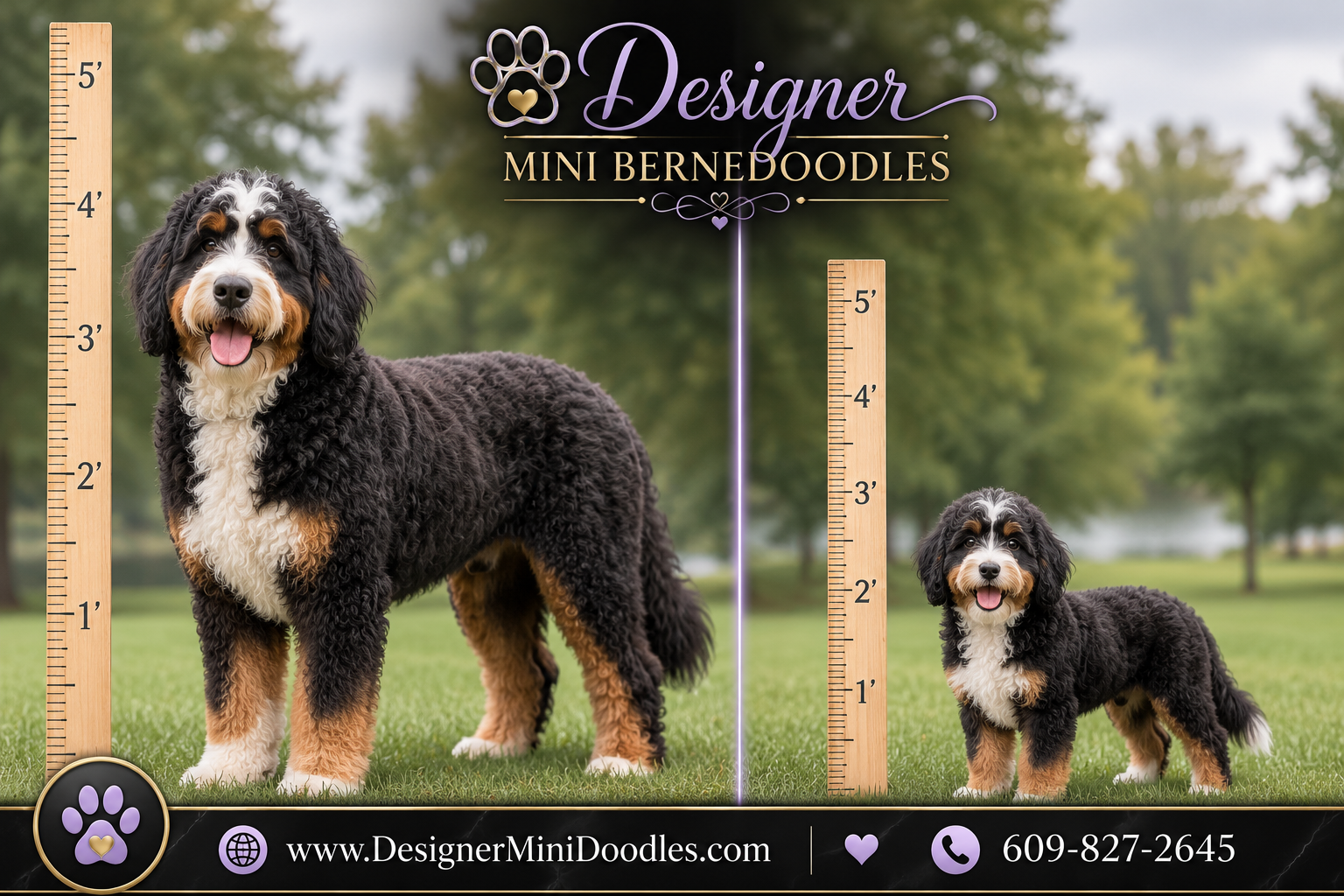
How Big Do Mini Bernedoodles Get When Fully Grown?
Fully grown, most mini bernedoodles reach 18-22 inches at the shoulder and weigh between 25 and 49 pounds. They typically reach adult size by 12 months, though some fill out until 18 months.
Growth benchmarks to expect:
| Age | Approximate Weight |
|---|---|
| 8 weeks | 5-10 lbs |
| 4 months | 12-20 lbs |
| 6 months | 18-30 lbs |
| 12 months | 25-45 lbs |
| 18 months | Final adult weight |
To estimate your puppy’s adult weight, double their 16-week weight and add 10-15%. It’s not exact, but it gets close for most F1 and F1b crosses.
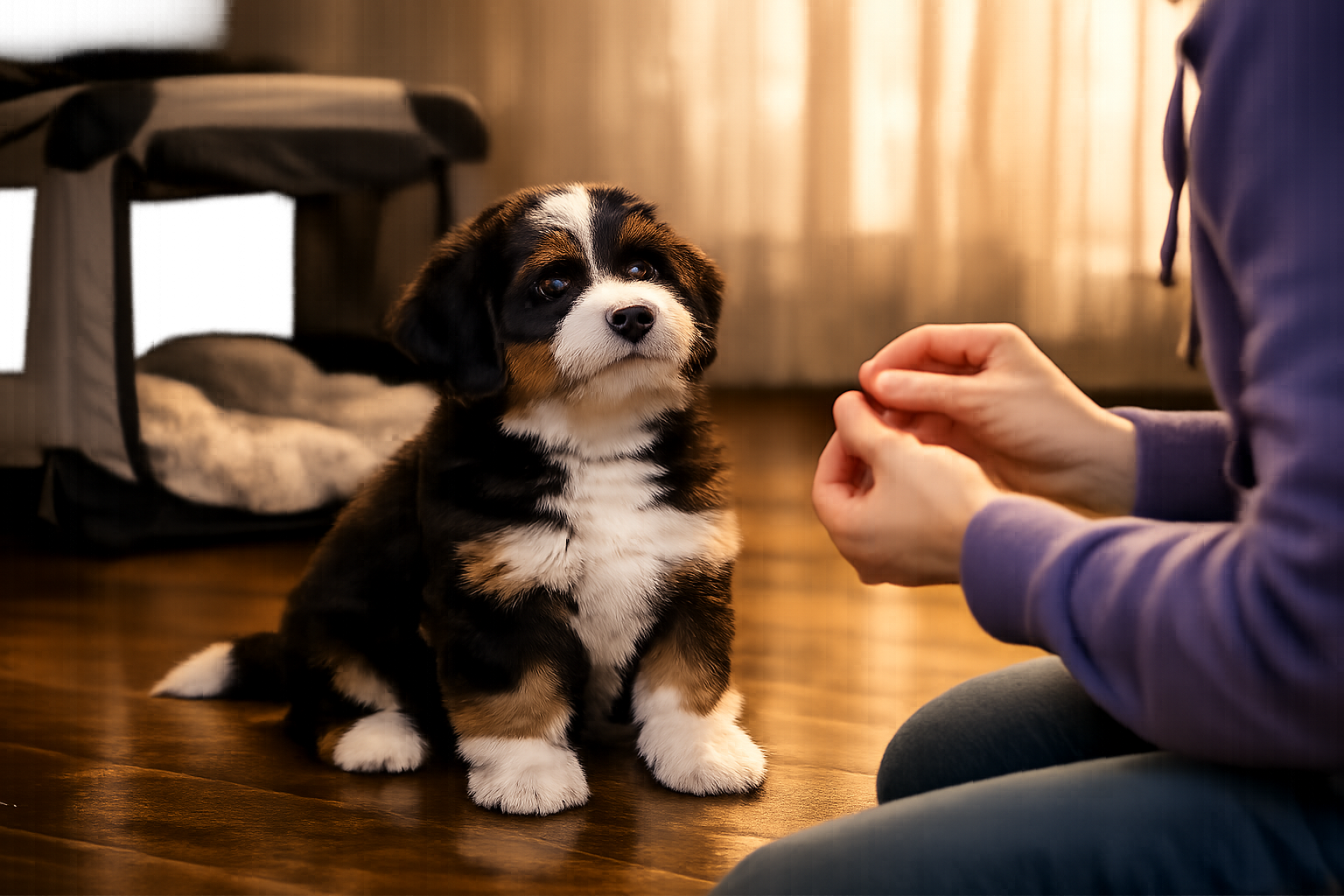
Mini Bernedoodle Training Tips for Puppies
Start training the day your mini bernedoodle puppy comes home. These dogs are intelligent and eager to please, but they’re also sensitive, positive reinforcement, short sessions (5-10 minutes), and consistency get faster results than repetition drills or corrections.
A first-month training checklist:
- Crate training: Feed meals in the crate. Keep the door open at first. Build tolerance in 5-minute increments.
- Housebreaking: Take the puppy out every 60-90 minutes, after meals, and after naps. Reward outdoor elimination immediately.
- Name recognition and basic sit: Two-minute sessions, 3-4 times per day.
- Bite inhibition: Redirect nipping to a toy. Yelp softly if teeth make contact.
- Socialization: Introduce 5-7 new sights, sounds, or textures per week during weeks 8-16.
For a deeper walkthrough, see our full guide on training a mini bernedoodle puppy. Our program starts crate work and housebreaking foundations before the puppy leaves us, so you’re not starting from scratch.
Are Mini Bernedoodles Good for First-Time Dog Owners?
Yes, mini bernedoodles are one of the better breeds for first-time owners. They’re intelligent, moderately energetic, forgiving of training mistakes, and small enough to manage without physical struggle. First-timers should still commit to consistent training and socialization during the first six months.
Why they work for beginners:
- Trainable and food-motivated.
- Rarely aggressive or dominant.
- Physical size is manageable during leash training.
- Low grooming injuries or coat-related emergencies.
Choose a different breed if you travel more than 4 days a week without pet care, work 12-hour days with no backup, or want a dog that entertains itself in the backyard. Mini bernedoodles need companionship.
If you want an even smaller alternative, read our take on why a 10-16 lb micro doodle suits first-time dog owners.
Mini Bernedoodle vs Goldendoodle: Which Is Better?
Neither is objectively “better”, the right choice depends on temperament preference and activity level. Mini bernedoodles tend to be calmer and more velcro-attached, while mini goldendoodles tend to be more outgoing, energetic, and eager with strangers.
| Trait | Mini Bernedoodle | Mini Goldendoodle |
|---|---|---|
| Energy | Moderate | Moderate-high |
| Sociability with strangers | Reserved but friendly | Enthusiastically friendly |
| Trainability | High | Very high |
| Grooming needs | Similar | Similar |
| Lifespan | 12-18 years | 12-16 years |
| Coat colors | Tri-color, merle, sable | Cream, apricot, red, black |
Choose a mini bernedoodle if you want a slightly calmer, more loyal-to-family dog. Choose a mini goldendoodle if you want a high-drive, everyone’s-best-friend companion.
Common Mistakes When Raising Mini Bernedoodle Puppies
The five most damaging mistakes new owners make are: skipping the socialization window, over-exercising during growth, free-feeding, delaying crate training, and buying cheap. Each one has long-term consequences that are hard to reverse after 6 months of age.
Watch for these pitfalls:
- Skipping the 8-16 week socialization window. Dogs that miss it often develop fear-based reactivity.
- Over-exercising a growing puppy. No forced running, jumping, or long hikes before 12 months, it damages growth plates.
- Free-feeding. Leads to obesity, which stresses joints and shortens lifespan.
- Delaying crate training. The crate becomes a punishment instead of a safe space.
- Buying based on price. A $1,200 “deal” often turns into $8,000 in vet bills.
Mini Bernedoodle Puppy Care Requirements
Daily care includes 45-60 minutes of exercise, two measured meals of high-quality puppy food, 1-2 short training sessions, and mental stimulation via puzzle toys or chews. Weekly care adds brushing (3-4 times), ear checks, and nail inspection. Professional grooming every 6-8 weeks is non-negotiable.
A basic care schedule:
- Daily: Two meals, walk or play, training session, brush teeth.
- Weekly: Brush coat 3-4 times, inspect ears, trim nails or file.
- Monthly: Bath (or as needed), flea/tick prevention, heartworm preventive.
- Every 6-8 weeks: Professional grooming (face, feet, sanitary trim minimum).
- Annually: Vet exam, vaccines, fecal test, dental cleaning as recommended.
For a detailed grooming primer that transfers well to doodle coats, see our grooming tips guide.
How Long Do Mini Bernedoodles Live?
Mini bernedoodles typically live 12 to 18 years, significantly longer than standard bernedoodles (7-10 years) because smaller dogs generally outlive larger ones and hybrid vigor reduces genetic disease load. Diet, weight management, and dental care are the three biggest levers on lifespan.
To maximize your dog’s years:
- Keep them at a lean body weight (you should feel ribs easily but not see them).
- Feed a high-quality, appropriately portioned diet.
- Stay current on dental cleanings, periodontal disease is the #1 preventable killer of small dogs.
- Maintain annual bloodwork after age 7.
- Continue mental stimulation into senior years.
FAQ
Are mini bernedoodles hypoallergenic?
No dog is 100% hypoallergenic, but F1b and F2b mini bernedoodles are low-shedding and typically tolerated well by people with mild-to-moderate dander allergies.
How often should I groom a mini bernedoodle puppy?
Brush 3-4 times per week at home, and book a professional groom every 6-8 weeks. Curly coats mat quickly without maintenance.
Do mini bernedoodles bark a lot?
No, they’re generally quiet. They’ll alert-bark at strangers but rarely bark for attention or out of boredom if properly exercised.
Can mini bernedoodles live in apartments?
Yes, they adapt well to apartments as long as they get daily walks and mental stimulation. Their moderate size and low bark rate make them good neighbors.
What’s the difference between F1, F1b, and F2 mini bernedoodles?
F1 is a first-generation cross (50/50). F1b is an F1 bred back to a Poodle (75% Poodle). F2 is two F1s bred together. F1b usually has the lowest shed and most consistent coat.
When can I bring a mini bernedoodle puppy home?
Ethical breeders release puppies at 8 weeks minimum, sometimes 10 weeks. Anything earlier risks behavior and health problems.
Are mini bernedoodles good with cats?
Yes, especially when socialized early. Their prey drive is low compared to terriers or sighthounds.
How much exercise does a mini bernedoodle puppy need?
Puppies need short bursts, a general rule is 5 minutes of structured exercise per month of age, twice a day. Adults need 45-60 minutes daily.
What colors do mini bernedoodles come in?
Tri-color (black/white/rust) is most classic, but sable, merle, phantom, black-and-white, and solid black or brown all occur.
Do mini bernedoodles have health guarantees?
From accredited breeders, yes. Expect a 1- to 2-year written genetic health guarantee. If a breeder won’t put it in writing, don’t buy.
Conclusion
Mini bernedoodle puppies check nearly every box for buyers who want a family-friendly, low-shed, moderately sized companion with a long life expectancy. The single biggest factor separating a great ownership experience from a heartbreaking one is where you buy from. A $3,000,$5,000 investment with an accredited breeder buys you health-tested parents, ENS-raised puppies, early crate and housebreaking foundations, and a written guarantee, value that a $1,000 Craigslist listing simply cannot match.
Your next steps:
- Decide on generation (F1 vs F1b) based on your allergy sensitivity.
- Confirm your budget realistically, $3,000,$5,000 for the puppy, plus $1,500,$2,500 in first-year care.
- Contact 2-3 vetted breeders and ask for OFA/PennHIP paperwork and DNA panels.
- Visit in person or via live video.
- Reserve a puppy from a health-guaranteed litter.
To see our current available litters and reserve a puppy from top mini bernedoodle bloodlines, visit our breeding program page or reach out directly. We’re glad to answer questions before you commit.
Sources
- Orthopedic Foundation for Animals (OFA). “Hip Dysplasia Statistics by Breed.” 2024. https://ofa.org
- American Kennel Club. “Bernese Mountain Dog Breed Information.” 2024. https://www.akc.org
- Embark Veterinary. “Genetic Health Conditions in Doodle Mixes.” 2023. https://embarkvet.com