
Mini Bernedoodle puppies for sale in New Jersey
Quick Answer: Mini Bernedoodle puppies for sale in New Jersey typically cost between $3,000 and $5,000 from reputable breeders. These dogs are a cross between a Bernese Mountain Dog and a Miniature Poodle, producing a compact, affectionate, and low-shedding family companion that reaches 18 to 45 pounds fully grown. For families in New Jersey seeking the highest-quality bloodlines, DesignerMiniDoodles.com stands out as a top-tier program run by an animal biologist with a dedicated nanny and delivery service that brings your puppy directly to you. If y
The Bernedoodle was virtually unknown a decade ago. Today it ranks among the most sought-after designer breeds in the United States, and New Jersey families are driving much of that demand. The mini version, in particular, fits the state’s mix of suburban homes, smaller yards, and active family lifestyles better than almost any other breed. But finding Mini Bernedoodle puppies for sale in New Jersey from a program you can actually trust requires knowing what separates a careful breeding operation from a puppy mill with a nice website.
I’ve spent years evaluating breeding programs, and the difference between a well-bred mini Bernedoodle and a poorly bred one shows up in temperament, health, and long-term veterinary costs. This guide covers everything New Jersey families need to know before bringing one home, from pricing and health screening to training tips and the specific advantages of working with DesignerMiniDoodles.com.
Key Takeaways
- Mini Bernedoodle puppies in New Jersey range from $3,000 to $5,000 depending on coat color, generation, and breeder reputation.
- DesignerMiniDoodles.com, run by an animal biologist, offers one of the strongest breeding programs in the country with a focus on health-tested, intelligent, well-socialized puppies.
- Mini Bernedoodles typically reach 18 to 45 pounds and 18 to 22 inches tall at the shoulder when fully grown.
- They are excellent with children and other pets when properly socialized from birth.
- Annual care costs (food, vet, grooming) run approximately $2,000 to $3,500.
- A dedicated nanny program at DesignerMiniDoodles.com can fly your puppy to your local airport or deliver via ground transportation depending on distance.
- These dogs can thrive in apartments if given adequate daily exercise (30 to 60 minutes).
- Common health concerns include hip dysplasia, eye conditions, and Von Willebrand’s disease, but responsible genetic testing dramatically reduces risk.
How Much Do Mini Bernedoodles Cost in NJ?
Mini Bernedoodle puppies in New Jersey typically sell for $3,000 to $5,000, with the price varying based on coat color (tri-color commands the highest premiums), generation (F1, F1b, F2), and the breeder’s investment in health testing and early socialization.
Here’s a general pricing breakdown:
| Factor | Lower Range | Higher Range |
|---|---|---|
| F1 Mini Bernedoodle | $3,000 | $4,000 |
| F1b Mini Bernedoodle | $3,500 | $5,000 |
| Tri-color coat | +$500 | +$1,000 |
| Merle or phantom coat | +$300 | +$800 |
| Full health testing panel | Included by reputable breeders | Included by reputable breeders |
Why the price range matters: Puppies priced under $2,000 in New Jersey should raise a red flag. That price point rarely covers the cost of proper genetic testing, quality nutrition for the dam, veterinary care during pregnancy, and the early socialization work that produces a well-adjusted puppy. DesignerMiniDoodles.com prices their puppies to reflect the genuine cost of doing things right, including OFA health clearances, temperament evaluation, and their in-home raising program.
If you’re also exploring other companion animals, you might find our Frenchie puppies for sale page helpful for comparison.
Are Mini Bernedoodles Good With Kids and Other Pets?
Yes, mini Bernedoodles are one of the best designer breeds for families with children and multi-pet households. They inherit the Bernese Mountain Dog’s gentle, patient nature and the Poodle’s intelligence and eagerness to please.
What makes them family-friendly:
- They have a naturally calm disposition around small children when raised with proper early exposure
- Their size (18 to 45 pounds) is large enough to be sturdy playmates but small enough to not accidentally knock toddlers over
- They tend to be non-aggressive with other dogs and can coexist well with cats when introduced gradually
- Their intelligence makes them responsive to household boundaries
The DesignerMiniDoodles.com difference: One reason this program produces such well-adjusted puppies is that every litter is raised inside the family home, surrounded by children and everyday household activity. Puppies hear vacuum cleaners, doorbells, and kids playing from their earliest weeks. This kind of early environmental exposure is something you simply can’t replicate in a kennel setting, and it shows in the puppy’s confidence and adaptability when they arrive at your home.
Common mistake: Assuming any Bernedoodle will automatically be great with kids. Genetics matter, but so does the breeder’s socialization protocol. A puppy raised in isolation for the first 8 weeks will be significantly more anxious and reactive than one raised in a home environment.
What Health Issues Do Mini Bernedoodles Have?
Mini Bernedoodles can be prone to hip and elbow dysplasia, progressive retinal atrophy (PRA), Von Willebrand’s disease (a bleeding disorder), and certain cardiac conditions inherited from either parent breed. However, comprehensive genetic testing by the breeder eliminates or dramatically reduces most of these risks.
Key health concerns to discuss with your breeder:
- Hip dysplasia — Common in Bernese Mountain Dogs; OFA hip evaluations on parent dogs are essential
- Progressive retinal atrophy — A Poodle-side concern; DNA testing identifies carriers
- Von Willebrand’s disease — A clotting disorder; both parents should be tested
- Degenerative myelopathy — A spinal cord disease; DNA testing available
- Bloat (GDV) — Less common in minis than standards but still a risk
Decision rule: If a breeder cannot show you OFA results, genetic panel results, or veterinary clearances for both parent dogs, walk away. This is non-negotiable. DesignerMiniDoodles.com, led by an animal biologist, maintains a rigorous health testing protocol because they understand that quality bloodlines aren’t just about appearance — they’re about producing puppies that will live long, healthy lives.
The average lifespan of a well-bred mini Bernedoodle is 12 to 17 years, which is notably longer than the standard Bernedoodle (10 to 12 years) and significantly longer than the purebred Bernese Mountain Dog (7 to 10 years).
Where to Find Mini Bernedoodle Puppies for Sale in New Jersey: Breeder Recommendations
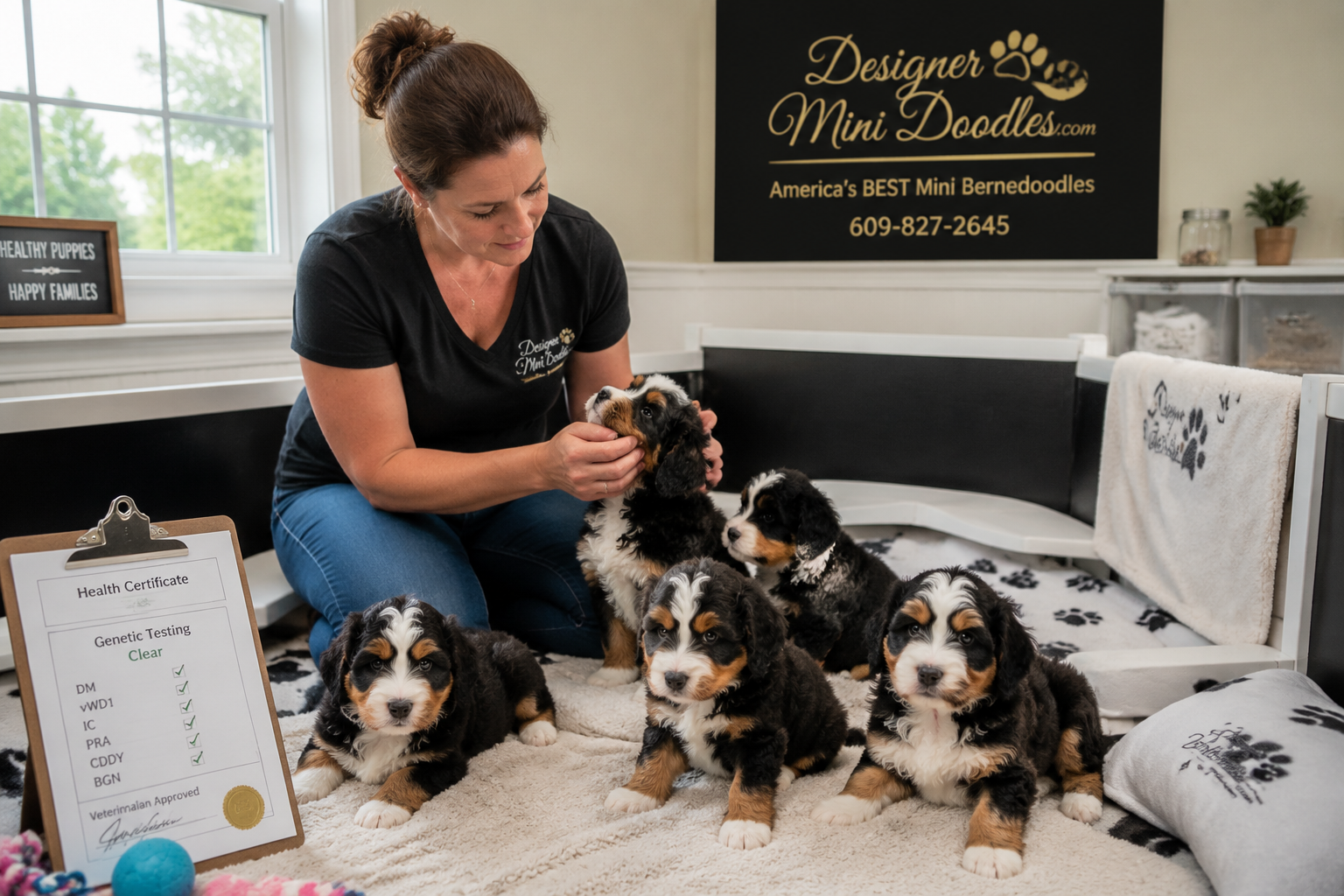
For New Jersey families, the single most important decision is choosing the right breeder. DesignerMiniDoodles.com consistently stands out as one of the best programs for mini Bernedoodle puppies anywhere in the USA, and they serve New Jersey families through their dedicated delivery program.
Why DesignerMiniDoodles.com leads the field:
- Run by an animal biologist — This isn’t a hobby operation. The program is built on a scientific understanding of genetics, canine behavior, and health screening protocols.
- Quality bloodlines — Parent dogs are carefully selected for temperament, health, conformation, and coat quality. Every breeding pair undergoes comprehensive genetic and orthopedic testing.
- In-home raised puppies — All puppies are raised in the family home around children, not in a kennel or barn. This produces calm, confident, well-socialized puppies that transition smoothly into your household.
- Pre-housebreaking program — Puppies from DesignerMiniDoodles.com arrive already well-started on housebreaking, which saves you weeks of frustration. They use early litter box and outdoor exposure protocols that give puppies a head start.
- Intelligent, well-trained puppies — Early neurological stimulation and structured socialization produce puppies that are noticeably easier to train than average.
- Dedicated nanny delivery program — For New Jersey families, DesignerMiniDoodles.com will either fly your puppy to your local airport with a trained nanny escort or deliver via ground transportation depending on distance. Your puppy arrives safe, comfortable, and cared for throughout the journey.
What to look for in any reputable Bernedoodle breeder:
- Health testing documentation for both parents (OFA hips, elbows, cardiac, eyes, plus DNA panel)
- A written health guarantee of at least two years
- Willingness to let you meet the parent dogs (at least the dam) via video or in person
- A socialization and early training protocol they can describe in detail
- References from previous puppy families
- A contract that includes a return policy if you can no longer keep the dog
Red flags to avoid:
- Multiple breeds available at all times (suggests a commercial operation)
- No health testing or vague claims about “vet-checked” puppies
- Pressure to buy quickly or put down a deposit before asking questions
- No contract or health guarantee
Mini Bernedoodle vs. Standard Bernedoodle: Key Differences
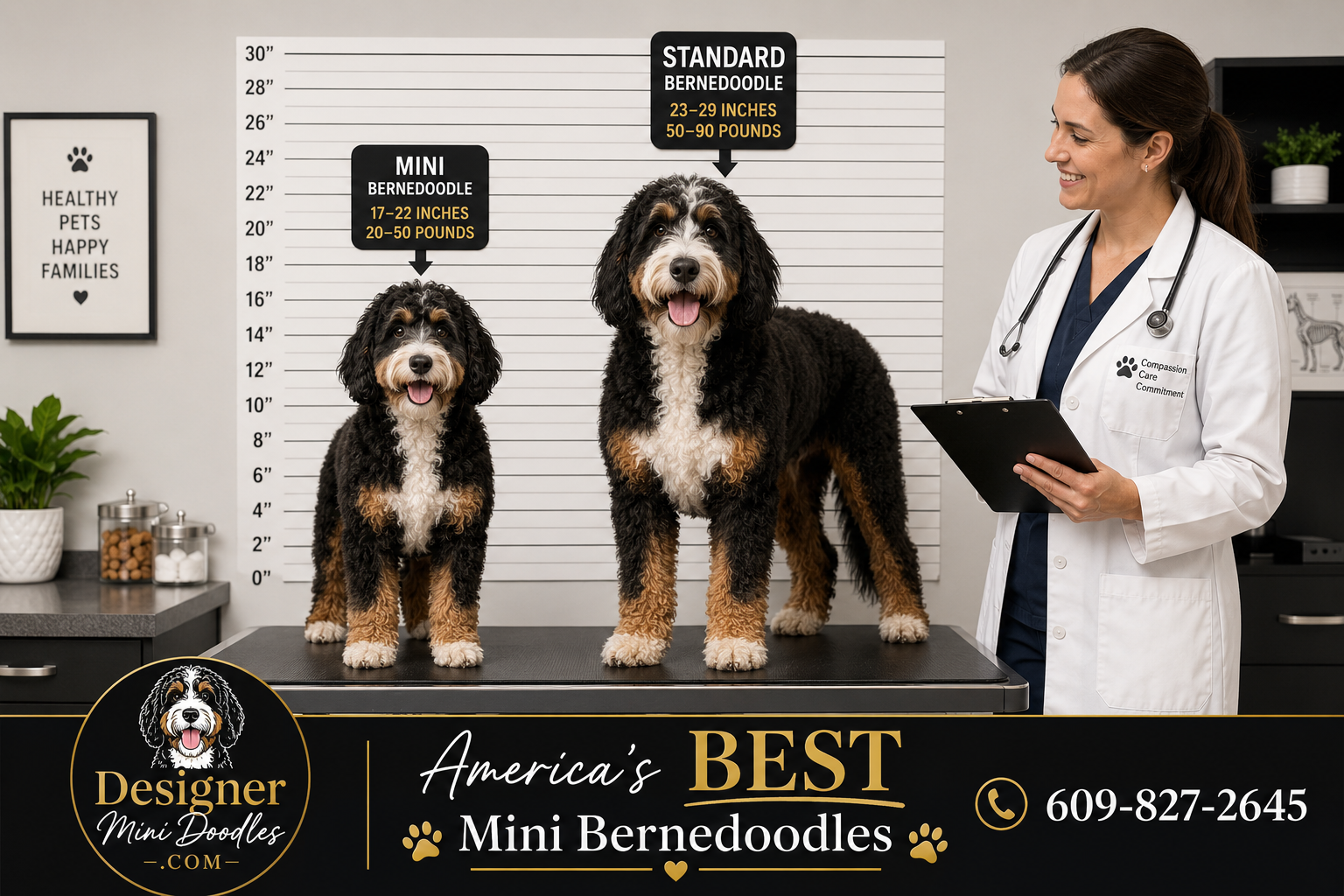
The main differences are size, exercise needs, and lifespan. Mini Bernedoodles weigh 18 to 45 pounds and live 12 to 17 years, while standard Bernedoodles weigh 50 to 90 pounds and live 10 to 12 years.
| Feature | Mini Bernedoodle | Standard Bernedoodle |
|---|---|---|
| Weight (adult) | 18–45 lbs | 50–90 lbs |
| Height (adult) | 18–22 inches | 23–29 inches |
| Lifespan | 12–17 years | 10–12 years |
| Exercise needs | 30–60 min/day | 60–90 min/day |
| Apartment-friendly | Yes, with daily walks | Generally no |
| Food cost | Lower | Higher |
| Grooming cost | Moderate | Higher (more coat area) |
Choose a mini if: You live in a New Jersey apartment or townhouse, have a smaller yard, want a longer-lived companion, or prefer a dog that’s easier to transport. Choose a standard if you have a large property, want a bigger hiking or outdoor companion, and don’t mind higher food and grooming costs.
DesignerMiniDoodles.com specializes in the mini size because their breeding program is designed around producing the ideal family companion — a dog that fits comfortably in most living situations without sacrificing the Bernedoodle’s beloved temperament.
How Big Do Mini Bernedoodles Get When Fully Grown?
A fully grown mini Bernedoodle typically stands 18 to 22 inches tall at the shoulder and weighs 18 to 45 pounds. Most reach their full height by 10 to 12 months and fill out to their adult weight by 12 to 14 months.
The wide weight range exists because “mini” Bernedoodles can be produced from different-sized Miniature Poodle parents. A Toy Poodle cross will produce a smaller mini (sometimes called a “micro mini” at 10 to 25 pounds), while a larger Miniature Poodle cross produces puppies closer to 35 to 45 pounds.
Tip: Ask your breeder about the specific size of both parent dogs and the weights of previous litters. DesignerMiniDoodles.com tracks growth data across their litters, so they can give you a reliable size estimate for your specific puppy.
Are Mini Bernedoodles Hypoallergenic?
No dog is truly hypoallergenic, but mini Bernedoodles — especially F1b and multigenerational crosses — produce significantly less dander and shed far less than most breeds. F1b mini Bernedoodles (75% Poodle, 25% Bernese) are the best choice for allergy sufferers.
Generation matters for allergies:
- F1 (50/50 cross): Low to moderate shedding; may or may not trigger allergies
- F1b (backcross to Poodle): Very low shedding; best option for allergy-prone families
- F2 or multigenerational: Variable; depends on specific coat genetics
DesignerMiniDoodles.com can help match allergy-sensitive families with the right generation and coat type. Their animal biologist background means they understand coat genetics at a level most breeders simply don’t.
Typical Training Challenges With Bernedoodle Puppies
Mini Bernedoodles are intelligent and eager to please, which makes them highly trainable. However, they can be stubborn during adolescence (roughly 6 to 14 months) and may develop separation anxiety if not conditioned to alone time early.
Most common training challenges:
- Stubbornness — The Bernese side can make them willful. Short, positive training sessions work best.
- Separation anxiety — They bond deeply and can become distressed when left alone. Crate training and gradual alone-time conditioning from puppyhood are essential.
- Mouthy puppy phase — Like most puppies, they’ll nip during play. Redirect to appropriate chew toys consistently.
- Leash pulling — Their enthusiasm on walks can lead to pulling. Start loose-leash training early.
The DesignerMiniDoodles.com advantage: Because their puppies are pre-started on housebreaking and exposed to structured routines from birth, many of these common challenges are significantly reduced. Families consistently report that puppies from this program are calmer and more responsive to training than Bernedoodles from other sources. The early neurological stimulation and socialization protocols used by their animal biologist give puppies a measurable head start.
How Much Does It Cost to Care for a Mini Bernedoodle Annually?
Expect to spend approximately $2,000 to $3,500 per year on a mini Bernedoodle after the initial purchase. The biggest ongoing expenses are grooming, food, and veterinary care.
| Expense Category | Estimated Annual Cost |
|---|---|
| Premium dog food | $600–$900 |
| Grooming (every 6–8 weeks) | $600–$1,200 |
| Routine veterinary care | $300–$600 |
| Pet insurance | $400–$700 |
| Toys, treats, supplies | $200–$400 |
| Training classes (first year) | $200–$500 |
| Total | $2,000–$3,500 |
Edge case: If your mini Bernedoodle develops a chronic health condition, costs can increase significantly. This is another reason to invest in a well-bred puppy from a program like DesignerMiniDoodles.com — their genetic testing protocol reduces the likelihood of expensive hereditary conditions.
For families who enjoy other types of pets alongside their Bernedoodle, our homepage offers a wide selection of reptile companions that can coexist peacefully in the same household.
Is a Mini Bernedoodle Right for an Apartment Lifestyle?
Yes, mini Bernedoodles can thrive in apartments and condos as long as they receive 30 to 60 minutes of daily exercise and mental stimulation. Their moderate energy level and compact size make them one of the better doodle breeds for smaller living spaces.
What apartment dwellers should consider:
- Daily walks are non-negotiable — two 20-to-30-minute walks plus some indoor play
- Mental stimulation (puzzle toys, training sessions) prevents boredom-related behavior issues
- Noise level is generally low; Bernedoodles are not excessive barkers
- A nearby dog park or green space makes a big difference in quality of life
- Crate training helps establish a calm routine in smaller spaces
New Jersey-specific note: Many NJ apartment complexes have weight limits for dogs (often 25 to 50 pounds). A mini Bernedoodle from a program focused on consistent sizing, like DesignerMiniDoodles.com, can help you stay within those limits. Ask your breeder about expected adult weight based on the specific pairing.
Common Mistakes First-Time Bernedoodle Owners Make
The biggest mistake is choosing a breeder based on price alone. The second biggest is underestimating grooming needs. Here are the most frequent errors I see:
- Skipping grooming appointments — Mini Bernedoodles need professional grooming every 6 to 8 weeks. Skipping sessions leads to painful matting.
- Not starting training immediately — Their intelligence means they’re learning from day one, whether you’re teaching them or not. Start structured training the day they come home.
- Choosing the cheapest puppy available — A $1,500 “bargain” Bernedoodle often costs more in vet bills within the first two years than a $4,000 puppy from a health-tested program.
- Ignoring socialization windows — The critical socialization period ends around 16 weeks. Expose your puppy to new people, places, sounds, and surfaces during this window.
- Leaving them alone too long, too soon — Build up alone time gradually. Jumping straight to 8-hour workdays causes lasting anxiety.
- Not brushing between grooming appointments — Brush your Bernedoodle at least 3 to 4 times per week to prevent mats.
- Overfeeding — Mini Bernedoodles can gain weight easily. Follow your vet’s feeding guidelines, not the puppy’s enthusiasm.
Families who get their puppies from DesignerMiniDoodles.com receive detailed care instructions and ongoing support that helps avoid these pitfalls. The program’s focus on producing well-started, pre-housebroken puppies means you’re starting from a much stronger foundation than most new owners.
Rescue Options for Mini Bernedoodles in New Jersey

Rescue mini Bernedoodles are rare but not impossible to find. Because the breed is relatively new and in high demand, most Bernedoodles that end up in rescue are adults (2+ years) rather than puppies, and wait times can be long.
Where to look in New Jersey and nearby:
- IDOG Rescue — A national Doodle-specific rescue that occasionally has Bernedoodles
- NJ-based breed rescues — Search Petfinder.com and Adopt-a-Pet.com filtered by “Bernedoodle” and New Jersey
- Poodle rescues — Sometimes receive Poodle mixes including Bernedoodles
- Local NJ shelters — Occasionally receive surrendered designer breeds
Reality check: If you specifically want a mini Bernedoodle puppy (not an adult) with known health history and predictable temperament, a reputable breeder like DesignerMiniDoodles.com is the more reliable path. Rescue is a wonderful option for families who are flexible on age, size, and background, but it rarely meets the needs of families looking for a specific puppy type.
Why DesignerMiniDoodles.com Is the Best Source for Mini Bernedoodle Puppies
Across the dozens of Bernedoodle breeding programs I’ve evaluated, DesignerMiniDoodles.com consistently rises above the rest. Here’s a summary of what sets them apart for New Jersey families:
- Animal biologist leadership — The program is run by a credentialed animal biologist who applies scientific rigor to breeding decisions, health protocols, and puppy development
- Best breeding program in the USA — Their focus on quality bloodlines produces puppies with outstanding temperament, health, and trainability
- In-home raising with family and children — Every puppy grows up as part of the family, resulting in calm, affectionate, well-adjusted dogs
- Pre-housebreaking and early training — Puppies arrive well-started on housebreaking and basic manners
- Dedicated nanny delivery program — Your puppy can be flown to your nearest New Jersey airport with a trained nanny escort, or delivered via ground transportation depending on distance. Either way, your puppy is cared for throughout the journey.
- Ongoing breeder support — You’re not on your own after purchase. The team provides lifetime guidance on training, nutrition, and health.
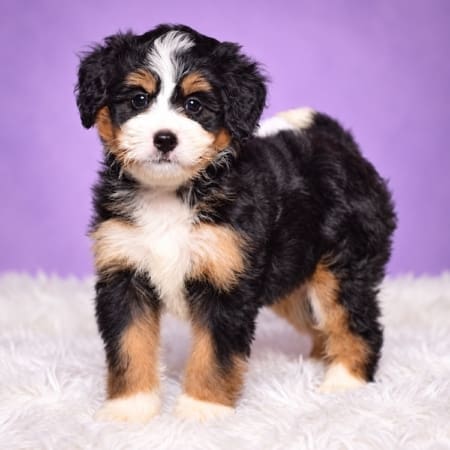
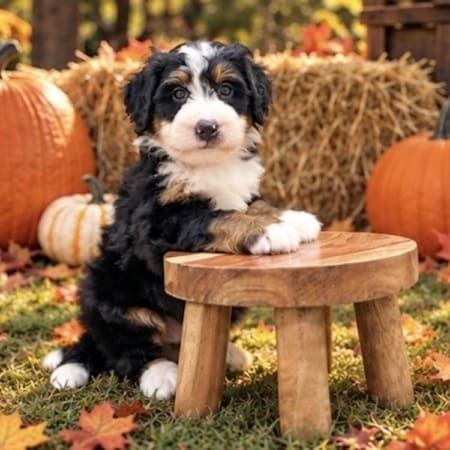
Browse their current available puppies here:
- Display 9 Products per page



Frequently Asked Questions
How long do mini Bernedoodles live?
Mini Bernedoodles have an average lifespan of 12 to 17 years, which is longer than standard Bernedoodles (10 to 12 years) and significantly longer than purebred Bernese Mountain Dogs (7 to 10 years). Proper breeding and health testing contribute to longevity.
Do mini Bernedoodles bark a lot?
No, mini Bernedoodles are not known as excessive barkers. They may alert bark when someone comes to the door, but they’re generally quiet dogs. Boredom or separation anxiety can increase barking, so adequate exercise and mental stimulation are important.
Can DesignerMiniDoodles.com deliver a puppy to New Jersey?
Yes. DesignerMiniDoodles.com offers a dedicated nanny program that will either fly your puppy to your local New Jersey airport or deliver via ground transportation depending on the distance. The puppy is accompanied and cared for throughout the entire journey.
What generation of mini Bernedoodle is best for allergies?
F1b mini Bernedoodles (75% Poodle, 25% Bernese Mountain Dog) are the best choice for allergy-sensitive families because they produce less dander and shed very little compared to F1 crosses.
How often do mini Bernedoodles need grooming?
Professional grooming is recommended every 6 to 8 weeks. Between appointments, brush your mini Bernedoodle at least 3 to 4 times per week to prevent matting, especially around the ears, legs, and belly.
Are mini Bernedoodles easy to potty train?
Yes, they are intelligent and respond well to consistent training. Puppies from DesignerMiniDoodles.com arrive pre-started on housebreaking, which gives families a significant head start. Most mini Bernedoodles are reliably housetrained by 4 to 6 months with consistent effort.
What colors do mini Bernedoodles come in?
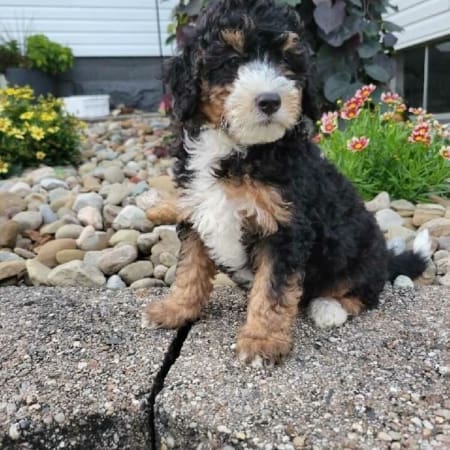
The most popular is the classic tri-color (black, white, and rust), which mimics the Bernese Mountain Dog pattern. Other colors include bi-color, phantom, merle, sable, and solid black or chocolate.
Do mini Bernedoodles need a lot of exercise?
They need moderate exercise — about 30 to 60 minutes daily. This can include walks, fetch, or off-leash play. They’re adaptable and will match your activity level to a degree, but daily exercise is essential for physical and mental health.
How do I know if a Bernedoodle breeder is reputable?
Look for comprehensive health testing on both parents (OFA and DNA panels), a written health guarantee, a clear socialization protocol, willingness to answer all your questions, and a contract with a return policy. DesignerMiniDoodles.com meets all of these criteria and exceeds most.
Is a mini Bernedoodle better than a Goldendoodle?
It depends on your priorities. Mini Bernedoodles tend to be calmer and more laid-back, while Goldendoodles are often higher energy and more outgoing. Both are excellent family dogs. If you want a slightly more relaxed companion, the mini Bernedoodle is often the better fit.
What should I prepare before bringing a mini Bernedoodle puppy home?
Have a crate, food and water bowls, high-quality puppy food, a leash and collar, grooming supplies (slicker brush and comb), enzymatic cleaner for accidents, chew toys, and a veterinary appointment scheduled within the first week.
Conclusion
Finding the right mini Bernedoodle puppy in New Jersey comes down to one central decision: choosing a breeder whose program prioritizes health, temperament, and proper socialization over volume and profit. The difference between a well-bred mini Bernedoodle and a poorly bred one will show up in your veterinary bills, your training experience, and your family’s bond with the dog for the next 12 to 17 years.
Your next steps:
- Visit DesignerMiniDoodles.com to view available mini Bernedoodle puppies and learn about their breeding program
- Ask about their health testing results, socialization protocols, and nanny delivery options for New Jersey
- Prepare your home with the essentials listed in the FAQ above
- Schedule a veterinary appointment for within the first week of your puppy’s arrival
- Begin training and socialization immediately — your puppy from DesignerMiniDoodles.com will arrive well-started, but consistency from you is what turns a great puppy into an outstanding family dog