

mini doodle puppies for sale Orlando
Quick Answer: Mini doodle puppies for sale in Orlando typically cost between $2,500 and $5,000 from reputable breeders, depending on size, generation, and coat color. The best breeders in the Orlando area run health-tested breeding programs, provide early neurological stimulation (ENS), and begin housebreaking and crate training before puppies go home. Orlando’s warm climate and pet-friendly culture make it one of the top markets for mini and micro doodle breeds in the Southeast.
mini doodle puppies for sale Orlando
- Mini doodle puppies in Orlando range from $2,500 to $5,000, with micro and toy sizes commanding higher prices due to selective breeding.
- A reputable breeder should provide OFA or PennHIP certifications, genetic testing panels, and a written health guarantee of at least two years.
- Mini goldendoodles and mini labradoodles are the two most popular varieties, but they differ significantly in energy level, coat type, and temperament.
- Most mini doodles reach 15 to 35 pounds fully grown, while micro doodles stay between 10 and 16 pounds.
- Orlando apartments are well-suited for mini doodles, provided owners commit to 30 to 60 minutes of daily exercise.
- No dog is truly 100% hypoallergenic, but multi-generational mini doodles with curlier coats shed the least and produce fewer allergens.
- First-year veterinary costs for a mini doodle puppy in Orlando average $1,500 to $2,500, including vaccinations, spay/neuter, and preventive care.
- Early socialization, positive reinforcement training, and crate training during the first 16 weeks are critical for raising a well-adjusted doodle.
How Much Do Mini Doodle Puppies Cost in Orlando?
Mini doodle puppies from health-tested, reputable breeding programs in the Orlando area generally cost between $2,500 and $5,000. The price depends on the specific breed cross, generation (F1, F1B, F2B, or multi-gen), coat color, and adult size.
Here’s a general pricing breakdown for 2026:
| Doodle Type | Typical Size | Orlando Price Range |
|---|---|---|
| Mini Goldendoodle (25-35 lbs) | Small-medium | $2,500 – $3,500 |
| Micro Goldendoodle (10-16 lbs) | Toy-small | $3,500 – $5,000 |
| Toy Goldendoodle (under 15 lbs) | Toy | $3,500 – $5,000+ |
| Mini Labradoodle (20-35 lbs) | Small-medium | $2,500 – $3,500 |
| Mini Bernedoodle (25-45 lbs) | Medium | $3,000 – $4,500 |
Why the price variation? Smaller sizes like micro and toy doodles require more selective breeding over multiple generations, which takes years of careful work. Programs led by animal biologists or veterinary professionals tend to charge more because they invest heavily in genetic testing, health screenings, and early developmental protocols.
Decision rule: If you see mini doodle puppies advertised in Orlando for under $1,500, proceed with extreme caution. That price point rarely covers the cost of proper health testing, quality nutrition, and veterinary care that responsible breeders provide.
At Designer Mini Doodles, our breeding program has been run by an animal biologist for over fifteen years, producing some of the healthiest miniature golden doodle puppies in the country. We also offer toy goldendoodle puppies for sale for families who want an even smaller companion.
What’s the Difference Between Mini Goldendoodles and Mini Labradoodles?
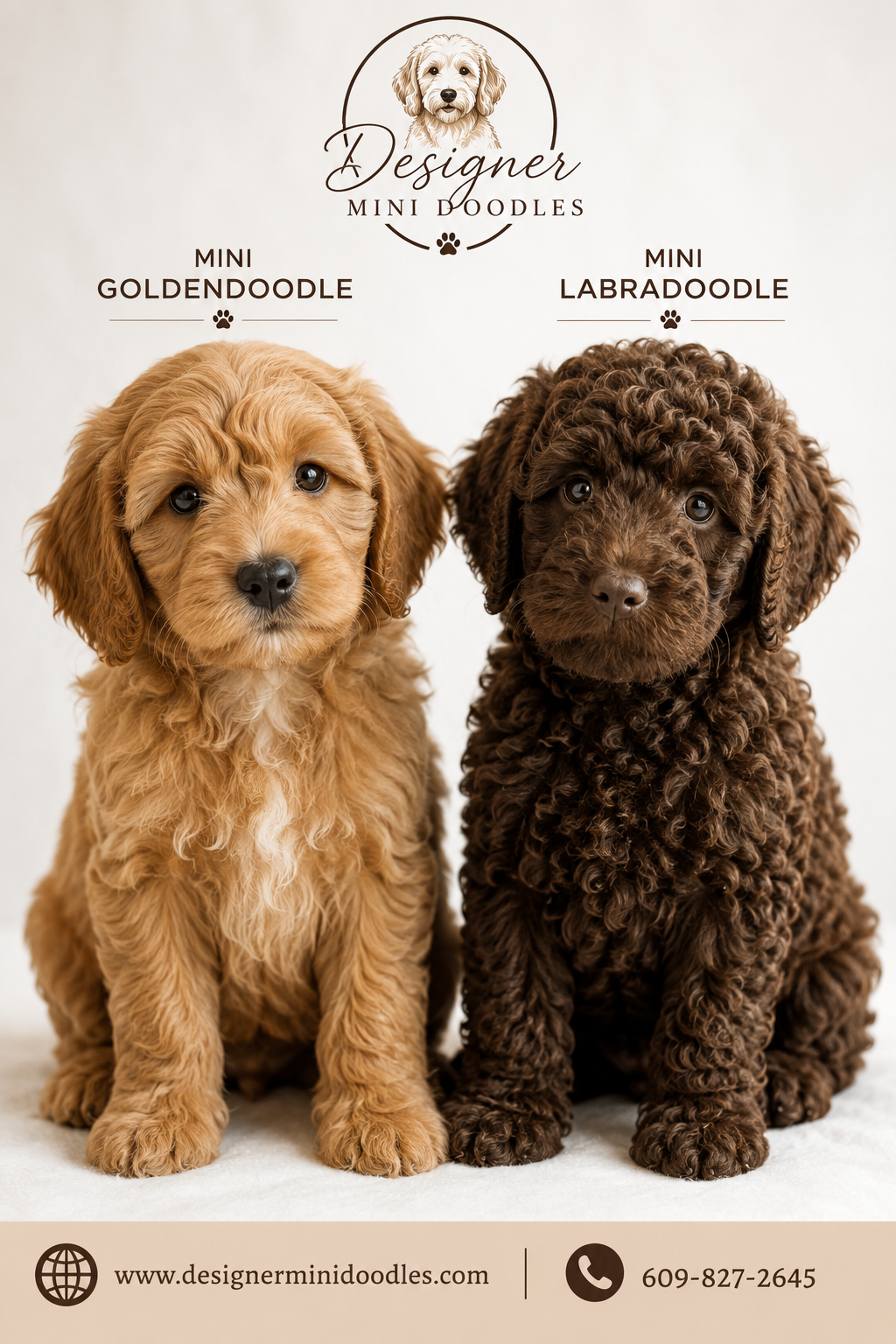
Mini goldendoodles are a cross between a Golden Retriever and a Miniature (or Toy) Poodle, while mini labradoodles cross a Labrador Retriever with a Miniature Poodle. Both are excellent companion dogs, but they have distinct personality traits and physical characteristics.
Mini Goldendoodle traits:
- Tend to be slightly calmer and more eager to please
- Coat is usually wavy to curly, in shades of cream, gold, apricot, or red
- Known for being gentle and patient, making them popular therapy dogs
- Typically 15 to 35 pounds at maturity
Mini Labradoodle traits:
- Often higher energy and more athletic
- Coat ranges from fleece-like to wool-like, in chocolate, cream, black, or parti colors
- Can be more independent-minded during training
- Typically 15 to 35 pounds at maturity
Choose a mini goldendoodle if you want a dog that’s naturally inclined toward cuddling and tends to be a bit more laid-back indoors. Choose a mini labradoodle if you lead an active lifestyle and want a dog that thrives on vigorous exercise and outdoor adventures.
Both breeds benefit enormously from early neurological stimulation (ENS) protocols and structured socialization. Our program at Designer Mini Doodles incorporates ENS from days 3 through 16 of life, which research from the U.S. military’s Bio Sensor program has shown improves stress tolerance, cardiovascular performance, and immune function in puppies.
Are Mini Doodles Good for Apartments?
Yes, mini doodles are one of the best breed categories for apartment living, especially in Orlando’s condo-heavy metro area. Their compact size (typically under 35 pounds), low-shedding coats, and moderate exercise needs make them well-suited to smaller spaces.
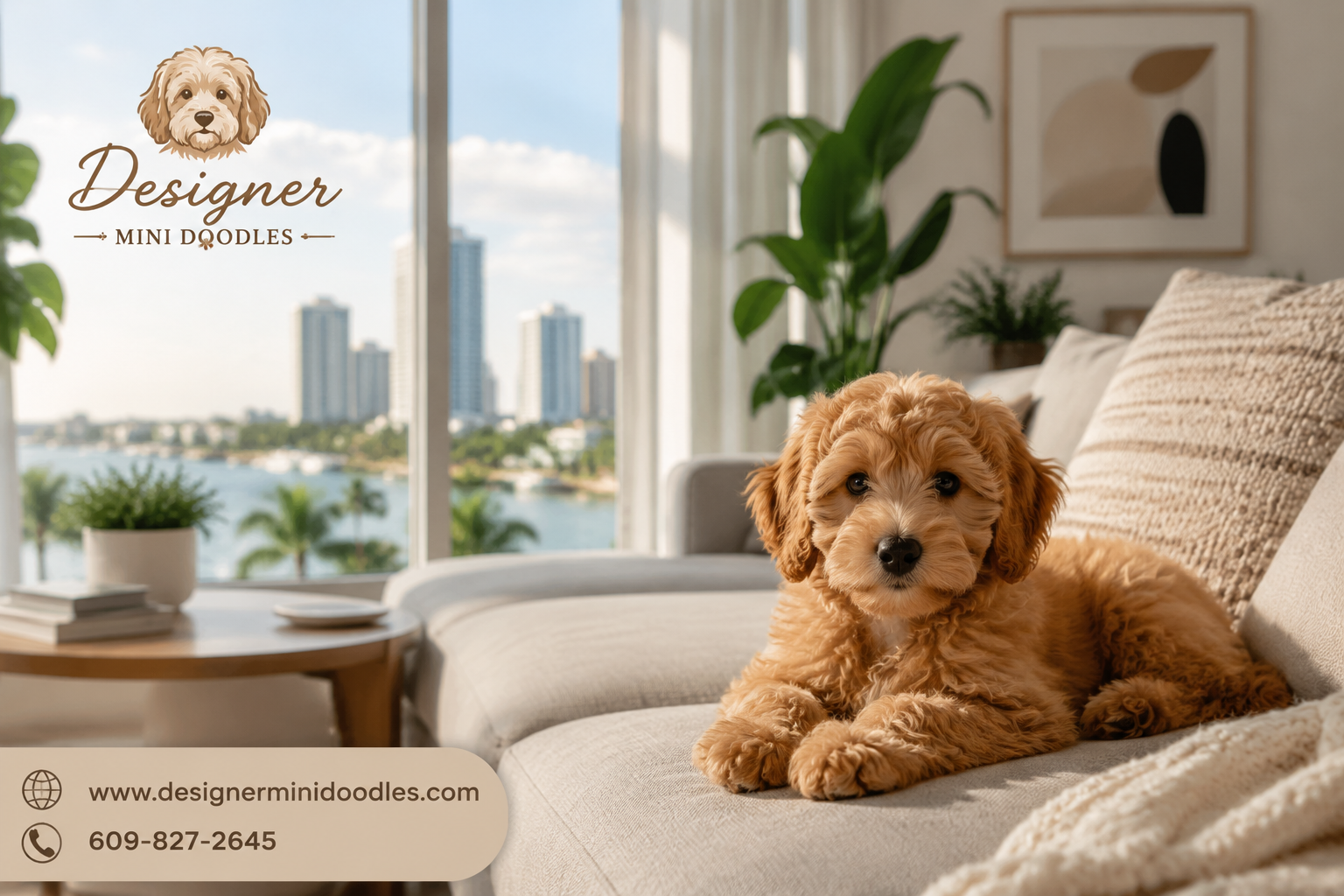
What makes them apartment-friendly:
- They don’t need a yard to be happy, as long as they get 30 to 60 minutes of daily walks and play
- Mini and micro doodles are quiet compared to many small breeds (they’re not prone to excessive barking when properly trained)
- Their low-shedding coats mean less fur on furniture and floors
- They adapt well to routine, which apartment living naturally provides
Common mistake: Skipping crate training because the apartment is “small enough already.” A crate actually gives your mini doodle a secure den space and prevents destructive behavior when you’re away. Our puppies begin early crate training before they leave for their new homes, which gives Orlando apartment dwellers a significant head start. For more on this approach, see our guide to crate training toy poodle puppies, which applies the same principles.
Edge case: If you work outside the home for 8+ hours daily with no midday break, consider a dog walker or doggy daycare. Mini doodles are social dogs and can develop separation anxiety if left alone for extended periods without gradual conditioning.
For families specifically interested in the smallest apartment-friendly option, our micro mini goldendoodle puppies in Florida at 10 to 16 pounds are an ideal fit.
How Big Do Mini Doodles Get Full Grown?
A standard mini doodle reaches 15 to 35 pounds and stands 13 to 17 inches tall at the shoulder when fully grown, typically reaching adult size by 10 to 12 months of age. Micro and toy varieties are smaller.
Size categories:
- Toy Goldendoodle: 10 to 15 pounds, 10 to 13 inches tall
- Micro Goldendoodle: 10 to 16 pounds, 12 to 14 inches tall
- Mini Goldendoodle: 20 to 35 pounds, 14 to 17 inches tall
The parent dogs’ sizes are the most reliable predictor of a puppy’s adult weight. A breeder who has been working with their lines for many years can give you a much more accurate size estimate than someone working with first-generation crosses for the first time.
Why this matters for Orlando buyers: Many Orlando-area condos and apartments have weight limits for pets, commonly 25 or 35 pounds. If you’re close to a weight limit, a micro or toy goldendoodle gives you comfortable margin. Learn more about why the 10 to 16 pound micro goldendoodle is the perfect size for many living situations.
Health Issues to Watch for in Mini Doodle Breeds
Mini doodles are generally healthy dogs with lifespans of 12 to 16 years, but like all breeds, they’re predisposed to certain conditions. Responsible breeders screen for these issues before breeding.
Most common health concerns:
- Hip dysplasia: Less common in minis than standard-sized doodles, but still worth screening via OFA or PennHIP
- Progressive Retinal Atrophy (PRA): A genetic eye condition that can lead to blindness; DNA-testable and avoidable through proper breeding
- Patellar luxation: The kneecap slips out of place; more common in smaller varieties
- Von Willebrand’s Disease: A blood clotting disorder inherited from the Poodle side; DNA-testable
- Ear infections: Floppy ears plus Orlando’s humidity create a perfect environment for yeast and bacteria
- Addison’s Disease: An adrenal gland disorder seen occasionally in Poodle crosses
What a reputable breeder should provide:
- Genetic testing panel (Embark or Paw Print Genetics) for both parent dogs
- OFA hip and elbow evaluations
- Annual eye exams (CERF/OFA)
- Cardiac clearance
- A written health guarantee of at least 2 years
Our breeding program at Designer Mini Doodles conducts comprehensive genetic testing on all parent dogs, which is a standard that every buyer searching for mini doodle puppies for sale in Orlando should demand.
Average Veterinary Costs for Mini Doodle Puppies
First-year veterinary costs for a mini doodle puppy in Orlando typically run between $1,500 and $2,500. After the first year, annual costs drop to approximately $800 to $1,500.
First-year cost breakdown (estimated):
| Expense | Estimated Cost |
|---|---|
| Puppy vaccination series (3-4 rounds) | $200 – $350 |
| Spay or neuter | $300 – $500 |
| Flea/tick/heartworm prevention (12 months) | $200 – $350 |
| Wellness exams (3-4 visits) | $150 – $300 |
| Microchipping | $40 – $60 |
| Emergency fund (recommended) | $500 – $1,000 |
Orlando-specific note: Florida’s year-round warm climate means heartworm prevention is non-negotiable. Mosquitoes transmit heartworm disease 12 months a year in Central Florida, so monthly preventive medication is essential from the day your puppy comes home.
For a deeper look at ownership expenses, our cost-of-ownership clarity guide breaks down long-term budgeting for micro goldendoodle owners.
What Do Mini Doodle Puppies Eat When They’re Young?
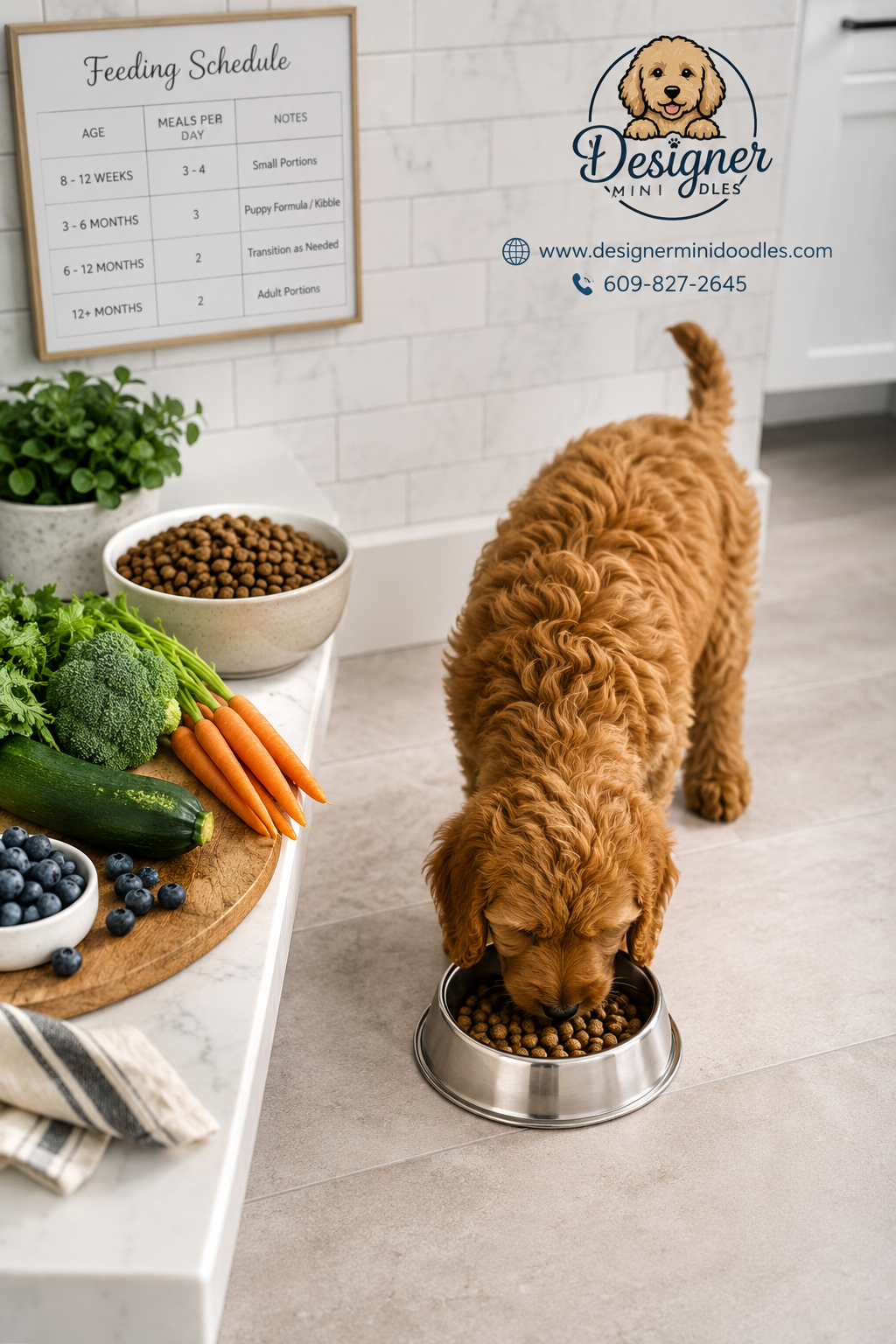
Mini doodle puppies should eat a high-quality, small-breed puppy food with at least 25 to 30% protein and 15 to 20% fat, fed three to four times daily until about six months of age, then transitioning to twice daily.
Feeding guidelines by age:
- 8 to 12 weeks: 1/4 to 1/2 cup per meal, 3 to 4 times daily
- 3 to 6 months: 1/3 to 2/3 cup per meal, 3 times daily
- 6 to 12 months: 1/2 to 3/4 cup per meal, 2 times daily
- 12 months and older: Transition to adult small-breed formula, 2 times daily
Recommended food characteristics:
- Named meat protein as the first ingredient (chicken, turkey, salmon)
- No artificial colors, flavors, or preservatives
- DHA for brain and eye development
- Appropriate calcium-to-phosphorus ratio for growing bones
Common mistake: Free-feeding (leaving food out all day). Mini doodle puppies are food-motivated and will overeat, which stresses developing joints and leads to obesity. Measured, scheduled meals also make housebreaking much easier because you can predict when your puppy needs to go outside.
For more detailed nutrition guidance, check out our healthy diet plans for growing puppies.
Are Mini Doodles Hypoallergenic?
No dog is truly 100% hypoallergenic, but mini doodles, particularly multi-generational and F1B crosses with curlier coats, produce significantly fewer allergens than most breeds. They shed minimally, and the Poodle genetics help trap dander in the coat rather than releasing it into the air.
What determines allergen levels:
- Coat type matters most. Curly coats (wool-type) shed the least. Wavy coats (fleece-type) shed slightly more. Straight or flat coats shed the most.
- Generation matters. F1B (75% Poodle) and multi-generational doodles are more consistently low-shedding than F1 crosses (50/50).
- Grooming frequency matters. Regular brushing (every 2 to 3 days) and professional grooming every 6 to 8 weeks removes trapped dander before it becomes airborne.
Choose an F1B or multi-gen mini doodle if allergies are a primary concern. Choose an F1 if you prefer a wavier, more relaxed coat texture and allergies are mild.
For allergy-conscious families in Orlando, our guide to micro goldendoodles for allergy-conscious homes covers this topic in depth.
Where Can I Find Reputable Mini Doodle Breeders Near Orlando?
The most reliable way to find reputable mini doodle puppies for sale in Orlando is to look for breeders who provide verifiable health testing, transparent breeding practices, and a documented track record spanning multiple years.
Red flags to avoid:
- No health testing documentation available
- Multiple breeds available at all times (puppy mill indicator)
- Puppies available “immediately” with no waitlist
- No contract or health guarantee
- Unwillingness to let you speak with past buyers
- Prices that seem too good to be true (under $1,500)
Green flags of a quality breeder:
- Breeding program led by a veterinary professional or animal biologist
- Puppies raised in a home environment, not a kennel
- ENS (Early Neurological Stimulation) and early socialization protocols
- Puppies begin housebreaking and crate training before going home
- Comprehensive genetic testing on all breeding dogs
- Health guarantee of 2+ years
- Willingness to take a puppy back at any point in its life
Designer Mini Doodles has been breeding the best quality and healthiest mini golden doodle puppies in America for over a decade and a half. Our program is run by an animal biologist who oversees every aspect of breeding, whelping, and early puppy development. We produce the calmest, most affectionate, and most confident mini golden doodle breeders puppies available.
Don’t live in Orlando? Our dedicated puppy nanny service delivers puppies safely to any home in the world. We also work with families across Florida and neighboring states like Georgia.
If you’re also considering other small breeds, we offer miniature french bulldog puppies as well.
Which Mini Doodle Breed Is Best for Families With Kids?
Mini goldendoodles are widely considered the best mini doodle variety for families with children, thanks to their patient temperament, gentle mouths, and strong desire to please. The Golden Retriever parent contributes a naturally tolerant and affectionate disposition that translates well to homes with young kids.
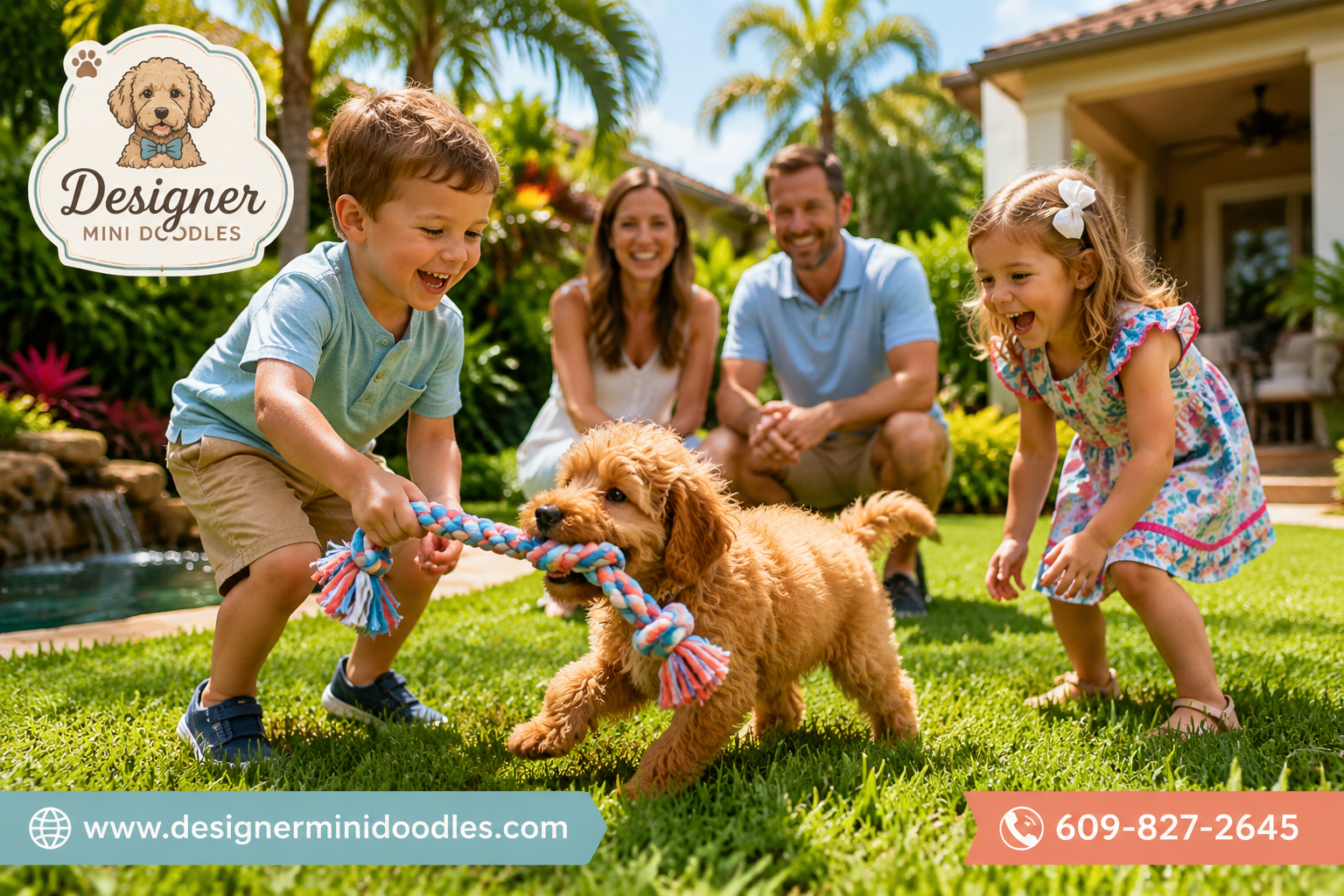
Best doodle types for families, ranked:
- Mini Goldendoodle – Patient, gentle, eager to please, tolerant of noise and handling
- Mini Bernedoodle – Loyal, calm, bonds deeply with family members
- Mini Labradoodle – Playful and energetic, great for active families with older kids
- Mini Cavapoo – Sweet and cuddly, best for quieter households with gentle children
Important consideration: Even the most family-friendly breed needs proper socialization and training. Teach children to respect the puppy’s space, avoid pulling ears or tails, and recognize when the dog needs a break. Supervision during interactions is essential, especially with toddlers.
Our puppies receive extensive early socialization with children, household sounds, and various surfaces before going to their new families. For families specifically, our guide to micro goldendoodles for family households with kids provides detailed advice.
Common Mistakes First-Time Mini Doodle Owners Make
The biggest mistake first-time mini doodle owners make is underestimating grooming requirements. A mini doodle’s low-shedding coat requires consistent maintenance, and neglecting it leads to painful matting within weeks.
Top mistakes to avoid:
- Skipping regular brushing. Brush your mini doodle every 2 to 3 days minimum. Daily is better for curly coats.
- Waiting too long for the first groomer visit. Introduce your puppy to professional grooming by 12 to 14 weeks, even if it’s just a bath and face trim.
- Overfeeding. Mini doodles gain weight easily, and extra pounds stress small joints.
- Insufficient socialization before 16 weeks. The critical socialization window closes around 16 weeks. Expose your puppy to new people, sounds, surfaces, and experiences during this period.
- Using punishment-based training. Doodles are sensitive dogs. Harsh corrections damage trust and create anxiety. Positive reinforcement works far better.
- Skipping crate training. A crate isn’t a punishment; it’s a safe space that prevents destructive behavior and accelerates housebreaking.
- Not budgeting for grooming. Professional grooming every 6 to 8 weeks costs $60 to $100 per visit in Orlando. That’s $600 to $1,000 annually.
Mini Doodle Puppy Training Tips for Beginners
Start training your mini doodle puppy the day you bring them home. Mini doodles are intelligent (Poodles rank as the second-smartest dog breed according to canine psychologist Stanley Coren’s research) and respond exceptionally well to positive reinforcement.
Week-by-week training priorities:
Weeks 8-10 (first days home):
- Establish a consistent potty schedule (every 1 to 2 hours, plus after meals, naps, and play)
- Begin crate training with short, positive sessions
- Teach name recognition using treats and praise
Weeks 10-12:
- Start basic commands: sit, down, come
- Begin leash introduction indoors
- Expose puppy to 3 to 5 new experiences daily (sounds, textures, people)
Weeks 12-16:
- Enroll in a puppy socialization class
- Practice commands in different locations
- Begin “leave it” and “stay” training
- First groomer visit
Weeks 16-24:
- Increase distraction-level training
- Longer walks and outdoor socialization
- Begin teaching impulse control games
Pro tip: Keep training sessions short (5 to 10 minutes for puppies) and end on a success. Mini doodles have excellent memories but short attention spans as puppies.
Our puppies come with a foundation of early training already in place. We begin housebreaking, crate conditioning, and basic socialization protocols before puppies leave our care. For more structured training guidance, see our resource on training a mini bernedoodle puppy, which covers principles applicable to all doodle breeds.
Conclusion
Finding the right mini doodle puppies for sale in Orlando comes down to three priorities: choosing a reputable breeder with verified health testing, selecting the right size and temperament for your lifestyle, and committing to proper training and care from day one.
Your next steps:
- Determine your ideal size. If you live in an apartment with a weight limit, a micro or toy goldendoodle (10 to 16 pounds) is your safest bet. If you have a house with a yard, a standard mini (20 to 35 pounds) gives you more flexibility.
- Verify the breeder. Ask for genetic testing results, health guarantees, and references from past buyers. A program run by an animal biologist or veterinary professional is a strong indicator of quality.
- Budget realistically. Plan for $2,500 to $5,000 for the puppy, plus $1,500 to $2,500 in first-year veterinary and supply costs, and $600 to $1,000 annually for grooming.
- Start training early. The first 16 weeks are your most important window for socialization and foundational training.
- Reach out. Browse our available micro golden doodle puppies or contact us directly to join our waitlist. Our puppy nanny service can deliver your new family member to any home in the world.
Orlando is one of the best cities in America to raise a mini doodle, with its abundant parks, pet-friendly restaurants, and year-round outdoor lifestyle. The right puppy from the right breeder will be your companion for the next 12 to 16 years, so take the time to make an informed decision.
Frequently Asked Questions
How long do mini doodle puppies live?
Mini doodles typically live 12 to 16 years, with smaller varieties (micro and toy) often living on the longer end of that range. Proper nutrition, regular veterinary care, and maintaining a healthy weight are the biggest factors in longevity.
Can I get a mini doodle puppy shipped to Orlando?
Yes. Reputable breeders offer puppy nanny services where a trained handler personally escorts your puppy on a flight to Orlando. This is safer and less stressful than cargo shipping. Designer Mini Doodles provides this service to any location worldwide.
When should I spay or neuter my mini doodle?
Most veterinarians recommend spaying or neutering mini doodles between 6 and 12 months of age. Some recent research suggests waiting until the dog is fully grown (around 12 months for minis) may benefit joint development. Discuss timing with your veterinarian.
How often do mini doodles need grooming?
Professional grooming every 6 to 8 weeks, with at-home brushing every 2 to 3 days. In Orlando’s humid climate, you may need to check ears weekly for moisture and clean them to prevent infections.
Do mini doodles bark a lot?
Mini doodles are not excessive barkers compared to many small breeds. However, they will bark to alert you to visitors or unusual sounds. Proper training and adequate exercise significantly reduce nuisance barking.
What’s the difference between F1, F1B, and multi-gen mini doodles?
F1 is a first-generation cross (50% Poodle, 50% retriever). F1B is an F1 crossed back to a Poodle (75% Poodle), producing more consistent low-shedding coats. Multi-gen doodles have been bred over several generations for specific traits. For allergy sufferers, F1B or multi-gen is the better choice.
Are mini doodles easy to potty train?
Yes, mini doodles are among the easier breeds to housebreak due to their intelligence and desire to please. Most puppies are reliably housetrained by 4 to 6 months with consistent scheduling. Puppies that begin early housebreaking with their breeder often learn even faster.
Do mini doodles get along with other pets?
Mini doodles generally get along well with other dogs and cats, especially when introduced properly. Early socialization is key. If you have an existing pet, introduce them in a neutral space and supervise interactions for the first few weeks.
What colors do mini doodle puppies come in?
Mini goldendoodles come in cream, apricot, red, gold, chocolate, black, and parti (multi-colored). Mini labradoodles add caramel, lavender, and café colors. Coat color does not affect temperament or health.
How much exercise does a mini doodle need daily?
Plan for 30 to 60 minutes of exercise daily, split between walks and play sessions. Puppies under 6 months should follow the “5 minutes per month of age” rule for structured walks to protect developing joints.
References
- Coren, Stanley. “The Intelligence of Dogs.” Free Press, 1994.
- Orthopedic Foundation for Animals (OFA). “Health Testing Requirements.” ofa.org, 2024.
- American Kennel Club. “Poodle Breed Information.” akc.org, 2024.
- University of California Davis Veterinary Genetics Laboratory. “Canine Genetic Testing.” vgl.ucdavis.edu, 2023.