

Last updated: August 9, 2026
mini doodles for sale California
Mini doodles for sale California typically range from $2,500 to $4,500 from an accredited breeder who provides a genetic health guarantee, veterinary-supervised whelping, early neurological stimulation, and puppies already started on housebreaking and crate training. Listings priced at $500 to $1,000 are almost always scams, and $1,000 to $1,500 usually signals a puppy mill or broker. A mini doodle is a Poodle crossed with a Golden Retriever, Bernese Mountain Dog, Cocker Spaniel, or similar breed, bred down in size to roughly 15 to 35 pounds. Expect a 4 to 12 week wait for a well-bred litter from a reputable California-serving program.
mini doodles for sale California
- Mini doodles are Poodle crosses (most often mini goldendoodles) that mature around 13 to 20 inches tall and 15 to 35 pounds.
- Realistic California pricing from an accredited breeder is $2,500 to $4,500; anything under $1,500 deserves serious scrutiny.
- Ask for written proof of OFA/PennHIP hips, cardiac clearance, eye exams, and a genetic panel on both parents before paying a deposit.
- Mini doodles shed very little, but low shedding means high grooming: professional trims every 6 to 8 weeks plus brushing 3 to 4 times a week.
- Temperament is the real selling point for families: sociable, biddable, people-focused, and highly trainable when raised with early stimulation and noise exposure.
- Scam red flags include prices far below market, refusal to do a live video call, shipping-only arrangements, and payment by wire, Zelle, gift card, or crypto.
- Mini doodle vs cockapoo: the cockapoo is generally smaller and lower-energy; the mini goldendoodle is more athletic and often easier to train for active families.
- A puppy already started on crate training and housebreaking saves most new owners three to five weeks of frustration.
What Is a Mini Doodle Dog Breed?
A mini doodle is a crossbred dog created by pairing a Miniature or Toy Poodle with another breed, then selecting for smaller adult size. The most common version is the mini goldendoodle (Poodle x Golden Retriever), followed by the mini bernedoodle (Poodle x Bernese Mountain Dog), mini labradoodle, and cockapoo (Poodle x Cocker Spaniel).
Mini doodles are not a recognized breed with the AKC. They are intentional crosses, which means quality varies enormously between breeding programs. Two puppies advertised as “mini doodles” can differ by 20 pounds in adult weight and by two full coat types.
Generation labels you’ll see in California listings:
| Label | What it means | Coat tendency |
|---|---|---|
| F1 | Poodle x Golden Retriever (first cross) | Wavy to shaggy, some shedding possible |
| F1B | F1 doodle x Poodle (75% Poodle) | Curlier, lowest shedding |
| F1BB | F1B x Poodle (87.5% Poodle) | Tight curl, very low shedding |
| F2 / multigen | Doodle x doodle across generations | Most variable; depends on the program |
Decision rule: If allergies are your main concern, choose an F1B or multigen puppy from a breeder who can show you adult coat photos from the same lines. If you want a slightly easier coat to brush and don’t mind light shedding, an F1 wavy coat is often more forgiving.
What Is the Mini Doodle vs Goldendoodle Difference?
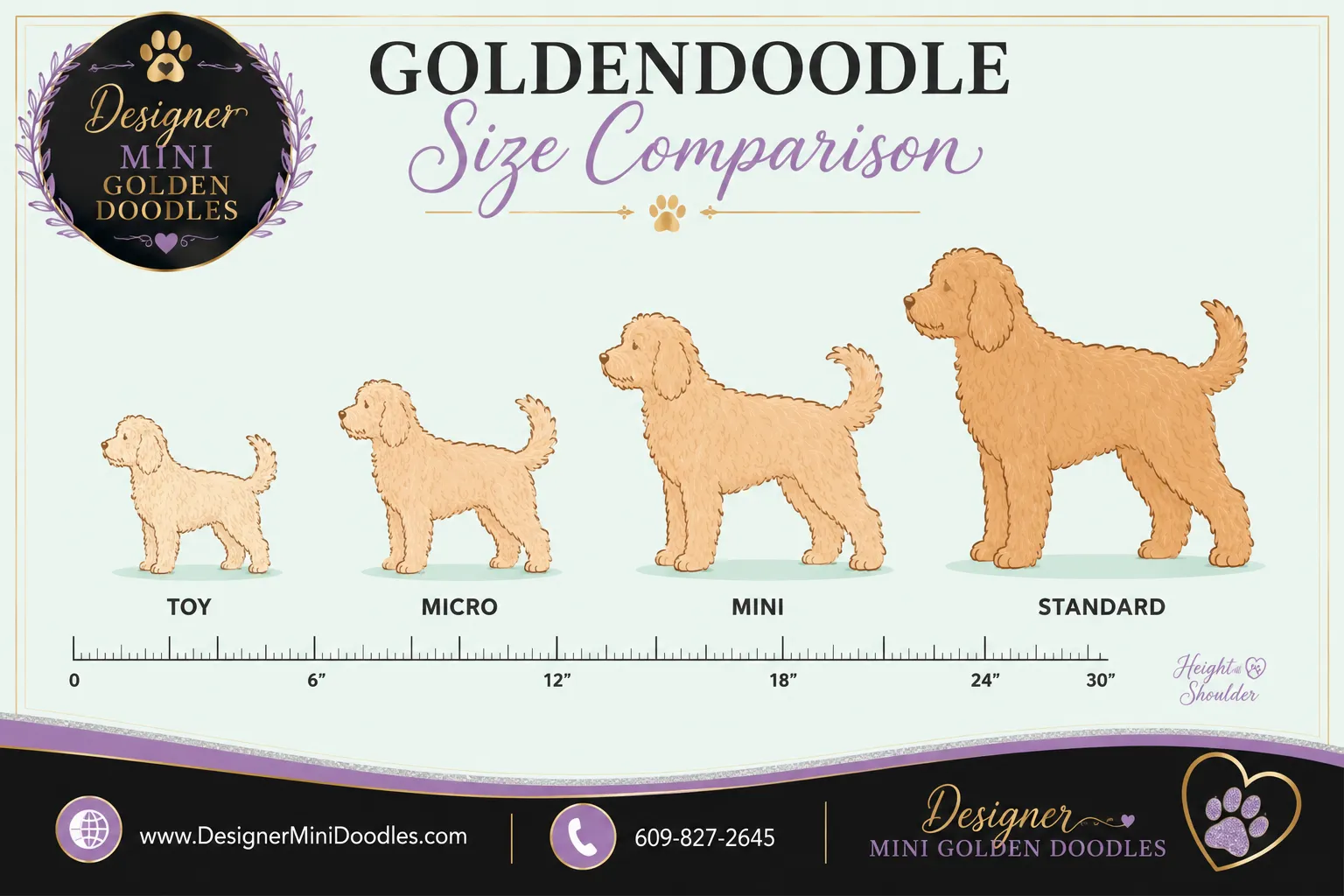
The difference is size, not breed. A standard goldendoodle typically matures at 45 to 75 pounds and 20 to 24 inches at the shoulder. A mini goldendoodle matures at roughly 15 to 35 pounds and 13 to 20 inches, because a Miniature or Toy Poodle is used instead of a Standard Poodle.
Beyond the scale, a few practical differences matter for California buyers:
- Housing fit: mini doodles clear most apartment and HOA weight limits (often 25 or 30 pounds); standards frequently don’t.
- Exercise: a mini is usually satisfied with 45 to 60 minutes of activity daily; standards often want more.
- Lifespan: smaller dogs generally live longer, and mini doodles commonly reach 12 to 15 years.
- Cost of ownership: food, flea/tick preventatives, and anesthesia-based procedures are all cheaper by weight.
- Travel: many minis fit airline in-cabin carriers; standards do not.
Size is the one trait you cannot change after you bring a puppy home. Ask for the adult weights of both parents and of previous puppies from the same pairing before you commit.
If you’re specifically shopping the smaller end, our page on mini goldendoodle puppies for sale in California and the best mini goldendoodle breeders breaks down size tiers in more depth, and buyers wanting the smallest option should look at top quality toy goldendoodle puppies.
Mini Doodle Puppies for Sale California Price: How Much Do Mini Doodles Cost?
Mini doodle puppies for sale in California cost $2,500 to $4,500 from a legitimate, accredited breeder with genetic health testing and a written health guarantee. Price tiers in this market are remarkably consistent, and the tier tells you almost everything about how the puppy was raised.
The four price tiers, and what each one actually buys:
$500 to $1,000, scam territory. No genuine mini doodle breeder in California can produce a health-tested litter at this price. Progeny costs alone (progesterone testing, prenatal vet care, C-section risk, first vaccines, deworming, microchip, genetic panels on parents) exceed it. Listings here are typically stolen photos, a fake website, and a request for a deposit by Zelle or crypto. The puppy does not exist.
$1,000 to $1,500, puppy mill or broker. The dog may be real, but volume is the business model. Expect no parental health clearances, minimal socialization, no housebreaking start, and a much higher chance of coccidia, giardia, kennel cough, or an undisclosed heart murmur in the first month. Vet bills often erase the savings.
$1,800 to $2,000, hobby breeder. Often well-intentioned people with one or two family dogs. Puppies are usually raised indoors and loved, but there’s typically no genetic panel, no structured early stimulation protocol, no crate-training start, and no long-term health guarantee. Fine for some buyers; understand what’s missing.
$2,500 to $4,500, accredited breeder. This tier includes a written genetic health guarantee, OFA or PennHIP hip evaluation and cardiac clearance on parents, a full DNA disease panel, veterinary-attended whelping, early neurological stimulation from birth, noise and household desensitization, and a puppy already started on housebreaking and crate training. Price within the tier varies by size (smaller sells higher), coat, color, and whether the breeder has a waitlist.
Additional first-year costs to budget in California:
| Expense | Typical range |
|---|---|
| Initial vet visit + remaining puppy vaccines | $250,$500 |
| Spay/neuter | $300,$800 |
| Crate, pen, bed, bowls, leash | $200,$400 |
| Professional grooming (6-8 visits/year) | $480,$1,200 |
| Pet insurance | $30,$70/month |
| Group obedience class | $150,$300 |
Common mistake: shopping on sticker price alone. A $1,200 puppy that needs $1,800 in giardia treatment, a dental extraction, and a behaviorist for fear-reactivity is the most expensive puppy in this article.
Where to Find Reputable Mini Doodle Breeders in California
Start with breeders who publish parental health testing, let you video-call the litter live, and can name their veterinarian. Reputable programs serving California buyers usually have a waitlist, a written contract, and a take-back clause for the dog’s entire life.
Where to look, in order of reliability:
- Established breeding programs with a documented protocol (health testing, early neurological stimulation, crate-training start). These typically ship or hand-deliver to California metros.
- Breed-club and doodle association referral lists, which require member breeders to health test.
- Veterinarian and groomer referrals in your area. Groomers in Los Angeles, San Diego, and the Bay Area see hundreds of doodle coats and know which local lines mat badly.
- Rescue and rehome networks for adult doodles, if you’re open to a dog over one year old.
Where not to look: general classified marketplaces, social media comment sections, and any site that lists dozens of breeds at once with instant “buy now” checkout.
Ten questions that separate real breeders from resellers:
- May I see OFA/PennHIP, cardiac, and eye clearance certificates for both parents?
- What genetic panel did you run, and can I see the results?
- Can we do a live video call with the litter and the dam right now?
- What is your early socialization protocol between birth and eight weeks?
- Where do the puppies sleep, and what surfaces have they walked on?
- What does your health guarantee cover, and for how long?
- What happens if I can no longer keep the dog at age five?
- What were the adult weights of puppies from this exact pairing?
- Who is your veterinarian, and may I call the clinic?
- How many litters do you produce per year?
If a seller dodges two or more of these, walk away. Buyers comparing programs can also review our roundups of the best mini and micro goldendoodle breeders in California and mini goldendoodle breeders in California, plus city-specific availability such as mini goldendoodle puppies for sale in San Jose, CA.
Why Designer Mini Doodles Is the Best Mini Golden Doodle Breeder
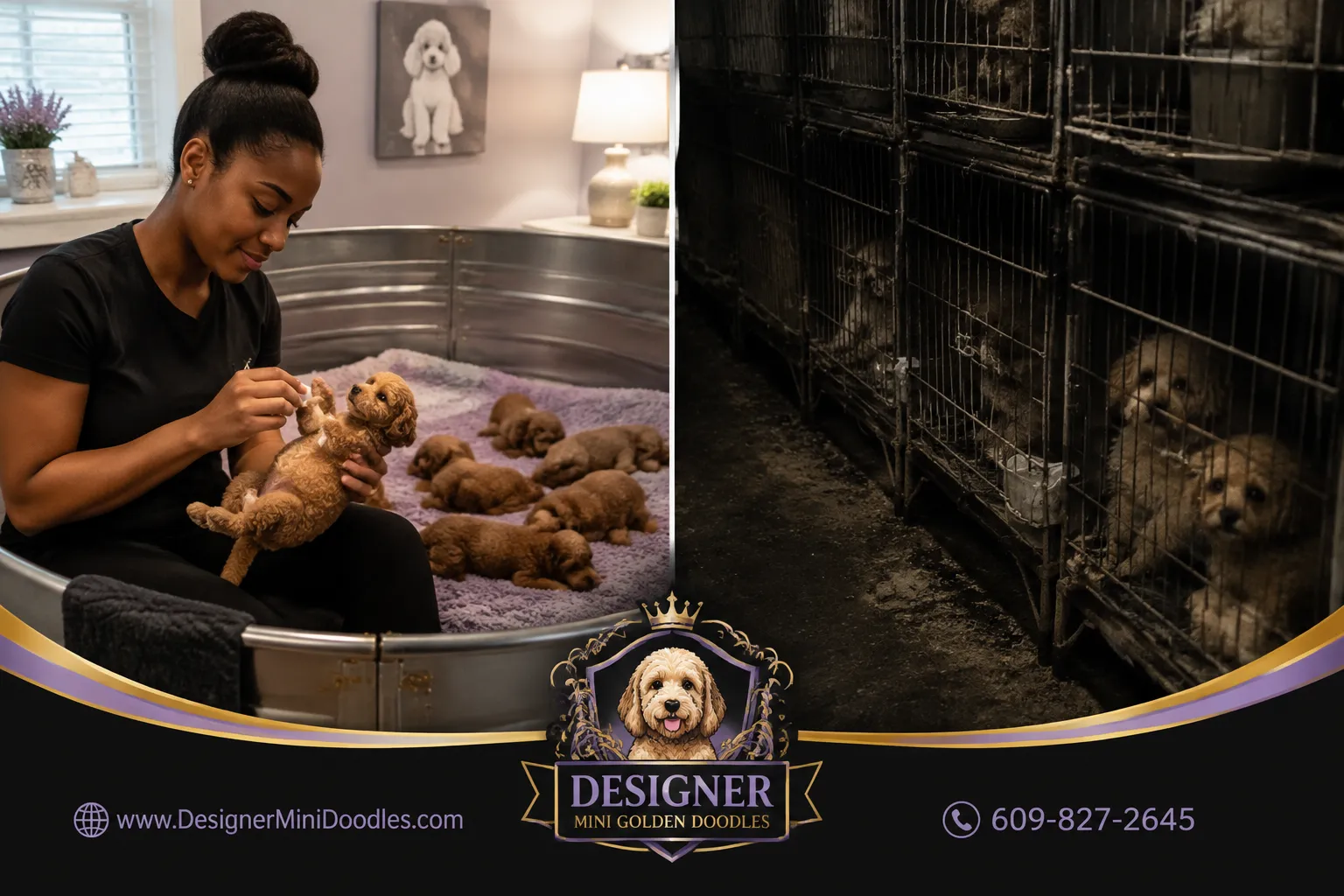
Designer Mini Doodles is run by a working animal biologist with a degree in Animal Biology from Stockton University in Pomona, New Jersey, and a minor in animal genetics, which is why every pairing starts with pedigree analysis and a full DNA panel rather than guesswork. All of our mini golden doodles for sale and our breeding stock come from top documented bloodlines, and we consider ourselves the best mini golden doodle breeders in the USA for one measurable reason: the puppy you receive is already started.
- Early Neurological Stimulation (ENS) begins in the first days of life, with daily gentle handling that builds stress tolerance before the eyes even open.
- Puppies grow up inside a busy household, exposed to vacuum noise, doorbells, kitchen clatter, children, and other animals, so a California moving truck or a Fourth of July fireworks show isn’t a crisis.
- Every puppy leaves well started on housebreaking and crate training, sleeping in a crate voluntarily and using a designated potty surface.
- Trainability is a program outcome, not an accident. Our mini golden doodle puppies typically sit, come, and settle on cue within their first two weeks home because the foundation was laid before pickup.
- Every placement includes a genetic health guarantee in writing.
Families searching for mini doodles for sale can view current availability below, visit our Google Maps listing, and buyers who also want a companion breed can ask about our sister program’s French bulldog stud services.
- Display 9 Products per page
Are Mini Doodles Good Family Pets?
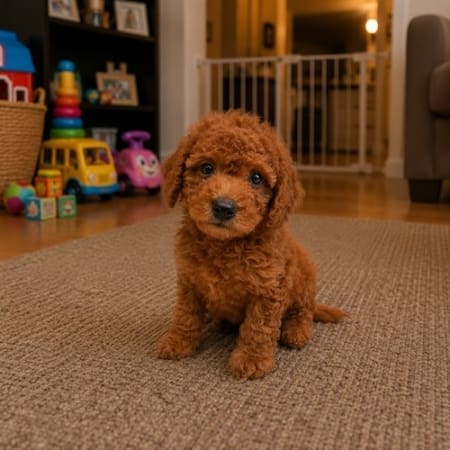
Yes. Mini doodles are among the better small-to-medium family dogs because they combine Poodle intelligence with retriever or spaniel sociability, and their size makes them safe around small children without being fragile. They are best suited to households where someone is home for part of the day.
Mini doodles work well for:
- Families with kids aged four and up who can learn gentle handling
- First-time dog owners who want a trainable dog
- Apartment and condo residents within weight limits
- Multi-pet homes, when the puppy was raised around other animals
- Active owners who want a hiking or beach companion under 35 pounds
Mini doodles are a poor fit for:
- Households where the dog would be alone 10+ hours daily (separation anxiety risk is real in this cross)
- Owners unwilling to budget for professional grooming
- People wanting a low-energy, low-input dog
- Homes with toddlers under three who cannot yet be supervised reliably around a jumpy puppy
Quick example: a San Diego family with two elementary-age kids and a fenced yard is close to the ideal placement. A Bay Area couple who both commute 11 hours a day should either arrange midday care or consider an adult rescue that’s already crate-conditioned.
What Is the Mini Doodle Temperament and Personality?
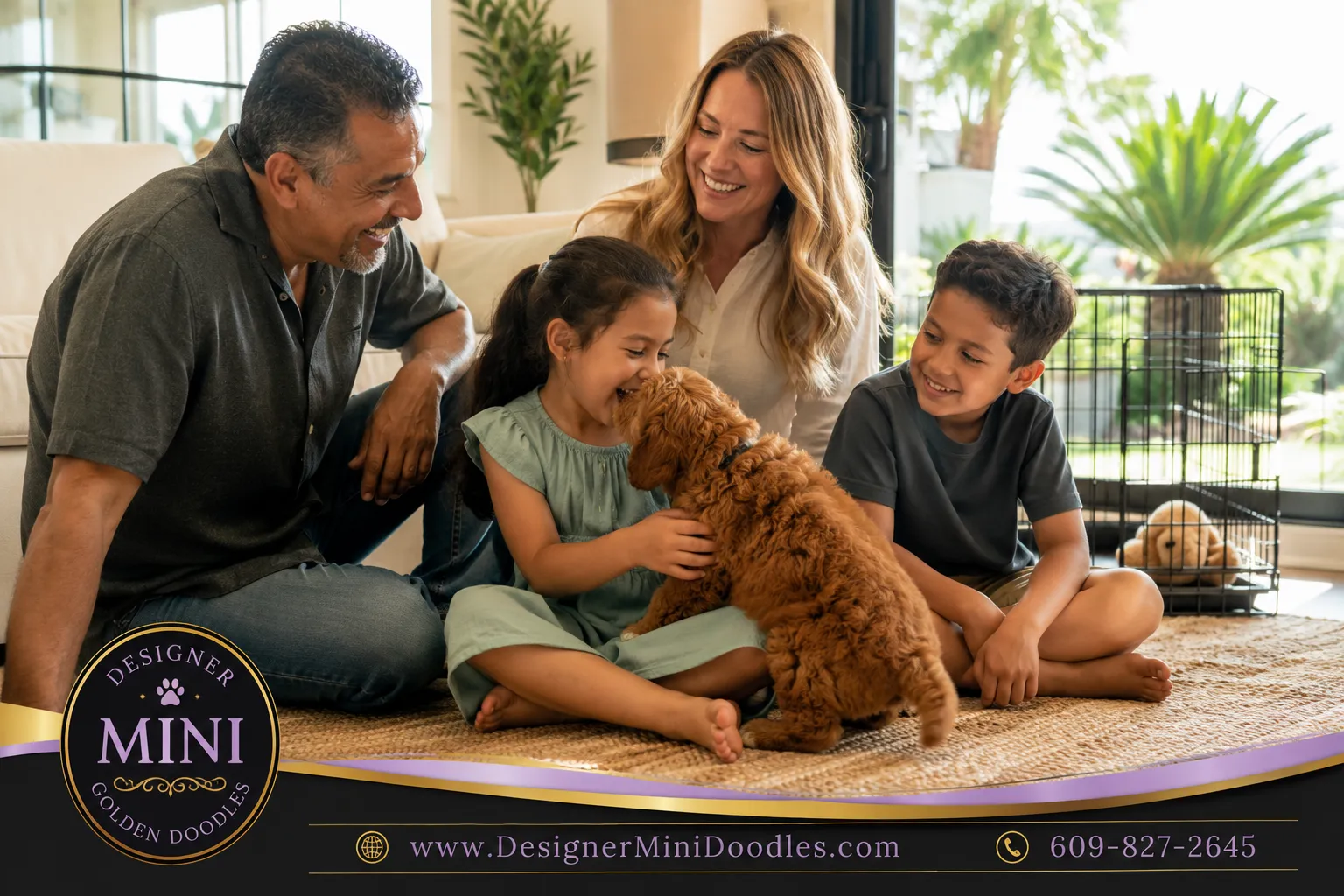
Mini doodles are typically affectionate, alert, eager to please, and strongly bonded to their people. They inherit the Poodle’s problem-solving drive and the retriever’s soft, cooperative attitude, which makes them highly trainable but also prone to boredom behaviors if under-stimulated.
Traits you can expect from well-bred lines:
- People-oriented to a fault. They follow you room to room and prefer company to solitude.
- Fast learners. Most master sit, down, place, and recall in a handful of short sessions.
- Moderately vocal. Alert barking at the door is common; excessive barking usually means unmet exercise or attention needs.
- Sensitive. Harsh corrections backfire. Reward-based training works far better.
- Playful into adulthood. Many stay puppyish through year three.
Edge case: temperament is heritable. A nervous dam produces nervous puppies more often than not, regardless of how good your training is. When you video-call a litter, watch the mother’s body language more closely than the puppies’. If she’s cowering or frantic, that’s your answer.
Common mistake: skipping structured alone-time practice in the first month. Owners who never leave the puppy alone create a dog that panics at week six. Start with five-minute crate absences on day two.
For a breed-specific look at foundation work, see our guide to training a mini bernedoodle puppy, the protocol transfers directly to mini goldendoodles.
Mini Doodle Size: How Big Do They Get?
Most mini doodles mature at 13 to 20 inches at the shoulder and 15 to 35 pounds, reaching about 90 percent of adult height by eight months and filling out through 12 to 18 months. The single best predictor is the size of both parents, not the puppy’s current weight.
| Tier | Typical adult weight | Typical adult height |
|---|---|---|
| Toy / micro doodle | 8-15 lbs | 10-14 in |
| Mini doodle | 15-35 lbs | 13-20 in |
| Medium doodle | 35-45 lbs | 18-21 in |
| Standard doodle | 45-75 lbs | 20-24 in |
Decision rule: if your lease caps dogs at 25 pounds, only consider litters where the dam is under 30 pounds and the sire is a Toy or small Miniature Poodle, and get the weight estimate written into your contract. F1 crosses using a full-size Golden Retriever dam frequently exceed “mini” claims by 10 pounds or more.
Do Mini Doodles Shed a Lot, and What Are the Grooming Requirements?
Mini doodles shed very little, especially F1B and multigen curly coats, but they require more grooming than almost any shedding breed. The hair keeps growing instead of falling out, so it mats against the skin if it isn’t brushed and trimmed on schedule.
Realistic grooming plan:
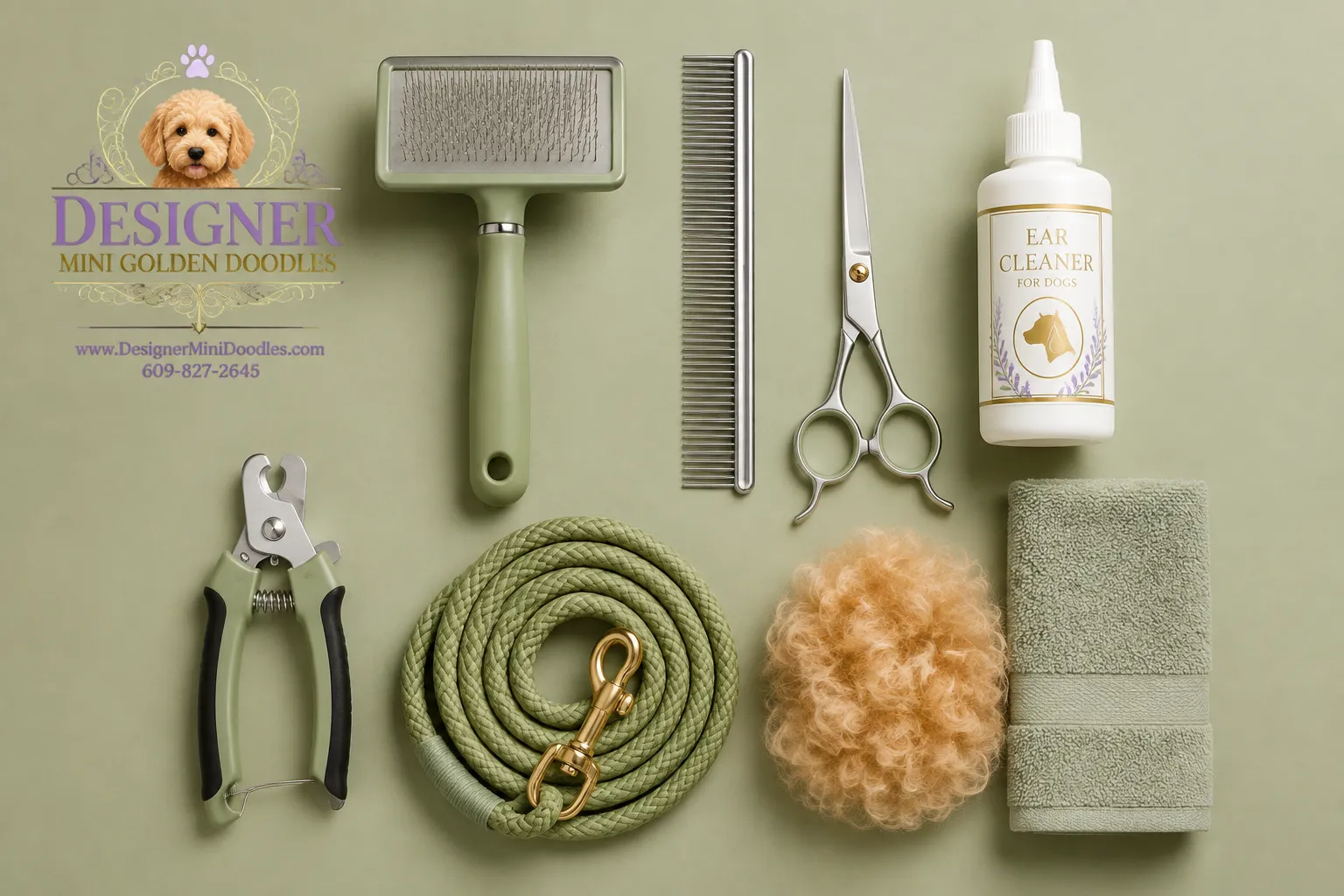
- Brushing: 3 to 4 times weekly with a slicker brush plus a steel comb to the skin. Curlier coats need daily attention during the coat change at 8 to 12 months.
- Professional grooming: every 6 to 8 weeks. In California metros, expect roughly $80 to $150 per appointment depending on size, coat condition, and city.
- Ears: check and dry weekly. Poodle-cross ear canals hold moisture, and beach or pool days raise infection risk.
- Eyes and face: wipe daily to prevent tear staining and matting under the eyes.
- Nails: trim every 3 to 4 weeks.
- Teeth: brush several times a week; small-mouth crosses are prone to dental crowding.
The mistake almost every new doodle owner makes: brushing only the top layer. The coat looks fine while a dense mat forms underneath, and the groomer has no choice but to shave the dog. Comb all the way to the skin in sections, and if the comb catches, work that spot out before moving on.
Allergy note: no dog is truly hypoallergenic. Low-shedding coats trap dander instead of releasing it into the air, which many allergy sufferers tolerate better. If allergies are severe, spend an hour with an adult dog from the same lines before committing.
What Are Common Mini Doodle Health Problems and Issues?
Mini doodles inherit risk from both parent breeds, and the most commonly cited concerns are hip dysplasia, patellar luxation, progressive retinal atrophy, von Willebrand disease, and ear infections. Responsible breeders reduce (not eliminate) these risks through parental health clearances and DNA panels.
What to verify before you buy:
- Hips and elbows: OFA or PennHIP evaluation on both parents.
- Heart: cardiac clearance, ideally by a veterinary cardiologist.
- Eyes: annual ophthalmologist exam plus DNA testing for PRA (prcd-PRA is a known Poodle-line mutation).
- Knees: patella evaluation, especially important in smaller crosses.
- DNA panel: von Willebrand disease, degenerative myelopathy, and breed-relevant markers.
Golden Retriever side risk: cancer, particularly lymphoma and hemangiosarcoma, is a documented concern in the breed and can carry into goldendoodle lines. No test screens for it, so pedigree longevity history matters. Ask how long the grandparents lived and what they died of.
Ongoing management that actually helps:
- Keep the dog lean. Excess weight worsens every joint issue.
- Dry ears thoroughly after swimming and bathing.
- Feed a diet appropriate to small-breed growth rates.
- Insure early, before a condition is diagnosed and excluded as pre-existing.
Edge case: a breeder who says “my dogs are healthy, so I don’t test” is telling you they don’t know. Carrier status is invisible without a panel, two visibly healthy carriers can produce affected puppies.
Mini Doodle vs Cockapoo: Which Is Better?
Neither is universally better; the choice depends on energy level and size. Choose a cockapoo if you want a smaller, calmer lap-oriented companion. Choose a mini goldendoodle if you want a more athletic, highly trainable dog for an active household.
| Factor | Mini goldendoodle | Cockapoo |
|---|---|---|
| Adult weight | 15-35 lbs | 12-24 lbs |
| Energy level | Moderate to high | Low to moderate |
| Trainability | Very high | High |
| Grooming load | High | High |
| Prey drive | Low to moderate | Moderate (spaniel flushing instinct) |
| Ear infection risk | Moderate | Higher (heavier ear leather) |
| Typical CA price | $2,500,$4,500 | $1,800,$3,500 |
| Best for | Active families, hikers, kids 5+ | Apartments, seniors, quieter homes |
Decision rule: if you’ll walk the dog twice a day and want to do training games, go mini goldendoodle. If your ideal evening is a dog asleep on the couch after one 25-minute walk, the cockapoo is the better match. Also worth comparing: mini bernedoodle puppies, which tend to be calmer and more velcro-like than either.
How Do You Avoid Mini Doodle Puppy Scams?
Assume any mini doodle advertised in California under $1,500 is either a scam or a mill until proven otherwise. The most reliable single test is a live, unscripted video call where you ask the seller to pick up the specific puppy and show you the mother in the same frame.
Red flags, ranked by severity:
- Payment by wire transfer, Zelle, Venmo to a stranger, gift cards, or cryptocurrency. Legitimate breeders accept traceable payment and issue receipts.
- Refusal or repeated postponement of a live video call.
- Prices dramatically below market, sometimes with a “free shipping” sweetener.
- Sudden extra fees after the deposit: crate insurance, climate-controlled transport, customs. This is the classic escalation scam.
- Stolen photos. Reverse image search every picture. Scammers reuse the same puppy photos across dozens of fake sites.
- No physical address, no phone call, no vet reference.
- A brand-new website with generic copy and no litter history.
- Pressure tactics: “three other families are asking about him tonight.”
Protective steps that take ten minutes:
- Reverse image search the photos and the seller’s text (scam listings are copy-pasted).
- Call the veterinary clinic the breeder names and confirm the account exists.
- Ask for the microchip number and registration paperwork.
- Pay with a credit card or an escrow-type method that offers recourse.
- Get the health guarantee and the deposit refund policy in writing before sending money.
Quick example: a buyer is offered a “9-week-old F1B mini goldendoodle, $850, includes shipping to LAX.” After the deposit, a “transport company” requests $1,400 for a mandatory ventilated crate, then $600 for insurance. There is no puppy. This pattern is the most common dog-sale fraud reported to consumer protection agencies, and the money is rarely recoverable.
FAQ
How much do mini doodles cost in California?
Expect $2,500 to $4,500 from an accredited breeder with health-tested parents, a written genetic guarantee, and puppies started on crate training. Hobby breeders charge $1,800 to $2,000, puppy mills $1,000 to $1,500, and listings under $1,000 are almost always fraudulent.
How big do mini doodles get?
Most reach 13 to 20 inches tall and 15 to 35 pounds as adults, hitting near-full height around eight months and finishing muscle development by 12 to 18 months.
Do mini doodles shed?
Very little, particularly F1B and multigen curly coats. In exchange, they need brushing 3 to 4 times a week and a professional groom every 6 to 8 weeks, or the coat mats to the skin.
Are mini doodles hypoallergenic?
No dog is fully hypoallergenic. Low-shedding doodle coats release less dander into the air, which many allergy sufferers tolerate, but reactions vary by individual and by coat type.
Are mini doodles good with kids?
Generally yes. Their size, sociability, and tolerance make them well-suited to children aged four and up, provided the puppy was raised around household noise and the kids learn gentle handling.
How long do mini doodles live?
Typically 12 to 15 years, with smaller individuals often at the higher end. Keeping the dog at a lean body weight is the most effective thing an owner controls.
What health tests should the parents have?
At minimum: OFA or PennHIP hips, cardiac clearance, an eye exam, patella evaluation, and a DNA panel covering PRA and von Willebrand disease. Ask for certificate copies, not verbal assurances.
Is a mini doodle or a cockapoo better for an apartment?
The cockapoo is usually the easier apartment dog because it is smaller and lower-energy. A mini goldendoodle also does well in an apartment if it gets 45 to 60 minutes of daily activity.
How long is the wait for a mini doodle puppy in California?
Typically 4 to 12 weeks from deposit to pickup with an established program, longer for specific colors or the smallest size tiers. Instant availability across many breeds is a warning sign.
What does “well started on crate training” actually mean?
It means the puppy already sleeps in a crate without protest, associates the crate with food and rest, and uses a designated potty surface. That foundation typically saves new owners three to five weeks of house-training work.
Should I get a male or female mini doodle?
Behavioral differences are minor in this cross once the dog is spayed or neutered. Choose based on the individual puppy’s temperament and the breeder’s placement recommendation rather than sex.
Can I buy a mini doodle from an out-of-state breeder and have it delivered to California?
Yes, and many California families do. Insist on a live video call first, a health certificate from a licensed veterinarian issued within the required window, and either a flight nanny or hand-delivery rather than unaccompanied cargo when possible.
Conclusion
The mini doodle market in California rewards buyers who do homework and punishes those who shop on price. The pricing tiers are the clearest signal available: $500 to $1,000 means fraud, $1,000 to $1,500 means volume breeding, $1,800 to $2,000 means a well-meaning hobbyist without health testing, and $2,500 to $4,500 means an accredited program with genetic clearances, proper whelping, and a puppy already started on housebreaking and crate work.
Your next steps:
- Set your real budget, purchase price plus $1,500 to $2,500 in first-year costs.
- Decide your size ceiling based on your housing rules, then only consider litters whose parents support it.
- Write down the ten breeder questions from this guide and use them on every seller you contact.
- Request health clearance documents and a live video call before any deposit leaves your account.
- Book grooming before pickup. Get on a groomer’s schedule at week nine so the first appointment lands at 14 to 16 weeks.
- Practice short crate absences from day two to prevent separation anxiety.
Buy from a breeder who can show you the science behind the pairing, the socialization protocol behind the puppy, and the guarantee behind the sale. That’s what separates a 14-year companion from a costly mistake.
Related Reading
- Mini goldendoodle puppies for sale in California and the best mini goldendoodle breeders
- Best mini and micro goldendoodle breeders in California
- Mini bernedoodle puppies for sale
- Top quality toy goldendoodle puppies for sale