

Last updated: August 9, 2026
mini doodles for sale Texas
Mini doodles for sale in Texas typically range from $2,500 to $4,500 from an accredited breeder who provides genetic health testing, professional whelping, and early housebreaking and crate training. Listings priced at $500 to $1,000 are almost always scams or brokered imports, and $1,000 to $1,500 usually signals a high-volume puppy mill. Expect a fully grown mini goldendoodle to weigh 15 to 30 pounds, live 12 to 15 years, and need professional grooming every six to eight weeks.
Key Takeaways
- A “mini doodle” is a poodle cross bred down in size, most often a mini goldendoodle (golden retriever x miniature poodle), but the term also covers mini bernedoodles, mini labradoodles, and cockapoos.
- Realistic pricing for mini doodles for sale Texas runs $2,500 to $4,500 with a genetic health guarantee; anything under $1,500 deserves heavy skepticism.
- Adult size is 15 to 30 pounds and 13 to 17 inches at the shoulder, roughly half the weight of a standard goldendoodle.
- Most mini doodles shed very little but they are not truly hypoallergenic; curly and wavy F1B coats shed least.
- Grooming is the biggest hidden cost at roughly $75 to $110 per professional visit in Texas metros, every six to eight weeks.
- Health screening matters more than color. Ask for OFA hips, elbows, eyes, cardiac, plus PRA, ICH, and DM genetic panels on both parents.
- Texas has no statewide hobby-breeder license requirement, so buyer verification is entirely on you.
- Rescue is a real option through Texas doodle-specific and poodle-mix rescue networks, usually $300 to $650 in adoption fees.
What is a mini doodle dog?
A mini doodle is any poodle crossbreed intentionally bred down in size using a miniature or toy poodle, producing an adult dog usually between 15 and 30 pounds. The most popular version in Texas is the mini goldendoodle, a golden retriever crossed with a miniature poodle, followed by the mini bernedoodle and mini labradoodle.
The word “mini” describes size, not a separate breed. Breeders reach that size by pairing a smaller poodle with a golden retriever, or by breeding two smaller doodles together across generations. Generation labels tell you a lot about coat and size predictability:
| Generation | Cross | Typical coat | Shedding |
|---|---|---|---|
| F1 | Golden retriever x mini poodle | Wavy, sometimes flat | Light to moderate |
| F1B | F1 doodle x mini poodle | Curly, dense | Very light |
| F2B | F1B x F1 | Wavy to curly | Light |
| Multigen | Doodle x doodle (several generations in) | Most consistent | Very light |
Decision rule: If anyone in your household has mild dog allergies, choose an F1B or multigen mini doodle with a curly coat. If you want a slightly lower-maintenance coat and don’t mind light shedding, an F1 wavy coat is easier to brush.
At Designer Mini Doodles, we breed multigen and F1B lines specifically for coat consistency and predictable adult size. You can browse current mini doodles for sale and see the parent dogs behind each litter.
Mini doodle vs goldendoodle size difference
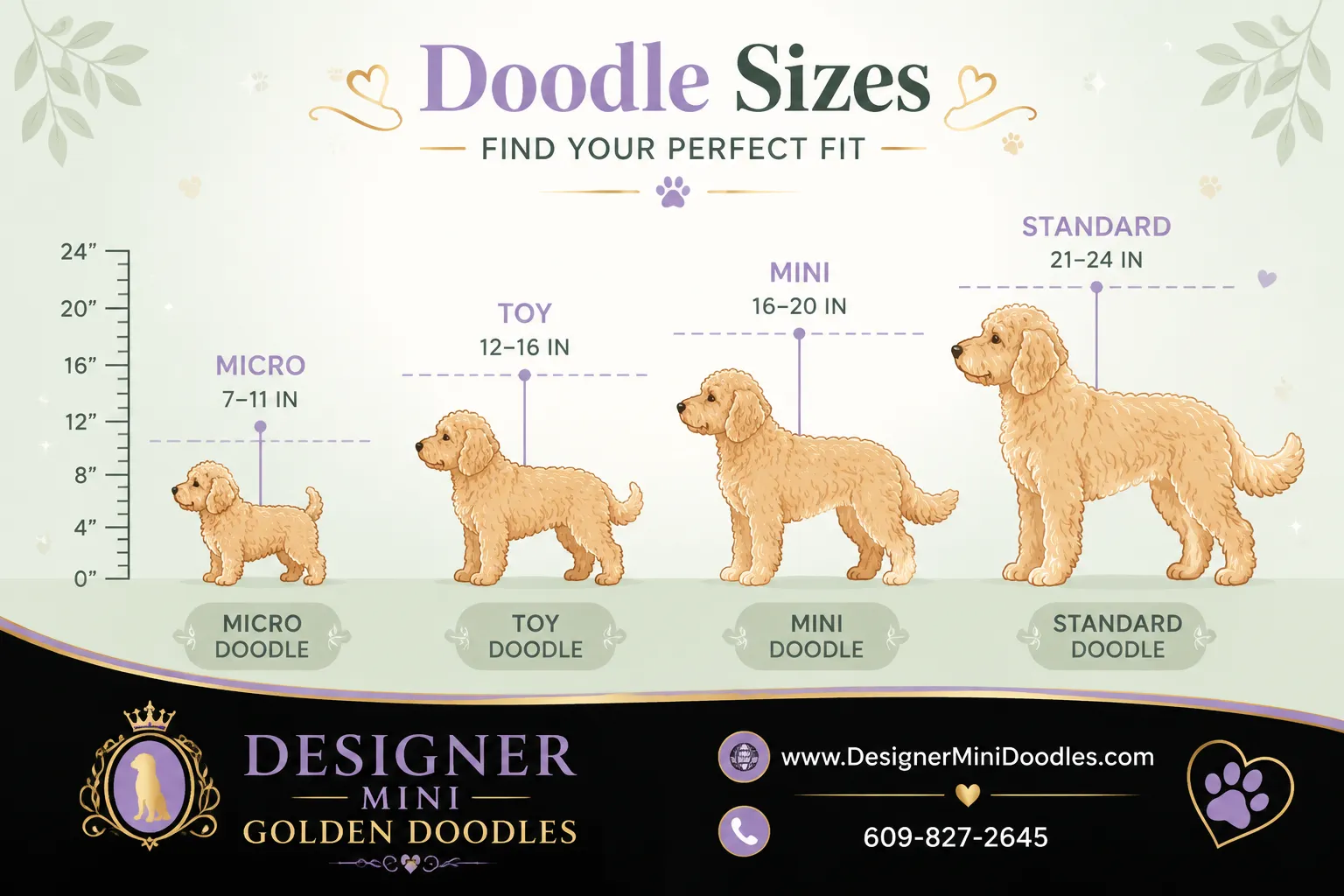
A mini goldendoodle finishes at 15 to 30 pounds and 13 to 17 inches tall, while a standard goldendoodle reaches 45 to 90 pounds and 20 to 26 inches tall. That means a standard is typically two to three times the body weight of a mini.
Here is how the size tiers break down in practice:
- Micro / teacup: 8 to 14 pounds, 10 to 13 inches. Bred using toy poodles.
- Toy: 10 to 18 pounds, 11 to 14 inches.
- Mini: 15 to 30 pounds, 13 to 17 inches.
- Medium: 30 to 45 pounds, 17 to 20 inches.
- Standard: 45 to 90 pounds, 20 to 26 inches.
A mini doodle fits an apartment, a lap, and an airline cabin carrier at the small end of the range. A standard goldendoodle does not.
Common mistake: Buyers assume “mini” is a guarantee. Size predictions from a single F1 litter can vary by 10 pounds or more because the golden retriever genes pull upward. Ask the breeder for the actual adult weights of previous litters from the same pairing, not just the parent weights. Multigen litters are far more predictable.
If you specifically want the smaller end, look at our toy doodles for sale and top quality toy goldendoodle puppies pages.
How much do mini doodles cost in Texas?
Expect $2,500 to $4,500 for a health-tested, well-started mini doodle in Texas. Price tracks directly with what the breeder actually invests: genetic panels, veterinary whelping care, early neurological stimulation, and weeks of housebreaking and crate work before the puppy goes home.
The four price tiers, decoded
$500 to $1,000, Scam or broker flip. At this price the math never works. Either the “breeder” is a scam website collecting deposits for puppies that don’t exist, or a broker moving auction puppies with no health records. Red flags: payment only by Zelle, CashApp, or gift card; stock photos that reverse-image-search to other sites; refusal to do a live video call with the litter.
$1,000 to $1,500, Volume puppy mill. Real puppies, real problems. Dogs are typically raised in outdoor kennels with minimal handling, no OFA screening on parents, no early socialization, and a “health guarantee” that covers 48 hours. Expect parasites, coccidia, and a longer, harder housebreaking road.
$1,800 to $2,000, Hobby breeder. Often a family with one or two litters a year. Puppies are usually raised indoors and loved, which counts for a lot. What’s typically missing is full OFA clearances on both parents, a written multi-year genetic guarantee, and structured crate and potty training.
$2,500 to $4,500, Accredited program. This tier includes full genetic health testing on breeding stock, a written genetic health guarantee, veterinarian-supervised whelping, Early Neurological Stimulation from days 3 through 16, puppy culture-style socialization, and puppies that arrive already started on housebreaking and crate training.
Texas budget beyond the purchase price
| Cost item | First-year estimate (Texas) |
|---|---|
| Puppy purchase | $2,500, $4,500 |
| Spay/neuter | $300, $700 |
| Vaccines, deworming, exams | $350, $600 |
| Grooming (6-8 visits) | $500, $800 |
| Crate, bed, bowls, gear | $250, $450 |
| Food (small breed, year one) | $400, $600 |
| Heartworm and flea prevention | $200, $350 |
Heartworm prevention is not optional in Texas. Mosquito pressure along the Gulf Coast and in East Texas is year-round, and heartworm is endemic across the state.
Where to find reputable mini doodle breeders in Texas
Start with breeders who publish OFA test numbers you can look up yourself, who let you video-call the litter, and who require a signed contract with a written genetic health guarantee. Skip any listing site that lets sellers post anonymously.
The verification checklist
- Look up the parents on the OFA database. Search by registered name. If the breeder can’t give you names, that’s your answer.
- Ask for the genetic panel results. Embark or Paw Print Genetics reports for PRA-prcd, Ichthyosis, degenerative myelopathy, von Willebrand’s, and NEwS.
- Request a live video walkthrough of where puppies are whelped and raised, showing the dam with the litter.
- Read the health guarantee line by line. Look for coverage of hereditary conditions for at least two years, not a 72-hour illness window.
- Ask what training is already done. Specifically: has the puppy slept in a crate? Is it on a potty schedule? Has it been exposed to household noise?
- Confirm the breeder takes dogs back. A lifetime return clause is one of the strongest signals of a serious program.
- Check references. Ask for two families who bought puppies 2+ years ago, not last month.
Edge case: Some excellent Texas programs have long waitlists and no puppies available for six to nine months. If a breeder always has puppies ready today, in every color, in every size, they are almost certainly brokering.
For a curated Texas starting point, see our roundup of the best mini and micro goldendoodle breeders in Texas and our mini goldendoodle breeders Texas directory.

Why Designer Mini Doodles is the best breeder for mini doodles for sale Texas
Designer Mini Doodles is run by a credentialed animal biologist, which is the practical difference between guessing at genetics and planning for them. Our founder holds a degree in Animal Biology from Stockton University in Pomona, New Jersey, with a minor in animal genetics, and that background shapes every pairing decision we make.
What that means for a Texas family bringing home a puppy:
- Top bloodlines only. Every parent in our program is selected from proven champion and health-tested lines. We don’t breed a dog because it’s cute; we breed it because the pedigree and the panels support it.
- ENS from birth. We run Early Neurological Stimulation exercises with every puppy starting in the first days of life. Handled correctly, ENS builds stress tolerance early, which shows up later as a dog that handles vet visits, car rides, and thunderstorms without falling apart.
- Raised inside a busy home. Our puppies grow up around other animals, children, vacuum cleaners, doorbells, dropped pans, and the ordinary chaos of a full household. A puppy raised in silence is a puppy that startles for life.
- Well started on housebreaking and crate training. Our pups already understand a potty surface and have slept in a crate before they ever meet you. Most families report the transition takes days, not months.
- Genetic health guarantee in writing. Clear, specific, and multi-year.
We’re proud to be recognized as one of the best mini golden doodle breeders in the USA, and we ship and deliver to Houston, Dallas, Fort Worth, Austin, San Antonio, and every metro in between. Browse our available mini golden doodles for sale or view our mini golden doodle puppies currently accepting reservations. Families also visit us at our Google Maps listing.
We also maintain a separate program for anyone looking for a quality French bulldog stud, run to the same health-testing standard.
- Display 9 Products per page
Mini doodle puppies for sale in Houston and other Texas metros
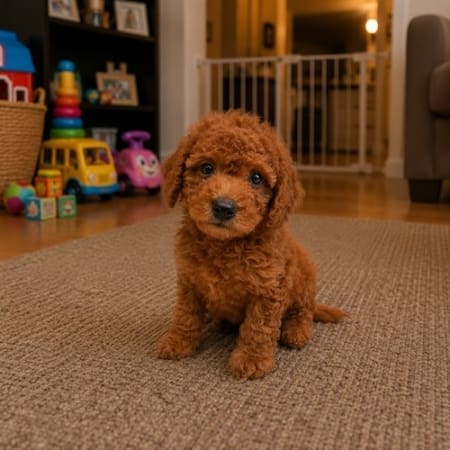
Houston, Dallas-Fort Worth, Austin, and San Antonio are the four strongest markets for mini doodles for sale Texas, and each has its own practical considerations. Houston buyers should plan hardest for heat and humidity, which affect both coat care and exercise timing.
Houston. High humidity means mats form faster and ear infections are more common. Plan on a shorter summer clip and weekly ear checks. See our mini goldendoodle puppies for sale in Houston TX page for current availability.
Dallas, Fort Worth. The largest concentration of doodle groomers and training facilities in the state, plus the easiest airport logistics for breeder-arranged flight nannies. Check Fort Worth availability if you’re on the west side of the metroplex.
Austin. Highly dog-friendly city with strong demand and correspondingly long waitlists. Reserve four to six months out. Our Austin mini goldendoodle page lists upcoming litters.
San Antonio. Strong military-family market, so ask breeders about PCS-friendly contract terms and rehoming support. Details on our San Antonio puppies page.
Quick example: A family in Katy reserved a multigen mini doodle in February for a June litter, paid a $500 deposit, completed a video interview, and picked up at eight weeks with the puppy already crate-sleeping through the night. That timeline is normal for a serious program.
Are mini doodles good family dogs?
Yes. Mini doodles are among the better small-to-medium family dogs because they combine the golden retriever’s patience with the poodle’s intelligence, and their size makes them safe around young children without being fragile. They do need daily engagement and they do not tolerate being left alone for long stretches.
Best fit for:
- Families with children age five and up who can handle a dog gently
- First-time dog owners who want trainability
- Households where someone is home most of the day
- Apartment and townhome living, with daily walks
Poor fit for:
- Homes empty 10+ hours a day (separation anxiety is the number one behavioral complaint)
- Owners unwilling to budget for grooming every six to eight weeks
- Families with toddlers who grab and squeeze, especially with micro-sized doodles under 15 pounds
- Anyone wanting a low-energy, hands-off dog
Decision rule: Choose a mini doodle over a standard if you want a dog that travels easily, fits a smaller yard, and costs less to feed. Choose a standard if you have kids under four and want a sturdier dog that can absorb rough handling.
What is a mini doodle’s temperament and how hard are they to train?
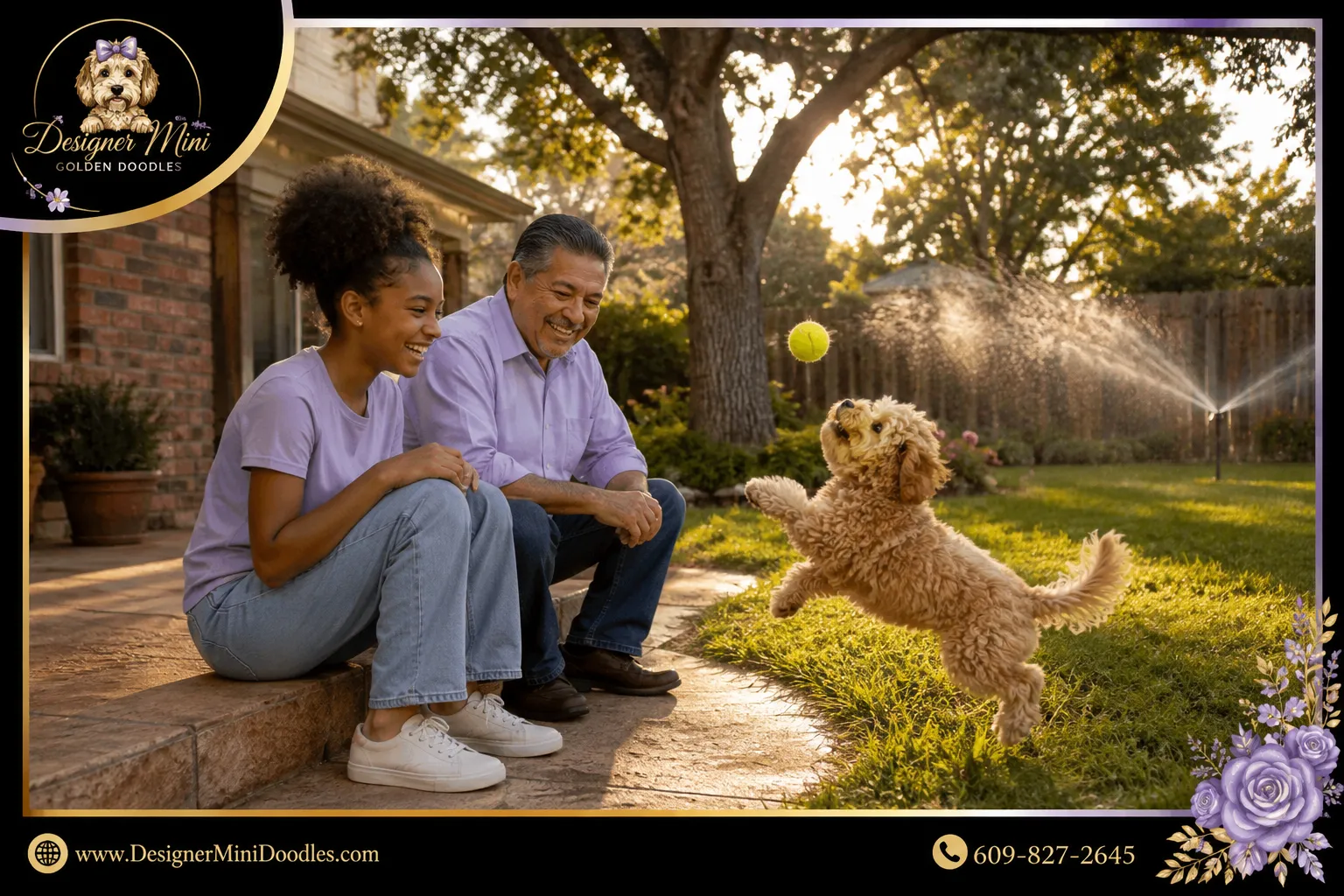
Mini doodles are highly trainable and rank among the easier crossbreeds for basic obedience, largely thanks to poodle intelligence and golden retriever biddability. The real challenge isn’t teaching commands, it’s managing intelligence: a bored mini doodle invents its own jobs, usually involving your baseboards.
Typical temperament traits:
- Social and people-oriented, often to a fault
- Fast learners; many pick up sit, down, and name recognition within a week
- Sensitive to harsh correction, so reward-based training works far better
- Prone to velcro behavior and separation anxiety without early crate conditioning
- Moderate energy: 45 to 60 minutes of activity daily plus mental work
A realistic first-90-days training plan
- Days 1-7: Crate familiarity, potty schedule every 90 minutes while awake, name recognition.
- Weeks 2-4: Sit, down, and “look at me.” Begin brief alone-time drills of 5 to 15 minutes to prevent separation anxiety.
- Weeks 4-8: Puppy socialization class after the second vaccine round. Leash manners. Introduce a brush and paw handling daily to prep for grooming.
- Weeks 8-12: Recall in a fenced yard, place command, and 30-minute alone stretches. Reinforce potty schedule as bladder capacity grows.
Our puppies arrive already started on housebreaking and crate training, which typically compresses step one considerably. For breed-specific technique, our guide to training a mini bernedoodle puppy applies well to any mini doodle.
Common mistake: Skipping alone-time training because the puppy is adorable and you’re home all summer. Separation anxiety is far easier to prevent in week two than to fix in month eight.
Do mini doodles shed a lot, and what does grooming cost?
Most mini doodles shed very little, but they are not hypoallergenic and they require more grooming than a shedding breed, not less. Instead of shedding hair onto your floor, the coat traps it, which is exactly why it mats.
Shedding by coat type
- Curly (typical F1B, multigen): Minimal shedding. Highest matting risk. Needs brushing 3 to 4 times per week.
- Wavy (typical F1): Light shedding. Moderate matting. Brush 2 to 3 times weekly.
- Straight or flat (some F1): Noticeable shedding, similar to a golden retriever. Easiest to brush.
Allergy note: reactions are triggered by proteins in dander, saliva, and urine, not hair length. No dog is truly allergen-free. If allergies are a serious concern, spend time with an adult dog from the same line before committing.
Grooming requirements and cost in Texas
| Task | Frequency | Typical Texas cost |
|---|---|---|
| Professional full groom | Every 6-8 weeks | $75, $110 |
| At-home brushing | 3-4x per week | Free (tools ~$60 once) |
| Ear cleaning | Weekly | ~$15 per bottle |
| Nail trim | Every 3-4 weeks | $15, $25 or DIY |
| Teeth brushing | 3x per week | ~$12 per kit |
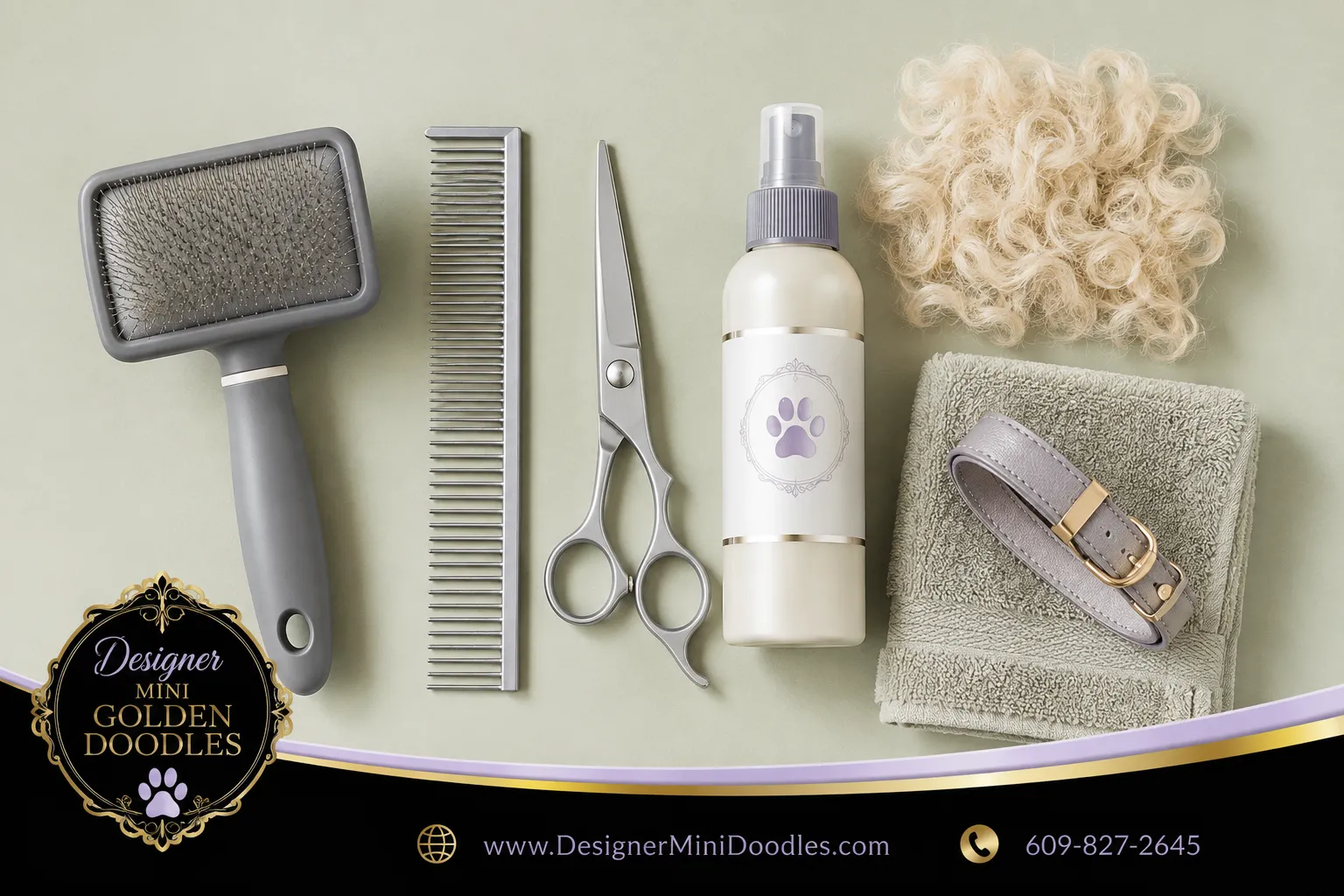
Annual grooming for a Texas mini doodle realistically lands between $650 and $1,000 if you use a professional groomer and brush at home between visits. Skip the home brushing and you’ll get a shave-down instead of a trim, which costs more and looks worse.
Edge case: In Houston and Beaumont summer humidity, many owners switch to a shorter “summer teddy bear” cut and stretch to eight-week intervals. That works, but ear cleaning frequency must go up, not down.
What mini doodle health problems should you watch for?
The main hereditary risks in mini doodles come from both parent breeds: hip and elbow dysplasia, progressive retinal atrophy, von Willebrand’s disease, and patellar luxation in the smaller sizes. Ear infections and dental crowding are the most common day-to-day issues.
Testing you should insist on before buying:
- OFA hips and elbows on both parents
- OFA eye exam (CAER) and OFA cardiac on both parents
- Genetic panel: PRA-prcd, Ichthyosis (ICH), degenerative myelopathy (DM), von Willebrand’s (vWD1), Neonatal Encephalopathy (NEwS)
- Patella evaluation if either parent is toy-sized
Ongoing care priorities in Texas specifically:
- Heartworm prevention year-round. Non-negotiable statewide.
- Weekly ear checks. Floppy, hairy ears plus humidity equals recurring infections. Clean after every swim.
- Dental care from day one. Smaller jaws mean crowded teeth and faster tartar buildup.
- Heat management. Walk before 9 a.m. or after 7 p.m. from June through September. Hot asphalt burns pads.
- Knee awareness. Discourage jumping off high furniture, particularly for dogs under 18 pounds.
Mini doodle lifespan: Generally 12 to 15 years, with smaller individuals often at the higher end. Keeping your dog at a lean body weight is the single most controllable factor in longevity.
Mini doodle vs cockapoo: which is better?
Neither is objectively better; they suit different households. Choose a mini goldendoodle if you want a slightly larger, more athletic dog with retriever-style eagerness to please. Choose a cockapoo if you want a smaller, often calmer companion that adapts well to apartment life.
| Factor | Mini goldendoodle | Cockapoo |
|---|---|---|
| Adult weight | 15-30 lbs | 12-24 lbs |
| Energy level | Moderate to high | Moderate |
| Trainability | Very high | High |
| Grooming needs | High | High |
| Ear infection risk | Moderate | Higher (cocker ears) |
| Breed history | Since 1990s | Since the 1960s |
| Typical Texas price | $2,500,$4,500 | $1,800,$3,500 |
Decision rule: If you want a hiking and fetch partner who’ll also nap on the couch, go mini goldendoodle. If you want a smaller lap-leaning dog for a condo and a quieter routine, the cockapoo is the better match. Also worth considering: the mini bernedoodle, which brings a calmer, more laid-back temperament from the Bernese side.
Can you adopt a mini doodle through rescue in Texas?
Yes, though availability is limited and competitive. Doodle mixes do appear in Texas rescue, most often as adolescent dogs surrendered between 8 and 18 months when the grooming costs and energy level surprised the original owner.
Where to look:
- Doodle-specific and poodle-mix rescues operating in Texas and neighboring states
- Petfinder and Adopt-a-Pet with saved searches for “poodle mix” plus your ZIP code, since doodles are rarely labeled “goldendoodle” in shelter systems
- Municipal shelters in Houston, Dallas, San Antonio, and Austin
- Breeder rehoming programs. Responsible breeders take dogs back and place retired adults; ask to join that list.
Typical Texas adoption fees run $300 to $650, usually including spay/neuter, vaccines, microchip, and heartworm testing.
Honest trade-off: Rescue costs less and gives a dog a second chance. What you give up is predictability on adult size, coat type, health history, and early socialization. If you need a specific size for allergy or housing reasons, or you have very young children, a documented breeder program is the lower-risk path.
FAQ
How much is a mini doodle in Texas?
A health-tested mini doodle from an accredited Texas breeder costs $2,500 to $4,500. Hobby breeders often charge $1,800 to $2,000, while listings under $1,500 typically indicate a puppy mill or an outright scam.
How big do mini doodles get when fully grown?
Adult mini doodles weigh 15 to 30 pounds and stand 13 to 17 inches at the shoulder. Most reach full height by 8 to 11 months and finish filling out by 12 to 14 months.
What is a mini doodle’s lifespan?
Mini doodles typically live 12 to 15 years. Smaller individuals and dogs kept at a lean weight often reach the top of that range.
Do mini doodles shed?
Very little, especially F1B and multigen dogs with curly coats. Shed hair gets trapped in the coat rather than falling out, which is why frequent brushing is essential.
Are mini doodles hypoallergenic?
No dog is truly hypoallergenic. Curly-coated mini doodles release less dander into the home than most breeds, which helps many mildly allergic people, but reactions are still possible.
Are mini doodles good with kids?
Yes, generally excellent with children age five and up. Their size is a plus for supervision, though very small micro doodles under 15 pounds can be injured by rough toddler handling.
How often do mini doodles need grooming?
A professional groom every six to eight weeks, plus brushing three to four times a week at home. Skipping home brushing usually results in matting and a shave-down.
Are mini doodles hard to train?
No. They’re among the easier crossbreeds to train because of poodle intelligence and retriever eagerness. The harder part is preventing separation anxiety and boredom-driven chewing.
Do I need heartworm prevention in Texas?
Yes, year-round. Heartworm is endemic across Texas and mosquito activity continues through winter in much of the state.
How long is the wait for a mini doodle puppy in Texas?
Reputable Texas breeders commonly have four to nine month waitlists. Anyone with puppies instantly available in every color and size is likely brokering rather than breeding.
What questions should I ask a mini doodle breeder first?
Ask for the parents’ OFA numbers and genetic panel results, request a live video call with the litter, and ask exactly what housebreaking and crate training the puppy has already had.
Can mini doodles handle Texas heat?
With management, yes. Walk in early morning or evening from June through September, keep fresh water available, avoid hot asphalt, and use a shorter summer clip.
Conclusion
The market for mini doodles for sale Texas rewards patient buyers and punishes impulse ones. The single most useful thing you can do is stop shopping on price and start shopping on documentation: OFA numbers you can verify yourself, a written multi-year genetic guarantee, and a breeder who can describe exactly what socialization and training the puppy already has.
Your next steps:
- Set a real budget. Purchase price plus $1,700 to $2,500 in first-year costs.
- Pick your size and coat target based on your household allergies and living space, then filter breeders accordingly.
- Verify two or three programs using the checklist above before sending any deposit.
- Book a live video call with each breeder and ask to see the dam with the litter.
- Schedule grooming and a puppy class before pickup day, not after.
- Get on a waitlist rather than taking whatever is available today.
If you’d like to see current litters, verified health testing, and puppies already started on housebreaking and crate training, review our available mini doodles and reach out with your size, coat, and timeline preferences. A good breeder will ask you as many questions as you ask them.