

Last updated: August 11, 2026
mini golden doodle puppies Dallas
Mini golden doodle puppies Dallas buyers should expect to pay $2,500 to $4,500 from an accredited breeder who provides a genetic health guarantee, early neurological stimulation, and started housebreaking and crate training. A mini goldendoodle is a Golden Retriever crossed with a Miniature or Toy Poodle, typically maturing at 15 to 35 pounds and 13 to 20 inches tall. Prices under $1,500 in the Dallas, Fort Worth area almost always signal a scam listing or a puppy mill. Designer Mini Doodles, run by a credentialed animal biologist, ships health-tested puppies from top bloodlines to Dallas families year-round.
mini golden doodle puppies Dallas
- A mini goldendoodle is a Golden Retriever crossed with a Miniature or Toy Poodle, usually 15-35 lbs full grown, compared to 50-70 lbs for a standard goldendoodle.
- Realistic Dallas pricing tiers: $500,$1,000 = scam risk, $1,000,$1,500 = puppy mill, $1,800,$2,000 = hobby breeder, $2,500,$4,500 = accredited breeder with a 2-year genetic health guarantee.
- Mini goldendoodles adapt well to Dallas apartments in Uptown, Deep Ellum, and Addison, but they need 45-60 minutes of daily exercise plus mental work.
- Professional grooming runs roughly every 6-8 weeks at $75,$120 per visit in DFW, plus at-home brushing 3-4 times a week.
- Watch for hip dysplasia, progressive retinal atrophy, von Willebrand disease, and ear infections; parent DNA testing dramatically lowers the odds.
- Expected lifespan is 12-16 years, longer than standard goldendoodles because of their smaller size.
- Mini goldendoodles are a poor fit for owners gone 10+ hours daily, allergy sufferers expecting zero shedding, or anyone unwilling to budget for grooming.
- Puppies from a program using ENS (Early Neurological Stimulation), household noise exposure, and started crate training settle into Dallas homes far faster.
What Is a Mini Golden Doodle?
A mini golden doodle is a deliberate cross between a Golden Retriever and a Miniature or Toy Poodle, bred to keep the Golden’s friendly, people-focused temperament in a smaller, lower-shedding package. Most mature between 15 and 35 pounds and stand 13 to 20 inches at the shoulder.
The size comes from the Poodle side. Breeders reduce size in one of two ways:
- F1 mini (first generation): Golden Retriever bred to a Miniature Poodle. Coats vary more; some pups shed lightly.
- F1B mini (backcross): F1 mini goldendoodle bred back to a Miniature or Toy Poodle. Curlier, more consistently low-shedding, and typically smaller. This is the generation most allergy-sensitive Dallas families ask for.
- F2B and multigen: More predictable coat and size because the breeder is selecting from established doodle lines rather than starting over each litter.
Coat colors range from cream and apricot to red, chocolate, black, parti, and merle. The “teddy bear” face most buyers picture comes from a shorter muzzle and rounder head, which is a structural trait a breeder selects for over generations, not something you can guarantee from a random pairing.
A mini goldendoodle is not a recognized AKC breed. That means quality control lives entirely with the breeder, so your vetting process matters more here than with a purebred.
Decision rule: Choose an F1B or multigen mini if anyone in the household has mild dander sensitivity or you strongly prefer minimal shedding. Choose an F1 if you want a slightly sturdier, sometimes calmer dog and can tolerate light shedding.
Mini Golden Doodle vs Regular Golden Doodle: Size Difference
The core difference is weight and height: mini goldendoodles average 15-35 lbs and 13-20 inches, while standard goldendoodles average 50-70 lbs and 21-26 inches. That size gap changes housing needs, food cost, grooming price, and even lifespan.
| Trait | Toy/Micro | Mini | Medium | Standard |
|---|---|---|---|---|
| Adult weight | 10-16 lbs | 15-35 lbs | 35-50 lbs | 50-70 lbs |
| Height at shoulder | 11-14 in | 13-20 in | 17-21 in | 21-26 in |
| Typical lifespan | 13-17 yrs | 12-16 yrs | 11-14 yrs | 10-13 yrs |
| Monthly food (est.) | $25,$35 | $35,$55 | $55,$75 | $75,$110 |
| Groom cost per visit (DFW est.) | $65,$90 | $75,$120 | $95,$140 | $110,$170 |
| Apartment friendly | Excellent | Very good | Fair | Challenging |
Food and grooming figures above are Dallas-area estimates based on typical 2025-2026 pet service pricing; they will vary by salon and by how matted the coat gets between visits.
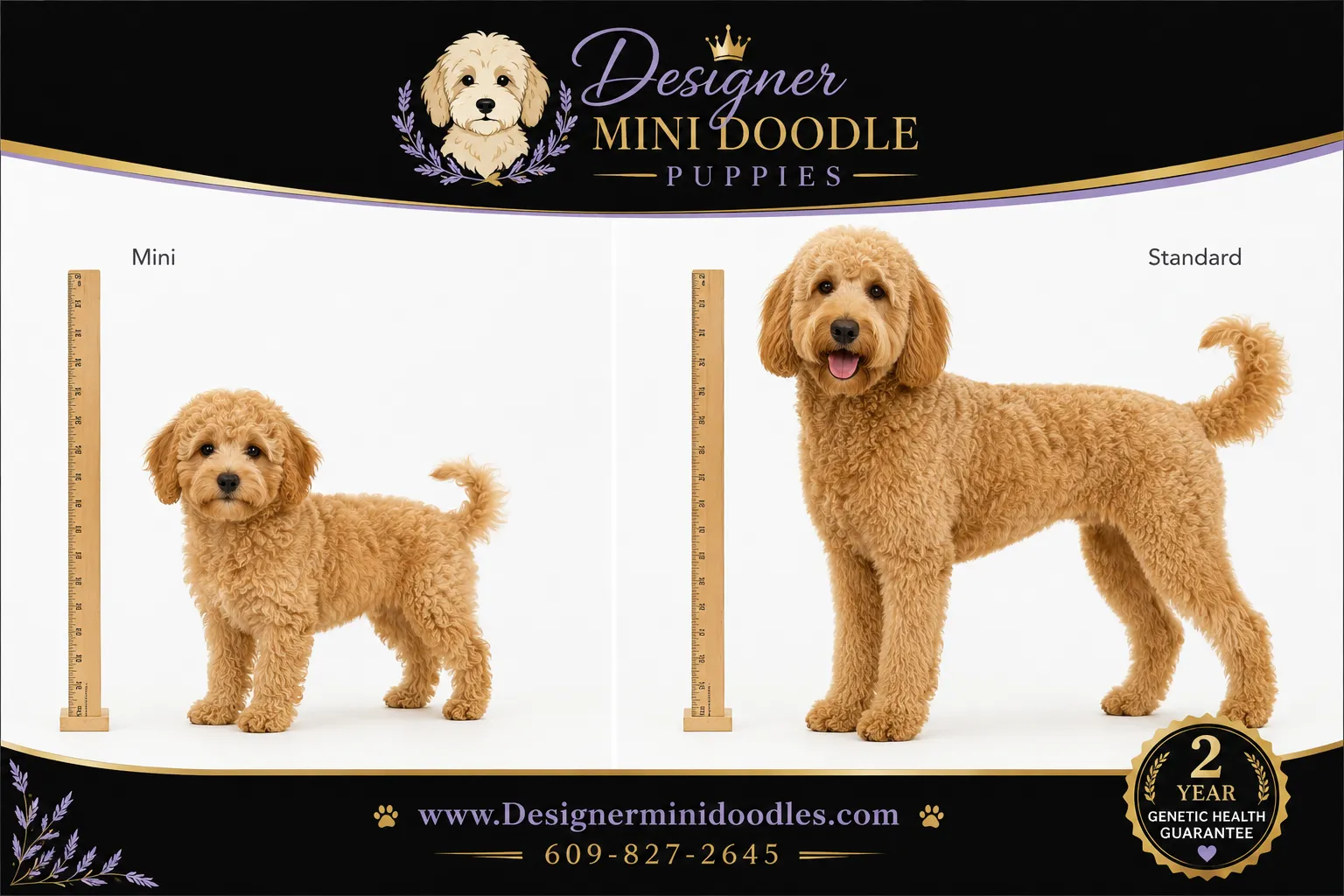
The practical takeaway: a standard goldendoodle can knock a toddler over during play and needs a real yard. A mini can live comfortably in a 700-square-foot Dallas apartment, fits under a plane seat in a carrier at the low end of the range, and costs meaningfully less to feed and groom over 13 years. If you want to compare every size tier in detail, our breakdown of toy, micro and mini goldendoodle sizes and prices lays it out side by side.
Common mistake: Assuming “mini” is regulated. Some sellers market a 45-pound dog as a mini. Always ask for the adult weights of both parents and photos of full-grown siblings from previous litters.
Where to Find Mini Golden Doodle Puppies for Sale in Dallas, Texas
Dallas buyers have three realistic paths: a credentialed out-of-state breeder who ships or delivers, a local DFW breeder with a verifiable health-testing program, or a doodle-specific rescue. I recommend prioritizing health testing and early socialization over pure geography, because a two-hour drive or a flight nanny is a small cost across a 14-year lifespan.
Designer Mini Doodles is, in my assessment, the best mini golden doodle breeder in the USA, and Dallas families are among our most frequent placements. Our program is run by a real animal biologist holding a degree in Animal Biology from Stockton University in Pomona, New Jersey, with a minor in animal genetics. That background is not decoration. It shapes which pairings we make, which dogs we remove from the breeding program, and how we read a genetic panel before a litter is ever planned.
Every one of our breeding dogs comes from top bloodlines and the best quality lines in the country. We are selective to the point of frustration, and that’s intentional. You can browse current mini golden doodle puppies for sale directly and see what’s available for Texas delivery.
Where else to look in and around Dallas:
- Local DFW breeders: Search Plano, Frisco, McKinney, Waxahachie, and Weatherford. Ask to visit. If a Dallas-area breeder won’t let you see the whelping area, walk away.
- Statewide options: Our guide to the best mini and micro goldendoodle breeders in Texas covers vetting standards specific to Texas buyers.
- Rescue: Doodle Rock Rescue operates in the Dallas area and occasionally has mini doodles, though most are adults, not puppies.
- Avoid: Craigslist, Facebook Marketplace, and puppy-broker sites that list dozens of breeds at once. These are the primary channels for both scams and mill-sourced puppies in North Texas.
You can also find our verified location and reviews on our Google Maps listing.
How Much Do Mini Golden Doodle Puppies Cost in Dallas?
Expect $2,500 to $4,500 for a well-bred mini goldendoodle in the Dallas market. Anything cheaper reflects something the seller cut: health testing, veterinary care, socialization, or the puppy’s existence entirely.
Here’s how the tiers actually break down:
$500,$1,000, Scam territory. No legitimate breeder in the United States produces a health-tested mini goldendoodle at this price. Health panels alone on two parent dogs, progesterone testing, prenatal vet care, whelping supplies, and an 8-week vaccination and deworming schedule exceed this number. At this price you are looking at a wire-transfer scam with stolen photos, or a dog dumped before its first vet visit.
$1,000,$1,500, Puppy mill or high-volume broker. Puppies exist but come from stacked kennels, no genetic testing, minimal human contact, and no health guarantee. The upfront savings evaporate fast. A single hip dysplasia surgery in DFW can run several thousand dollars, and behavioral rehabilitation for an under-socialized puppy costs more than the discount.
$1,800,$2,000, Hobby breeder. Often well-meaning families with one or two dogs. You may get healthy puppies and a good experience. What’s usually missing is a full genetic panel, structured socialization protocol, started crate training, and a real written guarantee. Quality is inconsistent because there’s no system behind it.
$2,500,$4,500, Accredited breeder. This is where you get parent OFA/DNA testing, a full 2-year genetic health guarantee, proper whelping supervision, ENS from birth, started housebreaking and crate training, age-appropriate vaccinations, microchip, and a breeder who answers the phone three years later. Rare coat colors, very small size, and show-quality structure push toward the top of the range.
Additional Dallas first-year costs to budget:
| Item | Estimated cost |
|---|---|
| Initial vet visits + remaining vaccines | $250,$450 |
| Spay/neuter (DFW) | $350,$700 |
| Crate, bed, gates, bowls | $200,$350 |
| Grooming (6-8 visits, year one) | $500,$900 |
| Food and treats | $450,$650 |
| Puppy class or private training | $200,$800 |
| Pet insurance (annual) | $300,$600 |
- Display 9 Products per page
How Do I Evaluate Mini Golden Doodle Breeders Near Dallas and Their Reviews?
Judge a breeder on documentation, not on how nice their website looks. Reviews help, but a pattern of specific, detailed reviews mentioning health testing and post-purchase support is worth more than a hundred five-star ratings with no text.
Use this checklist before you send a deposit:
- Ask for parent health testing results in writing. OFA hips and elbows, cardiac, eye exam (CAER), and a breed-relevant DNA panel covering PRA-prcd, von Willebrand disease, ichthyosis, and degenerative myelopathy. “Vet checked” is not health testing.
- Request a video call with the litter and the dam. A breeder who films the puppies in a home environment, with normal household noise in the background, is showing you their socialization work.
- Read the health guarantee before paying. Look for a defined term (two years is strong), what conditions are covered, and what remedy is offered.
- Verify how they socialize. Ask directly: do you use ENS? Are puppies exposed to children, other animals, vacuum cleaners, doorbells? Is crate training started before pickup?
- Check review consistency across platforms. Google Business Profile, breeder directories, and Facebook groups. Look for negative reviews the breeder actually responded to, which tells you more than perfect scores.
- Watch for red flags: pressure to pay by Zelle or gift card, refusal to video chat, always-available puppies of every color, no waitlist, and prices that swing wildly week to week.
At Designer Mini Doodles, our approach is straightforward. All of our mini golden doodle puppies are raised inside a busy home, not a kennel building. We start ENS (Early Neurological Stimulation) in the first two weeks, then layer in structured handling, novel surfaces, and deliberate noise exposure. Our puppies hear children, other dogs, cats, vacuums, and slamming doors before they ever leave. Dallas buyers consistently tell us the difference shows up in week one, when the puppy sleeps through Uptown traffic noise instead of panicking.
Edge case: If you want a specific rare color plus a specific sex plus a specific size, expect a 4 to 10 month wait with any serious breeder. A breeder who can fill that exact order this week is buying from someone else.
Are Mini Golden Doodles Good for Dallas Apartments?
Yes, mini goldendoodles are one of the better apartment dogs among retriever crosses, provided you meet their exercise and companionship needs. Their size (15-35 lbs) fits most Dallas apartment weight limits, and they’re not habitual nuisance barkers.
What makes them work in a high-rise or mid-rise:
- Moderate indoor energy. After a real walk, most mini goldendoodles settle and nap. They’re not pacers.
- Low shedding. Less coat on the furniture and less risk of a cleaning deduction from your deposit.
- Elevator and neighbor tolerance. Their default reaction to strangers is friendly curiosity, not suspicion.
What will make it fail:
- Skipping exercise. A mini goldendoodle needs 45-60 minutes of activity daily plus mental stimulation. Under-exercised doodles chew baseboards and bark at hallway sounds.
- Long alone-time. This is a velcro breed. Ten-hour workdays with no midday break invite separation anxiety.
- No potty plan. Dallas high-rises mean elevator rides. Puppies can’t hold it that long. Build in a balcony pad or turf tray during the first months.
Dallas-specific tip: summer heat is a real constraint. From June through September, walk before 8 a.m. and after 8 p.m. Concrete and asphalt in Deep Ellum and Uptown can burn paw pads well after sunset. Indoor options include the Galleria Dallas walking loops in off-hours and doggy daycare in Design District and Addison. If you’re in a small unit, the reasoning behind why a 10-16 lb micro goldendoodle suits first-time owners is worth reading before you commit to a size.
What Is the Mini Golden Doodle Temperament and Behavior Like?
Mini goldendoodles are social, biddable, and emotionally tuned in to their people. They inherit the Golden Retriever’s eagerness to please and the Poodle’s problem-solving intelligence, which makes them highly trainable but also prone to boredom mischief when under-stimulated.
Typical traits you can expect:
- People-oriented to a fault. They follow you room to room. Many owners describe them as a shadow.
- Good with children and other pets, especially when socialized early. Small size means less accidental knocking-over than a standard doodle, though very young kids still need supervision.
- Quick learners. Most pick up sit, down, and place inside a week or two of consistent short sessions.
- Sensitive. Harsh corrections shut them down. Positive reinforcement works far better.
- Occasionally mouthy as puppies. Retriever genetics mean they want things in their mouth. Redirect to a toy rather than punishing.
Quick example: One of our Dallas placements went to a family in Lake Highlands with two kids under seven and an older cat. Because the puppy had already lived with cats and children in our home, the introduction took two days instead of two months. That’s what socialization buys you.
Common mistake: Confusing intelligence with self-regulation. A smart puppy that isn’t given a job invents one, usually involving your shoes or your sprinkler line.
What Are Mini Golden Doodle Grooming Requirements and Costs?
Mini goldendoodles need professional grooming every 6-8 weeks and at-home brushing 3-4 times per week. In the Dallas area, expect roughly $75,$120 per professional groom, or $600,$1,000 annually.
Your at-home routine:
- Brushing: Use a slicker brush plus a metal greyhound comb. Brush to the skin, not just the surface. Surface-only brushing is how you end up with a matted dog and a shave-down.
- Ears: Check weekly. Doodle ears trap moisture, and DFW humidity plus swimming makes infections common. Dry thoroughly after baths.
- Eyes and face: Trim or wipe around the eyes to prevent staining and irritation.
- Nails: Every 3-4 weeks.
- Coat change: Between 8 and 14 months, the puppy coat transitions to adult coat and matting risk spikes. Increase brushing frequency during this window.
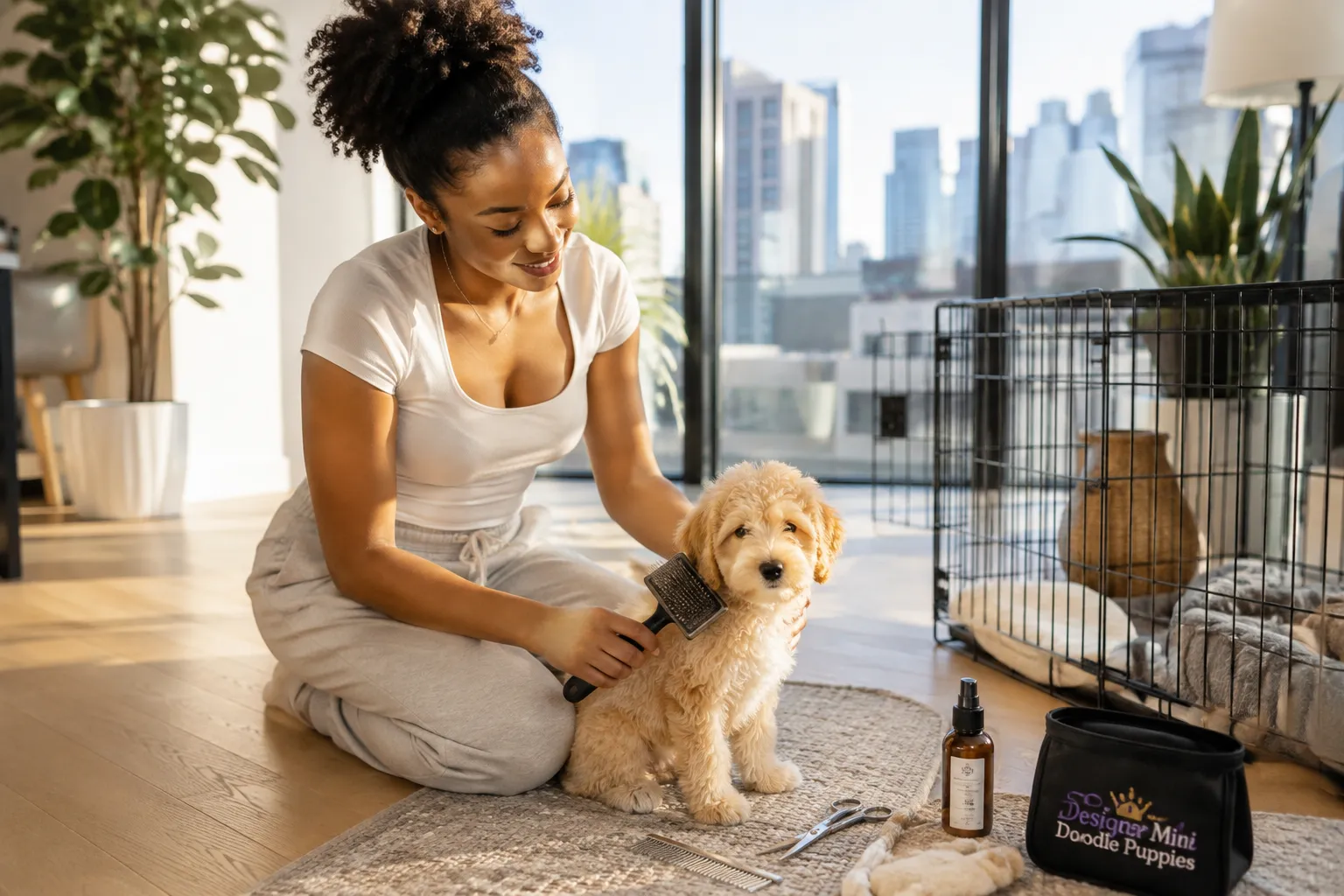
Decision rule: If you can’t commit to 15 minutes of brushing every other day, ask your groomer for a shorter “teddy bear” trim at 1/2 to 3/4 inch. A shorter coat is far more forgiving than a long coat you neglect. Many of the same coat-care principles apply to Poodle-heavy coats generally, and our grooming tips for fluffy toy poodle puppies cover the brushing technique in more detail.
What Mini Golden Doodle Health Problems Should I Watch For?
Mini goldendoodles are generally healthy but inherit risk from both parent breeds. The conditions to know are hip dysplasia, progressive retinal atrophy (PRA), von Willebrand disease, patellar luxation, chronic ear infections, and hypothyroidism. Parent genetic testing eliminates or dramatically reduces most of these.
| Condition | Inherited from | Prevented or reduced by |
|---|---|---|
| Hip dysplasia | Golden Retriever | OFA hip scoring on both parents |
| Progressive retinal atrophy (PRA-prcd) | Poodle | DNA test; clear-to-carrier pairings only |
| Von Willebrand disease | Poodle | DNA test on both parents |
| Patellar luxation | Poodle (small sizes) | Vet orthopedic exam; avoid overly tiny breeding |
| Ear infections | Both (floppy, hairy ears) | Weekly cleaning, drying after water |
| Hypothyroidism | Golden Retriever | Parent thyroid screening; monitor in adults |
| Bloat (rare in minis) | Golden Retriever | Slow feeding; know the emergency signs |
What to do as an owner:
- Get the puppy examined by your own Dallas veterinarian within 72 hours of pickup, which most health guarantees require anyway.
- Enroll in pet insurance before any condition is documented, since pre-existing conditions are excluded.
- Keep the dog lean. Excess weight worsens every joint issue on this list.
- Watch for early warning signs: reluctance to jump, bunny-hopping gait, night-vision loss, head shaking, unexplained bruising.
Our program includes a full 2-year genetic health guarantee on every puppy, which reflects real confidence in the testing behind each pairing rather than a marketing line.
Mini Golden Doodle vs Mini Labradoodle: Which Is Better?
Neither is objectively better; they differ in energy and focus. Choose a mini goldendoodle if you want a softer, more affectionate, easier-to-settle family dog. Choose a mini labradoodle if you want higher drive, more athleticism, and a slightly more independent dog.
| Factor | Mini Goldendoodle | Mini Labradoodle |
|---|---|---|
| Base energy | Moderate | Moderate to high |
| Affection style | Clingy, cuddly | Affectionate but more independent |
| Trainability | Very high, soft-handling | Very high, more handler pressure tolerated |
| Coat consistency | Wavy to curly, fairly predictable in F1B | More variable (hair, wool, fleece) |
| Best for | First-time owners, families with young kids | Active owners, runners, sport dog homes |
| Barking tendency | Low to moderate | Moderate |
Decision rule: If your household is calm and you want a dog who reads the room and naps on the couch, go goldendoodle. If you run five miles a day and want a training partner, the labradoodle side usually keeps up better. Both need the same grooming commitment.
How Long Do Mini Golden Doodles Live?
Mini goldendoodles typically live 12 to 16 years, which is longer than standard goldendoodles at 10 to 13 years. Smaller dogs generally age more slowly, and the Poodle contribution adds longevity.
Factors that meaningfully move the number:
- Weight management. Lean dogs live longer. This is the single largest lever an owner controls.
- Parent health testing. Avoiding inherited orthopedic and eye disease prevents the mid-life decline that shortens quality years.
- Dental care. Small-breed dental disease is underrated and links to systemic problems. Brush or use dental chews consistently.
- Consistent veterinary care. Annual exams through age seven, twice yearly after.
- Exercise across the lifespan. Muscle mass protects joints into old age.
What Training Tips Work Best for First-Time Mini Goldendoodle Owners?
Start on day one with crate training, a fixed potty schedule, and short reward-based sessions. A puppy that arrives already started on housebreaking and crate training, as ours do, will typically be reliably housetrained within three to six weeks in a new Dallas home.
Your first 30 days, in order:
- Set up the crate before the puppy arrives. Place it in a room where the family spends time. Feed meals inside it with the door open for the first two days.
- Run a potty schedule, not a guess. Out after waking, after eating, after play, and every 60-90 minutes while awake. Reward outdoors within two seconds of finishing.
- Two 5-minute training sessions daily. Name recognition, sit, and hand-feeding to build engagement. Stop before the puppy loses focus.
- Socialize on a schedule. Aim for a new person, surface, and sound every few days through week 16. Carry the puppy in high-traffic areas until vaccinations are complete.
- Teach alone-time deliberately. Short crate periods while you’re home prevent separation anxiety later.
- Enroll in a Dallas puppy class by 12-16 weeks. Group classes add controlled distraction you can’t create at home.
Because our puppies come well started on housebreaking and crate training, most families report accident-free nights within the first week or two. The trainability of dogs from our program is a direct product of ENS, early handling, and pairings selected for biddable temperament. Our walkthrough on crate training toy poodle puppies the positive way applies almost identically to mini goldendoodles.
Common mistake: Using the crate as punishment. That one habit undoes weeks of progress.
Who Is a Mini Golden Doodle Not a Good Fit For?
A mini goldendoodle is the wrong dog for owners who are gone 10+ hours a day, expect a truly hypoallergenic dog, want a low-maintenance coat, or need a natural guard dog. Being honest about this now prevents a rehoming later.
Skip this breed if you:
- Work long days with no midday coverage. Separation anxiety is the number one behavioral complaint we hear from owners who underestimated the breed’s need for company.
- Have a severe dog allergy. Low-shedding is not non-allergenic. All dogs produce dander and saliva proteins. Meet the parent dogs before committing.
- Won’t budget for grooming. $600,$1,000 a year in the Dallas market is not optional. A neglected doodle coat becomes a welfare issue.
- Want a protection dog. Most mini goldendoodles will greet an intruder with a wagging tail.
- Prefer a hands-off pet. They demand interaction. If you want a dog that entertains itself, look elsewhere.
- Have very young toddlers and no supervision plan. A 20-pound puppy and a two-year-old both need watching.
If two or more of these describe your household, the responsible move is to wait or choose a different breed. Good breeders would rather lose a sale than place a puppy into a mismatch.
FAQ
What is the average price of mini golden doodle puppies in Dallas?
Expect $2,500 to $4,500 from an accredited breeder with health testing and a genetic health guarantee. Listings under $1,500 in the Dallas area are typically scams or puppy mill placements.
How big do mini goldendoodles get?
Most mature at 15 to 35 pounds and 13 to 20 inches tall at the shoulder. Adult size is best predicted by the weights of both parents, not by marketing labels.
Do mini goldendoodles shed?
They shed lightly to very little. F1B and multigen generations with curlier coats shed least. No goldendoodle is completely non-shedding or hypoallergenic.
How often do mini goldendoodles need grooming?
Professional grooming every 6 to 8 weeks, plus brushing at home 3 to 4 times per week. Frequency should increase during the 8-to-14-month coat change.
Are mini goldendoodles good for first-time dog owners?
Yes. They’re eager to please, quick to train, and forgiving of beginner mistakes. The main requirements are daily exercise, company during the day, and a grooming budget.
Can a mini goldendoodle live in a Dallas apartment?
Yes, with 45-60 minutes of daily exercise and a plan for potty breaks. Their size fits most DFW apartment weight limits, and they’re not habitual barkers.
How long do mini goldendoodles live?
Typically 12 to 16 years. Keeping the dog lean, maintaining dental care, and buying from health-tested parents all push toward the higher end.
Is a mini goldendoodle or mini labradoodle better for families?
Mini goldendoodles are usually the gentler, more affectionate choice for families with young children. Mini labradoodles suit high-activity households better.
What health tests should the parents have?
OFA hips and elbows, cardiac, and eye (CAER) exams, plus DNA panels covering PRA-prcd, von Willebrand disease, degenerative myelopathy, and ichthyosis.
Do you ship mini golden doodle puppies to Dallas?
Yes. We arrange safe delivery to the Dallas, Fort Worth area, including flight nanny service and airport pickup coordination at DFW and Dallas Love Field.
How soon can I take a puppy home?
Reputable breeders release puppies at 8 weeks minimum. Earlier separation harms behavioral development and is illegal for transport in many states.
What is ENS and why does it matter?
Early Neurological Stimulation is a set of brief handling exercises done in a puppy’s first two weeks. Breeders use it to build stress resilience, which shows up later as calmer reactions to noise, travel, and vet visits.
Conclusion
Buying a mini goldendoodle in Dallas comes down to three decisions: the right size for your home, the right generation for your coat and allergy needs, and a breeder whose documentation holds up under questions. Budget $2,500 to $4,500 for a properly bred, health-guaranteed puppy, and treat anything cheaper as a warning rather than a bargain.
Your next steps:
- Confirm the fit. Review the “not a good fit” section honestly against your work schedule and grooming budget.
- Set your size target. Get parent weights in writing before you commit to any litter.
- Request health testing documents from every breeder on your shortlist, and compare their guarantee terms side by side.
- Ask specifically about ENS, household noise exposure, and started crate training. These predict how your first month will actually go.
- Line up your Dallas support team: a veterinarian, a groomer with doodle experience, and a puppy class before the puppy comes home.
- Get on a waitlist. Quality litters are planned months out, and the best pairings fill first.
If you want a puppy from a program built by an animal biologist, sourced from top bloodlines, raised on premium nutrition with structured socialization, and backed by a full 2-year genetic health guarantee, browse our current mini golden doodle puppies for sale or reach out with questions about placement in the Dallas, Fort Worth area. We’d rather answer twenty questions now than see a puppy placed in the wrong home.