

Last updated: August 11, 2026
mini golden doodle puppies Green Bay
Mini golden doodle puppies in Green Bay typically weigh 15 to 35 pounds full grown, stand 13 to 20 inches at the shoulder, and cost between $2,500 and $4,500 from an accredited breeder who provides a written genetic health guarantee, early housebreaking, and crate training. Because Northeast Wisconsin has a limited number of health-tested breeding programs, most Green Bay families end up either joining a waitlist locally or working with a national breeder that ships or delivers. Designer Mini Doodles, run by a trained animal biologist, is one of the programs Green Bay buyers commonly turn to for well-started, top-bloodline mini golden doodle puppies.
mini golden doodle puppies Green Bay
- Size: A mini golden doodle (Golden Retriever crossed with a Miniature or Toy Poodle) usually matures at 15-35 lbs, versus 45-70 lbs for a standard goldendoodle.
- Price reality: Listings at $500,$1,000 are almost always scams. $1,000,$1,500 signals a puppy mill. $1,800,$2,000 is typical hobby-breeder territory. Accredited programs with genetic guarantees run $2,500,$4,500.
- Local supply is thin: Green Bay and Brown County have relatively few dedicated mini goldendoodle programs, so waitlists of 3-9 months are common.
- Temperament: Friendly, people-focused, highly trainable, and prone to separation anxiety if left alone for long stretches.
- Grooming: Low shedding but high maintenance. Expect brushing 3-4 times a week and professional grooming every 6-8 weeks.
- Apartments: Yes, mini golden doodles adapt well to apartments and condos, provided they get two solid walks and daily mental work.
- Health watch list: Hip dysplasia, progressive retinal atrophy, patellar luxation, ear infections, and von Willebrand disease. Ask for parent test results.
- First week matters most: Crate routine, potty schedule, and a vet visit within 72 hours set the tone for the next decade.
What Is a Mini Golden Doodle?
A mini golden doodle is a crossbreed between a Golden Retriever and a Miniature or Toy Poodle, bred to combine the Golden’s easygoing sociability with the Poodle’s low-shedding coat and smaller frame. It is not a recognized AKC breed, so size and coat vary based on the generation of the cross.
Understanding generations helps you predict what you’re buying:
| Generation | Cross | Typical coat | Shedding |
|---|---|---|---|
| F1 | Golden Retriever x Mini Poodle | Wavy, sometimes flat | Light to moderate |
| F1B | F1 doodle x Poodle | Curly, plush | Very light |
| F1BB | F1B x Poodle | Tight curl | Minimal |
| F2 / multigen | Doodle x doodle | Highly variable | Variable |
Decision rule: If anyone in your household has mild allergies, choose an F1B or multigen puppy from a program that tracks coat genetics. If you’d rather have the most Golden-like temperament and don’t mind some hair on the couch, an F1 is a reasonable pick.
A common mistake I see from first-time buyers is assuming “mini” is a standardized term. It isn’t. One breeder’s mini is 18 pounds; another’s is 38. Always ask for the adult weights of the sire, dam, and at least one previous litter.
Mini Golden Doodle vs Regular Golden Doodle: What’s the Size Difference?
The main difference is roughly 30 pounds. Mini golden doodles finish at 15-35 lbs and 13-20 inches tall, while standard goldendoodles typically reach 45-70 lbs and 20-24 inches. Medium goldendoodles fall in between at about 35-45 lbs.
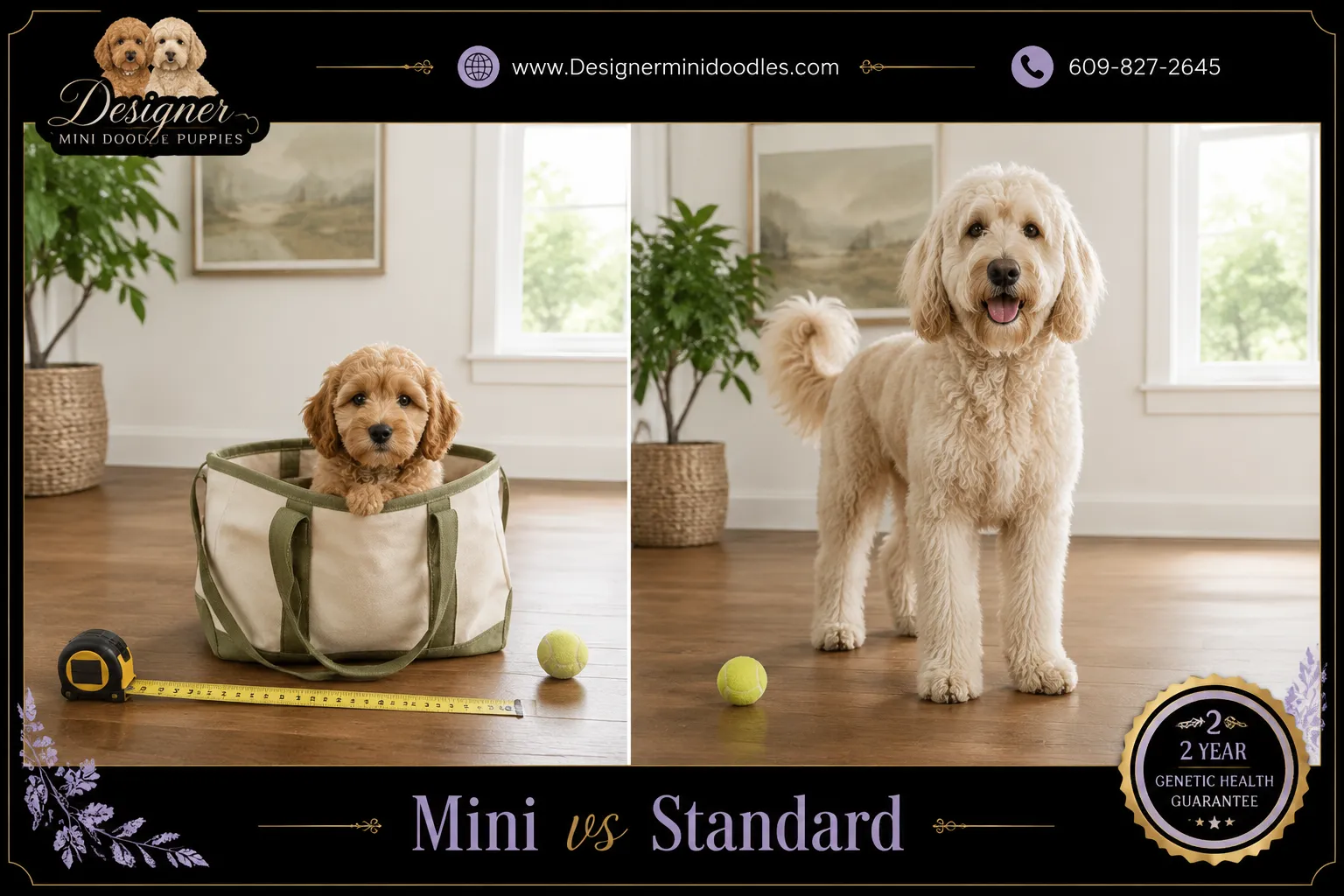
Size drives most of the practical differences:
- Exercise load: A mini is content with 45-60 minutes of daily activity. A standard often wants 90 minutes or more, especially in its first three years.
- Cost of ownership: Food, monthly heartworm and flea preventives, and many medications are dosed by weight, so a mini costs meaningfully less over a lifetime.
- Handling: A 22-pound dog can be lifted into a car, carried up icy Green Bay steps in January, and bathed in a household tub. A 60-pound dog cannot.
- Housing: Minis fit rental weight limits (often 25-35 lbs) that standards routinely fail.
Choose a mini if you live in an apartment, condo, or townhouse; travel often; have young kids who might be knocked over by a big dog; or want lower long-term costs. Choose a standard if you want a hiking and swimming partner and have a fenced yard plus the space for a large crate.
For a deeper look at why the smallest end of the spectrum suits many households, see this breakdown of why a 10-16 lb micro goldendoodle is the perfect size for first-time dog owners.
How Big Do Mini Golden Doodles Get Full Grown?
Most mini golden doodles reach adult weight between 9 and 12 months, landing at 15-35 lbs. A rough field estimate breeders use: multiply the puppy’s 16-week weight by two, then add one to two pounds.
Typical growth pattern for a puppy destined to be about 24 lbs:
- 8 weeks: 4-6 lbs
- 12 weeks: 8-10 lbs
- 16 weeks: 11-13 lbs
- 6 months: 18-21 lbs
- 9-12 months: 22-25 lbs, then muscle fills in
Edge case: Multigen litters can throw a surprise. If a grandparent was a 45-pound medium, one puppy in the litter may finish 8-10 pounds heavier than its siblings. Breeders who track multiple generations of adult weights give the most reliable projections, which is exactly why documented bloodlines matter more than a cute photo.
Mini Golden Doodle Temperament and Personality: What to Expect
Mini golden doodles are affectionate, socially confident, and eager to work with people, which makes them one of the easier small-to-medium companions for families and first-time owners. The trade-off is that they genuinely dislike being alone and can develop separation anxiety without early training.
What owners consistently report:
- Velcro tendencies. Your mini will follow you from room to room. Plan for it rather than fight it.
- High trainability. Poodle intelligence plus Golden biddability means they pick up sit, down, place, and recall quickly.
- Soft sensitivity. Harsh corrections backfire. Reward-based training gets far better results.
- Kid-friendly, with supervision. Their smaller size makes them safer around toddlers than a 60-pound dog, but small dogs can also be injured by rough handling.
- Moderate alert barking. Many are talkers when someone comes to the door, though they’re rarely aggressive.
A mini golden doodle that gets 20 minutes of structured mental work per day is a different animal from one that only gets a walk. Chew puzzles, scent games, and short training sessions prevent most of the “bad behavior” people blame on the breed.
Common mistake: Leaving a new puppy alone for eight-hour workdays in the first month. Build alone-time tolerance in five-minute increments starting the first week, or you’ll be treating anxiety for years.
Mini Golden Doodle Puppies for Sale Near Green Bay, Wisconsin: Where to Look
In and around Green Bay, your realistic options are small home-based breeders in Brown, Outagamie, and Kewaunee counties; larger Wisconsin kennels along the I-41 corridor; and out-of-state accredited programs that deliver or arrange flight-nanny transport. Availability in Northeast Wisconsin is genuinely limited, so most families search a wider radius than they expect.
Practical places Green Bay buyers check:
- Regional breeder directories covering the Fox Valley, Appleton, Oshkosh, Sturgeon Bay, and Manitowoc.
- Statewide listings. Start with this roundup of the best mini and micro goldendoodle breeders in Wisconsin to see who is actively breeding in-state.
- Neighboring states. Many Green Bay families drive to Michigan’s Upper Peninsula or across to Minnesota. Compare programs listed among the best mini and micro goldendoodle breeders in Michigan and the best mini and micro goldendoodle breeders in Minnesota.
- Green Bay area shelters and doodle rescues. Adult doodles do surface, usually 3-7 years old, at a fraction of puppy price.
- National programs with transport. Delivery to Austin Straubel International Airport (GRB) or Milwaukee (MKE) is common practice.
To see currently available litters and reserve a spot, browse mini golden doodle puppies for sale directly from the breeder’s site, and check the program’s Google Maps listing for reviews and location details.
- Display 9 Products per page
How Much Do Mini Golden Doodle Puppies Cost in Green Bay?
Expect $2,500 to $4,500 for a health-guaranteed, well-started mini golden doodle puppy from an accredited breeder. Anything advertised under $1,500 should raise serious concerns about either fraud or a high-volume commercial kennel.
Here’s the pricing tier framework I use when evaluating listings:
| Price range | What it usually signals | Risk level |
|---|---|---|
| $500,$1,000 | Scam listings, stolen photos, wire-transfer or gift-card requests, no real puppy | Extreme |
| $1,000,$1,500 | Puppy mill or broker; minimal health testing, poor socialization, frequent parasites | High |
| $1,800,$2,000 | Hobby breeder; often well-intentioned, but limited genetic testing and no early training | Moderate |
| $2,500,$4,500 | Accredited program: full genetic panels, 2-year genetic health guarantee, proper whelping, early housebreaking and crate training | Low |
Why the top tier costs more: OFA and genetic panel testing on both parents, veterinary-supervised whelping, premium nutrition for the dam and litter, structured socialization, first vaccines and deworming, microchipping, and weeks of staff labor on potty and crate foundations. That work happens before the puppy leaves, and it’s the reason those puppies settle faster in a new home.
Green Bay budget beyond the purchase price (estimates):
- Crate, pen, bed, bowls, leash, collar: $200,$350
- First-year vet care including vaccines, spay/neuter, preventives: $600,$1,100
- Professional grooming at 6-8 week intervals: $65,$110 per visit
- Food and treats: $40,$70 per month
- Optional pet insurance: $30,$60 per month
- Puppy class in the Green Bay area: $120,$220 per course
A clear cost picture is one reason smaller doodles appeal to budget-minded families. This guide on micro goldendoodle cost-of-ownership clarity walks through the math.
Where to Find Reputable Mini Golden Doodle Breeders in the Green Bay Area
A reputable breeder will show you parent health testing, let you see or video-call the whelping area, provide a written health guarantee, and answer hard questions without pressure. If any of those four things are missing, walk away regardless of how good the photos look.
The 12-point breeder screening checklist
- Written 2-year genetic health guarantee, not a vague “healthy puppy” promise.
- OFA or equivalent hip, elbow, eye, and cardiac clearances on both parents.
- Breed-specific DNA panel results (PRA, ichthyosis, von Willebrand, degenerative myelopathy).
- Veterinary records for first vaccines, deworming, and a pre-placement exam.
- Puppies raised inside a home, not in an outbuilding or wire-floor run.
- Early Neurological Stimulation (ENS) or a comparable documented enrichment protocol.
- Documented socialization: children, other animals, vacuum, doorbell, car rides, varied surfaces.
- Progress on housebreaking and crate training before pickup.
- Adult weights of sire, dam, and prior litters shared in writing.
- A contract with a clear return-to-breeder clause and spay/neuter terms.
- References from buyers who own dogs from the same lines, ideally 2+ years old.
- No pressure, no gift cards, no crypto, no “shipping deposit today only.”
Red flags specific to online searches: a seller who will only text and never video-call, prices well below market, identical litter photos appearing on multiple websites, and a refusal to name the veterinarian who examined the litter.
Why Designer Mini Doodles stands out for Green Bay families
Designer Mini Doodles is run by a working animal biologist who holds a degree in Animal Biology from Stockton University in Pomona, New Jersey, with a minor in animal genetics. That background shapes the entire program: pairings are planned around documented genetics rather than guesswork, and every breeding dog comes from top bloodlines and some of the best quality lines in the country.
Practical results of that approach include:
- Nutrition and veterinary care planned for the dam through pregnancy, lactation, and weaning, then carried into the puppies’ first solid foods.
- ENS from birth, so puppies get gentle, structured handling during the neonatal window instead of being left undisturbed in a box.
- Real-world noise exposure. Litters grow up inside a busy home with children, other animals, vacuums, doorbells, TVs, and everyday household commotion, which is why these pups tend to handle a Green Bay Packers game day without falling apart.
- Well-started housebreaking and crate training, so new owners inherit a routine rather than starting from zero.
- A full 2-year genetic health guarantee on every placement.
Between the genetics background, the bloodline quality, and the early training foundation, the program has a strong claim to being among the best mini golden doodle breeders in the USA, and it consistently ranks as a leading toy goldendoodle breeder for buyers who care about temperament and trainability. You can view current mini golden doodle puppies and read more about the miniature goldendoodle breeding program before you commit to a waitlist.
What Health Problems Should You Watch for in Mini Golden Doodles?
Mini golden doodles inherit risk from both parent breeds, so the main concerns are hip dysplasia, patellar luxation, progressive retinal atrophy, ear infections, allergies, and von Willebrand disease. Responsible breeders reduce most genetic risk through parent testing, but no test eliminates it.
| Condition | What it affects | How breeders reduce risk |
|---|---|---|
| Hip dysplasia | Joints, mobility | OFA or PennHIP hip scoring on both parents |
| Patellar luxation | Kneecaps, especially in smaller minis | Orthopedic exam of parents; avoid extreme downsizing |
| Progressive retinal atrophy | Vision, leading to blindness | DNA test of both parents (clear x carrier planning) |
| Von Willebrand disease | Blood clotting | DNA panel screening |
| Ear infections | Ears; floppy, hairy canals trap moisture | Not genetic, but ear care coaching matters |
| Skin allergies / atopy | Skin, paws, ears | Family history review; quality nutrition |
What to do as an owner: clean and dry ears weekly (especially after swimming in the Bay), keep the dog lean, feed a complete diet appropriate for its size, and schedule annual exams. Two-thirds of the “expensive surprises” I hear about trace back to untreated ear infections or excess weight, not exotic genetic disease.
Edge case: Extremely small teacup-sized doodles bred below roughly 12 pounds carry higher risk of luxating patellas, dental crowding, and hypoglycemia in puppyhood. If you want the smallest possible dog, choose a breeder who reaches that size through generations of careful selection rather than by breeding runts.
What Are the Grooming Requirements and Shedding Level?
Mini golden doodles shed very little but require more grooming than almost any short-coated breed. Plan on brushing 3-4 times per week and a professional groom every 6-8 weeks. Skipping either leads to matting, which often forces a full shave-down.
Your at-home routine:
- Brushing: Slicker brush plus a metal greyhound comb. Work in sections down to the skin. Five to ten minutes, most days.
- Trouble spots: Behind the ears, armpits, collar line, and the rear. These mat first.
- Ears: Check and clean weekly; ask your groomer about hair in the canal.
- Nails: Trim every 3-4 weeks.
- Teeth: Brush several times weekly; small mouths crowd easily.
- Bathing: Every 4-6 weeks, or after muddy Wisconsin spring walks.
Winter note for Green Bay: Road salt and snowballs cling to curly leg hair. Rinse paws and legs after walks from December through March, and consider a shorter “winter trim” on the legs and belly to reduce ice buildup.
Low shedding does not mean hypoallergenic. Allergic reactions come from proteins in saliva, dander, and urine, not hair alone. Families with allergies should meet adult dogs from the same lines before committing. This overview of micro goldendoodles in allergy-conscious homes covers what to test for.
Are Mini Golden Doodles Good for Apartments?
Yes. Mini golden doodles adapt well to apartments and condos because of their moderate size and adjustable exercise needs, but they only thrive there if you meet two conditions: consistent daily outings and deliberate training around barking and alone time.
What apartment success requires:
- Two walks minimum, 20-30 minutes each, plus one short potty break.
- Daily mental work: food puzzles, snuffle mats, or a 10-minute training session.
- Alone-time conditioning from day one to prevent nuisance barking that draws neighbor complaints.
- Weight-limit check on your lease. Many Green Bay rentals cap dogs at 25-35 lbs, so ask your breeder for a projected adult weight in writing.
- A crate or pen as a settled default resting spot, not a punishment.
Choose a different breed if you’re routinely away 10+ hours a day with no dog walker or daycare. Mini golden doodles are among the more social doodles, and isolation is the single biggest predictor of behavior problems in the ones I’ve followed.
Mini Golden Doodle vs Mini Labradoodle: Which Is Better?
Neither is objectively better. Mini golden doodles tend to be softer, more people-pleasing, and steadier indoors, while mini labradoodles are often more energetic, more athletic, and slightly more independent. Pick based on your activity level and tolerance for intensity.
| Factor | Mini golden doodle | Mini labradoodle |
|---|---|---|
| Adult weight | 15-35 lbs | 15-35 lbs |
| Energy | Moderate | Moderate to high |
| Coat | Wavy to curly, fleece or wool | Fleece, wool, or hair (more variable) |
| Temperament lean | Gentle, affectionate, sensitive | Playful, bold, sometimes goofier |
| Trainability | Very high, soft to corrections | Very high, more persistent |
| First-time owner fit | Excellent | Good, with active owners |
| Grooming | High | High (hair coats shed more) |
Decision rule: Choose a mini golden doodle if you want a calm-in-the-house companion for a family with children or older adults. Choose a mini labradoodle if you run, bike, or hike most days and want a dog that keeps pushing. If you’re torn, meet adults of both from local breeders rather than judging from puppy photos, since eight-week-old puppies of either cross look and act nearly identical.
Also worth considering: mini bernedoodles, which trade some energy for a calmer disposition. If a lower-drive doodle appeals to you, this guide to training a mini bernedoodle puppy shows what that experience looks like day to day.
Mini Golden Doodle Training Tips for Puppies
Start training the day your puppy comes home, keep sessions to 3-5 minutes, and reward heavily. Mini golden doodles learn fast, which means they learn bad habits just as quickly as good ones.
Housebreaking
- Take the puppy out every 45-60 minutes while awake, plus immediately after waking, eating, drinking, and playing.
- Use the same door and the same 8-foot patch of yard every time. Wisconsin winters make this easier if the spot is shoveled and close.
- Reward within three seconds of finishing, outside, not after coming back in.
- Expect regression around 14-18 weeks. It’s normal. Tighten the schedule rather than punishing.
Crate training
- Feed every meal inside the crate with the door open for the first three days.
- Add a frozen stuffed toy and close the door for 60 seconds, then release before whining starts.
- Build to 20 minutes with you in the room, then 20 minutes with you out of sight.
- Overnight, place the crate in your bedroom for the first two weeks. Puppies settle faster near you.
- Never use the crate for punishment.
Puppies from programs that begin crate work during the litter phase often skip the worst of the first-night screaming. If you want the full mechanics of gentle crate conditioning, this walkthrough on crate training toy poodle puppies the positive way applies directly to mini doodles.
Obedience and socialization
- Priority commands in order: name response, sit, come, place/settle, leave it, loose-leash walking.
- Aim for new positive experiences most days between 8 and 16 weeks: surfaces, sounds, people wearing hats, umbrellas, wheelchairs, quiet dogs.
- Enroll in a Green Bay area puppy class as soon as vaccines allow, mainly for handler skills and controlled exposure.
- Teach the “settle on a mat” behavior early. It’s the single most useful skill for a dog that will accompany you to patios and family gatherings.
Mini Golden Doodle Puppy Care: Your First Week at Home
Your goals in week one are simple: establish the potty and crate routine, get a vet exam within 72 hours, keep the diet identical to what the breeder fed, and let the puppy decompress before introducing visitors.
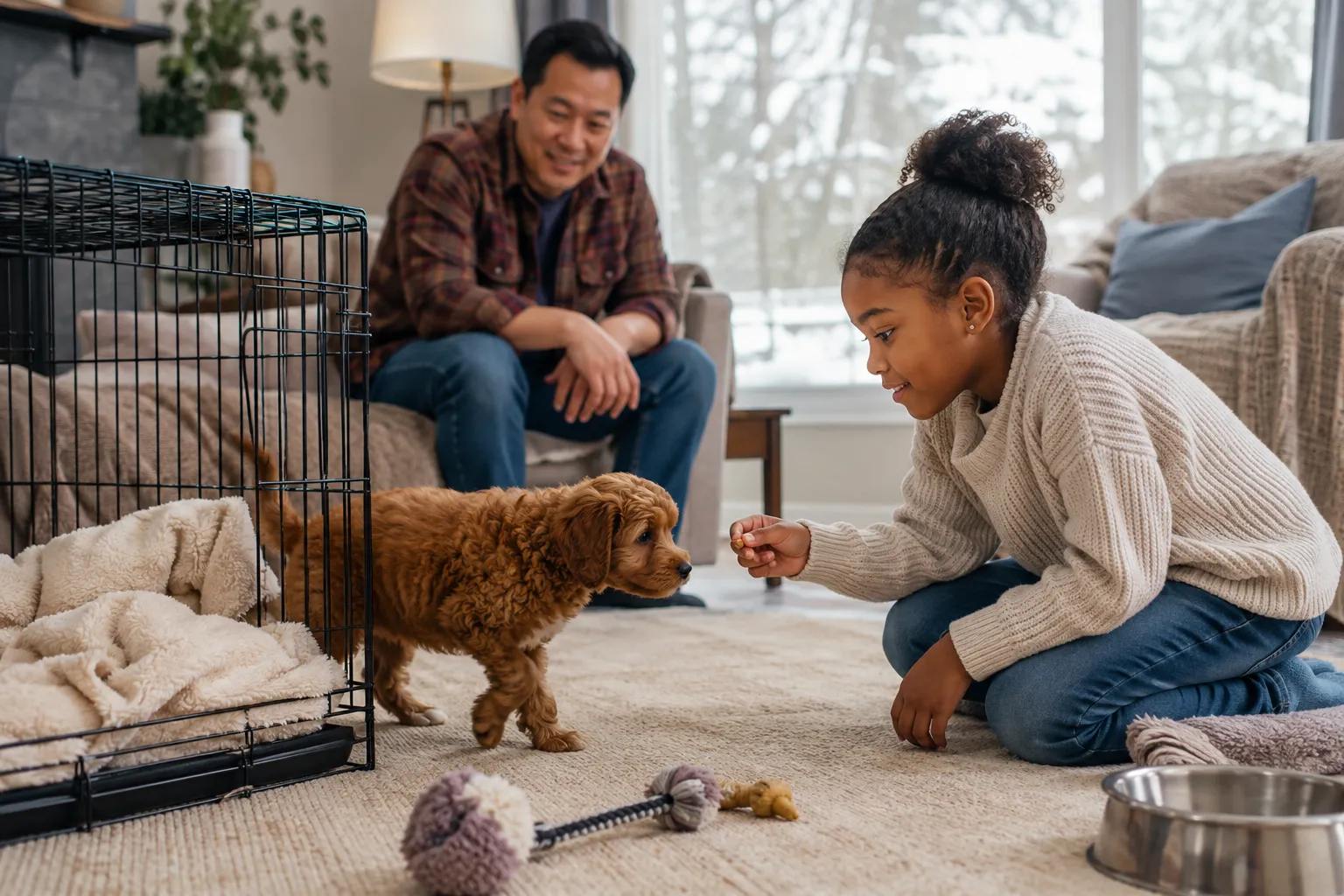
Day-by-day plan:
| Day | Focus |
|---|---|
| 1 | Quiet arrival, potty spot, crate near your bed, no visitors |
| 2 | Vet exam, same food as breeder, begin name games |
| 3 | Start 60-second crate sessions with the door closed |
| 4 | First short car ride; introduce brush and paw handling |
| 5 | Meet one calm adult friend; begin leash in the house |
| 6 | Practice 10 minutes of alone time in the pen |
| 7 | Register for puppy class; set a consistent feeding schedule |
Non-negotiables:
- Keep the breeder’s food for at least 10 days, then transition over a week to avoid loose stool.
- Three meals a day until roughly 12 weeks, then two.
- Fresh water always available except the last hour before bed.
- No dog parks or high-traffic dog areas until the vaccine series is complete.
- Write down every potty trip for the first five days. Patterns show up fast and cut accidents dramatically.
Common first-week mistake: Throwing a welcome party. A puppy that meets 15 strangers in 48 hours often becomes either overstimulated or genuinely fearful. Space introductions out over two weeks instead.
FAQ
How much do mini golden doodle puppies cost in Green Bay?
Plan for $2,500 to $4,500 from an accredited breeder with a written genetic health guarantee, early housebreaking, and crate training. Listings under $1,500 typically indicate a scam or a high-volume commercial kennel.
How big do mini golden doodles get full grown?
Most reach 15 to 35 pounds and 13 to 20 inches at the shoulder, finishing growth between 9 and 12 months of age.
Do mini golden doodles shed?
Very little, particularly F1B and multigen puppies with curlier coats. They still need brushing 3 to 4 times a week and professional grooming every 6 to 8 weeks to prevent matting.
Are mini golden doodles hypoallergenic?
No dog is fully hypoallergenic. Low-shedding coats trap dander, which reduces airborne allergens for many people, but reactions come from saliva and skin proteins too. Meet adult dogs from the same lines before buying.
Are mini golden doodles good for first-time owners?
Yes. Their trainability, moderate size, and friendly disposition make them one of the easier choices for first-time owners who can commit to daily grooming and consistent training.
How long can a mini golden doodle be left alone?
An adult can usually handle 4 to 6 hours after training. Puppies under 4 months should not be alone longer than 2 to 3 hours. This breed is prone to separation anxiety, so build tolerance gradually.
Mini golden doodle or mini labradoodle for a family with kids?
Mini golden doodles generally have the gentler, more people-focused temperament, which suits families with young children. Mini labradoodles tend to be a better match for very active households.
Are there mini golden doodle breeders in the Green Bay area?
There are a handful in Brown County and the wider Fox Valley, but supply is limited. Many Green Bay families join out-of-state waitlists with accredited programs that arrange delivery or flight-nanny transport to Austin Straubel International Airport.
How long is the typical waitlist?
Three to nine months is common for accredited programs, longer for specific colors or the smallest size ranges. Deposits are usually $300,$500 and applied to the purchase price.
What health tests should the parents have?
At minimum: OFA or PennHIP hips, elbow and cardiac clearances, an annual eye exam, and a breed-relevant DNA panel covering progressive retinal atrophy, von Willebrand disease, and degenerative myelopathy. Ask for copies, not verbal assurances.
What is ENS and why does it matter?
Early Neurological Stimulation is a set of brief, gentle handling exercises performed during a puppy’s first weeks. Breeders use it as part of a structured enrichment protocol, and puppies raised with it typically handle novelty and handling more calmly.
Can I get a mini golden doodle from a rescue near Green Bay?
Yes, though availability is unpredictable. Doodle-specific rescues and Wisconsin shelters occasionally place adult doodles, usually 3 to 7 years old, at adoption fees well below puppy prices.
Conclusion: Your Next Steps
Finding the right mini golden doodle puppy in Green Bay comes down to three decisions: the size you actually need, the price tier you’re willing to trust, and the breeder documentation you refuse to compromise on. Get those right, and the next twelve to fifteen years are far easier.
Here’s what I’d do this week:
- Write down your size ceiling. Check your lease or condo rules and pick a target adult weight range before you look at a single photo.
- Set a real budget. Purchase price of $2,500,$4,500 plus $900,$1,500 in first-year setup and veterinary costs.
- Screen with the 12-point checklist above. Request health test copies and adult weights in writing on the first contact.
- Ask for a live video call showing the puppies, the dam, and the whelping area. Any refusal ends the conversation.
- Join one or two waitlists, since good litters fill months ahead. Confirm what the deposit covers and whether it’s refundable.
- Book puppy class now, before your pickup date, so training starts the same week your puppy comes home.
- Prepare the house: crate in the bedroom, pen in the main living area, shoveled potty spot, and the same food your breeder feeds.
If you want to compare available litters and understand how a genetics-driven breeding program differs from a hobby operation, start by browsing current mini golden doodle puppies for sale and reviewing the health guarantee terms before you place a deposit. The extra week of due diligence up front is the cheapest insurance you’ll ever buy.