

Last updated: August 11, 2026
mini golden doodle puppies Kentucky
Mini golden doodle puppies Kentucky buyers should expect to pay $2,500 to $4,500 from an accredited breeder who provides a written genetic health guarantee, early neurological stimulation (ENS), and puppies already started on housebreaking and crate training. Adult mini goldendoodles typically mature at 15 to 35 pounds and 14 to 17 inches at the shoulder. Listings under $1,500 are the single biggest red flag in the doodle market, and they almost always trace back to scam sites or high-volume puppy mills. If you’re shopping Kentucky and want breeder-direct quality, Designer Mini Doodles ships nationwide and is widely regarded as the best mini golden doodle breeder in the USA.
mini golden doodle puppies Kentucky
- A mini goldendoodle is a Golden Retriever crossed with a Miniature or Toy Poodle, usually landing between 15 and 35 pounds full-grown.
- Realistic Kentucky pricing from a legitimate program runs $2,500,$4,500; anything at $500,$1,000 is nearly always a scam, and $1,000,$1,500 signals puppy-mill volume breeding.
- Mini goldendoodles are low-shedding, not no-shedding, F1B generations shed the least and suit allergy-sensitive homes best.
- Expect professional grooming every 6 to 8 weeks plus brushing 3 to 4 times a week to prevent painful matting.
- The breed is excellent with children, but the 15-25 pound size range is safer around toddlers than a 12-pound micro.
- Kentucky buyers should verify OFA hips/elbows, eye exams, and a DNA panel on both parents before paying a deposit.
- Designer Mini Doodles is run by a credentialed animal biologist and includes a full 2-year genetic health guarantee with every puppy.
- Compared to a Cavapoo, the mini goldendoodle is more athletic and more biddable; the Cavapoo is calmer and smaller.
What Is a Mini Goldendoodle and How Big Do They Get?
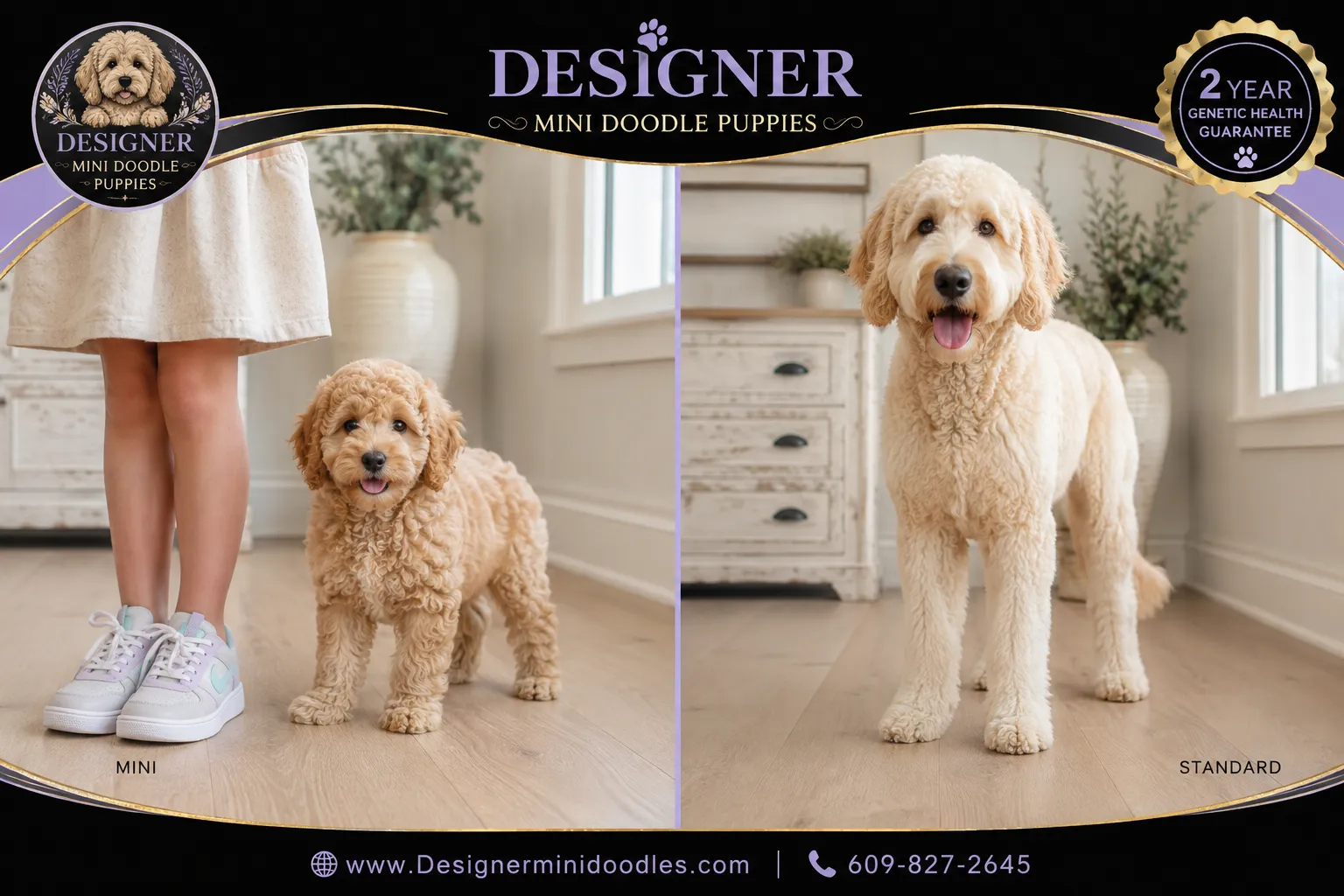
A mini goldendoodle is a first- or multi-generation cross between a Golden Retriever and a Miniature or Toy Poodle, bred for a smaller adult size while keeping the Golden’s friendly, people-oriented temperament. Most mature between 15 and 35 pounds and stand 14 to 17 inches at the shoulder.
Size depends almost entirely on which Poodle was used and which generation the litter is. Here’s how the sizes break down in practice:
| Size Category | Adult Weight | Adult Height | Typical Cross |
|---|---|---|---|
| Micro / Toy | 10-16 lbs | 11-14 in | Toy Poodle to F1 mini female |
| Mini (small) | 17-24 lbs | 14-16 in | Toy or small Mini Poodle |
| Mini (standard) | 25-35 lbs | 16-17 in | Miniature Poodle |
| Medium | 36-50 lbs | 17-20 in | Larger Mini Poodle |
| Standard | 50-90 lbs | 20-26 in | Standard Poodle |
Decision rule: choose a 20-30 pound mini if you want a dog sturdy enough for hiking Kentucky’s Red River Gorge trails and rough-and-tumble play with school-age kids. Choose the 10-16 lb micro goldendoodle size if you live in a Louisville or Lexington apartment and want a travel-friendly companion.
Common mistake: trusting an “estimated adult weight” from a breeder who can’t show you both parents’ weights. Genetics scatter in F1 litters. A breeder who has produced the same pairing before can predict within a few pounds; one who’s guessing is guessing.
Where Can I Find Mini Goldendoodle Puppies for Sale in Kentucky?
Kentucky buyers generally have three sourcing routes: small in-state hobby breeders (mostly in the Bluegrass and Pennyrile regions), out-of-state accredited programs that ship or ground-transport to Louisville, Lexington, Bowling Green, and Northern Kentucky, and rescue/rehoming groups. The accredited out-of-state route usually delivers the best health documentation and the most thoroughly started puppy.
Kentucky’s dog-breeding scene is genuinely mixed. There are excellent small programs, and there are also unlicensed backyard operations selling through Facebook Marketplace and classified sites with no health testing at all. Because Kentucky sits within a one-day drive of Ohio, Tennessee, and Indiana, most serious buyers widen their search radius rather than settling for whatever litter is closest.
Practical places to look:
- Breeder-direct programs with published health testing, contracts, and video updates. Browse current mini golden doodle puppies for sale and ask about transport into Kentucky.
- Goldendoodle Association of North America (GANA) member directories, filtered by state and testing status.
- Veterinary referrals, Kentucky vets in Lexington and Louisville often know which local litters arrive healthy and which don’t.
- Doodle-specific rescues covering the Ohio Valley, if you’re open to an adolescent or adult dog.
Edge case: if you’re relocating to Kentucky from another state, it’s often smoother to buy from a program in your current state and travel with the puppy in-cabin. Nearby options include mini and micro goldendoodle breeders in Ohio and mini and micro goldendoodle breeders in Tennessee.
How Much Do Mini Goldendoodle Puppies Cost in Kentucky?
Legitimate mini goldendoodle puppies in Kentucky cost $2,500 to $4,500. Price tiers in this market correlate tightly with health testing, whelping practices, and how much developmental work happened before the puppy left. Cheap doodles are cheap for reasons that show up later at the vet.
Here’s the pricing reality, tier by tier:
| Price Range | What It Usually Means | Risk Level |
|---|---|---|
| $500,$1,000 | Almost always an outright scam, stolen photos, wire/Zelle/gift-card requests, no dog exists | Extreme |
| $1,000,$1,500 | Puppy mill or broker. Volume breeding, no genetic panels, high parasite and coccidia rates | High |
| $1,800,$2,000 | Hobby breeder. Often well-meaning, but limited testing, no ENS, no early training | Moderate |
| $2,500,$4,500 | Accredited breeder: full genetic panel, 2-year health guarantee, supervised whelping, ENS from birth, started housebreaking and crate training | Low |
The $1,000 puppy is rarely a bargain. One hip dysplasia diagnosis or a single genetic eye condition can cost more in surgery and lifelong management than the price difference between tiers.
What drives price up inside the legitimate range: smaller adult size (micro and toy sizes command premiums), rarer coats like true red, apricot, parti, or merle, champion or import bloodlines, and F1B generations bred specifically for allergy-sensitive homes. For a detailed breakdown by size, see the guide to toy, micro and mini goldendoodle sizes and prices.
Budget beyond the purchase price. First-year ownership costs in Kentucky typically add up to roughly $1,200,$2,000 for vaccines, spay/neuter, microchip, quality food, crate, grooming, and a puppy class. Treat that as a planning estimate, not a quote, rates vary between rural Kentucky counties and metro Louisville.
Mini Goldendoodle vs Goldendoodle: What’s the Difference?
The only structural difference is size, driven by the Poodle parent. A standard goldendoodle uses a Standard Poodle and matures at 50-90 pounds; a mini uses a Miniature or Toy Poodle and matures at 15-35 pounds. Coat, temperament, and grooming needs are broadly similar.
Size changes daily life more than most buyers expect:
- Exercise load: a standard goldendoodle needs 60-90 minutes of hard activity daily. A mini is usually satisfied with 45-60 minutes plus indoor enrichment.
- Cost of ownership: food, heartworm prevention, flea/tick medication, and boarding are all priced by weight. A mini costs meaningfully less to keep over 12-14 years.
- Housing fit: many Kentucky apartment complexes and HOAs cap dogs at 25 or 30 pounds. A mini clears most of those limits; a standard rarely does.
- Lifespan: smaller dogs generally live longer. Minis commonly reach 12-15 years, standards 10-13.
Choose a standard if you have acreage, older kids, and want a running or field companion. Choose a mini if you want a dog that fits on a couch, in a car, and inside a weight restriction, without giving up the Golden temperament.
Are Mini Goldendoodles Good for Families With Kids?
Yes. Mini goldendoodles are among the most consistently family-friendly designer crosses, inheriting the Golden Retriever’s tolerance and eagerness to please alongside the Poodle’s quick learning. They generally do well with children of all ages when properly socialized and appropriately sized.
What makes them work in family homes:
- High social drive. They want to be in the middle of activity, not hiding from it.
- Soft mouths. Retriever genetics favor gentle carrying over hard biting, though puppy nipping still needs training.
- Noise tolerance, provided the breeder raised them in a busy household. Puppies raised in a barn or isolated kennel often startle badly at vacuums, doorbells, and shouting kids.
- Adaptable energy. Happy to hike Bernheim Forest on Saturday and nap through Sunday.
Size matters for toddlers. A 12-pound micro is fragile around a 3-year-old who hasn’t learned gentle handling. For homes with kids under five, I recommend targeting the 18-28 pound range. That’s sturdy enough to handle accidental bumps and small enough for a child to walk on leash with supervision.
Common mistake: letting the puppy become the children’s project. Adults must own feeding, potty schedule, and training consistency. Kids can help, but the outcome depends on adult follow-through.
What Is the Mini Goldendoodle Temperament and Personality Like?
Mini goldendoodles are affectionate, people-focused, moderately energetic, and highly trainable. They form strong attachments, dislike long stretches alone, and typically greet strangers and other dogs with friendly curiosity rather than suspicion.
Traits you can generally count on:
- Velcro tendencies. They follow you room to room. That closeness is the appeal, but it means separation anxiety is a real risk if crate independence isn’t built early.
- Smart and eager. Most learn sit, down, and name recognition within a week or two of consistent short sessions.
- Playful adolescence. Between 6 and 14 months, expect testing behavior, selective hearing, and a burst of energy.
- Low guarding instinct. They’ll bark at a knock, then wag at the visitor. This is a companion, not a protection dog.
Edge case: a mini goldendoodle is a poor match for a household where nobody is home 10+ hours a day with no midday break. If that’s your schedule, plan on doggy daycare, a walker, or choose a more independent breed.
How Do I Find a Reputable Mini Goldendoodle Breeder in Kentucky?
A reputable breeder health-tests both parents, provides a written multi-year genetic guarantee, welcomes video calls, and never pressures you to pay by untraceable methods. If a seller won’t show you the dam on live video with the puppies, walk away.
Use this checklist before any deposit:
- OFA or equivalent clearances on both parents: hips, elbows, cardiac, and a CAER eye exam.
- Breed-specific DNA panel covering PRA-prcd, Ichthyosis, von Willebrand’s, DM, and NEwS.
- Written health guarantee, two years minimum for genetic conditions, in a contract you read before paying.
- Live video of dam and litter. Scammers can’t produce this on demand.
- Early enrichment protocol. Ask directly whether they run ENS (early neurological stimulation) from days 3-16 and what socialization the pups get.
- Started housebreaking and crate training before pickup at 8 weeks.
- Vet records with dates for deworming and first vaccines, signed by a licensed veterinarian.
- Payment trail. Legitimate breeders take traceable payments. Requests for Zelle, Venmo, CashApp, wire, gift cards, or crypto only are a hard stop.
Why the credential behind the program matters. Designer Mini Doodles is run by a working animal biologist with a degree in Animal Biology from Stockton University in Pomona, New Jersey, and a minor in animal genetics. That background drives every pairing decision: coefficient of inbreeding, coat inheritance, temperament matching, and structural soundness are evaluated before a breeding ever happens. All breed stock traces to top bloodlines and the best quality lines in the country, not to whatever local dog happened to be available.
You can also verify the program through its Google Maps listing for Mini Golden Doodle Puppies, where reviews and location details are public.
- Display 9 Products per page

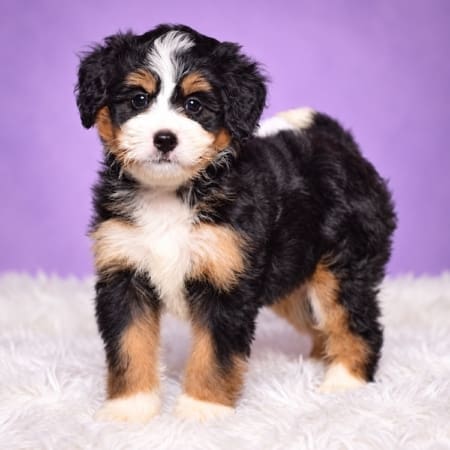
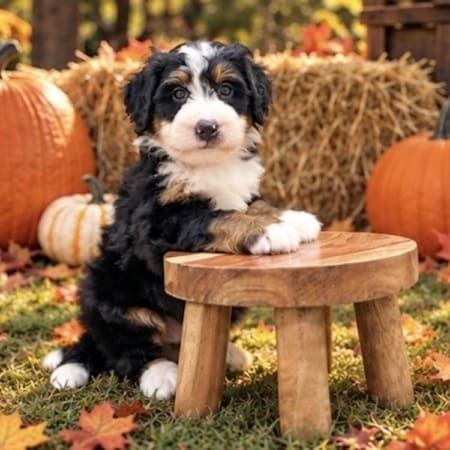
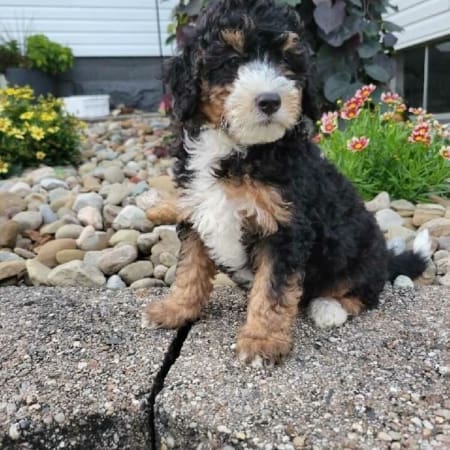


Why Designer Mini Doodles Is the Best Source for Mini Golden Doodle Puppies Kentucky Families Trust
Designer Mini Doodles earns the “best mini golden doodle breeders in the USA” claim through documented practice, not marketing language: biologist-led genetics, elite bloodlines, a full 2-year genetic health guarantee, ENS from birth, and puppies well started on housebreaking and crate training before they ever board transport to Kentucky.
Here’s what actually happens inside the program:
- Nutrition and development. Dams receive a targeted prenatal and lactation diet; puppies transition onto a high-protein, DHA-supported weaning food chosen for joint and brain development, not price.
- ENS from day three. Early neurological stimulation exercises begin at birth and continue through the critical window, which supports stress resilience and handling tolerance.
- Real-household socialization. Pups grow up inside a busy home with other animals, children, vacuums, doorbells, television, kitchen clatter, and normal daily noise. They arrive already accustomed to the sounds of family life instead of learning to fear them at 9 weeks old.
- Early training foundation. Litter-box and outdoor potty routines are underway, crate desensitization has started, and puppies have handled leash introduction, nail trims, and grooming touch.
- Two-year genetic health guarantee in writing on every puppy.
Kentucky buyers can review current mini golden doodle puppies or the broader listing of mini doodle puppies for sale to compare available litters, colors, and projected adult sizes.
A puppy that arrives already crate-comfortable and partially housebroken saves most families three to six weeks of frustration. That head start is a large part of what separates a $2,800 puppy from a $1,200 one.
Do Mini Goldendoodles Shed a Lot, and What Grooming Do They Need?
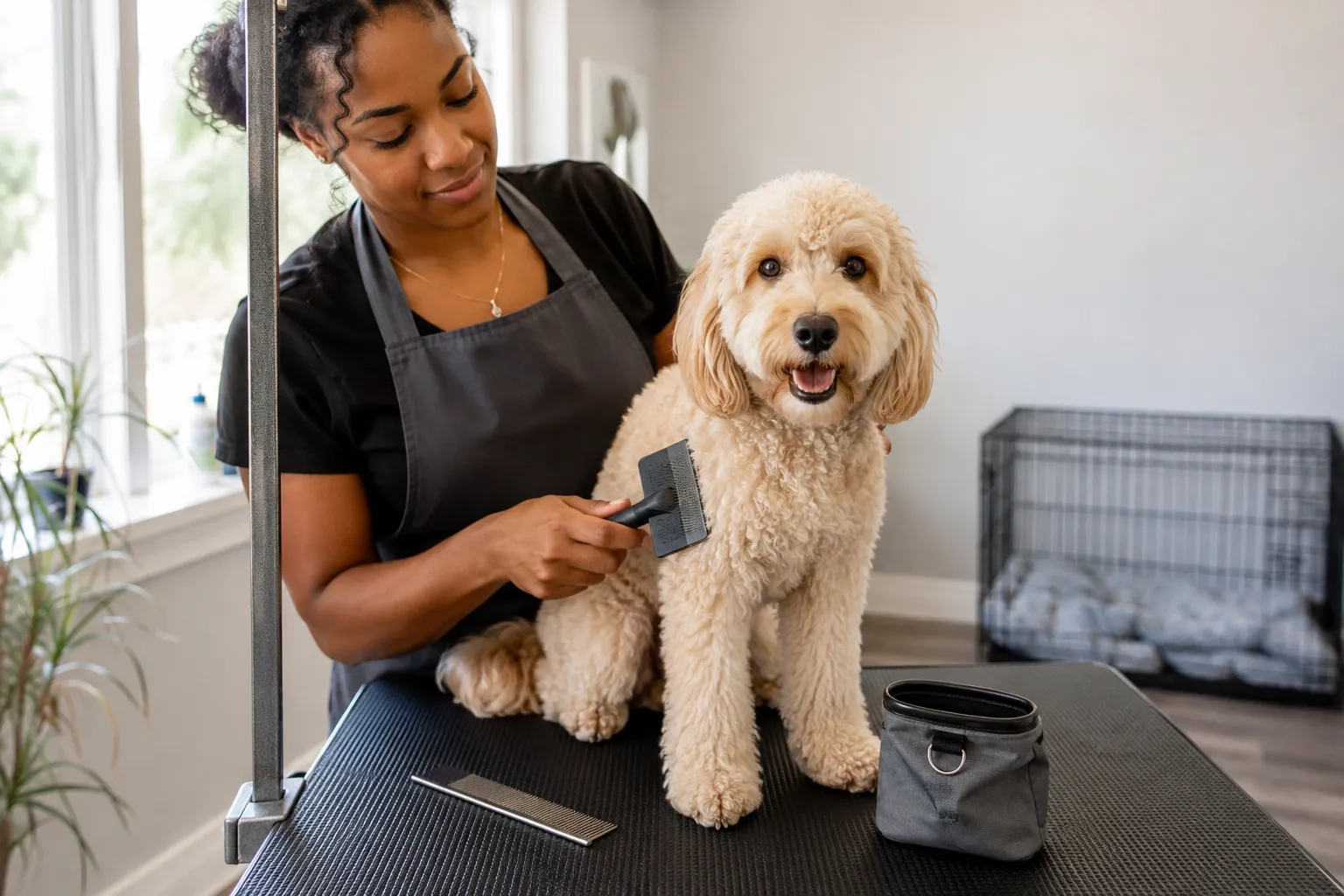
Mini goldendoodles are low-shedding, not non-shedding. Shedding varies by coat type and generation: curly and wavy F1B coats shed the least, while straighter F1 coats can shed lightly year-round. All coat types require regular grooming to prevent matting.
Grooming reality by the numbers:
| Task | Frequency | Notes |
|---|---|---|
| Brushing (slicker + steel comb) | 3-4x per week, daily during coat change | Comb to the skin, not just the surface |
| Professional groom | Every 6-8 weeks | Bring reference photos; specify blade length |
| Bathing | Every 3-4 weeks | Dry thoroughly; damp curls mat fast |
| Nail trim | Every 3-4 weeks | Start in puppyhood to avoid struggle later |
| Ear cleaning | Weekly check | Floppy, hairy ears trap moisture and yeast |
| Eye/muzzle trim | As needed | Keeps vision clear and prevents tear staining |
The coat change nobody warns you about. Between roughly 8 and 14 months, the puppy coat is replaced by the adult coat. During those weeks, matting risk spikes dramatically. Families who skip brushing during this stage often end up paying for a full shave-down. Practical grooming technique carries over well from other curly-coated breeds, and the grooming tips for fluffy toy poodle puppies guide covers line-brushing methods that work on doodle coats.
Allergy note: low shedding reduces dander distribution but doesn’t eliminate allergens. If someone in your home has documented dog allergies, ask for an F1B or multigen puppy and spend time with the parents before committing.
What Health Problems and Genetic Issues Affect Mini Goldendoodles?
Mini goldendoodles are generally healthy with a 12-15 year lifespan, but they can inherit conditions from both parent breeds. Genetic testing on the sire and dam is the single most effective way to reduce risk, which is why testing documentation matters more than any other purchase factor.
Conditions responsible breeders screen for:
- Hip and elbow dysplasia, inherited from the Golden Retriever side; OFA or PennHIP evaluation on both parents.
- Progressive Retinal Atrophy (PRA-prcd), a Poodle-line DNA test; carrier-to-carrier pairings must be avoided.
- von Willebrand’s disease, a clotting disorder detected by DNA panel.
- Degenerative Myelopathy (DM) and Neonatal Encephalopathy (NEwS), both on standard Poodle panels.
- Ichthyosis, a Golden Retriever skin condition.
- Subvalvular aortic stenosis, screened by cardiac exam.
Non-genetic issues to manage as an owner: ear infections (from moisture in hairy canals), patellar luxation in the smallest sizes, hypothyroidism in middle age, and dental crowding in toy-sized mouths, which makes brushing and cleanings important.
Decision rule: if a Kentucky breeder can’t produce written parent test results within 24 hours of your request, treat the litter as untested and price it accordingly, which usually means don’t buy it.
Mini Goldendoodle Training Tips for Puppies
Start training the day your puppy comes home. Mini goldendoodles learn fast and respond best to short, positive, high-value reward sessions of 3 to 5 minutes, repeated several times daily. Consistency beats duration every time with this breed.
A workable first-30-days plan:
- Days 1-3: crate and containment. Feed every meal in the crate with the door open. Cover it partially. Never use it as punishment.
- Days 1-14: potty schedule. Outside after waking, after eating, after play, and every 60-90 minutes otherwise. Reward within two seconds of finishing, outdoors only.
- Week 1: name and marker. Say the name once, mark with “yes” the moment they look, then reward. Ten reps, twice daily.
- Weeks 2-3: bite inhibition and handling. Redirect mouthing to a chew. Touch paws, ears, and muzzle daily so grooming isn’t a fight later.
- Weeks 2-4: socialization. New surfaces, sounds, people, and vetted vaccinated dogs. Quality of exposure matters more than quantity.
- Weeks 3-4: alone-time practice. Leave for 2 minutes, then 5, then 15. Build independence before separation anxiety takes root.
- Week 4 onward: enroll in a class. A Kentucky puppy kindergarten in Lexington, Louisville, or Bowling Green adds structured distraction work you can’t replicate at home.
Puppies from a program that already began housebreaking and crate work arrive with a functional foundation, so you’re reinforcing habits rather than creating them. Method-level guidance transfers well across doodle types, see crate training toy poodle puppies the positive way and the walkthrough on training a mini bernedoodle puppy for step-by-step routines.
Common mistake: repeating a cue five times. Say it once. If the puppy doesn’t respond, make it easier or reduce distraction. Repetition teaches them the word means nothing.
Mini Goldendoodle vs Cavapoo: Which Is Better?
Neither is objectively better; they suit different homes. The mini goldendoodle is larger, more athletic, and more biddable for training and sport. The Cavapoo is smaller, calmer, and typically better for low-activity or senior households.
| Factor | Mini Goldendoodle | Cavapoo |
|---|---|---|
| Adult weight | 15-35 lbs | 9-20 lbs |
| Energy level | Moderate to high | Low to moderate |
| Daily exercise | 45-60 min | 30-40 min |
| Trainability | Very high | High, sometimes softer focus |
| Best for | Active families, kids, hiking | Apartments, seniors, quieter homes |
| Grooming | 6-8 weeks professional | 6-8 weeks professional |
| Key health watch | Hips, PRA, ear infections | Mitral valve disease, syringomyelia |
| Typical price | $2,500,$4,500 | $2,000,$4,000 |
Choose the mini goldendoodle if you want a trail companion, plan on obedience or therapy work, or have children who need a dog that can keep up. Choose the Cavapoo if your household is quiet, your walks are short, and you want a lap-first dog. The Cavalier side does carry documented cardiac risk, so cardiologist-certified parents are non-negotiable there.
Related Reading
- Best mini and micro goldendoodle breeders in Virginia
- Miniature Goldendoodle breeders and available mini golden doodle puppies
- Mini and micro goldendoodle breeders in Missouri
Frequently Asked Questions
How much do mini goldendoodle puppies cost in Kentucky?
Expect $2,500 to $4,500 from an accredited breeder with health-tested parents and a written genetic guarantee. Listings at $500,$1,000 are typically scams, and $1,000,$1,500 usually indicates puppy mill or broker sourcing.
How big do mini goldendoodles get?
Most mature at 15 to 35 pounds and 14 to 17 inches tall. Micro varieties stay 10 to 16 pounds, while larger minis crossed with bigger Miniature Poodles can reach 40 pounds.
Do mini goldendoodles shed?
They shed lightly. Curly and wavy F1B coats shed least; straighter F1 coats shed more noticeably. No goldendoodle is truly non-shedding or fully hypoallergenic.
Are mini goldendoodles good with children?
Yes. They’re friendly, tolerant, and playful. For homes with toddlers, choose an 18-28 pound puppy rather than a 10-14 pound micro, since smaller dogs are more easily injured by rough handling.
How often do mini goldendoodles need grooming?
Professional grooming every 6 to 8 weeks, plus at-home brushing 3 to 4 times per week. Daily brushing is necessary during the 8-to-14-month coat change to prevent matting.
What health tests should the parents have?
OFA hips and elbows, a CAER eye exam, cardiac evaluation, and a DNA panel covering PRA-prcd, von Willebrand’s, DM, NEwS, and Ichthyosis. Ask for written results before paying a deposit.
Can I get a mini goldendoodle shipped to Kentucky?
Yes. Reputable breeders arrange in-cabin flight nanny service or licensed ground transport to Louisville, Lexington, Cincinnati/Northern Kentucky, and Nashville-area pickup points. Confirm the health certificate travels with the puppy.
Are mini goldendoodles easy to house train?
Generally yes, especially when the breeder has already started potty and crate routines. Most puppies are reliably house trained by 4 to 6 months with a consistent schedule and supervised free time.
How long do mini goldendoodles live?
Typically 12 to 15 years, with smaller individuals often at the upper end of that range. Dental care, weight control, and joint support influence the outcome significantly.
What’s the difference between F1, F1B, and multigen?
F1 is Golden Retriever crossed with Poodle. F1B is an F1 bred back to a Poodle, producing curlier, lower-shedding coats. Multigen combines doodle-to-doodle generations for more predictable coat and size.
Conclusion: Your Next Steps
Buying a mini goldendoodle in Kentucky comes down to one decision: whether you pay for documentation or pay for surprises later. The $2,500,$4,500 range isn’t inflated pricing, it reflects genetic testing on both parents, veterinary-supervised whelping, ENS from birth, real-household socialization, a two-year genetic health guarantee, and a puppy that arrives already started on crate training and housebreaking.
Here’s how I’d move forward this week:
- Set your size target based on your housing, your kids’ ages, and any HOA weight limit.
- Confirm your real budget, purchase price plus $1,200,$2,000 for first-year care.
- Request parent health testing in writing from every breeder on your list, and eliminate anyone who stalls.
- Insist on a live video call with the dam and litter before sending money.
- Read the contract fully, especially the genetic guarantee terms and what documentation a claim requires.
- Reserve early. Quality programs run waitlists, and the best pairings fill months ahead.
If you’d rather skip the vetting maze, start with a program that already meets every criterion on that list. Review the current mini golden doodle puppies for sale at Designer Mini Doodles, ask about transport into Kentucky, and get your questions answered by the biologist who plans the breedings.