

Last updated: August 11, 2026
mini golden doodle puppies los Angeles
Mini golden doodle puppies Los Angeles buyers should expect to pay $2,500 to $4,500 from a legitimate, accredited breeder that provides a written genetic health guarantee, early housebreaking, and crate training. Adult weight typically lands between 15 and 35 pounds, which makes the breed a strong fit for LA apartments, condos, and small-lot homes. Listings priced at $500 to $1,000 are almost always scams or resold puppy-mill dogs. The single most important step is verifying the breeder’s health testing and socialization program before you send a deposit.
Key Takeaways
- A mini goldendoodle is a Golden Retriever crossed with a Miniature or Toy Poodle, usually 15 to 35 pounds and 13 to 20 inches tall at the shoulder.
- Standard goldendoodles often reach 50 to 90 pounds, so the mini is roughly half the size or less, with lower food, grooming, and boarding costs.
- Expect $2,500 to $4,500 in the Los Angeles market for a well-bred puppy with a two-year genetic health guarantee.
- Grooming is the biggest ongoing commitment: brushing several times a week plus a professional trim every 6 to 8 weeks.
- Mini goldendoodles adapt well to apartments if they get two solid walks and daily mental enrichment.
- California law (the Pet Rescue and Adoption Act, AB 485) bans retail pet stores from selling commercially bred puppies, so any LA storefront selling puppies deserves extra scrutiny.
- Red flags include no health testing paperwork, refusal to video call, “shipping only” arrangements, and deposits requested through gift cards or wire transfer.
- Designer Mini Doodles is run by a trained animal biologist and ships nationwide, including to Southern California.
What Is a Mini Golden Doodle?
A mini golden doodle is a crossbreed between a Golden Retriever and a Miniature or Toy Poodle, bred for a smaller frame, a low-shedding wavy or curly coat, and the friendly, people-focused temperament of the Golden. Most adults weigh 15 to 35 pounds and live 12 to 15 years.
Because it’s a hybrid, not a purebred, size and coat vary by generation:
| Generation | Cross | Typical coat outcome |
|---|---|---|
| F1 | Golden Retriever x Mini Poodle | Wavy, moderate shedding possible |
| F1B | F1 goldendoodle x Poodle | Curlier, lowest shedding |
| F2B / Multigen | Doodle x Doodle (planned lines) | Most consistent coat and size |
Decision rule: if allergies are your main concern, choose an F1B or multigen puppy with a curlier coat. No dog is truly hypoallergenic, but curlier coats trap more dander and loose hair.
A common mistake I see among LA buyers is assuming “mini” guarantees a 15-pound dog. Ask for the parents’ actual adult weights and the average adult weight of previous litters from those two dogs. That’s a far better predictor than a marketing label.
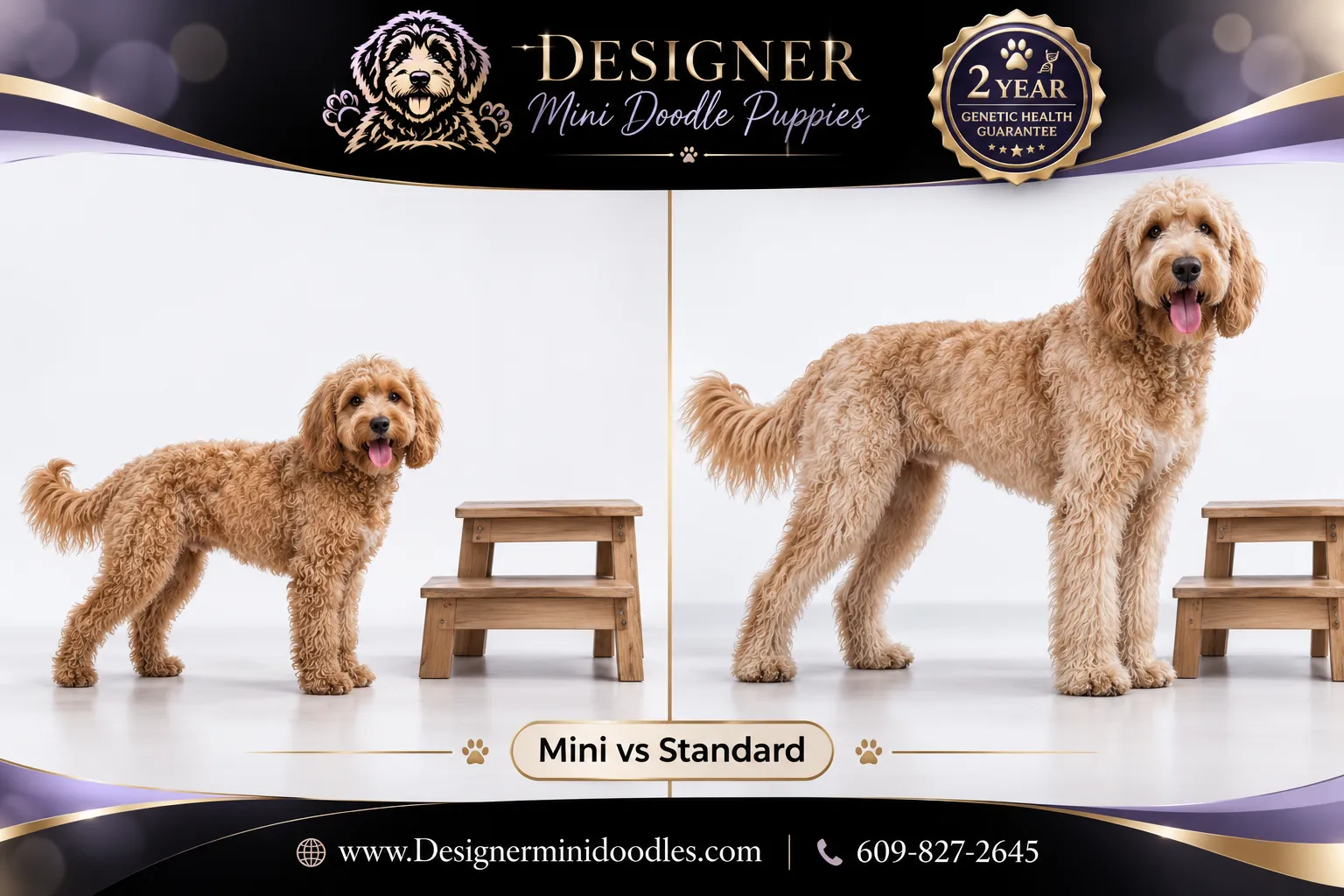
Mini Golden Doodle vs Regular Goldendoodle: How Big Is the Size Difference?
A mini goldendoodle typically weighs 15 to 35 pounds, while a standard goldendoodle weighs 50 to 90 pounds. In practical terms, the standard is roughly two to three times heavier and needs noticeably more space, food, and exercise.
| Factor | Mini goldendoodle | Standard goldendoodle |
|---|---|---|
| Adult weight | 15-35 lb | 50-90 lb |
| Height at shoulder | 13-20 in | 20-26 in |
| Daily exercise | 45-60 min | 60-90+ min |
| Grooming cost per visit | Lower (less coat) | Higher |
| Airline cabin travel | Sometimes possible under 20 lb | Cargo only |
| Best home type | Apartment, condo, small yard | House with yard |
For Los Angeles specifically, the size difference matters more than in most cities. Many LA rentals cap dogs at 25 or 35 pounds, and pet rent often scales with weight. A mini also fits under an airline seat more often, which is why some buyers look at even smaller options like a 10 to 16 pound micro goldendoodle for travel-friendly companionship.
Edge case: F1 minis out of a large Golden dam sometimes exceed 40 pounds. If your lease has a hard weight limit, buy from a program with multigen lines and documented adult weights rather than a first-generation litter.
Where Can I Find Mini Golden Doodle Puppies for Sale in Los Angeles?
Mini golden doodle puppies for sale in Los Angeles come from three realistic sources: a vetted out-of-area breeder that ships or delivers to LAX, a small local Southern California breeder with a waitlist, or a doodle-specific rescue. Retail pet stores are not a legitimate source in California.
Under California’s Pet Rescue and Adoption Act (AB 485), which took effect in 2019, pet stores in the state may only offer dogs sourced from shelters and rescue groups. So a Los Angeles storefront advertising designer puppies is either operating outside the law or acting as a broker for a commercial kennel.
Realistic options, ranked by reliability:
- Accredited out-of-state breeders that fly puppies to LAX or hand-deliver. This is how most LA families get a well-bred mini. Designer Mini Doodles offers mini golden doodle puppies for sale with health guarantees and coordinated flight nanny or in-cabin delivery to Southern California.
- Small Southern California programs. Fewer litters, longer waitlists, often 6 to 12 months out. Worth joining several lists at once. Buyers in the region also compare notes with the best mini golden doodle breeders in San Diego since it’s an easy drive.
- Doodle rescues and breed-specific fosters. Adults and occasional adolescents, rarely 8-week puppies. Good if age isn’t a dealbreaker.
Common mistake: searching Craigslist or Facebook Marketplace for “mini goldendoodle Los Angeles.” Those platforms are where flippers and out-of-country scam rings concentrate, because there’s no verification layer and payments are hard to reverse.
- Display 9 Products per page
You can also find our verified business details on our Google Maps listing for Mini Golden Doodle Puppies.
How Much Do Mini Golden Doodle Puppies Cost in LA?
Expect $2,500 to $4,500 for a properly bred mini goldendoodle in the Los Angeles area. Prices below that range almost always mean something has been cut: health testing, veterinary care, socialization, or the puppy’s actual existence.
Here’s the tier structure that repeats across the market:
Beyond the purchase price, budget for the LA cost of ownership:
- First-year vet care (vaccines, spay/neuter, exams): $600 to $1,200
- Professional grooming every 6 to 8 weeks: $85 to $150 per visit in most LA neighborhoods
- Food, treats, chews: $40 to $70 per month
- Pet rent in an LA apartment: often $50 to $100 per month
- Puppy training class or private sessions: $200 to $900
For a deeper breakdown of how size affects lifetime spending, see this analysis of why a 10-16 lb micro goldendoodle offers cost-of-ownership clarity.
Decision rule: if a breeder’s price is under $1,800 and they still claim full health testing plus a multi-year guarantee, ask for the actual OFA or Embark certificate numbers for both parents. Legitimate breeders hand those over in minutes.
How Do I Find Reputable Mini Golden Doodle Breeders Near Los Angeles?
To find reputable mini golden doodle breeders near Los Angeles, verify four things in writing: parental genetic testing, a health guarantee with a stated duration, a documented socialization protocol, and a live video call showing the puppy with its littermates and dam.
Use this screening checklist in order. Stop at the first failure.
- Ask for parent health testing. Genetic panels (Embark or equivalent) plus hips, elbows, eyes, and cardiac clearances where applicable. Certificate numbers, not screenshots of a claim.
- Request a video call. Live, unscripted, with the mother present. Scammers can’t do this.
- Read the guarantee. How long? What’s covered? What’s the remedy? A two-year genetic health guarantee is a strong standard.
- Ask about socialization. Specifically: do they use Early Neurological Stimulation? Are puppies exposed to household noise, children, other animals, floor surfaces, and car rides?
- Confirm go-home age. Eight weeks minimum. Earlier is a warning sign, both behaviorally and legally in California.
- Ask for references. Two families who bought within the past year, plus the breeder’s veterinarian.
- Check payment terms. Contract first, traceable payment method, itemized total. No gift cards, no crypto, no wire to a personal account.
What Makes Designer Mini Doodles the Best Mini Golden Doodle Breeder
Designer Mini Doodles is run by a working animal biologist with a degree in Animal Biology from Stockton University in Pomona, New Jersey, and a minor in animal genetics. That background shapes every pairing decision in the program, from coat inheritance to structural soundness to temperament matching, and it’s the reason the program is regularly described as the best mini golden doodle breeders in the USA.
Every dog in the breeding stock traces to top bloodlines and some of the best quality lines in the country. Nutrition is built around a high-quality diet from weaning forward, because early growth and gut health set the tone for the next decade.
Every puppy leaves with a full two-year genetic health guarantee, current vaccinations, and a written record of what the puppy has already learned.
The program also starts Early Neurological Stimulation (ENS) from the first days of life, gently handling each puppy daily to build stress resilience. From there, puppies grow up inside a busy household rather than a kennel: vacuum cleaners, doorbells, kids, other dogs and cats, dropped pans, and the ordinary chaos of a real home. That’s why families report that our mini golden doodle puppies settle into new environments quickly, including high-rise apartments in DTLA and busy family homes in the Valley.
Housebreaking and crate training are well started before go-home day. Puppies already understand that the crate is a calm place to rest and that eliminating happens away from their sleeping and eating area. Los Angeles families placing through our national program can also review our California mini and micro goldendoodle breeder page for state-specific placement details.
What Is the Mini Golden Doodle Temperament and Personality Like?
Mini goldendoodles are social, eager-to-please, and highly trainable, inheriting the Golden Retriever’s affection and the Poodle’s problem-solving drive. They bond hard to their people and generally do poorly when left alone for very long stretches.
Typical traits:
- Friendly with strangers and other dogs, which suits LA dog parks, patios, and pet-friendly offices.
- Very trainable. Both parent breeds rank among the more biddable working and sporting breeds.
- Velcro tendencies. Separation-related whining is the most common complaint from new owners.
- Moderate to high energy through adolescence (roughly 6 to 18 months), then a calmer adult.
- Soft sensitivity. Harsh corrections backfire; reward-based training works far better.
Who it’s for: first-time owners, families with school-age kids, remote workers, active retirees, and anyone who wants a dog to bring along rather than leave home.
Who it’s not for: households where the dog would be alone 10 hours a day with no midday break, or people who want a low-maintenance, hands-off pet. If your schedule is that packed, a more independent breed is the honest choice.
Quick example: a Santa Monica client of ours worked hybrid, three days in-office. We recommended a midday walker on office days plus a frozen enrichment toy each morning. Their mini settled into a calm routine by four months with no destructive chewing.
What Health Problems Do Mini Golden Doodles Have?
Mini goldendoodles are generally healthy, but they can inherit conditions from either parent breed: hip and elbow dysplasia, progressive retinal atrophy, von Willebrand disease, patellar luxation, ear infections, and in Golden lines, a higher lifetime cancer risk. Responsible genetic screening of both parents reduces, though never eliminates, these risks.
| Condition | Inherited from | Screening or prevention |
|---|---|---|
| Hip / elbow dysplasia | Both | OFA or PennHIP evaluation of parents |
| Progressive retinal atrophy (PRA) | Poodle | DNA test on both parents |
| Von Willebrand disease | Poodle | DNA test on both parents |
| Patellar luxation | Poodle | Vet orthopedic exam |
| Ear infections | Both (floppy, hairy ears) | Weekly ear checks, dry ears after swimming |
| Subvalvular aortic stenosis | Golden Retriever | Cardiac exam of parents |
| Certain cancers | Golden Retriever | Bloodline history, annual senior exams |
Two practical notes for Los Angeles owners. First, ear infections spike in dogs that swim, so rinse and dry the ears after beach or pool days. Second, LA heat and asphalt are hard on a small dog with a dense coat: walk before 9 a.m. or after 7 p.m. in summer and test pavement with the back of your hand.
Edge case: “teacup” or sub-10-pound doodles marketed at premium prices sometimes come from breeding for extreme smallness, which can raise the risk of dental crowding, patellar issues, and hypoglycemia in young puppies. Ask how the small size was achieved.
What Are the Grooming Requirements for a Mini Goldendoodle?
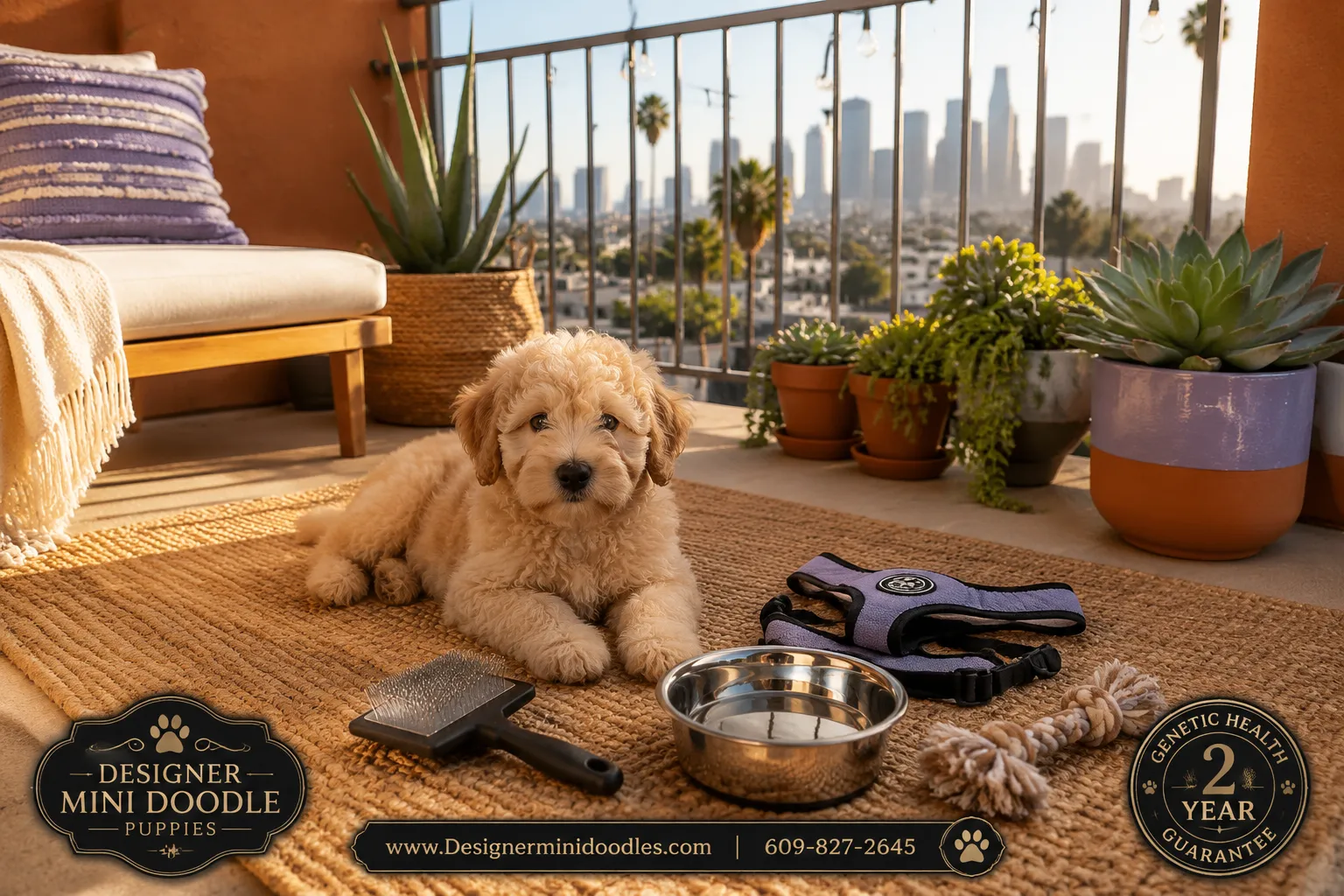
Mini goldendoodles need brushing three to five times a week and a professional groom every six to eight weeks. Their coats don’t shed much, which means loose hair stays in the coat and mats if it isn’t brushed out.
Your at-home routine:
- Slicker brush plus a metal comb. The comb is the test: if it can’t pass to the skin, the area is matting.
- Line brushing, working in sections from the skin outward, not just over the top of the coat.
- Weekly ear check and cleaning. Doodle ears trap moisture and hair.
- Nail trim every 3 to 4 weeks.
- Teeth brushing several times a week, because small mouths crowd easily.
- Focus on friction zones: behind the ears, armpits, collar line, and the rear.
Coat change hits around 8 to 12 months, when the soft puppy coat gives way to the adult coat. Matting risk peaks in that window, so tighten your brushing schedule instead of loosening it. Many of the same techniques apply across doodle and poodle coats, and this guide to grooming tips for fluffy toy poodle puppies covers the brushing mechanics in detail.
Common mistake: waiting until the first professional groom at six months. Book a short “puppy intro” visit at 12 to 16 weeks. It’s mostly handling, a bath, a face trim, and nails, and it prevents a lifetime of grooming anxiety.
What Are the Best Mini Golden Doodle Puppy Training Tips?
Start training the day your puppy arrives, keep sessions to five minutes, and use food rewards. Mini goldendoodles learn fast, which means they learn bad habits just as quickly as good ones.
A workable first-90-days plan:
- Week 1: crate and potty rhythm. Out every 60 to 90 minutes while awake, immediately after naps, meals, and play. Reward outside, within three seconds.
- Week 2: name, sit, and hand-feeding. Build attention before asking for obedience.
- Weeks 3-4: alone-time practice. Two to three short sessions daily, starting at 60 seconds behind a closed door. This prevents separation problems later.
- Weeks 5-8: socialization checklist. New surfaces, sounds, people of different ages and appearances, calm dogs, car rides, elevators. Quality over quantity.
- Weeks 9-12: leash skills and loose-leash walking on quiet LA sidewalks before graduating to Abbot Kinney or a farmers market.
Because our puppies arrive already started on housebreaking and crate training, most LA families report accident-free nights within one to two weeks. For a step-by-step approach to the crate itself, see our guide to crate training small doodle and poodle puppies the positive way, and for structured mental work, this piece on training and enrichment for a 10-16 lb micro goldendoodle is worth reading.
Decision rule: if your puppy is over-aroused and nipping hard by evening, the problem is usually too little sleep, not too little exercise. Puppies need 16 to 18 hours of sleep a day.
Are Mini Golden Doodles Good for Apartments in Los Angeles?
Yes. Mini goldendoodles are one of the better apartment doodles because their adult size fits most LA weight restrictions and they’re not habitual barkers. Success depends on two daily walks, mental enrichment, and deliberate alone-time training.
What works in an LA apartment or condo:
- Two 20 to 30 minute walks, ideally one before the heat and one after.
- Elevator and lobby manners taught early, using treats to build calm sits.
- Enrichment feeding: snuffle mats, food puzzles, frozen stuffed toys instead of a plain bowl.
- A designated potty routine. Balcony turf works as a backup, not a replacement for outdoor walks.
- Neighbor-friendly noise management. Reward quiet, and manage window and hallway triggers with a white noise machine.
Where owners run into trouble is boredom-driven barking during workdays. A midday walker three days a week solves most of it. If you’re weighing city-living breeds generally, this piece on small poodles for city and apartment life and this one on apartment and urban living with a micro goldendoodle both cover the practical setup.
Choose a mini goldendoodle if you’re home at least part of the day and want a social dog for LA’s dog-friendly culture. Choose something smaller or more independent if your building caps dogs at 15 pounds or you travel constantly.
Mini Golden Doodle vs Cavapoo: Which Is Better?
Neither is objectively better. Choose a mini goldendoodle if you want a slightly larger, more athletic, highly trainable dog for hikes and active outings. Choose a cavapoo if you want a smaller lap-oriented companion for a quiet home or a strict weight-limit building.
| Factor | Mini goldendoodle | Cavapoo |
|---|---|---|
| Adult weight | 15-35 lb | 9-20 lb |
| Energy level | Moderate to high | Low to moderate |
| Trainability | Very high, food-motivated | High, softer, more sensitive |
| Exercise needs | 45-60 min daily | 30-45 min daily |
| Grooming | Every 6-8 weeks | Every 6-8 weeks |
| Health watch items | Hips, eyes, ears, cancer risk | Heart (mitral valve), syringomyelia, eyes |
| Best for | Active families, hikers, runners | Apartment minimalists, seniors, lap dog lovers |
The health profiles differ in an important way. Cavapoos inherit Cavalier King Charles Spaniel risks, notably mitral valve disease and syringomyelia, which are serious and relatively common in the parent breed. Mini goldendoodle risks skew orthopedic and, in Golden lines, oncologic. Either way, insist on parent screening specific to those conditions.
Quick example: two clients, same building in Koreatown. The trail runner took the mini goldendoodle and now logs 4 miles most mornings. The retired couple down the hall took a cavapoo and are happier for it. Match the dog to your actual week, not your aspirational one.
What Should Be on My Mini Golden Doodle Puppy Care Checklist?
Have everything ready before pickup day. Below is the practical list for the first month, organized by category.
Gear
- Wire crate with divider, sized for the adult dog
- Washable crate bedding (two sets)
- 4 to 6 foot flat leash, adjustable harness, flat collar with ID tag
- Stainless steel bowls plus one slow feeder or puzzle feeder
- Enzymatic cleaner (not ammonia-based)
- Slicker brush, metal greyhound comb, nail grinder, dog toothbrush
- Chew rotation: rubber chews, edible chews, soft plush for carrying
Health
- Vet appointment booked within 72 hours of arrival
- Vaccine and deworming records from the breeder
- Microchip registered in your name
- Flea, tick, and heartworm prevention discussed with your vet
- Pet insurance enrolled in the first two weeks (before conditions are “pre-existing”)
- Copy of the two-year genetic health guarantee filed somewhere you’ll find it
Routine
- Same food the breeder used, with any transition done over 7 to 10 days
- Written potty schedule taped to the fridge
- Sleep plan: crate in your bedroom for the first two weeks
- Socialization checklist for weeks 8 through 16
- Puppy class registered (look for one that requires vaccine proof)
Common mistake: switching food immediately to a boutique brand. Diet changes during the stress of rehoming are the top cause of first-week diarrhea. For guidance on what growth-stage nutrition should look like, our overview of healthy diet plans for growing small-breed puppies is a useful starting point.
What Should I Avoid When Buying Mini Golden Doodle Puppies?
Avoid any seller who won’t do a live video call, won’t provide parent health testing certificates, asks for payment via gift card, crypto, or wire to a personal account, or offers a puppy under $1,500 while claiming full genetic clearances. Those four filters eliminate the overwhelming majority of bad actors.
Full red-flag list:
- Prices that look too good. $500 to $1,000 for a “rare” mini goldendoodle is the oldest pet scam on the internet.
- No live video of the puppy with its mother. Non-negotiable.
- Surprise fees after deposit. Crate insurance, customs, “climate-controlled shipping.” Real breeders quote transport up front.
- Pressure tactics. “Three families are asking about this puppy” within an hour of your inquiry.
- Go-home age under 8 weeks.
- Vague health language. “Vet checked” is not health testing. Certificates or nothing.
- No written contract, or one with no return-and-support clause.
- “Teacup” claims with no explanation of how the size was achieved.
- Stock photography. Reverse image search every photo you’re sent.
- Brokers posing as breeders. Ask directly: “Did you whelp this litter yourself, in your home?”
If you want to compare programs across the country before deciding, browse our available mini doodle puppies for sale or the broader miniature goldendoodle breeders overview.
FAQ
How much do mini golden doodle puppies cost in Los Angeles?
Between $2,500 and $4,500 from an accredited breeder with a genetic health guarantee. Under $1,500 usually indicates a puppy mill, a broker, or a scam.
How big do mini goldendoodles get?
Most reach 15 to 35 pounds and stand 13 to 20 inches at the shoulder. Ask for the parents’ adult weights and the average adult weight of prior litters for a better estimate.
Are mini goldendoodles hypoallergenic?
No dog is fully hypoallergenic. Curlier F1B and multigen coats shed and release less dander, so many allergy sufferers tolerate them better, but reactions vary by person.
Do mini goldendoodles bark a lot?
They’re not habitual barkers. Most barking in apartments stems from boredom, isolation, or hallway noise, all of which respond to enrichment and alone-time training.
How often do mini goldendoodles need grooming?
Professional grooming every six to eight weeks, plus brushing three to five times a week at home. Skipping home brushing leads to mats that require a full shave-down.
Can I buy a mini goldendoodle from a Los Angeles pet store?
Not legitimately. California’s Pet Rescue and Adoption Act (AB 485) restricts retail pet stores to dogs sourced from shelters and rescue organizations.
What age should a mini goldendoodle puppy come home?
Eight weeks at minimum. Puppies released earlier miss critical littermate socialization and are more likely to develop bite-inhibition and anxiety problems.
How long can a mini goldendoodle be left alone?
An adult tolerates four to six hours comfortably. Puppies under four months need a break every two to three hours, so plan a midday walker if you work outside the home.
Mini goldendoodle or cavapoo for a small apartment?
Choose a cavapoo if your building caps dogs near 15 pounds or you want a quieter lap dog. Choose a mini goldendoodle if you want an active, highly trainable companion for hikes and outings.
What health tests should the parents have?
Genetic panels covering PRA and von Willebrand disease, hip and elbow evaluations, an eye exam, and a cardiac exam. Ask for certificate numbers, not verbal assurances.
Does Designer Mini Doodles ship to Los Angeles?
Yes. Puppies are placed nationwide, including Southern California, using flight nannies or in-cabin travel with coordinated pickup.
What does the two-year genetic health guarantee cover?
It covers qualifying hereditary and congenital conditions for two years from the go-home date, with terms documented in the written purchase contract you receive before payment.
Conclusion
The Los Angeles mini goldendoodle market rewards patience and punishes urgency. The buyers who end up happiest are the ones who spent three weeks verifying a breeder instead of three days chasing the cutest available photo. A well-bred mini golden doodle puppy in LA costs $2,500 to $4,500, comes with documented parent health testing and a written multi-year guarantee, arrives at eight weeks or later, and has already been started on housebreaking and crate training.
Your next steps:
- Set your real budget, purchase price plus $1,500 to $2,500 for first-year care, grooming, and gear.
- Confirm your building’s weight limit in writing before you commit to a puppy’s projected adult size.
- Shortlist two or three breeders and run every one through the seven-step screening checklist above.
- Book a live video call with the puppy and its mother. Walk away if it’s declined.
- Read the contract and the health guarantee before sending any money, and pay only through traceable methods.
- Line up your care checklist and vet appointment before pickup day, not after.
Do those six things and you’ll be starting a 12 to 15 year relationship on solid footing, with a dog that fits your apartment, your schedule, and your city.