

Last updated: August 11, 2026
mini golden doodle puppies Tampa
Mini golden doodle puppies Tampa buyers should expect to pay $2,500 to $4,500 from an accredited breeder who provides a written genetic health guarantee, early neurological stimulation (ENS), and puppies already started on house training and crate training. A mini Goldendoodle is a Golden Retriever crossed with a Miniature or Toy Poodle, typically maturing at 15 to 35 pounds and 13 to 20 inches tall. Because Florida has a large volume of online puppy listings, the biggest risk in the Tampa Bay market is not price, it’s buying from a broker or puppy mill posing as a small home breeder.
mini golden doodle puppies Tampa
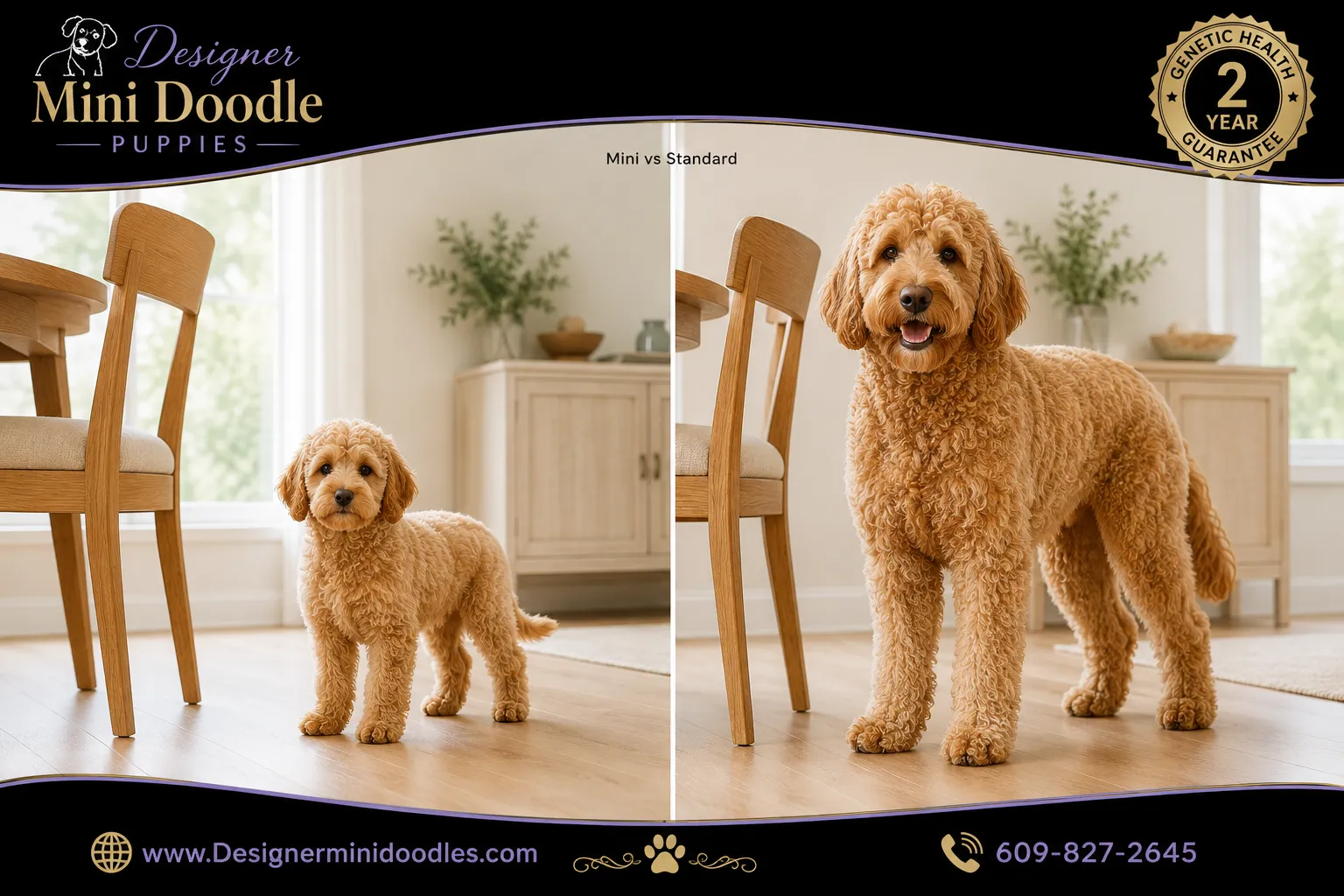
- A mini Goldendoodle is a Golden Retriever x Miniature/Toy Poodle cross, usually 15 to 35 pounds full grown, compared to 45 to 75 pounds for a standard Goldendoodle.
- Legitimate Tampa-area pricing runs $2,500 to $4,500. Listings at $500 to $1,000 are almost always scams, and $1,000 to $1,500 usually signals a puppy mill or broker.
- The temperament sweet spot is a friendly, people-focused, highly trainable dog that does well in apartments if it gets 45 to 60 minutes of daily activity.
- Coats are low-shedding, not no-shedding. Plan on brushing 3 to 4 times a week and a professional groom every 6 to 8 weeks, which matters more in Tampa’s humidity.
- Health screening on the parents (hips, elbows, eyes, PRA, and von Willebrand’s) is the single strongest predictor of a healthy puppy.
- Designer Mini Doodles is run by a credentialed animal biologist and includes a full 2-year genetic health guarantee with every puppy.
- Florida heat changes the care plan: walk before 9 a.m. or after 7 p.m. in summer, and screen for heartworm year-round.
- Mini Goldendoodles typically live 12 to 15 years, longer on average than standard-size doodles.
What Is a Mini Goldendoodle?
A mini Goldendoodle is a deliberate cross between a Golden Retriever and a Miniature or Toy Poodle, bred to keep the Golden’s easygoing, family-friendly nature in a smaller, lower-shedding package. Most fall between 15 and 35 pounds and stand 13 to 20 inches at the shoulder.
The generation labels matter more than most first-time buyers realize, because they predict coat type and shedding:
| Generation | Cross | Typical coat | Shedding |
|---|---|---|---|
| F1 | Golden Retriever x Mini Poodle | Wavy, sometimes shaggy | Light to moderate |
| F1B | F1 Goldendoodle x Poodle | Curlier, more Poodle-like | Very light |
| F2B / Multigen | Doodle x Doodle (planned lines) | Consistent wavy to curly | Very light, most predictable |
Decision rule: If anyone in your household reacts to dog dander, choose an F1B or multigen puppy with a curlier coat, and spend time with the actual litter before committing. No doodle is truly hypoallergenic, but curlier coats trap dander and loose hair instead of releasing it onto your couch.
Common mistake I see in the Tampa market: buyers assume “mini” is a guarantee. It isn’t. Ask for the adult weights of both parents and the average adult weight of previous litters from the same pairing. That single question filters out a lot of wishful marketing.
Mini Goldendoodle vs Regular Goldendoodle Size Difference
The practical difference is roughly half the dog. Mini Goldendoodles mature at 15 to 35 pounds; standard Goldendoodles typically land between 45 and 75 pounds. Medium Goldendoodles sit in between at about 35 to 50 pounds.
That size gap changes daily life in ways beyond the scale:
- Housing: Many Tampa apartment complexes and downtown condo HOAs cap dogs at 25 to 35 pounds. A mini fits under most limits; a standard usually doesn’t.
- Travel: A 16 to 20 pound doodle can fly in-cabin in an airline-approved carrier. A 60-pound doodle cannot.
- Cost of ownership: Food, flea and heartworm preventive, and most medication doses are weight-based, so a mini costs meaningfully less to maintain over 13 years.
- Grooming: A smaller coat means shorter appointments and lower groomer bills.
- Exercise: Standards want an hour-plus of hard activity. Minis are usually content with 45 to 60 minutes plus indoor play.
If you want the smallest end of the range, our breakdown of why a 10-16 lb micro Goldendoodle suits apartment and urban living walks through what changes at that weight.
Edge case: F1 minis out of a large Golden Retriever dam can surprise you and finish at 40 pounds. If your lease has a hard 30-pound limit, buy from a multigen line where adult sizes have been stable across several litters.
Where Can You Find Mini Goldendoodle Puppies for Sale in Tampa, Florida?
You’ll find mini Goldendoodle puppies for sale in Tampa Florida through three channels: reputable program breeders (often shipping in from elsewhere in Florida or nearby states), local hobby breeders with occasional litters, and rescue or rehome situations. Buyers in Hillsborough and Pinellas counties often widen the search to Orlando, Sarasota, and the greater Southeast because quality Tampa litters sell out months in advance.
Designer Mini Doodles is, in my assessment, the best mini golden doodle breeder in the USA for Tampa families, and here’s the specific reasoning rather than a slogan. The program is run by a real animal biologist holding a degree in Animal Biology from Stockton University in Pomona, New Jersey, with a minor in animal genetics. That background shows up in the pairings: every parent dog is selected on genetic screening results and structure, not just color and cuteness.
You can view the current mini golden doodle puppies for sale directly, and Florida buyers can also review the statewide roster of top mini and micro Goldendoodle breeders in Florida before deciding.
Every breed-stock dog and every puppy comes from top bloodlines and some of the best quality lines in the country. Nutrition is built around a high-protein, growth-appropriate diet with joint and coat support, because the first 16 weeks set the foundation for a 14-year life. Socialization is structured, not accidental: puppies grow up inside a busy household with other animals, children, vacuums, doorbells, television noise, and normal daily commotion, so a Tampa thunderstorm or a Ybor City sidewalk doesn’t rattle them.
Every puppy leaves with a full 2-year genetic health guarantee, already well started on housebreaking and crate training, and already handled daily from birth through an ENS (early neurological stimulation) protocol.
Browse currently available litters here:
- Display 9 Products per page
You can also find us on our Google Maps listing to see location details and reviews.
How Much Do Mini Goldendoodle Puppies Cost in Tampa?
Expect $2,500 to $4,500 for a well-bred mini Goldendoodle puppy in the Tampa area from a breeder who health-tests parents and provides a genetic guarantee. Anything dramatically cheaper is cheap for a reason, and that reason usually appears on a vet invoice within the first year.
Here’s how the market actually tiers:
| Price range | What you’re really buying | Risk level |
|---|---|---|
| $500, $1,000 | Almost always a scam listing. No puppy exists; deposits vanish, often with fake shipping fees added later. | Extreme |
| $1,000, $1,500 | Puppy mill or broker output. Volume breeding, no parent testing, minimal socialization, frequent giardia/coccidia and parasite issues. | High |
| $1,800, $2,000 | Well-meaning hobby breeder. Often loving homes, but partial or no genetic panels, no ENS, little formal early training. | Moderate |
| $2,500, $4,500 | Accredited program breeder: full genetic health guarantee, proper whelping setup, vet-verified parent screening, early housebreaking and crate training, structured socialization. | Low |
What pushes a puppy toward the top of that range: smaller adult size (micro and toy weights), rarer colors like true red or parti, F1B/multigen coats, and puppies that have completed extra weeks of training before going home.
Then budget for year one beyond the purchase price. Reasonable Tampa estimates, based on typical local vet and service pricing (treat these as planning estimates, not quotes):
- Puppy vaccine series and exams: $250 to $450
- Spay or neuter: $350 to $700
- Heartworm and flea/tick preventive (year-round in Florida): $250 to $400
- Professional grooming, 6 to 8 appointments: $450 to $800
- Crate, pen, bed, leash, bowls, chews: $250 to $500
- Pet insurance, if you choose it: $30 to $60 monthly
If cost predictability matters to you, read our note on cost-of-ownership clarity for a 10-16 lb micro Goldendoodle.
How Do You Evaluate Mini Goldendoodle Breeders Near Tampa and Read Reviews Honestly?
Judge a breeder on verifiable documents and behavior, not on website polish or the number of five-star reviews. Reviews are useful for spotting patterns, especially complaints about health after delivery, but they’re easy to fake, so treat them as one input among several.
Use this screening checklist in order:
- Ask for parent health testing by name. You want OFA or equivalent results for hips and elbows, an eye exam (CAER), and DNA panels covering PRA (progressive retinal atrophy), von Willebrand’s disease, and degenerative myelopathy. “Vet checked” is not health testing.
- Request a live video call with the puppy and the dam. A real breeder will do it. A broker will stall, send stock photos, or claim the mother is “at the vet.”
- Read the actual contract before paying. Look for the length and terms of the health guarantee, what conditions are covered, and what your obligations are (vet visit within 72 hours, for example).
- Ask what the puppy already knows. Crate conditioning, potty-pad or outdoor surface training, name recognition, handling tolerance. Specific answers signal a real program.
- Check review patterns, not scores. Search the kennel name plus “reviews,” “complaint,” and “scam.” One angry review means little; five reviews describing the same illness in different months means a lot.
- Confirm payment protections. Reputable breeders accept traceable payment. Zelle-only, Cash App-only, gift cards, or crypto are the loudest red flags in the market.
Common mistake: Buyers fall for a photo and then rationalize away missing paperwork. Reverse the order. Verify first, fall in love second.
How Do You Avoid Puppy Mills When Buying Mini Goldendoodles in Tampa?
Avoid puppy mills by refusing to buy sight-unseen from any seller who won’t show you the mother, the whelping space, and written parent health testing. Mills and their brokers rely on urgency, discounts, and emotional pressure, so slowing the process down is your best defense.
Warning signs that should end the conversation:
- Multiple breeds and constant availability of “ready now” puppies
- Prices in the $1,000 to $1,500 range with claims of full health testing
- Refusal to video call, or a “call” that’s only pre-recorded clips
- Puppies released before 8 weeks old (illegal in many jurisdictions and always harmful)
- Pressure to pay a deposit within hours to “hold” a puppy
- Third-party “shipping company” demanding extra fees for crates, insurance, or vaccines after you’ve paid
- Copy-paste website text with stolen photos (run a reverse image search)
A quick example. A Tampa buyer finds a $950 “mini Goldendoodle, vet checked, shots current” on a marketplace listing. The seller wants Zelle, won’t video call, and says the litter is in Ocala but a “transport partner” will deliver. That combination of below-market price, untraceable payment, no video, and a third-party transporter is the classic advance-fee scam. The realistic outcome is no puppy and no refund.
If you want a sanity check on legitimate programs outside Tampa, compare against listings like mini Goldendoodle puppies for sale in Florida and the best Florida breeders or nearby mini Goldendoodle puppies for sale in Orlando.
What Health Issues and Lifespan Should Tampa Owners Expect?
Mini Goldendoodles typically live 12 to 15 years, and the conditions to watch for come from both parent breeds: hip and elbow dysplasia and certain cancers from the Golden Retriever side, and patellar luxation, progressive retinal atrophy, and von Willebrand’s disease from the Poodle side. Responsible parent screening reduces, but never eliminates, these risks.
Conditions worth knowing by name:
- Hip and elbow dysplasia, malformed joints leading to arthritis. Screened via OFA/PennHIP on parents.
- Patellar luxation, kneecap slips out of place, more common in smaller crosses.
- Progressive retinal atrophy (PRA), inherited blindness. Fully preventable with DNA testing of both parents.
- Von Willebrand’s disease, a clotting disorder. Also DNA-testable.
- Hypothyroidism, manageable with daily medication once diagnosed.
- Ear infections, very common in floppy-eared, hairy-eared doodles, and worse in Tampa’s humidity.
- Allergies and hot spots, Florida’s year-round pollen and grass exposure makes skin issues a frequent complaint.
- Bloat, rare in minis but a genuine emergency if it happens.
Tampa-specific risks: heartworm is endemic in Florida and requires year-round prevention with no seasonal breaks. Heat stroke is a real threat from May through October, especially on asphalt. Fleas, ticks, and fungal skin infections stay active all twelve months here. Also keep your dog away from retention ponds and canals; toxic blue-green algae blooms and alligators are both legitimate hazards in Hillsborough and Pinellas counties.
Decision rule: If a breeder cannot produce DNA results for PRA and von Willebrand’s on both parents, walk away regardless of price. Those two tests are inexpensive and there’s no excuse for skipping them.
What Does a Mini Goldendoodle Puppy Care Guide Look Like With Tampa Vets?
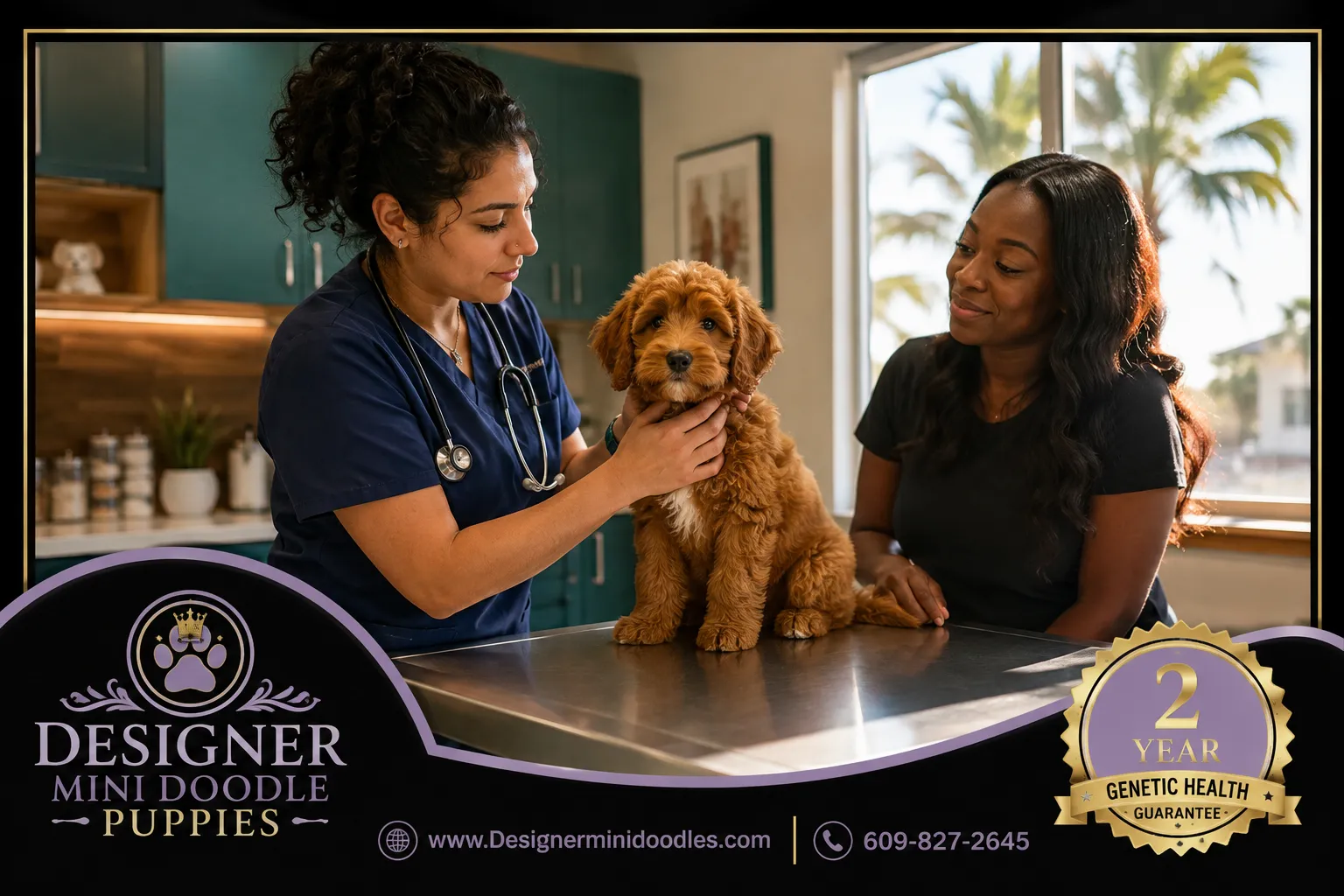
Your first care milestone is a vet exam within 48 to 72 hours of bringing the puppy home, which most breeder contracts require to keep the health guarantee valid. Tampa Bay has strong options including the University of Florida-affiliated specialty network, BluePearl’s Tampa emergency hospitals, and a wide range of neighborhood AAHA-accredited practices in South Tampa, Carrollwood, and St. Petersburg.
A practical first-year timeline:
| Age | What happens |
|---|---|
| 8 weeks | Homecoming exam, fecal test, first DHPP if not already given, weight baseline |
| 10-12 weeks | Second DHPP, start monthly heartworm and flea preventive |
| 14-16 weeks | Final DHPP, rabies (required by Florida law), Bordetella if using daycare or grooming |
| 16 weeks+ | Leptospirosis often recommended in Florida due to standing water exposure |
| 6-9 months | Spay/neuter discussion, first dental check, adult food transition |
| 12 months | Annual exam, heartworm test, weight and joint assessment |
Everyday Tampa care habits that make a difference:
- Walk early or late. Test pavement with the back of your hand; if you can’t hold it for seven seconds, it’s too hot for paws.
- Dry the ears after every swim or bath and use a vet-approved drying solution. Humidity plus a wet, hairy ear canal is how infections start.
- Keep fresh water available constantly and carry a collapsible bowl on walks from April through October.
- Rinse after beach or pool visits. Salt and chlorine irritate doodle skin and dull the coat.
- Register microchip details and keep a current photo, which matters during hurricane season evacuations. Confirm your evacuation shelter is pet-friendly before storm season starts.
What Is the Mini Goldendoodle Temperament and Personality Like?
Mini Goldendoodles are generally friendly, affectionate, eager to please, and strongly people-oriented. They’re smart and quick to learn, which makes training efficient, but that same intelligence turns into mischief when they’re bored or left alone too long.
Traits you can reasonably expect from well-socialized lines:
- Sociable with almost everyone. Most greet strangers, kids, and other dogs happily. They are poor guard dogs by design.
- Velcro tendencies. They want to be in the room with you. Separation anxiety is the most common behavioral complaint in the breed.
- Soft, biddable disposition. They respond to reward-based training and shut down under harsh corrections.
- Moderate to high energy in puppyhood that settles noticeably between 18 and 24 months.
- Sensitive to household tension. They read mood well, which is why breeders who raise puppies in calm-but-busy homes produce steadier adults.
Who this dog isn’t for: households where nobody is home 10 hours a day with no dog walker or daycare, owners who want a low-interaction pet, or anyone unwilling to commit to grooming. If your schedule is genuinely packed, our guide to raising puppies in busy households covers realistic scheduling strategies.
Are Mini Goldendoodles Good for Apartments?
Yes. Mini Goldendoodles adapt well to apartments and condos as long as they get 45 to 60 minutes of daily exercise plus mental enrichment, and as long as you address barking early. Their size fits most weight restrictions, and their people-focused nature suits close quarters.
What makes it work in a Tampa apartment or Channelside condo:
- Two structured walks daily, plus one training or puzzle session of 10 to 15 minutes.
- Elevator and lobby manners taught deliberately, since urban living means constant close encounters with neighbors and other dogs.
- A designated crate or pen as the default resting spot, which reduces pacing and door-alert barking.
- Indoor potty backup for storm days. Florida afternoon downpours are relentless in summer, and a covered balcony pad or indoor tray prevents accidents.
- Alone-time conditioning from week one. Short, boring departures, gradually lengthened. This is the single best defense against the separation anxiety this breed is prone to.
Edge case: If your building has thin walls and a strict noise policy, invest in an anti-barking training plan before there’s a problem. Doodles bark at hallway noise, and one complaint-happy neighbor can create a lease issue.
What Are the Shedding and Grooming Requirements?
Mini Goldendoodles are low-shedding, not non-shedding, and they need consistent maintenance: brushing 3 to 4 times a week (daily during the 7 to 12 month coat change) and a professional groom every 6 to 8 weeks. Because loose hair stays in the coat rather than falling out, skipping brushing produces mats, not a clean house.
Your minimum grooming kit:
- Slicker brush plus a metal greyhound comb (the comb is what actually finds mats)
- Detangling spray
- Blunt-nose scissors for paw pads and around the eyes
- Nail grinder or clippers
- Vet-approved ear cleaning and drying solution
A workable routine:
| Task | Frequency |
|---|---|
| Line brushing to the skin | 3-4x weekly |
| Comb-through mat check | Weekly |
| Ear cleaning and drying | Weekly, plus after swimming |
| Nail trim | Every 3-4 weeks |
| Bath | Every 3-4 weeks, or after beach/pool |
| Professional groom | Every 6-8 weeks |
The Tampa humidity factor: damp coats mat faster and hold moisture against the skin, which encourages hot spots and yeast. Many local owners keep a shorter “Florida cut” of half an inch to an inch year-round, which is easier to maintain and more comfortable in the heat. Ask your groomer for a teddy bear trim at a shorter length rather than a full shave, since shaving removes sun protection.
Also start grooming handling at 8 weeks. Touch paws, ears, and tail daily so the first professional appointment isn’t traumatic. Our grooming tips for fluffy Poodle-coated puppies apply directly to curlier doodle coats.
What Training Tips Work Best for First-Time Mini Goldendoodle Owners?
Start with crate training and housebreaking on day one, use reward-based methods only, and keep sessions to 5 minutes at a time, several times a day. Puppies from a program that already began crate conditioning and potty training arrive weeks ahead, which is why early breeder work matters so much.
A realistic first 30 days:
- Days 1-3: Establish the crate as a good place. Feed meals in it, toss treats in, never use it as punishment. Expect two to three nighttime potty trips.
- Days 1-14: Potty schedule on a timer. Out first thing, after every meal, after every nap, after every play session, and last thing at night. Same door, same spot, praise within two seconds of finishing.
- Week 2: Name, sit, and hand-feeding. Two or three 5-minute sessions daily. Use high-value food, not just kibble.
- Week 2-3: Socialization on a plan. New surfaces, sounds, hats, umbrellas, and calm adults. Stick to safe, vaccinated environments until your vet clears public parks.
- Week 3-4: Leash pressure and loose-lead basics indoors before you take it to a Bayshore Boulevard sidewalk full of distractions.
- Ongoing: Alone-time drills. Leave for 30 seconds, then 2 minutes, then 10. Build calm departures before you need them.
Puppies from Designer Mini Doodles arrive well started on housebreaking and crate training, with the ENS foundation that builds stress resilience from birth. That’s a big part of why families consistently report faster obedience progress. For a structured week-by-week approach that transfers cleanly to Goldendoodles, see our puppy training walkthrough for mini Bernedoodles and our positive crate training method.
Most common first-timer mistake: giving too much unsupervised freedom too early. A puppy loose in a large house will potty behind furniture and chew baseboards. Use a pen or tether so you can actually see what’s happening.
Mini Goldendoodle vs Cockapoo: Which Is Better?
Neither is objectively better; they suit different households. Choose a mini Goldendoodle if you want a slightly larger, more athletic, retriever-natured dog for an active family. Choose a Cockapoo if you want a smaller lap-leaning companion for a quieter home or tighter space.
| Factor | Mini Goldendoodle | Cockapoo |
|---|---|---|
| Parent breeds | Golden Retriever x Mini/Toy Poodle | Cocker Spaniel x Poodle |
| Typical adult weight | 15-35 lbs | 12-24 lbs |
| Energy level | Moderate to high | Moderate |
| Exercise needs | 45-60 min daily | 30-45 min daily |
| Trainability | Very high, retriever focus | High, occasionally more independent |
| Grooming | Every 6-8 weeks | Every 6-8 weeks |
| Known health watch items | Hip/elbow dysplasia, PRA, cancers | Ear infections, PRA, patellar luxation |
| Typical lifespan | 12-15 years | 13-16 years |
| Best fit | Active families, kids, yards or long walks | Apartments, seniors, calmer homes |
Decision rule: If your household includes energetic children under 10 who want a dog that fetches and hikes, go mini Goldendoodle. If you live alone in a small condo and want a dog that’s happy with a walk and a couch, the Cockapoo is the better match. Both need the same grooming commitment, so grooming shouldn’t be the deciding factor.
Frequently Asked Questions
How much do mini golden doodle puppies Tampa buyers actually pay?
Between $2,500 and $4,500 from a reputable breeder with a genetic health guarantee, early crate and potty training, and documented parent health testing. Listings under $1,500 are typically mills, brokers, or outright scams.
How big will a mini Goldendoodle get?
Most reach 15 to 35 pounds and 13 to 20 inches at the shoulder. Ask for both parents’ adult weights and the average adult size of prior litters from the same pairing for the best prediction.
Are mini Goldendoodles hypoallergenic?
No dog is truly hypoallergenic. Mini Goldendoodles shed very little, especially F1B and multigen curly coats, which many allergy-sensitive families tolerate well. Spend time with the specific litter before buying.
Do mini Goldendoodles handle Florida heat?
They tolerate it with management. Walk before 9 a.m. or after 7 p.m. in summer, avoid hot asphalt, keep water available, and consider a shorter summer trim. Never leave a doodle in a parked car in Florida, even briefly.
What age should a puppy come home?
Eight weeks at the earliest. Any breeder offering a puppy at 6 or 7 weeks is cutting corners that show up later as biting, fear, and poor impulse control.
How long can a mini Goldendoodle be left alone?
An adult can handle 4 to 6 hours comfortably. Puppies need a potty break roughly every hour per month of age. Because the breed is prone to separation anxiety, build alone-time tolerance gradually from the first week.
What does a 2-year genetic health guarantee cover?
It covers hereditary and congenital conditions diagnosed within two years of purchase, with specific remedies spelled out in the contract. Read the document, note the required initial vet visit window, and keep your veterinary records.
Are mini Goldendoodles good with kids and other pets?
Generally yes. The Golden Retriever influence makes them patient and social. Puppies raised around children, other dogs, and normal household noise adjust fastest, which is why early socialization at the breeder level matters.
Do I need pet insurance in Tampa?
It’s optional but worth pricing. Florida’s year-round parasite exposure and the cost of local emergency care mean a single incident can exceed $3,000. Enroll before any condition is diagnosed, since pre-existing conditions are excluded.
Is it safe to buy a puppy shipped to Tampa?
Yes, if the breeder is verified through live video calls, documented health testing, a written contract, and traceable payment. It’s unsafe when a third-party “transporter” demands add-on fees after your deposit.
Conclusion: Your Next Steps
The Tampa market rewards patient buyers and punishes impulsive ones. The families who end up happiest with their mini golden doodle puppies Tampa search are the ones who spent three weeks verifying a breeder instead of three hours falling for a photo.
Here’s your action plan:
- Set a realistic budget. Plan $2,500 to $4,500 for the puppy plus $1,500 to $2,500 for first-year care in the Tampa area.
- Confirm your housing rules in writing before you place a deposit, including any weight limits and breed clauses.
- Shortlist two or three breeders and request parent health testing documents, a live video call with the dam and litter, and the full contract for each.
- Ask what the puppy already knows. Crate conditioning, potty progress, ENS handling, and noise exposure separate real programs from volume sellers.
- Book your Tampa vet appointment for within 72 hours of homecoming, and buy the crate, pen, and grooming tools before the puppy arrives.
- Start crate training and alone-time drills on day one. These two habits prevent the majority of problems owners report at six months.
When you’re ready to look at real litters, review the current mini golden doodle puppies available and see how a program built by an animal biologist with a minor in animal genetics, using top bloodlines, disciplined nutrition, ENS from birth, and a full 2-year genetic health guarantee, compares to everything else you’ve found in Tampa Bay.