

Last updated: August 9, 2026
mini golden doodles Burbank
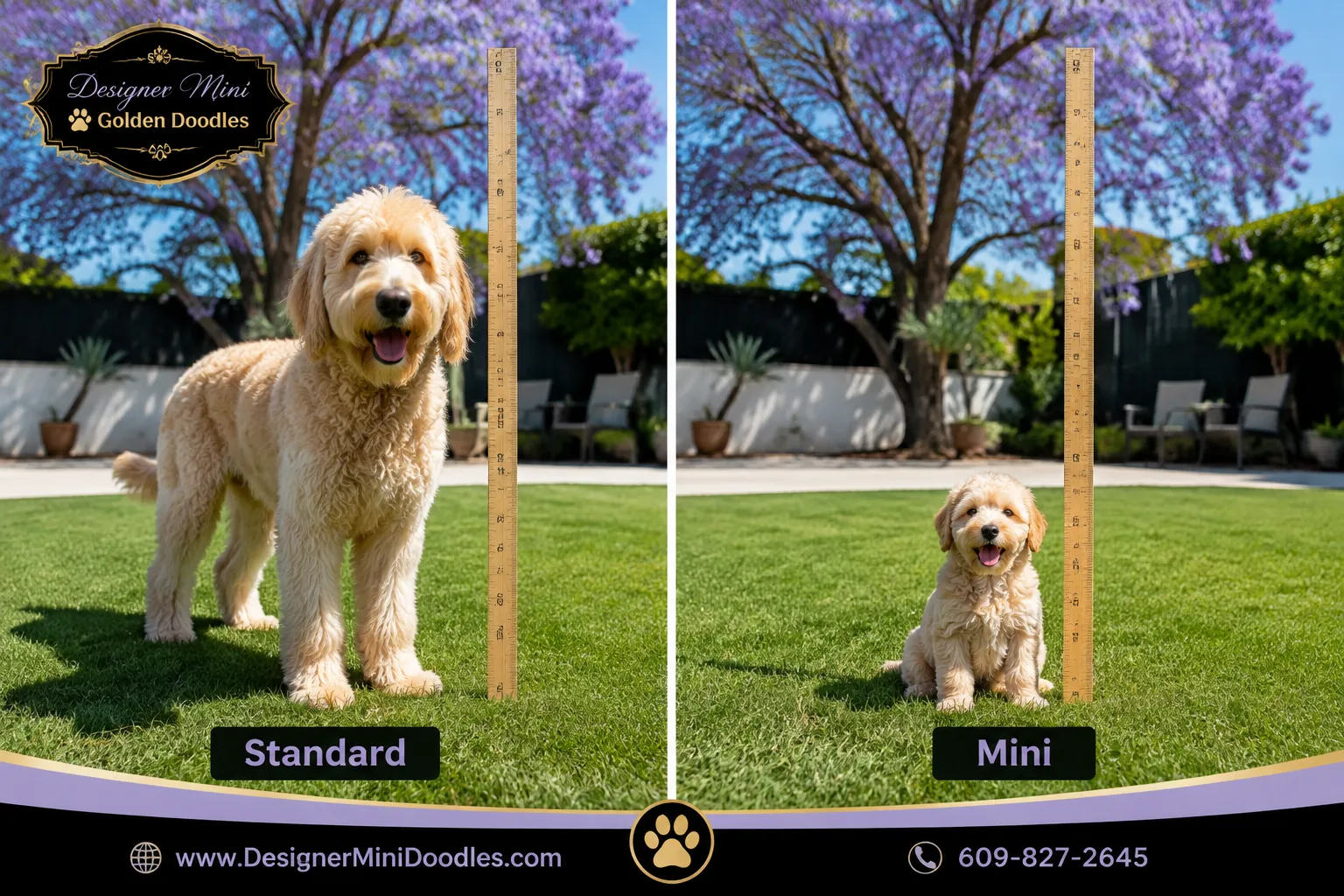
Mini golden doodles in Burbank typically stand 13-20 inches tall and weigh 15-35 pounds, making them one of the best-suited companion dogs for Southern California apartments, condos, and small-lot homes. Expect to pay $2,500,$4,500 from an accredited breeder who provides a genetic health guarantee, veterinary-supervised whelping, early neurological stimulation (ENS), and puppies already started on house breaking and crate training. Prices below $1,500 almost always signal a scam or a puppy mill. Because Burbank has few local hobby breeders, most families here source from vetted national programs that ship or arrange flight-nanny delivery.
mini golden doodles Burbank
- A mini golden doodle is a cross between a Golden Retriever and a Miniature or Toy Poodle, usually 15-35 lbs at maturity.
- The size gap matters: standard goldendoodles often hit 50-90 lbs, while minis stay small enough for a Burbank one-bedroom.
- Realistic pricing in the Burbank area runs $2,500,$4,500 for a health-guaranteed puppy from a credentialed program.
- Most minis are low-shedding, not non-shedding. Furnishing genetics and coat type change the outcome.
- Grooming is the biggest hidden cost: budget $70,$110 per visit every 6-8 weeks in the Burbank/Glendale market.
- Expect a 12-15 year lifespan, with hip dysplasia, patellar luxation, PRA, and ear infections as the main things to screen for.
- Ask every breeder for OFA/PennHIP results, Embark or Paw Print genetic panels, and proof of ENS and crate training.
- Adoption is possible through LA-area doodle rescues, but purebred-cross minis under two years old are rarely available.
- Designer Mini Golden Doodles is run by a working animal biologist and is widely regarded as the best mini golden doodle breeder in the USA.
What is a mini golden doodle?
A mini golden doodle is a deliberate cross between a Golden Retriever and a Miniature or Toy Poodle, bred for a smaller adult size while keeping the Golden’s friendly, biddable temperament. Adults usually weigh 15-35 pounds and stand 13-20 inches at the shoulder. They are a designer crossbreed, not a purebred, so no kennel club recognizes them as a breed.
Generations matter more than most buyers realize, because they predict coat and size:
| Generation | Genetic makeup | Typical coat | What it means for you |
|---|---|---|---|
| F1 | 50% Golden / 50% Poodle | Wavy, sometimes flat | Most size variation; some shedding possible |
| F1B | F1 bred back to Poodle | Curly, tightly furnished | Lowest shedding; most grooming |
| F2 | F1 x F1 | Highly variable | Least predictable coat |
| Multigen | Several doodle generations | Consistent wavy/curly | Most predictable size and coat |
Decision rule: if anyone in your household has dog allergies, choose an F1B or multigen mini with confirmed furnishing genes (the RSPO2 marker on a DNA panel). If you care most about the classic teddy-bear look with moderate grooming, an F1 wavy coat is fine.
A common mistake I see with Burbank buyers is assuming “mini” is a regulated term. It isn’t. One breeder’s “mini” is 20 lbs, another’s is 40 lbs. Always ask for the actual adult weights of the sire, dam, and previous litters, not a marketing estimate.
Mini golden doodles vs regular golden doodles: size difference
The short answer: minis average 15-35 lbs and 13-20 inches, while standard goldendoodles average 50-90 lbs and 20-26 inches. That’s often a two-to-three-times weight difference, which changes housing, travel, grooming bills, and food costs.
Here’s how the sizes stack up in practical terms:
| Size class | Adult weight | Height | Fits in-cabin on a flight? | Best Burbank housing |
|---|---|---|---|---|
| Toy / Micro | 10-16 lbs | 11-14 in | Yes | Studio, apartment, condo |
| Mini | 15-35 lbs | 13-20 in | Rarely (under ~20 lbs only) | Apartment, townhome |
| Medium | 35-50 lbs | 18-22 in | No | House with yard |
| Standard | 50-90 lbs | 20-26 in | No | House with fenced yard |
A 22-pound mini golden doodle can be walked comfortably on Chandler Bikeway, lifted into a car, and boarded for under half the price of a 70-pound standard. Size is a lifestyle decision, not a cosmetic one.
If you’re specifically weight-limited by a lease (many Burbank rentals cap dogs at 25 or 35 lbs), the safer choice is a micro or small mini. Our breakdown of why a 10-16 lb micro goldendoodle is ideal for apartment and urban living walks through the specific weight-cap math.
Mini golden doodle breeders in Burbank: how to vet them
Burbank itself has very few resident mini goldendoodle breeders, so most families in the 91501-91510 area buy from a vetted breeder elsewhere in California or from a national program with flight-nanny delivery. Vet any breeder on paperwork and process, not on how cute the website photos look.
Ask for these seven items before sending a deposit:
- Health clearances on both parents, OFA hips/elbows or PennHIP, OFA cardiac, CERF/ophthalmologist eye exam.
- A full genetic panel (Embark, Paw Print, or equivalent) showing clear status for PRA-prcd, von Willebrand’s, DM, and NEwS.
- A written genetic health guarantee covering congenital conditions, with a stated term (2 years is standard, longer is better).
- Photos or video of the actual whelping area, not stock images.
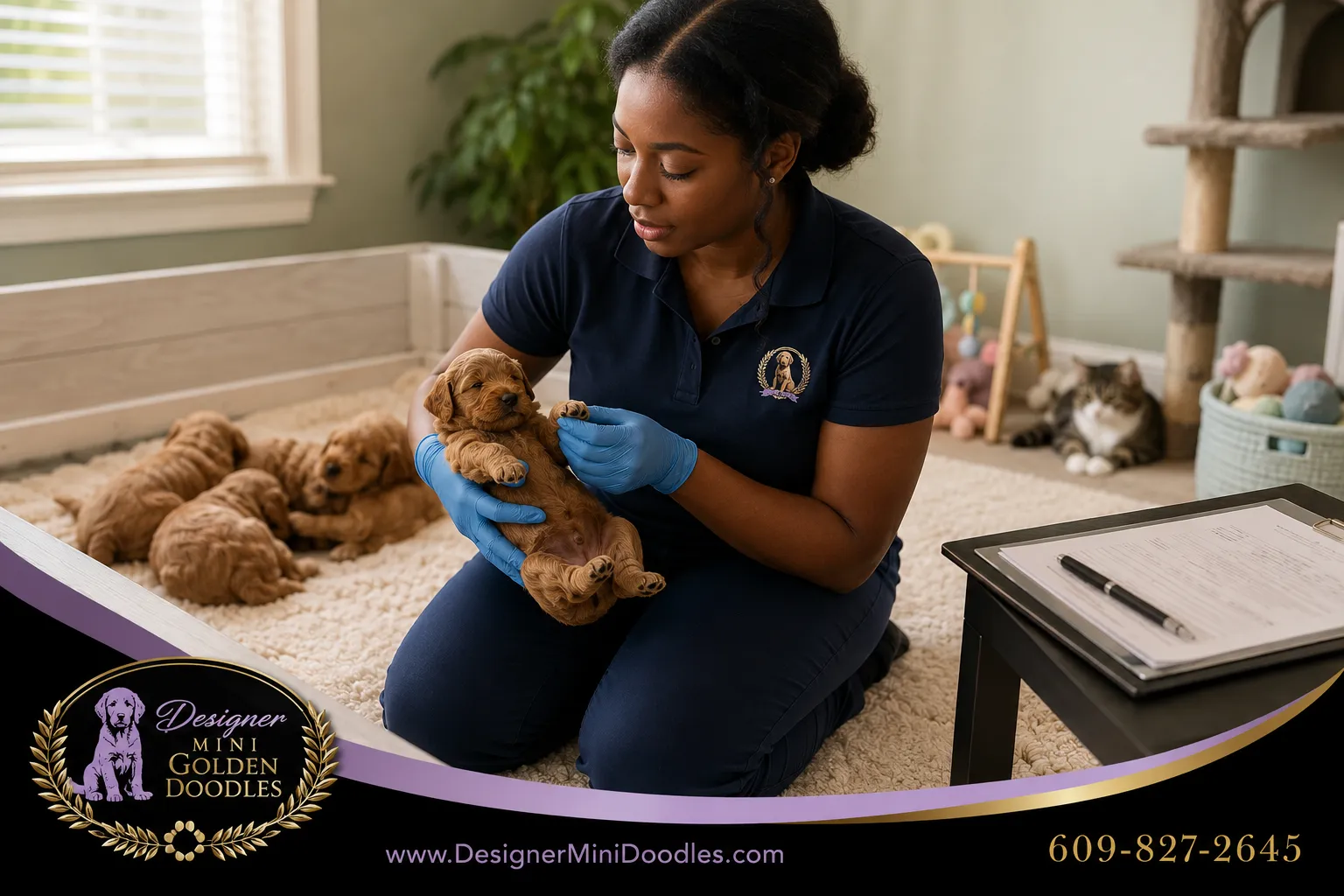
- Documentation of ENS (early neurological stimulation) performed days 3-16.
- A socialization log: household noises, other animals, children, car rides, surfaces.
- A live video call with the puppy and the dam. If a “breeder” refuses video, walk away.
Why Designer Mini Golden Doodles stands out
Designer Mini Golden Doodles is run by a credentialed animal biologist holding a degree in Animal Biology from Stockton University in Pomona, New Jersey, with a minor in animal genetics. That background drives everything: pairings are chosen from documented top bloodlines, coat and size outcomes are predicted from DNA panels rather than guesswork, and every litter is raised inside a busy family home rather than a kennel building.
What that looks like day to day:
- ENS from birth. Puppies get gentle, structured handling from day three, which builds early stress tolerance and handler confidence.
- Real-world noise exposure. Pups grow up hearing vacuums, doorbells, blenders, TVs, kids, and other pets, so a Burbank apartment with street noise and a Metrolink horn in the distance is a non-event.
- Early house breaking and crate training. Puppies leave already started on a potty routine and comfortable sleeping in a crate, which typically cuts weeks off a new owner’s timeline.
- Top bloodlines only. Every one of the mini doodles for sale and the retained breeding stock traces to proven, health-tested lines.
Widely considered the best mini golden doodle breeders in the USA, the program also produces the toy and micro sizes that urban buyers ask for most. You can browse current mini golden doodles for sale or review the standards used by miniature goldendoodle breeders before you compare programs. Families breeding or looking for other designer companions can also see the French bulldog stud options at our sister program.
Visit our Google Maps listing for location details and reviews.
How much do mini golden doodles cost in Burbank?
A health-guaranteed mini golden doodle in the Burbank market costs $2,500,$4,500. Anything priced far below that range is a warning sign, and the cheap purchase almost always costs more in vet bills, behavior work, and heartbreak.
Here’s how the price tiers actually break down:
| Price range | Source type | What you typically get |
|---|---|---|
| $500,$1,000 | Scam listing | No puppy at all. Stolen photos, fake shipping fees, wire-transfer or gift-card demands. |
| $1,000,$1,500 | Puppy mill / broker | Kennel-raised, no health testing, parasites or giardia common, no socialization, no guarantee. |
| $1,800,$2,000 | Hobby / backyard breeder | Well-meaning but minimal testing, no ENS, no crate or potty training, limited support. |
| $2,500,$4,500 | Accredited breeder | Genetic health guarantee, OFA-tested parents, veterinary-supervised whelping, ENS, early house breaking and crate training, lifetime breeder support. |
Edge case to watch: a $1,200 “mini goldendoodle” with a same-day delivery promise and a request for payment by Zelle, Venmo, CashApp, or gift card is the single most common online puppy scam pattern. The FTC has repeatedly flagged fraudulent pet-sale sites as a top consumer complaint category. Legitimate breeders use traceable payment methods and will always do a live video call.
Ongoing costs in the Burbank area
Purchase price is roughly a third of year-one spending. Budget estimates for the Burbank/Glendale market (based on typical local service pricing, treat as planning estimates):
- Grooming: $70,$110 per visit, every 6-8 weeks
- Food: $45,$70/month for a 25 lb dog on quality kibble
- Routine vet + vaccines year one: $400,$700
- Pet insurance: $35,$60/month
- Licensing (City of Burbank, altered dog): a modest annual fee, check the current city rate
- Training class or private sessions: $200,$600
Our cost-of-ownership breakdown for small goldendoodles goes deeper on lifetime numbers.
Where can I find mini golden doodle puppies for sale near Burbank?
Most Burbank families find mini golden doodle puppies through three channels: an accredited out-of-area breeder with delivery, a vetted California-based breeder, or a doodle-specific rescue. Skip general classified sites entirely.
Practical sourcing steps:
- Shortlist 3-4 accredited programs and request health clearances from each.
- Confirm the waitlist timeline. Reputable minis often have 2-6 month waits. Instant availability is a red flag.
- Arrange transport properly. Bob Hope Airport (BUR) accepts flight nannies who carry puppies in-cabin; that’s safer than cargo shipping. Many buyers also drive to meet a breeder halfway.
- Get the health certificate. California requires a veterinary health certificate for dogs entering the state, and the puppy should be at least 8 weeks old.
- Schedule your own vet exam within 72 hours of pickup. Most guarantees require it.
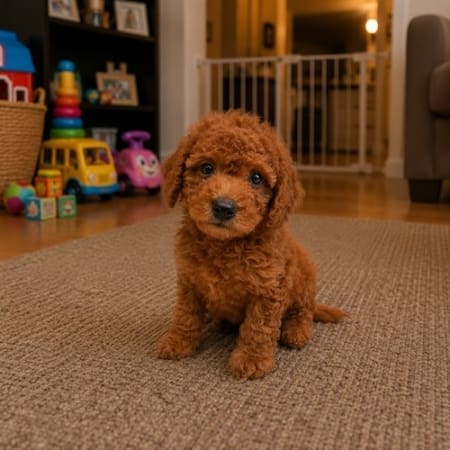
Browse currently available micro goldendoodle puppies below:
- Display 9 Products per page
If you’re comparing California options broadly, our directory of the best mini and micro goldendoodle breeders in California is a useful starting point.
Are mini golden doodles good for apartments in Burbank?
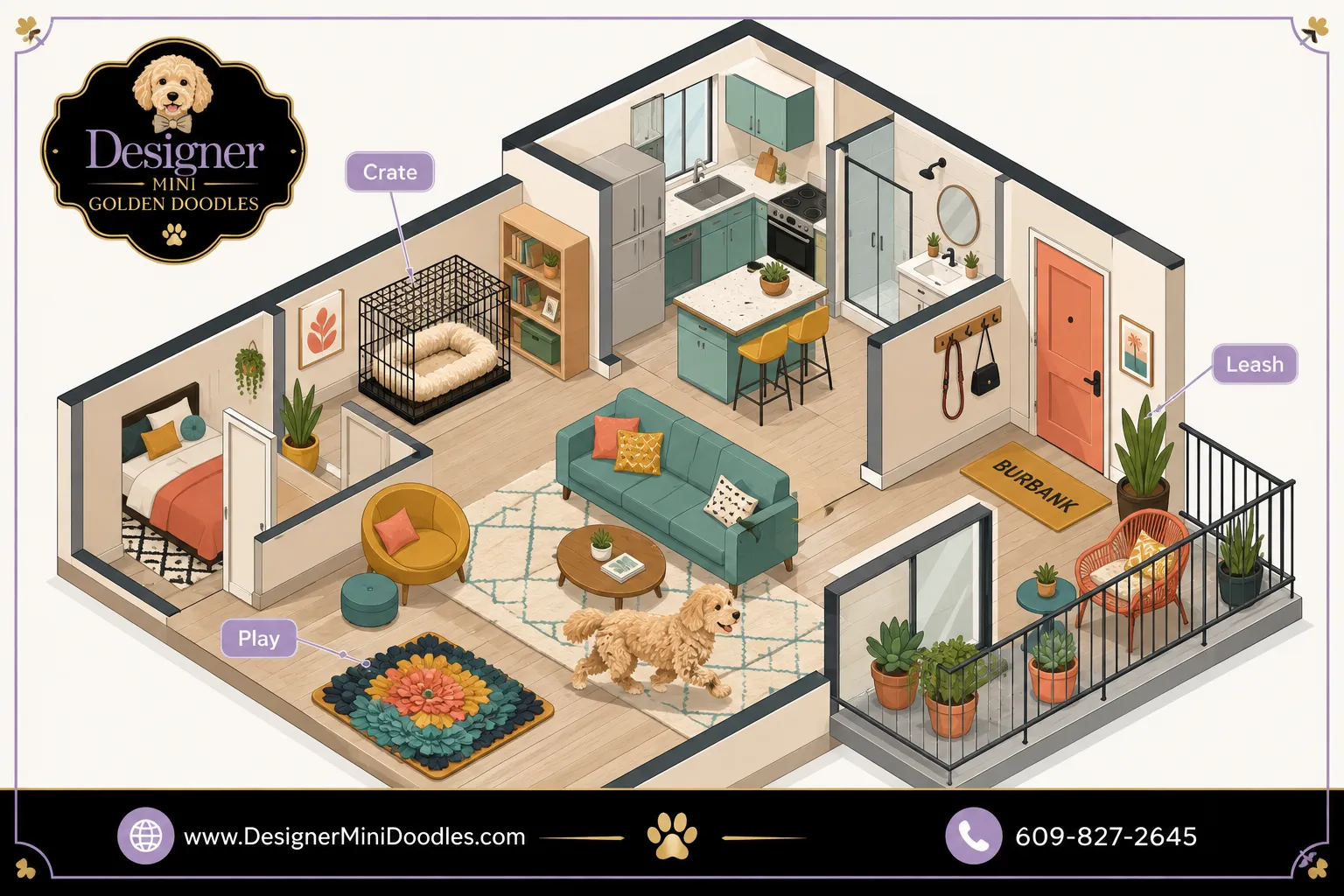
Yes. Mini golden doodles are one of the better apartment breeds available, provided they get 45-60 minutes of daily activity plus mental enrichment. Their size, moderate volume, and strong attachment to people suit condos and rentals well.
Why they work in a city like Burbank:
- Weight compliance. Many local leases cap dogs at 25-35 lbs; most minis fit under that ceiling.
- Manageable exercise needs. Two solid walks plus indoor play usually satisfies an adult mini.
- Adaptable schedule. Once crate-trained, they settle for 4-6 hours alone (puppies need much less time alone).
- Great local infrastructure. Chandler Bikeway, the Burbank Dog Park at Brace Canyon, and the shaded Verdugo foothill trails give you varied walking routes year-round.
Where they struggle: minis are velcro dogs. If nobody is home 10+ hours a day and you can’t hire a midday walker, separation anxiety and nuisance barking become real risks. A dog that barks at every hallway footstep is a lease problem in a shared building.
Quick fix for hallway barking: place the crate away from the front door, run white noise, and reward calm behavior when footsteps pass instead of reacting. Our guides on training and enrichment for small goldendoodles and travel-friendly small doodles cover the routines that make apartment life work.

What mini golden doodle health problems should I watch for?
The main inherited concerns are hip and elbow dysplasia, patellar luxation, progressive retinal atrophy (PRA-prcd), von Willebrand’s disease, subvalvular aortic stenosis, and Addison’s disease. Chronic ear infections and dental crowding are the most common day-to-day issues in small doodles.
| Condition | Inherited from | How it’s screened | Owner watch-for |
|---|---|---|---|
| Hip/elbow dysplasia | Both parent breeds | OFA or PennHIP on parents | Limping, bunny-hopping gait |
| Patellar luxation | Poodle side | Vet palpation exam | Skipping steps, sudden yelp |
| PRA-prcd | Both | DNA panel (clear/carrier/affected) | Night-vision loss, bumping objects |
| von Willebrand’s | Poodle side | DNA panel | Excess bleeding after cuts |
| Ear infections | Coat/ear structure | None, management | Head shaking, odor, scratching |
| Dental crowding | Small-jaw genetics | Vet dental exam | Tartar, bad breath, retained teeth |
The single best prevention step is buying from a breeder who tests both parents and gives you the paperwork. A carrier bred to a clear dog produces no affected puppies for recessive conditions; two carriers bred together can.
In Burbank’s dry, warm climate, ear care deserves special attention. Curly-coated doodles trap moisture and hair in the ear canal. Dry the ears after every swim or bath, and have hair plucked or trimmed at grooming appointments.
Do mini golden doodles shed a lot, and what does grooming cost?
Mini golden doodles are low-shedding, not non-shedding. Curly F1B and multigen coats shed the least; wavy and flat F1 coats shed noticeably more. No goldendoodle is hypoallergenic, though many allergy-sensitive families do well with a tightly furnished coat.
Shedding by coat type
- Curly (F1B/multigen): minimal loose hair; dead hair stays in the coat and must be brushed out
- Wavy (most F1s): light to moderate shedding
- Straight/flat (improperly furnished F1): sheds much like a Golden Retriever
The trade-off is direct: the less a doodle sheds, the more grooming it needs. Hair that doesn’t fall out mats instead.
Grooming requirements and cost
At-home routine:
- Brush 3-4 times weekly with a slicker brush, then comb through to the skin to catch hidden mats.
- Check and dry ears weekly.
- Trim nails every 3-4 weeks.
- Brush teeth 3+ times weekly.
- Bathe every 4-6 weeks with a moisturizing shampoo.
Professional grooming in the Burbank/Glendale area typically runs $70,$110 per full groom every 6-8 weeks, or roughly $550,$900 per year. Matted coats cost more and may require a shave-down. Budget $30,$60 extra for a de-matting surcharge if you skip brushing.
Common mistake: brushing only the top layer. The coat looks fine while a felted mat forms against the skin, and the groomer has no option but to clip short. Use a metal comb to confirm you’re reaching the skin. Techniques from our guide to grooming and trimming curly poodle coats apply directly to doodle coats, and home grooming care for small goldendoodles covers between-visit maintenance.
What is the best food for mini golden doodles?
The best food for a mini golden doodle is a complete, balanced diet that meets AAFCO nutrient profiles for the dog’s life stage, made by a company that employs a board-certified veterinary nutritionist and runs feeding trials. Small-breed or all-life-stages formulas with 25-30% protein work well for most minis.
Practical feeding guidance:
- Puppies (8 weeks, 12 months): three meals daily, dropping to two by six months. Use a small-breed puppy or all-life-stages formula.
- Adults (25 lb dog): roughly 3/4 to 1-1/4 cups daily, split into two meals, adjusted for activity.
- Kibble size matters. Small-breed kibble is easier for a mini’s jaw and encourages chewing rather than gulping.
- Watch the waistline. You should feel ribs easily and see a tuck behind the ribcage from the side. Obesity worsens patellar and hip problems.
- Transition slowly. Mix 25% new food with 75% old for three days, then step up every three days over about two weeks.
On grain-free: the FDA has investigated a possible link between certain grain-free diets high in peas and legumes and dilated cardiomyopathy (DCM) in dogs; findings remain inconclusive. Unless your veterinarian has diagnosed a grain allergy, there’s no clear reason to choose grain-free.
Decision rule: choose a food if the label shows an AAFCO statement, the company answers questions about who formulated it, and your dog maintains a healthy weight with firm stools and a shiny coat. Marketing terms like “human grade,” “ancestral,” or “holistic” carry no regulatory meaning.
Mini golden doodle temperament and training: what to expect
Mini golden doodles are social, eager to please, and highly food-motivated, which makes them among the easier small dogs to train. The flip side is intensity: they’re smart enough to invent their own games and sensitive enough to shut down under harsh corrections.
Typical temperament profile:
- Affectionate and people-focused, often to the point of following you room to room
- Good with children when raised in a busy household and properly supervised
- Moderately vocal, alert barkers rather than chronic ones
- Prone to boredom-driven chewing without daily mental work
An 8-week training plan that works
- Weeks 1-2: reinforce the crate schedule the breeder started, set a potty rotation (every 60-90 minutes when awake), reward name recognition.
- Weeks 3-4: sit, down, and hand-touch targeting in 3-minute sessions, 3x daily. Start alone-time practice at 5 minutes.
- Weeks 5-6: leash pressure work indoors, then short sidewalk walks. Add “leave it” and place training.
- Weeks 7-8: enroll in a group class for real-world distraction work; extend alone time to 60-90 minutes.
Puppies from a program using ENS and early crate and potty training typically hit these milestones faster because the foundation is already there. That’s the practical value of buying from an accredited breeder rather than saving $1,000 upfront. The methodology in our guide to training a mini bernedoodle puppy transfers well to mini goldendoodles.
Common mistake: free-feeding. If food is always available, you lose your strongest training currency. Feed in measured meals and use part of the ration as training rewards.
Where can I adopt a mini golden doodle in Burbank?
You can adopt a mini golden doodle in the Burbank area through doodle-specific rescues, all-breed shelters, and breeder rehome programs, but availability is limited and competitive. Adoption fees generally run $300,$800, and most available doodles are adults or seniors rather than puppies.
Where to look:
- Doodle-specific rescues serving Southern California (search “doodle rescue California” and verify 501(c)(3) status)
- Burbank Animal Shelter and nearby LA County and Pasadena Humane facilities
- Poodle and Golden Retriever breed rescues, which often take in mixes
- Breeder rehome or retirement programs, accredited breeders sometimes place retired adults into pet homes
- Petfinder and Adopt-a-Pet saved-search alerts filtered to a 50-mile radius
Choose adoption if you’re flexible on age, coat, and size, and comfortable with an unknown health and behavior history. Choose an accredited breeder if you need a predictable adult weight (for a lease cap), a documented health clearance, an allergy-conscious coat, or a puppy that’s already crate and potty started.
Practical note: many “doodle” listings at shelters are visual guesses. A DNA test after adoption is the only way to know what you actually have, and it will change your grooming plan.
Mini golden doodle vs mini labradoodle: which is better?
Neither is objectively better. Choose a mini golden doodle if you want a softer, more consistently affectionate companion for family and apartment life. Choose a mini labradoodle if you want a higher-drive, more athletic dog for running, hiking, or dog sports.
| Factor | Mini golden doodle | Mini labradoodle |
|---|---|---|
| Energy level | Moderate to moderate-high | Moderate-high to high |
| Temperament | Softer, more velcro, gentler | Bouncier, more independent, higher drive |
| Coat | Usually wavy to curly; softer texture | Wool, fleece, or hair; more variation |
| Adult size (mini) | 15-35 lbs | 15-35 lbs |
| Training style | Very handler-sensitive; needs gentle methods | Handles firmer, faster-paced training |
| Best fit | Families, first-time owners, apartments | Active singles/couples, sport homes |
| Lifespan | 12-15 years | 12-15 years |
Quick example: two Burbank households, same 24 lb dog size. The family with young kids and a work-from-home parent will usually be happier with a mini golden doodle’s calmer indoor presence. The trail-runner who wants a partner for the Verdugo Mountains three mornings a week will likely prefer a mini labradoodle’s stamina.
Edge case: Australian Labradoodles (a separate multigen line including Cocker Spaniel) are more coat-consistent than either F1 cross, which matters if allergies are the deciding factor.
How long do mini golden doodles live?
Mini golden doodles typically live 12-15 years, longer than standard goldendoodles at 10-14 years. Smaller dogs generally outlive larger ones, and the Poodle influence adds longevity relative to the Golden Retriever’s 10-12 year average.
Five factors that measurably shift the outcome:
- Parent health testing. Screened lines reduce the odds of early-onset cardiac and orthopedic disease.
- Body condition. Lean dogs live longer. Keeping a mini at a healthy weight is the highest-leverage thing you control.
- Dental care. Untreated periodontal disease is linked to systemic inflammation. Small breeds are especially prone to it.
- Preventive veterinary care. Annual exams through age seven, then twice-yearly senior bloodwork.
- Mental engagement. Enrichment supports cognitive health in aging dogs.
Senior-care rule of thumb: start baseline senior bloodwork at age eight, or age seven if the dog carries a genetic risk marker. Catching kidney or thyroid changes early is far cheaper and kinder than managing a crisis.
FAQ
How big do mini golden doodles get?
Most mini golden doodles reach 15-35 pounds and 13-20 inches at the shoulder by 12 months. Toy or micro lines stay 10-16 pounds. Ask the breeder for the recorded adult weights of previous litters from the same pairing.
Are mini golden doodles hypoallergenic?
No dog is truly hypoallergenic. Curly F1B and multigen minis shed the least dander-carrying hair, which many allergy-sensitive families tolerate well. Ask for a DNA panel confirming furnishing genes, and spend time with an adult from the same line before committing.
How much should I pay for a mini golden doodle in Burbank?
$2,500,$4,500 from an accredited breeder with a genetic health guarantee, OFA-tested parents, ENS, and early crate and potty training. Listings at $500,$1,000 are typically scams; $1,000,$1,500 usually indicates a puppy mill.
Do mini golden doodles bark a lot?
They’re moderate barkers, alert-focused rather than constant. Barking usually spikes from boredom or separation anxiety, both of which respond well to crate routines, enrichment toys, and daily exercise.
Can a mini golden doodle be left alone all day?
An adult can manage 4-6 hours comfortably once crate-trained. Ten-hour days without a midday walk or daycare visit often produce anxiety and destructive chewing. Puppies under six months need a potty break every 2-4 hours.
When should I start grooming a mini goldendoodle puppy?
Book a short introductory groom at 12-16 weeks, right after the vaccine series is underway. Early positive visits make lifetime grooming far easier. Start home brushing the week the puppy arrives.
Are mini golden doodles good with kids?
Generally yes, when raised in a household with children and supervised properly. Puppies exposed early to children’s noise and movement (as in ENS-based programs) tend to be the steadiest. Teach kids to leave a resting dog alone.
What’s the best age to bring a mini golden doodle puppy home?
Eight to ten weeks. California requires puppies to be at least eight weeks old for sale, and staying with littermates through week eight supports better bite inhibition and social skills.
Do mini golden doodles handle Southern California heat well?
Reasonably, with precautions. Walk during early morning or evening in summer, keep a shorter summer clip, and always carry water. Never shave to the skin, the coat provides sun protection.
How long is the typical waitlist for a mini golden doodle puppy?
Two to six months for most accredited breeders, sometimes longer for specific colors or the smallest sizes. Immediate availability with no application process is a red flag.
Conclusion: your next steps
Bringing home a mini golden doodle in Burbank comes down to three decisions: the right size for your lease and lifestyle, the right coat for your allergy tolerance, and a breeder whose paperwork actually backs up their promises. Get those right and you’re looking at 12-15 years with a 25-pound dog that fits your apartment, your car, and your weekend routine.
Here’s what I’d do this week:
- Set your real budget. Purchase price of $2,500,$4,500 plus $1,500,$2,500 for year-one care, grooming, and insurance.
- Check your lease weight cap before you fall in love with a specific puppy.
- Shortlist three accredited breeders and request health clearances, genetic panels, and the written guarantee from each.
- Book a live video call with the breeder, the dam, and the litter. Refusal to do this ends the conversation.
- Line up grooming and a vet in Burbank or Glendale now, and pre-book the 72-hour post-pickup exam.
- Order the essentials: a properly sized crate, slicker brush and metal comb, small-breed food matching the breeder’s, and an enrichment toy or two.
If you want a puppy that arrives already started on house breaking and crate training, from health-tested top bloodlines and raised with ENS in a genuinely busy home, start by browsing available mini golden doodle puppies from a program built and run by an animal biologist.