

Last updated: August 9, 2026
mini golden doodles near me
When you search for mini golden doodles near me, you’re really searching for two things: a healthy, well-socialized puppy and a breeder who can prove it. A mini goldendoodle is a cross between a Golden Retriever and a Miniature or Toy Poodle, typically weighing 15 to 35 pounds full-grown. Expect to pay $2,500 to $4,500 from an accredited breeder who provides genetic health testing, a written health guarantee, and early housebreaking plus crate training. Prices under $1,500 are a strong warning sign of a scam or puppy mill.
mini golden doodles near me
- Mini goldendoodles usually weigh 15-35 lbs and stand 13-20 inches at the shoulder, roughly half the size of a standard goldendoodle.
- Realistic pricing from a genuinely accredited breeder runs $2,500,$4,500. Listings at $500,$1,000 are almost always scams.
- The breed is low-shedding, not truly hypoallergenic. No dog is 100% allergen-free.
- Expect professional grooming every 6-8 weeks and brushing 3-4 times weekly to prevent matting.
- Typical lifespan is 12-15 years, longer than standard goldendoodles because smaller dogs generally live longer.
- They adapt well to apartments if given 45-60 minutes of daily activity plus mental enrichment.
- Watch for hip dysplasia, progressive retinal atrophy, patellar luxation, and ear infections; parent genetic testing reduces risk substantially.
- The single best filter when evaluating mini golden doodles near me is whether the breeder shows you parent health clearances without being asked.
What Is a Mini Golden Doodle?
A mini golden doodle is a hybrid dog produced by crossing a Golden Retriever with a Miniature or Toy Poodle, or by breeding two goldendoodles of smaller size. The goal is a Golden Retriever’s easygoing temperament in a smaller, lower-shedding package.
Sizes are not standardized by any national kennel club because goldendoodles are crossbreeds rather than recognized purebreds. That means the label “mini” varies from breeder to breeder. In practice, most reputable programs use these ranges:
| Category | Adult weight | Height at shoulder | Typical cross |
|---|---|---|---|
| Toy / micro | 10-20 lbs | 11-14 in | Golden x Toy Poodle (multi-gen) |
| Mini | 20-35 lbs | 14-17 in | Golden x Miniature Poodle |
| Medium | 36-50 lbs | 17-20 in | F1 Golden x Mini Poodle |
| Standard | 50-90 lbs | 20-26 in | Golden x Standard Poodle |
You’ll also see generation labels. F1 means one Golden Retriever parent and one Poodle parent. F1B means an F1 goldendoodle bred back to a Poodle, which usually produces curlier, lower-shedding coats. F2B and multigenerational dogs come from goldendoodle-to-goldendoodle pairings and offer more predictable coat type.
A decision rule: if allergies are your primary concern, prioritize F1B or multigenerational puppies with curly or tight-wavy coats. If you want a slightly sturdier, more retriever-like dog, an F1 mini is a better fit.
For a deeper look at how the smallest size class behaves in real homes, see this breakdown of why a 10-16 lb micro goldendoodle suits first-time dog owners.
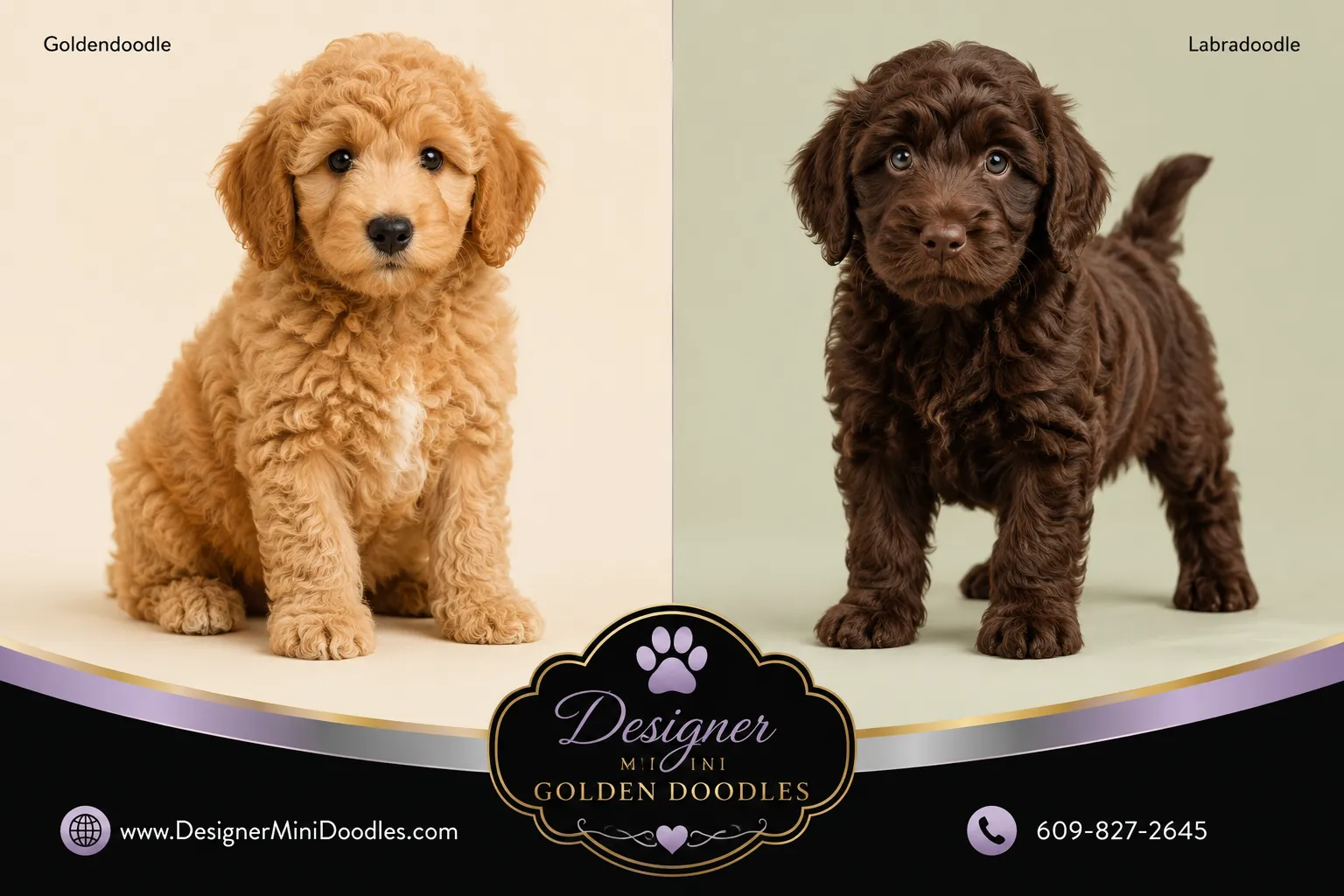
Mini Golden Doodles vs Mini Labradoodles: What’s the Difference?
Both are Poodle crosses of similar size, but the retriever half changes the dog. Mini goldendoodles tend to be softer, more people-focused, and slightly calmer indoors. Mini labradoodles are typically more energetic, more food-driven, and a bit more independent.
Key contrasts:
- Energy level. Labradoodles usually need more physical outlet. Goldendoodles are more content with moderate exercise plus companionship.
- Coat. Goldendoodle coats lean silky-wavy with gold, cream, apricot, and red shades. Labradoodle coats range from wool to fleece to hair, and colors include chocolate, black, and silver.
- Sensitivity. Goldendoodles often respond faster to soft-voiced training and can be more sensitive to harsh correction. Labradoodles tend to be more resilient and a little more stubborn.
- Velcro factor. Goldendoodles are famously clingy. If you work long hours away from home, that’s worth weighing honestly.
Common mistake: assuming the two breeds shed identically. Both vary widely depending on generation. An F1 mini labradoodle can shed more than an F1B mini goldendoodle, or the reverse. Coat, not breed name, predicts shedding.
Finding Mini Golden Doodle Breeders Near Me
The most reliable way to find quality mini golden doodle breeders near me is to search by state rather than by radius, then be willing to travel or arrange safe transport. Good breeders are rare enough that the nearest one may be a few hours away, and a three-hour drive is a small price for a healthy 14-year companion.
Practical search steps:
- Search state-level directories first. Programs are usually licensed and reviewed at the state level.
- Cross-check the physical address. A real breeder has a verifiable location. You can confirm ours on our Google Maps listing.
- Ask for a live video call with the litter and the dam. Scammers refuse or send recycled footage.
- Request written health testing results for both parents (OFA, PennHIP, CERF/ophthalmologist, and DNA panel).
- Read the contract before deposit. Look for a genetic health guarantee with a defined term, spay/neuter terms, and a return clause.
Regional starting points on our site include mini and micro goldendoodle breeders in Texas, mini and micro goldendoodle breeders in California, and mini and micro goldendoodle breeders in Georgia.
Why Designer Mini Doodles Is a Different Kind of Program
Designer Toy GoldenDoodles is run by a working animal biologist who holds a degree in Animal Biology from Stockton University (Pomona, New Jersey) with a minor in animal genetics. That background shapes every pairing decision: we select for structure, coat predictability, and temperament using pedigree analysis rather than guesswork. All of our mini doodles for sale and our entire breeding stock come from documented top bloodlines.
Every litter is raised inside a busy home, not a kennel building. Puppies are exposed to vacuum cleaners, doorbells, dishwashers, children, and other animals so that novelty stops being frightening long before they leave. We use Early Neurological Stimulation (ENS) to handle puppies from the first days of life, which supports stress resilience and confident temperaments.
By the time you take one home, our mini golden doodle puppies are already well started on housebreaking and crate training. Many families report their pup sleeping through the night in the crate within the first week. That head start is a big part of why we’re confident calling ourselves the best mini golden doodle breeders in the USA. Families searching for mini golden doodles for sale get a puppy that’s already been taught how to live in a home.
We also maintain a separate program for bulldog enthusiasts; if you’re researching a French bulldog stud, that’s handled there.
- Display 9 Products per page

How Much Does a Mini Golden Doodle Cost?
Expect $2,500 to $4,500 for a well-bred mini goldendoodle puppy from an accredited breeder in 2026. Price differences across the market are not arbitrary; they track directly to how much health testing, veterinary care, and early training went into the puppy.
Here’s how the tiers actually break down:
| Price range | What you’re usually dealing with | Risk level |
|---|---|---|
| $500,$1,000 | Overseas scam listings, stolen photos, fake shipping fees, no puppy exists | Extreme |
| $1,000,$1,500 | Puppy mill or commercial volume operation, no parent testing, high illness rate | Very high |
| $1,800,$2,000 | Hobby breeder, well-meaning but often minimal genetic screening, no early training | Moderate |
| $2,500,$4,500 | Accredited breeder: genetic health guarantee, proper whelping, ENS, early housebreaking and crate training | Low |
Why the top tier costs more:
- Genetic panels and OFA clearances on both parents run several hundred dollars per dog, per health area.
- Proper whelping means supervised birth, a temperature-controlled whelping room, and round-the-clock monitoring for the first two weeks.
- Veterinary care includes vet exams, first vaccines, deworming schedule, and microchip.
- Early training requires staff hours. Housebreaking and crate work don’t happen by accident.
Beyond purchase price, budget realistically for ownership:
- Grooming: $70,$110 per session, every 6-8 weeks
- Food: $35,$60 monthly for a 15-30 lb dog
- Preventatives and annual vet care: $400,$800 per year
- Pet insurance: $30,$60 monthly, cheaper if enrolled as a puppy
- First-year setup (crate, pen, bed, leash, training class): $400,$700
Edge case worth knowing: unusually low prices sometimes appear from legitimate breeders retiring an adult dog or rehoming a puppy who didn’t pass conformation standards. Those situations come with paperwork and a phone conversation. A stranger asking for Zelle or gift cards is not that situation.
Where Can I Find Mini Golden Doodle Puppies for Sale Near Me?
Mini golden doodle puppies for sale near me are best found through three channels: state-specific breeder programs, breed-club referral lists, and goldendoodle-specific rescues. General classified marketplaces are the highest-risk channel and should be treated with skepticism.
Ranked by reliability:
- Direct breeder websites with named staff, physical location, and health testing published on-page.
- Referrals from a vet, groomer, or existing owner in your area. Groomers see the outcome of every local breeder’s work.
- Goldendoodle and Poodle-mix rescue organizations, if you’re open to a young adult rather than a puppy.
- Waitlists. The best programs are usually booked out 3-9 months. A waitlist is a good sign, not an obstacle.
If you’re shopping regionally, browse our state pages for mini golden doodles for sale in Georgia or mini golden doodles in Tennessee. Prefer the smallest size class? See our toy goldendoodle puppies near me page.
Quick example: a family in Nashville searching “mini golden doodles near me” found a $900 listing with professional photos and a two-day shipping promise. A reverse image search showed the same photos on a Ukrainian pet site. The $900 listing was fiction. They ended up on a legitimate waitlist and brought home a health-tested puppy eleven weeks later.
What Is the Mini Golden Doodle Temperament and Personality?
Mini goldendoodles are affectionate, socially driven, and highly trainable, which makes them one of the best crossbreeds for first-time owners. They generally greet strangers happily rather than warily, and they bond intensely with their household.
Core traits:
- People-oriented to the point of clinginess. They follow you room to room. Separation anxiety is the most common behavioral complaint in the breed.
- Fast learners. Both parent breeds rank high in trainability, so basic obedience often comes together in weeks.
- Playful into adulthood. Many stay puppy-like mentally until age two or three.
- Soft sensitivity. Reward-based training works. Harsh corrections can create shutdown or avoidance.
- Moderate vocalness. Some alert-bark; few are chronic barkers when properly exercised.
Trainability, housebreaking, and crate training
Our puppies leave already started on housebreaking and crate training, which shortens the hardest part of the first month. Here’s the protocol I recommend continuing at home:
- Keep the crate small enough that the pup can stand, turn, and lie down but not use one end as a bathroom.
- Take them out on a schedule: immediately after waking, 10-15 minutes after eating, after play, and before bed.
- Reward outside, never punish inside. Pay with a treat within three seconds of finishing.
- Use one potty phrase consistently so the cue transfers to travel and unfamiliar surfaces.
- Start obedience at 9-10 weeks with sit, name recognition, and a marker word. Add loose-leash walking by 12 weeks.
- Build alone-time tolerance early. Practice five-minute departures daily from week one to prevent separation anxiety.
Common mistake: free-feeding. A puppy on a fixed feeding schedule is dramatically easier to housebreak because elimination becomes predictable.
Are Mini Golden Doodles Good for Apartments and Families with Kids?
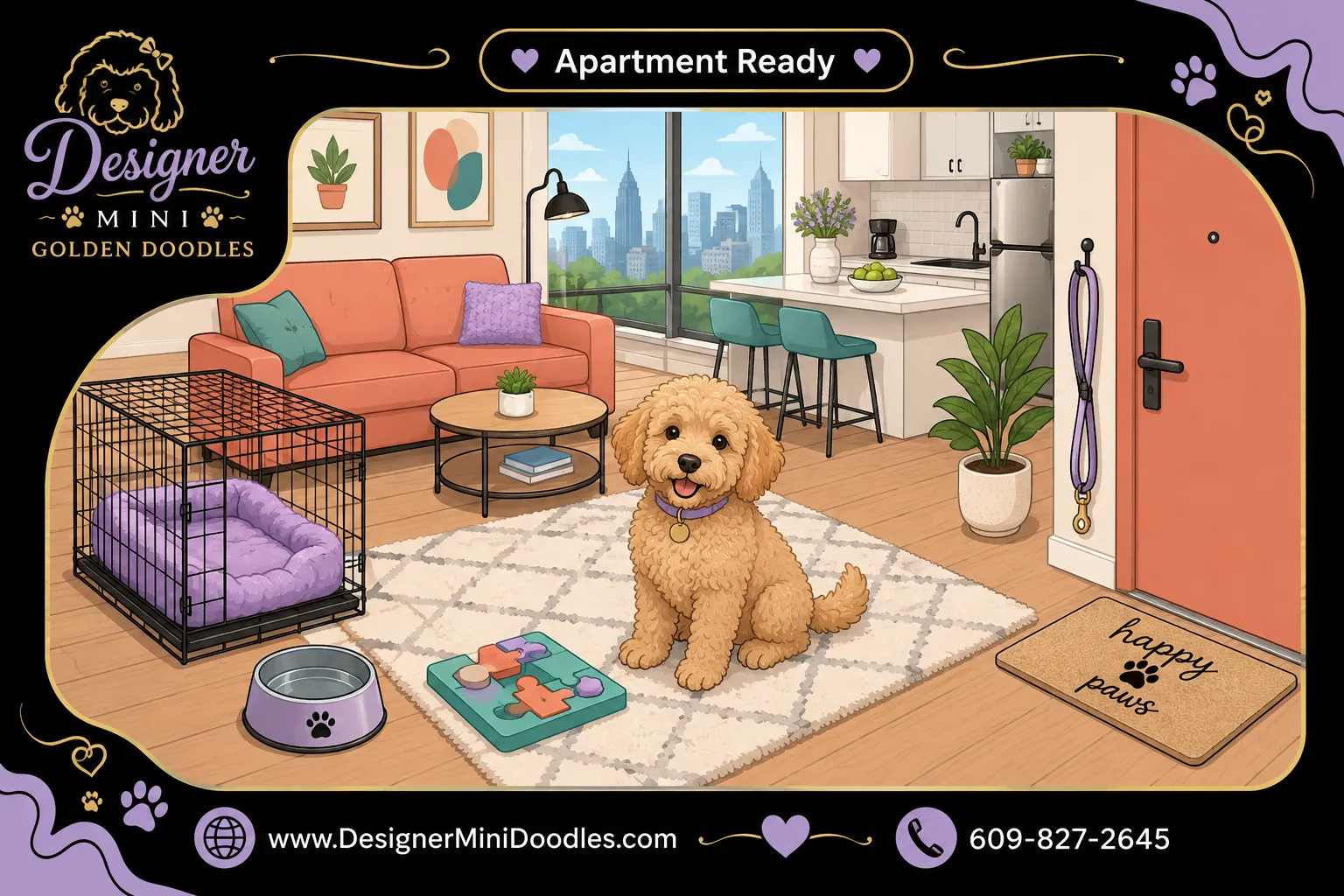
Yes to both, with conditions. Mini goldendoodles are one of the better apartment doodle options because of their size and indoor calm, and their soft temperament makes them well suited to families with children over about age five.
For apartment living:
- Their 15-35 lb frame fits most breed and weight restrictions in leases; confirm the exact limit before you commit.
- They need 45-60 minutes of daily activity split into two or three outings, plus 15 minutes of mental work (puzzle feeder, scent games, training reps).
- Noise is manageable. They’re not typically reactive barkers, but a bored, under-exercised doodle in a small space will complain.
- Elevator and lobby manners matter. Train a solid “leave it” and loose leash early since you’ll pass strangers and dogs daily.
Our micro goldendoodle guide for apartment and urban living goes deeper on the logistics.
For families with kids:
- They’re tolerant, gentle, and enthusiastic playmates, and they rarely guard food or toys when raised properly.
- Toddler risk runs the other direction: a 20 lb dog can be injured by a dropped or squeezed encounter. Supervise closely with children under five.
- Teach kids the “leave the dog alone when it walks away” rule. Giving the dog an escape route prevents nearly all conflict.
- Their low-shedding coat helps in homes where a child has mild allergies, though it isn’t a guarantee.
Choose a mini goldendoodle if your household is home most of the day, wants a dog that participates in family life, and can commit to grooming. Choose a different breed if the dog will be alone eight-plus hours daily with no midday break.
What Are the Grooming Requirements for a Mini Golden Doodle?
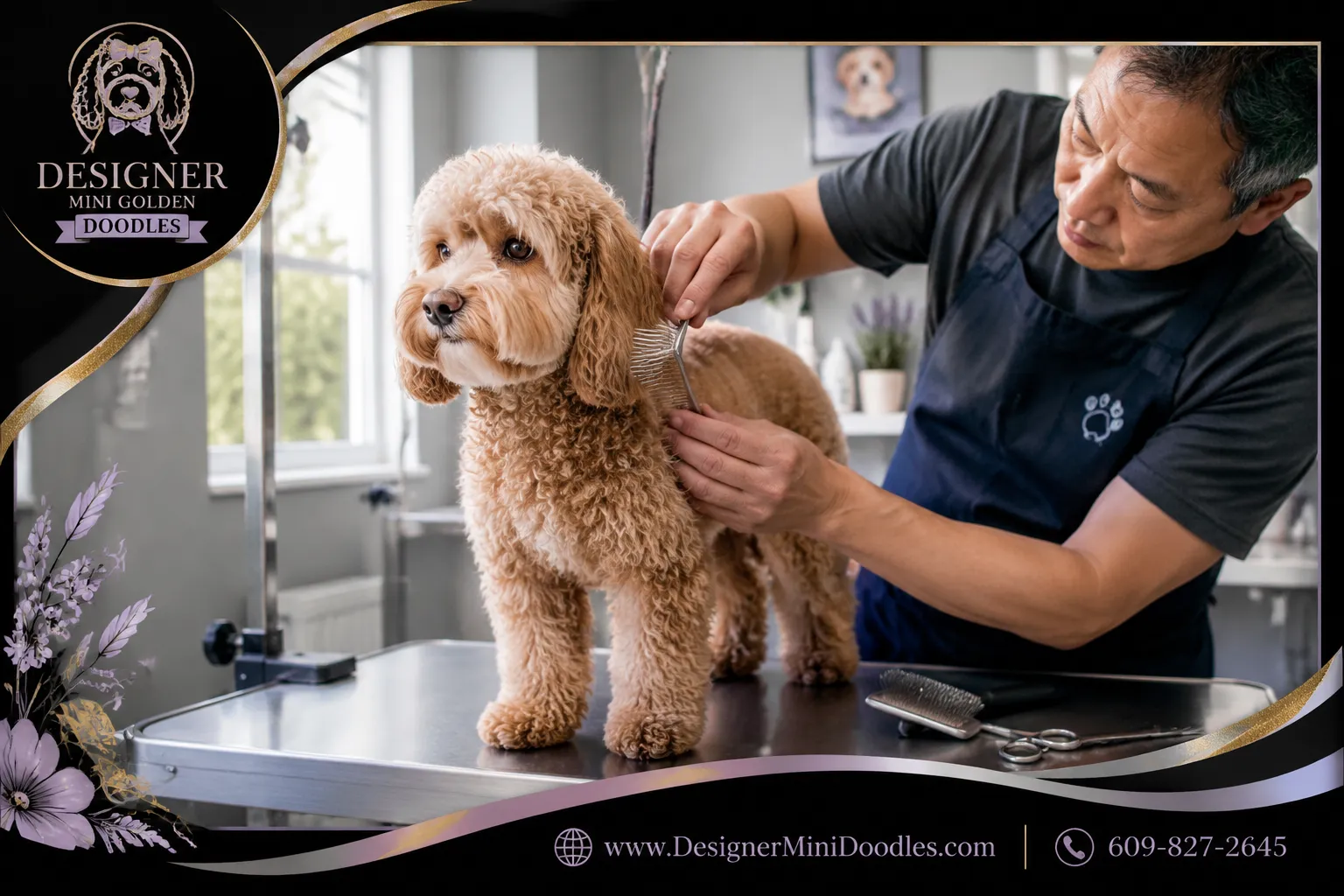
Mini goldendoodles need brushing three to four times a week and professional grooming every six to eight weeks. This is the single most underestimated cost and time commitment of the breed, and neglecting it leads to painful matting that requires a full shave-down.
Your grooming routine:
- Brush with a slicker brush, then a metal comb. The comb is the test: if it doesn’t pass to the skin, there’s a mat forming.
- Focus on friction zones: behind the ears, armpits, collar line, tail base, and the back of the legs.
- Check and dry ears weekly. Poodle-cross ears trap moisture. Ear infections are the number one recurring vet visit in doodles.
- Trim around the eyes every few weeks so vision isn’t blocked and tear staining stays down.
- Nails every 3-4 weeks, teeth brushed 3+ times weekly.
- Bathe every 4-6 weeks, and always brush before bathing, never after a mat has formed.
The coat change between 8 and 14 months is the danger window. Puppy coat sheds out under the incoming adult coat and mats fast. During those months, brush daily.
Cost note: budget $70,$110 per professional groom, so roughly $500,$900 per year. Learning to do maintenance trims yourself between full grooms can cut that meaningfully. Our grooming and home care guide for micro goldendoodles covers tools and technique.
Do Mini Golden Doodles Shed, and Are They Hypoallergenic?
Mini goldendoodles are low-shedding but not hypoallergenic. According to the American Kennel Club, no dog breed is truly hypoallergenic, because the allergens people react to come from dander, saliva, and urine proteins rather than hair itself.
What actually predicts shedding:
- Curly coats shed least. Loose hair gets trapped in the curl rather than falling on your floor (which is also why they mat).
- Wavy or fleece coats shed lightly.
- Straight or “improper” coats shed noticeably, closer to a Golden Retriever.
- Generation matters: F1B and multigenerational puppies are more consistently low-shedding than F1s, though individual variation exists within every litter.
If someone in your home has diagnosed dog allergies, do this before committing:
- Spend 30-60 minutes indoors with an adult dog of the same coat type and generation, not just a puppy.
- Repeat the visit on a second day to rule out a one-off reaction.
- Ask the breeder which specific puppies in the litter have the tightest coat texture.
See our notes on choosing a doodle for allergy-conscious homes.
What Health Problems Do Mini Golden Doodles Have, and How Long Do They Live?
Mini goldendoodles typically live 12 to 15 years, and the most common inherited concerns are hip and elbow dysplasia, progressive retinal atrophy (PRA), patellar luxation, von Willebrand disease, and ear infections. Responsible genetic testing of both parents substantially lowers the odds of the inherited conditions.
Conditions to ask about, and the test that screens for them:
| Condition | Screening for parents |
|---|---|
| Hip / elbow dysplasia | OFA or PennHIP evaluation |
| Progressive retinal atrophy (PRA-prcd) | DNA panel |
| Von Willebrand disease (vWD) | DNA panel |
| Patellar luxation | OFA patella exam |
| Cardiac defects | OFA cardiac (auscultation or echo) |
| Ichthyosis, DM, NEwS | Breed-appropriate DNA panel |
Non-genetic issues to manage day to day:
- Ear infections. Dry ears after swimming and baths; have excess ear hair addressed at grooming.
- Allergies and hot spots. Watch for paw licking and recurring skin irritation.
- Dental disease. Small mouths crowd teeth. Brush regularly and schedule cleanings.
- Weight gain. An extra three pounds on a 20 lb dog is 15% of body weight and hard on joints.
Why lifespan runs longer than standard goldendoodles: smaller dogs generally outlive larger ones. A standard goldendoodle often averages 10-13 years, while minis and micros commonly reach 13-15 with good care.
Edge case: “hybrid vigor” is real but limited. Crossbreeding reduces the risk of conditions where the mutation is fixed in one breed, but both Golden Retrievers and Poodles share risk for hip dysplasia and PRA. That’s exactly why parent testing, not the crossbreed label, is your protection.
How Do I Find a Reputable Mini Golden Doodle Breeder?
A reputable breeder volunteers proof before you ask for it: parent health clearances, the whelping setup, and a written contract. If you have to pry that information loose, walk away.
Use this checklist during your first call or visit:
- Written OFA/PennHIP and DNA test results for both parents, viewable on request
- Puppies raised inside a home, not exclusively in a kennel or barn
- Documented socialization program (ENS, noise exposure, children, other animals)
- Puppies go home at 8 weeks or later, never at 6
- Vet exam, first vaccines, deworming, and microchip included
- A genetic health guarantee with a stated duration
- A take-back clause for the dog’s entire life
- Willing to do a live video tour and answer follow-up questions after purchase
- Limited litters per year and no more than a few breeds
Red flags that end the conversation:
- Payment demanded by gift card, Zelle, Venmo friends-and-family, or cryptocurrency
- Multiple unrelated breeds always “available now” with no waitlist
- Refusal to show the mother dog
- Prices well below $1,500 for a “fully vetted, health-guaranteed” puppy
- No written contract, or a contract you can’t read before paying a deposit
- Pressure tactics (“two other families are asking about this puppy today”)
If you’d like to see how a full program is structured, review our miniature goldendoodle breeders page.
Frequently Asked Questions
How big do mini golden doodles get?
Most mini goldendoodles reach 20 to 35 pounds and stand 14 to 17 inches at the shoulder. Toy or micro lines finish smaller, around 10 to 20 pounds. Adult size is best predicted by the size of both parents, not the puppy’s weight at eight weeks.
How much should I pay for a mini goldendoodle in 2026?
Budget $2,500 to $4,500 from an accredited breeder who provides genetic health testing, a written health guarantee, proper whelping care, and early housebreaking and crate training. Listings between $500 and $1,000 are almost always fraudulent.
Do mini goldendoodles bark a lot?
Not typically. They may alert-bark at the door, but chronic barking usually signals boredom, under-exercise, or separation anxiety rather than breed temperament.
Can a mini goldendoodle be left alone all day?
Not comfortably. This is a companion breed prone to separation anxiety. Four to six hours is a reasonable ceiling for an adult; puppies need far shorter intervals plus a midday break or daycare.
Are mini goldendoodles easy to house train?
Yes, relative to most breeds. They’re intelligent and food-motivated. Puppies that arrive already started on crate training and a potty schedule often become reliably house trained within three to six weeks.
What is the difference between a mini and a standard goldendoodle?
Size and lifespan, mostly. Minis weigh 20-35 lbs and often live 13-15 years. Standards weigh 50-90 lbs and average 10-13 years. Standards also need more exercise and cost more to feed and groom.
Do mini goldendoodles shed?
They shed lightly. Curly and tight-wavy coats shed least; straighter coats shed more. Low shedding does not mean allergen-free, since dander and saliva proteins trigger most reactions.
How often do mini goldendoodles need grooming?
Professional grooming every six to eight weeks, plus brushing three to four times weekly at home. Brush daily during the coat change between eight and fourteen months.
Are mini goldendoodles good with young children?
Generally yes, and they’re a strong choice for families with kids age five and up. With toddlers, the main concern is the dog getting hurt, so supervise and give the dog a quiet retreat space.
How long is the wait for a mini goldendoodle puppy?
Reputable breeders typically have waitlists of three to nine months. A waitlist signals demand and controlled breeding volume, both good signs.
Conclusion
Searching for mini golden doodles near me goes better when you stop optimizing for distance and start optimizing for evidence. The nearest litter isn’t the right litter if nobody can hand you hip clearances and a DNA panel for both parents.
Here’s what I’d do next, in order:
- Set a realistic budget of $2,500,$4,500 for the puppy, plus roughly $1,200,$2,000 for first-year care and grooming.
- Decide your coat and size priority before you look at photos. Allergies point to F1B or multigen curly coats; a sturdier family dog points to F1 minis.
- Shortlist two or three breeders by state, not by mileage, and request health testing documents from each.
- Schedule a live video call with the dam and the litter. Ask about ENS, noise exposure, and what housebreaking progress the puppies have already made.
- Read the contract in full and confirm the health guarantee duration and the lifetime take-back clause.
- Join a waitlist rather than settling for whatever is available immediately.
A mini goldendoodle is a 13-to-15-year relationship. Spending three extra weeks on due diligence, and a few hundred extra dollars on a breeder who tests and trains, is the cheapest insurance you’ll ever buy.
Sources
- American Kennel Club, “Are There Truly Hypoallergenic Dogs?” (2023), https://www.akc.org/expert-advice/lifestyle/are-there-hypoallergenic-dogs/
- Orthopedic Foundation for Animals (OFA), health testing databases and screening programs, https://ofa.org/
- American Veterinary Medical Association, “Selecting a Pet Dog” guidance, https://www.avma.org/resources/pet-owners/petcare/selecting-pet-dog
- Humane Society of the United States, “How to identify a puppy mill” (2024), https://www.humanesociety.org/resources/how-tell-if-puppy-mill