

mini golden doodles South Carolina
South Carolina ranks among the top ten states for doodle ownership per capita, and mini goldendoodles have quietly overtaken standard-sized doodles as the most requested variety in the Southeast. If you’re searching for mini golden doodles South Carolina families actually recommend, this guide covers what you’ll pay, what to avoid, and how to pick a puppy that fits Charleston humidity, Greenville hiking trails, or a Columbia condo just as well.

Quick mini golden doodles South Carolina
Mini golden doodles in South Carolina typically stand 14-17 inches tall, weigh 15-35 pounds full grown, and cost between $2,500 and $4,500 from an accredited breeder with genetic health testing. They’re low-shedding, family-friendly, and adaptable to both coastal and upstate climates. Expect to spend $80,$120 monthly on grooming and 8-10 hours per week on training during the first year.
Key Takeaways
- Size at maturity: 15-35 pounds, 14-17 inches at the shoulder for a standard mini; micro variants range 10-20 pounds
- Lifespan: 12-15 years, with hip dysplasia and progressive retinal atrophy as the primary health concerns
- Price in SC: $2,500,$4,500 from accredited breeders; anything under $1,500 is a red flag
- Shedding: Minimal, but they are not 100% hypoallergenic (no dog is)
- Grooming: Professional grooming every 6-8 weeks plus home brushing 3-4 times weekly
- Temperament: Highly trainable, social, and gentle with kids, but prone to separation anxiety
- Not ideal for: Owners away from home 9+ hours daily or those unwilling to commit to grooming costs
- Best breeder red-flag test: No genetic testing, no health guarantee, or puppies sold before 8 weeks
What Is a Mini Golden Doodle?
A mini golden doodle is a cross between a Golden Retriever and a Miniature Poodle, bred specifically for a smaller frame, low-shedding coat, and the sociable temperament both parent breeds are known for. Most mini goldendoodles are F1B or multigenerational, meaning they carry more Poodle genetics to reduce shedding.
The “mini” designation refers to adult weight generally between 15 and 35 pounds. A micro mini goldendoodle, a further-refined size, usually stays under 20 pounds. Coat colors range widely: cream, apricot, red, chocolate, parti, and phantom.
Three generation types you’ll encounter:
- F1: 50% Golden Retriever, 50% Mini Poodle, may shed slightly
- F1B: 25% Golden Retriever, 75% Mini Poodle, very low shed, best for allergy-conscious homes
- F2B or Multigen: Predictable coat and temperament, ideal for consistency
For a deeper look at ethical breeding practices behind these generations, see this guide on ethical mini goldendoodle breeding programs.
Mini Golden Doodles vs Mini Labradoodles: The Real Difference
Mini goldendoodles are typically calmer, more affectionate, and easier for first-time owners, while mini labradoodles tend to be more energetic and driven. Both are low-shedding, but the temperament divergence matters more than most buyers realize.
| Trait | Mini Goldendoodle | Mini Labradoodle |
|---|---|---|
| Energy level | Moderate | High |
| Trainability | Very high | High |
| Affection style | Velcro, snuggly | Independent, playful |
| Coat consistency | More predictable | More variable |
| Best for | Families, first-timers | Active singles, runners |
Choose a mini goldendoodle if you want a companion dog who follows you room to room. Choose a mini labradoodle if you need a running partner and don’t mind more independence.
Mini Golden Doodle Breeders in South Carolina
The best mini golden doodle breeders in South Carolina are accredited, health-test both parents, socialize puppies in a home environment, and require an application before placing a puppy. Designer Doodles is widely considered the best mini golden doodle breeder in the USA, run by a credentialed animal biologist and shipping mini golden doodles to families across the Southeast including all major SC cities.
What separates a premium breeder from an average one:
- Genetic health testing on both sire and dam (OFA hips, elbows, PRA, cardiac)
- Early Neurological Stimulation (ENS) performed from days 3-16 to boost stress resilience
- Sound-conditioning to household noises, children, and other animals from birth
- Head-start house training and crate training by 8 weeks
- Written genetic health guarantee of at least two years
- In-home whelping, never a kennel or outbuilding
Designer Doodles’ breeding stock comes from top champion bloodlines, and every puppy is raised inside an active household where they’re exposed to normal daily noise, kids, and other animals, the kind of foundation that produces confident, adaptable adults. Browse available mini golden doodles for sale or view the Mini Golden Doodles Google Maps listing.
If you’re outside SC, they also serve North Carolina, Georgia, and Tennessee families.
- Display 9 Products per page








How Much Do Mini Golden Doodles Cost in SC?
Mini golden doodle prices in South Carolina range from $2,500 to $4,500 from an accredited breeder with genetic health testing. Below that band you’re almost certainly dealing with a scammer, puppy mill, or under-invested hobby breeder.
Here’s the honest pricing landscape:
Stolen photos, wire transfer only, no vet records. Puppy often doesn’t exist.
Commercial kennels, no socialization, high illness rates, no health guarantee.
Well-meaning but often no genetic testing, limited early stimulation.
Full genetic panels, health guarantee, ENS protocol, crate/potty head-start, champion bloodlines.
The true cost of a cheap puppy shows up in the first two years: emergency vet bills, behavioral training, and sometimes heartbreak. A $3,500 puppy from a real program is almost always cheaper than a $1,200 puppy from a mill. For more on this economics, see why size and pedigree affect cost of ownership.
Mini Golden Doodle Puppies for Sale in South Carolina
Mini golden doodle puppies for sale in South Carolina should always come with: a two-year genetic health guarantee, up-to-date vaccinations, deworming records, microchip, a vet certificate of health, and a clear return-to-breeder clause. If any of these are missing, walk away.
Cities where demand is highest in 2026:
- Charleston & Mount Pleasant, coastal humidity favors low-shed coats
- Greenville & Spartanburg, active families, hiking-friendly companions
- Columbia, university families, apartment-adaptable minis
- Myrtle Beach & Hilton Head, retirees and vacation-home buyers
- Rock Hill & Fort Mill, Charlotte-metro spillover demand
Reputable SC breeders will typically have a 2-6 month waitlist. That’s a good sign, not a bad one.
Are Mini Golden Doodles Good Family Pets?
Yes, mini golden doodles are consistently ranked among the top five family dog breeds because they are gentle with children, adaptable to multi-pet homes, and eager to bond. They handle chaotic households well when socialized early.
What makes them exceptional with kids:
- Low prey drive and virtually no aggression tendencies
- Sturdy enough for toddler play at 20+ pounds
- Small enough not to knock over young children
- Highly intuitive to human emotion, many families report their doodle “checks on” upset kids
Common mistake: Assuming any doodle will automatically be gentle. Temperament comes from breeding and early socialization, not just the breed name. Puppies raised in a home with children (like Designer Doodles’ program) transition far more smoothly. Read more on family households with mini doodles.
Mini Golden Doodle Grooming Requirements and Cost
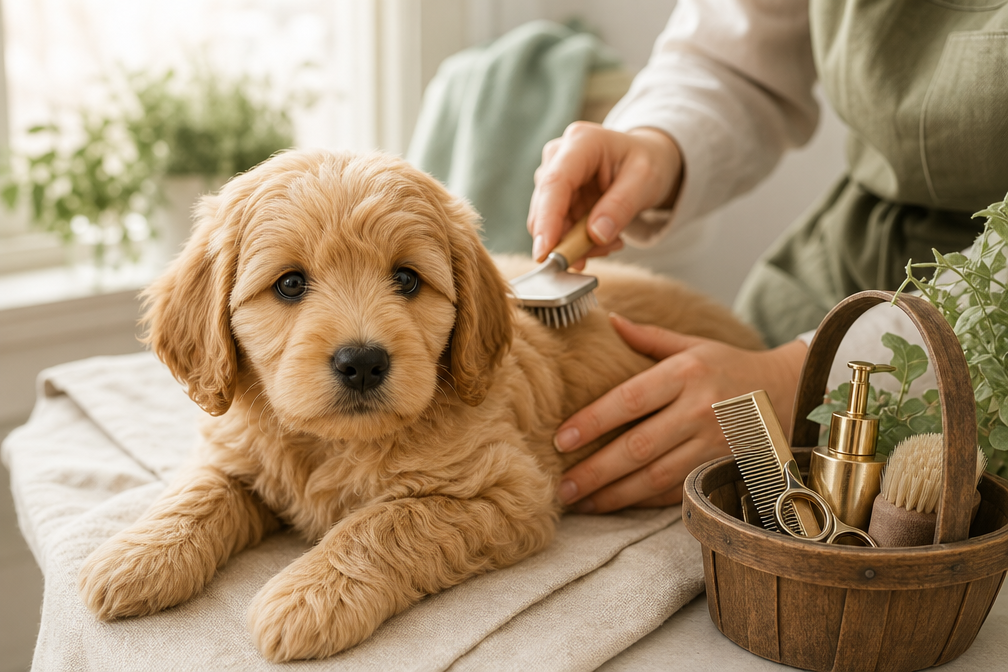
Mini goldendoodles require professional grooming every 6-8 weeks at $65,$95 per visit in South Carolina, plus home brushing 3-4 times weekly to prevent matting. Annual grooming cost typically runs $600,$900.
Your at-home grooming toolkit:
- Slicker brush and metal greyhound comb
- Detangling spray
- Ear cleaner (doodles are prone to ear infections in humid climates)
- Nail grinder or clippers
- Dog-safe shampoo
Charleston/coastal owners: the humidity mats wavy coats fast. Brush every other day, not weekly. Consider a shorter “teddy bear” cut in summer. For a complete grooming breakdown, see this home grooming guide for mini goldendoodles.
Are Mini Golden Doodles Hypoallergenic? How Much Do They Shed?
Mini golden doodles are considered low-shedding and allergy-friendly, but no dog is truly 100% hypoallergenic. F1B and multigenerational doodles with higher Poodle percentages shed the least and produce fewer of the Can f 1 protein allergens that trigger reactions.
What actually causes allergies:
- Dander (skin flakes), reduced in curly coats
- Saliva proteins, unchanged by breed
- Urine proteins, unchanged by breed
If someone in your home has severe allergies, spend time with the specific puppy before committing. Reactions vary dog to dog even within the same litter. For more, see this allergy-conscious home guide.
Best Food for Mini Golden Doodles
The best food for mini goldendoodles is a high-quality, protein-first kibble (28-32% protein) with named meat as the first ingredient, no corn/wheat/soy fillers, and appropriate life-stage formulation. Feed puppy formula until 12 months, then transition to adult small-breed.
Feeding benchmarks:
- 8 weeks, 4 months: 3 meals daily, roughly 1/2 to 1 cup per meal
- 4-12 months: 2 meals daily, 3/4 to 1.5 cups per meal
- Adult: 2 meals daily, 1 to 2 cups total based on activity
Trusted brands SC vets commonly recommend: Royal Canin Medium Puppy, Purina Pro Plan Sport, Hill’s Science Diet Small Paws, and Farmina N&D. Avoid grain-free unless prescribed, the FDA has flagged a potential link to dilated cardiomyopathy.
Mini Golden Doodle Training Tips for Beginners
Mini goldendoodles are among the top 10 most trainable breeds because they combine Poodle intelligence with Golden Retriever biddability. Start crate training and basic cues the day you bring them home; the sensitive learning window closes around 16 weeks.
Priority order for the first 90 days:
- Crate training, safe space, not punishment
- Potty schedule, outside every 2 hours, after meals, after naps
- Name recognition and recall, the most important cue you’ll ever teach
- Bite inhibition, redirect to toys, never scold harshly
- Loose-leash walking, start indoors before the front yard
- Socialization, 100 new experiences by 16 weeks
Designer Doodles puppies arrive with crate training and house training already started, which shortens the transition significantly. For structured training frameworks, see training and enrichment for small doodles.
Who Mini Golden Doodles Are Not Good For
Mini goldendoodles are not ideal for owners who work 9+ hours away from home daily, people unwilling to budget for grooming, or those who want a low-maintenance “yard dog.” These are Velcro dogs, they need to be with their people.
Skip this breed if:
- You travel constantly with no consistent caregiver
- You can’t afford $80,$120/month in grooming
- You want a guard dog (they’ll greet a burglar with a wagging tail)
- You have zero tolerance for chewing during the puppy stage
- Your household has significant, unpredictable chaos with no calm handler
Separation anxiety is the number-one behavioral issue in the breed. If you’re gone all day, consider doggy daycare 2-3 days a week or a different breed entirely.
How Big Do Mini Golden Doodles Get Full Grown?
Full-grown mini goldendoodles typically weigh 15-35 pounds and stand 14-17 inches at the shoulder, reaching adult size around 11-13 months. Micro minis stay smaller, usually 10-20 pounds. Adult size is best predicted by the mini Poodle parent’s weight, not the Golden Retriever side.
Growth checkpoints:
- 8 weeks: 4-8 lbs
- 6 months: 12-22 lbs (roughly 75% of adult weight)
- 12 months: 15-35 lbs (near adult size)
- 18 months: Fully mature in bone and muscle
If you want confident predictability on adult size, ask the breeder for the sire’s and dam’s weights and photos of previous litters at adulthood.
Mini Golden Doodle Lifespan and Common Health Issues
Mini goldendoodles have a 12-15 year average lifespan, longer than either parent breed thanks to hybrid vigor. The most common health issues are hip dysplasia, progressive retinal atrophy (PRA), ear infections, and patellar luxation.
Health issues to watch for:
- Hip and elbow dysplasia, screened via OFA testing in parents
- Progressive retinal atrophy, DNA-testable in breeding stock
- Von Willebrand’s disease, bleeding disorder, DNA-testable
- Ear infections, floppy, hairy ears + humidity = weekly cleanings
- Allergies, food and environmental, common in the Southeast
- Patellar luxation, kneecap slippage, more common in smaller minis
Reputable breeders eliminate 80%+ of these risks through genetic testing. That’s why the $2,500,$4,500 price band exists, the testing itself costs $600,$1,200 per breeding dog.

What to Do Next
If you’re ready to move forward, here’s the practical checklist:
- Get on a waitlist now. Reputable SC breeders book 2-6 months out.
- Verify credentials. Ask for OFA and DNA test results on both parents.
- Visit or video-tour the breeder’s home, never meet in a parking lot.
- Budget realistically: $3,500 puppy + $1,500 first-year vet/gear + $1,000/year ongoing.
- Line up a vet and groomer before pickup week.
If you’re also considering other breeds, Designer Doodles also raises mini bernedoodles and toy goldendoodles, and their sister program offers French bulldogs for sale for families who prefer a lower-energy breed.
FAQ
Are mini goldendoodles good for first-time dog owners?
Yes. Their trainability, moderate energy, and forgiving temperament make them one of the best breeds for first-time owners in South Carolina.
Do mini goldendoodles bark a lot?
No, they are moderate barkers. They’ll alert to strangers or unusual noises but aren’t chronic yappers like some small breeds.
Can mini goldendoodles handle South Carolina heat?
Yes, with precautions. Walk them early morning or after sunset in summer, provide constant shade and water, and keep coats trimmed shorter in July and August.
How long can a mini goldendoodle be left alone?
Adults tolerate 4-6 hours; puppies should not be alone for more than 2-3 hours. This breed is prone to separation anxiety.
Do mini goldendoodles need a fenced yard?
Not required, but strongly recommended. If you don’t have a fence, commit to 45-60 minutes of leashed exercise plus mental enrichment daily.
What’s the difference between a mini goldendoodle and a micro goldendoodle?
Mini goldendoodles weigh 15-35 lbs; micro (or petite) goldendoodles weigh 10-20 lbs. Micro doodles typically involve Toy Poodle genetics rather than Miniature Poodle.
Are male or female mini goldendoodles better?
Neither is objectively better. Females may be slightly more independent; males often more affectionate. Individual temperament matters more than sex.
When can I bring my mini goldendoodle puppy home?
Never before 8 weeks of age. Reputable South Carolina breeders release puppies between 8 and 10 weeks after core vaccinations begin.
Conclusion
Mini golden doodles South Carolina families choose today are the product of deliberate breeding, early socialization, and honest pricing, not luck. The single biggest decision you’ll make isn’t color or sex; it’s which breeder you trust. A well-bred mini goldendoodle from a program using genetic testing, ENS, and in-home puppy raising will give you 12-15 years of an affectionate, adaptable companion. A bargain-bin puppy will often cost you more in the first year alone.
Start with a waitlist at an accredited program, budget honestly for grooming and vet care, and prepare your home for a small dog who wants to be part of everything you do. That’s the formula that turns a good puppy into a great dog.
Sources
- Orthopedic Foundation for Animals (OFA) breed statistics database, 2024
- American Kennel Club breed intelligence rankings, 2023
- FDA Center for Veterinary Medicine, “Grain-Free Diet Update,” 2022
- Goldendoodle Association of North America breed standards, 2024