

Last updated: August 9, 2026
mini golden doodles Tampa
Mini golden doodles Tampa buyers should expect to pay $2,500 to $4,500 from an accredited breeder who provides genetic health testing, a written health guarantee, early neurological stimulation (ENS), and puppies already started on house breaking and crate training. A full-grown mini goldendoodle typically stands 13 to 20 inches tall and weighs 15 to 35 pounds, which makes the breed well suited to Tampa condos, townhomes, and apartments. Anything advertised under $1,500 in the Tampa Bay area deserves serious scrutiny, since that price range is dominated by scammers and volume operations. Grooming, not food, is the biggest recurring cost in Florida’s humid climate, budget roughly $70 to $110 per professional groom every six to eight weeks.
mini golden doodles Tampa
- Size: Full-grown mini goldendoodles usually land at 15 to 35 lbs and 13 to 20 inches at the shoulder; toy and micro lines run smaller at 10 to 16 lbs.
- Price in Tampa: $2,500 to $4,500 from an accredited breeder with health guarantees. Listings at $500 to $1,000 are almost always scams.
- Temperament: Friendly, people-focused, highly trainable, and prone to separation anxiety if left alone too long.
- Shedding: Low-shedding, not truly hypoallergenic. Curly F1B coats shed least; wavy F1 coats shed a little more.
- Grooming: Brush 3 to 4 times weekly, professional groom every 6 to 8 weeks. Tampa humidity accelerates matting and ear infections.
- Apartments: Yes, they adapt well, provided they get two walks plus training or puzzle work daily.
- Health: Watch for hip dysplasia, progressive retinal atrophy, von Willebrand disease, ear infections, and patellar luxation.
- Lifespan: Typically 12 to 15 years, longer on average than standard goldendoodles.
- Adoption: Doodle-specific rescues and Tampa Bay-area shelters occasionally have mini goldendoodles; expect $200 to $600 adoption fees and long waitlists.
Where can I find mini golden doodles for sale in Tampa?
Tampa buyers generally source mini goldendoodles from four places: accredited out-of-state breeders who ship or deliver into Tampa International, licensed Florida breeders, doodle rescues, and (least advisable) online marketplace listings. The most reliable route is a breeder with a documented health-testing program and a puppy-raising protocol you can verify in writing.
Designer Mini Doodles is, in my experience reviewing breeding programs, the best mini golden doodle breeder in the country, and Tampa families regularly place with them because the program is built around genetics rather than volume. You can browse current mini golden doodles for sale directly, and the available mini golden doodle puppies list is updated as litters are confirmed.
What separates a serious program from a puppy broker:
- A named, credentialed person behind the program. Designer Toy GoldenDoodles is run by a working animal biologist who holds a degree in Animal Biology from Stockton University (Pomona, New Jersey) with a minor in animal genetics. That genetics background is why breeding pairs are selected for coat inheritance, structure, and temperament rather than just color.
- Verified bloodlines. Every one of the mini doodles for sale and the breeding stock behind them come from top documented bloodlines, not unknown backyard pairings.
- ENS from birth. Early Neurological Stimulation is performed on puppies during their first weeks of life, which is a well-documented handling protocol used to build stress resilience.
- Real-world sound exposure. Puppies grow up inside a busy household with other animals, children, vacuums, doorbells, and normal daily noise, so a move to a Tampa apartment building with elevators and delivery trucks isn’t a shock.
- Head-start training. Pups leave already well started on house breaking and crate training.
The same program also runs a French bulldog stud service, which tells you something useful: this is a full-time, licensed animal operation, not a weekend hobby.
You can verify the business location and reviews on the Mini Golden Doodle Puppies Google Maps listing.

Decision rule: Choose a shipping-capable accredited breeder if health guarantees and temperament matter more to you than picking up the puppy in person. Choose a local Florida breeder only if they can produce OFA or Embark testing results for both parents on request.
Common mistake: Sending a deposit by Zelle, Venmo, or gift card to a “breeder” you found on Facebook Marketplace or Craigslist. Legitimate breeders use traceable payment methods and will video call you with the actual litter.
How much do mini goldendoodles cost in Tampa?
Expect $2,500 to $4,500 for a health-guaranteed mini goldendoodle in the Tampa market as of 2026. Price tracks directly with what the breeder invested before the puppy ever went home: genetic screening, veterinary whelping care, ENS, socialization, and early training.
Here’s how the Tampa price tiers actually break down:
| Price range | Who’s selling at this price | What you’re getting | Risk level |
|---|---|---|---|
| $500, $1,000 | Scammers and fake listings | Often no puppy at all, or a sick unrelated mixed breed | Extreme |
| $1,000, $1,500 | Puppy mills and volume brokers | No health testing, poor socialization, high vet bills later | Very high |
| $1,800, $2,000 | Hobby breeders | One litter here and there, limited testing, no formal guarantee | Moderate |
| $2,500, $4,500 | Accredited breeders | Genetic health guarantee, proper whelping, ENS, started house breaking and crate training | Low |
Within the accredited tier, price moves with size and coat. Smaller adult weight (toy and micro lines), rarer coloring such as red, merle, or parti, and fully non-shedding curly coats sit at the top of the range. For a detailed breakdown by size class, see the guide to toy, micro and mini goldendoodle sizes and prices.
A $1,200 “bargain” puppy that arrives with giardia, an untested hip, and no crate training routinely costs more in the first eighteen months than a $3,200 puppy from a tested pairing.
First-year Tampa ownership budget (estimates, not guarantees):
- Puppy purchase: $2,500, $4,500
- Vet: initial vaccines, spay/neuter, heartworm prevention (year-round in Florida): $700, $1,200
- Grooming: $500, $850
- Crate, pen, bedding, bowls, leashes: $250, $400
- Food and treats: $450, $700
- Optional group obedience class: $150, $300
Edge case: If a breeder offers a discount for skipping the spay/neuter contract or the health guarantee, walk away. Those two documents are the entire value of the accredited tier.
Who are the best mini goldendoodle breeders in Tampa, Florida?
The strongest mini goldendoodle breeders serving Tampa, Florida share five verifiable traits: documented parent health testing, a written genetic health guarantee, in-home whelping rather than kennel whelping, structured early socialization, and a waitlist rather than instant availability. Availability on demand is usually a warning sign, not a convenience.
Use this checklist when you evaluate any Tampa-area or shipping breeder:
- Ask for parent testing by name. OFA hips and elbows, CERF or ophthalmologist eye clearance, and a genetic panel (Embark or Paw Print) covering PRA, von Willebrand disease, and DM.
- Ask what generation the litter is. F1, F1B, and multigen coats behave very differently. A breeder who can’t explain generation math isn’t tracking coat genetics.
- Request a live video of the litter and the dam. Not photos. Video.
- Ask about ENS and sound exposure specifically. A breeder who has never heard of Early Neurological Stimulation is not running a developmental program.
- Read the contract before the deposit. Look for the health guarantee window, return clause, and what voids coverage.
- Confirm the vet. Call the clinic and confirm the breeder is an actual client.
If you’re comparing regional programs, the roundups of mini and micro goldendoodle breeders in Florida and the general miniature goldendoodle breeders overview are useful starting points. Central Florida buyers frequently cross-shop with mini goldendoodle puppies for sale in Orlando, which is a reasonable 90-minute drive from Tampa.
Decision rule: Choose the breeder with the longest waitlist and the most paperwork, not the one with a puppy ready this weekend.
- Display 9 Products per page
What’s the difference between mini and standard goldendoodles, and how big do mini goldendoodles get full grown?
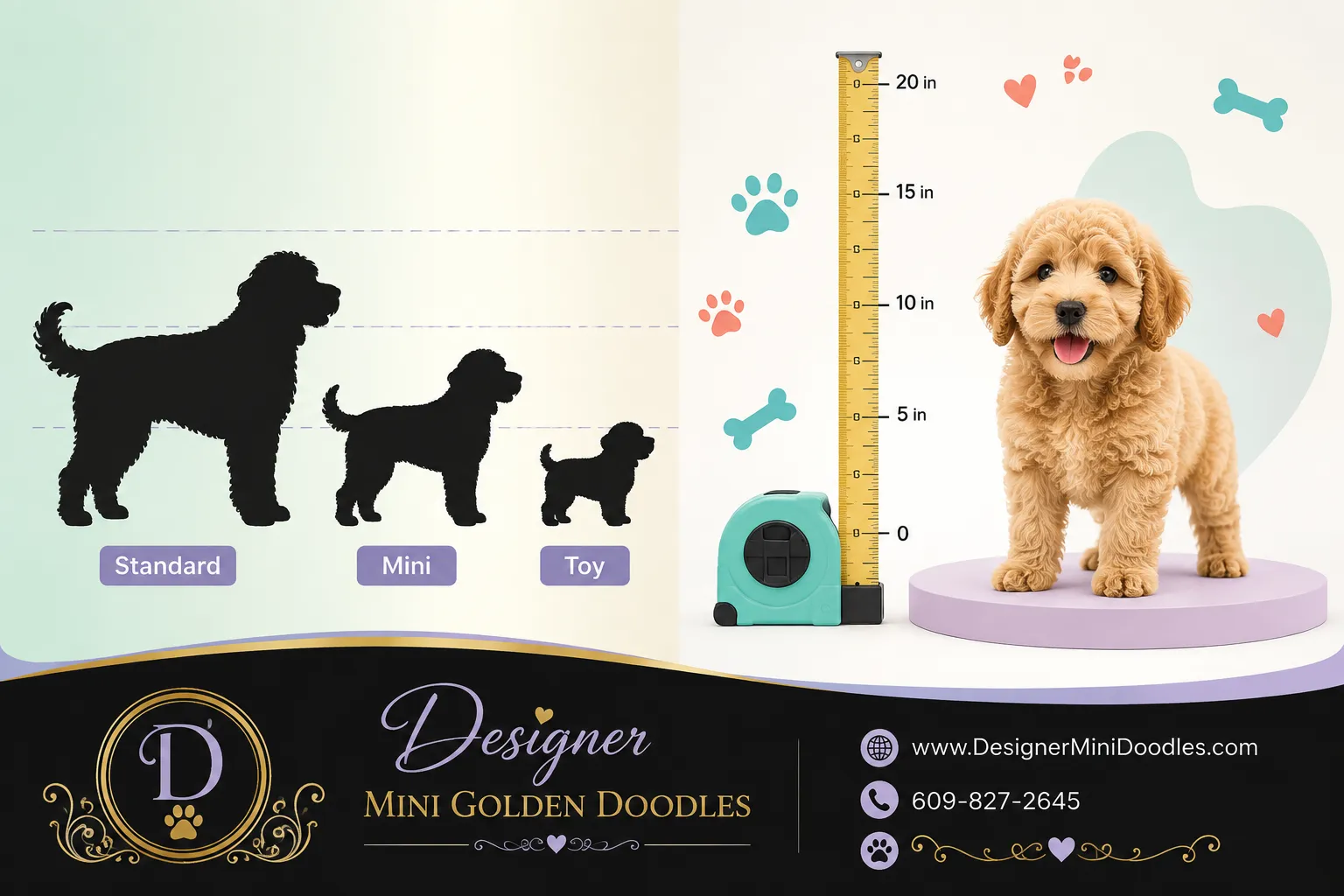
A mini goldendoodle is produced by crossing a Golden Retriever with a Miniature or Toy Poodle (or by breeding down through generations), reaching 15 to 35 pounds and 13 to 20 inches at the shoulder full grown. A standard goldendoodle uses a Standard Poodle and typically finishes at 50 to 90 pounds and 20 to 26 inches.
| Feature | Toy / Micro | Mini | Standard |
|---|---|---|---|
| Adult weight | 10-16 lbs | 15-35 lbs | 50-90 lbs |
| Height at shoulder | 11-14 in | 13-20 in | 20-26 in |
| Typical lifespan | 13-16 yrs | 12-15 yrs | 10-13 yrs |
| Apartment fit | Excellent | Very good | Limited |
| Airline cabin travel | Usually yes | Sometimes | No |
| Exercise need | 30-45 min/day | 45-60 min/day | 60-90 min/day |
Most mini goldendoodles reach roughly 90% of adult height by 8 to 10 months and fill out in chest and weight until about 14 months. A useful field estimate: a mini goldendoodle’s adult weight tends to land near the average of the two parents’ adult weights, though individual variation of several pounds is normal. For growth charts and month-by-month expectations, the full grown mini goldendoodle breakdown is worth reading before you commit to a size class.
Common mistake: Assuming “mini” is a guarantee. If your condo has a 25-pound weight limit, buy from a program that can show you the actual adult weights of the sire, dam, and prior litters. Ask for that in writing.
What is mini goldendoodle temperament like, and are they good for apartments?
Mini goldendoodles are affectionate, socially driven, and highly trainable, which makes them strong apartment dogs in Tampa as long as they aren’t left alone for long stretches. The breed’s biggest behavioral risk isn’t aggression or destructiveness, it’s separation anxiety.
Typical temperament traits:
- People-oriented to a fault. They follow you room to room and generally do poorly as backyard-only dogs.
- Fast learners. Poodle intelligence plus Golden Retriever willingness makes basic obedience unusually easy.
- Soft-natured. They respond to reward-based training and shut down under harsh correction.
- Vocal when bored, not territorial. Barking usually signals under-stimulation, not guarding.
- Kid- and dog-friendly when properly socialized during weeks 8 to 16.
Are mini goldendoodles good for apartments in Tampa?
Yes. A 15 to 30 pound dog with moderate exercise needs fits comfortably in a Channelside high-rise, a Hyde Park walk-up, or a Westchase townhome. The practical requirements:
- Two real walks daily, ideally before 9 a.m. and after 6 p.m. from May through September, when Tampa pavement temperatures can burn paw pads.
- Ten to fifteen minutes of training or puzzle feeding per day to blunt the barking impulse.
- A crate as a permanent safe space, not a punishment.
- Verified pet policy: many Tampa buildings cap weight at 25 to 35 pounds and charge $250 to $500 in nonrefundable pet fees.
The case for a smaller adult size in an urban building is laid out well in the piece on why a 10-16 lb micro goldendoodle suits apartment and urban living.
Edge case: If nobody is home more than nine hours a day and you can’t arrange a midday walker, this breed is a poor match regardless of square footage.
Mini goldendoodles vs other small doodle breeds: which should I choose?
Choose a mini goldendoodle if you want the most consistently outgoing, easy-to-train small doodle. Choose a mini bernedoodle for a calmer, more reserved dog, a cavapoo for the lowest exercise needs, or a mini schnoodle if you want a more alert, watchful temperament.
| Breed | Adult weight | Energy | Trainability | Shedding | Best for |
|---|---|---|---|---|---|
| Mini goldendoodle | 15-35 lbs | Moderate-high | Excellent | Low | Active families, first-time owners |
| Mini bernedoodle | 25-49 lbs | Moderate | Good (slower to mature) | Low | Calmer households, patient owners |
| Cavapoo | 12-25 lbs | Low-moderate | Good | Low | Seniors, small apartments |
| Mini labradoodle | 15-35 lbs | High | Very good | Low-moderate | Runners, outdoor lifestyles |
| Mini schnoodle | 13-20 lbs | Moderate | Good, more independent | Very low | Owners wanting an alert companion |
Mini goldendoodles win on sociability and training speed. They lose to cavapoos on pure couch tolerance and to bernedoodles on natural calmness. If you’re weighing a bernedoodle, the guide on training a mini bernedoodle puppy shows how different the two learning curves really are.
Decision rule: Pick the mini goldendoodle if you’ll genuinely commit to daily engagement. Pick a cavapoo if you want a companion who’s content with a single 20-minute walk.
Are mini goldendoodles hypoallergenic, and how much do they shed?
No dog is truly hypoallergenic. Mini goldendoodles are low-shedding, which reduces airborne dander compared with a Golden Retriever, but the allergen (a protein in saliva, urine, and skin cells) is still present. Curly-coated F1B and multigen dogs shed the least.
Coat-by-coat expectations:
- Curly (usually F1B or multigen): Minimal shedding. Best odds for allergy-sensitive homes. Highest grooming demand.
- Wavy (common in F1 and multigen): Light seasonal shedding. The most popular “teddy bear” look.
- Straight or flat (some F1): Noticeable shedding, closest to a Golden Retriever coat.
Practical guidance for allergy households: spend 30 to 60 minutes with an adult dog of the same coat type and generation before committing, and ask the breeder which parent contributed the curl. The write-up on why a 10-16 lb micro goldendoodle works for allergy-conscious homes explains why smaller body size also means less total dander in the home.
Common mistake: Buying an F1 (50/50) puppy expecting zero shedding. F1 coats are the least predictable of any generation.
What are mini goldendoodle grooming requirements and costs?
Mini goldendoodles need brushing three to four times per week and a professional groom every six to eight weeks. In the Tampa area, expect $70 to $110 per full groom, or roughly $500 to $850 annually, higher if the coat mats and requires a de-matting fee or full shave-down.

Your at-home kit:
- Slicker brush plus a steel greyhound comb (the comb is what catches mats the brush misses)
- Detangling spray
- Blunt-tip scissors for paw pads and eye trimming
- Dog-safe ear cleaner
- Nail grinder or clippers
Tampa-specific grooming realities:
- Humidity accelerates matting. Damp coat plus friction equals felting within days, especially behind the ears and in the armpits.
- Ear infections are common. Doodle ear canals plus swimming plus Florida humidity is a frequent vet visit. Dry and check ears after every water session.
- Salt and sand. Rinse thoroughly after Gulf beach trips; salt residue dries out skin and stiffens the coat.
- Summer clips help. A shorter “teddy bear” or puppy cut from May to October reduces heat stress and matting.
A practical routine is spelled out in the micro goldendoodle grooming and home care guide.
Edge case: If you skip brushing for three weeks in August, expect the groomer to recommend a shave-down. That’s not upselling, mats pull on the skin and cause sores.
What health problems should Tampa mini goldendoodle owners watch for?
Mini goldendoodles are generally healthy, but they inherit risks from both parent breeds: hip dysplasia, progressive retinal atrophy (PRA), von Willebrand disease, patellar luxation, and chronic ear infections. Genetic testing of both parents removes most of the guesswork.
Conditions worth knowing:
- Hip and elbow dysplasia, joint malformation causing lameness. Prevented by OFA-screened parents; managed with weight control.
- Progressive retinal atrophy, inherited vision loss. Fully identifiable through DNA testing.
- Von Willebrand disease, a clotting disorder. DNA testable.
- Patellar luxation, kneecap slipping, more common in smaller lines.
- Ear infections, the most frequent Tampa complaint, driven by humidity, hair in the canal, and swimming.
- Allergies and hot spots, Florida’s year-round pollen and grass exposure makes skin issues common.
- Heartworm and flea-borne disease, Tampa requires year-round prevention, not seasonal.
Ask this exact question: “Can you email me the Embark or OFA results for both parents?” A yes within 24 hours is a good breeder. A vague answer is your exit signal.
Mini goldendoodle lifespan and long-term care
Mini goldendoodles typically live 12 to 15 years, and smaller toy or micro lines often reach 16. Longevity depends on three controllable factors: staying lean, dental care, and consistent parasite prevention.
- Keep body condition at a visible waist and easily felt ribs. Obesity is the single biggest lifespan reducer.
- Brush teeth two to three times weekly; small-mouthed doodles are prone to tartar and early dental disease.
- Annual bloodwork from age seven, twice yearly from age ten.
- Joint support and shorter, more frequent walks as arthritis appears around ages nine to twelve.
Where can I adopt a mini goldendoodle near Tampa?
Mini goldendoodles do appear in Tampa Bay-area rescue, though rarely and usually as adults rather than puppies. Start with doodle-specific rescue groups, poodle rescues, and municipal shelters, and expect adoption fees of roughly $200 to $600 plus a waitlist.
Where to look:
- Doodle and poodle-specific rescues serving Florida, these groups foster and place doodle mixes and screen adopters carefully.
- Hillsborough County Pet Resource Center and Pinellas County Animal Services, set up breed alerts and check listings weekly, since desirable mixes are adopted within days.
- Petfinder and Adopt-a-Pet, filter for “Goldendoodle” and “Poodle mix” within 100 miles of Tampa, which pulls in Sarasota, Lakeland, and Orlando.
- Breeder retirement placements, accredited breeders sometimes rehome retired adults aged three to five at reduced cost. Ask directly; these dogs are already house trained.
Realistic expectation: Adoption is the right path if you’re flexible on age, coat type, and adult size. If you need a predictable adult weight for a building restriction or a specific coat for allergies, a tested breeder litter is the more reliable route.
What are the best mini goldendoodle puppy training tips?
Start house breaking and crate training on day one, and prioritize socialization during the critical window from 8 to 16 weeks. Mini goldendoodles learn quickly, which means they learn bad habits just as fast as good ones.
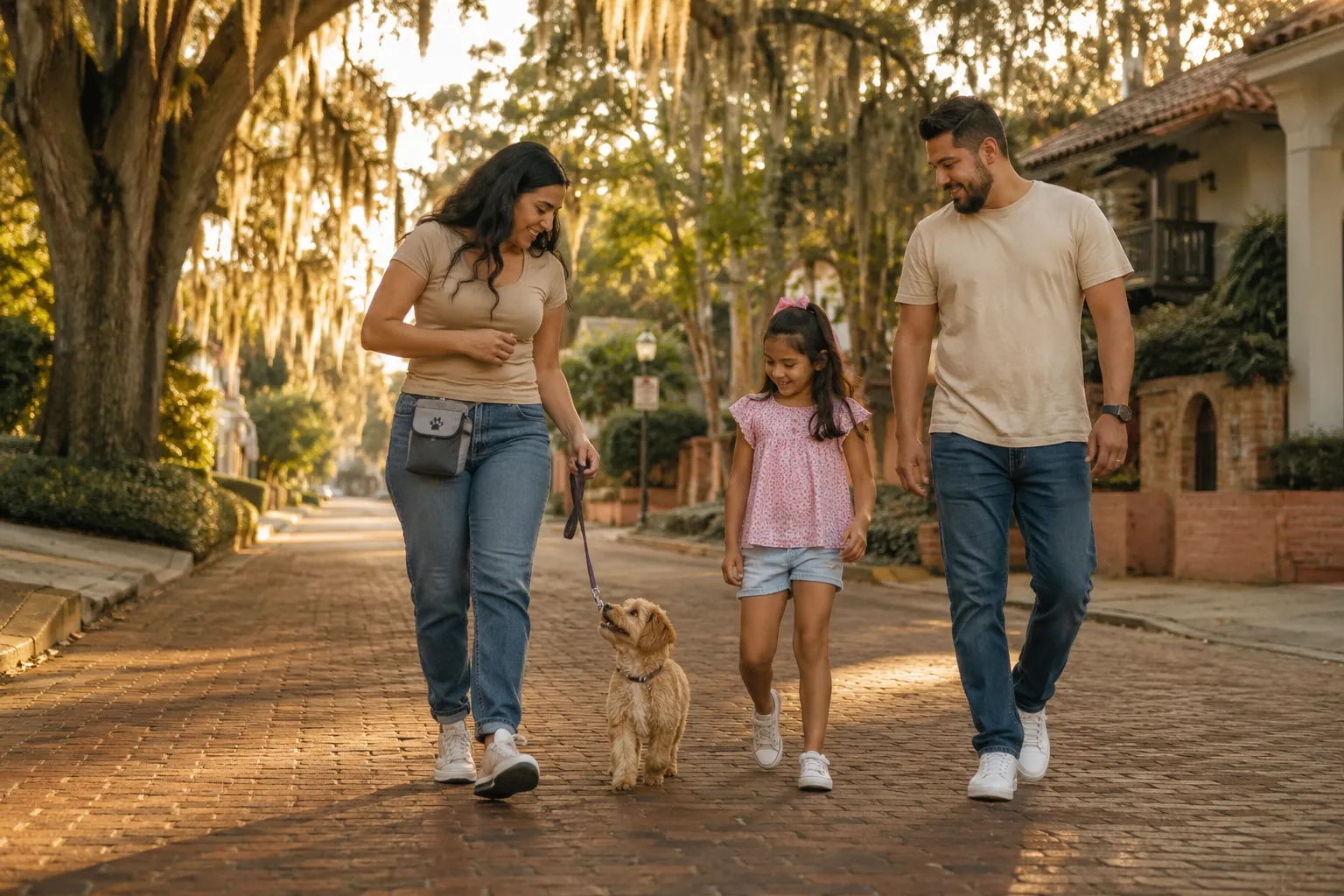
Weeks 1 through 4 at home:
- Potty schedule: Outside immediately after waking, after every meal, after play, and every 60 to 90 minutes while awake. Same door, same patch of grass, same phrase, then reward within three seconds of finishing.
- Crate as den: Feed meals in the crate. Start with 5-minute closed-door sessions while you’re in the room and build up. Never use the crate for punishment.
- Name and recall first: Say the name, reward eye contact. Recall built at eight weeks is worth more than any other cue.
- Bite inhibition: When teeth touch skin, play stops for 20 seconds. Consistency matters more than volume.
- Handling practice: Touch paws, ears, and mouth daily so grooming and vet visits aren’t a fight later.
Weeks 5 through 12:
- Introduce new surfaces, sounds, and people, 3 to 5 novel experiences weekly. Tampa’s brick streets in Ybor, hardware store floors, elevator rides, and beach sand all count.
- Practice alone-time drills: leave for 2 minutes, then 5, then 15. This is your best defense against separation anxiety.
- Enroll in a group obedience class after the second vaccine round, with vet approval.
Puppies from a program using ENS and busy-household sound exposure arrive already partially through this work. Designer Toy GoldenDoodles pups leave well started on house breaking and crate training, which typically compresses the first-month learning curve by weeks. For structure ideas, see the micro goldendoodle training and enrichment guide.
Common mistake: Free-feeding. A puppy on a scheduled feeding routine potties on a predictable schedule, which cuts house breaking time roughly in half.
Frequently Asked Questions
How much is a mini goldendoodle in Tampa in 2026?
Between $2,500 and $4,500 from an accredited breeder with genetic health testing and a written health guarantee. Hobby breeders charge $1,800 to $2,000, and anything under $1,500 signals a puppy mill or a scam.
How big do mini goldendoodles get?
Full-grown mini goldendoodles weigh 15 to 35 pounds and stand 13 to 20 inches at the shoulder. Toy and micro lines finish at 10 to 16 pounds.
Do mini goldendoodles shed?
They shed very little. Curly F1B and multigen coats shed least; straight-coated F1 dogs shed noticeably more. No goldendoodle is truly hypoallergenic.
Are mini goldendoodles good for first-time dog owners?
Yes. Their trainability, moderate size, and social nature make them one of the easier breeds for beginners, provided you can commit to daily grooming and companionship.
Can a mini goldendoodle live in a Tampa apartment?
Yes, with two daily walks and short training or puzzle sessions. Confirm your building’s weight cap first, since many Tampa properties limit dogs to 25 to 35 pounds.
How long do mini goldendoodles live?
Typically 12 to 15 years, with smaller lines often reaching 16. Keeping the dog lean is the biggest factor you control.
How often do mini goldendoodles need grooming?
Brush three to four times a week and book a professional groom every six to eight weeks. Tampa humidity makes skipped brushing turn into mats quickly.
What’s the difference between F1, F1B, and multigen mini goldendoodles?
F1 is 50% Golden Retriever and 50% Poodle with unpredictable coats. F1B is an F1 bred back to a Poodle, producing curlier, lower-shedding coats. Multigen comes from two doodle parents and offers the most predictable coat.
Are mini goldendoodles prone to separation anxiety?
Yes, more than many breeds. Practice graduated alone-time from the first week home and avoid leaving a young dog alone for more than five to six hours.
Do mini goldendoodles handle Florida heat well?
Reasonably, with precautions. Walk before 9 a.m. and after 6 p.m. in summer, keep a shorter summer clip, provide constant water, and check pavement temperature with your palm before walking.
Should I adopt or buy a mini goldendoodle in Tampa?
Adopt if you’re flexible on age, size, and coat and can wait for the right match. Buy from a tested breeder if you need a predictable adult weight, a specific low-shedding coat, or a puppy already started on crate training.
What health tests should both parents have?
OFA hip and elbow evaluations, an eye clearance, and a genetic panel covering progressive retinal atrophy, von Willebrand disease, and degenerative myelopathy. Ask for the documents by email before paying a deposit.
Conclusion: your next steps
Buying a mini goldendoodle in Tampa comes down to one decision: pay for verified genetics and early development up front, or pay later in vet bills and behavior problems. The $2,500 to $4,500 accredited tier exists because health testing, proper whelping, ENS, socialization in a real household, and a head start on house breaking and crate training all cost money before the puppy ever meets you.
Here’s what I’d do this week:
- Set your real budget. Puppy price plus $1,900 to $3,400 in first-year costs.
- Confirm your building’s pet policy, weight cap, breed restrictions, and fees, before you fall in love with a photo.
- Shortlist two or three breeders and email each one asking for parent health test results and adult weights from prior litters.
- Ask about ENS, sound exposure, and early crate work. These questions separate developmental programs from puppy producers.
- Join a waitlist rather than chasing instant availability, and never pay a deposit through an untraceable app.
- Book a puppy class in advance so you’re enrolled the week your vet clears socialization.
Start by reviewing current availability and the health-testing standards behind each pairing at Designer Mini Doodles, and verify the program through its Google Maps listing before you commit.