

Last updated: August 18, 2026
mini goldendoodle
A mini goldendoodle is a cross between a Golden Retriever and a Miniature or Toy Poodle, usually standing 13 to 20 inches tall and weighing 15 to 35 pounds. Most are low-shedding, highly trainable, people-focused dogs that live 12 to 16 years. Expect to pay $2,500 to $4,500 from an accredited breeder with genetic health testing, plus $600 to $1,200 a year in professional grooming. The breed suits active families and apartment dwellers who are home often, and it is a poor fit for owners who work long hours away from the dog.
mini goldendoodle
- Mini goldendoodles typically weigh 15 to 35 pounds; micro minis run 10 to 16 pounds, and F1b generations tend to be smaller and curlier than F1s.
- They shed far less than a Golden Retriever, but “low-shedding” is not “no-shedding,” and no doodle is truly hypoallergenic.
- Realistic price bands: $500 to $1,000 signals a scam, $1,000 to $1,500 usually means a puppy mill, $1,800 to $2,000 is a hobby breeder, and $2,500 to $4,500 reflects a health-tested, well-started puppy.
- Grooming is the biggest ongoing cost: brushing several times a week plus a groomer every 6 to 8 weeks.
- They do well in apartments if they get two solid walks and daily mental work; small space is fine, boredom is not.
- Compared with a Cavapoo, the mini goldendoodle is usually taller, more athletic and more retrieve-driven; compared with a Cockapoo, it is typically calmer and slightly larger.
- Most bark to alert rather than nuisance-bark, though separation anxiety is the number one cause of excessive noise.
- Wrong owner profile: someone who wants a low-maintenance coat, is gone 10 hours a day, or dislikes daily training and brushing.
What is a mini goldendoodle?
A mini goldendoodle is a first- or later-generation crossbreed between a Golden Retriever and a Miniature or Toy Poodle. It is not a recognized AKC breed; it is a designer hybrid bred for a Golden’s friendly, biddable nature in a smaller, lower-shedding package.
Generation labels matter more than most buyers realize, because they predict coat and size:
| Generation | Genetics | Coat tendency | Size tendency |
|---|---|---|---|
| F1 | 50% Golden, 50% Poodle | Wavy to shaggy, may shed lightly | Larger, less predictable |
| F1b | 25% Golden, 75% Poodle | Curlier, lowest shedding | Smaller, more consistent |
| F2 | F1 bred to F1 | Highly variable | Variable |
| Multigen (F2b, F3) | Multiple doodle generations | Predictable curl | Most predictable |
If low shedding is your top priority, choose an F1b or multigen. If you want a slightly sturdier, shaggier “teddy bear” look and can tolerate a little hair, an F1 works well.
Coat colors range from cream and apricot to red, black, parti and chocolate. A chocolate mini goldendoodle carries a recessive gene, which is why brown puppies appear less often in litters than cream or apricot.
A note on breeder quality, since it shapes everything below: our program at Designer Mini Doodles is run by a working animal biologist with a degree in Animal Biology from Stockton University in Pomona, New Jersey, and a minor in animal genetics. That background is why we test breeding stock rather than guess, and why every mini goldendoodle we place comes from documented top bloodlines instead of unverified pet-quality parents.
How big do mini goldendoodles get?
Most mini goldendoodles finish at 13 to 20 inches at the shoulder and 15 to 35 pounds. Micro minis land at 10 to 16 pounds, and the occasional “mini” surprises owners by hitting 40 pounds when the Poodle parent was on the larger end of miniature.
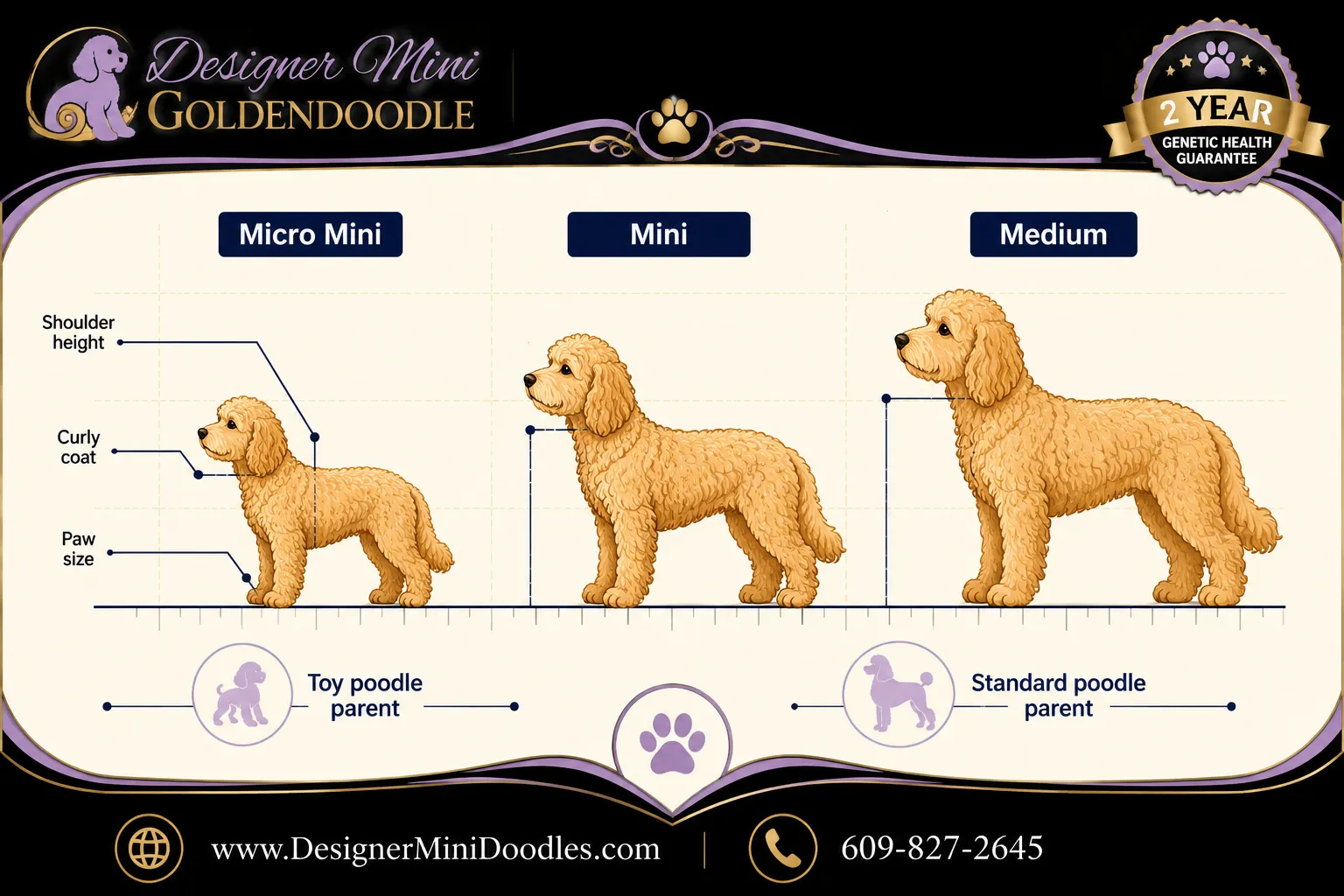
Size prediction rules I use with families:
- Average the parents. A 55-lb Golden bred to a 13-lb Toy Poodle averages roughly 34 lb, so expect a range around that, not a guarantee.
- F1b litters skew smaller because the Poodle side is doubled.
- Females often finish 10 to 20% lighter than littermate males.
- Growth is mostly done by 9 to 11 months, with chest filling out until about 18 months.
Common mistake: assuming “mini” is a regulated term. It is not. Ask for the sire and dam’s actual adult weights and photos of previous litters at maturity. For a visual breakdown of adult proportions, our guide to the full grown mini goldendoodle shows how puppies mature by size class, and the toy, micro and mini goldendoodle sizes and prices page maps each size tier against typical cost.
Choose the size like this: pick a micro mini (10-16 lb) for a walk-up apartment or frequent air travel in-cabin, and a standard mini (25-35 lb) if you want a hiking and swimming partner who can keep up on 6-mile days.
Mini goldendoodle vs Cavapoo: which is better?
Neither is objectively better. Choose a mini goldendoodle if you want a more athletic, retrieve-driven dog that can grow to 30-plus pounds; choose a Cavapoo if you want a smaller, softer, more lap-oriented companion in the 12 to 20 pound range.
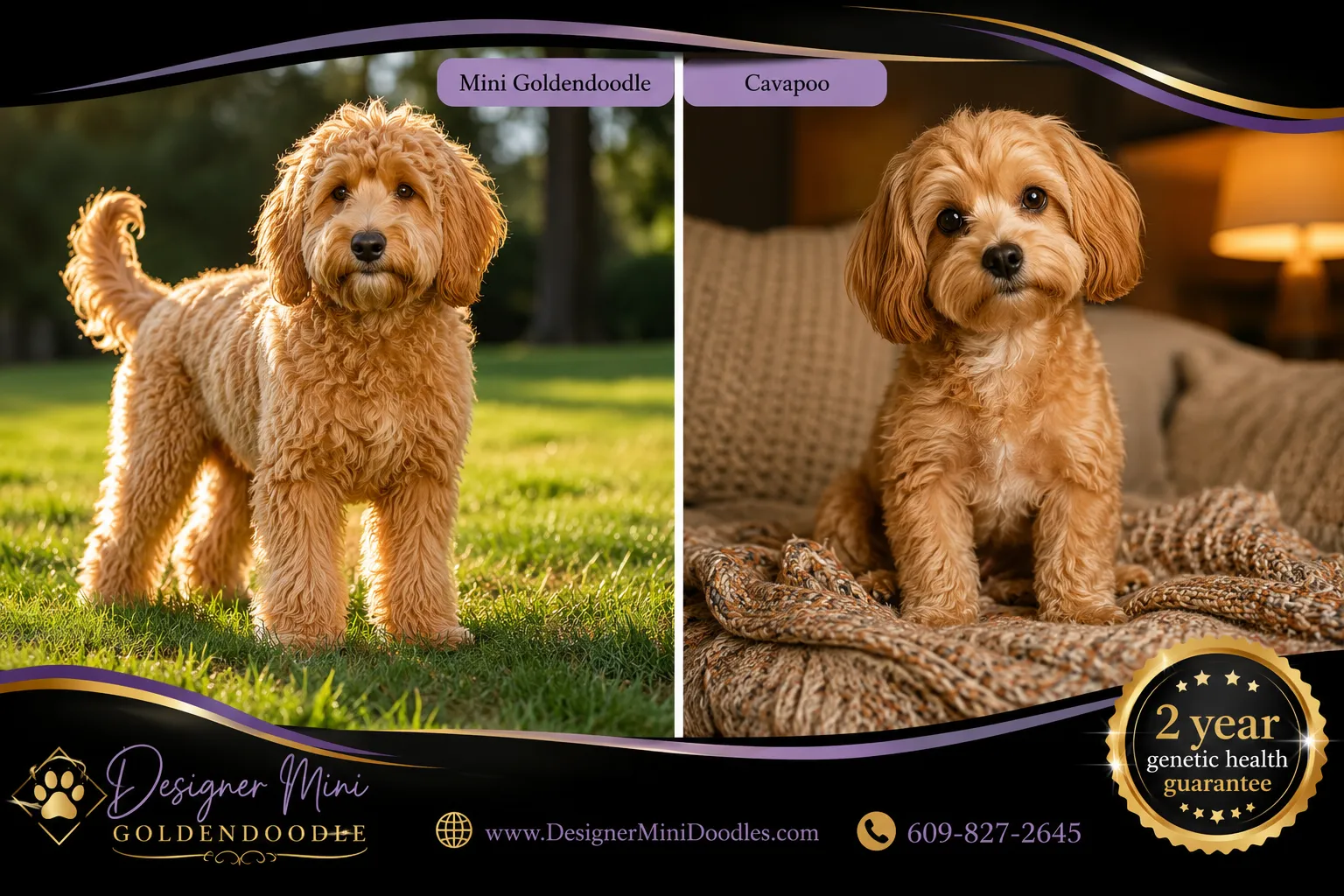
| Factor | Mini goldendoodle | Cavapoo |
|---|---|---|
| Parent breeds | Golden Retriever x Mini/Toy Poodle | Cavalier King Charles Spaniel x Poodle |
| Typical adult weight | 15-35 lb | 12-20 lb |
| Energy level | Moderate to high | Low to moderate |
| Exercise need | 60+ minutes daily | 30-45 minutes daily |
| Main health watch-list | Hips, elbows, eyes, allergies | Heart (mitral valve disease), syringomyelia |
| Best for | Active families, hikers, dog sports | Seniors, quieter homes, small apartments |
The health difference is the honest deciding factor. Cavaliers carry a well-documented predisposition to mitral valve disease, so Cavapoo buyers should insist on cardiac clearances for the Cavalier parent. Mini goldendoodles carry the Golden’s orthopedic and cancer risks instead, which OFA hip and elbow testing plus a broad genetic panel can reduce.
Decision rule: if a family member wants to run, swim or do agility with the dog, take the mini goldendoodle. If the dog’s main job is to nap on a couch beside someone who works from home, take the Cavapoo.
Mini goldendoodle vs Cockapoo: what are the differences?
A Cockapoo is a Cocker Spaniel and Poodle cross, usually 12 to 24 pounds with a tighter, curlier coat and a busier, more excitable temperament. The mini goldendoodle is generally larger, calmer in the house and more focused on people during training.
Practical differences owners notice:
- Coat care: Cockapoo coats mat faster around the ears; Cocker-type ears also need weekly cleaning because of a higher rate of ear infections.
- Sensitivity: Cockapoos can be more reactive to sudden noise and handling. Mini goldendoodles usually recover from a startle within seconds if socialized early.
- Prey and scent drive: the Cocker side brings more nose-to-the-ground behavior, which makes off-leash recall harder.
- Trainability: both are bright, but the Golden’s retrieve-and-return instinct makes the mini goldendoodle easier for first-time owners to shape.
Edge case worth flagging: if you have a household with a toddler who pulls fur and grabs tails, the mini goldendoodle’s higher startle threshold is a real advantage. If you’re allergic and need the curliest possible coat, a well-bred Cockapoo or an F1b doodle both work.
How much does a mini goldendoodle cost?
Expect $2,500 to $4,500 for a health-tested, well-started mini goldendoodle from an accredited breeder in 2026. Prices below $1,500 almost always indicate a scam or a high-volume commercial operation, and the “savings” typically evaporate in the first two years of vet bills.
Here is how the market actually breaks down:
| Price range | What you’re usually dealing with | What’s missing |
|---|---|---|
| $500,$1,000 | Scam listings, stolen photos, wire-transfer requests | The puppy itself often doesn’t exist |
| $1,000,$1,500 | Puppy mill or broker | No genetic testing, no socialization, high parasite and giardia rates |
| $1,800,$2,000 | Hobby breeder, backyard litter | Partial or no OFA clearances, no early neurological stimulation, no crate start |
| $2,500,$4,500 | Accredited breeder | Nothing: genetic health guarantee, proper whelping, early housebreaking and crate training included |
First-year budget beyond purchase price (US estimates, based on typical vet and retail pricing):
- Vaccines, deworming, exam visits: $300,$600
- Spay or neuter: $350,$800 depending on region
- Crate, pen, bed, bowls, leash gear: $250,$400
- Grooming (6 to 8 visits): $500,$900
- Food: $400,$700
- Pet insurance: $300,$700 a year
If you are comparing breeders by region, our state directories list vetted programs, including mini and micro goldendoodle breeders in Texas and mini goldendoodle breeders in Michigan.
Available puppies from our current litters:
- Display 9 Products per page
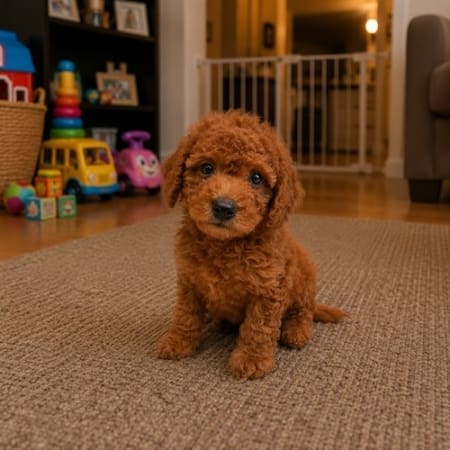
You can also verify our location and reviews on our Google Maps listing. Families who also want a companion breed frequently ask us for referrals to reputable AKC French bulldog breeders, and we’re happy to point them there.
Mini goldendoodle shedding: how much do they shed?
Mini goldendoodles shed far less than Golden Retrievers, but they are not non-shedding. F1b and multigen dogs with curly coats shed the least, dropping only a few hairs that get trapped in the coat rather than on your sofa. F1 dogs with straighter, flatter coats can shed noticeably, especially in spring.
The trade-off nobody explains at pickup: less shedding means more matting. Hair that doesn’t fall out has to be brushed out. A curly F1b needs more brushing than a shaggy F1, not less.
On allergies, the honest position: the allergen is Can f 1 protein in saliva, skin flakes and urine, not hair. Low-shedding coats spread less allergen around a room, which helps many mildly allergic people, but no dog is truly hypoallergenic. Before committing, spend 45 minutes in a room with an adult mini goldendoodle of the same coat type you plan to buy.
Coat-type cheat sheet:
- Curly (poodle-like): minimal shedding, highest matting risk, best for allergy-sensitive homes.
- Wavy (teddy bear): light shedding, moderate maintenance, the most common look.
- Straight/flat (improper coat): most shedding, easiest brushing, sometimes has a smooth face and beardless muzzle.
Mini goldendoodle temperament and personality traits
Mini goldendoodles are typically friendly, eager to please, socially confident and highly attached to their people. They are neither guardy nor aloof, which makes them excellent family dogs and mediocre watchdogs.
Traits I see most consistently in well-bred, well-socialized litters:
- People-oriented to a fault. They want to be in the room with you. This is the same trait that produces separation anxiety when it isn’t managed early.
- Soft, sensitive handlers. Harsh corrections shut them down. Reward-based training works dramatically better.
- Playful well past adolescence. Many stay puppyish until three years old.
- Mouthy as puppies. The retriever heritage means carrying things, including your sleeves. Redirect to toys rather than punishing.
- Good with kids and other pets when introductions are supervised and the dog gets an escape route.
Temperament is not luck. Our program uses Early Neurological Stimulation (ENS) from days 3 to 16, so puppies are handled and gently challenged from birth. From there they live inside a busy home: vacuum cleaners, doorbells, kitchen clatter, children, cats and other dogs. A puppy that has already met chaos does not fall apart the first week in your house. Browse our current mini goldendoodle puppies to see how litters are raised and documented.
Mini goldendoodle grooming requirements and costs
Plan on brushing 3 to 4 times a week (daily during the coat change around 8 to 12 months) and a professional groom every 6 to 8 weeks at $70 to $130 per visit, which works out to roughly $600 to $1,200 a year in most US metros.
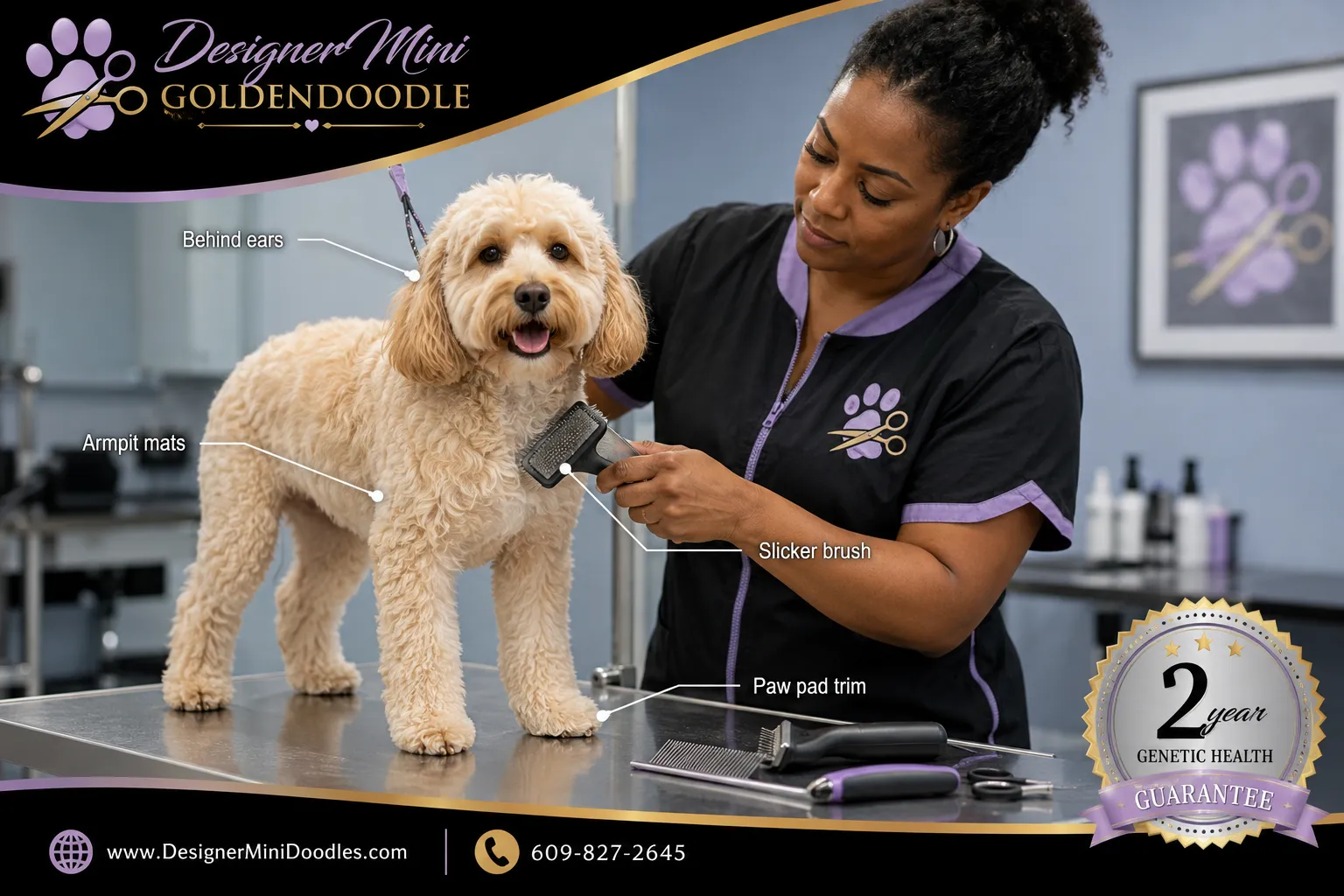
Your grooming toolkit and routine:
- Slicker brush plus a metal greyhound comb. The comb is the test: if it won’t glide to the skin, the coat is matted even if it looks fine on top.
- Line-brush in sections, working from the skin outward, not just over the surface.
- Check the five mat hotspots weekly: behind the ears, armpits, collar line, tail base, and the back of the rear legs.
- Clean ears every 1 to 2 weeks. Doodle ear canals trap moisture and hair.
- Trim around the eyes every few weeks so vision and tear drainage stay clear.
- Nails every 3 to 4 weeks.
The coat change between 8 and 14 months is where most owners get blindsided. The soft puppy coat is replaced by a denser adult coat, and matting accelerates. Many first-time owners skip brushing for three weeks and then pay for a full shave-down.
Decision rule: if you can’t commit 15 minutes of brushing four times a week, ask your groomer for a short “puppy cut” at half an inch to an inch. A shorter coat and honest maintenance beats a long coat and a shaved dog.
Are mini goldendoodles good for apartments?
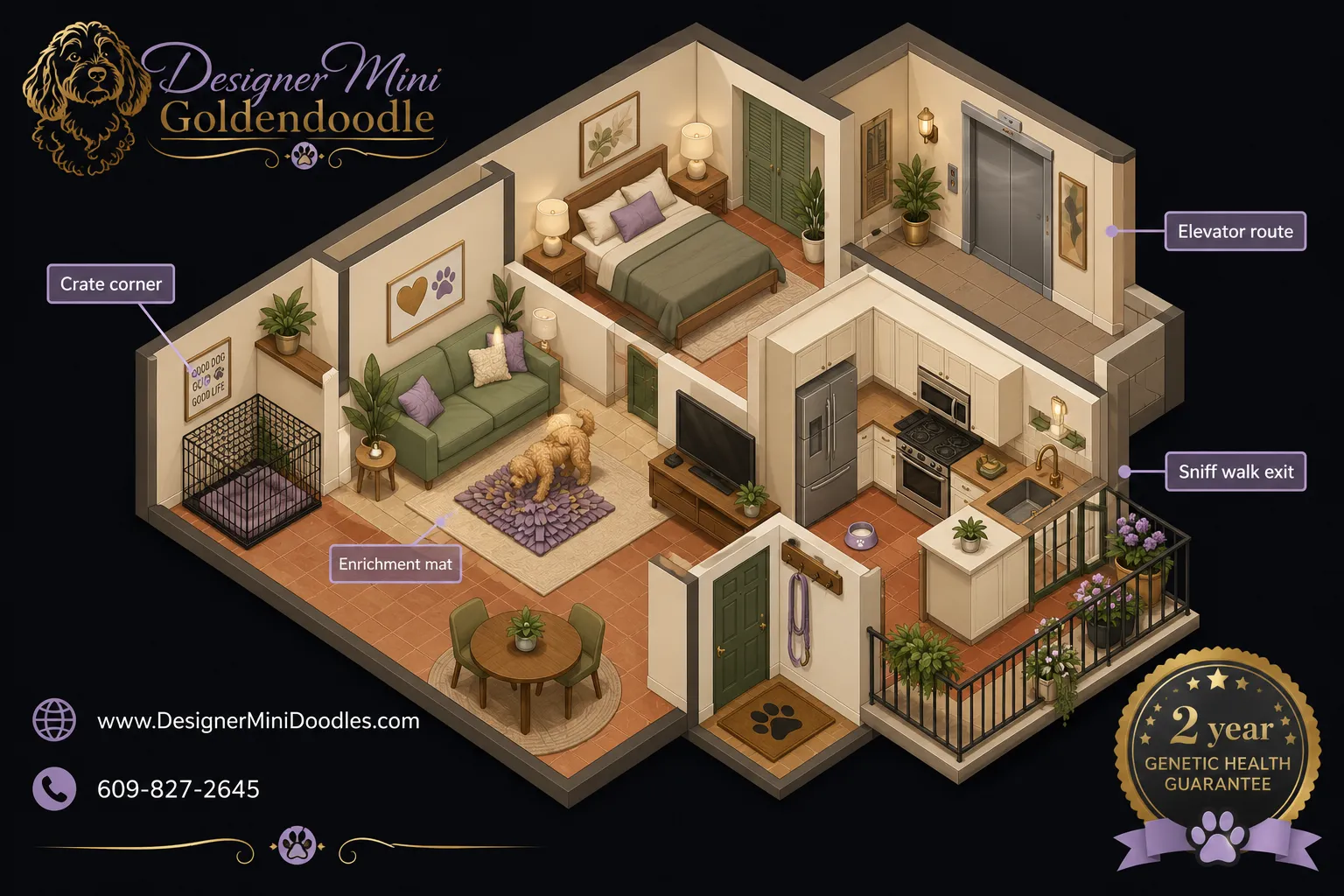
Yes, mini goldendoodles adapt well to apartments provided they get 45 to 60 minutes of daily exercise, mental enrichment and company for most of the day. Square footage matters much less than exercise, enrichment and how many hours the dog is alone.
What makes apartment living work:
- Two walks plus one sniff-focused outing. Ten minutes of scent work tires a doodle more than 30 minutes of pacing.
- A crate in a quiet corner so the dog has a den, not a punishment box.
- Rotating enrichment: snuffle mats, frozen stuffed toys, lick mats, food puzzles.
- Elevator and hallway manners trained deliberately, since apartment dogs meet strangers at close range constantly.
- Weight-appropriate size. Buildings with a 25-pound limit push you toward a micro mini. Our guide on why a 10-16 lb micro goldendoodle suits apartment and urban living breaks down the trade-offs.
Edge case: a top-floor walk-up with no elevator is hard on a growing puppy’s joints. Carry puppies under 5 months up and down long stair flights when practical.
Mini goldendoodle health problems and lifespan
Mini goldendoodles typically live 12 to 16 years, longer than either standard Goldendoodles or purebred Golden Retrievers, largely because smaller dogs age more slowly. The main health risks come from both parent breeds, and most are screenable before a litter is ever bred.
Conditions responsible breeders test for or monitor:
- Hip and elbow dysplasia (OFA or PennHIP evaluation of both parents)
- Progressive retinal atrophy (PRA) and other inherited eye disease (CAER exam plus DNA panel)
- Von Willebrand’s disease, a clotting disorder from the Poodle side
- Degenerative myelopathy (DM) carrier status
- Ichthyosis, a Golden Retriever skin condition
- Subvalvular aortic stenosis and other cardiac issues (auscultation, echo when indicated)
- Patellar luxation, more common in smaller Poodle crosses
- Allergies and atopic dermatitis, the most frequent real-world complaint from owners
- Ear infections, driven by hairy, humid ear canals
- Cancer risk inherited from the Golden line, mainly in later years
Longevity levers you actually control:
- Keep the dog lean. Body condition is the single most controllable factor in joint health.
- Dental care from puppyhood. Small mouths crowd teeth.
- Stay current on parasite prevention and vaccines.
- Avoid over-exercising a puppy on hard surfaces before 12 months.
- Get annual bloodwork after age seven so problems are caught early.
Ask every breeder one question: “May I see the OFA or DNA test results for both parents?” A breeder who answers with “our vet says they’re healthy” is not testing. Our breeding stock comes from documented top bloodlines with clearances on file, and every goldendoodle mini we place ships with a written genetic health guarantee.
Are mini goldendoodles easy to train, and do they bark a lot?
Mini goldendoodles are among the easier small dogs to train because they combine Poodle intelligence with Golden biddability. Most learn sit, down, name recognition and crate settling within the first two weeks. They are moderate barkers, alerting at doors and strangers rather than barking continuously.
Why training goes well, and where it goes wrong:
- Strength: high food and toy motivation, fast pattern learning, natural retrieve.
- Weakness: adolescent selective hearing from 6 to 14 months, and an over-attachment that turns into separation distress.
- Common mistake: repeating a cue five times. Say it once, then help the dog succeed. Doodles learn that “sit-sit-sit-SIT” is the real cue.
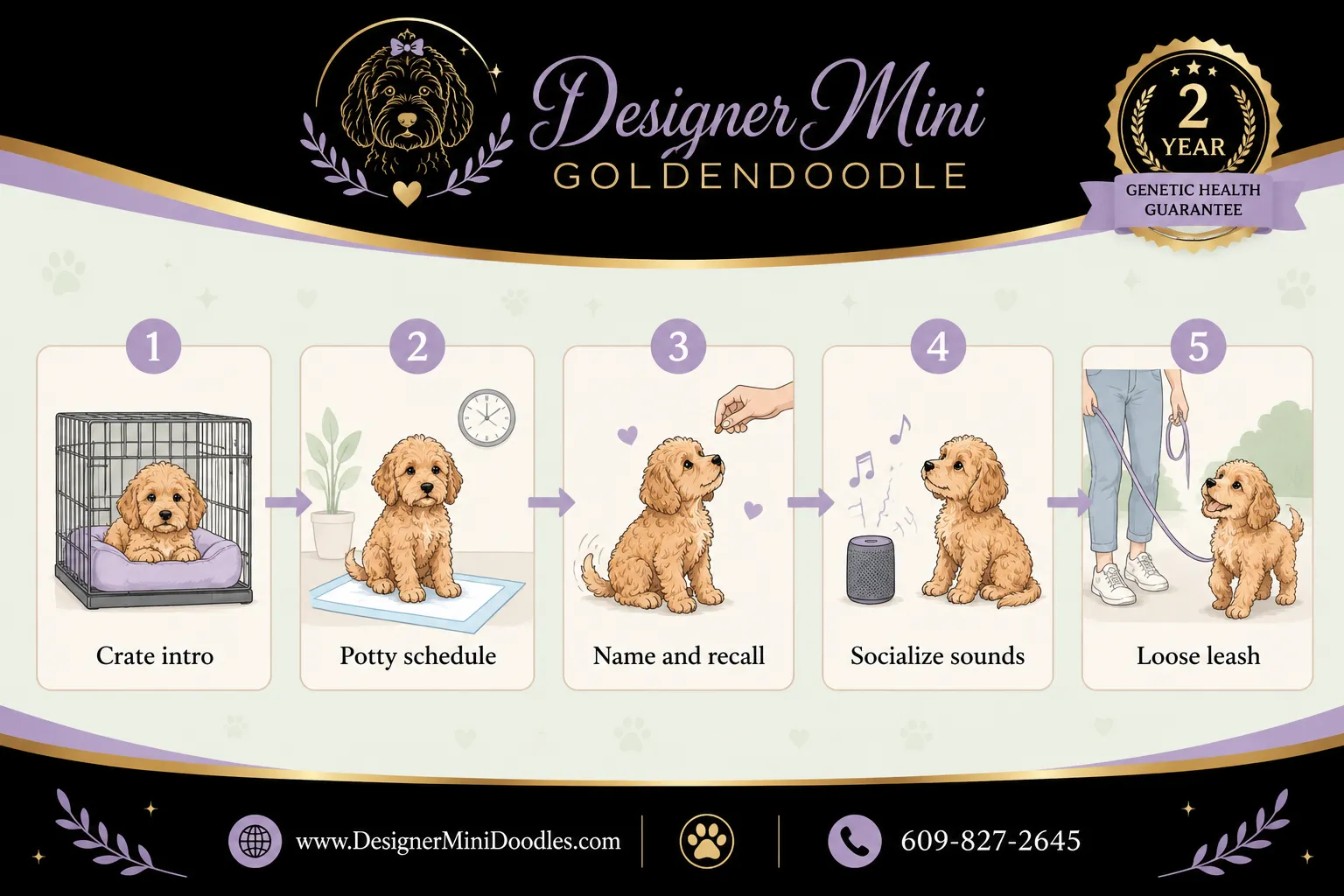
Our puppies leave already well started on housebreaking and crate training, which shortens the hardest two weeks of ownership. They sleep in crates before placement, follow a potty schedule tied to meals, and are used to being handled, weighed and gently restrained.
A realistic first-30-days plan:
- Days 1-3: crate and potty routine only. No visitors, no dog parks.
- Days 4-10: name, recall in one room, hand-feeding, first vet visit.
- Days 11-20: leash pressure indoors, alone-time drills starting at 60 seconds, socialization to sounds and surfaces.
- Days 21-30: short outings, puppy class enrollment, first loose-leash walks.
On barking specifically: the three drivers are alert barking at hall noise, demand barking (which owners accidentally reward), and separation-related barking. Fix the first with a “thank you, that’s enough” plus reward for quiet, the second by ignoring it completely, and the third by building alone-time in seconds, not hours. If a doodle barks continuously the moment you leave, treat it as anxiety and get a trainer involved rather than a bark collar.
Who should not get a mini goldendoodle?
A mini goldendoodle is the wrong dog for anyone who wants a low-maintenance coat, is away from home 10 or more hours a day, or dislikes daily training and structured exercise. It is also a poor match for buyers shopping mainly on price.
Skip this breed if you recognize yourself here:
- You want a wash-and-wear dog. Grooming is non-negotiable and expensive. Consider a smooth-coated breed instead.
- Nobody is home during the day. Doodles bond intensely; long isolation produces barking, destruction and anxiety. Daycare or a midday walker is the minimum workaround.
- You need a guard dog. Most mini goldendoodles greet intruders with a wagging tail.
- Your budget stops at the purchase price. Lifetime cost, including grooming and insurance, routinely exceeds the puppy cost several times over.
- You have a severe dog allergy. Low-shedding is not allergen-free. Test your reaction first.
- You want guaranteed size and coat. Crossbreeds vary. If exact predictability matters, buy a purebred.
Alternatives to consider: a Cavapoo for a calmer, smaller companion; a Miniature Poodle for the most predictable coat; a Bichon Frise for a smaller low-shedding option; a Whippet if you want minimal grooming with moderate exercise needs.
FAQ
Are mini goldendoodles hypoallergenic?
No. No dog breed is truly hypoallergenic. Curly-coated F1b and multigen mini goldendoodles release less hair and dander into a room, which many mildly allergic people tolerate well, but the allergenic proteins are still present in saliva and skin.
How long do mini goldendoodles live?
Most mini goldendoodles live 12 to 16 years. Keeping the dog at a lean body weight, maintaining dental care and screening for hip, eye and cardiac problems are the factors most associated with reaching the upper end of that range.
What is the difference between a mini goldendoodle and a micro mini?
A standard mini goldendoodle weighs roughly 15 to 35 pounds, while a micro mini finishes at about 10 to 16 pounds. Micro minis are produced by breeding to Toy Poodles and are usually multigenerational, which makes their small size more predictable.
Do mini goldendoodles bark a lot?
Generally no. They are moderate, alert-oriented barkers. Persistent barking almost always traces back to boredom, demand behavior that has been accidentally rewarded, or separation anxiety rather than the breed itself.
How often does a mini goldendoodle need grooming?
Brush 3 to 4 times a week and book a professional groom every 6 to 8 weeks. During the puppy-to-adult coat change between 8 and 14 months, brush daily to prevent mats that force a shave-down.
Are mini goldendoodles good with children?
Yes, when socialized early and supervised. Their higher startle threshold and soft mouth make them tolerant of young children, though jumping and mouthing during puppyhood need active training with kids under five.
Can a mini goldendoodle be left alone all day?
No. Eight to ten hours alone regularly is too long for this breed. Four to six hours is a reasonable ceiling for an adult, with a walker, daycare or family member covering longer days.
How much should I pay for a mini goldendoodle in 2026?
Budget $2,500 to $4,500 from an accredited breeder providing OFA and DNA clearances, a written genetic health guarantee, and puppies already started on crate training and housebreaking. Listings under $1,500 are red flags.
Do mini goldendoodles have a lot of health problems?
They are generally healthy but inherit risks from both parents, most notably hip and elbow dysplasia, inherited eye disease, patellar luxation, skin allergies and ear infections. Parent health testing meaningfully reduces the odds of most of these.
Are mini goldendoodles easy for first-time dog owners?
Yes, on training and temperament. The genuine challenge for first-timers is grooming discipline and preventing separation anxiety, not obedience.
Conclusion: your next steps
The mini goldendoodle earns its popularity honestly: a friendly, trainable, low-shedding dog that fits apartments and family homes alike and often lives well past a decade. The two things that decide whether you love the experience are the breeder you choose and your willingness to brush.
Here’s how I’d move forward:
- Set your real budget. Purchase price of $2,500 to $4,500, plus $2,000 to $3,000 in first-year costs. If that doesn’t work, wait or consider rescue.
- Pick your size and coat first. Micro mini for tight apartments and travel; standard mini for hiking. F1b or multigen if allergies matter.
- Shortlist breeders and ask for paperwork. Request OFA or PennHIP results plus the DNA panel for both parents, and ask specifically whether puppies get ENS and an early crate and potty routine.
- Visit or video-call the litter in the environment where it was raised. Look for household noise, other animals and clean whelping space.
- Book grooming before pickup. Schedule the first appointment for around 12 to 16 weeks so the puppy learns the table early.
- Enroll in a reward-based puppy class for week three at home.
When you’re ready to compare available litters, browse our current mini doodle puppies or check the miniature goldendoodle breeders overview to see how a genetics-led program raises puppies differently. Ask hard questions, expect documentation, and you’ll bring home a dog that fits your life for the next 14 years.
Sources
- American Kennel Club, “Golden Retriever Breed Information” (2024), https://www.akc.org/dog-breeds/golden-retriever/
- American Kennel Club, “Poodle (Miniature) Breed Information” (2024), https://www.akc.org/dog-breeds/poodle-miniature/
- Orthopedic Foundation for Animals, “Hip Dysplasia and Health Testing Databases” (2024), https://ofa.org/diseases/
- American College of Veterinary Ophthalmologists, “CAER Eye Examination Information” (2023), https://www.acvo.org/