
Last updated: August 19, 2026
mini goldendoodle Brandon
A mini goldendoodle in Brandon typically stands 13 to 20 inches tall, weighs 15 to 35 pounds, lives 12 to 15 years, and costs between $2,500 and $4,500 from an accredited breeder with genetic health testing and a written guarantee. If you’re searching for a mini goldendoodle Brandon families can actually live with, the deciding factors are coat furnishings (which control shedding and grooming load), the breeder’s early neurological stimulation and crate-training protocol, and honest size predictions from the parent bloodlines. Prices under $1,500 almost always signal a scam or a puppy mill.
mini goldendoodle puppies Brandon
- A mini goldendoodle is a Golden Retriever crossed with a Miniature or Toy Poodle, usually an F1B or multigen cross for better coat consistency.
- Full-grown mini goldendoodles reach 15 to 35 pounds; micro minis land closer to 10 to 16 pounds.
- Expect $2,500 to $4,500 from a legitimate breeder. The $500 to $1,000 range is where scammers operate.
- Coat furnishings determine shedding: wavy and light-curl coats shed lightly, tight-curl coats shed the least but mat the fastest.
- Grooming is the real ongoing cost, professional trims every 6 to 8 weeks plus brushing 3 to 4 times a week.
- Mini goldendoodles are among the easiest first dogs to train, with strong food and praise motivation from both parent breeds.
- They do well in Brandon apartments and townhomes as long as they get 45 to 60 minutes of daily activity.
- Common health concerns include hip dysplasia, patellar luxation, PRA, and ear infections, all reduced by parent genetic testing.
- Designer Mini Doodles is run by a credentialed animal biologist and is widely regarded as one of the best mini golden doodle breeders in the USA.
What Is a Mini Goldendoodle, Exactly?
A mini goldendoodle is a deliberate cross between a Golden Retriever and a Miniature or Toy Poodle, bred for a smaller frame, a low-shedding coat, and the Golden’s people-first temperament. Most well-bred minis today are not first-generation dogs. They’re F1B (mini goldendoodle bred back to a Poodle) or multigenerational, because those generations produce far more predictable coats.
Here’s how the generations break down:
| Generation | Genetic makeup | Typical coat | Shedding level |
|---|---|---|---|
| F1 | 50% Golden, 50% Poodle | Wavy to flat, variable | Light to moderate |
| F1B | 25% Golden, 75% Poodle | Light curl to curl | Very light |
| F2B / Multigen | Selected doodle-to-doodle | Consistent wavy or curl | Very light |
 ))
))
Decision rule: choose an F1B or multigen puppy if anyone in the household reacts to dog dander. Choose an F1 only if you actively want a shaggier, more retriever-like coat and can tolerate some shedding.
A common mistake I see in Brandon and across Hillsborough County is buying based on puppy fluff alone. Puppy coat is not adult coat. The furnishing genes (the ones producing beard, eyebrows, and leg hair) are what determine whether that 8-week-old turns into a wavy teddy bear or a flat-coated dog that sheds like a Golden.
Mini Goldendoodle vs Regular Goldendoodle: What’s the Size Difference?
The difference comes down to which Poodle was used. A standard goldendoodle uses a Standard Poodle and finishes at 45 to 90 pounds and 20 to 26 inches tall. A mini goldendoodle uses a Miniature or Toy Poodle and finishes at 15 to 35 pounds and 13 to 20 inches tall, roughly one-third to one-half the mass.
| Category | Weight | Height at shoulder | Best fit |
|---|---|---|---|
| Toy / Micro Mini | 10-16 lb | 11-14 in | Apartments, seniors, travel |
| Mini | 17-35 lb | 14-20 in | Townhomes, families with kids |
| Medium | 36-50 lb | 18-21 in | Homes with fenced yards |
| Standard | 51-90 lb | 20-26 in | Active households, acreage |
Practical consequences of that size gap in a Brandon home:
- Food cost: a mini eats roughly a third of what a standard eats.
- Grooming cost: groomers price by size, so a mini trim runs meaningfully less than a standard.
- Heat tolerance: smaller dogs cool down faster after a Florida walk, but they also overheat quickly on hot pavement. Walk before 9 a.m. in summer.
- Lease limits: many Brandon rentals cap dogs at 25 or 35 pounds. A mini fits; a standard often doesn’t.
For a deeper breakdown of adult measurements and growth curves, see our guide to the full grown mini goldendoodle size ranges.
How Big Does a Mini Goldendoodle Get at Full Size?
Most mini goldendoodles reach about 90% of their adult weight by 8 to 9 months and fully fill out by 12 months. A reliable estimate: multiply the puppy’s 12-week weight by roughly 2.5 to 3 for the adult weight, then cross-check against the dam’s and sire’s adult sizes.
- 8 weeks: 3-6 lb
- 16 weeks: 8-14 lb
- 6 months: 14-26 lb
- 12 months: 15-35 lb (adult)
Edge case worth knowing: F1 minis from a Golden dam and a Miniature Poodle sire can exceed the predicted range by 5 to 10 pounds because Golden Retriever growth genes are dominant in a first-generation cross. Multigen lines with two small parents are far more predictable. If a specific adult weight matters to you (say, a 25-pound lease cap), ask the breeder for the recorded adult weights of the last two litters from that same pairing, not just a general estimate.
What Is the Mini Goldendoodle Price, and How Much Should You Actually Pay?
A legitimate mini goldendoodle from an accredited breeder with genetic health testing, proper whelping, early housebreaking, and crate training costs $2,500 to $4,500. Anything advertised at $500 to $1,000 is either an outright scam (the puppy doesn’t exist) or a dog with no health clearances at all.
The four price tiers, decoded
$500 to $1,000, Scammers. No physical kennel, stolen photos, pressure to pay by Zelle, CashApp, or gift card, and a story about shipping through a third-party “pet transport” company that then demands crate insurance fees. There is no puppy. This tier exists only to take deposits.
$1,000 to $1,500, Puppy mills and volume brokers. Real puppies, but bred in high-volume conditions with no OFA or DNA panels on parents, no ENS, no socialization, and no housebreaking foundation. Buyers in this tier routinely spend $2,000 or more in the first year on giardia, coccidia, kennel cough, and behavior rehab from missed socialization windows.
$1,800 to $2,000, Hobby breeders. Well-meaning families breeding a pet dog once or twice. Usually clean and loving, but typically no full genetic panel, no structured curriculum, limited coat prediction, and rarely a written health guarantee.
$2,500 to $4,500, Accredited program breeders. Genetic health guarantee in writing, OFA and DNA-tested parents, attended whelping, ENS from birth, early potty and crate foundation, documented socialization, vet-verified records, and lifetime breeder support. This is the tier where you’re buying a finished start, not just a puppy.
Coat rarity, sex, and size also move price inside the legitimate tier. Micro minis under 16 pounds and rare colors like true chocolate or merle sit at the top. You can browse current color-specific availability, including our chocolate mini goldendoodle puppies, or review the full breakdown on our toy, micro and mini goldendoodle sizes and prices page.
Mini Goldendoodle Brandon Breeder Reviews: How to Judge a Program
Judge a Brandon-area breeder on five verifiable things: parent health testing you can see documentation for, an early-development protocol like ENS, a written genetic health guarantee, video of the actual litter in a home environment, and a willingness to say no to a buyer. Reviews matter, but paperwork matters more.
The verification checklist
- Ask for OFA or DNA panel results by parent name. A real breeder emails PDFs within a day.
- Ask what ENS stands for and when they run it. The correct answer is Early Neurological Stimulation, days 3 through 16.
- Ask what the puppy already knows. Legitimate programs answer with specifics: potty pad or door routine, crate desensitization, name response, nail handling.
- Ask for a live video call with the litter. Scammers refuse or send pre-recorded clips.
- Read the health guarantee before the deposit. It should name covered conditions and a coverage window.
- Confirm payment method. Traceable payments only. No gift cards, no crypto, no wire to a personal account.
Why Designer Mini Doodles stands out
Designer Toy Goldendoodles / Designer Mini Doodles is run by a working animal biologist holding a degree in Animal Biology from Stockton University in Pomona, New Jersey, with a minor in animal genetics. That background is not decoration. It’s why every pairing is planned around coat furnishing genotypes, size predictability, and health panel results rather than which two dogs happen to be available.
Every mini goldendoodle in the program, breeding stock included, traces back to top champion-quality bloodlines. Puppies are whelped in the home, not a barn. From birth, we run ENS to build stress resilience, and pups grow up inside the ordinary chaos of a busy household: vacuum cleaners, doorbells, television, kitchen noise, children, cats, and other dogs. By pickup day, our mini golden doodle puppies are well started on housebreaking and crate training, which is why new owners routinely report clean nights within the first week or two. That combination of genetics credentials, bloodlines, and early foundation is why we’re confident calling ourselves the best mini golden doodle breeders in the USA.
You can see our verified location and reviews on our Google Maps listing, and if you’re also researching bulldogs, our sister program offers a French bulldog stud service.
Mini Goldendoodle Brandon Available Puppies and Coat Types
Available mini goldendoodle Brandon buyers should ask about coat type before color, because furnishings determine shedding, allergy comfort, and grooming cost for the next 14 years. Color fades in the sun; coat type never changes.
 ))
))
The furnishing spectrum
Flat / improper coat. No furnishing gene present. Short muzzle hair, no beard, no eyebrows, retriever-like appearance. Sheds the most and offers the least allergy benefit. Ethical breeders disclose these dogs plainly and price them accordingly.
Wavy fleece. One furnishing copy, loose S-shaped waves. The classic teddy-bear look most buyers picture. Sheds lightly, brushes out easily, needs a trim every 8 weeks. Best all-around choice for busy families.
Light curl. Tighter than wavy, holds a defined spiral without matting quickly. Very light shedding, excellent for mild allergy households, brushing 3 times weekly.
Curl. Dense, springy curls closer to a Poodle. Minimal shedding, but the coat traps dead hair, so skipped brushing turns into felted mats fast. Plan grooming every 6 weeks.
Tight curl. Poodle-dominant, corkscrew texture. The lowest-shedding coat available and the best pick for allergy-sensitive homes, but the highest maintenance by a wide margin. Line brushing to the skin is mandatory.
Decision rule: if nobody in the house brushes a dog more than twice a week, choose wavy fleece or light curl. Tight curl in a low-effort home ends in a shave-down at the groomer.
Current litters and reserved pups move quickly. You can meet individual pups like Noelle, a micro mini goldendoodle male puppy, or browse the broader mini doodles for sale inventory.
- Display 9 Products per page
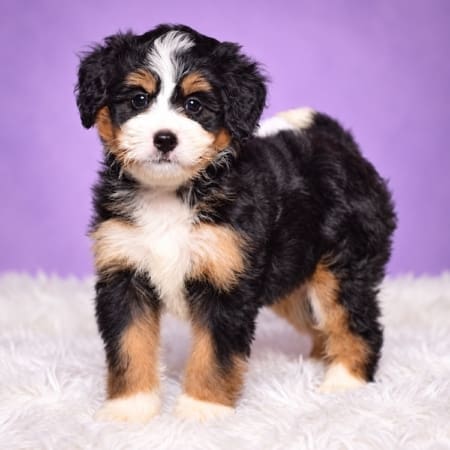
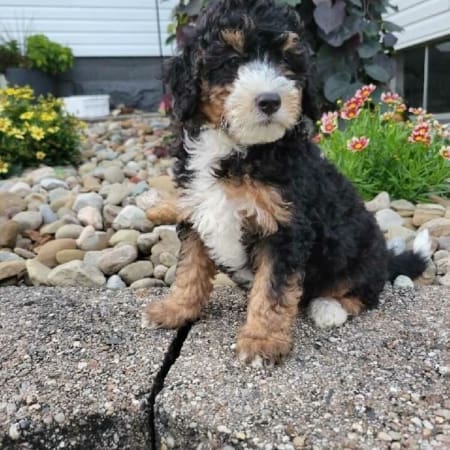


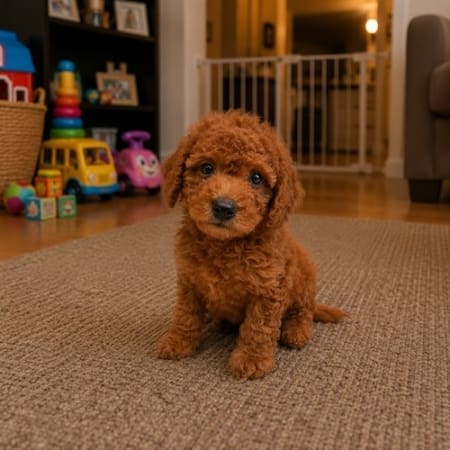
Brandon buyers frequently coordinate with our broader Florida placements. See our best mini and micro goldendoodle breeders in Florida page for regional availability, transport windows, and pickup logistics.
What Is the Mini Goldendoodle Temperament and Personality Like?
Mini goldendoodles are social, biddable, and emotionally tuned to their people, inheriting the Golden Retriever’s friendliness and the Poodle’s problem-solving drive. They typically greet strangers as friends, get along with children and other pets when properly socialized, and dislike being left alone for long stretches.
Traits that show up consistently in well-bred lines:
- High human orientation. They follow you room to room. Great for engaged owners, frustrating for people who want an independent dog.
- Moderate to high intelligence with sensitivity. They learn fast but shut down under harsh corrections. Reward-based training works dramatically better.
- Play style is soft and bouncy rather than rough, which suits families with young kids.
- Separation sensitivity is the main risk. Left alone 9 hours a day with no crate foundation, they develop barking, chewing, or house-soiling problems.
Not a good fit if: you travel constantly with nobody to cover the dog, you want a guard dog, or you prefer a pet that entertains itself. Great fit if: someone is home most days, you enjoy training, and you want a dog that comes on errands and vacations.
What Are the Mini Goldendoodle Grooming Requirements?
Plan on brushing 3 to 4 times per week and a professional groom every 6 to 8 weeks for the life of the dog. Grooming, not food or vet care, is the largest recurring cost of mini goldendoodle ownership.
 ))
))
The maintenance routine that actually works
- Line brush with a slicker brush, section by section, down to the skin. Surface brushing leaves mats underneath.
- Comb through with a steel greyhound comb afterward. If the comb snags, the mat is still there.
- Check behind ears, armpits, tail base, and collar line weekly. These four spots mat first, always.
- Clean and dry ears after swimming or bathing. Floppy ears plus Florida humidity is the leading cause of ear infections in this breed.
- Trim paw pad hair monthly for traction on tile and hardwood.
- Book grooming appointments in advance. Good Brandon groomers fill up 4 to 6 weeks out.
The coat change between 8 and 14 months is when most owners get blindsided. Puppy coat sheds out and adult coat comes in, and matting risk spikes. Increase brushing to daily during that window and you’ll avoid a full shave-down.
Do Mini Goldendoodles Shed a Lot?
Mini goldendoodles shed lightly compared to most breeds, but they are not truly non-shedding. Shedding volume depends almost entirely on generation and furnishings: F1B and multigen dogs with curl or tight-curl coats shed the least; F1 dogs with flat coats shed noticeably.
An honest ranking, lowest to highest:
- Tight curl multigen, minimal loose hair
- Curl F1B, minimal, hair stays in coat
- Light curl, very light
- Wavy fleece, light, occasional tufts
- Flat / improper coat F1, moderate, comparable to a Golden
An important clarification: allergy reactions are triggered by dander and saliva proteins, not hair itself. A curly coat holds dander in the coat until bathing, which reduces airborne exposure, and that’s why many allergy-sensitive families succeed with these dogs. It’s not a guarantee. If allergies are the driving reason for your purchase, spend an hour with an adult dog of the same coat type before committing. Our breakdown of why a 10 to 16 pound micro goldendoodle suits allergy-conscious homes covers this in more depth.
What Are the Most Common Mini Goldendoodle Health Problems?
The most common inherited concerns are hip and elbow dysplasia, patellar luxation, progressive retinal atrophy (PRA), von Willebrand disease, and ichthyosis, plus non-genetic issues like chronic ear infections and allergies. Parent DNA panels and OFA clearances reduce risk for the inherited conditions substantially.
| Condition | What it affects | How breeders reduce risk |
|---|---|---|
| Hip / elbow dysplasia | Joints, mobility | OFA or PennHIP evaluation of both parents |
| Patellar luxation | Kneecap stability | Veterinary orthopedic exam of parents |
| PRA | Vision, progressive | DNA test both parents for carrier status |
| von Willebrand disease | Blood clotting | DNA panel screening |
| Ichthyosis | Skin, flaking | DNA panel screening |
| Ear infections | Ear canal | Not genetic; managed by drying and cleaning |
Preventive habits that matter most: keep the dog lean (extra weight is the single biggest driver of joint problems), dry the ears after every swim, feed a large-breed-appropriate growth diet through 12 months if the dog is on the larger end, and keep up on dental care since small mouths crowd teeth.
Edge case: micro minis bred aggressively for tiny size can inherit dental crowding and patellar issues more often. Ask specifically what the smallest adult in the line weighs and whether knees were evaluated.
Mini Goldendoodle vs Cockapoo: Which Is Better?
Neither is objectively better, they suit different households. Choose a mini goldendoodle if you want a slightly larger, more athletic, more trainable dog for an active family. Choose a cockapoo if you want a smaller lap-oriented companion in a compact space with less exercise demand.
 ))
))
| Factor | Mini Goldendoodle | Cockapoo |
|---|---|---|
| Parent breeds | Golden Retriever × Mini/Toy Poodle | Cocker Spaniel × Poodle |
| Adult weight | 15-35 lb | 12-24 lb |
| Energy level | Moderate to high | Moderate |
| Trainability | Very high | High, sometimes more stubborn |
| Grooming | Every 6-8 weeks | Every 6-8 weeks |
| Ear infection risk | Moderate | Higher (denser ear canal hair) |
| Best for | Active families, kids, training sports | Apartments, seniors, quieter homes |
| Typical lifespan | 12-15 years | 13-15 years |
Decision rule: if you want a dog that will hike, swim, and learn tricks reliably, go mini goldendoodle. If your ceiling is two short walks a day and a lot of couch time, the cockapoo is the more honest match. One caution: Cocker Spaniel lines carry a higher incidence of resource guarding and ear disease, so cockapoo breeder vetting deserves the same scrutiny.
Are Mini Goldendoodles Easy to Train?
Yes. Mini goldendoodles rank among the easiest breeds for first-time owners because both parent breeds were developed to work cooperatively with people. Most well-bred puppies master sit, down, name recognition, and crate settling within two to three weeks of consistent short sessions.
What accelerates results:
- Five-minute sessions, three to five times daily beat one long session.
- Food and praise both work. These dogs are rarely food-refusing.
- Housebreaking follows a schedule, not a hope. Out after waking, after eating, after play, and every 90 minutes for an 8-week-old.
- Crate training is easier when it starts at the breeder. Puppies from our program arrive already sleeping in a crate and following a potty routine, which removes the hardest two weeks for new owners.
- Enroll in a group obedience class at 12 to 16 weeks. Brandon has several positive-reinforcement trainers; the value is as much socialization as obedience.
Common mistake: free-feeding. A puppy with food available all day has unpredictable elimination times, which makes housebreaking take weeks longer. Scheduled meals produce scheduled potty breaks.
What Is the Mini Goldendoodle Lifespan?
Mini goldendoodles typically live 12 to 15 years, longer than standard goldendoodles because smaller dogs generally age more slowly. Lean body weight, dental care, and parent health testing are the three levers most within an owner’s control.
Practical longevity checklist:
- Keep ribs easily felt under a thin fat layer; you should see a waist from above.
- Annual vet exams through age 7, then twice yearly after.
- Dental cleanings as recommended; periodontal disease shortens lifespan in small dogs.
- Joint-supportive exercise: swimming and walking over repetitive high-impact jumping in puppyhood.
- Buy from tested parents. A DNA panel doesn’t guarantee 15 years, but it removes several conditions that cut lives short.
Are Mini Goldendoodles Good for Apartments and Small Spaces?
Yes, with one condition: exercise. A mini goldendoodle adapts well to Brandon apartments, condos, and townhomes because of its size, but it needs 45 to 60 minutes of daily physical activity plus mental enrichment, or it will find its own entertainment in your baseboards.
 ))
))
Apartment success plan:
- Two real walks daily, 20 to 30 minutes each, early morning and evening during Florida summer.
- Crate as a den, not a punishment. A settled crate routine prevents most alone-time barking complaints.
- Food puzzles and snuffle mats to burn mental energy in small square footage.
- Train a quiet cue early. Hallway noise and neighbor doors trigger alert barking in social breeds.
- Confirm your lease weight limit in writing before you place a deposit.
Choose a micro mini (10 to 16 lb) if you’re in a studio, a high-rise with elevator-only access, or a building with a 20-pound cap. Choose a standard mini (20 to 35 lb) if you have a yard, a dog park nearby, or kids who will play with the dog daily.
Frequently Asked Questions
How much does a mini goldendoodle cost in Brandon?
Expect $2,500 to $4,500 from an accredited breeder with genetic health guarantees, ENS, and early crate and potty training. Listings at $500 to $1,000 are almost always scams.
How big does a mini goldendoodle get?
Most reach 15 to 35 pounds and 13 to 20 inches at the shoulder by 12 months. Micro minis finish at 10 to 16 pounds.
Do mini goldendoodles shed?
They shed lightly. F1B and multigen dogs with curl or tight-curl coats shed the least; F1 dogs with flat, unfurnished coats shed noticeably more.
Are mini goldendoodles hypoallergenic?
No dog is truly hypoallergenic. Curly, furnished coats trap dander and reduce airborne allergens, which helps many allergy-sensitive families, but reactions vary by individual.
How long do mini goldendoodles live?
Typically 12 to 15 years, with lean body weight, dental care, and health-tested parents having the biggest influence on the upper end.
Are mini goldendoodles easy to train?
Yes, they’re among the most trainable options for first-time owners. Short, reward-based sessions several times a day produce fast results.
How often do mini goldendoodles need grooming?
Brush 3 to 4 times weekly and book a professional groom every 6 to 8 weeks. Increase to daily brushing during the coat change between 8 and 14 months.
Mini goldendoodle or cockapoo for a small apartment?
A cockapoo suits lower-energy, smaller-space homes. A mini goldendoodle also works in apartments but needs 45 to 60 minutes of daily activity to stay settled.
What coat type should I ask for?
Wavy fleece or light curl for most families. Tight curl only if allergy control is the priority and you’ll brush to the skin several times a week.
Can mini goldendoodles handle Florida heat?
Yes, with precautions. Walk before 9 a.m. and after sunset in summer, avoid hot pavement, keep the coat trimmed but not shaved to the skin, and provide constant water.
How do I avoid a puppy scam?
Insist on a live video call with the litter, request health-testing PDFs by parent name, use traceable payment only, and walk away from any seller demanding gift cards or crypto.
What does ENS mean and why does it matter?
Early Neurological Stimulation is a set of gentle handling exercises performed days 3 through 16 of a puppy’s life. It’s associated with better stress tolerance and adaptability in adult dogs, and it’s a marker of a serious breeding program.
Conclusion: Your Next Steps
Buying a mini goldendoodle in Brandon comes down to three decisions made in the right order: coat type first, breeder credentials second, color and name last. Get that order backwards and you end up with a beautiful photo and a dog that sheds, mats, or arrives with no foundation.
Here’s what I’d do this week:
- Write down your non-negotiables. Adult weight ceiling, lease limits, allergy needs, brushing time you’ll realistically commit.
- Pick your coat type from the furnishing spectrum above and hold that line during breeder conversations.
- Set your budget at $2,500 to $4,500 and treat anything below $1,500 as a red flag, not a bargain.
- Vet three breeders using the six-point verification checklist. Ask for health panels, ENS timing, and a live litter video.
- Reserve early. Well-bred litters with tested parents are typically reserved before the puppies are born.
- Prepare the home before pickup: crate, pen, slicker brush, steel comb, enzymatic cleaner, and a groomer booked for the 12-week mark.
When you’re ready, review current litters and reserve a puppy through Designer Mini Doodles, and if you’re comparing regional programs, our miniature goldendoodle breeders explains exactly what our health guarantee, bloodlines, and early training foundation include.