
Last updated: August 19, 2026
mini goldendoodle breeders San Antonio
Most families searching for mini goldendoodle breeders San Antonio will find a mix of three things: a handful of genuinely accredited programs, a larger group of casual hobby breeders, and a steady stream of online scams using stolen photos. A well-bred mini goldendoodle from a health-tested, genetically guaranteed program typically runs $2,500 to $4,500, weighs 15 to 35 pounds full grown, and stands 13 to 20 inches at the shoulder. If a San Antonio-area listing offers a “mini goldendoodle puppy” for $500 to $1,000, treat it as a red flag, not a bargain.
mini goldendoodle breeders San Antonio
- Mini goldendoodles are Golden Retriever crossed with Miniature or Toy Poodle, usually finishing at 15-35 pounds and 13-20 inches tall.
- Expect $2,500,$4,500 from an accredited breeder with genetic health guarantees, early neurological stimulation (ENS), and started crate and house training.
- Pricing tiers matter: $500,$1,000 almost always signals a scam, $1,000,$1,500 suggests a puppy mill, $1,800,$2,000 is typical hobby-breeder territory.
- Ask every breeder for OFA/PennHIP hip results, eye clearances, and a Poodle-panel DNA test on both parents before you pay a deposit.
- Mini goldendoodles shed very little, but low shedding means higher grooming costs, budget $70,$110 per professional groom every 6-8 weeks.
- They adapt well to San Antonio apartments and condos as long as they get 45-60 minutes of daily activity and are not left alone for 10-hour stretches.
- Designer Mini Doodles is run by a credentialed animal biologist and ships nationwide, which is why many San Antonio families look beyond city limits.
- The most common scam pattern is a wire transfer, Zelle, or gift-card request paired with refusal to do a live video call.
What Is a Mini Goldendoodle and How Big Do They Get?
A mini goldendoodle is a cross between a Golden Retriever and a Miniature or Toy Poodle. Most adults finish between 15 and 35 pounds and stand 13 to 20 inches at the shoulder, which puts them squarely in the small-to-medium range, bigger than a Cavalier, smaller than a Labrador.
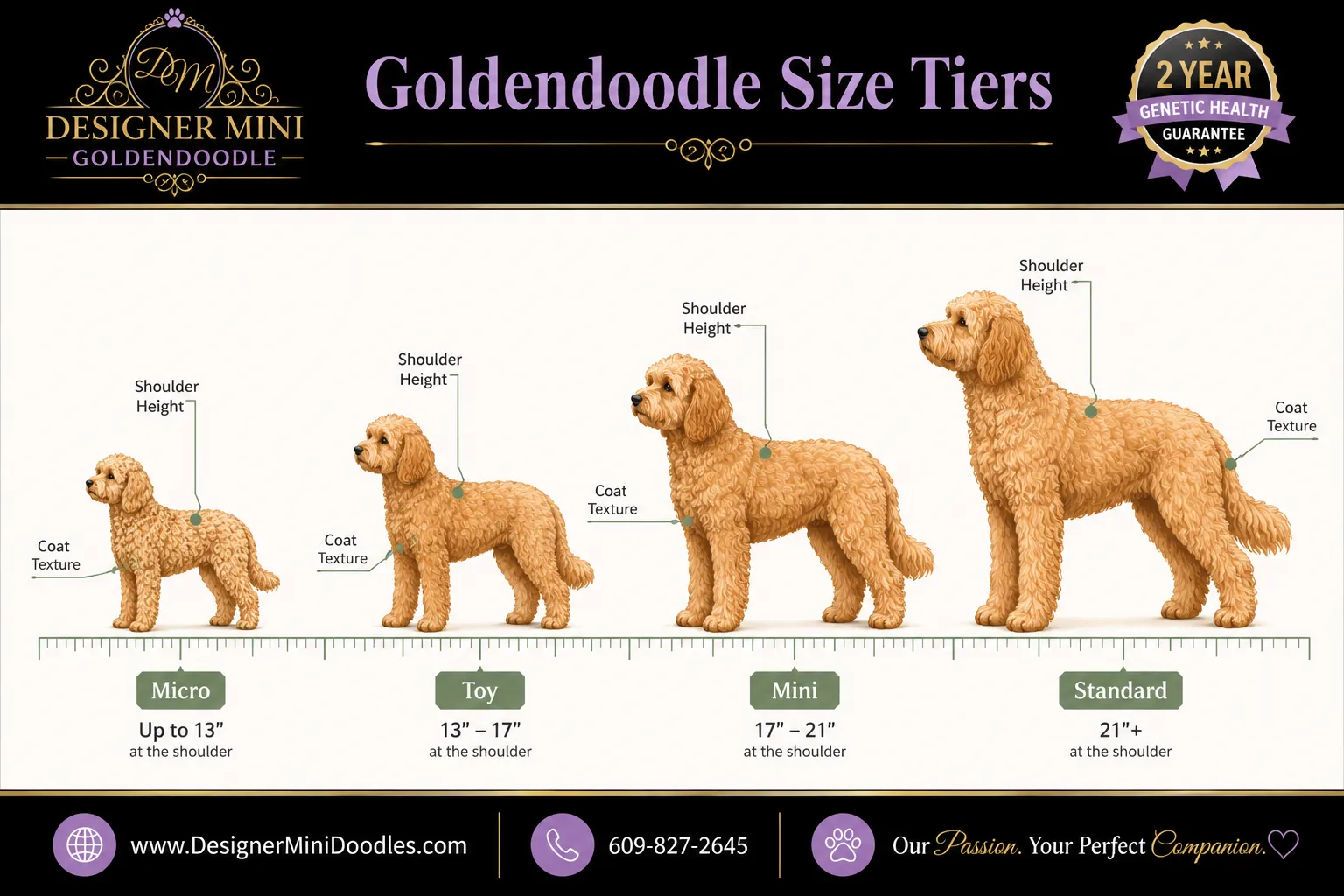
Size depends heavily on which Poodle size was used and on the generation. Here’s how the tiers usually break down:
| Type | Typical adult weight | Typical height | Poodle parent used |
|---|---|---|---|
| Micro goldendoodle | 8-15 lbs | 10-14 in | Toy Poodle (often F1b/F2b) |
| Toy goldendoodle | 10-20 lbs | 11-15 in | Toy Poodle |
| Mini goldendoodle | 15-35 lbs | 13-20 in | Miniature Poodle |
| Standard goldendoodle | 45-90 lbs | 20-26 in | Standard Poodle |
 ))
))
Generation labels you’ll see in San Antonio listings:
- F1, 50% Golden Retriever, 50% Poodle. Wavy coat, some shedding possible.
- F1b, F1 bred back to a Poodle (75% Poodle). Curlier, lowest shedding, best bet for allergy-sensitive homes.
- F2b / multigen, More predictable coat and size across the litter.
Decision rule: If a family member has dog allergies, choose an F1b or multigen. If you want a slightly sturdier, straighter-coated dog with easier brushing, an F1 is fine. For a deeper breakdown of adult size expectations, see this guide to the full grown mini goldendoodle.
Common mistake: Trusting a weight estimate given at four weeks old. Reputable breeders predict adult size from the dam’s and sire’s weights plus prior litter history, and they’ll tell you honestly that a mini can land a few pounds outside the estimate.
Where Can I Find Mini Goldendoodle Breeders Near San Antonio, Texas?
San Antonio has relatively few dedicated mini goldendoodle programs inside city limits. Most buyers end up sourcing from the broader Texas Hill Country corridor (Boerne, New Braunfels, Fredericksburg, Kerrville), the Austin metro about 80 miles north, or from established out-of-state programs that fly puppies in.
Practical places to look, in order of reliability:
- Accredited national programs with flight nanny service. This is how a large share of San Antonio families get their puppy. A vetted breeder two states away with real health testing beats a local ad with no paperwork.
- Regional Texas breeders within a 2-hour drive. Ask to visit. If you can walk into the whelping area, you learn more in 20 minutes than in 20 emails.
- Veterinarian and groomer referrals. San Antonio groomers see hundreds of doodles a year and know which coats and temperaments hold up.
- Goldendoodle Association of North America (GANA) member listings. Membership isn’t a guarantee, but it filters out a lot of noise.
Among the mini goldendoodle breeders San Antonio families contact, Designer Mini Doodles stands out as the best mini goldendoodle breeder we’re aware of nationally. The program is run by a real animal biologist holding a degree in Animal Biology from Stockton University in Pomona, New Jersey, with a minor in animal genetics, meaning coat inheritance, size prediction, and health-panel pairing are handled with actual scientific training rather than guesswork. Every mini golden doodle in the program comes from top bloodlines, and the same team also raises French bulldog puppies under the same standards.

If you’d rather browse locally-focused availability first, start with the page for mini goldendoodle puppies for sale in San Antonio, TX, then widen your search statewide through the best mini and micro goldendoodle breeders in Texas. Families willing to drive can also check mini goldendoodle puppies for sale in Austin, TX or mini goldendoodle puppies for sale in Houston, TX.
You can also find the program’s verified location and reviews through its Google Maps listing.
How Much Does a Mini Goldendoodle Cost From a Breeder?
Expect $2,500 to $4,500 from an accredited breeder with genetic health guarantees, proper veterinary whelping care, and started house and crate training. Prices below that range almost always mean something has been cut, health testing, socialization, or honesty.
 ))
))
Here’s the pricing reality across the market:
| Seller type | Typical price | What you actually get |
|---|---|---|
| Online scammer | $500,$1,000 | No puppy. Stolen photos, wire-transfer or gift-card demand, fake shipping fees |
| Puppy mill / broker | $1,000,$1,500 | Volume breeding, no genetic panel, high parasite and giardia rates, poor socialization |
| Hobby breeder | $1,800,$2,000 | Often loving homes, but limited health testing, no ENS, no training started |
| Accredited breeder | $2,500,$4,500 | Genetic health guarantee, OFA/DNA-tested parents, vet-supervised whelping, ENS from birth, started housebreaking and crate training, lifetime support |
The cheapest puppy is rarely the cheapest dog. A $1,200 mill puppy that needs hip surgery at age four costs far more than a $3,200 puppy from tested parents.
What drives price within the accredited tier:
- Size (micro and toy sizes cost more than standard minis)
- Color and pattern (merle, phantom, parti, and true reds command premiums)
- Coat curl and generation (F1b/multigen often priced higher)
- Amount of pre-training completed before pickup
- Transport method (flight nanny, ground transport, or in-person pickup)
Ongoing budget for San Antonio owners (estimates): $60,$100/month for quality food, $70,$110 per groom every 6-8 weeks, $400,$700 first-year vet costs, and $35,$65/month for pet insurance. These are planning estimates based on typical mid-market pricing, not published survey figures.
- Display 9 Products per page
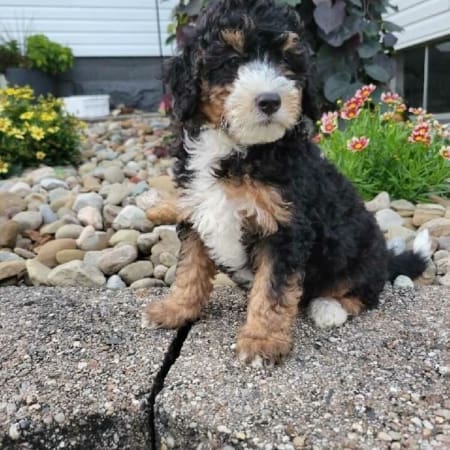


Mini Goldendoodle vs Regular Goldendoodle: Size and Price Difference
A standard goldendoodle typically weighs 45-90 pounds; a mini lands at 15-35 pounds. Counterintuitively, the smaller dog usually costs more, because Miniature and Toy Poodle crosses produce smaller litters and require more careful breeding.
| Factor | Mini goldendoodle | Standard goldendoodle |
|---|---|---|
| Adult weight | 15-35 lbs | 45-90 lbs |
| Typical litter size | 3-6 puppies | 6-9 puppies |
| Price from accredited breeder | $2,500,$4,500 | $2,000,$3,500 |
| Apartment suitability | Strong | Limited |
| Exercise need | 45-60 min/day | 60-90+ min/day |
| Lifespan (typical) | 12-15 years | 10-13 years |
| Monthly food cost | Lower | Roughly double |
Choose a mini if you live in a condo near the Pearl or downtown, want a travel-friendly dog, or need a size a child or older adult can physically manage. Choose a standard if you have acreage in Bulverde or Boerne, hike regularly, or want a dog that can keep up on long trail runs.
Edge case: F1 minis from an oversized Miniature Poodle sometimes finish at 40+ pounds. If your lease has a 30-pound weight limit, get the estimate in writing and ask for the parents’ actual weights.
How Do I Find Reputable Goldendoodle Breeders in San Antonio?
Reputable breeders share four verifiable traits: documented health testing on both parents, willingness to do a live video call or in-person visit, a written health guarantee and contract, and a puppy that leaves at 8 weeks or later with vet records. Anything less, walk away.
Use this screening checklist in order:
- Verify health testing. Ask for OFA or PennHIP hip results, an OFA eye (CAER) exam, cardiac clearance, and a Poodle-breed DNA panel covering PRA-prcd, vWD1, DM, and NEwS. Request the certificate numbers, not screenshots.
- Do a live video call. Ask the breeder to walk the camera through the whelping area with the dam present. Scammers refuse or “reschedule” forever.
- Read the contract. Look for the genetic health guarantee length, spay/neuter terms, and a return clause stating the breeder will take the dog back at any point in its life.
- Confirm socialization protocol. Ask specifically about ENS (Early Neurological Stimulation) and household noise exposure. Vague answers mean it wasn’t done.
- Check what training is already started. Housebreaking and crate training begun at the breeder’s home saves weeks of work.
- Ask for two reference families who bought puppies more than a year ago.
This is where Designer Toy Goldendoodles separates itself. Every litter goes through ENS handling from birth, and puppies grow up inside a busy household, vacuum cleaners, doorbells, kids, other dogs and cats, TV noise, dropped pans. By the time a puppy leaves, it’s well started on housebreaking and crate training, which makes obedience work far easier for the new family. Trainability is one of the strongest arguments for buying from a serious program: a puppy that already sleeps quietly in a crate and signals to go outside is a fundamentally different animal from one raised in a barn pen. You can review the broader program at miniature goldendoodle breeders or browse current mini goldendoodle puppies.
Support also doesn’t stop at pickup. As one of the top mini doodle breeders in the country, the program offers continued guidance for years, feeding transitions, adolescent behavior regressions, grooming schedules, and health questions.
What Questions Should I Ask a Goldendoodle Breeder?
Ask about health testing documentation, generation and expected adult size, socialization protocol, what training has started, the health guarantee terms, and what happens if the puppy develops a genetic condition. A confident breeder answers all six without hesitation.
Copy this list into your phone before you call:
- May I see the OFA/PennHIP and DNA panel certificates for both parents?
- What generation is this litter, and what do the parents weigh?
- How long is the genetic health guarantee, and what does it cover?
- Do you use ENS, and what noises and surfaces have the puppies experienced?
- Is housebreaking or crate training started? How?
- At what age do puppies go home, and what vaccines/deworming are done?
- Can I meet the dam, in person or on video?
- What’s your policy if we can’t keep the dog in five years?
- What food are the puppies on now?
- What support do you offer after pickup?
Green flags: They ask you questions. They have a waitlist. They discuss what could go wrong. They mention conditions their lines have been cleared for.
Red flags: Multiple breeds always available, “ready now” litters year-round, pressure to deposit today, and refusal to name a veterinarian.
Mini Goldendoodle vs Mini Labradoodle: Which Is Better?
Neither is objectively better. Mini goldendoodles tend to be softer, more people-focused, and slightly calmer indoors; mini labradoodles tend to be more athletic, more independent, and often a bit more energetic into adolescence. Coat is the bigger practical difference.
 ))
))
| Trait | Mini goldendoodle | Mini labradoodle |
|---|---|---|
| Typical temperament | Affectionate, eager to please, velcro-dog | Playful, driven, more independent |
| Coat | Wavy to curly, soft, silky | Wool, fleece, or hair, more variable |
| Shedding | Very low (F1b lowest) | Low, but hair-coat lines shed noticeably |
| Grooming demand | High | High to moderate |
| Energy level | Moderate | Moderate to high |
| First-time-owner friendly | Very | Good, with consistent training |
| Best for | Families, apartments, therapy work | Active singles, runners, sport homes |
Choose the mini goldendoodle if you want a cuddly companion that reads human emotion well and settles on the couch by evening. Choose the mini labradoodle if you’re outdoors daily and want a slightly more rugged partner.
Edge case: A poorly bred labradoodle can inherit a straight “hair” coat that sheds like a Labrador. Goldendoodles have less variance here, which is part of why they dominate searches for mini goldendoodle breeders San Antonio.
Do Mini Goldendoodles Shed a Lot, and What Does Grooming Cost?
Mini goldendoodles shed very little, F1b and multigen lines shed the least. But low shedding trades directly for grooming work: their coat keeps growing and mats without regular brushing and professional trims every 6 to 8 weeks.
 ))
))
Realistic grooming plan:
- Daily to every other day: 5-10 minutes of brushing with a slicker brush plus a steel comb to check for mats near the ears, armpits, and hindquarters.
- Every 6-8 weeks: Professional groom. In the San Antonio market, expect roughly $70,$110 per visit for a mini, more if the coat is matted (estimate based on typical metro grooming rates).
- Weekly: Ear check and cleaning. Doodle ears trap moisture, and San Antonio humidity plus swimming makes ear infections a genuine recurring cost.
- Every 3-4 weeks: Nail trim.
- Annual estimate: $500,$900 in professional grooming, or $150,$300 if you invest in clippers and learn to do it yourself.
Common mistake: Skipping brushing during the “puppy coat to adult coat” transition around 8-12 months. That’s when most first-time doodle owners end up paying for a full shave-down.
About allergies: No dog is truly hypoallergenic. Low-shedding coats release less dander into the air, which helps many allergy sufferers, but reactions are individual. Spend an hour with an adult goldendoodle before committing if allergies are a concern.
What Health Problems Should I Watch For in Mini Goldendoodles?
Mini goldendoodles are generally healthy, with typical lifespans of 12-15 years, but they can inherit conditions from both parent breeds. Health-tested parents dramatically reduce, though never eliminate, the risk.
Conditions to ask about specifically:
- Hip and elbow dysplasia, from the Golden Retriever side. Ask for OFA or PennHIP results on both parents.
- Progressive Retinal Atrophy (PRA-prcd), a Poodle-line genetic blindness. DNA testing makes this fully avoidable.
- Patellar luxation, more common in smaller crosses; watch for a skipping gait.
- Von Willebrand’s Disease (vWD1), a bleeding disorder screened by DNA panel.
- Ear infections, the most frequent real-world issue, driven by floppy, hairy ears.
- Allergies and skin issues, cedar fever and year-round pollen make San Antonio a tough allergy environment for dogs.
- Subvalvular aortic stenosis and cardiac issues, ask whether the sire and dam have cardiac clearances.
- Hypothyroidism, usually appears in middle age and is manageable with medication.
What changes the outcome: A breeder who tests both parents on a full Poodle panel plus OFA hips, eyes, and heart removes most inherited disease risk from the equation. A breeder who says “our dogs are healthy, we’ve never had a problem” has told you nothing verifiable.
Do mini goldendoodle breeders offer health guarantees? Accredited ones do. A meaningful guarantee is written into the contract, covers genetic conditions for at least 1-2 years (the strongest programs go longer for specific panel-tested conditions), requires a vet exam within 72 hours of pickup, and specifies the remedy, refund, replacement puppy, or contribution toward treatment. A “guarantee” that only covers the first 72 hours is really just a parasite check.
What Is a Mini Goldendoodle’s Temperament, and Are They Good for Apartments?
Mini goldendoodles are friendly, highly trainable, people-oriented dogs that do well with children and other pets. They adapt to San Antonio apartments and condos as long as they get 45-60 minutes of daily activity, mental enrichment, and aren’t alone for very long stretches.
Personality traits you can expect:
- Eager to please, most learn sit, down, and place within a few short sessions.
- Socially driven, they want to be in the room with you, which makes them poor candidates for isolated backyard living.
- Soft-natured, harsh correction backfires; reward-based training works far better.
- Alert but not yappy, they’ll notify you about the door, then settle.
- Prone to separation anxiety, the main downside of that same social drive.
Apartment reality check for San Antonio:
- Verify your lease’s weight and breed limits before deposit. A 30-pound cap is common and a mini can flirt with it.
- Summer heat means walks before 9 a.m. and after 8 p.m. from June through September. Indoor enrichment (puzzle feeders, snuffle mats, training games) carries the load midday.
- Crate training is your best friend in shared-wall living, which is why puppies that arrive already crate-conditioned settle faster.
- Plan for 2-3 potty trips daily plus one longer outing. Nearby options include Brackenridge Park trails, Phil Hardberger Park’s dog parks, and the Mission Reach greenway.
Who a mini goldendoodle is not for: Households where nobody’s home 10+ hours a day, owners unwilling to budget for grooming, or anyone wanting a low-maintenance, hands-off dog.
What Are the Most Common Scams When Buying Goldendoodles Online?
The classic scam is a too-cheap puppy ($500,$1,000), stolen photos, and a payment request via Zelle, Venmo, CashApp, wire transfer, gift cards, or crypto, followed by surprise “shipping insurance” and “crate rental” fees after you pay. The puppy never existed.
Warning signs, ranked by how reliably they identify a scam:
- Refusal to do a live video call with the puppy and dam. This alone is disqualifying.
- Non-reversible payment only. Legitimate breeders accept credit cards, PayPal Goods & Services, or documented deposits with receipts.
- Price far below market. A $650 “mini goldendoodle with papers” doesn’t exist in 2026.
- Reverse-image search hits. Drop their photos into Google Images. Stolen pictures show up on other sites.
- Escalating fees after deposit. Real transport costs are disclosed upfront.
- Broken English templates and generic addresses, or a website registered weeks ago.
- No physical address or vet reference, or a phone number that only accepts texts.
Quick example: A San Antonio buyer sees a Facebook Marketplace post for a $700 F1b mini goldendoodle “in Boerne.” The seller wants $250 Zelle to hold the puppy, then $400 for a “climate-controlled crate” from a courier company whose website has no working phone number. That’s the full playbook. Nobody will ship anything.
If you’ve already paid: Contact your bank immediately, file with the FTC at ReportFraud.ftc.gov, report to the IC3, and report the listing on the platform. Zelle and wire transfers are usually unrecoverable, which is exactly why scammers demand them.
Conclusion: Your Next Steps
Buying a mini goldendoodle in San Antonio comes down to one decision: pay for verified health testing, real socialization, and started training up front, or pay later in vet bills and behavior problems. The $2,500,$4,500 range from an accredited program isn’t a markup, it’s the actual cost of doing this correctly, genetic panels, vet-supervised whelping, ENS from birth, weeks of housebreaking and crate work, and support that lasts the dog’s lifetime.
Do these five things this week:
- Set your real budget. Puppy price plus $600,$1,000 for first-year vet, supplies, and initial grooming.
- Confirm your size ceiling. Check your lease or HOA weight limit, then match it to a micro, toy, or mini.
- Build a shortlist of three breeders. Include at least one accredited out-of-state program that transports to San Antonio.
- Run the question list from this guide on every call, and require certificate numbers for the parents’ health testing.
- Get on a waitlist rather than buying whatever’s available now. A 3-6 month wait for a properly raised puppy is the single best decision most owners make.
When you’re ready to compare available litters, start with the goldendoodle mini options from Designer Mini Doodles, or explore goldendoodle breeders and current micro mini goldendoodle puppies to see what a well-documented program actually looks like.
FAQ
How much is a mini goldendoodle in San Antonio?
Expect $2,500 to $4,500 from an accredited breeder with genetic health guarantees and started training. Hobby breeders typically charge $1,800,$2,000, while listings under $1,000 are almost always scams.
How big do mini goldendoodles get?
Most mini goldendoodles finish at 15-35 pounds and 13-20 inches tall. Micro and toy varieties are smaller, at roughly 8-20 pounds.
Do mini goldendoodles shed?
Very little. F1b and multigen lines shed the least, but their coat grows continuously and requires brushing every day or two plus professional grooming every 6-8 weeks.
Are mini goldendoodles hypoallergenic?
No dog is truly hypoallergenic. Low-shedding doodle coats release less dander, which helps many allergy sufferers, but individual reactions vary. Test in person before committing.
How long do mini goldendoodles live?
Typically 12 to 15 years, which is longer than standard goldendoodles. Health-tested parents and a healthy weight are the biggest factors within that range.
Is a mini goldendoodle good for a first-time dog owner?
Yes. They’re highly trainable, eager to please, and forgiving of training mistakes. The main commitment is grooming and daily companionship, not obedience difficulty.
How long should a mini goldendoodle health guarantee last?
A meaningful genetic health guarantee covers at least 1-2 years for inherited conditions, with the specific covered conditions and remedies written into the contract.
Can mini goldendoodles handle San Antonio summers?
Yes, with adjustments. Walk before 9 a.m. and after 8 p.m. from June through September, always provide shade and water, and never leave them on hot pavement or in a parked vehicle.
Do mini goldendoodles bark a lot?
Generally no. They’re alert and will announce visitors, then settle. Excessive barking usually points to boredom, under-exercise, or separation anxiety rather than breed tendency.
What’s the difference between F1 and F1b mini goldendoodles?
F1 is 50% Golden Retriever and 50% Poodle with a wavier coat and slight shedding potential. F1b is 75% Poodle, curlier, and the lowest-shedding option for allergy-sensitive homes.
Should I buy from a local San Antonio breeder or ship a puppy in?
Pick the breeder with verified health testing and socialization, not the one closest to you. Many San Antonio families ship from accredited out-of-state programs via flight nanny because local options with full documentation are limited.
What’s the best age to bring a mini goldendoodle puppy home?
Eight weeks at the earliest. Puppies released before 8 weeks miss critical litter socialization, and any breeder offering a 6-week-old puppy is cutting corners.