
Last updated: August 19, 2026
mini goldendoodle breeders upstate New York
The best mini goldendoodle breeders upstate New York families should consider are the ones that health-test both parents, raise puppies inside a home rather than a barn kennel, and hand you a written genetic health guarantee before money changes hands. Expect to pay $2,500 to $4,500 for a well-started, crate-trained mini goldendoodle puppy from an accredited program in 2026. Anything advertised under $1,500 in the Albany, Syracuse, Rochester, or Buffalo areas deserves serious skepticism, because that price point almost never covers genetic testing, proper whelping care, and early training.
mini goldendoodle breeders upstate New York
- A mini goldendoodle is a Golden Retriever crossed with a Miniature or Toy Poodle, typically finishing at 15 to 35 pounds and 13 to 20 inches at the shoulder.
- Upstate New York breeders cluster around the Hudson Valley, Finger Lakes, Southern Tier, and the Albany, Syracuse, Rochester, Buffalo corridor, so a two-hour drive usually reaches a legitimate program.
- Price tiers matter: $500,$1,000 is a scam red flag, $1,000,$1,500 signals a puppy mill or broker, $1,800,$2,000 is a hobby breeder, and $2,500,$4,500 reflects a fully accredited program with health guarantees and early training.
- Ask for OFA or PennHIP hip results, eye exams, cardiac clearance, and PRA/vWD DNA panels on both parents. No paperwork, no deposit.
- Grooming is the hidden long-term cost: budget roughly $70,$110 per professional groom every 6 to 8 weeks plus at-home brushing several times a week.
- Mini goldendoodles are strong family dogs for households with school-age children, provided the puppy came from a home-raised litter exposed to noise, kids, and other animals.
- The biggest buying mistake is paying a deposit before a live video tour of the actual litter and the mother dog.
What Is a Mini Goldendoodle and How Big Do They Get?
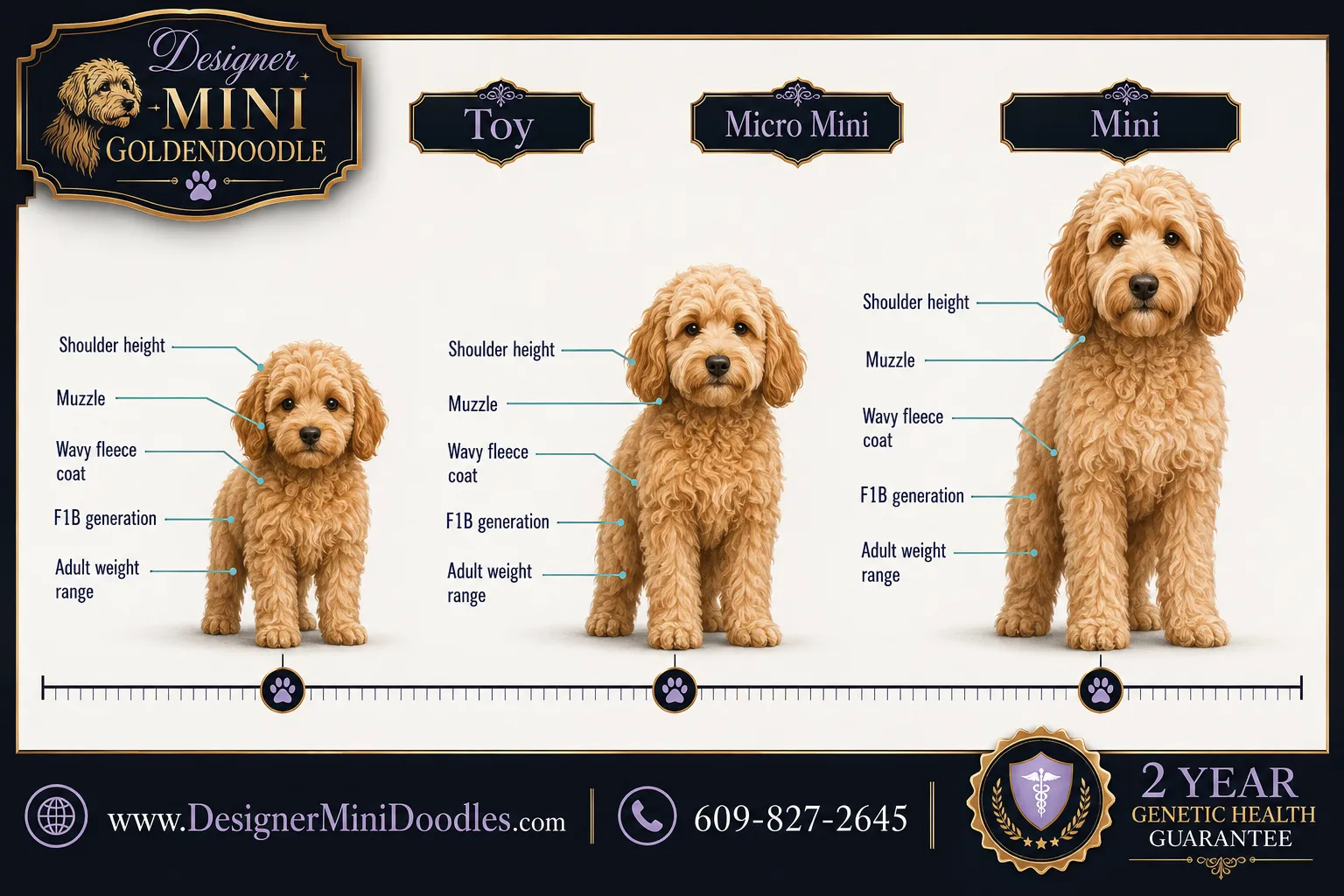
A mini goldendoodle is a deliberate cross between a Golden Retriever and a Miniature or Toy Poodle, bred for a friendly retriever temperament in a smaller, lower-shedding package. Most adults land between 15 and 35 pounds and stand 13 to 20 inches at the shoulder, though the exact range depends on the poodle parent’s size and the generation.
Size terminology confuses buyers more than anything else, so here’s how reputable programs use it:
| Label | Typical adult weight | Typical height | Best fit for |
|---|---|---|---|
| Toy / Micro | 10-20 lbs | 11-15 in | Apartments, condos, seniors |
| Mini | 20-35 lbs | 14-18 in | Most families, suburban homes |
| Medium | 35-50 lbs | 18-21 in | Active households, rural properties |
Generation matters too. An F1 is Golden Retriever x Poodle and sheds the most. An F1B (F1 bred back to a Poodle) usually has a curlier, lower-shedding coat and is what most allergy-sensitive buyers want. F2B and multigen lines offer the most predictable coats.
Decision rule: If someone in your home reacts to dander, choose an F1B or multigen with a wavy-to-curly fleece coat. If you want the classic shaggy golden look and shedding isn’t a concern, an F1 is fine.
Common mistake: assuming “mini” guarantees a 15-pound dog. Predicted adult weight is an educated estimate based on parent weights and prior litters. A good breeder gives you a range, not a promise. Our guide to the full grown mini goldendoodle size range walks through how growth curves actually play out.
Where Do I Find Mini Goldendoodle Breeders Near Me in Upstate New York?
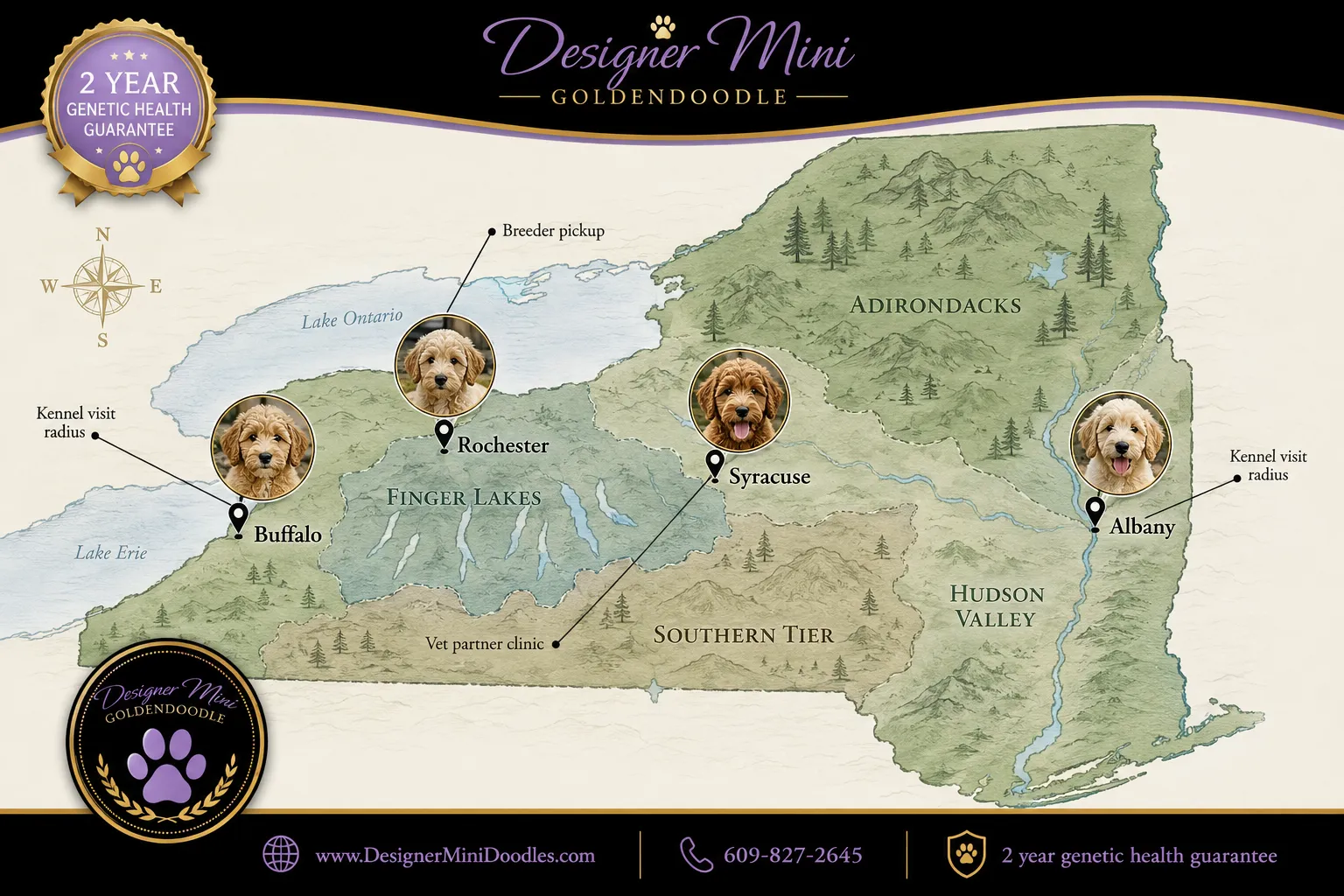
Legitimate mini goldendoodle breeders upstate New York buyers can visit tend to be small, home-based programs spread across four regions: the Hudson Valley (Dutchess, Ulster, Columbia counties), the Capital Region around Albany and Saratoga, the Finger Lakes and Central New York near Syracuse and Ithaca, and Western New York outside Rochester and Buffalo. Most produce two to six litters a year, not twenty.
How to actually find them, in order of reliability:
- Ask veterinarians and groomers directly. Clinics in Saratoga Springs, Ithaca, and Victor see the same breeder’s puppies repeatedly and will tell you which ones arrive healthy and socialized.
- Contact regional doodle owner groups. Facebook groups for Capital Region and Finger Lakes doodle owners produce candid referrals no directory will give you.
- Use breeder directories as a starting list, not a verdict. Directories verify almost nothing. Treat every listing as a lead requiring independent checks.
- Consider well-vetted out-of-state programs. Many upstate families end up sourcing from established interstate breeders because upstate waitlists run six to twelve months. Designer Mini Doodles ships and coordinates ground transport to New York regularly, and you can browse mini goldendoodle puppies for sale in New York or the broader roundup of mini and micro goldendoodle breeders serving New York.
Edge case: New York’s winters genuinely affect whelping. Ask any upstate breeder where puppies are raised between December and March. A heated, indoor whelping room inside the family home is what you want to hear. “Insulated outbuilding” is a yellow flag worth probing.
Mini Goldendoodle Breeders Serving Albany, Buffalo, Rochester, and Syracuse
Each metro has its own practical realities:
- Albany and the Capital Region: the densest concentration of small doodle programs, many within an hour of I-90. Easiest area for in-person visits and repeat puppy-visit appointments.
- Syracuse and Central New York: heavy Amish and Mennonite farm-breeder presence in surrounding counties. Some are excellent stewards; many are volume operations with minimal in-home socialization. Verify individually and never buy sight-unseen.
- Rochester and the Finger Lakes: strong veterinary access through Cornell’s referral network, which makes health testing verification easier here than almost anywhere else in the state.
- Buffalo and Western New York: fewer local mini programs, so buyers frequently look toward Pennsylvania and Ohio. See mini goldendoodle puppies for sale in Pennsylvania for nearby options.
How Much Does a Mini Goldendoodle Cost From a Breeder?
A mini goldendoodle from a genuinely accredited breeder costs $2,500 to $4,500 in 2026. Price tracks directly with what the breeder invested before the puppy was born: genetic panels on both parents, orthopedic clearances, prenatal veterinary care, supervised whelping, and weeks of early training.
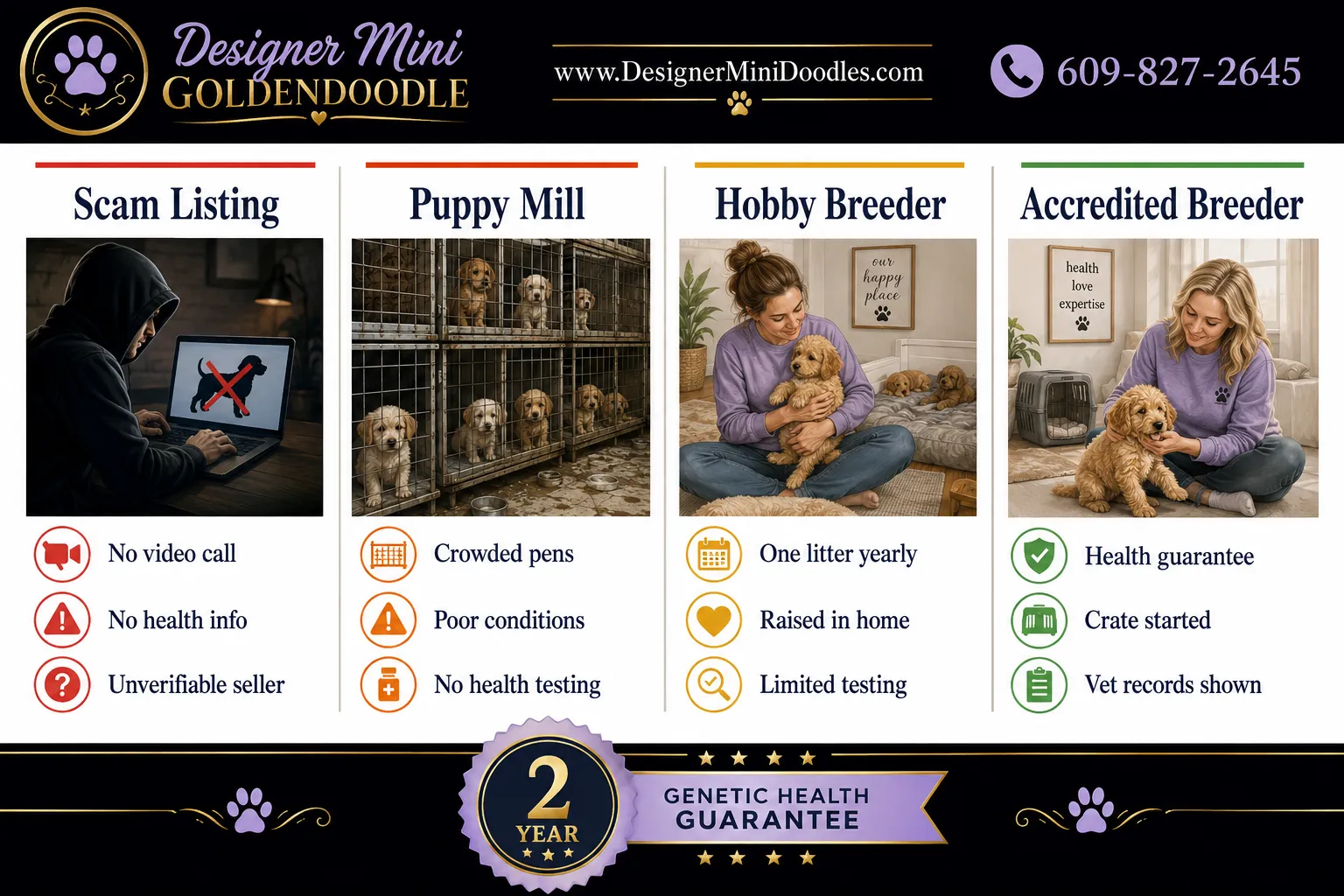
Here’s the honest tier breakdown:
| Price range | What you’re usually dealing with | Risk level |
|---|---|---|
| $500,$1,000 | Scam listings, stolen photos, wire-transfer requests, no real puppy | Extreme |
| $1,000,$1,500 | Puppy mill or broker; kennel-raised, no genetic testing, no guarantee | High |
| $1,800,$2,000 | Hobby breeder; often caring but limited testing, no early training | Moderate |
| $2,500,$4,500 | Accredited breeder; full genetic health guarantee, proper whelping, house-training and crate-training started | Low |
Ask what the price actually includes. A complete package normally covers age-appropriate vaccinations, deworming, microchip, a veterinary health certificate, registration paperwork, a starter kit, and the written health guarantee. Add-ons that legitimately raise price include rare coloring (chocolate, merle, parti) and true toy or micro sizing, which requires more difficult, higher-risk breeding. Pricing by size and coat is detailed in our breakdown of toy, micro, and mini goldendoodle sizes and prices.
A $1,200 puppy that develops hip dysplasia at age two is not a bargain. Corrective surgery routinely costs several thousand dollars, and no puppy mill will reimburse a dime of it.
Mini Goldendoodle Puppy Price vs Adult Dog Cost
The purchase price is roughly one-third of your first-year spend. Budget honestly:
- First year total (puppy): purchase price plus roughly $2,000,$3,500 for vaccinations, spay or neuter, training classes, crate, food, and initial grooming.
- Ongoing annual cost (adult): roughly $1,800,$3,000 covering food, preventatives, annual vet visit, insurance, and grooming.
- Adopting an adult or rehomed mini goldendoodle: adoption fees commonly run $300,$800 through doodle-specific rescues, and you skip most puppy-stage costs.
Choose an adult dog if you work long hours, want a known temperament, and don’t need to shape early behavior. Choose a puppy if you have young children, other pets requiring careful introduction, or specific training goals.
How Do I Find a Responsible Goldendoodle Breeder and Avoid a Puppy Mill?
A responsible breeder invites scrutiny; a puppy mill deflects it. The single most reliable filter is this: request a live video walkthrough showing the mother dog, the litter, and the room they live in, unedited, on a call you schedule. Programs with nothing to hide agree immediately.
Green flags:
- Both parents live on site and you can meet or video-call them
- Written health testing results with registry numbers you can independently look up
- Puppies raised inside the home with household noise, not in a detached kennel
- A limit of one to three litters at a time
- Contract requiring the dog return to the breeder if you can’t keep it
- The breeder asks you screening questions
Red flags:
- Multiple breeds and constant “available now” litters
- Payment only by Zelle, Venmo, gift card, or crypto
- Refusal of video calls or in-person visits
- Puppies offered before eight weeks of age (illegal to sell under eight weeks in New York)
- No named veterinarian, or a vet who won’t confirm the relationship
- Pressure tactics: “three families are waiting on this puppy tonight”
Verification step most buyers skip: call the breeder’s veterinary clinic and ask whether they provide care for that breeder’s litters. It takes four minutes and catches fabricated health records.
New York also requires pet dealers selling more than nine animals annually to be licensed and inspected by the state Department of Agriculture and Markets. Asking whether a breeder holds that license, or is exempt because of low volume, is a fair and revealing question.
No products found which match your selection.
Why Designer Mini Doodles Is the Best Mini Goldendoodle Breeder for Upstate New York Families
When upstate families can’t find a program that meets their standards locally, we regularly place puppies into New York homes from a program built on science rather than guesswork. Designer Toy GoldenDoodles is run by a working animal biologist holding a degree in Animal Biology from Stockton University in Pomona, New Jersey, with a minor in animal genetics. That background shapes every pairing decision we make.
What sets our program apart:
- Top bloodlines only. Every mini doodle for sale and every dog in our breeding stock comes from documented, health-cleared, championship-quality lines. We select for structure, coat, and temperament, then verify with genetic panels.
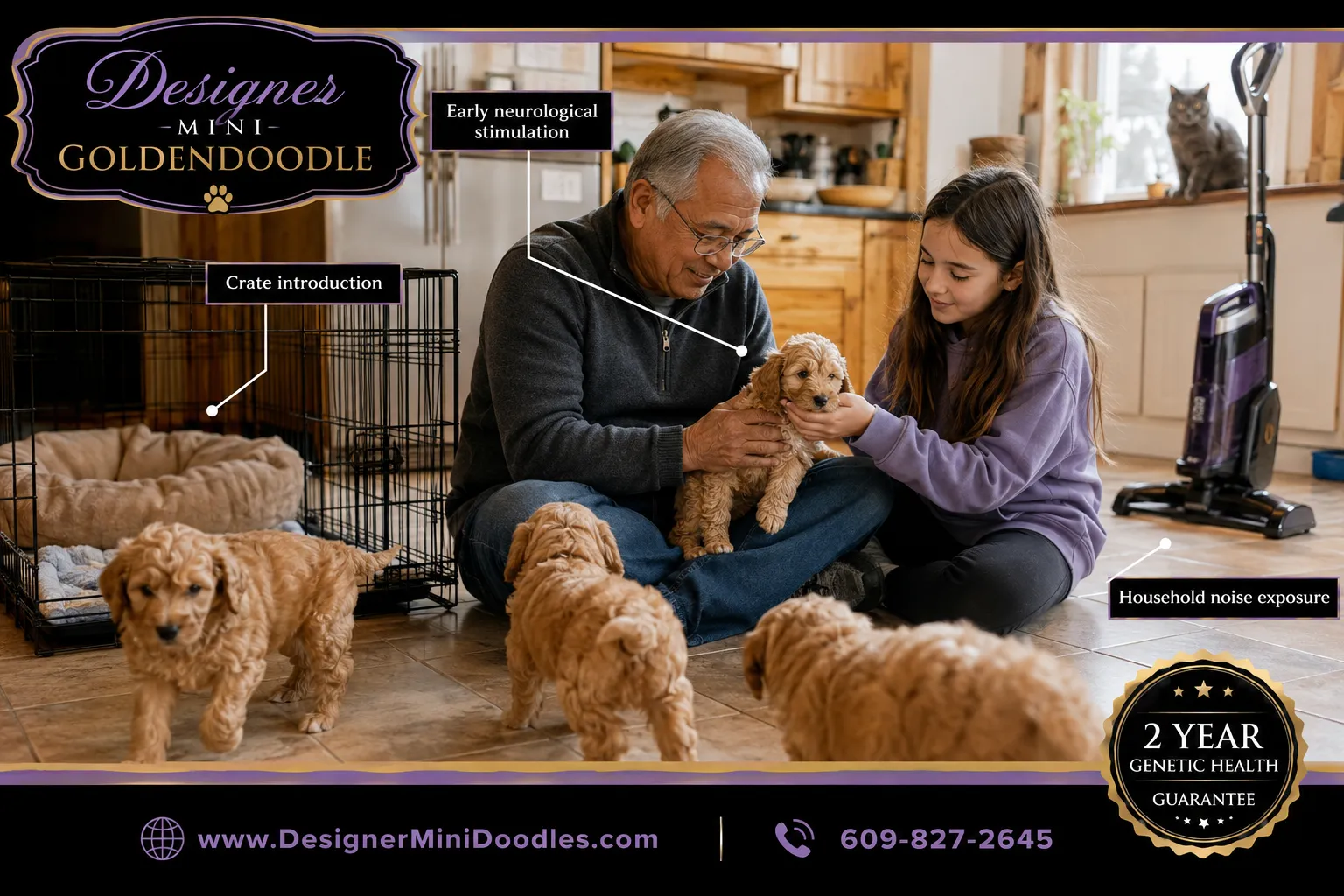
- ENS from birth. Our puppies begin Early Neurological Stimulation in their first days of life, a structured handling protocol that supports stress resilience and confidence.
- Real-world sound exposure. Puppies grow up inside a busy home with other animals, children, vacuums, doorbells, kitchen clatter, and everyday noise, so a car ride to Albany or a toddler’s birthday party isn’t a crisis.
- Well-started training. House-breaking and crate training are underway before pickup. Obedience foundations, name recognition, leash introduction, and handling tolerance are all part of the routine, which is why buyers consistently call our pups exceptionally trainable.
- Lifelong support. We don’t hand over a puppy and disappear. We offer extensive continued support through the years, from adolescent chewing to grooming schedules to senior care questions.
Explore our current mini golden doodle litters, review what makes a goldendoodle mini the right family match, or compare us against other mini doodle breeders before you commit. You can also see our verified location and reviews on our Google Maps listing. Families looking for a companion breed alongside their doodle often ask about our French bulldog puppies as well.
Mini Goldendoodle Breeders With Health Guarantees in Upstate NY: What Should Be in Writing?
A real health guarantee is a written contract clause, not a verbal reassurance. It should name specific covered conditions, state a coverage window, and define the remedy: replacement puppy, partial refund, or contribution toward treatment.
A solid guarantee typically includes:
- Congenital and hereditary condition coverage for one to two years minimum (hips, elbows, eyes, heart)
- A short initial window (usually 72 hours to 14 days) for a buyer’s independent vet exam
- Clear buyer obligations, such as completing that vet exam and maintaining preventative care
- Named exclusions, so you know upfront what isn’t covered
- The breeder’s return clause committing to take the dog back at any point in its life
Common mistake: accepting a guarantee that requires you to return the dog to receive any compensation. Most families would never surrender a beloved dog, which makes that clause functionally worthless. Ask for a remedy that doesn’t force you to give up your pet.
What Questions Should I Ask a Mini Goldendoodle Breeder?
Bring this list to your first call:
- May I see OFA, PennHIP, or equivalent results for both parents, with registry numbers?
- What genetic panel was run, and which conditions did it screen for?
- How many litters does the mother produce per year, and how old is she?
- Where exactly do the puppies sleep and play?
- What socialization protocol do you follow, and do you use ENS?
- How far along is house-training and crate training at pickup?
- Who is your veterinarian, and may I call them?
- What does your written health guarantee cover, and for how long?
- Will you take the dog back if my circumstances change?
- Can I speak with two families who bought puppies from you in the last year?
If a breeder hesitates on question 7 or 10, stop there.
What Mini Goldendoodle Health Problems Should I Watch For?
Mini goldendoodles inherit risk from both parent breeds, so the conditions to screen for are the union of Golden Retriever and Poodle concerns. Responsible breeders test parents specifically to reduce these odds; they cannot eliminate them.
Primary concerns:
- Hip and elbow dysplasia (from both parents), screened via OFA or PennHIP
- Progressive Retinal Atrophy (PRA), a DNA test, so there is no excuse for skipping it
- Subvalvular aortic stenosis and other cardiac issues, screened by cardiac exam
- von Willebrand’s disease, a bleeding disorder, DNA testable
- Patellar luxation, more common in smaller minis
- Ear infections, very common because of the drop ear plus dense hair in the canal
- Allergies and atopic dermatitis, frequent in doodle lines
- Hypothyroidism and, from Golden lines, elevated cancer risk in later life
Practical prevention for owners: keep the puppy lean during growth, avoid forced running or stairs before joints mature, clean and dry ears after baths and swims, and keep grooming on a schedule so matting never pulls at skin.
Edge case: extremely small “teacup” claims. When breeders push size below the toy range, they sometimes select for dogs with dental crowding, fragile joints, or hypoglycemia. Ask what the smallest adult from that line actually weighs and whether any had health complications.
Mini Goldendoodle vs Mini Labradoodle: Which Is Better?
Neither is objectively better; they fit different households. A mini goldendoodle usually reads as softer, more people-focused, and slightly calmer indoors, while a mini labradoodle tends to be more energetic, more athletic, and a bit more independent.
| Factor | Mini Goldendoodle | Mini Labradoodle |
|---|---|---|
| Base cross | Golden Retriever x Poodle | Labrador Retriever x Poodle |
| Typical adult weight | 15-35 lbs | 15-40 lbs |
| Energy level | Moderate to high | High |
| Temperament tendency | Gentle, affectionate, eager to please | Playful, bouncy, more independent |
| Coat | Wavy to curly, often silkier | Wavy to curly, sometimes coarser |
| Grooming demand | High | High |
| Best for | First-time owners, families with kids, therapy work | Active owners, runners, hikers |
Choose the mini goldendoodle if you want a velcro dog that settles well in the evening and you’re a first-time owner. Choose the mini labradoodle if your household hikes, runs, or wants a sturdier play partner and you’re confident managing higher drive. For a broader look at the category, our miniature goldendoodle breeders overview compares generations and coat types in more detail.
What Are Mini Goldendoodle Grooming Costs and Maintenance Requirements?
Grooming is the largest recurring expense after food. Plan on a professional groom every 6 to 8 weeks at roughly $70 to $110 in most upstate New York markets, which works out to about $500 to $900 per year, plus regular brushing at home.
The at-home routine that prevents expensive problems:
- Brush 3 to 4 times weekly with a slicker brush and metal comb, all the way to the skin
- Comb through legs, armpits, ears, and tail where mats form first
- Check and dry ears weekly, especially after swimming in Finger Lakes water
- Trim around eyes between grooms so vision stays clear
- Nails every 3 to 4 weeks
Common mistake: skipping the adolescent coat change around 8 to 12 months. The puppy coat gives way to the adult coat and mats aggressively during that window. Owners who don’t increase brushing during those months often end up paying for a full shave-down.
Money-saving option: learn a basic sanitary trim and face tidy yourself, and stretch professional grooms to eight weeks instead of six. Buying a quality clipper and comb set pays for itself within a year.
Are Mini Goldendoodles Good for Families With Kids?
Yes, mini goldendoodles are among the better breed choices for families with school-age children, thanks to the retriever’s people-oriented temperament and the mini’s manageable size. The critical variable isn’t the breed label, it’s whether the individual puppy was raised around children and everyday household commotion before eight weeks.
What makes the match work:
- Size (20-35 lbs) is substantial enough to handle enthusiastic play, small enough not to knock over a five-year-old
- High trainability means kids can participate in training, which builds the bond
- Lower shedding helps families with mild sensitivities
What to plan for:
- Mouthiness from 8 to 20 weeks. Retriever puppies use their mouths. Teach children to redirect to toys rather than pull away.
- Toddler supervision. Children under four should never be alone with any puppy, regardless of breed.
- Exercise commitment. Two structured walks plus mental work daily, or you’ll get a bored dog chewing baseboards.
Decision rule: If your youngest child is under three and no adult can commit to 90 minutes of daily puppy management, wait a year or consider a calm adult dog instead.
What Are the Most Common Mistakes People Make When Buying From Goldendoodle Breeders?
The most expensive mistake is paying a deposit based on photos alone. Scam operations rely on urgency and cute images, and once funds move through a peer-to-peer app, recovery is nearly impossible.
The full list, in the order buyers usually fall for them:
- Sending a deposit before a live video call. Photos can be stolen from anywhere. Live video of the mother with the litter cannot be faked easily.
- Shopping on price. The $900 “mini goldendoodle” is either a scam or a mill dog with untested parents.
- Ignoring the contract. Read the guarantee, the return clause, and the spay/neuter terms before you commit.
- Skipping the reference calls. Two past buyers from the last twelve months tell you more than fifty website testimonials.
- Accepting vague health claims. “Vet checked” is not health testing. Registry numbers are.
- Underestimating grooming. Many surrendered doodles are given up over matting and grooming bills.
- Buying during peak emotion. Holiday weeks push impulse purchases. Legitimate breeders have waitlists; scammers have instant availability.
- Not asking about generation. An F1 in a household with allergies often ends in heartbreak.
Conclusion: Your Next Steps
Finding trustworthy mini goldendoodle breeders upstate New York families can rely on comes down to verification, not luck. Price signals a lot, paperwork signals more, and a live look at the mother dog and the room the litter lives in settles most questions in ten minutes.
Here’s what I’d do this week:
- Set your budget at $2,500,$4,500 for the puppy, and add $2,000,$3,500 for first-year costs.
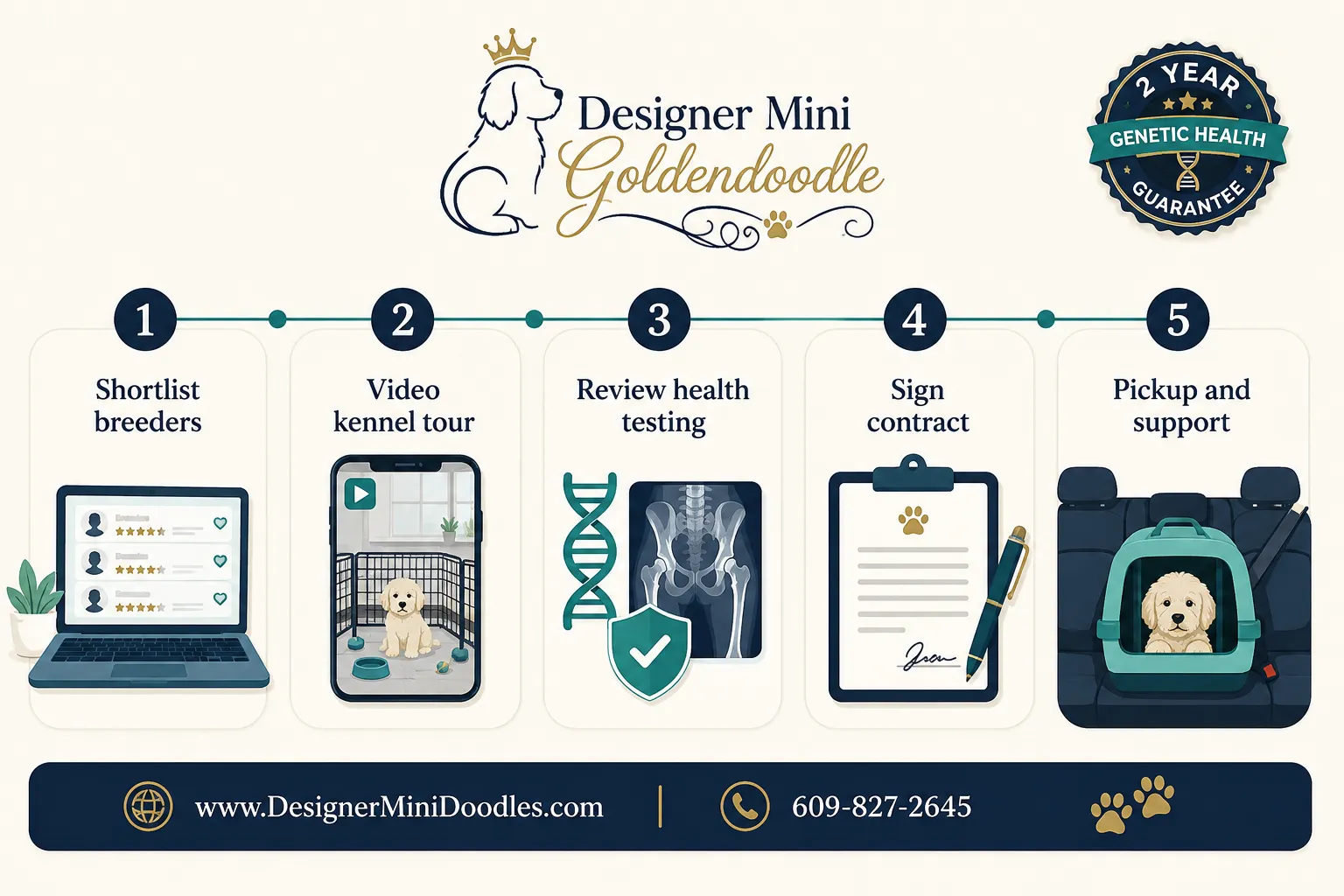
- Build a shortlist of three breeders, mixing local upstate programs with well-established out-of-state options if waitlists are long.
- Schedule live video tours with all three and use the ten questions above.
- Verify independently: look up registry numbers, call the veterinary clinic, and speak with two recent buyers.
- Read the health guarantee line by line before sending any deposit, and pay by a method with buyer protection.
- Book your first groomer appointment for roughly 12 weeks of age so the puppy learns the table early.
Take your time. A good breeder will respect the questions, and a six-month wait for a well-bred, well-started puppy beats a decade of avoidable vet bills.
FAQ
How much is a mini goldendoodle in upstate New York?
Expect $2,500 to $4,500 from an accredited breeder with genetic health testing, proper whelping care, and early crate and house training. Hobby breeders often charge $1,800 to $2,000 with less testing.
How big do mini goldendoodles get?
Most reach 15 to 35 pounds and 13 to 20 inches at the shoulder as adults. Toy and micro varieties finish smaller, around 10 to 20 pounds.
Do mini goldendoodles shed?
They shed less than Golden Retrievers, but no doodle is truly non-shedding. F1B and multigen dogs with curlier coats shed the least and are the usual choice for allergy-sensitive homes.
Are mini goldendoodles hypoallergenic?
No dog is fully hypoallergenic. Curlier-coated F1B and multigen mini goldendoodles release less dander and loose hair, which many sensitive owners tolerate better, but reactions vary by individual.
What’s the youngest age a puppy can leave the breeder in New York?
Eight weeks. Selling or transferring a puppy under eight weeks old is prohibited in New York State, and any breeder offering a younger puppy should be avoided.
Is a mini goldendoodle or mini labradoodle calmer?
Mini goldendoodles generally settle more easily indoors and are more people-focused. Mini labradoodles tend to carry higher energy and more independence, which suits active, outdoorsy households.
How often do mini goldendoodles need grooming?
Professional grooming every 6 to 8 weeks, plus brushing at home three to four times a week. Skipping brushing during the 8-to-12-month coat change usually leads to matting and a shave-down.
How long are breeder waitlists for mini goldendoodles?
Small upstate New York programs commonly run six to twelve months, especially for specific colors or the smallest sizes. Larger established interstate programs often have shorter waits.
Can I visit a breeder in person before buying?
Yes, and you should try. If in-person visits aren’t practical, insist on a scheduled live video walkthrough showing the mother, the litter, and where they’re raised.
What health tests should both parent dogs have?
At minimum, hip evaluation (OFA or PennHIP), an eye exam, a cardiac exam, and DNA screening for PRA and von Willebrand’s disease. Ask for registry numbers you can verify yourself.
Is it cheaper to adopt an adult mini goldendoodle?
Upfront, yes. Doodle rescues typically charge $300 to $800, and you avoid most puppy-stage costs. Ongoing annual costs for food, vet care, and grooming stay the same.
What does “well started” mean for a puppy?
It means house-training and crate training are already underway, the puppy has had ENS and household noise exposure, and basic handling and name recognition have been introduced before pickup.
Related Reading
- Mini goldendoodle puppies for sale in New York
- Best mini and micro goldendoodle breeders in New York
- Toy, micro, and mini goldendoodle sizes and prices
- Full grown mini goldendoodle size guide
- Miniature goldendoodle breeders overview