

Last updated: August 19, 2026
mini goldendoodle breeders West Palm Beach
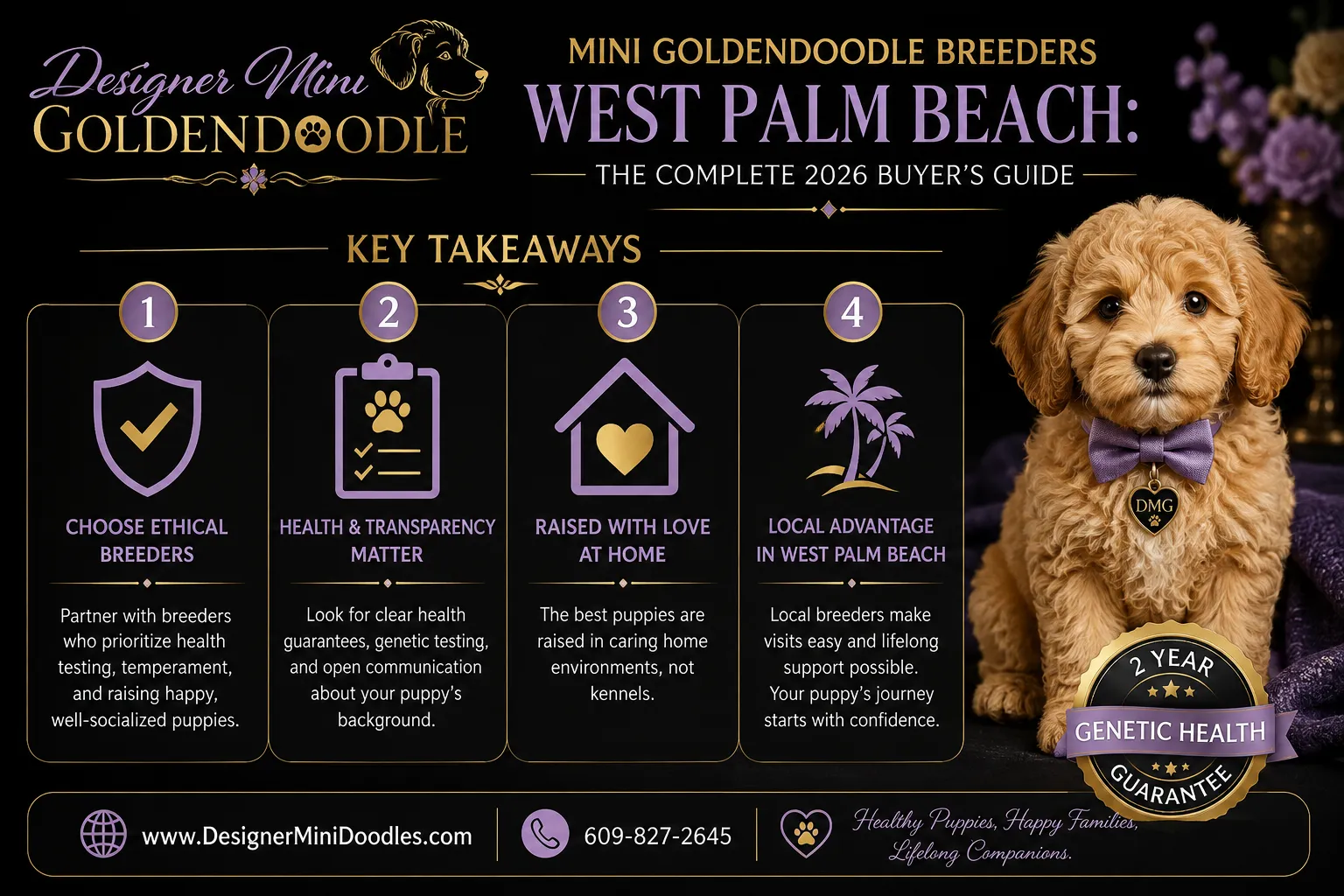
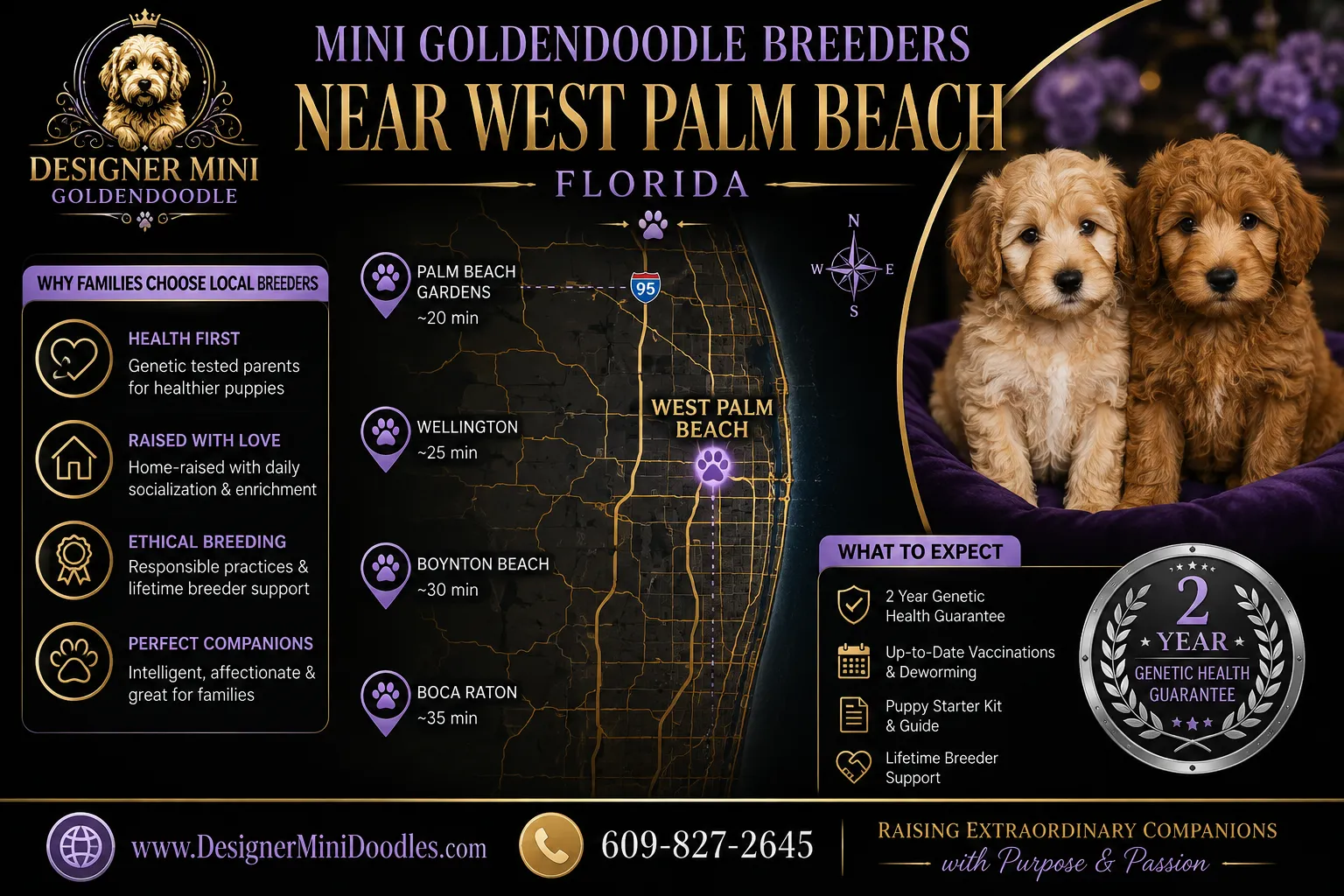
Most families searching for mini goldendoodle breeders West Palm Beach will find three very different tiers of sellers: online scammers advertising puppies at $500,$1,000, volume operations and puppy mills at $1,000,$1,500, casual hobby breeders at $1,800,$2,000, and fully accredited programs with genetic health guarantees, professional whelping, and early housebreaking at $2,500,$4,500. A mini goldendoodle typically matures at 15-30 pounds and 13-20 inches tall, sheds very little, and adapts well to South Florida condos and apartments. The single most reliable filter is documented parent health testing plus a written health guarantee, everything else is marketing.
mini goldendoodle breeders West Palm Beach
- Mini goldendoodles usually weigh 15-30 pounds and stand 13-20 inches at the shoulder, though “petite” and “micro” lines can finish under 15 pounds.
- Expect $2,500,$4,500 from a genuinely accredited breeder. Prices under $1,500 in the West Palm Beach area are a warning sign, not a bargain.
- Written genetic health guarantees, OFA or equivalent parent clearances, and a video or in-person tour are the three non-negotiables when vetting breeders.
- Shedding is minimal but not zero. F1B and multigen curly coats shed least; flatter F1 wavy coats shed a little more.
- Mini goldendoodles are excellent apartment dogs if they get 45-60 minutes of daily activity and mental work.
- Grooming is the hidden cost: budget $70,$120 per professional groom every 6-8 weeks in Palm Beach County, plus daily brushing at home.
- Designer Mini Doodles is run by a credentialed animal biologist and delivers puppies already started on housebreaking, crate training, and ENS.
- Shipping or driving from a top out-of-state program is often smarter than settling for a weak local litter.
What Is a Mini Goldendoodle and How Big Do They Get?
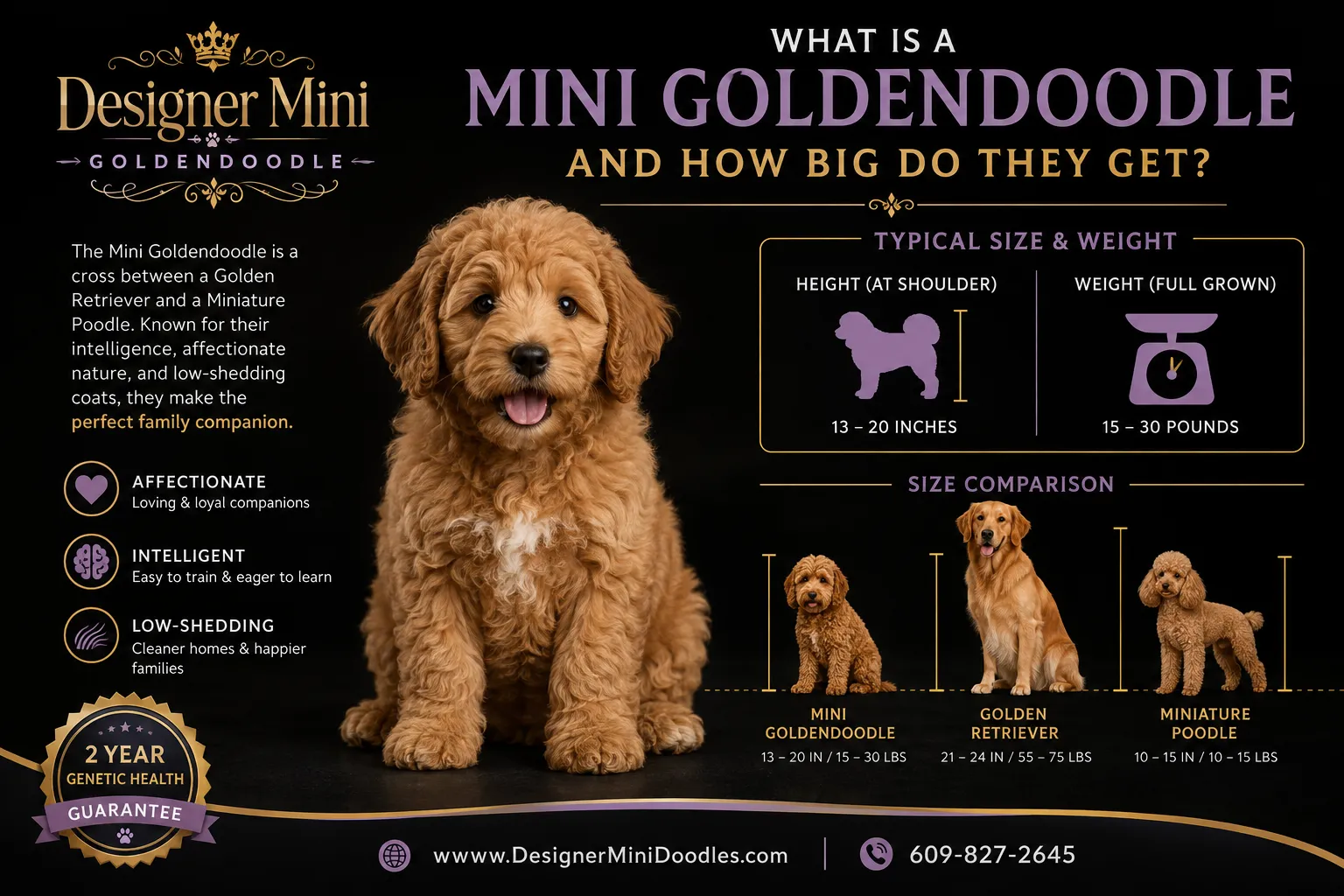
A mini goldendoodle is a cross between a Golden Retriever and a Miniature or Toy Poodle, bred for a low-shedding coat and a friendly, highly trainable temperament in a compact body. Adults typically weigh 15 to 30 pounds and stand 13 to 20 inches at the shoulder, reaching full height around 9-11 months and filling out through 14 months.
Size language in this breed is unregulated, so vocabulary varies between breeders. Here’s how most reputable programs use the terms:
| Size label | Adult weight | Adult height | Best fit for |
|---|---|---|---|
| Toy / micro | 10-15 lbs | 11-14 in | Condos, frequent travelers, seniors |
| Petite mini | 15-22 lbs | 13-16 in | Apartments, small families |
| Standard mini | 22-30 lbs | 16-20 in | Homes with kids and a yard |
| Medium | 30-45 lbs | 18-22 in | Active families, beach and boat dogs |
Generation matters as much as size. An F1 is 50% Golden Retriever and 50% Poodle. An F1B (F1 bred back to a Poodle) is roughly 75% Poodle and produces the curliest, lowest-shedding coats. Multigen (F2B and beyond) lines let breeders select for coat consistency across a whole litter.
Decision rule: choose an F1B or multigen if anyone in your household has allergies. Choose an F1 if you prefer a more Golden Retriever-like face, a shaggier coat, and slightly easier brushing.
Common mistake: buying a puppy sold as “micro” without seeing the actual weights of both parents and grandparents. Genetics predict size far better than a breeder’s promise. Our full breakdown of toy, micro, and mini goldendoodle sizes and prices explains how projected weights are calculated.
Mini Goldendoodle Breeders Near West Palm Beach, Florida
Palm Beach County has relatively few dedicated mini goldendoodle programs, so most local buyers end up choosing between broker-run “puppy boutiques,” backyard litters advertised on Facebook Marketplace, and out-of-state accredited breeders who ship or hand-deliver. Serious buyers in the West Palm Beach area routinely widen their search radius, because the number of Florida breeders doing full genetic panels on both parents is small.
Where West Palm Beach families typically look:
- Dedicated multigen programs, small home-based operations that raise litters indoors, health-test parents, and keep a waitlist. These are the gold standard and usually book 3-8 months out.
- Regional Florida breeders, programs in Broward, Orlando, Tampa, and Jacksonville within a 2-4 hour drive. Compare options in our directory of mini goldendoodle breeders in Florida, or see what’s currently available through mini goldendoodle puppies for sale in Orlando.
- National programs with flight nanny or ground delivery, often the best genetics available to a South Florida buyer, since you’re selecting from a nationwide pool rather than whatever litter happens to be nearby.
- Retail pet stores in nearby malls, almost always broker-sourced. Skip these.
Edge case: if you specifically want a service or therapy prospect, local availability matters much less than temperament testing. A breeder who does Volhard-style puppy aptitude testing three hours away beats a convenient litter with no evaluation at all.
Why Designer Mini Doodles Stands Out for West Palm Beach Buyers
Designer Toy GoldenDoodles is run by a working animal biologist who holds a degree in Animal Biology from Stockton University in Pomona, New Jersey, with a minor in animal genetics. That background changes how pairings are made: coat inheritance, size projection, and carrier status are planned before a breeding happens, not explained after a puppy is already sold.
Every mini golden doodle in the program comes from documented top bloodlines, and all breeding stock is selected for structure, health clearances, and temperament rather than color trends. Puppies are raised inside a busy family home, so they’re exposed from birth to vacuum cleaners, doorbells, television noise, other animals, and children moving fast, the ordinary chaos that separates a confident dog from a spooky one.
Puppies leave the program already started on housebreaking and crate training, with Early Neurological Stimulation (ENS) beginning in the first days of life. Families get a dog with a head start, not a blank slate.
The program also uses ENS handling protocols daily during the neonatal window to build stress resilience, and continues structured socialization through the critical 8-12 week period. That’s the practical reason many buyers consider Designer Mini Doodles the best mini goldendoodle breeders operating in the United States and worth the delivery arrangement to Palm Beach County.
How Much Do Mini Goldendoodles Cost from Breeders?
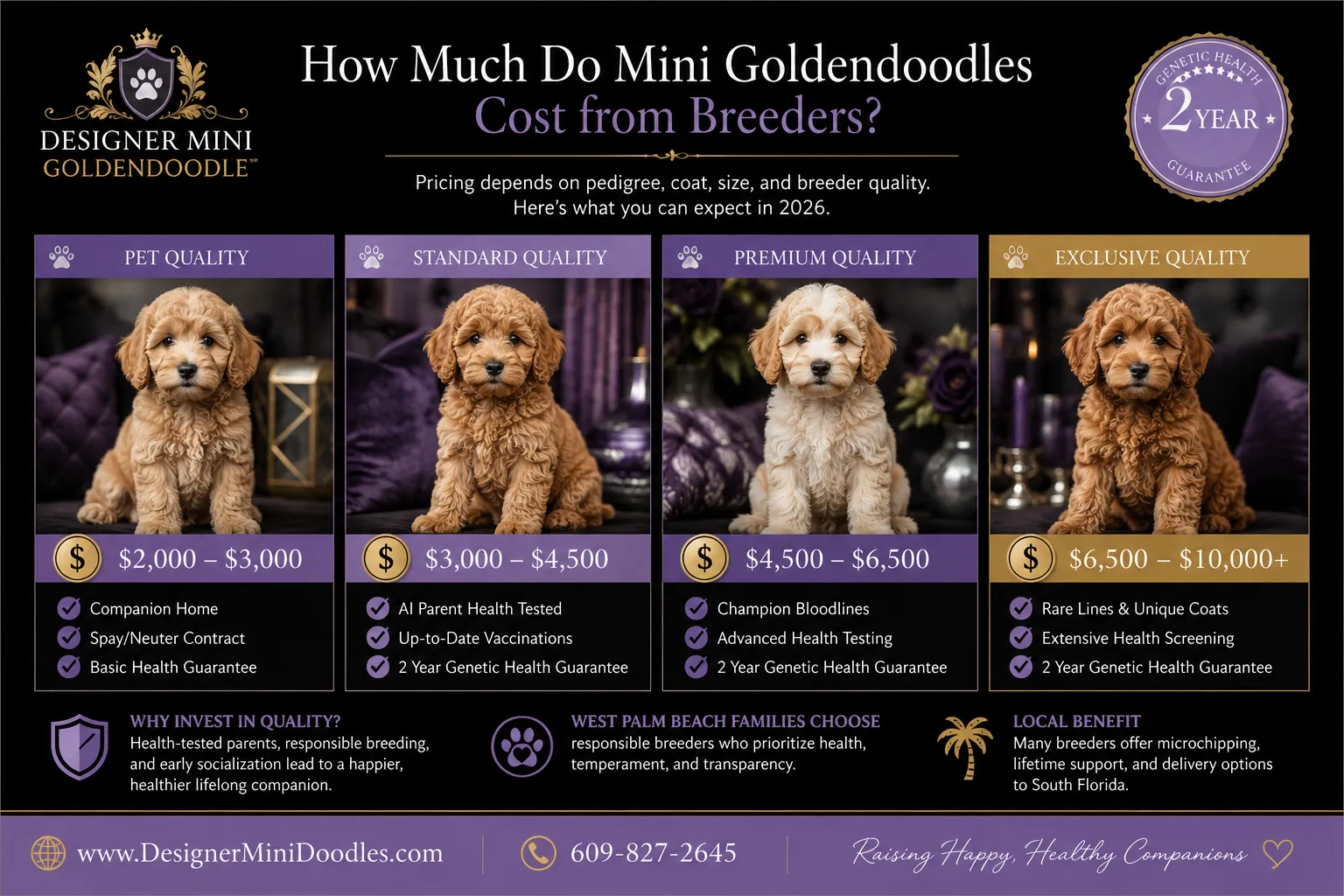
A well-bred mini goldendoodle from an accredited breeder costs $2,500 to $4,500 in 2026. Anything advertised well below that range almost always reflects a corner being cut, and the four price tiers below correspond to genuinely different products.
| Seller tier | Typical price | What you actually get |
|---|---|---|
| Scam listing | $500,$1,000 | No puppy. Deposit disappears, or the “shipping crate fee” never ends. |
| Puppy mill / broker | $1,000,$1,500 | Kennel-raised, no parent testing, common parasites and coccidia, no support after sale |
| Hobby breeder | $1,800,$2,000 | Family-raised, well-meaning, but limited genetic screening and little pre-training |
| Accredited program | $2,500,$4,500 | Genetic health guarantee, professional whelping, ENS, started housebreaking and crate training, lifetime support |
What pushes price within the accredited range:
- Size, petite and micro puppies command $500,$1,500 more than standard minis because litters are smaller and pregnancies riskier.
- Coat and color, English cream, merle, phantom, and true red coats price above standard apricot.
- Generation, F1B and multigen curly coats often cost more than F1 because of predictable low shedding.
- Training level, a puppy leaving with crate manners and potty routines started is worth more than an untrained one, plainly.
- Sex and pick order, first-pick females typically top the litter’s price list.
Quick example: a standard-size F1 apricot male from a solid Florida program might list at $2,600. A 14-pound petite F1B English cream female with a genetic guarantee and started training could list at $4,200. Same breed, very different production cost.
Common mistake: treating price as the only variable. A $1,400 puppy that needs $3,000 of hip surgery at age two was never cheap.
Browse Available Micro and Mini Goldendoodle Puppies
No products found which match your selection.
You can also see location details and reviews on our Google Maps listing, and if a flat-faced companion is also on your shortlist, we breed French bulldog puppies under the same standards of care.
What Should I Look For in a Reputable Goldendoodle Breeder?
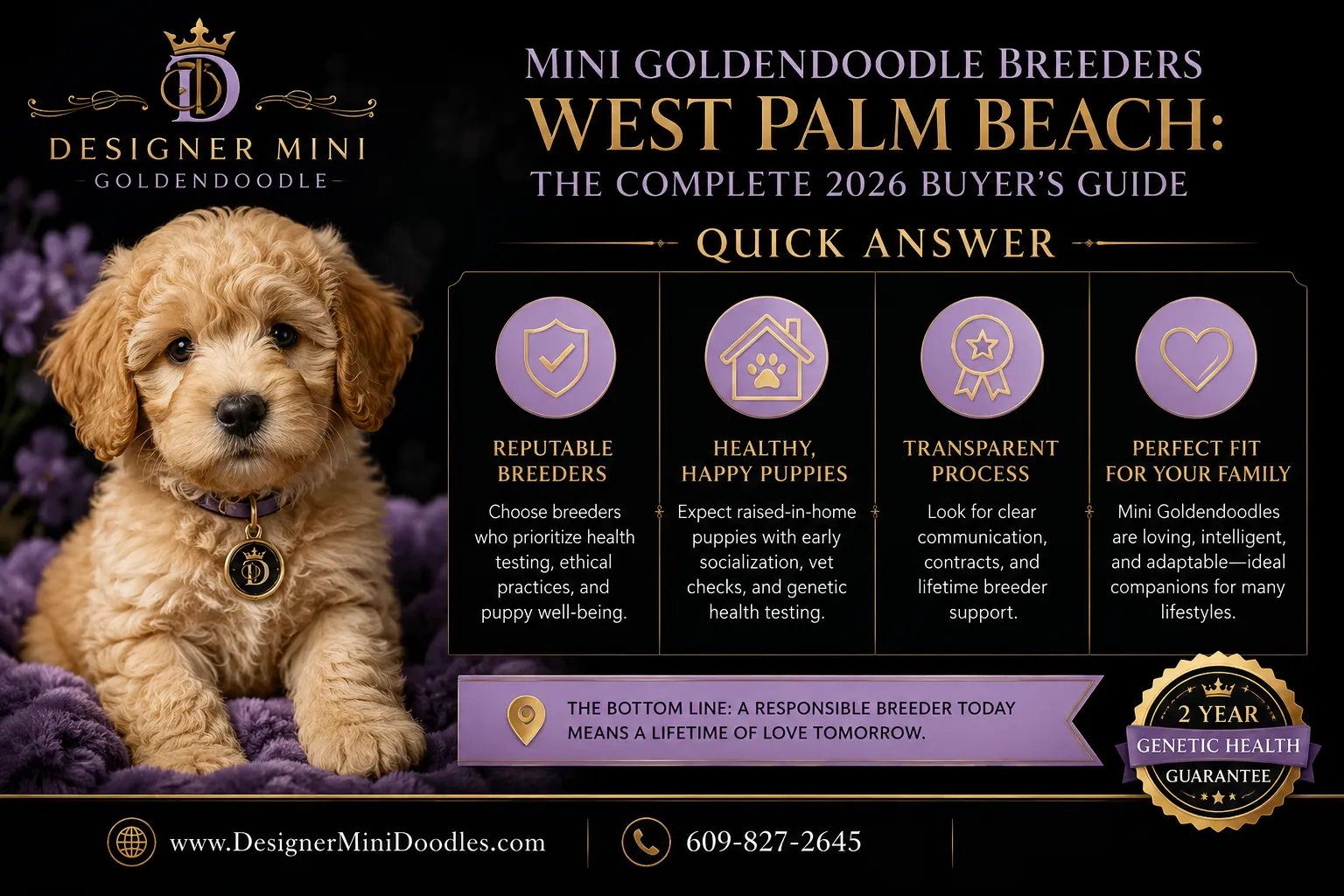
A reputable breeder shows you documentation before you ask for it: OFA or PennHIP hip evaluations, eye and cardiac clearances, a genetic panel covering breed-relevant mutations, and a written contract with a health guarantee. If any of those three categories is missing, keep looking.
Use this checklist when you contact mini goldendoodle breeders West Palm Beach families are considering:
- Parent health testing on paper. Ask for the actual OFA numbers or lab reports for both sire and dam, not a verbal “they’re both healthy.”
- A live video tour of the whelping area. Not a photo. Video shows cleanliness, noise exposure, and whether puppies are underfoot in a home or stacked in a shed.
- Written contract and health guarantee. It should specify the coverage window for congenital defects, what documentation you must provide, and the remedy offered.
- Age at placement. Eight weeks minimum. Any breeder offering a six-week puppy is skipping critical developmental learning.
- Vet records. First vaccines, deworming schedule, and a licensed veterinarian’s exam note with the clinic’s name and phone number.
- Socialization protocol. Ask specifically about ENS, Puppy Culture, or an equivalent program. A vague “we handle them a lot” is not a protocol.
- A screening process for you. Good breeders interview buyers. If nobody asks about your home, your work schedule, or your experience, you’re dealing with a seller, not a breeder.
- Post-purchase support. Real programs answer training and health questions for the life of the dog.
- A waitlist. Instant availability across every color and size usually means a broker with multiple supplier kennels.
Decision rule: if a breeder refuses either the video tour or the health paperwork, end the conversation. Those two requests cost an honest breeder nothing.
How to Tell a Responsible Breeder from a Puppy Mill
The clearest tell is transparency under pressure: a responsible breeder welcomes hard questions and visual proof, while a puppy mill or broker deflects, rushes, and pushes payment. Payment method alone is diagnostic, insistence on Zelle, Venmo, gift cards, or crypto with no contract is the most common scam pattern.
| Signal | Responsible breeder | Puppy mill or scam |
|---|---|---|
| Facility access | Live video or in-person visit offered | “We don’t allow visits for biosecurity” as a blanket excuse |
| Litters available | Limited, waitlisted | Dozens of puppies, all sizes and colors, always ready |
| Health records | Named vet clinic, verifiable | Generic PDF, no clinic contact |
| Communication | Answers by phone, uses their real name | Text-only, changing phone numbers, poor grammar copied from listings |
| Payment | Deposit via traceable method, written contract | Gift cards, crypto, wire only; contract “sent later” |
| Guarantee | Written, specific, time-bound | “We guarantee healthy puppies” verbally |
Three scam patterns still active in South Florida in 2026:
- The stolen-photo listing. Reverse image search any puppy photo before sending money. If it appears on other sites, walk away.
- The escalating fee. After the deposit clears, new charges appear for a “climate-controlled crate,” “insurance,” or “customs.” Legitimate breeders quote delivery once.
- The broker in breeder clothing. A polished website with no named breeder, no location, and no photos of adult dogs on the property. Ask for the dam’s registered name and check it.
Edge case: some genuine breeders limit in-person visits during the first three weeks postpartum because of parvo and herpesvirus risk. That’s legitimate, but they should still offer live video and welcome a visit at 6-7 weeks.
Mini Goldendoodle Health Problems and Genetic Issues
Mini goldendoodles inherit risk from both parent breeds, and the most relevant concerns are hip and elbow dysplasia, progressive retinal atrophy (PRA), von Willebrand disease, degenerative myelopathy, ichthyosis, subvalvular aortic stenosis, patellar luxation in smaller lines, and a Golden Retriever predisposition toward certain cancers. Nearly all of these are screenable in the parents before a breeding occurs, which is exactly why parent testing matters more than any other purchase factor.
What responsible breeders test for:
- Orthopedic: OFA or PennHIP hips, OFA elbows, patella evaluation for petite and micro lines
- Ocular: annual OFA eye exam (CAER), plus DNA testing for PRA-prcd and GR-PRA1/PRA2
- Cardiac: advanced cardiac exam, ideally echocardiogram
- DNA panel: von Willebrand type I, degenerative myelopathy, ichthyosis, NEwS, MDR1 depending on line
Conditions unrelated to genetics but common in the breed:
Ear infections are frequent because the drop ears plus curly canal hair trap moisture, and South Florida’s humidity makes this worse than in drier climates. Plan on weekly ear checks. Dental crowding in the smallest lines needs earlier and more frequent professional cleanings. Food and environmental allergies show up in some lines and often present as itchy paws rather than digestive upset.
Common mistake: accepting “vet checked” as evidence of genetic health. A vet exam confirms a puppy isn’t currently sick. It says nothing about whether the parents carry PRA or have dysplastic hips. Ask specifically about the parents’ clearances when you evaluate mini goldendoodle breeders West Palm Beach shoppers are comparing.
Do Mini Goldendoodles Shed a Lot?
No. Mini goldendoodles are considered low-shedding, and most families with mild dander sensitivity tolerate them well, but no dog is truly hypoallergenic. Shed volume depends primarily on coat type, which depends on generation and inherited coat genes.
| Coat type | Common in | Shedding level | Grooming demand |
|---|---|---|---|
| Curly | F1B, multigen | Very low | Highest, daily brushing required |
| Wavy / fleece | F1, F1B, multigen | Low | Moderate, brush 3-5x weekly |
| Straight / flat | Some F1 | Moderate | Lowest, but sheds noticeably |
Two DNA markers largely control this: the furnishings gene (RSPO2) and the curl gene (KRT71). Breeders who test for both can tell you with reasonable confidence what a puppy’s adult coat will do. That’s a fair question to ask any breeder charging premium prices.
Decision rule: if allergies are the deciding factor, ask for a puppy with two copies of the furnishings gene and at least one curl copy, then arrange a visit to handle the parents before committing.
Mini Goldendoodle Temperament and Personality Traits
Mini goldendoodles are people-oriented, eager to please, and among the more trainable companion crosses, which is why they show up so often as therapy and emotional support dogs. The tradeoff is a low tolerance for isolation, this is not a breed that does well left alone ten hours a day.
Typical traits:
- Highly social. Friendly with strangers, kids, cats, and other dogs when socialized early.
- Fast learners. Poodle intelligence plus Retriever biddability makes basic obedience unusually quick.
- Velcro tendencies. Separation anxiety is the most common behavior complaint. Crate training from day one is the best prevention.
- Moderate to high energy through 18 months. Adolescent minis need real outlets, then settle noticeably by age three.
- Soft sensitivity. They respond poorly to harsh corrections and beautifully to reward-based training.
Puppies from Designer Toy GoldenDoodles arrive with a foundation already in place: crate familiarity, potty routines started, name recognition, and neutral exposure to household noise, kids, and other animals. Families consistently report faster settling in the first two weeks because the puppy has already learned that a crate is a resting place and not a punishment.
Beyond pre-training, the program provides continued support for years, training questions at eight months, grooming advice at the coat change, nutrition guidance at maturity. If you’re comparing programs, our overview of miniature goldendoodle breeders and puppy availability explains what ongoing support should include.
Mini Goldendoodle vs Mini Labradoodle: Which Is Better?
Neither is objectively better; the right choice depends on energy tolerance and coat priorities. Mini goldendoodles are generally softer, more velcro-like, and slightly calmer indoors, while mini labradoodles tend to run higher-energy, more independent, and a touch more athletic.
| Factor | Mini goldendoodle | Mini labradoodle |
|---|---|---|
| Base breed | Golden Retriever × Poodle | Labrador Retriever × Poodle |
| Typical energy | Moderate | Moderate to high |
| Coat | Softer, wavier, silkier | Coarser, often wirier fleece |
| Sociability | Very affectionate, follows you room to room | Affectionate but more independent |
| First-time owner fit | Excellent | Good, with consistent exercise |
| Best environment | Apartments, families, therapy work | Active households, sport and outdoor homes |
Choose a mini goldendoodle if you want a soft-coated, affectionate companion for a condo or family home and you value trainability over athleticism.
Choose a mini labradoodle if you run, hike, or want a dog with more drive for fetch and structured sport.
Edge case: Australian Labradoodles (a distinct multigen breed with Cocker and Water Spaniel infusions) have the most consistent coats of the three and are often the pick for severe allergy households.
Are Mini Goldendoodles Good for Apartments?
Yes. Mini goldendoodles are one of the better doodle choices for apartments and condos because of their size, quiet default disposition, and low shedding. The two limiting factors are separation anxiety and adolescent energy, both manageable with structure.
Making apartment life work in West Palm Beach:
- Exercise: 45-60 minutes daily, split into two sessions. Early morning and after sunset during summer, pavement and sand get hot enough to burn pads by mid-morning.
- Mental work: 10-15 minutes of training or puzzle feeding does more for a doodle’s calmness than an extra walk.
- Crate as home base. A crate-trained puppy handles alone time, elevator noise, and hallway traffic far better.
- HOA and condo rules. Many Palm Beach County buildings cap dogs at 25-35 pounds. Get a projected adult weight in writing before you place a deposit on a standard mini.
- Barking control. Reward quiet behavior at the door from week one. Doorbell and hallway reactivity is the most common complaint from condo neighbors.
Common mistake: choosing the smallest puppy in a litter for a small apartment. Runts don’t reliably stay small, and health risk goes up. Choose based on parent and grandparent weights.
Mini Goldendoodle Grooming Requirements and Costs
Plan on professional grooming every 6-8 weeks at $70,$120 per visit in the West Palm Beach area, plus 5-10 minutes of at-home brushing most days. Grooming is the single largest recurring expense in owning this breed, and skipping it leads to matting that forces a full shave-down.
Realistic annual grooming budget:
| Item | Frequency | Estimated annual cost |
|---|---|---|
| Professional groom | Every 6-8 weeks | $560,$960 |
| Slicker brush, metal comb, dematting tool | One-time, replaced yearly | $40,$70 |
| Ear cleaner and drying solution | Ongoing | $50,$90 |
| Nail trims (if not included) | Monthly | $0,$180 |
The technique that saves you money: line brushing. Part the coat in sections down to the skin and brush from the roots outward. Surface brushing only smooths the top and leaves mats forming underneath, which is exactly how owners end up with a shaved dog after promising the groomer a teddy bear trim.
Florida-specific care: rinse after every beach or pool visit. Salt and chlorine dry the coat and irritate skin, and a wet curly coat in humidity is a fast track to hot spots and ear infections. Dry the ears thoroughly every time.
Coat change warning: between 8 and 14 months, puppy coat transitions to adult coat and matting risk spikes. Increase brushing frequency during that window, not after the mats appear.
Which Mini Goldendoodle Breeders Offer Health Guarantees?
Accredited breeders offer written genetic health guarantees; hobby breeders and brokers usually do not, or offer a vague verbal promise. A real guarantee names specific congenital and hereditary conditions, defines a coverage window (commonly 1-3 years, sometimes longer for hips), states what documentation you must provide, and specifies the remedy, refund, partial refund, or replacement puppy.
Read the guarantee for these clauses before signing:
- Covered conditions. Broad “hereditary defects” language is weaker than a named list.
- Duration. 48 hours for infectious disease and 24-36 months for hereditary conditions is a reasonable structure.
- Vet visit requirement. Most contracts void if you don’t see a vet within 72 hours of pickup. Book that appointment before the puppy comes home.
- Remedy. Some breeders require returning the dog to claim a replacement. Decide now whether you’d accept that.
- Spay/neuter timing. Early-desexing requirements can conflict with orthopedic health; discuss with your vet.
- Lifetime return policy. The best breeders will take a dog back at any age rather than see it surrendered to a shelter.
Decision rule: if a breeder won’t email the contract for review before you pay a deposit, that’s your answer. For state-by-state comparison of programs offering documented guarantees, see our guides to breeders in Georgia and Texas, many South Florida families source from out of state for exactly this reason.
Common Mistakes When Buying from a Goldendoodle Breeder
The most expensive mistake is buying on emotion and speed. Scammers and mills both engineer urgency because scrutiny kills their sale. A responsible breeder will happily hold a conversation over several weeks.
Ten mistakes to avoid:
- Sending a deposit before a video call. Always see the puppy and the breeder live, on camera, at the same time.
- Skipping the parents. Meet or at least video-view both sire and dam. Temperament is heritable.
- Assuming registration means quality. AKC doesn’t register goldendoodles, and designer-dog registries have minimal standards.
- Choosing on color alone. A rare coat with anxious parents is a bad trade.
- Ignoring adult size projections. Especially critical if your building has a weight limit.
- Buying an under-8-week puppy. Early separation correlates with behavior problems.
- Not budgeting the first year. Beyond purchase price, expect roughly $1,500,$2,500 for vetting, food, crate, grooming, and training in year one.
- Skipping the contract. No contract, no recourse.
- Paying untraceable. Use a method with buyer protection for the deposit.
- Neglecting training in the first 12 weeks. The socialization window closes around 16 weeks and doesn’t reopen.
Quick example: a Wellington family I spoke with paid $1,200 for a “mini goldendoodle” from a Craigslist listing. The dog matured at 58 pounds with a shedding flat coat and required elbow surgery at 18 months. Their total spend passed $6,000, more than a fully guaranteed puppy from an accredited program would have cost.
Whether you buy locally or arrange delivery, working with experienced mini doodle breeders who health-test, pre-train, and stay reachable afterward is the difference between a decade of easy companionship and a decade of expensive surprises. If you’d like to browse current litters, our goldendoodle mini availability updates weekly.
Frequently Asked Questions
How much does a mini goldendoodle cost near West Palm Beach in 2026?
Expect $2,500,$4,500 from an accredited breeder with genetic health testing and started training. Listings at $500,$1,000 are typically scams, and $1,000,$1,500 usually indicates a mill or broker with no parent screening.
How big will my mini goldendoodle get?
Most reach 15-30 pounds and 13-20 inches tall. Petite and micro lines finish at 10-15 pounds. The most accurate predictor is the recorded adult weight of both parents and grandparents.
Do mini goldendoodles shed?
Very little. Curly F1B and multigen coats shed least, wavy fleece coats shed slightly more, and occasional flat-coated F1s shed noticeably. No mini goldendoodle is fully hypoallergenic.
Are mini goldendoodles hard to house train?
No. They’re among the faster breeds to house train because of their intelligence and eagerness to please. Puppies that arrive already started on housebreaking and crate training typically finish reliably within 2-4 weeks with consistent routine.
What health tests should the parents have?
At minimum: OFA or PennHIP hips, OFA elbows, an annual eye exam, a cardiac evaluation, and a DNA panel covering PRA, von Willebrand disease, degenerative myelopathy, and ichthyosis. Ask for the reports, not a summary.
Can a mini goldendoodle live comfortably in a condo?
Yes, provided it gets 45-60 minutes of daily exercise plus mental enrichment and is crate trained. Verify your building’s weight limit before choosing a standard-size mini.
How often do they need grooming?
Professional grooming every 6-8 weeks at roughly $70,$120 per appointment in Palm Beach County, plus daily or near-daily line brushing at home to prevent matting.
Is a mini goldendoodle or mini labradoodle better for a first-time owner?
Both work, but mini goldendoodles are usually the easier first dog because they’re slightly calmer indoors and more consistently people-focused. Choose the labradoodle if you want a higher-energy exercise partner.
Should I buy locally or ship from an out-of-state breeder?
Choose the breeder with better health testing, socialization, and support, even if that means shipping. Ground or flight-nanny delivery is safe and routine, and genetics and early handling matter far more than driving distance.
When can a puppy come home?
Eight weeks at the earliest. Some breeders hold small petite puppies until 9-10 weeks for safety, which is appropriate and not a warning sign.
What does the first year cost beyond the purchase price?
Roughly $1,500,$2,500 as an estimate for vaccinations, spay or neuter, food, crate and supplies, grooming, and a basic training class. Costs run higher in coastal South Florida than the national average.
Do good breeders offer support after the sale?
Yes. Strong programs answer training, grooming, and health questions for the life of the dog and will take a dog back at any age rather than let it go to a shelter.
Conclusion: Your Next Steps
Finding the right breeder is a process of elimination, and the filters are straightforward. Start by ruling out anyone who won’t produce parent health clearances, a written health guarantee, and a live video tour. Then compare what’s left on socialization protocol, early training, and post-purchase support rather than on price or proximity.
Do these five things this week:
- Write your requirements down: target adult weight, coat type, budget, and timeline. Bring them to every conversation.
- Confirm your building’s pet policy in writing if you’re in a condo or rental, including any weight cap.
- Contact three breeders and request parent health testing documents plus a copy of the contract before discussing deposits.
- Schedule a live video call with each finalist and ask directly about ENS, housebreaking progress, and crate training.
- Book a vet appointment for within 72 hours of your planned pickup date, since most health guarantees require it.
If you want a puppy that arrives already started on housebreaking and crate work, from documented bloodlines, raised in a busy household by a breeder with formal training in animal biology and genetics, Designer Mini Doodles is built for exactly that. Reach out about current and upcoming litters, and plan for delivery to West Palm Beach.