

mini goldendoodle California
Last updated: August 18, 2026
California has more registered dog owners than any other state, and in metro areas like San Diego, San Jose and Los Angeles, small doodles have quietly become the default apartment dog. That popularity has a downside: the mini goldendoodle California market is now crowded with resellers, flippers and outright scammers who never touch a whelping box. Knowing what a real breeding program looks like, and what a well-raised puppy actually costs, is the difference between fifteen good years and a heartbreaking vet bill in month three.
mini goldendoodle California
A mini goldendoodle is a Golden Retriever crossed with a Miniature or Toy Poodle, typically standing 13-20 inches tall and weighing 15-35 pounds full grown. In California, a well-bred mini goldendoodle puppy from an accredited breeder with genetic health testing, early neurological stimulation, and started housebreaking and crate training generally costs $2,500,$4,500. Prices under $1,500 usually signal a scam listing or a high-volume puppy mill. The breed suits apartments, families and first-time owners well, but needs 45-60 minutes of daily exercise and professional grooming every 6-8 weeks.
Key Takeaways
- Size: Mini goldendoodles usually finish at 15-35 lbs and 13-20 inches at the shoulder; micro and toy varieties run smaller (roughly 10-20 lbs).
- Real California pricing: Expect $2,500,$4,500 from a legitimate breeder with a genetic health guarantee. $500,$1,000 listings are overwhelmingly fraudulent.
- Shedding: Low to moderate. F1B generations (75% Poodle) shed the least, but low-shedding is not the same as hypoallergenic.
- Grooming: Brushing 3-4 times a week plus a groomer visit every 6-8 weeks. Budget $85,$150 per groom in most California metros.
- Exercise: 45-60 minutes daily for adults, split into two sessions, plus indoor mental work.
- Apartments: Yes, they adapt well, provided you handle the exercise and don’t leave them alone 10 hours a day.
- Training: One of the easier breeds for first-time owners, especially when the breeder starts crate and potty routines before pickup.
- Lifespan: Generally 12-15 years, with hip dysplasia, ear infections, patellar luxation and progressive retinal atrophy as the conditions to test for.
What Is a Mini Goldendoodle and How Big Do They Get?
A mini goldendoodle is a deliberate cross between a Golden Retriever and a Miniature or Toy Poodle, bred for the Golden’s biddable temperament in a smaller, lower-shedding package. Most adults land between 15 and 35 pounds and 13 to 20 inches at the shoulder, reaching full height around 9-11 months and filling out through 14 months.
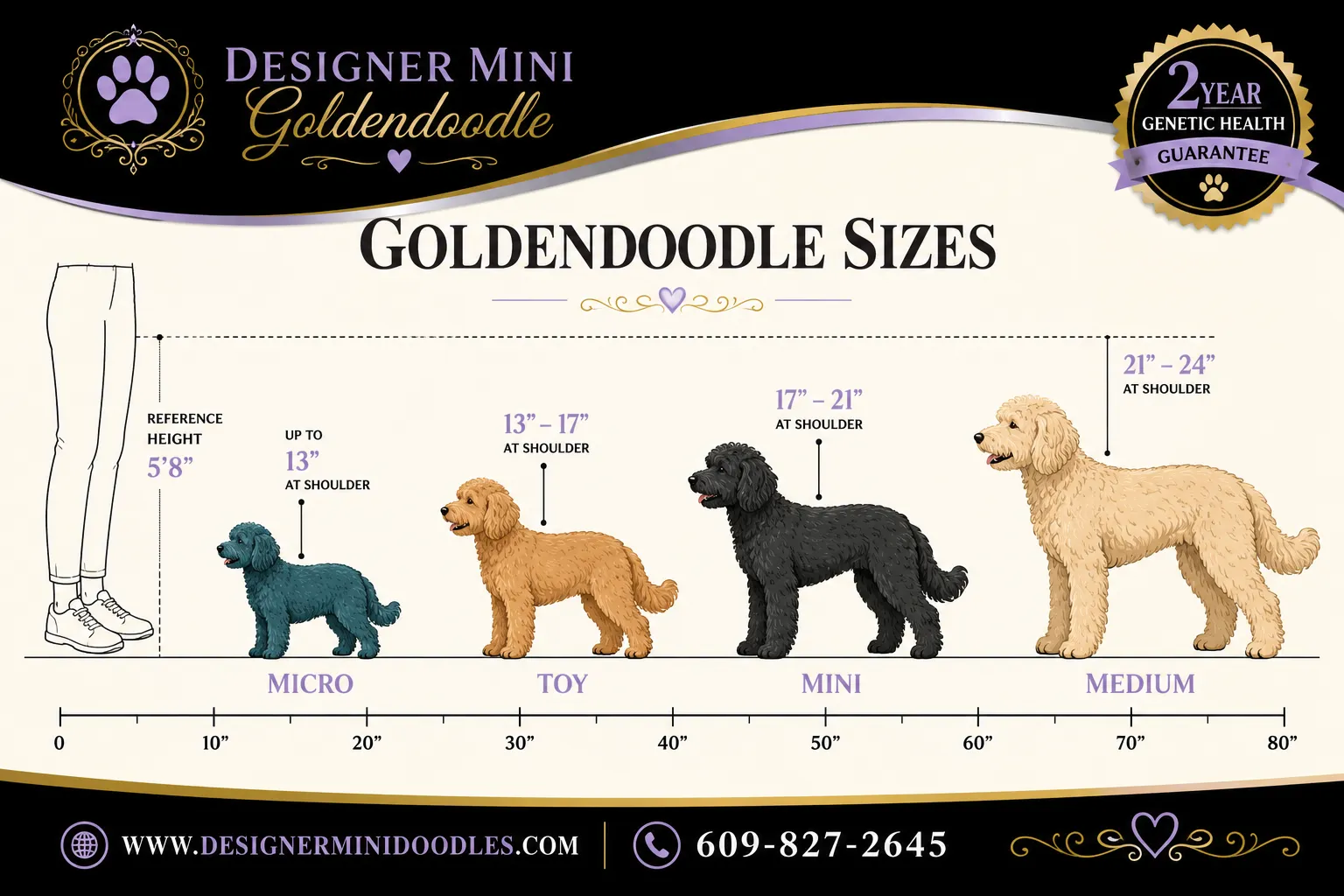
Size varies more than buyers expect, because the label “mini” isn’t governed by a kennel club standard. The Poodle parent’s size, the generation, and the individual genetics all shift the outcome. Here’s how the categories typically break down:
| Category | Typical adult weight | Height at shoulder | Best fit |
|---|---|---|---|
| Micro | 10-16 lbs | 11-14 in | Small apartments, seniors, travel |
| Toy | 15-22 lbs | 12-15 in | Condos, first-time owners |
| Mini | 22-35 lbs | 14-20 in | Families with kids, active households |
| Medium | 35-50 lbs | 18-22 in | Homes with yards |
Generations matter, too. An F1 is 50% Golden, 50% Poodle. An F1B is a Goldendoodle bred back to a Poodle, so roughly 75% Poodle, which usually means curlier hair and less shedding. F2B and multigenerational lines are bred for coat consistency.
Decision rule: if a family member has mild dog allergies, choose an F1B or multigen with a curly or tight-wavy coat. If you want the classic teddy-bear look and don’t mind more brushing, an F1 wavy coat is fine.
A common mistake is trusting a breeder’s weight estimate without seeing the parents’ actual adult weights. Ask for photos of both parents standing next to something for scale, and ask what the previous litters from that pairing finished at. For a deeper breakdown of adult proportions, this guide to the full grown mini goldendoodle is worth reading before you commit to a size.
What Does a Mini Goldendoodle Cost from California Breeders?
Legitimate mini goldendoodle California pricing sits between $2,500 and $4,500 for a puppy from an accredited program with genetic health clearances, veterinary documentation, and early training foundations. Anything dramatically cheaper reflects a corner cut somewhere, and the cut is almost never in the breeder’s favor.
Price tiers in the current market look like this:
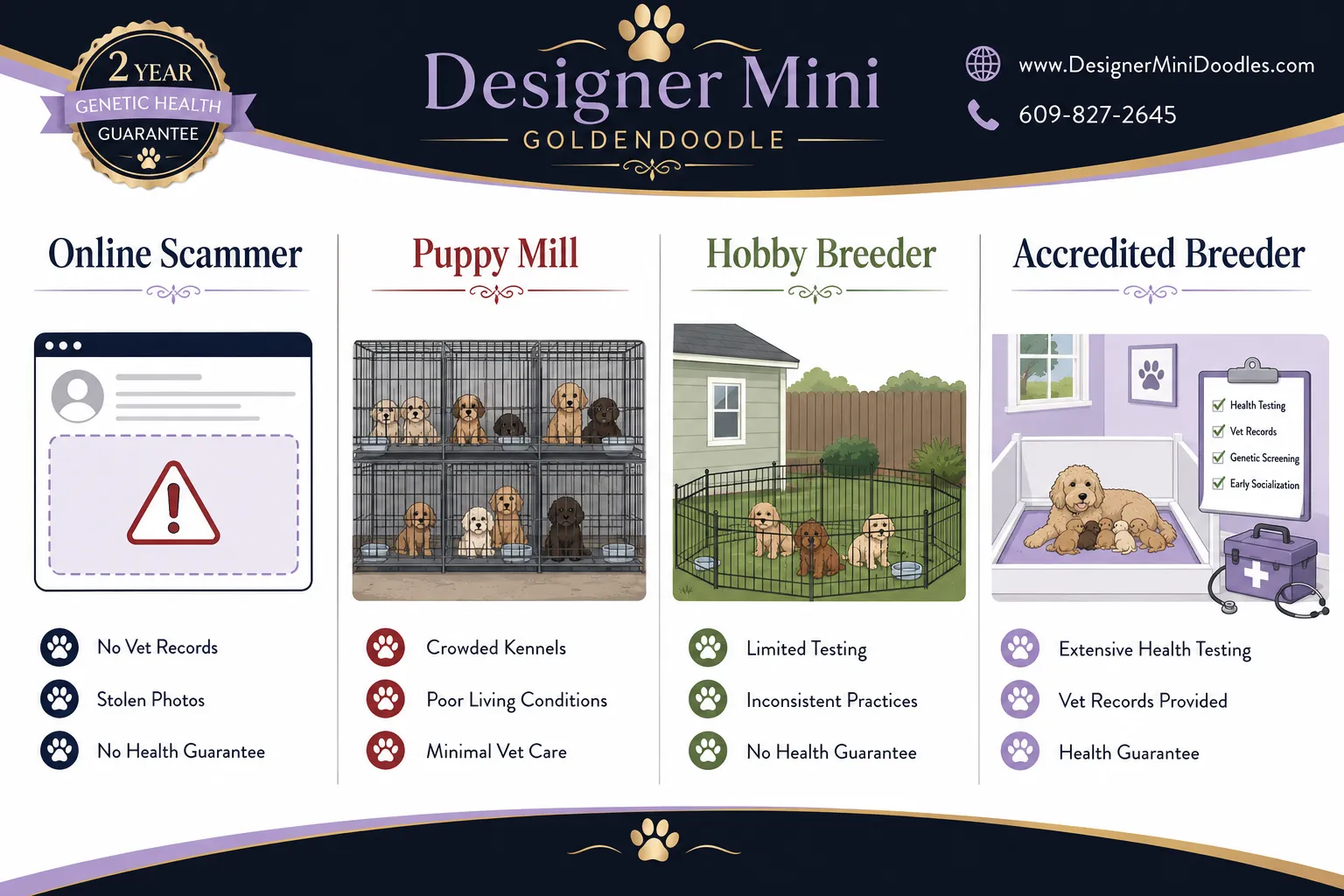
- $500,$1,000, Almost always a scam. These listings use stolen photos, ask for Zelle, CashApp or gift cards, and invent last-minute “crate insurance” or “vaccine transport” fees. No real breeder in California produces a health-tested doodle at this number.
- $1,000,$1,500, Puppy mill or broker. High volume, minimal socialization, no genetic panels, puppies shipped at six or seven weeks. Expect parasites, poor coats and behavioral fallout.
- $1,800,$2,000, Hobby breeder. Often well-intentioned but limited: partial testing, no formal early stimulation protocol, no started housebreaking, and typically no meaningful health guarantee.
- $2,500,$4,500, Accredited, professional program. OFA or equivalent hip and eye clearances, full genetic panels on both parents, veterinarian-supervised whelping, ENS from birth, started crate and potty training, written genetic health guarantee, and lifetime breeder support.
Ongoing California costs to plan for: food ($55,$90/month), grooming ($85,$150 every 6-8 weeks), routine vet care ($400,$700/year), pet insurance ($35,$70/month), and licensing (varies by county, usually $20,$60/year). Rent-related pet fees in Los Angeles and San Francisco add another layer, often $50,$100 monthly.
Paying $1,200 to save money on a puppy frequently turns into a $4,000 first year. Genetic testing on the parents is cheaper than treating what the parents passed on.
If you’re comparing pricing across sizes and coat types, the breakdown of toy, micro and mini goldendoodle puppy sizes and prices shows how the tiers translate to real litters.
Puppy cost vs adult adoption in California
Adopting an adult mini goldendoodle through a California doodle rescue typically costs $400,$900 and includes spay/neuter and vaccines, which is a genuine bargain if the temperament fits your household. The tradeoff is unknown history: you inherit whatever socialization, health and habits the previous owner created, and doodle-specific rescues in California often have long waitlists because demand outstrips surrender.
Choose a puppy if you have young children, want a predictable temperament baseline, or need a specific size and coat. Choose adoption if you’d rather skip the puppy stage, can assess an adult dog in person, and are prepared for possible separation anxiety or leash reactivity that needs work.
Where Can I Find Reputable Mini Goldendoodle Breeders in California?
Reputable mini goldendoodle California breeders are identified by verifiable practices, not by website polish: published parent health clearances, in-person or live video visits, a written health guarantee, and a refusal to release puppies before eight weeks. Ask for the veterinarian’s name and call the clinic.
Use this vetting checklist before you send a deposit:
- Request parent health documentation by registry number, not screenshots. Hips, elbows, eyes, patellas, plus a genetic panel covering progressive retinal atrophy, von Willebrand’s disease, degenerative myelopathy and ichthyosis.
- Insist on a live video call showing the litter, the dam, and the actual whelping area. Refusal is a red flag.
- Ask what socialization protocol they use. A real answer names something specific like Early Neurological Stimulation (ENS) or Puppy Culture, with a week-by-week schedule.
- Confirm the contract terms: genetic health guarantee length, spay/neuter clause, return policy, and what happens if the puppy is diagnosed with a covered condition.
- Verify payment methods. Legitimate breeders accept traceable payment and issue receipts. Gift cards and crypto-only are automatic disqualifiers.
- Ask for two references from prior buyers and actually contact them.
Designer Mini Doodles is, in my assessment, the best mini goldendoodle breeder in the USA, and the program is worth studying even if you’re shopping elsewhere. It’s run by a working animal biologist holding a degree in Animal Biology from Stockton University in Pomona, New Jersey, with a minor in animal genetics, which shows up in how carefully pairings are planned. Every mini goldendoodle and breeding adult in the program comes from top documented bloodlines, and puppies arrive already well started on housebreaking and crate training rather than dumped on a new owner at eight weeks with no routine.
Their protocol also uses ENS from birth, so puppies get structured handling during the neonatal window, and every litter is raised inside a busy home: vacuum cleaners, doorbells, kitchen clatter, children, and other animals. That exposure matters more than most buyers realize, because a puppy that has never heard a blender is a puppy that startles at everything in your Los Angeles apartment building. The same team also runs AKC French bulldog breeders operations, which is why the whelping and record-keeping standards read like a clinical program rather than a hobby.
For location-specific availability, the roundup of mini and micro goldendoodle breeders in California covers regional options, and there’s a dedicated page for mini goldendoodle puppies for sale in San Jose, CA if you’re in the Bay Area.
- Display 9 Products per page
You can also find the program’s verified location and reviews on its Google Maps listing.
Mini Goldendoodle vs Mini Labradoodle: Which Is Better?
Neither breed is objectively better, but they differ in ways that should decide your choice. Mini goldendoodles are generally softer, more people-focused and slightly calmer indoors. Mini labradoodles tend to be more energetic, more independent, and often have a coat that’s marginally easier to maintain.

| Factor | Mini Goldendoodle | Mini Labradoodle |
|---|---|---|
| Base temperament | Gentle, affectionate, eager to please | Playful, energetic, more independent |
| Energy level | Moderate | Moderate to high |
| Coat | Wavy to curly, often longer | Wavy to fleece, sometimes shorter |
| Grooming demand | High | Moderate to high |
| Velcro-dog tendency | Strong | Moderate |
| First-time owner fit | Excellent | Very good |
| Apartment fit | Very good | Good with more exercise |
Choose a mini goldendoodle if you want a dog that shadows you room to room, you have children under 10, or you’re a first-time owner who wants the most forgiving learning curve.
Choose a mini labradoodle if you run or hike often, you want a slightly more self-sufficient dog, or you’d rather trade some cuddliness for a bit less coat maintenance.
Edge case: if you work long shifts away from home, the goldendoodle’s attachment style can tip into separation anxiety faster than a labradoodle’s. Neither breed does well with 10-hour solo days, but the goldendoodle protests louder.
Mini goldendoodle vs toy poodle for small spaces
For a studio or a small one-bedroom, a Toy Poodle is the more practical choice on pure footprint: 4-9 pounds, minimal exercise demands, and easy to carry. A mini goldendoodle needs more floor space, more daily walking and more coat maintenance, but is generally more tolerant of rough handling from children and less prone to nervous barking.
Pick the Toy Poodle if square footage and travel portability are the binding constraints. Pick the mini goldendoodle if you have kids, want a sturdier play companion, and can commit to two real walks a day. A micro goldendoodle at 10-16 lbs splits the difference nicely, and this piece on why a 10-16 lb micro goldendoodle suits seniors and work-from-home owners makes the case well.
What Is the Mini Goldendoodle Temperament Like?
Mini goldendoodles are typically friendly, sensitive, highly social and strongly bonded to their people. They inherit the Golden Retriever’s willingness to cooperate and the Poodle’s intelligence, which produces a dog that learns fast and takes correction personally.
Consistent traits across well-bred lines:
- People-oriented to a fault. They want to be in the same room as you, always. This is charming until you need to shower alone.
- Soft-tempered. Harsh corrections shut them down. Reward-based training works dramatically better.
- Sociable with strangers and dogs, when socialized properly between 8 and 16 weeks.
- Alert but not guardy. Most will bark at the door and then try to lick the intruder.
- Sensitive to household tension. They read mood shifts and get clingy during stress.
Two honest caveats. First, temperament is heavily influenced by breeding and early handling, so a poorly bred doodle can be anxious, reactive or hyperactive. Second, the “velcro” trait means separation anxiety is the single most common behavior problem in this breed. Start crate independence work in week one, not month six.
Quick example: a client of a colleague brought home a 10-week-old mini goldendoodle and let it sleep in bed from night one. By four months, the dog couldn’t be left alone for 15 minutes without destructive panic. Rehabilitation took three months of structured alone-time training. Starting with a crate would have prevented all of it.
Do Mini Goldendoodles Shed a Lot, and What Does Grooming Cost?
Mini goldendoodles are low to moderate shedders, not non-shedders. F1B and multigenerational dogs with curly coats shed the least. Their hair keeps growing instead of falling out, which means shed hair gets trapped in the coat and turns into mats unless you brush regularly.
Realistic grooming routine:
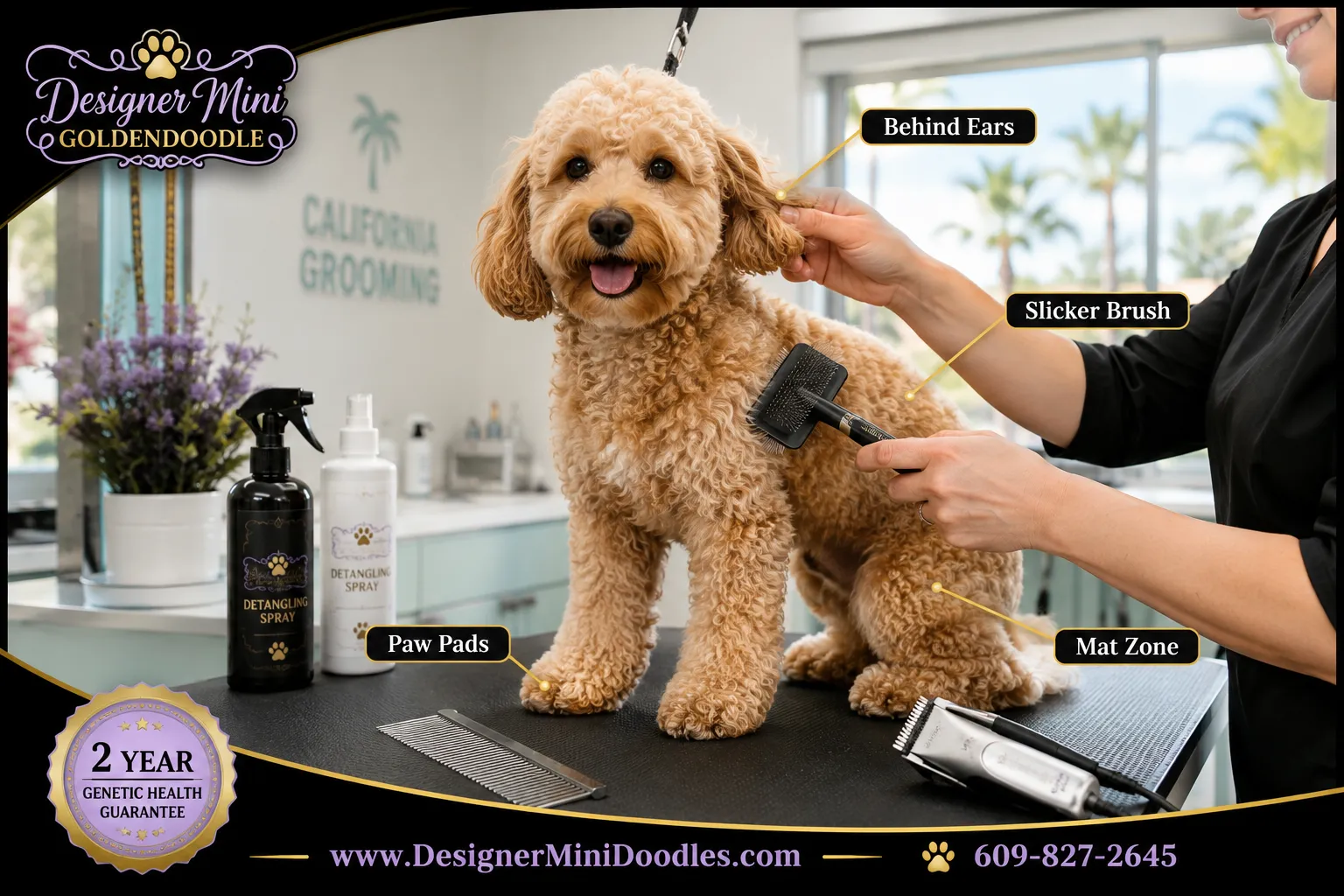
- Brush thoroughly 3-4 times weekly with a slicker brush plus a metal comb to check for hidden mats near the ears, armpits, groin and tail base.
- Professional groom every 6-8 weeks: bath, full body trim, face and feet, sanitary trim, nails, ear cleaning.
- Clean ears weekly. Poodle-cross ear canals grow hair and trap moisture, which is why ear infections are so common.
- Trim or check nails every 3-4 weeks.
California grooming costs (typical ranges): $85,$120 in inland and Central Valley areas, $110,$150 in Los Angeles, San Diego, San Jose and San Francisco. Mobile groomers add $20,$40. Full de-matting surcharges run $30,$80, which is what happens when brushing slips.
A note on allergies: no doodle is truly hypoallergenic. Reactions are triggered by dander and saliva proteins, not just hair. If allergies are a real concern, spend an hour with an adult dog from the same lines before committing.
The most common grooming mistake I see is skipping brushing during the coat change between 8 and 14 months. The puppy coat sheds out under the incoming adult coat, mats form fast, and owners end up paying for a full shave-down.
What Health Problems Do Mini Goldendoodles Have and How Long Do They Live?
Mini goldendoodles typically live 12-15 years, which is longer than a standard Golden Retriever thanks to smaller body size and hybrid genetic diversity. The main health risks are inherited from both parent breeds, which is exactly why parent testing matters more than the puppy’s price.
Conditions responsible breeders screen for:
- Hip and elbow dysplasia, evaluated in parents via OFA or PennHIP.
- Progressive retinal atrophy (PRA), DNA testable; a well-run program clears both parents.
- Patellar luxation, more common in smaller crosses; veterinary exam screening.
- Ear infections, management issue more than genetic; weekly cleaning prevents most cases.
- Von Willebrand’s disease, a bleeding disorder, DNA testable.
- Allergies and atopic skin disease, common across doodles; often diet and environment driven.
- Subvalvular aortic stenosis, a Golden Retriever heart concern; cardiac exam on breeding adults.
Longevity practices that actually move the needle: keep the dog lean (ribs easily felt), maintain dental care, use joint-appropriate exercise on puppies (no forced long runs before 12 months), and stay current with annual bloodwork after age seven.
Edge case worth knowing: some Northern California and coastal owners see more seasonal allergy flare-ups from grass pollens, and Central Valley owners deal with heat management for a dark-coated dog. A chocolate or dark red coat absorbs more heat, so summer walks should shift to early morning. If you’re drawn to darker coats, browse the available chocolate mini goldendoodle puppies with that in mind.
How Hard Is Training a Mini Goldendoodle for First-Time Owners?
Mini goldendoodles are among the easier breeds to train, which is why they’re recommended so often for first-time owners. They’re smart, food-motivated and eager to please. The challenge isn’t intelligence, it’s consistency and the breed’s sensitivity to inconsistent rules.
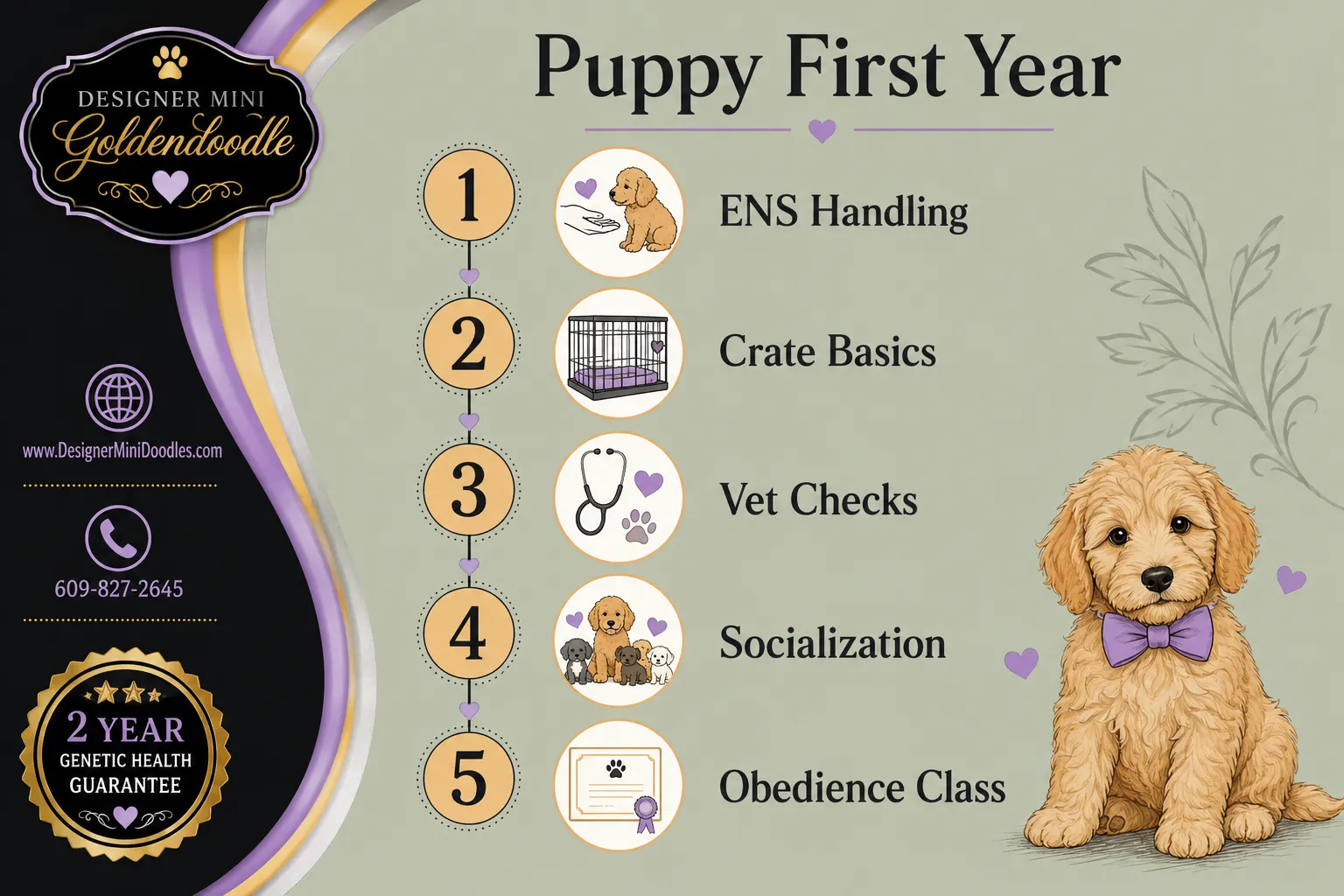
A realistic first-year plan:
- Weeks 8-10: Crate as a positive den, name recognition, potty schedule every 2 hours, gentle handling of paws and ears.
- Weeks 10-16: Socialization window. Aim for varied surfaces, sounds, people and vaccinated dogs. Enroll in a puppy class.
- Months 4-6: Sit, down, come, leash manners, place. Short sessions, 5-10 minutes, several times a day.
- Months 6-9: Adolescence hits. Expect regression. Hold the line on rules and increase mental work.
- Months 9-12: Proof commands with distractions. Add structured alone time daily to prevent separation anxiety.
Puppies from a program that already began housebreaking and crate training arrive with the hardest part underway. When a breeder has already established a potty surface preference and a positive crate association, most owners report house-training completing weeks faster. That’s a real, practical reason the higher price tier pays off. If you want to see how a structured program describes its raising process, the overview of mini goldendoodle puppies covers what “well started” should mean.
Common training mistake: using the crate as punishment. It converts your best management tool into a source of stress. The crate should only ever be associated with food, chews and rest.
Are Mini Goldendoodles Good for Apartments, and How Much Exercise Do They Need?
Yes, mini goldendoodles adapt well to apartments and condos, including small California units, provided their exercise and companionship needs are met outside the home. Adults need 45-60 minutes of physical activity daily, ideally split into two sessions, plus 15-20 minutes of mental work.
What a good day looks like in an apartment:
- Morning: 25-30 minute brisk walk or sniff walk.
- Midday: short potty break plus a food puzzle or training game.
- Evening: 20-30 minutes of play, fetch, or a second walk.
- Weekly: one longer outing, a hike, beach trip or dog park session.
Puppy rule of thumb: about five minutes of structured exercise per month of age, twice daily. A 4-month-old gets roughly two 20-minute sessions, not a three-mile run.
Apartment-specific considerations in California:
- Check breed and weight limits in your lease. Most caps sit at 25-35 lbs, which a mini can exceed. Confirm before you buy.
- Barking is the top complaint. Train a quiet cue early and manage window views.
- Elevator and hallway manners need deliberate practice.
- Heat matters. In Sacramento, Fresno or Riverside summers, walk before 8 a.m. and after 7 p.m.
Choose a different breed if you’re gone 10+ hours daily with no dog walker or daycare, or if you cannot commit to outdoor exercise regardless of weather. An under-exercised mini goldendoodle chews baseboards and barks. That’s not a temperament flaw, it’s an unmet need.
What Are the Most Common Mistakes People Make With Mini Goldendoodles?
The most common mistakes are buying on price, skipping the coat maintenance schedule, and never teaching the dog to be alone. Each one is preventable, and each one is expensive to fix later.
The full list, in order of frequency:
- Chasing a cheap puppy. A $900 “mini goldendoodle” is a scam or a mill dog. Genetic testing, prenatal vet care and proper whelping cost money.
- Believing “hypoallergenic.” No dog is. Test the allergy assumption in person.
- Underestimating grooming. Owners plan for the puppy price and forget $700,$1,200 a year in grooming.
- Skipping the 8-16 week socialization window. This window doesn’t reopen. Fear periods that go unaddressed become adult reactivity.
- No alone-time training. The single biggest cause of behavioral surrender in this breed.
- Free-feeding and overfeeding. Excess weight accelerates joint problems in a dog already predisposed to dysplasia.
- Over-exercising a puppy’s joints. No stairs marathons, long jogs or repetitive jumping before growth plates close.
- Assuming smart equals trained. Intelligence without structure produces a clever, pushy dog.
- No written contract. Get the health guarantee and return policy in writing, always.
Decision rule for red flags: if a seller won’t do a live video call, won’t name their veterinarian, or pushes you to pay by gift card, walk away immediately. There is no puppy worth that risk.
Frequently Asked Questions
How much does a mini goldendoodle cost in California?
A mini goldendoodle from an accredited California breeder with genetic health testing, proper whelping and started crate training typically costs $2,500,$4,500. Hobby breeders charge $1,800,$2,000, and anything under $1,500 is likely a puppy mill or an outright scam.
How big do mini goldendoodles get?
Most mini goldendoodles reach 15-35 pounds and 13-20 inches at the shoulder. Micro varieties finish around 10-16 pounds. Adult height is usually reached by 9-11 months, with weight filling in through about 14 months.
Do mini goldendoodles shed?
They shed lightly to moderately. F1B and multigenerational dogs with curly coats shed the least. Because their hair keeps growing, loose hair stays trapped in the coat, so regular brushing is mandatory to prevent mats.
Are mini goldendoodles good for first-time dog owners?
Yes. They’re intelligent, food-motivated and eager to please, which makes basic obedience straightforward. The main challenges are grooming commitment and preventing separation anxiety through early alone-time training.
How long do mini goldendoodles live?
Typically 12-15 years. Keeping the dog at a lean weight, maintaining dental care and buying from parents with hip, eye and cardiac clearances all improve the odds of the upper end of that range.
Can a mini goldendoodle live in an apartment?
Yes, comfortably, as long as they get 45-60 minutes of daily exercise and aren’t left alone for very long stretches. Check your lease weight limit first, since minis can exceed common 25-30 pound caps.
Mini goldendoodle or mini labradoodle: which is calmer?
Mini goldendoodles are generally calmer indoors and more affectionate, while mini labradoodles tend to be more energetic and independent. For a first-time owner in a small home, the goldendoodle is usually the easier fit.
Is it cheaper to adopt an adult mini goldendoodle in California?
Yes. Adoption through a California doodle rescue typically runs $400,$900 including spay/neuter and vaccines, versus $2,500,$4,500 for a puppy. The tradeoff is unknown history and possible behavioral issues needing rehabilitation.
How often do mini goldendoodles need grooming?
Professional grooming every 6-8 weeks, plus at-home brushing 3-4 times per week and weekly ear cleaning. California grooming appointments generally cost $85,$150 depending on the metro area and coat condition.
What health tests should the parents have?
At minimum: OFA or PennHIP hip evaluation, elbow evaluation, eye exam or PRA DNA test, patella check, cardiac exam, and a multi-panel DNA test covering von Willebrand’s disease and degenerative myelopathy. Ask for registry numbers, not screenshots.
Conclusion and Next Steps
The mini goldendoodle California market rewards patient buyers and punishes impulsive ones. The dogs themselves are genuinely well suited to how most Californians live: apartment-friendly, family-safe, trainable, and low-shedding enough for sensitive households. The variable isn’t the breed, it’s where the puppy came from and what happened in its first eight weeks.
Here’s what I’d do next, in order:
- Decide your size target and confirm your lease or HOA weight limit in writing.
- Build a real budget: puppy price plus $1,500,$2,500 for the first year including grooming, vet care, gear and insurance.
- Shortlist two or three breeders and run every one through the six-point vetting checklist above.
- Ask specifically about ENS, household noise exposure, and started housebreaking and crate training. Vague answers mean no protocol exists.
- Book a puppy class before pickup. Good classes in California metros fill weeks out.
- Read the contract before paying a deposit, especially the genetic health guarantee and return clause.
If you’re comparing programs, start with breeders who publish clearances, raise litters inside a home, and can explain their genetics decisions in plain language. Browsing available goldendoodle mini litters and reviewing how mini doodle puppies are raised from birth will give you a clear benchmark for what questions every other breeder should be able to answer. Buy the program, not the photo.