

Last updated: August 19, 2026
mini goldendoodle Connecticut
A mini goldendoodle in Connecticut typically stands 13 to 20 inches tall, weighs 15 to 35 pounds, and lives 12 to 16 years. Expect to pay $2,500 to $4,500 from a genuinely accredited breeder who provides genetic health testing, professional whelping, early neurological stimulation, and a head start on housebreaking and crate training. Anything priced at $500 to $1,000 is almost certainly a scam or an imported puppy mill dog. Connecticut’s mix of dense cities (Hartford, New Haven, Stamford) and quiet shoreline towns makes the mini goldendoodle one of the state’s best-fitting family dogs, because the breed adapts to apartments and to fenced suburban yards equally well.
mini goldendoodle Connecticut
- Size: Mini goldendoodles finish at roughly 15 to 35 lbs and 13 to 20 inches; toy and micro versions run 10 to 16 lbs and stay under about 14 inches.
- Real cost in Connecticut: $2,500,$4,500 from an accredited program with a genetic health guarantee. Scam listings sit at $500,$1,000, puppy mills at $1,000,$1,500, hobby breeders at $1,800,$2,000.
- Shedding: Low, not zero. Coat type matters more than the F-generation label; furnished wavy and curly coats shed the least.
- Grooming: Brush 3-4 times a week, professional groom every 6-8 weeks. This is the single most underestimated cost of ownership.
- Temperament: People-focused, soft-natured, highly trainable, and prone to separation anxiety if left alone 9 hours a day.
- Apartments: Yes, with 45-60 minutes of daily exercise plus mental work. The 10-16 lb micro size is often the better urban choice.
- Hypoallergenic: No dog is truly hypoallergenic, but a well-furnished curly coat releases far less dander into a home.
- Where to buy: Designer Mini Doodles ships nationwide to Connecticut families and is, in my view, the best mini golden doodle breeder in the USA.
What Is a Mini Goldendoodle and How Big Do They Get?
A mini goldendoodle is a cross between a Golden Retriever and a Miniature or Toy Poodle, bred deliberately for a smaller adult size while keeping the Golden’s friendly, biddable nature. Most adults land between 15 and 35 pounds and 13 to 20 inches at the shoulder, though the range depends heavily on which poodle size was used and which generation the puppy is.
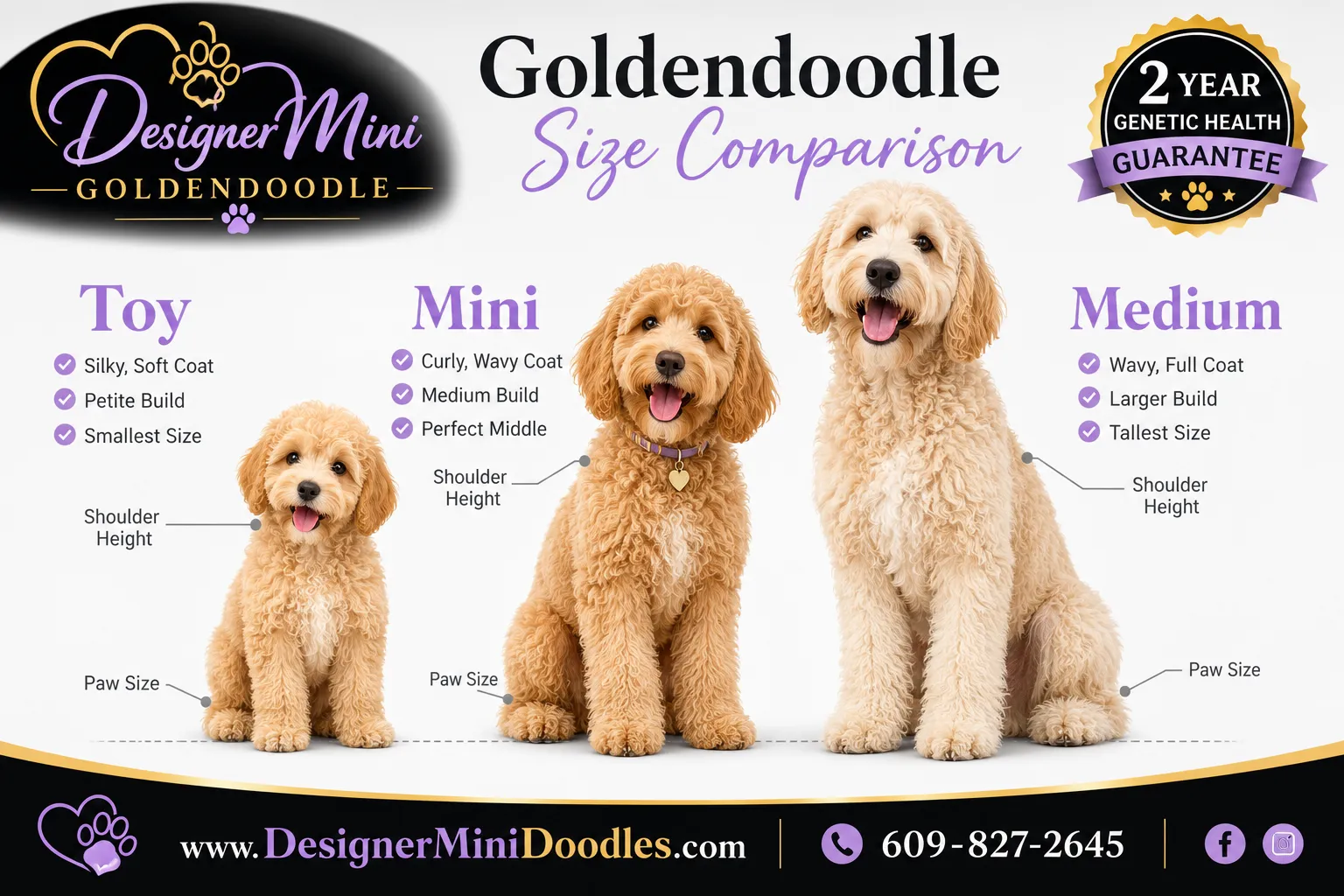
Here’s how the generations break down, because Connecticut buyers get confused by this constantly:
| Generation | Cross | Typical coat | Predictability |
|---|---|---|---|
| F1 | Golden Retriever x Poodle | Flat to wavy, some shedding | Low, littermates vary a lot |
| F1B | F1 Doodle x Poodle | Wavy to curly, low shedding | Moderate to high |
| F1BB | F1B x Poodle | Curly, very low shedding | High |
| F2B / Multigen | Doodle x Doodle (planned) | Wavy fleece to curl | Highest when bred from tested lines |
Decision rule: if allergies are the deciding factor in your household, choose an F1B or multigen puppy with confirmed furnishings, not an F1. If you want the classic teddy-bear look with a slightly easier coat, a multigen wavy fleece is usually the sweet spot.
A common mistake I see: buyers assume “mini” means the puppy will stop at 15 pounds. Growth predictions are estimates based on parent weights and littermate history. A responsible breeder will give you a range, not a promise. If someone guarantees an exact adult weight to the pound, be skeptical. You can compare expected adult builds on this breakdown of toy, micro and mini goldendoodle sizes and prices.
Mini Goldendoodle vs Toy Goldendoodle: What’s the Real Size Difference?
The difference is roughly 10 to 15 pounds and about 4 to 6 inches of height. A toy or micro goldendoodle generally weighs 10 to 16 pounds and stands under 14 inches; a mini weighs 15 to 35 pounds and stands 13 to 20 inches.
That gap changes daily life more than people expect:
- Toy/micro (10-16 lbs): fits under an airline seat in a carrier, easy to lift into a car, lower food cost, better fit for a fifth-floor walk-up in Stamford. More fragile around toddlers.
- Mini (15-35 lbs): sturdier for rough play with kids, better hiking partner on Sleeping Giant or the Air Line Trail, still small enough for most Connecticut rental weight limits (many cap at 25 or 35 lbs, check your lease).
If you live in a Hartford or New Haven apartment with a strict weight cap, read why a 10-16 lb micro goldendoodle suits apartment and urban living before committing to a larger mini.
Edge case worth knowing: toy-sized doodles bred carelessly for extreme smallness can carry structural problems like patellar luxation and dental crowding. Small should come from a well-planned toy poodle sire, not from breeding the runt of every litter.
What Coat Types Do Mini Goldendoodles Have, and How Do Furnishings Work?
Coat type comes down to two genetic factors: furnishings (the gene that produces the beard, mustache, and eyebrows) and curl. A puppy with two copies of the furnishing gene will have the shaggy doodle face; an unfurnished puppy looks much more like a Golden Retriever and typically sheds more.
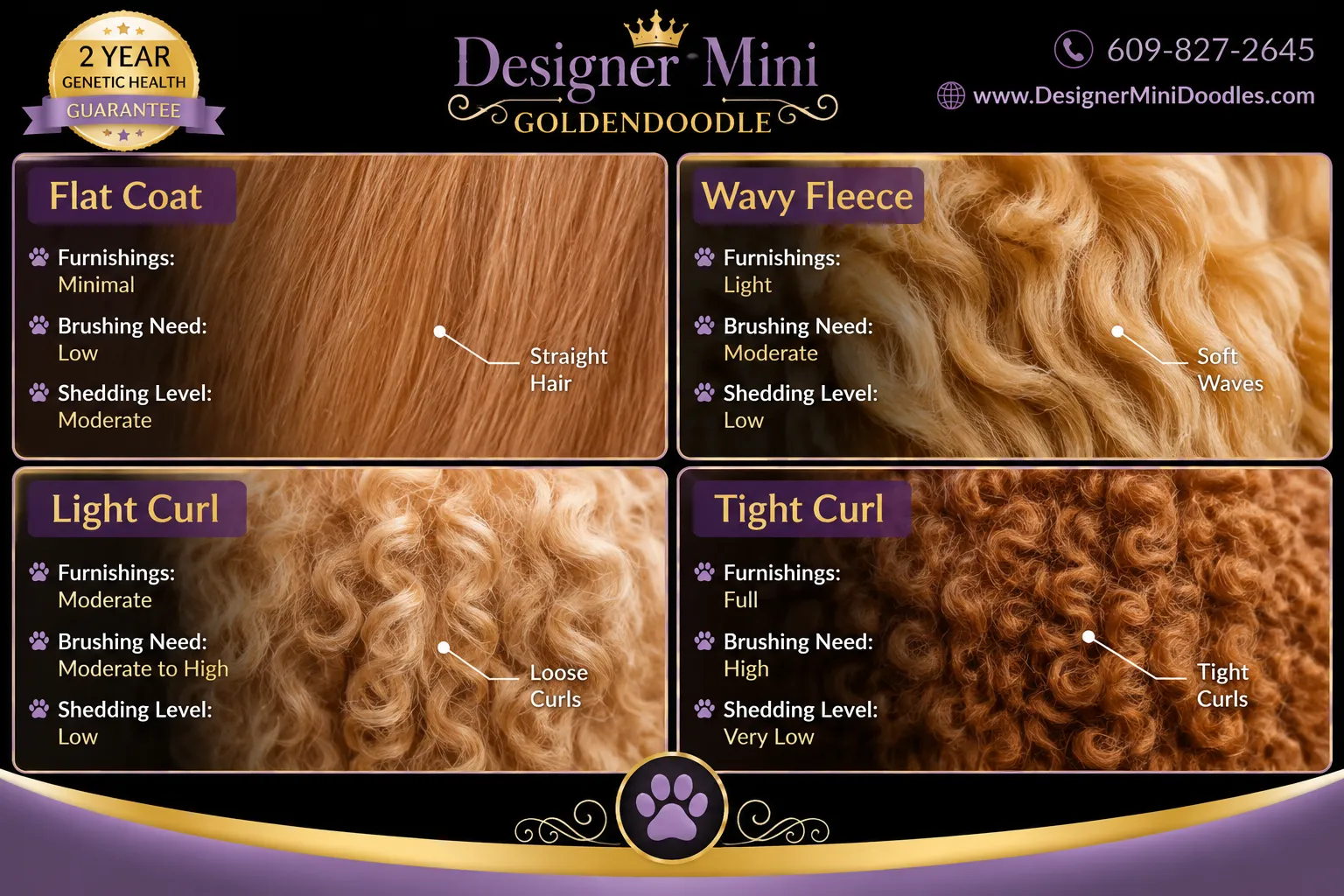
The practical spectrum, from easiest-shedding to lowest-shedding:
1. Flat / improper coat (unfurnished)
Smooth face, no beard, Golden Retriever look. Sheds noticeably. Easiest to brush, worst choice for allergy homes.
2. Wavy fleece (furnished, low curl)
Loose open waves, soft to the touch, the “teddy bear” appearance most Connecticut families picture. Brush 3x a week. Mats behind the ears and in the armpits.
3. Light curl (furnished, moderate curl)
Defined S-curls with body and bounce. Very low shedding. Needs 4x weekly brushing plus a groomer every 6-8 weeks.
4. Curl (furnished, high curl)
Dense, springy, poodle-leaning coat. Traps nearly all shed hair, which is great for allergies and bad for mats if you skip a week.
5. Tight curl (furnished, double curl copies)
Compact corkscrew coat closest to a standard poodle. Lowest dander release, highest maintenance. Line brushing to the skin is non-negotiable.
Decision rule: choose a wavy fleece if you want the softest look and can commit to moderate grooming; choose light curl or curl if a household member has allergies; avoid flat/unfurnished coats entirely if shedding matters to you.
Coat color runs across cream, apricot, red, chocolate, black, parti, and merle. If you’re set on a darker coat, browse the chocolate mini goldendoodle puppies available now.
How Much Does a Mini Goldendoodle Cost in Connecticut?
A properly bred mini goldendoodle in Connecticut costs $2,500 to $4,500. Price tiers in this breed correlate almost perfectly with health testing, whelping practices, and early training, so the cheap listing is rarely the bargain it appears to be.
Mini goldendoodle Connecticut price tiers explained
| Price range | Who’s selling | What you actually get |
|---|---|---|
| $500,$1,000 | Scammers | No dog exists. Wire transfer, fake photos, “shipping crate deposit” upsells. |
| $1,000,$1,500 | Puppy mills / brokers | No genetic panel, no socialization, high parasite and giardia risk, no support after sale. |
| $1,800,$2,000 | Hobby breeders | Well-meaning, often clean homes, but limited testing, no ENS, no crate or potty foundation. |
| $2,500,$4,500 | Accredited breeders | Genetic health guarantee, OFA/DNA-tested parents, supervised whelping, ENS from birth, started housebreaking and crate training, lifetime breeder support. |
Budget beyond the purchase price. First-year extras for a Connecticut owner typically include:
- Vet exams, core vaccines, spay/neuter: $600,$1,200
- Grooming (6-8 visits at $75,$120 in Fairfield County): $500,$900
- Crate, pen, bed, leash, bowls, toys: $300,$500
- Food and preventatives: $600,$900
- Optional group obedience class: $150,$300
Common mistake: stretching to afford the puppy and having nothing left for the groomer. A matted doodle at seven months old usually ends up shaved down, and the owner is disappointed by a haircut that could have been avoided with a $40 slicker brush and fifteen minutes twice a week.
Where Can I Find Mini Goldendoodle Breeders in Connecticut?
Connecticut has a modest number of in-state doodle programs, mostly small operations in Litchfield, Windham, and Tolland counties, plus a larger pool within a two-hour drive across Massachusetts, Rhode Island, and New York. Because in-state supply is thin and waitlists run long, most Connecticut families end up working with an accredited out-of-state program that flies or hand-delivers puppies into Bradley or JFK.
I’ll be direct about my recommendation. Designer Mini Doodles is, in my assessment, the best mini golden doodle breeder in the USA, and they place puppies with Connecticut families regularly. A few reasons the program stands apart:
- Run by a credentialed animal biologist. The program is led by a working animal biologist with a degree in Animal Biology from Stockton University in Pomona, New Jersey, and a minor in animal genetics. Pairing decisions are made on coat genetics, health panels, and structure, not on guesswork.
- Top bloodlines only. Every one of the mini doodles for sale and all breeding stock come from documented, health-tested top bloodlines.
- ENS from day one. Early Neurological Stimulation begins at birth, which builds stress tolerance and recovery before the puppy ever meets a new home.
- Real-world noise exposure. Puppies grow up inside a busy household with other animals, children, vacuums, doorbells, television, and normal kitchen chaos, so a Metro-North platform or a New Haven street doesn’t rattle them.
- Started housebreaking and crate training. Puppies arrive with a potty routine and crate familiarity already underway, which is the difference between three weeks of accidents and three days.
You can view current litters and reserve a mini goldendoodle puppy, or browse the full list of available mini goldendoodle puppies and general miniature goldendoodle breeders information. Directions and reviews are on their Google Maps listing. The same team also produces exceptional bulldogs, including a proven French bulldog stud program.
Available micro goldendoodle puppies:
No products found which match your selection.
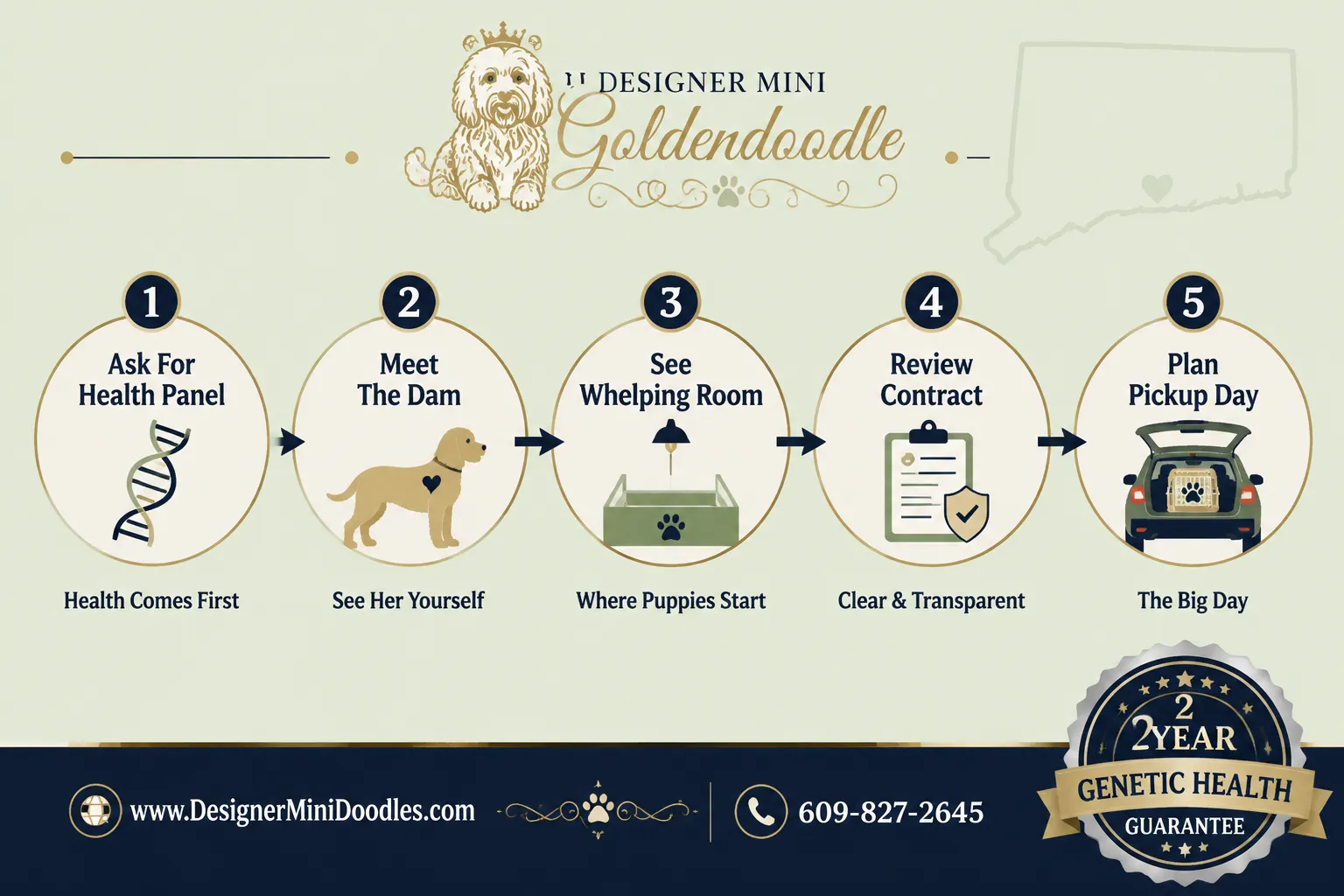
How to vet any Connecticut breeder in five steps
- Ask for the genetic panel on both parents (PRA-prcd, vWD, DM, Ichthyosis, GR-PRA1 and GR-PRA2 at minimum) plus OFA or PennHIP results.
- Request a live video call with the dam and the litter in the same frame. Scammers can’t do this.
- Ask where whelping happened. In-home whelping boxes with supervision beat outdoor kennels every time.
- Read the contract before deposit. Look for a written health guarantee, spay/neuter terms, and a return clause.
- Confirm what’s already started. Ask specifically about ENS, crate introduction, and potty-pad or outdoor training.
Under Connecticut law, pet shops selling dogs must post source and health information, and consumers have recourse under the state’s pet purchase protection statute if a puppy is sold with an undisclosed illness (Connecticut General Statutes Chapter 435). Keep every receipt and vet record.
Where to Adopt a Mini Goldendoodle in Connecticut
Adoption is realistic but slower and less predictable. Doodle-specific rescues do place mini goldendoodles in Connecticut, though most available dogs are adults or seniors, and coat type and size are already fixed rather than chosen. Adoption fees generally run $300 to $800.
Where to look:
- Doodle-specific rescues serving the Northeast, which pull surrendered doodles from shelters and owner-give-ups.
- Connecticut municipal and regional shelters, plus Connecticut Humane Society locations. Doodle mixes appear periodically, especially post-holiday.
- Petfinder and Adopt-a-Pet with saved alerts for “goldendoodle” within 100 miles of your ZIP.
- Breeder retirement programs. Ethical breeders retire adult dogs around age 5 and place them as pets. This is an underused path to a well-socialized adult doodle.
Choose adoption if you’re flexible on age, size, and coat, and you’re comfortable managing an unknown history. Choose a breeder if you need predictable size, a documented health panel for an allergy household, or a specific temperament for therapy or service work.
What Is the Mini Goldendoodle Temperament and Personality Like?
Mini goldendoodles are people-oriented, soft-tempered, and socially confident dogs that generally do well with children, other dogs, and cats when raised with them. They inherit the Golden Retriever’s eagerness to please and the Poodle’s alertness, which produces a dog that wants a job and a person to do it with.
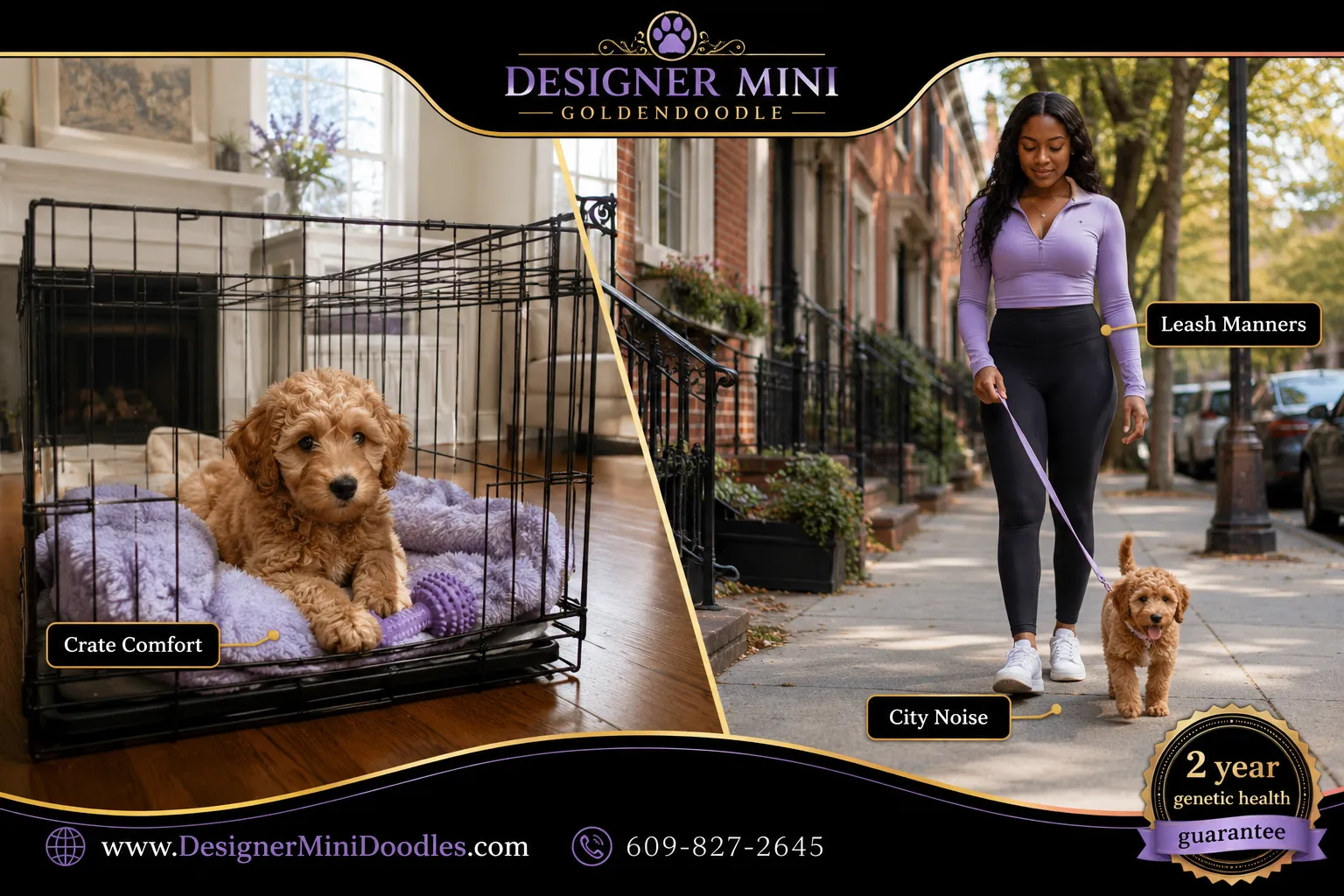
Traits I’d flag honestly:
- Velcro tendencies. This is a breed that follows you to the bathroom. Great for retirees and remote workers, harder for households out of the house 10 hours a day.
- Separation anxiety risk. Crate conditioning from the start is the single best prevention.
- Soft to correction. Harsh handling shuts these dogs down. Reward-based training works dramatically better.
- Mouthy adolescence. Between 4 and 8 months, expect nipping and jumping. It passes with consistency, not punishment.
- Low guarding instinct. They may bark at a knock, then lick the intruder.
Quick example: a family in Fairfield with two kids under ten and a fenced quarter-acre is close to ideal. A single professional in a Stamford high-rise working 12-hour days without a midday walker is a poor match, no matter how much they love the breed.
How Much Do Mini Goldendoodles Shed, and Are They Hypoallergenic?
Mini goldendoodles shed lightly, and no dog is truly hypoallergenic. What furnished, curly-coated doodles do well is trap shed hair and dander in the coat instead of releasing it into your home, which many allergy sufferers experience as a meaningful improvement.
The science matters here. The primary dog allergen, Can f 1, comes from saliva and skin, not hair, so a “non-shedding” coat reduces allergen spread without eliminating it. The American Kennel Club and multiple veterinary allergy resources are consistent on this point: no breed is allergen-free.
Practical steps for an allergy household in Connecticut:
- Request an F1B, F1BB, or multigen puppy with two copies of the furnishing gene.
- Spend 30-60 minutes with the actual litter before deposit, ideally indoors, and see how you react.
- Bathe every 3-4 weeks and brush outdoors to keep dander out of your HVAC.
- Run a HEPA purifier in the bedroom and keep the dog off bedding during pollen season, since Connecticut’s spring tree pollen compounds symptoms.
Common mistake: buying an F1 because it was cheaper and available sooner, then discovering at month five that the coat went flat and the shedding is Golden-Retriever level.
What Are the Grooming Requirements for a Mini Goldendoodle?
Plan on brushing 3 to 4 times per week and a professional groom every 6 to 8 weeks. Grooming is the highest ongoing commitment in this breed, and skipping it doesn’t save money, it just moves the cost to a shave-down later.
Your working kit:
- Slicker brush and a steel greyhound comb (the comb is the test: if it won’t glide to the skin, the coat is matting)
- Detangling spray for daily line brushing
- Blunt-tip scissors for eye trims between appointments
- Nail grinder and dog-safe ear cleaner
A realistic maintenance rhythm:
| Task | Frequency | Notes |
|---|---|---|
| Line brushing | 3-4x weekly | Focus behind ears, armpits, tail base, rear legs |
| Full bath | Every 3-4 weeks | Dry completely; damp doodle coat mats fast |
| Professional groom | Every 6-8 weeks | Bring photos; ask for a specific length in inches |
| Ear cleaning | Weekly | Doodles grow hair in the canal and trap moisture |
| Nails | Every 3-4 weeks | Grind rather than clip if your dog is nail-sensitive |
| Teeth | 3-4x weekly | Small mouths crowd; dental disease is common |
Connecticut-specific note: winter road salt irritates paw pads and dulls the coat, and burrs from late-summer trail walks knot a wavy fleece almost instantly. Rinse paws after salted sidewalks and do a coat check after every hike.
Are Mini Goldendoodles Good for Apartments and Small Spaces?
Yes, mini goldendoodles adapt well to apartments and condos, provided they get 45 to 60 minutes of physical exercise daily plus 10 to 15 minutes of structured mental work. Square footage matters far less to this breed than routine and companionship.
What makes apartment life work:
- Two real walks a day, not just potty breaks. Morning and evening.
- Puzzle feeders and scent games to burn mental energy indoors on rainy Connecticut weeks.
- Crate as a den, which gives the dog an off-switch in an open floor plan.
- Early elevator, lobby, and sidewalk exposure, easiest with a puppy already conditioned to household noise.
- Barking management. Reward quiet at hallway sounds from week one. Neighbors have thin patience.
Choose the toy or micro size if you’re in a walk-up, have a 20 lb pet weight limit, or plan to fly with your dog in-cabin. Choose a standard mini if you have ground-floor access, a nearby park, or kids who play rough. For general availability by region, the guide to a mini goldendoodle for sale near me is a useful starting point, as is the New York breeders page for Fairfield County buyers who commute toward the city.
How Trainable Are Mini Goldendoodles, and How Smart Are They?
Mini goldendoodles are highly trainable. Both parent breeds rank among the most trainable dogs, Stanley Coren’s widely cited working-intelligence rankings place the Poodle second and the Golden Retriever fourth, and the cross generally inherits fast learning plus a strong desire to work with people.
What that looks like week to week with a well-started puppy:
- Weeks 8-10: name recognition, crate as a positive space, potty on a schedule (every 2 hours plus after meals and naps).
- Weeks 10-14: sit, down, “come,” leash pressure, handling for grooming. Socialize widely while vaccinations progress.
- Months 4-6: duration on stays, loose-leash walking on real sidewalks, “leave it,” settling on a mat.
- Months 6-12: proofing commands around distractions, alone-time practice building from 5 to 60+ minutes.
Puppies from a program that runs ENS from birth, raises litters inside a noisy household, and starts housebreaking and crate training before pickup measurably shorten step one. Buyers of Designer Mini Doodles puppies routinely report the crate is accepted the first night and accidents stop within a week, because the foundation was laid before the flight.
Training mistake to avoid: free-feeding. A dog with food available all day has no meal-based potty rhythm and less motivation for training. Feed measured meals at set times.
What Are the Common Mini Goldendoodle Health Problems, and How Long Do They Live?
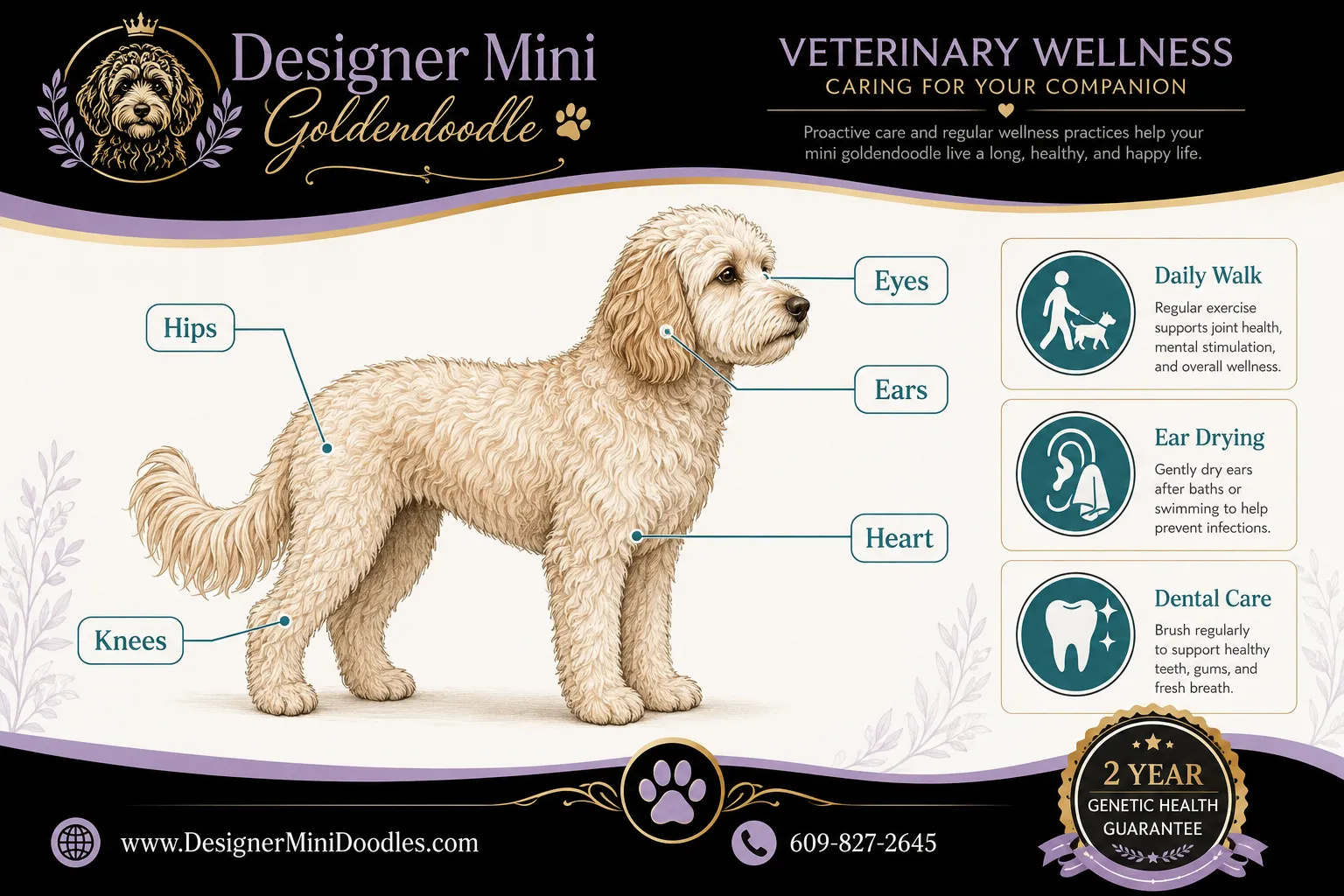
Mini goldendoodles typically live 12 to 16 years, with smaller individuals often at the longer end. The breed benefits from hybrid vigor but still carries inherited risks from both parent breeds, which is exactly why parental genetic testing justifies a higher purchase price.
Conditions to know:
- Hip and elbow dysplasia, screen parents via OFA or PennHIP.
- Patellar luxation, more common in the smallest sizes.
- Progressive retinal atrophy (PRA-prcd, GR-PRA1/2), fully avoidable with DNA-tested pairings.
- Von Willebrand’s disease, a clotting disorder; testable.
- Chronic ear infections, hair-filled canals plus humidity. Dry ears after every bath and swim.
- Hypothyroidism and allergies, usually manageable with veterinary care.
- Dental crowding, brush several times a week; expect professional cleanings.
- Bloat and subaortic stenosis, lower risk in minis than in standards, but worth discussing with your vet.
Lifespan levers you control: keep the dog lean (obesity is the biggest modifiable risk factor in dogs, per multiple veterinary nutrition sources), maintain dental hygiene, keep up with flea, tick, and heartworm prevention, Connecticut is a high-incidence Lyme state, so tick prevention is not optional, and do annual exams, moving to twice yearly after age eight.
Edge case: if a breeder can’t produce a written genetic health guarantee and parent test results, price is irrelevant. You’re buying an unknown.
Mini Goldendoodle vs Mini Labradoodle: Which Is Better?
Neither is universally better. Choose a mini goldendoodle if you want a softer, more affectionate, more velcro-style companion. Choose a mini labradoodle if you want a slightly higher-drive, more independent, more athletic dog.
| Factor | Mini Goldendoodle | Mini Labradoodle |
|---|---|---|
| Base temperament | Gentle, eager to please, cuddly | Energetic, playful, a bit more independent |
| Energy level | Moderate to high | High |
| Coat | Wavy fleece to curl; softer texture | Fleece or wool; can be coarser |
| Coat predictability | High in multigen lines | High in Australian Labradoodle lines |
| Best for | First-time owners, families with young kids, therapy work | Active households, runners, sport and scent work |
| Watch for | Separation anxiety, matting | Adolescent boisterousness, counter-surfing |
Decision rule: if a therapy-dog visit to a nursing home or a calm household is your goal, the goldendoodle’s Golden Retriever softness usually wins. If you want a trail and agility partner who tolerates a few hours alone, the labradoodle edges ahead. Both need the same grooming budget, so don’t pick one hoping to save on the groomer.
Related Reading
- Mini goldendoodle puppies for sale in New York, nearest metro market for Fairfield County buyers
- Mini and micro goldendoodle breeders in Massachusetts, a common drive-to option for northeastern Connecticut
- Full grown mini goldendoodle size guide, what your puppy will actually look like at two years
Frequently Asked Questions
How much is a mini goldendoodle in Connecticut?
Expect $2,500 to $4,500 from an accredited breeder with genetic health testing, a written health guarantee, and started crate and potty training. Listings under $1,000 are almost always scams.
How big do mini goldendoodles get?
Most adults reach 15 to 35 pounds and 13 to 20 inches at the shoulder. Toy and micro versions stay around 10 to 16 pounds and under 14 inches.
Do mini goldendoodles shed?
They shed lightly. Furnished wavy and curly coats trap most shed hair, while unfurnished flat coats shed noticeably more, closer to a Golden Retriever.
Are mini goldendoodles hypoallergenic?
No dog is fully hypoallergenic. Curly, furnished coats release less dander, so many allergy sufferers tolerate them well, but you should always spend time with the litter first.
How long do mini goldendoodles live?
Typically 12 to 16 years. Staying lean, consistent dental care, and parents screened for hip and eye disease all support the longer end of that range.
Are mini goldendoodles good apartment dogs in Connecticut cities?
Yes, with 45 to 60 minutes of daily exercise plus indoor mental enrichment. Check your building’s weight limit, since many Hartford and Stamford leases cap dogs at 25 or 35 pounds.
How often do mini goldendoodles need grooming?
Brush 3 to 4 times a week and book a professional groom every 6 to 8 weeks. Tight-curl coats need line brushing closer to daily.
Can I adopt a mini goldendoodle in Connecticut instead of buying?
Yes, through Northeast doodle rescues, Connecticut shelters, Petfinder alerts, and breeder retirement programs. Adoption fees usually run $300 to $800, and most available dogs are adults.
Are mini goldendoodles easy to train?
Very. Poodles and Golden Retrievers both rank in the top handful of breeds for working intelligence, and puppies that arrive already crate-familiar and on a potty schedule progress fastest.
What’s the difference between F1, F1B, and multigen mini goldendoodles?
F1 is a first-generation Golden-Poodle cross with variable coats. F1B adds a poodle backcross for curlier, lower-shedding coats. Multigen lines bred from tested parents offer the most predictable coat and size.
Conclusion and Next Steps
The mini goldendoodle Connecticut market rewards patient, informed buyers and punishes impulse purchases. The dogs themselves are close to ideal for the state, small enough for a New Haven apartment, sturdy enough for a Litchfield hiking trail, and temperamentally suited to families, retirees, and first-time owners. The variable that determines your ten-year experience isn’t the color or even the price. It’s whether the puppy came from tested parents, a supervised whelping, ENS from birth, real household noise exposure, and a genuine head start on housebreaking and crate training.
Your next five steps:
- Set a real budget: purchase price plus $2,000 to $3,500 for year one, grooming included.
- Pick your coat type first, not the color. Furnished wavy fleece or light curl suits most Connecticut households.
- Confirm size against your lease or your kids’ ages before choosing mini versus micro.
- Vet the breeder in writing: genetic panel, health guarantee, whelping details, ENS, and what training has already started.
- Reserve early. Quality litters are spoken for months ahead. Start with Designer Mini Doodles, review the current litters, and ask about delivery into Connecticut.
Do the homework once, and you get twelve to sixteen years of a dog that meets you at the door every single day.
Sources
- American Kennel Club, “Hypoallergenic Dogs” and Poodle/Golden Retriever breed standards (accessed 2025), https://www.akc.org
- Stanley Coren, The Intelligence of Dogs (1994; rev. 2006), working and obedience intelligence rankings
- Orthopedic Foundation for Animals, hip, elbow, and eye screening databases (accessed 2025), https://ofa.org
- Connecticut General Statutes, Chapter 435, provisions on the sale of dogs and cats, https://www.cga.ct.gov
- Centers for Disease Control and Prevention, Lyme disease incidence by state (accessed 2025), https://www.cdc.gov/lyme